How we make this list: we compare pricing pages, product documentation and public user reviews. Ratings come from G2, Capterra or Trustpilot, with the date we checked them.
Key takeaways
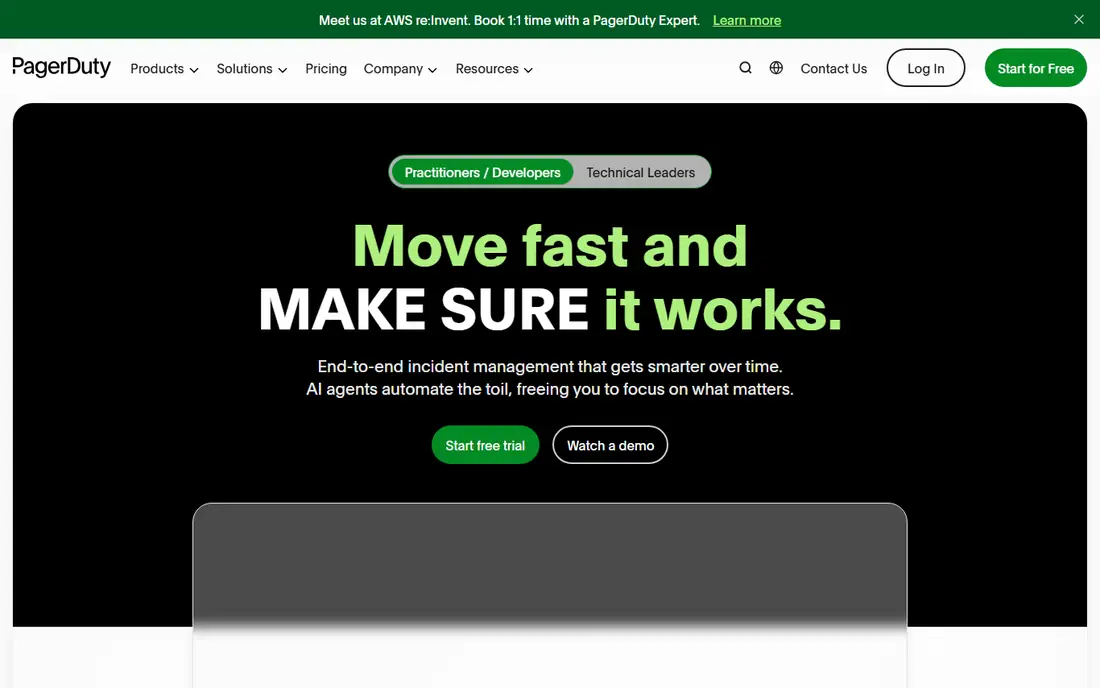
- PagerDuty remains the default on-call platform for large SRE teams, with 750+ integrations and AI agents for response.
- incident.io and Rootly suit Slack-first teams that want fast response, AI investigations and built-in status pages.
- FireHydrant and xMatters suit teams that want end-to-end automation from alerting to retrospectives.
- Jira Service Management and ServiceNow suit enterprises that need full ITSM, while Splunk On-Call suits teams already on Splunk observability.
Quick comparison
| Tool | Best for | Starting price | Free plan |
|---|
 PagerDuty | Large SRE teams needing proven on-call at scale | See website | See website |
 incident.io | Slack-first teams that want AI investigations | See website | See website |
 Rootly | AI-native on-call and incident response | $20 | See website |
 FireHydrant | End-to-end incident management from alerting to retros | See website | See website |
 Jira Service Management | ITSM teams already using Atlassian tools | See website | See website |
 ServiceNow | Large enterprises needing a full ITSM platform | See website | No |
 xMatters | Automated incident management with AI intelligence | See website | See website |
 Splunk On-Call | On-call for teams already using Splunk observability | See website | See website |
Is your product missing or out of date?
We review this list regularly. Vendors can request a listing, send updated pricing or ask about featured placement.
#2incident.io
Best for: Slack-first teams that want AI investigations4.8/5 on
G2 (233 reviews, checked Oct 2026)
Visit incident.io
Starting priceSee website
Free planSee website
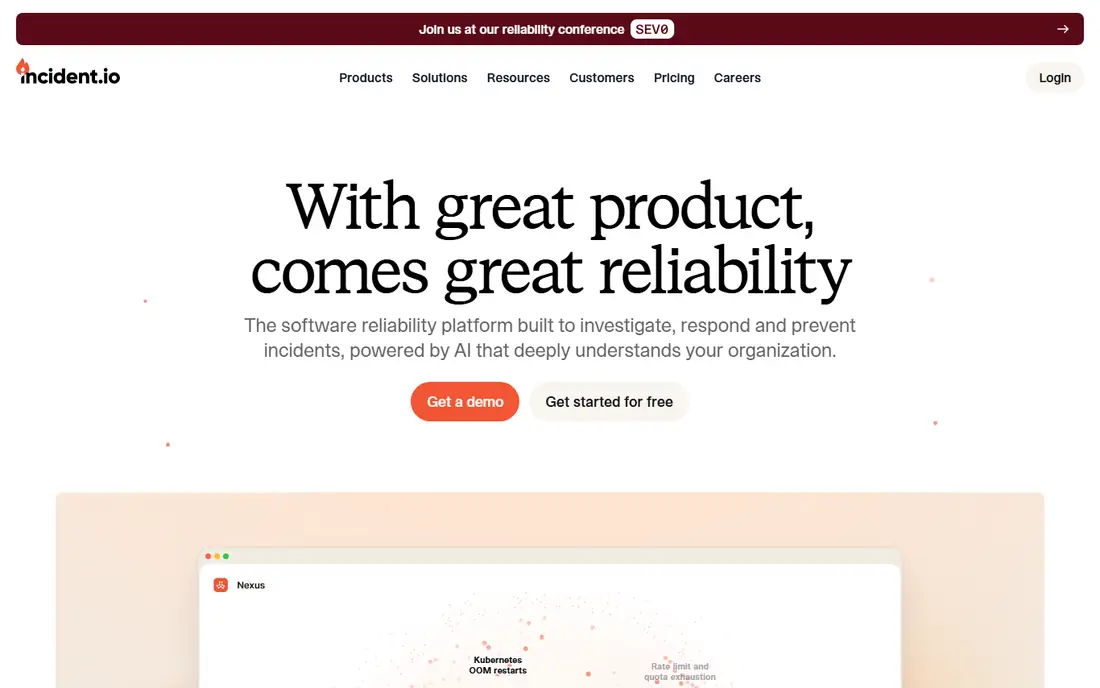
incident.io is an AI software reliability platform built to investigate, respond and prevent incidents, with AI that deeply understands your organization. Its four pillars work together from first alert to final fix: on-call routing with AI noise filtering, investigations with agentic root cause analysis, response inside Slack and Microsoft Teams, and status pages that update customers automatically.
The investigations feature stands out: an agent scans thousands of signals, delivers a structured root cause hypothesis in seconds, and keeps working alongside responders until resolution. Zendesk modernized incident response across 1,200+ engineers with incident.io in 10 weeks. For Slack-first SRE teams, incident.io is the most modern alternative to PagerDuty.
What we like- On-call, investigations, response and status pages in one platform
- Agentic root cause analysis from the moment of declaration
- Resolves from Slack and Teams
Watch out for- Pricing not shown on the homepage
- Newer vendor than PagerDuty or ServiceNow
#3Rootly
Best for: AI-native on-call and incident response4.8/5 on
G2 (165 reviews, checked Oct 2026)
Visit rootly.com
Starting price$20
Free planSee website
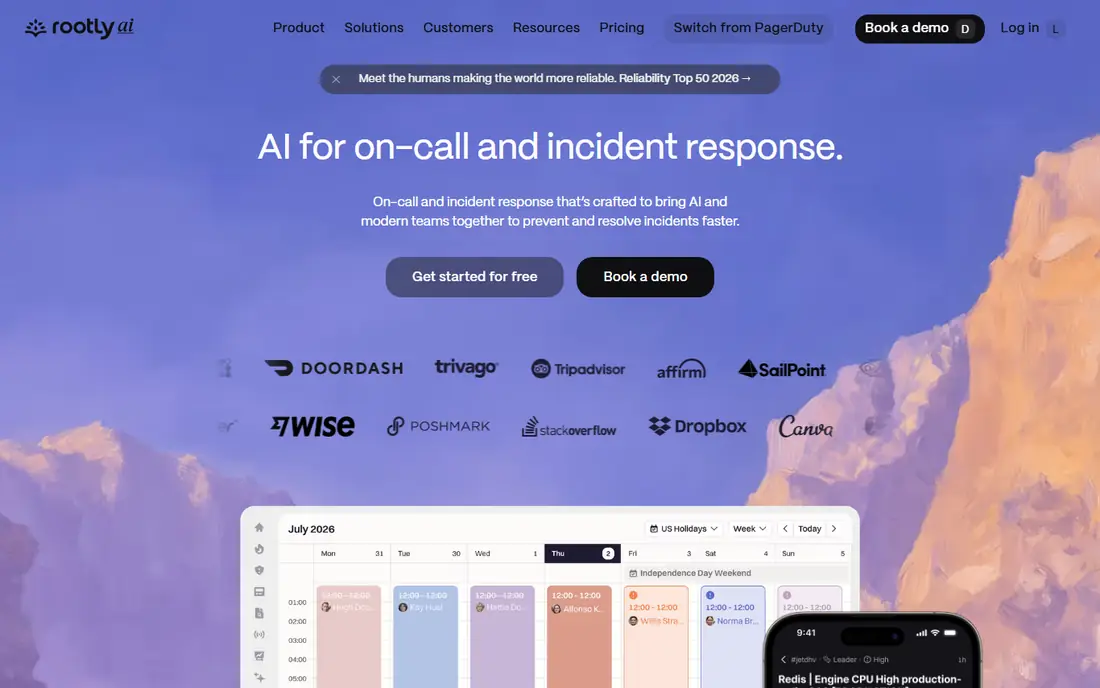
Rootly is an AI-native incident management platform for on-call and incident response, designed to bring AI and modern teams together to prevent and resolve incidents faster. Its AI surfaces relevant context from alerts, code changes and past incidents, identifies probable root causes with confidence scores, and suggests fixes with full visibility into every decision.
On-call features include human-friendly schedules, alerting in one place, a mobile app crafted down to the ringtone that wakes you, and 99.99 percent availability infrastructure. Response runs in Slack, Google Chat and Teams, with workflows, communications and AI retros with Jira-synced action items. Customers quoted include Motive, Tripadvisor, Replit and Webflow. For teams that want AI-native response at a clear starting price, Rootly is compelling.
What we like- AI for on-call and response with root cause confidence scores
- On-call schedules, alerting and mobile app
- Status pages and retro templates included
Watch out for- Smaller ecosystem than PagerDuty
- Pricing detail beyond the $20 starting figure needs the pricing page
#4FireHydrant
Best for: End-to-end incident management from alerting to retros4.5/5 on
G2 (143 reviews, checked Oct 2026)
Visit firehydrant.com
Starting priceSee website
Free planSee website
FireHydrant offers all-in-one alerting, on-call and incident management on one platform, covering planning, response and improvement. Planning tools include automated runbooks, on-call and alerting, and a service catalog for ownership and dependencies. Response runs in Slack or Teams with AI insights, live transcriptions and status pages, and improvement covers AI-enhanced retrospectives, intelligent follow-ups and analytics on MTTx patterns.
One customer, Backblaze, reports cutting mean time to mitigate by 91 percent. FireHydrant stresses enterprise-grade security with SOC 2, SSO, RBAC, audit logs and SCIM, plus 350+ API endpoints and Terraform support. For teams that want one platform from first alert to final retro, FireHydrant is the most complete mid-market option.
What we like- All-in-one alerting, on-call and incident management
- AI insights, transcripts and retrospectives
- Service catalog and 350+ API endpoints
Watch out for- Pricing not shown on the homepage
- Smaller brand than PagerDuty for enterprise procurement
#5Jira Service Management
Best for: ITSM teams already using Atlassian tools4.3/5 on
G2 (986 reviews, checked Oct 2026)
Visit atlassian.com
Starting priceSee website
Free planSee website
Jira Service Management, part of Atlassian's Service Collection, unites teams on a single AI-powered platform to deliver service at scale. Its AI detects incidents early, groups related alerts, analyzes root causes and prevents similar incidents, while change automation assesses risk from CI/CD tools and deploys faster. The Teamwork Graph surfaces relationships between incidents, changes, assets and the people who resolved them, recommending actions from organizational history.
Trusted by more than 65,000 teams, Jira Service Management suits organizations that already use Jira and Confluence, since incident work connects directly to development tickets. For SRE teams inside Atlassian shops, it avoids adding another vendor, though dedicated response tools may move faster in Slack.
What we like- AI-powered ITSM for incidents, changes and requests
- Teamwork Graph connects incidents, assets and people
- Trusted by 65,000+ teams
Watch out for- Incident response is one part of a broad ITSM suite
- Pricing needs the pricing page
Starting priceSee website
Free planNo
ServiceNow is a single, unified AI platform for digital business transformation, covering ITSM, incident response, change, asset and service management alongside broader enterprise workflows. Its homepage cites recent Gartner and Forrester recognition across ITSM, automation, low-code and service management categories, reflecting its enterprise standing.
One flag: the ServiceNow homepage extract during research showed only analyst citations rather than product detail, so feature specifics should be confirmed in a demo. ServiceNow suits large enterprises that need governance, compliance and deep workflow automation, but its cost and implementation effort exceed what most small SRE teams need.
What we like- Single unified AI platform for ITSM and digital workflows
- Strong analyst recognition across ITSM and automation
- Deep enterprise integrations
Watch out for- Homepage extract was thin, showing only analyst citations
- Enterprise pricing and implementation effort are significant
#7xMatters
Best for: Automated incident management with AI intelligence4.5/5 on
G2 (794 reviews, checked Oct 2026)
Visit xmatters.com
Starting priceSee website
Free planSee website
xMatters automates incident management, enriches alerts and removes the overhead of disconnected tools, powered by purpose-built AI. Its AI agent surfaces the right context, people and actions in the moment, combining intelligent automation with real-time insight. Workflows cover the full cycle: know earlier through observability integrations, respond faster with automated communication and escalation, resolve automatically with predefined runbooks, and improve continuously with post-incident analytics.
The platform supports strict compliance needs across healthcare, financial services and government, with full audit trails of every action taken during an incident. Its user conference, Resilience 2027, runs under the Everbridge banner, reflecting its ownership. For enterprises that want automation-first incident management, xMatters is a strong contender.
What we like- Purpose-built AI agent for incident intelligence
- Automated workflows for communication, escalation and remediation
- Unlimited integrations
Watch out for- Pricing not shown on the homepage
- Now part of the Everbridge community, which may affect roadmap focus
#8Splunk On-Call
Best for: On-call for teams already using Splunk observability4.5/5 on
G2 (52 reviews, checked Oct 2026)
Visit splunk.com
Starting priceSee website
Free planSee website
Splunk On-Call improves business outcomes with automated incident response, sending metadata-rich notifications direct to any device, with actions to resolve, reroute or snooze alerts from native iOS and Android apps. It automates escalations, war rooms and post-incident reviews, and its reporting covers incident frequency, MTTA and MTTR to manage alert noise and reduce burnout.
One customer, PSCU, cut mean time to acknowledge from four hours to 20 minutes in 12 months, and under two minutes after three years. Machine learning recommends responders with the right expertise, using historical insights and audit trails. For teams already invested in Splunk APM and observability, On-Call keeps incident response inside the same platform.
What we like- Metadata-rich notifications to any device
- Automated escalations, war rooms and post-incident reviews
- Machine learning responder recommendations
Watch out for- Best inside the Splunk ecosystem
- Standalone buyers may prefer a dedicated response platform
How we chose
We opened each platform's homepage in October 2026 to confirm it loads and belongs to the product named, with one flagged exception: ServiceNow's homepage extract was thin, showing only analyst citations. We weighed on-call quality, AI features, Slack and Teams integration, automation depth, status pages, retrospectives and enterprise fit for SRE teams specifically.
Start with on-call fundamentals before AI features. Check scheduling flexibility, escalation policies, overrides, mobile alerting and noise filtering, since a platform that pages the wrong person at 3 a.m. fails no matter how good its AI looks. Trial the on-call rotation with your real team for at least two weeks.
Next, check how incidents run in your chat tool. SRE teams live in Slack or Teams, so response, role assignment, timelines and status updates should work there without switching apps. Also confirm status pages, runbooks and retrospective templates, since those save hours across every incident.
Finally, measure what matters after adoption: mean time to acknowledge, mean time to resolve, alert noise per responder and on-call burnout. A platform should reduce pages and toil, not add dashboards. If MTTR and responder satisfaction do not improve within a quarter, the tool is not earning its cost.
Frequently asked questions
What is the best incident management platform for small SRE teams?
incident.io or Rootly, for Slack-first response with AI help at a scale suited to smaller teams. FireHydrant is also strong for end-to-end coverage without enterprise cost.
Is PagerDuty still the best on-call tool?
For large teams, yes. Its 750+ integrations, proven scale and AI agents make it the safest enterprise choice, though smaller teams may find incident.io or Rootly faster to adopt.
Do these platforms replace monitoring tools?
No. Incident platforms sit on top of monitoring and observability tools such as Datadog, Splunk or Grafana, routing and managing alerts rather than generating them. Splunk On-Call is the exception for teams already on Splunk.
What is MTTR and why does it matter?
Mean time to resolve measures how long incidents take from detection to fix. Lower MTTR means less downtime and customer impact, and it is the main metric SRE teams use to judge incident tooling.
Should SRE teams use AI incident tools?
AI helps with noise filtering, root cause hypotheses and retrospective drafting, but it does not replace human judgment during incidents. Use AI to speed triage and documentation, and keep humans in charge of mitigation decisions.
Sources we checked (8)
- https://www.pagerduty.com
- https://www.incident.io
- https://www.rootly.com
- https://www.firehydrant.com
- https://www.atlassian.com/software/jira/service-management
- https://www.servicenow.com
- https://www.xmatters.com
- https://www.splunk.com/en_us/products/on-call.html
Is your product missing or out of date?
We review this list regularly. Vendors can request a listing, send updated pricing or ask about featured placement.

Shihab Mia · Founder, Rankite
Shihab has 5+ years in B2B and SaaS SEO. He writes Rankite's software buying guides from pricing pages, documentation and public user reviews. More about Shihab.