How we make this list: we compare pricing pages, product documentation and public user reviews. Ratings come from G2, Capterra or Trustpilot, with the date we checked them.
Key takeaways
- GitHub is the default for most distributed teams, with pull requests, Copilot review help and the largest developer ecosystem.
- GitLab suits teams that want code review, CI/CD and security in one platform with a single workflow.
- Bitbucket suits Jira shops, Gerrit suits patch-based workflows at scale, and Review Board suits on-prem and air-gapped teams.
- Graphite suits fast-moving GitHub teams with stacked pull requests, while CodeScene and SonarQube add quality gates and automated verification.
Quick comparison
| Tool | Best for | Starting price | Free plan |
|---|
 GitHub | Distributed teams that want the standard pull request workflow | Free | Yes |
 GitLab | Teams that want review, CI/CD and security in one platform | See website | See website |
 Bitbucket | Teams already using Jira | Free | Yes |
 Gerrit | Large teams with patch-based review workflows | Free | Yes |
 Review Board | On-prem and air-gapped review workflows | See website | Open source |
 CodeScene | Teams gating AI-generated code on quality | See website | See website |
 Graphite | GitHub teams using stacked pull requests | See website | See website |
 SonarQube | Automated quality and security verification before merge | See website | Community edition |
Is your product missing or out of date?
We review this list regularly. Vendors can request a listing, send updated pricing or ask about featured placement.
#1GitHub
Best for: Distributed teams that want the standard pull request workflow4.7/5 on
G2 (2,412 reviews, checked Oct 2026)
Visit github.com
Starting priceFree
Free planYes

GitHub keeps developers, agents and code together on one platform, with planning, discussion and code review kept next to the code itself. Pull requests are the core review unit: reviewers comment on lines, request changes, approve and merge, while Copilot Autofix finds vulnerabilities and suggests secure fixes in seconds. GitHub scales from startups to enterprises in any industry.
For distributed teams, GitHub's advantage is familiarity: most developers already know it, which removes onboarding friction across time zones. Its free tier covers public repositories and small teams, while paid plans add advanced security, code owners and required reviewers. For most remote teams, GitHub is the safe default.
What we like- Pull requests keep conversation and context next to code
- Copilot helps write, test and fix code
- Built-in security with Copilot Autofix
Watch out for- Advanced enterprise features require paid plans
- Review automation often needs Actions or third-party apps
#2GitLab
Best for: Teams that want review, CI/CD and security in one platform4.5/5 on
G2 (902 reviews, checked Oct 2026)
Visit gitlab.com
Starting priceSee website
Free planSee website

GitLab is the all-in-one DevOps platform, where merge requests combine code review with built-in CI/CD pipelines, security scanning and issue tracking. Reviewers see pipeline results, security findings and code changes in one place, which helps distributed teams avoid switching between five tools to judge a change.
The single-platform story suits teams that want one source of truth for planning, code, testing and deployment. Note that GitLab's homepage could not be fetched during this research due to a policy block, so its listing rests on search evidence and should be confirmed on gitlab.com before purchase. For teams consolidating tools, GitLab remains a strong pick.
What we like- Merge requests, pipelines, security scanning and issue tracking in one place
- Single workflow reduces tool sprawl
- Self-managed option available
Watch out for- Homepage fetch was blocked by policy in this research, so details here rest on search evidence
- Platform breadth can feel heavy for small teams
#3Bitbucket
Best for: Teams already using Jira4.4/5 on
G2 (1,015 reviews, checked Oct 2026)
Visit bitbucket.org
Starting priceFree
Free planYes
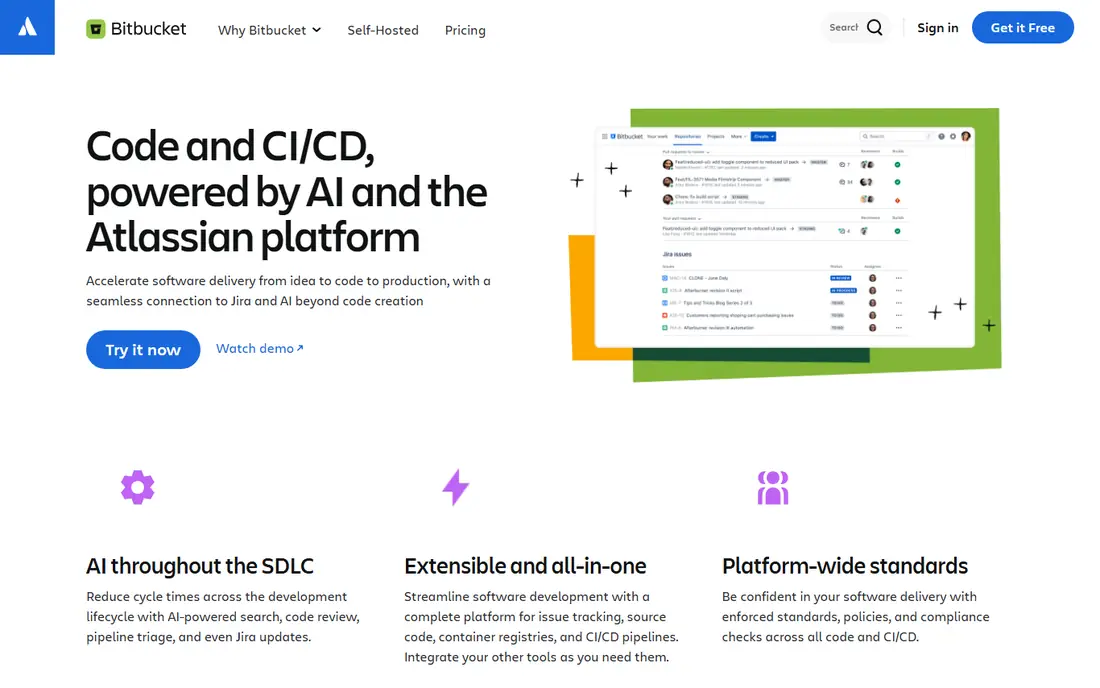
Bitbucket is the Git solution for teams using Jira, connecting code to planning and incident management with native Jira links, Rovo AI and the Teamwork Graph. Its AI code reviewer reviews all code changes and suggests fixes so teams merge faster, while merge checks enforce code quality policies and compliance across the organization. Bitbucket Pipelines runs CI/CD with hosted or private runners.
With 15 million developers across more than a million teams, Bitbucket's strength is the Atlassian ecosystem: Jira issue statuses update automatically when issue keys appear in commits, and reviewers can open Jira tickets from the pull request screen. Pricing starts free for up to 5 users, with Standard from $15 per month and Premium from $30 per month. For Jira shops, Bitbucket is the natural choice.
What we like- Native Jira and Jira Service Management connections
- AI code reviewer suggests fixes
- Free tier for up to 5 users, Standard from $15 per month
Watch out for- Smaller ecosystem than GitHub
- AI features require Premium
Starting priceFree
Free planYes
Gerrit is a web-based code review system for Git repositories with patchset-based review workflows, fine-grained permissions and CI/CD integration. Its model follows the proven mailing-list workflow used by Git itself and the Linux kernel: patches are reviewed and iterated on before being applied to the main repository, which supports higher code quality. It offers 100 or more community plugins, a full REST API, global replication and active-active clustering for enormous repositories.
Gerrit runs locally in under 2 minutes via a Java archive or Docker container, and GerritHub.io offers a free hosted option even for private repositories. For large, regulated or kernel-style teams that need strict access control, Gerrit is unmatched. Smaller teams may prefer the simpler pull request model.
What we like- 100 percent open source with no licensing fees
- Patchset-based reviews with fine-grained permissions
- Scales to thousands of developers
Watch out for- Workflow differs from pull requests, so onboarding takes time
- Self-hosting requires operations effort
Starting priceSee website
Free planOpen source
Review Board is a long-running code review tool used by teams at Amazon, LinkedIn, Cisco, Mozilla and VMware, with a focus on on-prem and air-gapped deployments that other vendors have abandoned. Installers and Docker containers make setup easy, flexible plans with top-shelf support are available, and RBCommons offers multi-tenant cloud hosting for teams that prefer managed service.
Its command line tools suit distributed workflows: post a review with rbt post, check status with rbt status, and land an approved change with rbt land. Review Board also handles image reviews with color diff and onion skin views, which suits design and media teams. For teams that must keep code behind the firewall, Review Board is a reliable choice.
What we like- Doubles down on on-prem with installers and Docker containers
- Cloud and managed hosting available
- Command line tools for posting and landing reviews
Watch out for- Smaller community than GitHub or GitLab
- Interface feels dated next to modern pull request tools
Starting priceSee website
Free planSee website
CodeScene helps engineering organizations scale AI coding safely and reduce technical debt, holding Code Health to a 9.5 rule at every step. Its three-phase model moves teams from pre-AI baselines through AI-assisted development to agentic fleets, gating every merge on code health. Customer proof cites 32 percent fewer critical hotspots, 38 percent less time in code review and 41 percent lower token spend.
For distributed teams adopting AI coding assistants, CodeScene answers the key question: is AI-generated code actually good? By gating merges on health scores, it prevents quality drift across time zones where reviewers cannot watch every change. Teams already happy with their review quality may not need it, but AI-heavy teams will value the guardrails.
What we like- Code Health scoring with a 9.5 quality bar for every merge
- Measures review time and technical debt
- Helps scale AI coding safely
Watch out for- Quality gating adds process that small teams may not need
- Pricing not shown on the homepage
Starting priceSee website
Free planSee website
Graphite is code review for the age of AI, built on GitHub with deep sync. Its core idea is stacking: create and manage stacks of dependent pull requests with a CLI and VS Code extension, so developers keep shipping while earlier changes are under review. A unified inbox and review workflow covers the team's pull requests, actionable Slack notifications meet reviewers where they are, and a merge queue automates safe merging.
Graphite's collaborative AI reviewer lives inside the pull request page, resolving CI failures, applying suggested fixes and committing changes in one conversation. Organizations that adopt Graphite ship more code with smaller pull requests and faster review cycles. For fast-moving GitHub teams, stacking alone justifies the tool.
What we like- Stacking keeps developers unblocked while changes await review
- Unified PR inbox and merge queue
- AI reviewer resolves CI failures in the PR
Watch out for- Built on GitHub, so non-GitHub teams cannot use it
- Stacking workflow takes learning
#8SonarQube
Best for: Automated quality and security verification before merge4.5/5 on
Capterra (68 reviews, checked Oct 2026)
Visit sonarsource.com
Starting priceSee website
Free planCommunity edition
SonarQube is code verification for the AI era, finding and fixing issues early with deep static analysis and real-time feedback in the existing workflow. It tracks maintainability, reliability and technical debt, detects vulnerabilities and security hotspots, and generates fix suggestions with a click. SonarQube Cloud is fully managed SaaS with a 99.9 percent uptime SLA, while SonarQube Server offers self-managed deployment with full data residency and air-gapped options.
Quality gates enforce go or no-go deployment decisions, so only code meeting set standards is eligible for merging. SonarQube supports more than 35 languages, integrates with GitHub, GitLab and Azure DevOps, and holds a 4.6 out of 5 G2 rating as a Leader for 6 years running. For distributed teams that want automated verification on every pull request, SonarQube is the standard.
What we like- Static analysis across 35 or more languages with quality gates
- Cloud and Server options
- Trusted by 7 million developers and 500,000 organizations
Watch out for- Automated checks complement but do not replace human review
- Enterprise features require paid editions
How we chose
We opened each vendor homepage in October 2026 to confirm it loads and belongs to the product named, except GitLab, whose homepage fetch was blocked by policy and is listed on search evidence. We weighed review workflow fit, distributed-team features such as async comments and notifications, CI/CD integration, quality automation and pricing model.
Start with your hosting and workflow. GitHub teams should compare GitHub itself with Graphite for stacking and SonarQube for verification. Jira teams should look at Bitbucket. Teams needing self-hosting should compare Gerrit, Review Board and SonarQube Server.
Next, set review standards before adding tools. Agree on response-time targets across time zones, required reviewers, size limits for pull requests and quality gates. Tools enforce standards, but they cannot create them.
Finally, measure review cycle time. Track time from pull request open to merge, reviewer response time and rework rate. If a tool does not shorten those numbers within a month, simplify the workflow before buying more features.
Frequently asked questions
What is the best code review tool for remote teams?
GitHub is the best default for most remote teams thanks to familiar pull requests and wide adoption. Bitbucket suits Jira teams, while GitLab suits teams that want review plus CI/CD in one platform.
Should distributed teams use stacked pull requests?
Stacking helps fast-moving teams stay unblocked, since developers can build on changes still under review. Graphite makes stacking easy on GitHub, but it requires discipline to keep stacks small and reviewable.
Can automated tools replace human code review?
No. SonarQube and CodeScene catch bugs, security issues and quality drift, but humans must still judge design, business logic and readability. Use automation to handle routine checks so reviewers focus on what matters.
Is Gerrit better than GitHub for large teams?
Gerrit suits very large teams with strict access control and patch-based workflows, such as kernel-style projects. Most distributed product teams will find GitHub pull requests simpler and faster to adopt.
Do code review tools work across time zones?
Yes, when configured for async review. Look for clear notifications, review deadlines, time-zone-aware assignment and written review norms, so work does not stall waiting for a reviewer who is asleep.
Sources we checked (8)
- https://github.com
- https://gitlab.com
- https://bitbucket.org
- https://www.gerritcodereview.com
- https://www.reviewboard.org
- https://codescene.com
- https://graphite.dev
- https://www.sonarsource.com/products/sonarqube/
Is your product missing or out of date?
We review this list regularly. Vendors can request a listing, send updated pricing or ask about featured placement.

Shihab Mia · Founder, Rankite
Shihab has 5+ years in B2B and SaaS SEO. He writes Rankite's software buying guides from pricing pages, documentation and public user reviews. More about Shihab.