How we make this list: we compare pricing pages, product documentation and public user reviews. Ratings come from G2, Capterra or Trustpilot, with the date we checked them.
Key takeaways
- Cool Calc is the practical default for residential contractors: a web based Manual J tool recognised by ACCA as Powered by Manual J, with free block load calculations and paid room by room reports.
- Wrightsoft's Right-J is the professional standard for firms doing volume residential design, integrating Manual J with Manual S equipment selection and Manual D duct design. Pricing is by licence, so check the site.
- Elite Software's RHVAC and CHVAC serve engineers who need a deep, detailed calculation engine for residential and commercial work.
- LoadCalc.net is free and fine for a sanity check, but it is not ACCA approved, so do not hand its output to a permit office that knows Manual J.
- The standard matters more than the app: only ACCA approved Manual J software produces a report a building department or rebate programme will accept. Rules of thumb, square foot per ton, are not a load calculation.
Quick comparison
Is your product missing or out of date?
We review this list regularly. Vendors can request a listing, send updated pricing or ask about featured placement.
The best HVAC load calculation apps
Starting priceFree
Free planYes
Cool Calc is what a modern Manual J looks like for a working contractor. It guides the inputs, uses current climate data, and produces the room by room report that inspectors and rebate programmes ask for, without a desktop install or a four figure licence. Its free block load tier means a contractor can start a real calculation today.
The trade off is depth against the old guard. Wrightsoft's libraries and duct design integration go further for firms doing design all day. Cool Calc fits the great middle of residential contractors, and the distributors who supply many of them now bundle it, so check whether your supplier account already includes access.
What we like- ACCA recognised Manual J methodology, producing reports a permit office will accept
- Runs in the browser on phone, tablet, or office PC, with no install
- Free block load calculations, with paid room by room reports and contractor features
- Draw or trace the floor plan and see loads room by room
Watch out for- Garbage in still rules: accuracy depends on honest construction inputs
- Some construction types and advanced cases have limited options
- The full contractor toolkit sits behind paid reports and plans
Starting priceSee website
Free planNo

Wrightsoft built the category's reference tool. Right-J inside Right-Suite Universal carries a project from loads to equipment to duct layout in one model, which is why production builders and design heavy contractors standardise on it. When a firm's week is design work, the time saved by that integration and its envelope libraries is real money.
The trade off is commitment: cost, learning curve, and a desktop era workflow. Wrightsoft fits established residential HVAC firms and designers whose volume makes design speed a competitive weapon, not the occasional calculator.
What we like- The long standing professional standard for residential load calculation
- Integrates Manual J loads with Manual S equipment selection and Manual D duct design in Right-Suite
- Deep libraries for envelope assemblies and equipment
- Report ready documentation for permits and production builders
Watch out for- Pricing is licence based and not stated simply in our sources, so confirm on the site
- A steep learning curve compared with guided web tools
- Desktop software in a category moving to the cloud
Starting priceSee website
Free planNo
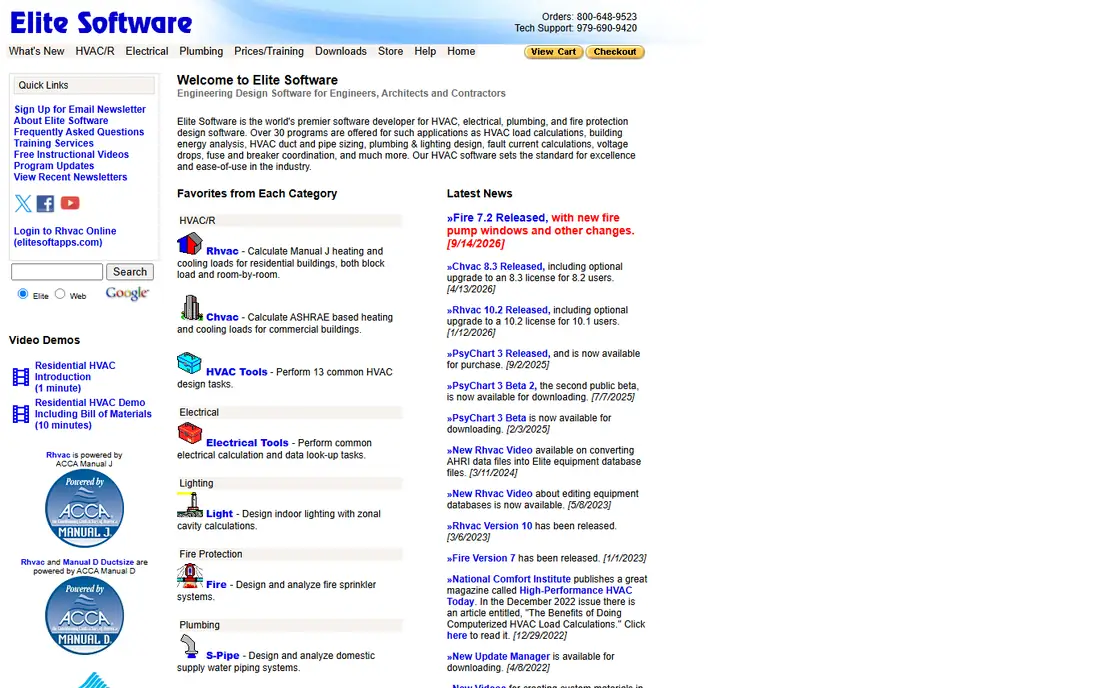
Elite Software is the engineer's shelf. Its programs expose the calculation in detail rather than hiding it behind a guided wizard, which is exactly what a mechanical engineer signing off a design wants. RHVAC handles the residential standard; CHVAC takes on commercial buildings with the same rigour.
The trade off is accessibility. Elite tools assume you understand the method, not just the answer. Elite fits engineering firms and expert designers who need defensible, detailed numbers and the control to stand behind them.
What we like- A powerful, detailed calculation engine trusted by engineers
- RHVAC covers residential Manual J work and CHVAC covers commercial loads
- Fine grained control over constructions, schedules, and systems
- A long track record in professional practice
Watch out for- Subscription and licence figures in sources vary widely by product, so confirm pricing directly
- The interface and workflow reward training and punish casual use
- Not a quick quote tool for a sales call
Starting priceFree
Free planYes
LoadCalc.net is the pocket calculator of the category. A contractor checking whether a quoted system size is even plausible, or a homeowner trying to understand a proposal, can run a quick estimate in minutes at no cost. Used that way, it is genuinely useful.
The trade off is authority, and the site does not pretend otherwise. When a permit, a rebate, or a dispute needs a real Manual J, use an approved tool. LoadCalc.net fits early stage estimates and second opinions, never final documentation.
What we like- Free in the browser with no account gymnastics
- A simple, direct interface for a fast load estimate
- Unlimited projects, useful for early conversations and sanity checks
- A paid desktop version exists for users who want more features
Watch out for- Not ACCA approved, so its reports are not permit quality Manual J
- Fewer construction options and less guidance than approved tools
- Easy to misuse as a sizing authority it does not claim to be
Starting price$47 per month
Free planNo
AutoHVAC is the challenger pitch: approved Manual J output without the distributor relationship some Cool Calc access depends on, and without Wrightsoft's licence weight. Its headline trick, reading plans with AI to populate the model, targets the slowest part of any load calculation, which is data entry.
The trade off is trust in the automation. A misread wall assembly quietly skews every room, so the professional habit is to spot check the extraction against the plans. AutoHVAC fits brand independent contractors doing steady residential volume who want approved reports at a subscription price a small firm can carry.
What we like- ACCA approved Manual J with permit quality reports
- AI extraction reads blueprints to speed up envelope and room inputs
- Web and mobile, with no distributor account required
- At $47 per month it undercuts legacy licence costs for small firms
Watch out for- AI plan reading is the feature most likely to misread an assembly, so verify extracted inputs
- A newer product than the established names
- Subscription pricing, so the cost runs whether you calculate or not
Starting priceFree
Free planYes
HAP is the commercial workhorse Carrier gives away. Engineers use it to size commercial systems and to compare the energy and operating cost of design alternatives across a full year of hourly weather. For a school, an office, or a retail building, this is the class of tool the design team expects.
The trade off is that it is professional engineering software with the manners to match. A residential contractor will find it heavy and slow for a house. Carrier HAP fits mechanical engineers and commercial designers who need load plus energy analysis in one established package.
What we like- Carrier's Hourly Analysis Program, free with registration
- Models commercial building loads hour by hour and compares system energy and economics
- A long established engineering tool with deep system simulation
- Useful for ASHRAE style commercial design work
Watch out for- Geared to commercial projects, with a steep learning curve for residential users
- Engineering software, not a quick app experience
- Support and training assume a professional user

#7
Trane TRACE 3D Plus
Best for: Commercial design and simulation
Visit trane.com
Starting priceSee website
Free planNo
TRACE 3D Plus is Trane's answer to the same commercial problem as HAP, with a visual, model based workflow: build the building in 3D, and the loads, simulations, and selections follow from the model. Reviewers of heat load software place it at the traceability end of the market, where every number can be walked back to an input for a reviewer.
The trade off is scale. This is design office infrastructure, priced and learned accordingly. TRACE 3D Plus fits engineering firms doing commercial work where documented, model based design is the deliverable.
What we like- A modern 3D modelling front end over a serious load and energy engine
- Carries a project from geometry to loads to equipment selection with traceable outputs
- Built for commercial design sign off and code work
- Backed by Trane's training and support organisation
Watch out for- Commercial engineering pricing, by quote
- Far beyond residential or small commercial needs
- The modelling workflow rewards firms that standardise on it
Starting priceFree
Free planYes
EnergyPlus is the foundation stone. It simulates how a whole building uses energy hour by hour, and it costs nothing because the public paid for it. Energy auditors, researchers, and HERS raters pair it, through front ends like OpenStudio, with the Manual J tools above: one to size the equipment, one to model the year.
The trade off is that nobody opens EnergyPlus casually. It rewards specialists. EnergyPlus fits energy professionals and engineers whose questions are about annual performance, code compliance, and retrofit savings rather than the size of one air conditioner.
What we like- The US Department of Energy's open source simulation engine, completely free
- Models energy, comfort, and systems behaviour across a full year
- The engine beneath many commercial front ends and research tools
- Unmatched depth for audits, retrofits, and rebate documentation
Watch out for- It is an engine, not an app: most users reach it through a graphical interface built on top
- It performs energy simulation, not Manual J, so it does not size residential equipment by itself
- A serious learning curve for new users
How we chose
We split the field the way the trade does: ACCA approved residential Manual J tools first, commercial load and simulation tools second, and free estimators labelled for what they are. Approval status was checked against ACCA recognition described in 2026 contractor guides, and prices come from vendor pages and those guides; where licence pricing is not published simply, we wrote See website. We deliberately print no accuracy claims for any tool, because a load calculation is only as honest as the inputs, and no software fixes a guessed wall assembly. We did not run calculations or claim hands on testing.
How to get a load calculation you can stand behind
Use approved software for anything official. If the output goes to a permit office, a utility rebate, or a customer dispute, it should come from an ACCA approved Manual J tool: Cool Calc, Wrightsoft, Elite, or AutoHVAC for houses. Keep LoadCalc.net and rules of thumb for the first conversation only, and never let a square feet per ton figure size a system in a climate with real humidity.
Feed the tool the building you actually have. Measure the house or work from plans, count the windows and their orientation honestly, use the real insulation and duct locations, and set the design temperatures your jurisdiction specifies rather than the ones that make the answer convenient. Then read the result with suspicion in both directions: a load far above the old system's size usually means an input error, and a load far below usually means a missed west facing glass wall. The software is fast now. The craft is in the inputs, and that part is still yours.
Frequently asked questions
What is Manual J and why does it matter?
Manual J is the ANSI and ACCA standard method for calculating a home's heating and cooling loads, room by room, from its construction, windows, orientation, and local design weather. It matters because equipment sized by Manual J runs longer, steadier cycles, controls humidity, and costs less to run than equipment sized by rule of thumb, and because building departments and rebate programmes require it. Oversizing, the common failure, is what Manual J exists to prevent.
Which load calculation apps are ACCA approved?
Among this list, Cool Calc, Wrightsoft Right-J, Elite Software's programs, and AutoHVAC are the Manual J tools with ACCA approval or recognition described in current contractor guides. Carrier HAP and Trane TRACE work to commercial standards rather than Manual J, EnergyPlus is a simulation engine, and LoadCalc.net is explicitly not ACCA approved. Always confirm a tool's current approval on ACCA's own listings before relying on it for a permit.
Can a homeowner use these tools?
For understanding, yes; for the official record, usually through a contractor. Cool Calc's guided flow and LoadCalc.net's simplicity let a careful homeowner estimate loads and check a proposal's plausibility, which is a genuinely good use. But permits and rebates generally want the calculation from the installing contractor, and the input craft, constructions, infiltration, duct losses, decides whether the number means anything.
How much does HVAC load software cost?
The range is the story: LoadCalc.net, Cool Calc's block loads, Carrier HAP, and EnergyPlus are free. AutoHVAC is $47 per month. Cool Calc's fuller reporting is sold in paid plans and is often bundled through distributors. Wrightsoft and Elite sell licences and subscriptions that vary by product and seat, and TRACE 3D Plus is quoted for engineering firms. For a residential contractor, the modern web tools have collapsed the cost of doing Manual J properly to nearly nothing.
What is the difference between a load calculation and energy modelling?
A load calculation finds the peak heating and cooling a building needs on its design days, which sizes the equipment; Manual J is the residential version. Energy modelling simulates all 8,760 hours of a year to predict energy use, cost, and comfort, which is what EnergyPlus, HAP, and TRACE do for commercial and audit work. They answer different questions, and serious projects often need both, in that order.
Sources we checked (0)
Is your product missing or out of date?
We review this list regularly. Vendors can request a listing, send updated pricing or ask about featured placement.

Shihab Mia · Founder, Rankite
Shihab has 5+ years in B2B and SaaS SEO. He writes Rankite's software buying guides from pricing pages, documentation and public user reviews. More about Shihab.
 Cool Calc
 Wrightsoft Right-J
 Elite Software RHVAC
 LoadCalc.net
 AutoHVAC
 Carrier HAP
 EnergyPlus