How we make this list: we compare pricing pages, product documentation and public user reviews. Rankite is independent; if a vendor ever pays for a featured spot, that listing is clearly labeled Partner.
Key takeaways
- Most home health platforms quote custom pricing: Alora publishes $295 per month per user, while Axxess, KanTime, Brightree and HomeCare Homebase ask you to talk to sales.
- Medicare-certified agencies billing home health should shortlist Axxess, KanTime, Brightree or HomeCare Homebase for OASIS documentation and claims workflow.
- Private duty and personal care agencies get more from WellSky Personal Care (formerly ClearCare), AxisCare or CareSmartz360, which are built around caregiver scheduling, EVV and client billing.
- Electronic visit verification is now required in most states, so every platform here includes EVV; the real difference is how clean the clock-in experience is for caregivers.
Quick comparison
| Tool | Best for | Starting price | Free plan |
|---|
 Alora Alora | Agencies delivering both skilled and non-skilled care that want a published price | $295/month/user | No (no free trial advertised) |
 Axxess Axxess | Home health agencies that want one vendor for clinical, scheduling and billing | See website (custom quote only) | No (no free trial advertised) |
 KanTime KanTime | Post-acute, hospice, pediatric and palliative agencies needing clinical documentation depth | See website (custom quote only) | No (no free trial advertised) |
 AxisCare AxisCare | Home care agencies wanting per-client pricing flexibility | See website (custom quote only) | No (no free trial advertised) |
 WellSky Personal Care WellSky Personal Care | Private duty and personal care agencies wanting caregiver scheduling with built-in telephony | See website (custom quote only) | No (no free trial advertised) |
 HomeCare Homebase HomeCare Homebase | Large home health and hospice agencies with multi-site operations | See website (custom quote only) | No (no free trial advertised) |
 Brightree Brightree | Agencies running both home health and home medical equipment lines | See website (custom quote only) | No (no free trial advertised) |
 CareSmartz360 CareSmartz360 | Small to mid-size agencies wanting affordable scheduling, EVV and billing | See website (custom quote only) | Free trial available (length unverified on vendor page) |
Is your product missing or out of date?
We review this list regularly. Vendors can request a listing, send updated pricing or ask about featured placement.
The best home health care software
Home health software buys fall into two camps. Medicare-certified agencies need OASIS documentation, physician orders, claims management and compliance tooling. Private duty agencies need caregiver scheduling, EVV, recruiting and client billing. Buy the wrong camp and you pay for features you never open while missing the ones you use daily. These eight platforms cover both sides, with pricing stated only where the vendor publishes it.
#1
Alora
Best for: Agencies delivering both skilled and non-skilled care that want a published price
Visit alorahealth.com
Starting price$295/month/user
Free planNo (no free trial advertised)
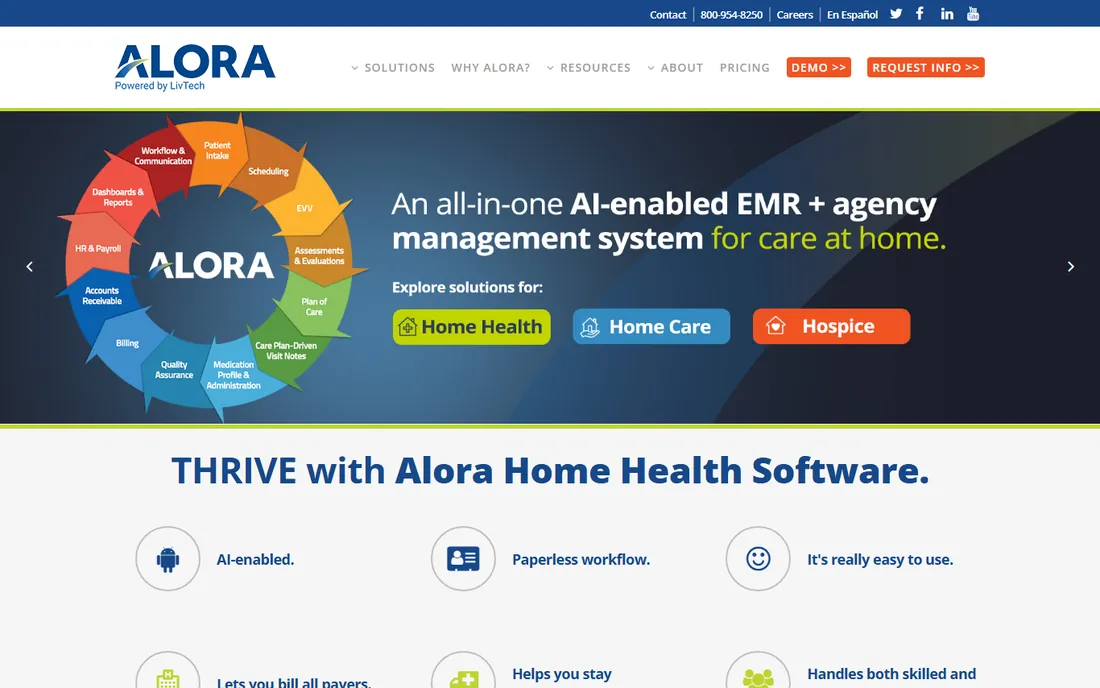
Alora positions itself as the all-inclusive option for agencies that do not want to buy five add-on modules to get a working system. The feature list runs long: electronic visit verification, one-click electronic faxing, integrated telephony, workflow automation, billing across all payers, scheduling, Plan of Care (485) management, point-of-care access, e-signature and automatic 485 generation from OASIS. Skilled and non-skilled care live in one platform, and multiple offices or business lines can be managed from the same login.
The distinguishing fact is commercial, not technical: Alora publishes its price at $295 per month per user. In a market where nearly every competitor requires a sales call for a quote, that transparency matters for smaller agencies planning a budget. The per-user model is the catch to model carefully, because every office employee and scheduler multiplies the bill. Agencies with a lean office staff and a heavy field workforce get the best value here.
What we like- One of the few vendors with published pricing
- Covers skilled and non-skilled lines in a single system
- Includes EVV, electronic faxing, telephony and workflow automation
Watch out for- Per-user pricing adds up for agencies with large office staff
- Implementation depth is thinner than the enterprise suites for very large multi-site agencies
#2
Axxess
Best for: Home health agencies that want one vendor for clinical, scheduling and billing
Visit axxess.com
Starting priceSee website (custom quote only)
Free planNo (no free trial advertised)
Axxess is the technology innovator pitch: one vendor for home health, home care and hospice, with a suite designed to cover the full operating stack. Reviewers like the pre-built documentation templates, the mobile app that supports offline work with auto-sync, and the PDGM center that flags ungroupable diagnoses and LUPA risks. Smart scheduling uses routing logic to cut travel time and overtime. Patient intake, scheduling, billing, QA and reporting all sit under one login.
The friction points are familiar to anyone who has bought enterprise healthcare software. Pricing is not published, and third-party estimates put the starting figure around $899 per user per month, which is steep for small agencies (unverified against Axxess's own page, so treat it as a rumor, not a quote). Reviewers also mention long ticket wait times and clunky update cycles. If you want fast time to value with clear pricing, Alora or CareSmartz360 are simpler; if you want suite depth, Axxess earns the shortlist.
What we like- Complete suite spanning home health, home care and hospice
- Reviewers consistently praise the clean interface and single login across modules
- Strong PDGM and OASIS tooling for reimbursement work
Watch out for- No published pricing, so budgeting starts with a sales call
- Reviewers report slow support ticket responses and occasional glitches in care plan data
#3
KanTime
Best for: Post-acute, hospice, pediatric and palliative agencies needing clinical documentation depth
Visit kantime.com
Starting priceSee website (custom quote only)
Free planNo (no free trial advertised)
KanTime is built for post-acute care, which shows in the feature design. The mobile point-of-care tools link items directly to the OASIS manual, so documentation errors get caught at the point of capture rather than in QA. The auto-QA feature automates approvals and flags problems with sticky notes. Scheduling is drag-and-drop with skill, location and shift-preference matching. Electronic claims support HCFA and UB04 forms.
This is the clinical depth pick for hospice, pediatric and palliative agencies that cannot afford documentation mistakes. The tradeoff is cost and complexity. KanTime does not publish pricing; third-party estimates suggest it starts around $2,000 per month and scales with users and features. Reviewers describe a real learning curve and occasional product freezes. It fits mid-size and larger organizations that have someone to own the system.
What we like- Mobile point-of-care tools link documentation items to the OASIS manual for accuracy
- Auto-QA automates approvals and flags errors
- Drag-and-drop scheduling matches caregivers by skill, location and shift preference
Watch out for- No published pricing and third-party estimates put the starting point near $2,000 per month
- Steep learning curve with limited training options reported by reviewers
#4
AxisCare
Best for: Home care agencies wanting per-client pricing flexibility
Visit axiscare.com
Starting priceSee website (custom quote only)
Free planNo (no free trial advertised)
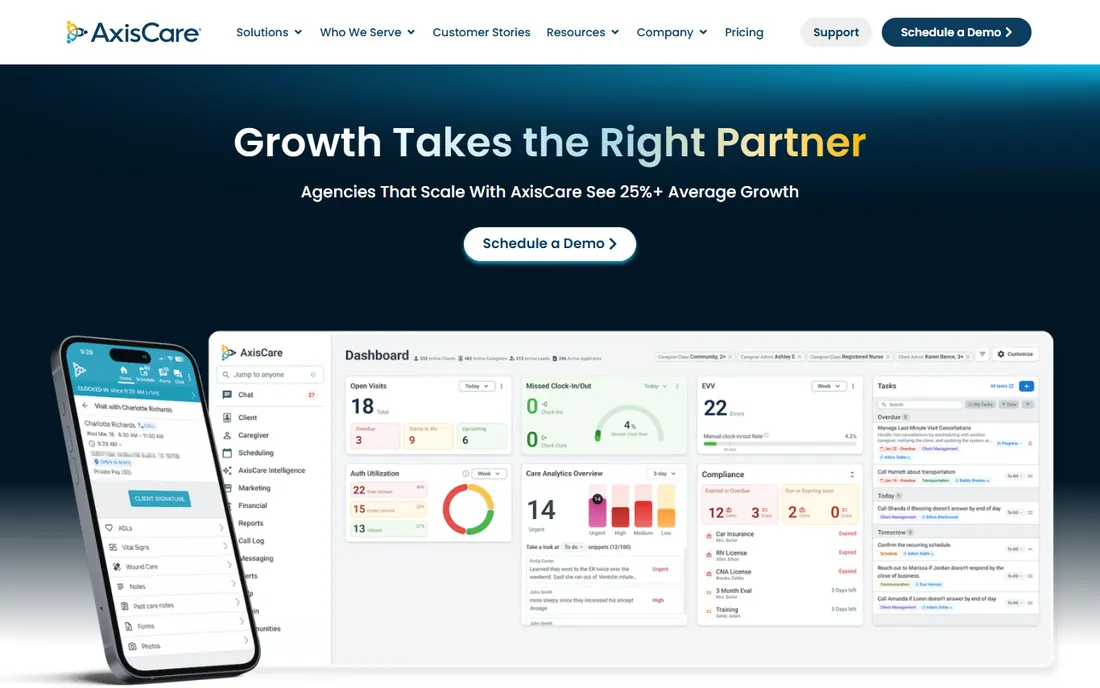
AxisCare is a home care scheduling and management platform built for non-medical home care first. The standout is the flex pricing model: agencies choose between a la carte and all-inclusive pricing, both structured around client count rather than user seats, which suits agencies whose office staff is small but whose caregiver roster is large. Integrations cover ADP, Paylocity, QuickBooks, HubSpot, CareAcademy and a long list of hiring and payroll tools.
Reviewers describe it as capable across the standard home care workflow: scheduling, caregiver management, billing, payroll and client communication. There is no free trial and no published price, so you will negotiate through sales. For agencies comparing against WellSky Personal Care and CareSmartz360, the per-client pricing model is the comparison point to pin down, because it changes the math depending on your client-to-caregiver ratio.
What we like- Flex pricing model with a choice of a la carte or all-inclusive per-client pricing
- Broad integration list including payroll, CRM and training tools
- Works for solo caregivers up through very large agencies
Watch out for- No published pricing and no free trial
- Feature breadth can feel complex for a very small agency that only needs scheduling
#5
WellSky Personal Care
Best for: Private duty and personal care agencies wanting caregiver scheduling with built-in telephony
Visit wellsky.com
Starting priceSee website (custom quote only)
Free planNo (no free trial advertised)
WellSky Personal Care is the product formerly known as ClearCare, and it remains one of the most widely used platforms for private duty home care. The feature set covers the private duty workflow end to end: scheduling, billing, HR and CRM in one place, telephony-based EVV, a mobile app that lets caregivers view appointments and request open shifts, and a family portal that gives clients' families real-time visibility into care plans. CareAcademy-based caregiver training is built in.
Third-party estimates put pricing around $100 per active client per month, which is not published by the vendor, so confirm it in a demo. The limits are architectural: integrations are narrower than competitors, and the platform does not support medical documentation, so mixed skilled and non-skilled agencies will outgrow it. For pure private duty agencies, the caregiver-facing mobile experience and the telephony EVV are the reasons it stays on shortlists.
What we like- Long track record in private duty home care (formerly ClearCare)
- Telephony-based EVV alongside mobile check-in
- Family portal and caregiver shift-request tools that reviewers praise
Watch out for- Limited third-party integrations compared with newer platforms
- No medical documentation support for agencies that also run skilled lines
#6
HomeCare Homebase
Best for: Large home health and hospice agencies with multi-site operations
Visit hchb.com
Starting priceSee website (custom quote only)
Free planNo (no free trial advertised)
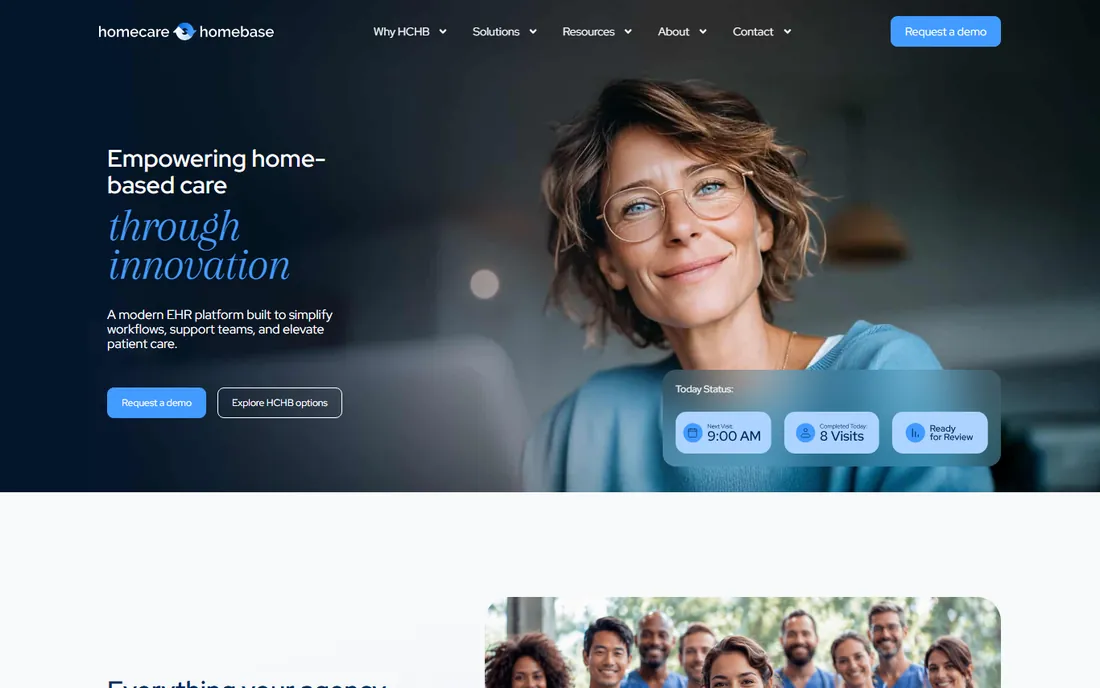
HomeCare Homebase (HCHB) is the scale play. The platform is designed for agencies that run multiple sites and large caregiver fleets, with smart scheduling that uses routing algorithms to reduce miles and overtime hours. Patient and employee information sits in one system, which pays off in reporting depth and in real-time visibility for administrators. It covers home health and hospice, with intake, scheduling, billing and clinical documentation in the suite.
The honest tradeoffs: pricing is custom and annual, so you cannot compare it against per-user or per-client platforms without a quote in hand. Reviewers flag an overwhelming initial setup and a real learning curve before the system clicks, plus slow app performance when loading large patient lists. Small agencies will find it heavy; multi-site agencies running complex billing will find the depth they need.
What we like- Built for scale from small startups to large multi-site agencies
- Smart scheduling with routing algorithms that cut travel time and overtime
- Strong reporting with patient and employee data in one place
Watch out for- Quote-based pricing with no published numbers
- Reviewers report a steep learning curve and slow load times when working with many patients at once
#7
Brightree
Best for: Agencies running both home health and home medical equipment lines
Visit brightree.com
Starting priceSee website (custom quote only)
Free planNo (no free trial advertised)
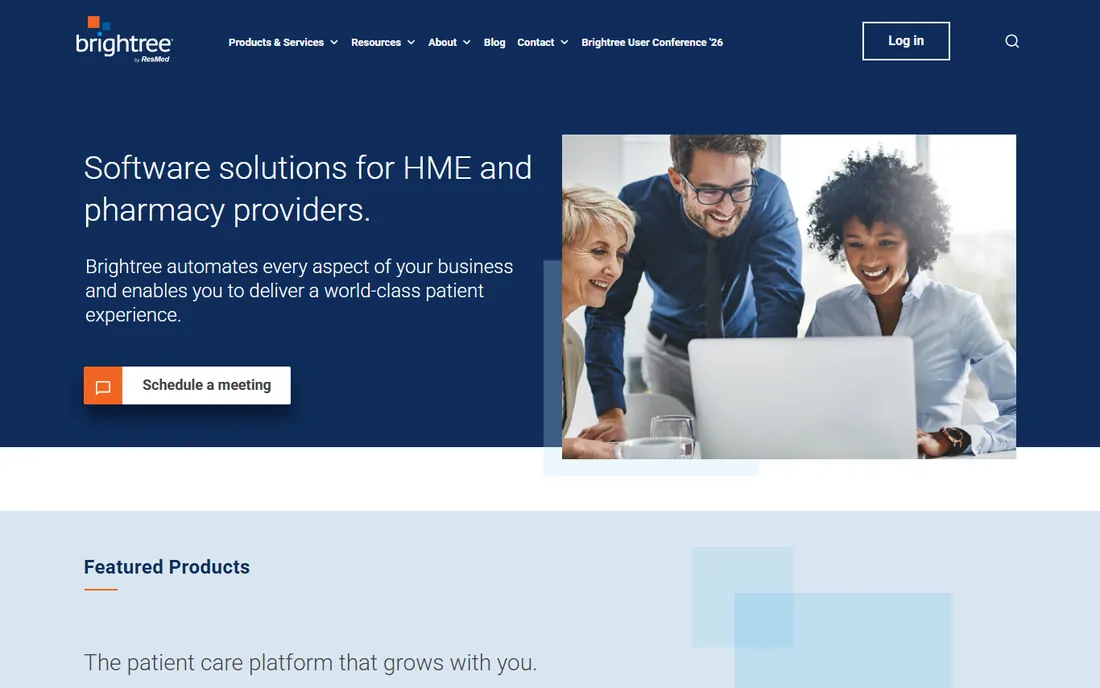
Brightree serves home health agencies, but its distinctive strength is breadth across adjacent lines: home medical equipment and DME, infusion, and home health can all run on the platform. Agencies that bill for equipment as well as visits avoid stitching together two systems. The billing and claims workflow is mature, with deep payer integrations built over years in the market.
The buying reality is enterprise-style: no published pricing, sales-led implementation, and an interface that shows its age next to newer competitors. Onboarding takes longer than the cloud-native alternatives. The buyers who choose Brightree are usually agencies with mixed business lines that need one vendor across them, or agencies whose payer mix demands the established claims infrastructure.
What we like- Strong fit for agencies with HME/DME operations alongside home health
- Mature billing and claims workflow
- Part of a large healthcare software family with deep payer integrations
Watch out for- No published pricing
- Interface and implementation reflect its enterprise heritage, with longer onboarding than modern competitors
#8
CareSmartz360
Best for: Small to mid-size agencies wanting affordable scheduling, EVV and billing
Visit caresmartz360.com
Starting priceSee website (custom quote only)
Free planFree trial available (length unverified on vendor page)
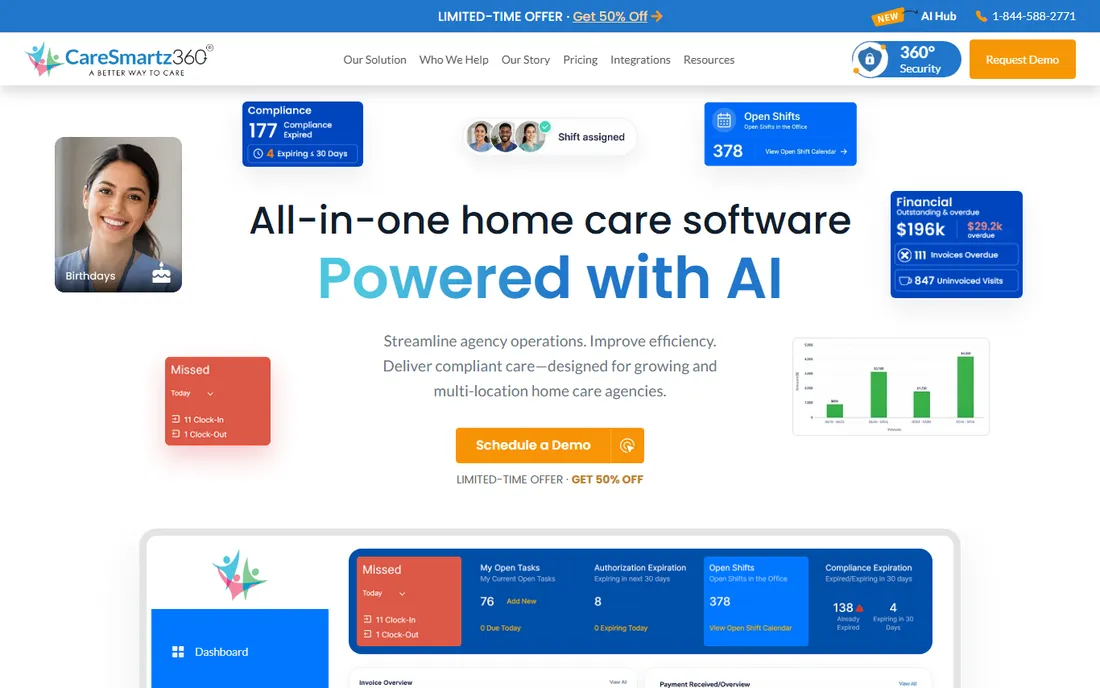
CareSmartz360 is the value pick for agencies that want the core home care workflow without enterprise pricing. It covers billing and invoicing, scheduling, EVV, caregiver and client management, payroll and reporting in one cloud platform, and reviewers consistently score it well on ease of use, functionality and support. Small businesses are its core audience, and the implementation is lighter than the enterprise suites on this list.
Third-party sources cite a starting price around $10 per month, which looks like a per-user or entry figure rather than a published vendor price, so do not budget against it; get the quote. A free trial is available. The limitation is clinical depth: Medicare-certified agencies with heavy OASIS and claims needs should compare Axxess or KanTime first. For private duty and small home care agencies, it is one of the friendlier buys on this list.
What we like- Reviewers rate it highly for ease of use and value for money
- Covers scheduling, billing, EVV, payroll and client management in one cloud platform
- Lighter implementation than the enterprise suites
Watch out for- No published pricing from the vendor itself
- Thinner clinical documentation depth than Axxess or KanTime for Medicare-heavy agencies
How we chose
We started with the categories buyers search: home health care software, home health software, home care software and private duty home care software. For each candidate we checked the vendor's own pricing page and product pages, cross-checked capabilities against reviews on Capterra, Software Advice, GetApp and SelectHub, and split the list between Medicare-facing clinical platforms and private duty scheduling platforms, because the two buyer types need different products. Where a vendor did not publish pricing, we wrote "See website" rather than repeating unverified third-party estimates.
What to look for when buying home health software
Match the platform to your payer mix first. If you bill Medicare, you need OASIS documentation support, physician order management, claims scrubbing and PDGM-aware billing; that is the Axxess, KanTime, Brightree and HomeCare Homebase tier. If your revenue is private pay, Medicaid waiver or long-term care insurance, you need scheduling, EVV, caregiver recruiting and client billing; that is the WellSky Personal Care, AxisCare, CareSmartz360 and Alora tier. Buying across the line in either direction wastes money.
Second, verify EVV compliance for your states. Electronic visit verification is required in most states for Medicaid-funded personal care and home health visits, and every platform here includes it, but the caregiver experience differs. Telephony-based EVV suits caregivers without smartphones; mobile app check-in with GPS suits the rest. Ask for a live demo of the exact clock-in flow your caregivers will use.
Third, model the pricing unit. These vendors price per user, per active client, or by custom quote, and the cheapest option for your agency depends on your office-to-field ratio. A per-user platform like Alora is cheap for agencies with few office staff and expensive for ones with large scheduling teams. A per-client platform like AxisCare or WellSky flips the math. Get three quotes in writing with your actual user and client counts before deciding.
The market split matters because the products are genuinely different. Clinical platforms (Axxess, KanTime, Brightree, HomeCare Homebase) are documentation and billing systems with scheduling attached. They live and die by OASIS accuracy, claims acceptance rates and audit readiness. Their implementations are heavier, their sales cycles are longer, and their pricing reflects the compliance value.
Private duty platforms (WellSky Personal Care, AxisCare, CareSmartz360, Alora in its non-skilled mode) are scheduling and workforce systems with billing attached. They live and die by caregiver adoption, schedule fill rates and EVV compliance. They are cheaper, faster to implement, and easier for office staff to learn. Alora is the bridge product: it handles both skilled and non-skilled lines, which is why mixed agencies shortlist it.
If you run both lines, you have two honest options. Run Alora across both, accepting thinner clinical depth than the pure clinical suites. Or run a clinical platform for the Medicare line and a private duty platform for the personal care line, accepting the cost and complexity of two systems. Most growing agencies start with one and split later.
Frequently asked questions
What is the average cost of home health care software?
Most vendors quote custom pricing, so averages mislead. The one published price on this list is Alora at $295 per month per user. Third-party sources estimate AxisCare from around $325 per month, WellSky Personal Care around $100 per active client per month, and KanTime from around $2,000 per month, but none of these appear on the vendors' own pages, so get written quotes with your actual numbers.
Which home health software is best for Medicare agencies?
Agencies billing Medicare should look at Axxess, KanTime, Brightree or HomeCare Homebase, which are built around OASIS documentation, physician orders and claims management. Private duty platforms like WellSky Personal Care and AxisCare lack the medical documentation depth Medicare billing requires.
Do I need EVV in my home health software?
In most states, yes for Medicaid-funded visits. The 21st Century Cures Act pushed states to require electronic visit verification for personal care and home health services, and every platform on this list includes some form of EVV. Confirm the specific EVV method (telephony, mobile app, GPS) works for your caregiver population.
Can one platform handle skilled and non-skilled care?
Alora is built for exactly this, handling both skilled and non-skilled lines in one system. Axxess also covers home health, home care and hospice in a suite. Pure private duty platforms like WellSky Personal Care do not support medical documentation, so mixed agencies should stick to the bridge products.
How long does implementation take?
Expect four to twelve weeks for the clinical suites, depending on agency size and data migration. Private duty platforms like CareSmartz360 and AxisCare typically go live faster, often in two to four weeks. Ask every vendor for a written implementation timeline and who does the data migration before signing.
Sources we checked (11)
- https://www.alorahealth.com/
- https://www.axxess.com/
- https://www.kantime.com/
- https://axiscare.com/
- https://wellsky.com/
- https://hchb.com/
- https://www.brightree.com/
- https://www.caresmartz360.com/
- https://www.capterra.com/compare/114010-233554/AgencyCore-vs-CareSmartz360
- https://www.selecthub.com/home-health-software/axxess-vs-hchb/
- https://www.selecthub.com/home-care-software/kantime-vs-wellsky-personal-care/
Is your product missing or out of date?
We review this list regularly. Vendors can request a listing, send updated pricing or ask about featured placement.

Shihab Mia · Founder, Rankite
Shihab has spent more than a decade helping SaaS and e-commerce brands grow through search. He writes Rankite's software buying guides from pricing pages, documentation and public user reviews. More about Shihab.