How we make this list: we compare pricing pages, product documentation and public user reviews. Ratings come from G2, Capterra or Trustpilot, with the date we checked them.
What is the best healthcare analytics company in 2026?
Health Catalyst is the best healthcare analytics company for most large health systems because its Data Operating System pairs a governed data platform with outcomes-improvement services proven across more than 50 integrated delivery networks. Arcadia suits value-based care organizations, IQVIA suits life sciences teams, and Definitive Healthcare suits commercial teams that need market intelligence.
Key takeaways
- Health Catalyst leads for large health systems, with enterprise subscriptions reported at 500,000 dollars or more per year and a platform plus services model.
- Arcadia is the strongest pick for value-based care, with more than 2,600 connected data sources feeding population health and risk models.
- IQVIA, Definitive Healthcare, and Merative serve different buyers: life sciences research, healthcare market intelligence, and real-world evidence respectively.
- None of the eight vendors publishes a self-serve price, so budget for a sales-led quote, an implementation project, and a multi-year contract.
- The healthcare analytics market was valued at 64.49 billion dollars in 2025 and is projected to grow at a 21.41 percent compound annual rate through 2034, according to Arcadia.
How is a healthcare analytics company different from a healthcare software company?
A healthcare software company sells the system of record, such as an electronic health record, a scheduling tool, or a billing system. A healthcare analytics company sells the layer that sits on top of those systems and turns their data into decisions. It ingests clinical, claims, financial, and operational data, cleans and links it, then delivers dashboards, risk scores, benchmarks, and predictions. Rankite already covers the software side in its guide to the best healthcare software companies, which lists EHR vendors such as Epic, Oracle Health, MEDITECH, athenahealth, and eClinicalWorks. This guide covers the analytics vendors that help hospitals, payers, and life sciences teams act on the data those systems collect.
What should you check before signing an analytics contract?
Check four things before you sign. First, data integration: confirm the vendor connects to your EHR, claims warehouse, and billing system without a separate integration project for every source. Second, governance: ask how patient data is de-identified, who can see row-level records, and whether the platform supports HIPAA-compliant access controls and audit logs. Third, time to value: ask for a named reference customer with a similar bed count or member count and a measured outcome, not a logo slide. Fourth, total cost: the subscription is only part of the bill, since implementation, data migration, training, and professional services often add a large share in year one. Get the services estimate in writing before you commit.
How much do healthcare analytics companies cost?
Expect enterprise pricing across the board. Health Catalyst subscriptions are reported at 500,000 dollars or more per year for large health systems. Arcadia, Optum Analytics, IQVIA, Merative, Flatiron Health, and Innovaccer do not publish list prices and quote each engagement. Definitive Healthcare sells subscription data products and also quotes per engagement. Small clinics and single practices will find these vendors too large and too expensive; they are built for health systems, payers, accountable care organizations, and life sciences companies with dedicated analytics teams. If your budget is under 50,000 dollars a year, a general business intelligence tool connected to your EHR exports is a more realistic route.
Comparison table
| Company |
Best for |
Starting price |
Free plan |
| Health Catalyst |
Large health systems and outcomes improvement |
Quote, reported 500,000 dollars plus per year |
No |
| Arcadia |
Value-based care and population health |
Quote |
No |
| Optum Analytics |
Payers and large provider networks |
Quote |
No |
| IQVIA |
Life sciences and real-world evidence |
Quote |
No |
| Definitive Healthcare |
Healthcare market intelligence |
Quote |
No |
| Merative |
Real-world data and clinical research |
Quote |
No |
| Flatiron Health |
Oncology data and research |
Quote |
No |
| Innovaccer |
Health system data unification |
Quote |
No |
Quick comparison
| Tool | Best for | Starting price | Free plan |
|---|
 Health Catalyst | Large health systems and academic medical centers running outcomes-improvement programs | Quote, enterprise subscriptions reported at 500,000 dollars or more per year | No free plan |
 Arcadia | Value-based care organizations, accountable care organizations, and health plans managing risk | Quote | No free plan |
 Optum Analytics | Health plans, pharmacy benefit managers, and large provider networks needing claims and utilization analytics | Quote | No free plan |
 IQVIA | Life sciences companies running real-world evidence, clinical development, and commercial analytics | Quote | No free plan |
 Definitive Healthcare | Life sciences, healthcare IT, and consulting teams that need healthcare market intelligence | Quote | No free plan |
 Merative | Life sciences and health plan teams needing real-world data, clinical research support, and health economics | Quote | No free plan |
 Flatiron Health | Oncology practices, cancer centers, and life sciences teams working with real-world oncology data | Quote | No free plan |
 Innovaccer | Health systems and payers unifying clinical, claims, and operational data on one platform | Quote | No free plan |
Is your product missing or out of date?
We review this list regularly. Vendors can request a listing, send updated pricing or ask about featured placement.
The 8 best healthcare analytics companies
#1
Health Catalyst
Best for: Large health systems and academic medical centers running outcomes-improvement programs
Visit healthcatalyst.com
Starting priceQuote, enterprise subscriptions reported at 500,000 dollars or more per year
Free planNo free plan
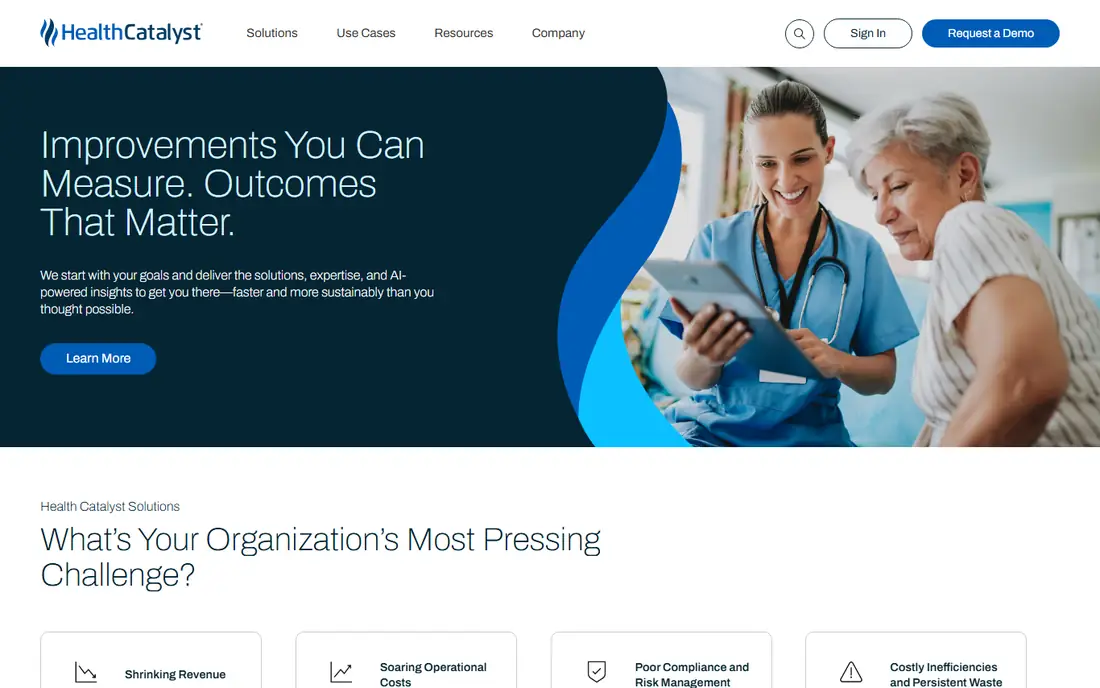
Health Catalyst combines a data platform with a services team, and that combination is why large health systems choose it. The Data Operating System ingests clinical, claims, and operational data into governed, measurement-ready datasets, and the company pairs the platform with analysts and improvement advisors who run quality and cost programs against it. The vendor reports more than 390 case studies and over 2.8 billion dollars in client-validated outcomes. The trade-off is scale: reported subscriptions start around 500,000 dollars a year, and the platform is designed for organizations with hundreds of beds and dedicated analytics staff. A community hospital with a small team will struggle to absorb both the cost and the change management. For a large system that wants measurable improvement rather than another dashboard, Health Catalyst is the strongest choice in this list.
What we like- Data Operating System with governed data models, deep outcomes-improvement services, proven across more than 50 integrated delivery networks
Watch out for- Enterprise pricing puts it out of reach for small providers, and implementations are long services-led projects
#2
Arcadia
Best for: Value-based care organizations, accountable care organizations, and health plans managing risk
Visit arcadia.io
Starting priceQuote
Free planNo free plan

Arcadia unifies claims, clinical, and social-determinant data into one platform built for organizations that carry financial risk for patient populations. Its strength is breadth of ingestion: more than 2,600 data sources feed risk stratification, care-gap closure, and contract performance reporting for accountable care organizations and health plans. The company was founded in 2007 and serves providers, payers, life sciences organizations, and government agencies. The main weakness is transparency. Pricing is quoted per engagement, and smaller organizations can find the platform oversized for their needs. If your organization bears risk under value-based contracts, Arcadia is the most focused option here. If you are paid fee-for-service and only need reporting, a lighter tool will serve you better.
What we like- More than 2,600 connected data sources, strong population health and risk modeling, named a leader in healthcare analytics by independent analysts
Watch out for- Quote-only pricing hides the real cost until late in the sales process, and the platform is built for risk-bearing organizations rather than fee-for-service hospitals
#3
Optum Analytics
Best for: Health plans, pharmacy benefit managers, and large provider networks needing claims and utilization analytics
Visit optum.com
Starting priceQuote
Free planNo free plan
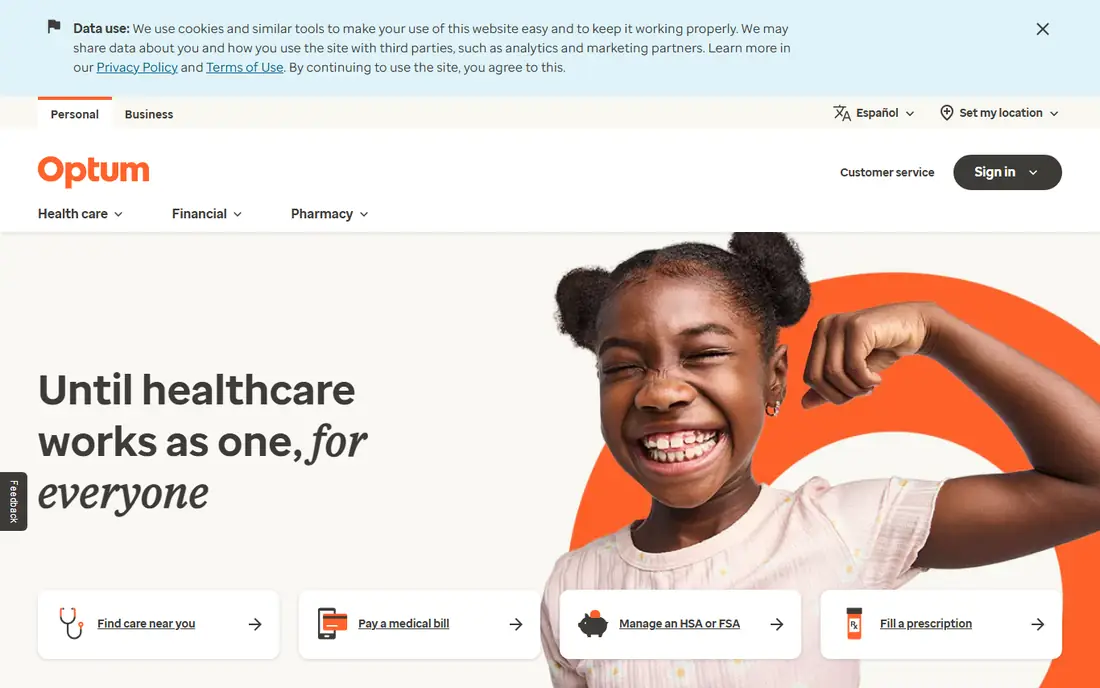
Optum Analytics is the analytics arm of Optum, the health services business of UnitedHealth Group, founded in 2011. It serves payers, providers, employers, and government agencies with claims analytics, revenue cycle analytics, utilization management, and population health tools. Its advantage is data scale: few vendors can match the volume of claims and clinical records flowing through the UnitedHealth ecosystem. The weakness is equally clear. Pricing is quoted, engagements are enterprise scale, and provider organizations sometimes hesitate to buy analytics from a company owned by a payer. For a health plan or a large payer-side team, Optum is a natural fit. For an independent hospital, ask hard questions about data use and independence before signing.
What we like- Massive claims and clinical data assets from UnitedHealth Group, broad payer and provider coverage, deep revenue cycle and utilization analytics
Watch out for- Quote-only enterprise pricing, and the vendor is part of a payer-owned group, which some provider buyers view as a conflict
#4
IQVIA
Best for: Life sciences companies running real-world evidence, clinical development, and commercial analytics
Visit iqvia.com
Starting priceQuote
Free planNo free plan
IQVIA is a life sciences analytics company built on large-scale real-world healthcare data. Its platforms support clinical development, real-world evidence generation, and commercial analytics for pharmaceutical and biotech companies. In the 2025 ISG Buyers Guide for Healthcare Analytics, IQVIA was rated Innovative overall and achieved top product-experience performance alongside Oracle and MedeAnalytics. The company is less useful outside life sciences: a hospital looking for operational dashboards will find the platform oriented toward drug development and market access. Pricing is quote-only and enterprise scale. For a life sciences team that needs real-world data plus the analytics to use it, IQVIA is the benchmark. For a provider, look at Health Catalyst or Arcadia instead.
What we like- One of the largest real-world healthcare datasets in the world, strong clinical trial and commercial analytics, top product-experience scores in the 2025 ISG healthcare analytics buyers guide
Watch out for- Built for life sciences buyers, so provider-side analytics teams will find much of the platform irrelevant, and pricing is entirely quote-based
#5
Definitive Healthcare
Best for: Life sciences, healthcare IT, and consulting teams that need healthcare market intelligence
Visit definitivehc.com
Starting priceQuote
Free planNo free plan
Definitive Healthcare is a publicly traded data and analytics company founded in 2011 and headquartered in Framingham, Massachusetts. It aggregates data across the healthcare ecosystem into subscription products covering hospitals, physicians, clinics, imaging centers, surgery centers, long-term care, and claims. The company serves about 2,400 customers and reported 241.5 million dollars in full-year 2025 revenue. Its strength is market intelligence: commercial teams use it to size markets, find buyers, and map affiliations. It is not a clinical analytics platform, so a hospital quality team will not find outcomes dashboards here. Pricing is subscription-based and quoted per engagement. For go-to-market and market-sizing work in healthcare, Definitive Healthcare is the most complete source in this list.
What we like- Profiles on more than 9,000 hospitals and 3 million clinicians, publicly traded with audited financials, strong claims and affiliation data
Watch out for- Focused on the business side of healthcare rather than clinical analytics, and subscriptions are quoted rather than published
#6
Merative
Best for: Life sciences and health plan teams needing real-world data, clinical research support, and health economics
Visit merative.com
Starting priceQuote
Free planNo free plan
Merative was formed in 2022 when Francisco Partners acquired IBM Watson Health and relaunched it as a standalone healthcare data company headquartered in Ann Arbor, Michigan. Its products cover healthcare data and analytics, clinical decision support, medical imaging, and real-world evidence, serving providers, health plans, life sciences organizations, and government entities. The best-known asset is the MarketScan research database, a large collection of de-identified claims data used widely in health economics research. The main drawback is clarity: the company is still young under its new name, and buyers should confirm which legacy IBM products are still supported. For real-world evidence and claims-based research, Merative remains a serious option alongside IQVIA.
What we like- Former IBM Watson Health assets including MarketScan claims data, strong real-world evidence capabilities, owned by Francisco Partners with a standalone focus
Watch out for- The rebrand from IBM Watson Health still confuses some buyers, and pricing is quote-only with enterprise minimums
#7
Flatiron Health
Best for: Oncology practices, cancer centers, and life sciences teams working with real-world oncology data
Visit flatiron.com
Starting priceQuote
Free planNo free plan
Flatiron Health was founded in 2012 in New York and became an independent affiliate of the Roche Group in 2018. It builds oncology data analytics from real patient experiences, translating clinical records into structured, research-ready datasets that support cancer treatment decisions, policy, and life sciences research. The company employs more than 2,500 people across the UK, Germany, Japan, and the USA. Its strength is specialization: no general analytics vendor matches its depth in oncology. Its weakness is the same specialization. A general hospital cannot use Flatiron for cardiology, orthopedics, or finance. For a cancer center or an oncology research team, Flatiron is the clearest fit in this list.
What we like- Deep oncology-specific data and analytics, part of the Roche Group since 2018, strong real-world evidence for cancer research
Watch out for- Oncology-only focus means it cannot serve general hospital analytics, and pricing is quote-only
#8
Innovaccer
Best for: Health systems and payers unifying clinical, claims, and operational data on one platform
Visit innovaccer.com
Starting priceQuote
Free planNo free plan
Innovaccer sells a healthcare data platform that unifies clinical, claims, financial, and operational data into a single layer for analytics, care management, and population health. It was rated Innovative in the 2025 ISG Buyers Guide for Healthcare Analytics and is frequently compared with Health Catalyst and Arcadia for enterprise platform deals. Its pitch is interoperability: the platform is designed to sit across existing EHRs and data warehouses rather than replace them. The weakness is the same as its rivals. Pricing is quoted, implementation is a program rather than a purchase, and small organizations will find it oversized. For a health system consolidating many data sources into one governed platform, Innovaccer deserves a place on the shortlist.
What we like- Unified data platform with strong interoperability, rated Innovative in the 2025 ISG healthcare analytics buyers guide, modern cloud architecture
Watch out for- Quote-only pricing, and the platform is aimed at large organizations with the staff to run a data unification program
How we picked these companies
We started from the 2025 ISG Buyers Guide for Healthcare Analytics, which assessed 20 providers, and cross-checked each vendor against recent company reporting and product pages on 11 November 2026. We kept vendors with a real analytics product, a verifiable customer base, and a distinct buyer. We excluded pure EHR vendors, which Rankite covers in its healthcare software guide, and general business intelligence tools that are not healthcare-specific. Every vendor in this list is quote-only, so prices are reported from third-party guides and vendor disclosures rather than published price lists, and we say so where a figure appears. For more on related buying decisions, see Rankite's guides to the best healthcare software companies, the best AI tools for human resources, and the best CRM software for consultants.
Frequently asked questions
How much does a healthcare analytics platform cost?
Expect enterprise pricing. Health Catalyst subscriptions are reported at 500,000 dollars or more per year for large health systems, and the other vendors in this list quote each engagement rather than publishing a price. Implementation, data migration, and professional services add to the first-year cost, so ask for the full services estimate in writing before you sign a contract.
Do these companies work with small clinics?
Mostly no. Health Catalyst, Arcadia, Optum, IQVIA, and Innovaccer are built for health systems, payers, and life sciences companies with dedicated analytics teams. A small clinic is better served by the reporting built into its EHR, or by a general business intelligence tool connected to EHR exports, at a fraction of the cost.
Is healthcare analytics software HIPAA compliant?
The vendors in this list are designed for HIPAA-regulated work, with access controls, audit logs, and business associate agreements. Compliance still depends on how you configure the platform and who you give access to, so confirm the business associate agreement terms and the de-identification approach for any dataset before you load patient data.
What is the difference between healthcare analytics and population health?
Population health is a use case inside healthcare analytics. It focuses on groups of patients, risk stratification, and closing care gaps for accountable care organizations and health plans. Healthcare analytics is broader and also covers clinical quality, finance, operations, and research. Arcadia is the strongest population health pick in this list.
Which vendor is best for life sciences?
IQVIA leads for life sciences teams that need real-world data plus clinical and commercial analytics. Merative is a strong alternative for real-world evidence built on claims data, and Flatiron Health is the pick for oncology-specific research. Definitive Healthcare suits commercial teams that need market intelligence rather than clinical analytics.
Sources we checked (10)
- https://www.healthcatalyst.com
- https://www.arcadia.io/resources/healthcare-analytics-companies/
- https://www.optum.com
- https://www.iqvia.com
- https://www.definitivehc.com
- https://www.merative.com
- https://www.flatiron.com
- https://www.innovaccer.com
- https://research.isg-one.com/hubfs/crm-properties-file-values/ISG_Buyers_Guide_Healthcare_Analytics_2025_Executive_Summary.pdf
- https://digitalhealth.folio3.com/blog/best-healthcare-analytics-software/
Is your product missing or out of date?
We review this list regularly. Vendors can request a listing, send updated pricing or ask about featured placement.

Shihab Mia · Founder, Rankite
Shihab has 5+ years in B2B and SaaS SEO. He writes Rankite's software buying guides from pricing pages, documentation and public user reviews. More about Shihab.