How we make this list: we compare pricing pages, product documentation and public user reviews. Ratings come from G2, Capterra or Trustpilot, with the date we checked them.
Key takeaways
- Tempus is the name to know in precision oncology, pairing genomic testing with one of the largest clinical data libraries in medicine.
- Aidoc and Viz.ai lead in hospital imaging and care coordination, where cleared algorithms flag time critical findings for clinical teams.
- Abridge owns the ambient documentation moment, turning patient conversations into clinical notes inside major health systems.
- Recursion and Owkin work upstream in drug discovery, selling to pharma rather than to hospitals.
- This is a list of vendors that sell to hospitals, clinics, and drug companies. Nothing here is medical advice, and these tools support clinicians rather than replace them.
Quick comparison
| Tool | Best for | Starting price | Free plan |
|---|
 Tempus | Precision oncology and clinical data | See website | No |
 Aidoc | Radiology triage and imaging AI | See website | No |
 Abridge | Ambient clinical documentation | See website | No |
 Viz.ai | Care coordination for time critical conditions | See website | No |
 PathAI | Digital pathology and biomarker work | See website | No |
 Recursion | AI drug discovery with pharma | See website | No |
 Butterfly Network | Handheld ultrasound with AI guidance | See website | No |
 Owkin | Federated drug discovery research | See website | No |
Is your product missing or out of date?
We review this list regularly. Vendors can request a listing, send updated pricing or ask about featured placement.
The best AI healthcare companies
Starting priceSee website
Free planNo
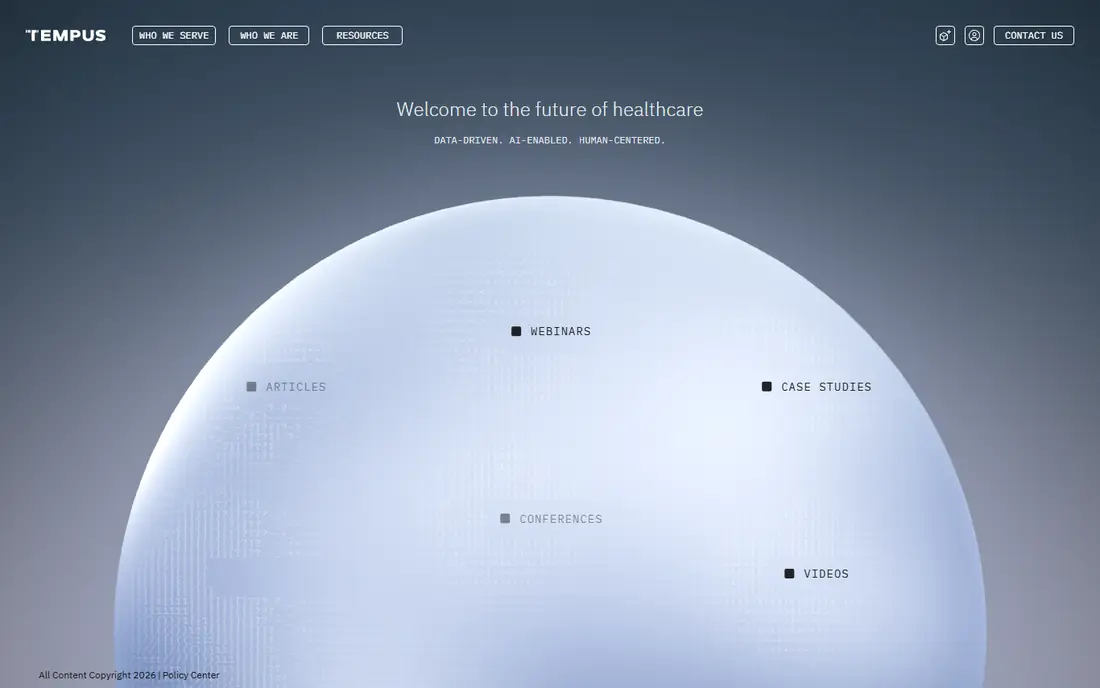
Tempus built its business on a simple idea: cancer care produces huge amounts of genomic and clinical data, and most of it used to sit unused. The Chicago company sequences tumors, structures the records around them, and sells oncologists reports that connect a patient's mutations to therapies and trials. Its data library, built from millions of de-identified records, is the asset rivals find hardest to copy.
Tempus is now a public company and has expanded into cardiology and pathology, but oncology remains the core. For a health system or pharma company that wants precision medicine data at scale, Tempus is the first call. For a small clinic that wants a simple tool, it is more platform than it needs.
What we like- Genomic testing and clinical data in one platform
- Large share of US oncologists connected to its network
- Strong trial matching tools
- Public company with reported results
Watch out for- Oncology is the centre, other specialties are thinner
- Value depends on data volume a buyer brings
- Enterprise contracts only
- Not a workflow tool for front line staff
Starting priceSee website
Free planNo
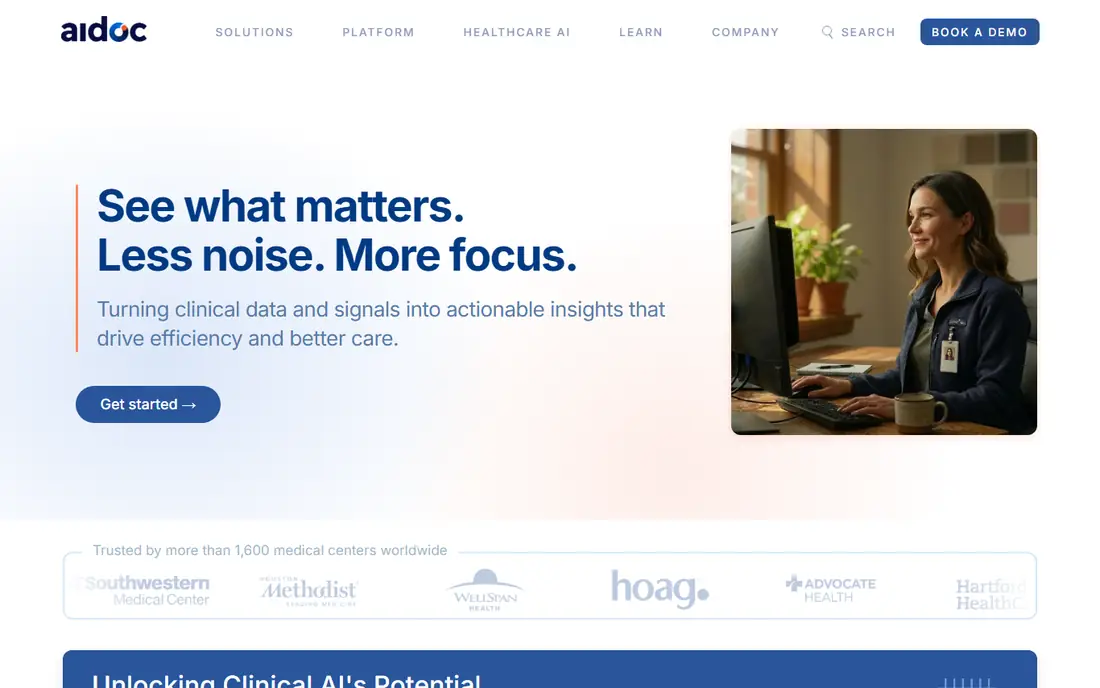
Aidoc sells an operating system for medical imaging. Its algorithms read scans as they are produced and push suspected strokes, brain bleeds, pulmonary emboli, and other urgent findings to the front of the worklist, so a radiologist sees the sickest patient first. The company reports deployment in more than 1,000 facilities, and its clearances cover a wide set of conditions.
The pitch is time. In stroke and trauma care, minutes change outcomes, and Aidoc sells the minutes. Hospitals with high imaging volume get the most from it. Smaller sites with a handful of scans a day will struggle to justify the platform fee, which is quoted per contract.
What we like- Many FDA cleared algorithms on one platform
- Flags strokes, bleeds, and clots for faster review
- Deployed in more than 1,000 facilities
- Works across scanner brands and hospital systems
Watch out for- Radiology and imaging adjacent work only
- Value depends on imaging volume
- Integration projects need IT time
- Contract pricing is opaque until you engage
#3Abridge
Best for: Ambient clinical documentation4.2/5 on
G2 (16 reviews, checked Oct 2026)
Visit abridge.com
Starting priceSee website
Free planNo
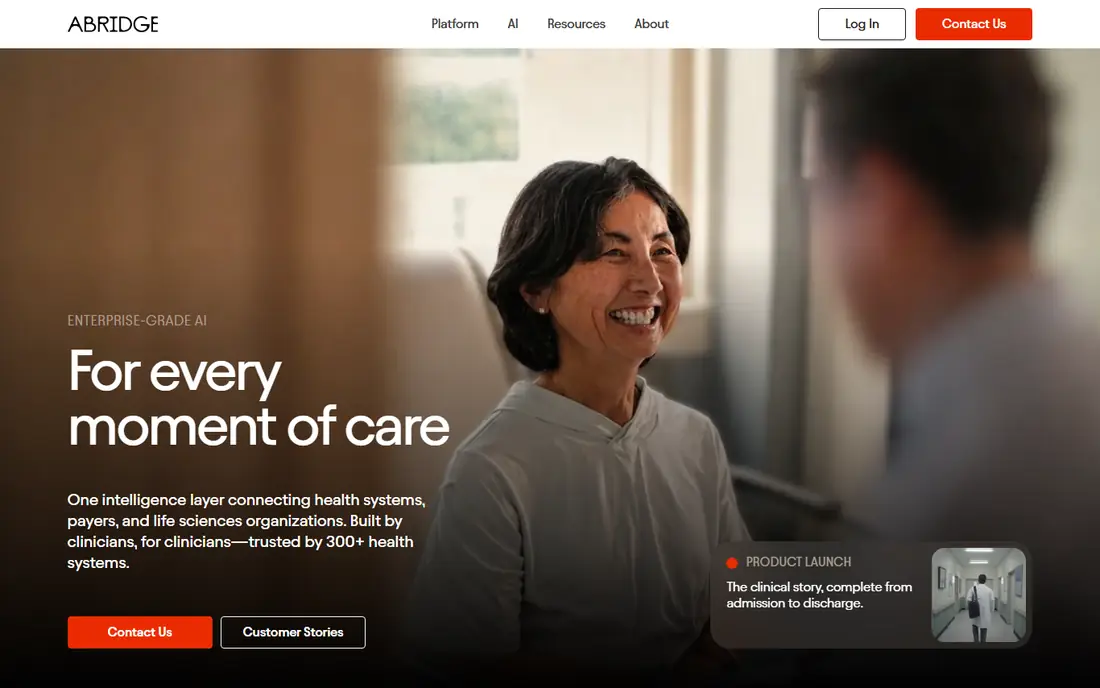
Abridge records the conversation between a clinician and a patient, with consent, and drafts the clinical note from it. The doctor checks and signs the note instead of typing it after hours. That simple promise, giving clinicians their evenings back, made Abridge one of the fastest growing companies in health AI, with rollouts at large systems such as Kaiser Permanente and Mayo Clinic reported in industry coverage.
Abridge works inside the record systems hospitals already run, which is why it spread quickly. Its limit is scope. It documents care rather than guiding it, and health systems still pay per clinician. For cutting documentation burden, it is the company buyers benchmark against.
What we like- Turns visit conversations into structured notes
- Deep links into Epic and other record systems
- Deployed at large systems including Kaiser Permanente
- Strong clinician satisfaction reporting
Watch out for- Documentation only, no diagnosis support
- Per clinician pricing adds up at scale
- Recording visits needs patient consent workflows
- Notes still need clinician review
#4
Viz.ai
Best for: Care coordination for time critical conditions
Visit viz.ai
Starting priceSee website
Free planNo
Viz.ai pairs detection with coordination. When its algorithms spot a likely large vessel stroke or another urgent finding on a scan, the app alerts the neurologist, surgeon, and care team at once, with the images on their phones. The company built its name in stroke care, where the gap between scan and treatment decides how much brain a patient keeps.
Coordination tools only work when the whole team uses them, so Viz.ai sells hospital by hospital and service line by service line. It has been adding conditions in cardiology and other areas. For systems that measure themselves on door to treatment times, Viz.ai is the standard the rest are compared with.
What we like- Alerts the whole care team when scans show a stroke or clot
- Mobile coordination cuts handoff delays
- Wide hospital adoption in stroke care
- Expanding into cardiology and trauma
Watch out for- Focused on a defined set of conditions
- Needs hospital wide buy in to work
- Alert fatigue is a real risk if tuned badly
- Pricing is contract based
Starting priceSee website
Free planNo
PathAI applies image analysis to pathology, the specialty that examines tissue under a microscope. Its models quantify cancer biomarkers and patterns in digitised slides, which helps pathologists score cases more consistently and helps drug companies find the patients most likely to respond to a therapy. Much of its business is with pharmaceutical firms and large labs rather than single hospitals.
The headwind is the lab itself. Many pathology departments still work on glass slides, and scanning them is a project before any AI runs. PathAI sells both the workflow platform and the algorithms to address that. For oncology research and trials, it is one of the most established names in digital pathology.
What we like- AI reads pathology slides for cancer biomarkers
- Works with pharma on trial and drug programs
- Strong research publications record
- Platform covers lab workflow as well as algorithms
Watch out for- Pathology digitisation is still early in many labs
- Sales cycles with pharma are long
- Not a tool for individual clinicians
- Revenue depends on partner programs
Starting priceSee website
Free planNo
Recursion runs one of the most automated biology operations in the industry. Robots run experiments on cells, imaging systems record how the cells respond to compounds and genetic changes, and models learn the patterns that point to new drug targets. The company works on its own pipeline and with large pharmaceutical partners, and it absorbed Exscientia to strengthen its chemistry side.
Buyers should be clear about what Recursion is. It is a drug discovery company, not software a hospital deploys, and its results arrive on pharmaceutical timescales. For pharma teams scouting AI discovery partners, though, Recursion is usually on the first list of meetings.
What we like- Automated labs generate huge experimental datasets
- Partnerships with major drug companies
- Own pipeline of candidate medicines
- Merged with Exscientia to add chemistry AI strength
Watch out for- Drug discovery timelines run in years
- Most value is still ahead of the science
- Not a product hospitals can buy
- Revenue is lumpy and partnership driven
Starting priceSee website
Free planNo
Butterfly Network put an ultrasound machine on a chip and sold it as a handheld probe that plugs into a phone or tablet. The Butterfly iQ line gives a clinician at the bedside a way to scan the heart, lungs, abdomen, and more without waiting for a cart, and its AI tools guide probe placement and label anatomy for users who do not scan every day.
It is the one company here that sells something close to a product price, though enterprise deals and software subscriptions still shape the real cost, so this guide lists See website. Butterfly fits emergency, rural, and teaching settings where access matters more than the last degree of image quality.
What we like- Whole body ultrasound in one handheld probe
- Far cheaper than cart based systems
- AI guidance helps less experienced users capture images
- Probe and software sell as a product, not a contract
Watch out for- Image quality trails high end carts for complex work
- Subscription needed for full software features
- Not every exam type is covered
- Hospital procurement still applies
Starting priceSee website
Free planNo
Owkin built its name on federated learning, a method that trains models across hospitals without patient data leaving each site. That approach won it a network of academic medical centres and pharmaceutical partners who want to study cancer and other diseases on real world data they could not otherwise combine.
Like Recursion, Owkin sells research capability to pharma and hospitals rather than a tool for the ward. Its recent work adds AI agents that propose hypotheses and plan experiments. For organisations that want discovery research with privacy built into the method, Owkin is a leading option.
What we like- Federated learning uses hospital data without moving it
- Strong academic and hospital network in Europe and the US
- Works with major pharma on discovery programs
- Publishes peer reviewed research
Watch out for- Research partner, not a deployable hospital product
- Projects run on research timescales
- Smaller commercial footprint than US rivals
- Value is hard to judge before a program completes
How we chose
We looked for companies with real deployments, regulatory clearances where their products need them, and a clear lane in the market rather than a general claim to do AI in health. Vendors were checked against trade coverage of hospital rollouts, FDA clearance reporting, and company disclosures in October 2026. We spread the list across the jobs buyers actually fund: data and precision medicine, imaging, documentation, coordination, pathology, devices, and drug discovery. We left out general technology giants whose health AI is one division among many, and services firms that implement other vendors' tools rather than building their own.
What to look for in an AI healthcare company
Start with the clearance and the evidence. A company selling into diagnosis or triage should name the regulatory clearances its algorithms hold and the studies behind them. Marketing language about accuracy means little next to a clearance and a deployment record in hospitals like yours. Ask for reference sites in your specialty and of your size, because a tool proven in a large academic centre may strain a community hospital.
Then look at workflow fit and total cost. Clinical AI succeeds when it sits inside the systems staff already use, the record, the imaging archive, the messaging app, and it fails when it adds a separate screen to check. Price the integration work, the per clinician or per scan fees, and the staff time to tune alerts, not just the licence. Finally, be honest about the lane. Documentation tools pay back in weeks. Discovery partnerships pay back in years, if at all. Buy the timeline your organisation actually needs.
Frequently asked questions
Are these companies selling to patients?
No. Every company here sells to hospitals, clinics, labs, or pharmaceutical firms. Their tools help clinicians document visits, read scans, coordinate care, or develop drugs. If you are a patient, you may meet their products inside a hospital visit, but you do not buy them yourself, and none of them replaces advice from your own doctor.
How is AI healthcare software regulated?
In the United States, software that diagnoses, triages, or guides treatment is usually a medical device and needs FDA clearance or approval before it is sold for that use. Documentation and workflow tools face lighter rules but still sit under privacy law such as HIPAA. Buyers should ask any vendor which clearances cover the exact feature they plan to use.
What is the fastest growing use of AI in hospitals?
Ambient documentation has spread fastest in the last two years, because it solves a problem every clinician feels, hours of typing after clinic. Companies such as Abridge grew quickly by drafting notes from visit conversations. Imaging triage, led by firms such as Aidoc and Viz.ai, has been deployed longer and is more deeply regulated.
Can AI healthcare tools replace doctors?
No, and none of the companies here claims that in its regulated products. The cleared tools flag findings, draft notes, quantify images, and match patients to trials. A clinician reviews and decides. The honest value case is time and consistency: catching a finding minutes earlier, or giving a doctor back an hour a day, at the scale of a whole health system.
Sources we checked (0)
Is your product missing or out of date?
We review this list regularly. Vendors can request a listing, send updated pricing or ask about featured placement.

Shihab Mia · Founder, Rankite
Shihab has 5+ years in B2B and SaaS SEO. He writes Rankite's software buying guides from pricing pages, documentation and public user reviews. More about Shihab.