How we make this list: we compare pricing pages, product documentation and public user reviews. Ratings come from G2, Capterra or Trustpilot, with the date we checked them.
Key takeaways
- NinjaTrader and Tradovate now share brokerage pricing, so the choice between them is mainly about desktop depth versus a cloud first interface.
- Micro contracts keep the entry cost low, with $50 intraday margins at NinjaTrader, Tradovate, AMP Futures, and Optimus Futures on popular micro contracts.
- TradeStation and Charles Schwab suit traders who also want stocks, options, and retirement accounts, but their futures commissions run higher than specialist futures brokers.
- Exchange, clearing, and regulatory fees sit on top of every broker commission, so compare the all in round turn cost, not the headline rate alone.
- Futures trading can lose more than your deposit when you trade on margin. This is not financial advice.
Quick comparison
| Tool | Best for | Starting price | Free plan |
|---|
 NinjaTrader | Advanced charting and automation | Free platform, $1.29 per side on standard contracts | Free trial |
 Tradovate | Cloud first futures trading | Free platform, $1.29 per side on standard contracts | Free trial |
 TradeStation | Multi asset active traders | $1.75 per side on standard contracts at low volume | Free trial |
 AMP Futures | Platform choice on a small account | See website | Free trial |
 Optimus Futures | Low commissions with no platform fee | $0.75 per side on E-mini contracts | Free trial |
 Cannon Trading | Broker support for commodity traders | See website | Free trial |
 Charles Schwab | thinkorswim users who also trade futures | $2.25 per contract | Free trial |
Is your product missing or out of date?
We review this list regularly. Vendors can request a listing, send updated pricing or ask about featured placement.
Starting priceFree platform, $1.29 per side on standard contracts
Free planFree trial
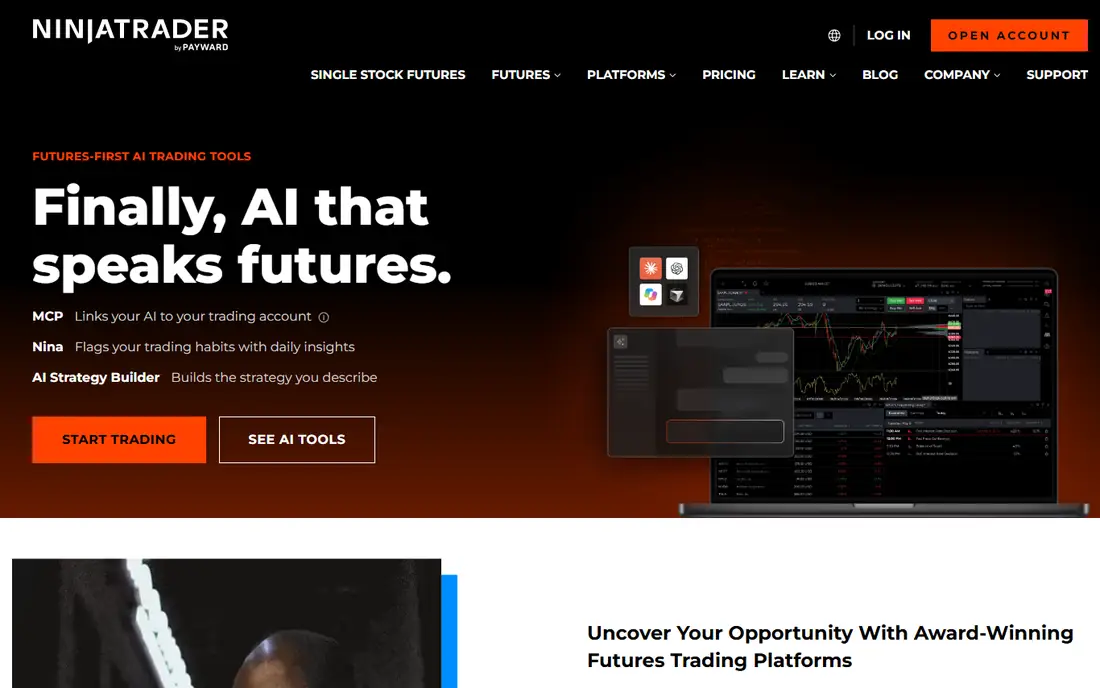
NinjaTrader is the reference point for serious retail futures traders, and its desktop platform explains why. Charts, order flow tools, and custom indicators can be arranged in detail, and traders who code can build and backtest strategies in C#. The free plan includes simulated trading, so you can learn order types and margin behaviour before funding a live account.
Pricing is tiered by plan rather than by account size alone. The free plan charges $1.29 per side on standard contracts and $0.39 per side on micros, while the $99 per month plan cuts those to $0.99 and $0.29, and a $1,499 lifetime licence cuts them further to $0.59 and $0.09. Exchange, clearing, and NFA fees apply on top. High volume traders can justify the paid plans quickly, while occasional traders are usually better on the free plan.
What we like- Free unlimited simulated trading
- Deep charting and C# strategy development
- $50 intraday margins on micros
Watch out for- Desktop software can feel heavy on older computers
- No stocks, ETFs, or equity options in the brokerage account
- Market data fees apply separately
Starting priceFree platform, $1.29 per side on standard contracts
Free planFree trial
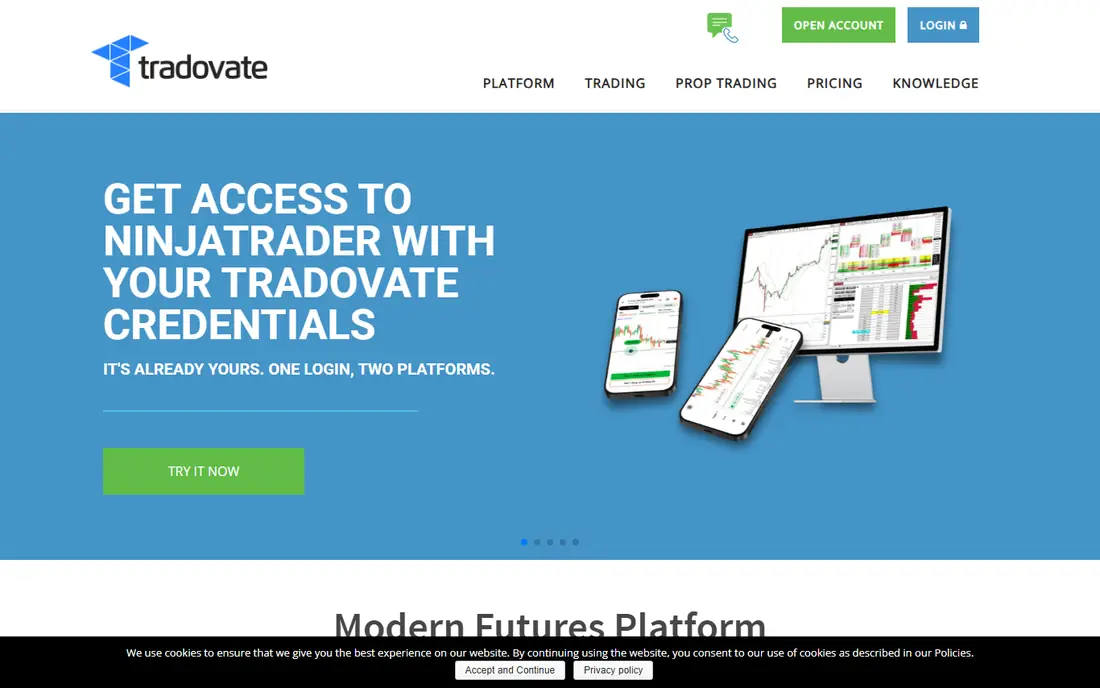
Tradovate suits a trader who wants to open a browser or phone and trade, rather than manage a desktop install. Because NinjaTrader owns Tradovate, the two share brokerage infrastructure and pricing tiers, and one login works across both front ends. That makes Tradovate a practical second screen for a NinjaTrader account holder, or a simpler first platform for a new futures trader.
The trade off is depth. Tradovate covers core charting, order entry, and replay well, but it does not match the desktop platform for custom indicators and strategy coding. If you trade from several devices, travel often, or use a Mac as your main computer, that portability outweighs the missing depth. If you automate strategies, start with NinjaTrader Desktop instead.
What we like- Web and mobile access with no desktop install
- Same brokerage pricing as NinjaTrader
- Market replay for reviewing past sessions
Watch out for- Charting depth is below NinjaTrader Desktop
- Some advanced automation features are limited
- Data fees still apply
Starting price$1.75 per side on standard contracts at low volume
Free planFree trial
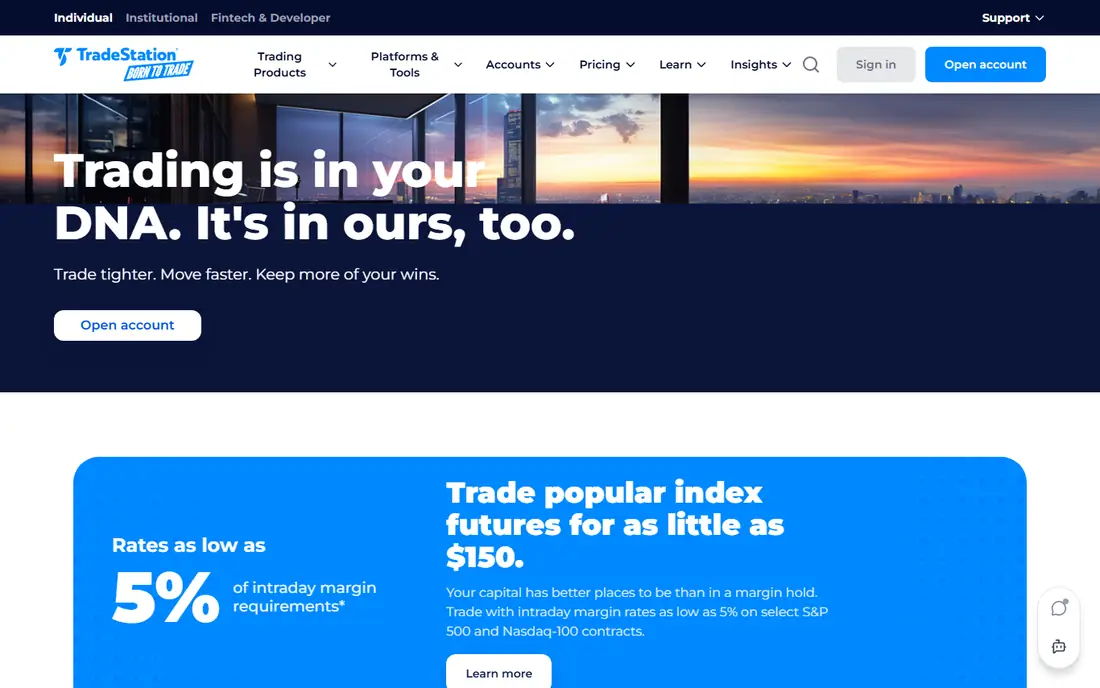
TradeStation appeals to a trader who does not want a futures only account. You can hold stocks, options, and futures together, build strategies in EasyLanguage, and use the same research and charting tools across asset types. Futures commissions start at $1.75 per side for standard contracts at 0 to 500 contracts per month, falling to $0.50 per side above 10,000 contracts, with micro contracts from $0.50 down to $0.25 per side.
That breadth costs more at low volume than NinjaTrader or Tradovate, and TradeStation charges a $35 annual IRA fee in some cases. It is still a sensible pick when futures are one part of a wider trading plan, or when EasyLanguage automation matters more than saving a few cents per contract. Pure futures traders on a tight budget will usually find a lower all in cost elsewhere.
What we like- Stocks, options, and futures in one account
- EasyLanguage for strategy building
- Strong desktop and web platforms
Watch out for- Futures commissions start higher than specialist brokers
- IRA annual fee applies to some accounts
- Margin rates are high at small balances
Starting priceSee website
Free planFree trial
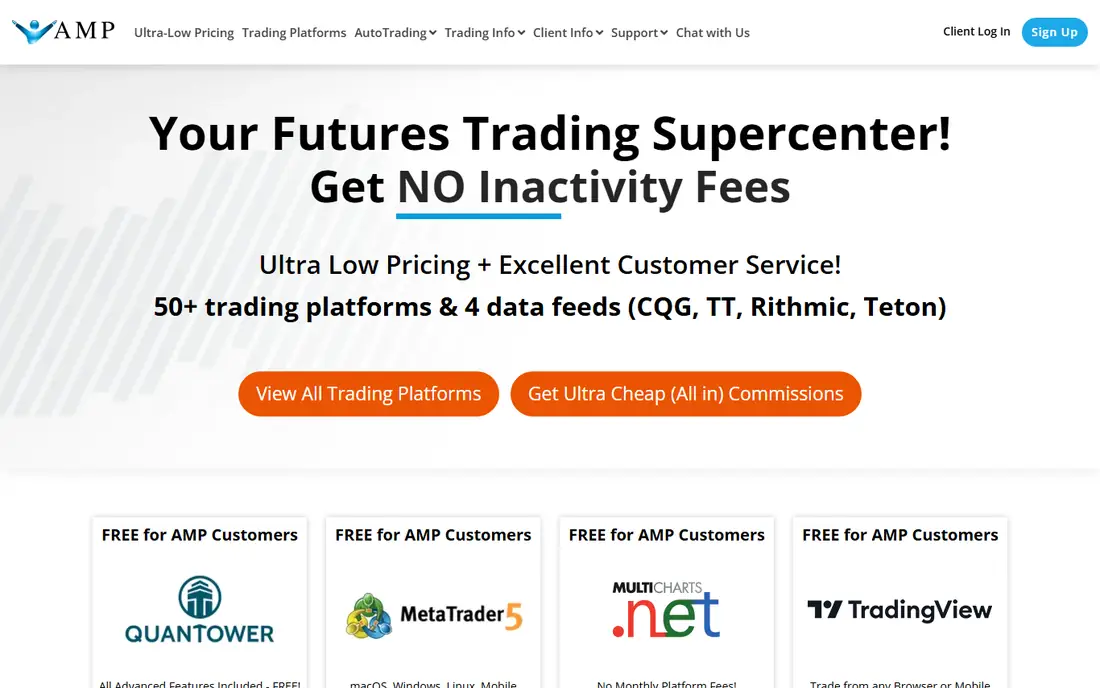
AMP Futures is less a single platform and more a brokerage that lets you pick your front end. Traders can connect through NinjaTrader, Tradovate, Rithmic, CQG, and other platforms, which means you are not locked into one charting style. The minimum balance to maintain a live data connection is $100, and day trade margins start at $50 on micros and $500 on E-minis in published comparisons.
That flexibility requires homework. Commission, data, and platform fees depend on the combination you choose, so two AMP traders can pay different totals for the same contract. Ask for a written quote for your exact platform, data feed, and contract before funding. If you already know which platform you like, AMP is a low friction way to trade it with a small account.
What we like- Wide choice of third party platforms including NinjaTrader and Tradovate
- $100 minimum to maintain a live data connection
- Low day trade margins
Watch out for- Pricing varies by platform and data feed, so quotes need checking
- Introducing broker model means clearing sits with a partner
- Support quality varies by platform
Starting price$0.75 per side on E-mini contracts
Free planFree trial
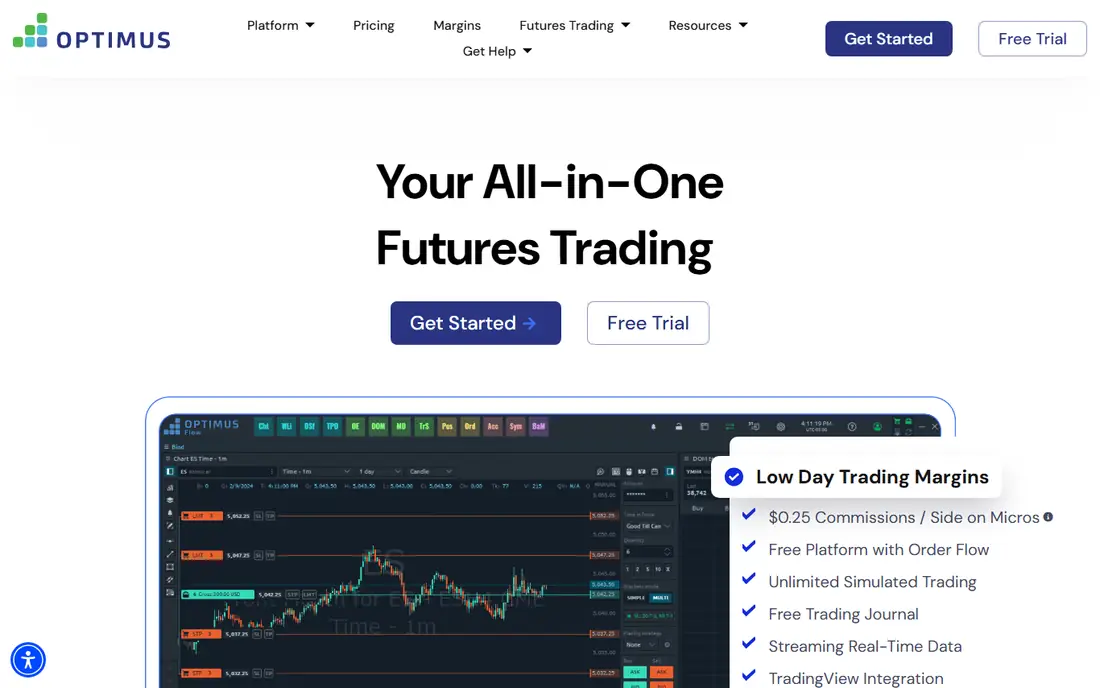
Optimus Futures keeps its pitch simple: no monthly platform fee, commissions from $0.25 per side on micros and $0.75 per side on E-minis, with volume discounts down to $0.05 per side for high volume traders. It offers its own Optimus Flow, web, and mobile platforms, plus TradingView, Sierra Chart, and more than 20 platforms in total. Day trade margins start at $50 on micros and $500 on E-minis.
The minimum balance is $500 for micros and $2,000 for E-minis or standard contracts, which is higher than AMP or NinjaTrader for a first account. Free real time Level 1 data is tied to trading activity in some cases, so an infrequent trader should confirm data costs before assuming they are free. For a regular trader who wants low commissions without a platform subscription, Optimus is a strong, focused choice.
What we like- No monthly platform fees
- Commissions from $0.25 per side on micros
- Its own Optimus Flow, web, and mobile platforms plus third party options
Watch out for- Minimum balance is $500 for micros and $2,000 for E-minis
- Level 1 data is free only with 10 or more trades per month in some cases
- Smaller brand than the largest brokers
Starting priceSee website
Free planFree trial
Cannon Trading is the pick on this list for a trader who wants to talk to a person. The firm has served commodity and futures traders from Los Angeles since 1988, and its Series 3 brokers help with platform setup, order routing, and risk questions. Self directed traders get lower commissions, while broker assisted clients pay for advice and support. Platforms include CQG Trader, R Trader Pro, and several other front ends, most with a free trial.
The main drawback is transparency at first glance. You will need to contact Cannon for a firm commission quote for your platform and volume, rather than reading a single published table. That extra step is worth it if you trade physical commodities, want broker guidance, or prefer phone support over chat. If you want instant online pricing and a modern app, a specialist platform broker will feel faster.
What we like- In business since 1988 with licensed commodity brokers
- Many platform choices
- Educational material for beginners
Watch out for- Pricing is not published as a simple rate card on the homepage
- Website feels dated compared with newer brokers
- Platform choice can overwhelm a new trader
#7Charles Schwab
Best for: thinkorswim users who also trade futures1.5/5 on
Trustpilot (786 reviews, checked Oct 2026)
Visit schwab.com
Starting price$2.25 per contract
Free planFree trial
Schwab suits an investor who already uses thinkorswim for stocks and options and wants to add futures without opening a second brokerage account. Futures cost $2.25 per contract, which is well above specialist futures pricing, but the convenience, research, and retirement account range can justify it for occasional futures trades. Paper trading in thinkorswim lets you practise futures order types before risking capital.
Do not pick Schwab as a primary futures broker if cost per contract is your main concern. A trader placing dozens of contracts a month will save a meaningful sum at NinjaTrader, Tradovate, or Optimus. Pick Schwab when futures are occasional, when you value one account for many asset types, or when thinkorswim is already your daily platform.
What we like- Thinkorswim charting and paper trading
- Stocks, options, bonds, and futures in one account
- Large branch and support network
Watch out for- Futures commission is higher than specialist brokers
- Margin rates are high at small balances
- Futures are a side feature, not the main focus
How we chose
We compared published commission schedules, intraday margin tables, platform lists, and simulation offers, and we read public reviews on G2, Capterra, and Reddit for recurring issues with data fees, support, and withdrawals. We kept only brokers and platforms that offer US futures trading to retail traders today, publish a commission or margin schedule, and provide a simulation or paper trading option. We mixed specialist futures brokers with multi asset brokers, so a dedicated futures trader and a stock trader adding futures can each find a fit.
Compare the round turn cost, not the headline rate
Add broker commission, exchange fees, clearing fees, and NFA fees for both sides of a trade. A $0.85 per side rate becomes about $1.70 plus pass through fees per round turn, and the gap between brokers narrows once those fees are included. Ask each broker for an all in example for the exact contract you trade most, such as Micro E-mini S and P 500 or E-mini Nasdaq.
Match margin to your account size
Intraday margins of $50 on micros let a small account trade, but they also mean a small move can use a large share of your capital. Overnight margins are much higher, and brokers can raise margins around news events. Fund an account you can afford to lose, keep position size small while learning, and avoid holding a position on margin overnight until you understand overnight margin calls.
Use simulation until order types feel automatic
Every platform here offers simulation or paper trading. Practise market, limit, stop, and bracket orders, and check how the platform handles a fast market, a partial fill, and a position held past the session close. A platform that feels clear in simulation will save costly mistakes in a live market.
Frequently asked questions
What is the best futures trading platform for beginners?
Tradovate is a good starting point because it runs in a browser, shares NinjaTrader brokerage pricing, and includes market replay and simulation. NinjaTrader Desktop suits a beginner who plans to learn charting in depth, while Optimus Futures suits a beginner with at least $500 who wants low commissions without a platform fee.
How much money do I need to trade futures?
You can open some futures accounts with no minimum deposit, but you still need enough to cover intraday margin and a buffer for losses. Micro contracts start at $50 intraday margin at several brokers here, while E-mini contracts start at $500. A $500 to $2,000 starting balance gives a micro trader room to learn without risking a margin call on the first trade.
Are futures commissions per side or per round turn?
Most brokers quote per side, meaning one buy or one sell. A round turn, one buy plus one sell, costs twice the per side rate plus exchange, clearing, and regulatory fees on both sides. Always confirm whether a quoted figure is per side or round turn before comparing brokers.
Can I trade futures on my phone?
Yes. Tradovate, NinjaTrader, Optimus Futures, and TradeStation all offer mobile apps, and Schwab offers futures in thinkorswim mobile. Mobile trading suits monitoring and simple orders, but complex charting and automation are easier on desktop or web.
What is the difference between a futures broker and a futures platform?
A broker holds your account, clears trades, and sets margins and commissions. A platform is the software you use to chart and place orders. Some firms, such as NinjaTrader and TradeStation, provide both. Others, such as AMP Futures and Cannon Trading, let you choose a third party platform while they act as your broker.
Is futures trading risky?
Yes. Futures use margin, so losses can exceed your deposit, and prices can move fast around economic news. This is not financial advice. Start with simulation, trade micro contracts, use stop orders, and only risk capital you can afford to lose.
Sources we checked (7)
- https://www.ninjatrader.com
- https://www.tradovate.com
- https://www.tradestation.com
- https://www.ampfutures.com
- https://www.optimusfutures.com
- https://www.cannontrading.com
- https://www.schwab.com
Is your product missing or out of date?
We review this list regularly. Vendors can request a listing, send updated pricing or ask about featured placement.

Shihab Mia · Founder, Rankite
Shihab has 5+ years in B2B and SaaS SEO. He writes Rankite's software buying guides from pricing pages, documentation and public user reviews. More about Shihab.