How we make this list: we compare pricing pages, product documentation and public user reviews. Rankite is independent; if a vendor ever pays for a featured spot, that listing is clearly labeled Partner.
Key takeaways
- Aplos publishes pricing on its own pricing page: Lite at $79/month, Core at $129/month, and Advanced at $229/month, each including unlimited customer support.
- MoneyMinder charges one flat $299/year with a 30-day free trial that needs no credit card, built for volunteer treasurers.
- MIP Fund Accounting tracks unlimited funds across 25 modules covering payroll, HR, grants and fixed assets, with quote-based pricing.
- Araize FastFund advertises free support and onboarding, no setup fees, and cancel-anytime terms on its homepage.
Quick comparison
| Tool | Best for | Starting price | Free plan |
|---|
 MIP Fund Accounting MIP Fund Accounting | Grant-heavy nonprofits, government agencies and schools | See website | No |
 Blackbaud Financial Edge NXT Blackbaud Financial Edge NXT | Large nonprofits already using Blackbaud fundraising products | See website | See website |
 Aplos Aplos | Small to midsize nonprofits and churches that want true fund accounting without enterprise complexity | $79/month | Free trial |
 Sage Intacct Sage Intacct | Growing and multi-entity nonprofits that need dimensional reporting | See website | See website |
 AccuFund AccuFund | Nonprofits and government agencies wanting a modular, economical system | See website | No |
 Araize FastFund Araize FastFund | Small to midsize nonprofits wanting accounting, payroll and fundraising in one system | See website | See website |
 Fund EZ Fund EZ | Budget-conscious small to midsize nonprofits that want control of their data | See website | See website |
 Xledger Xledger | Mid-market nonprofits that want a unified cloud finance system | See website | See website |
 MoneyMinder MoneyMinder | Volunteer treasurers, PTAs, clubs and very small nonprofits | $299/year | Free trial (30 days) |
 CenterPoint CenterPoint | Small nonprofits and municipalities that prefer on-premise software | See website | See website |
Is your product missing or out of date?
We review this list regularly. Vendors can request a listing, send updated pricing or ask about featured placement.
The best fund accounting software
Most nonprofits pick accounting software the way they pick a printer, by price, and regret it the way they regret a printer, every month for years. Fund accounting is not regular accounting with a nonprofit logo. You need to track restricted and unrestricted dollars separately, prove to grantors that money went where it was supposed to, and produce FASB-compliant statements your auditor will not argue with. The ten tools below span the real market, from volunteer-treasurer simple to enterprise-grade.
#1
MIP Fund Accounting
Best for: Grant-heavy nonprofits, government agencies and schools
Visit mip.com
Starting priceSee website
Free planNo
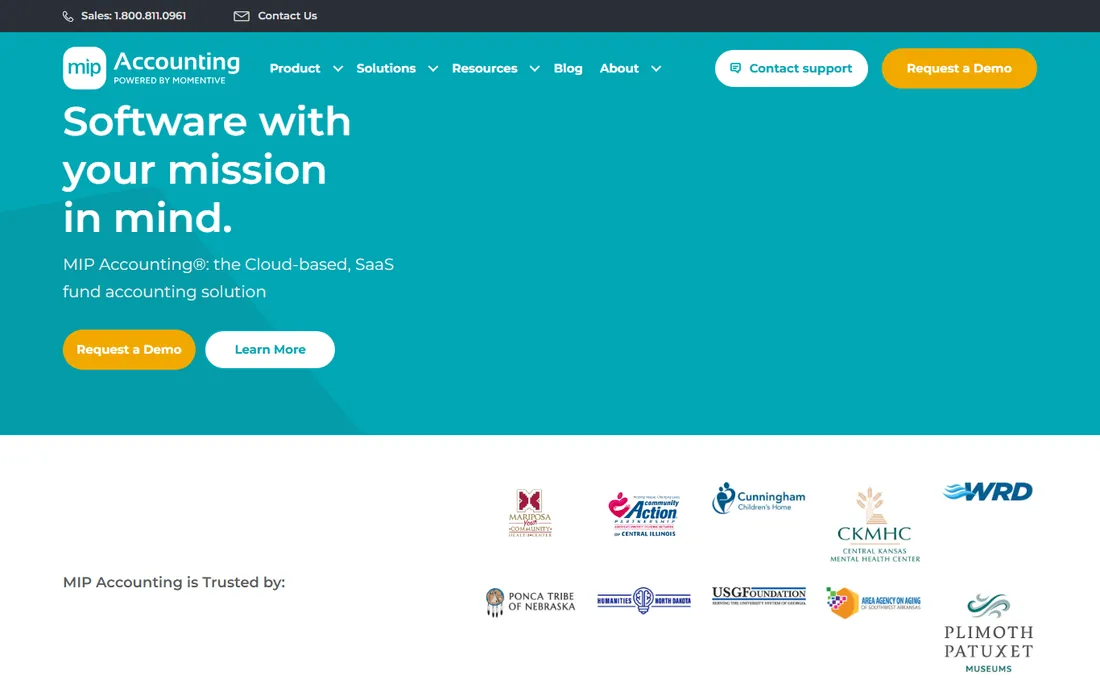
MIP Fund Accounting from Community Brands is the product other fund accounting tools get compared against, and it has been in the category since 1982. The core promise is depth: unlimited funds, advanced audit reporting, fraud deterrence, encumbrance accounting and a table-driven chart of accounts you can segment to match your organization.
The honest trade-off is complexity and cost structure. Pricing is custom, and payroll, HR, EFT, purchasing and several reporting integrations are sold as add-ons rather than bundled, which means the entry price and the real price can differ substantially. Reviewers also describe a real learning curve, especially around reporting, though the vendor counters with webinars, guides and training. Support quality gets praised when you have it, but multiple reviewers note that advanced help costs extra. If you manage federal grants or multiple restricted funding streams, MIP's depth is worth the evaluation. If you are a ten-person nonprofit, start further down this list.
What we like- Tracks unlimited funds with true fund accounting
- 25 modules covering payroll, HR, grants and fixed assets
- Cloud, on-premise or self-hosted deployment options
Watch out for- Quote-based pricing with add-on modules that add up
- Reviewers consistently flag the learning curve on reporting
#2
Blackbaud Financial Edge NXT
Best for: Large nonprofits already using Blackbaud fundraising products
Visit blackbaud.com
Starting priceSee website
Free planSee website
Blackbaud Financial Edge NXT is the heavyweight option for large social-impact organizations. It is a cloud fund accounting platform built specifically for nonprofits, with general ledger, accounts payable, cash management, budget management, allocation management and projects, grants and endowments. The killer feature is the ecosystem: it connects natively with Raiser's Edge NXT for fundraising, so development and finance stop reconciling two systems by hand.
The catch is that this is enterprise software in every sense. Pricing is quote-based and typically runs into five figures annually, implementation is delivered by Blackbaud's own services team, and the platform assumes you have finance staff. Small nonprofits will drown in it. For organizations with $5 million-plus operating budgets and complex restricted funding, though, it is the standard for a reason. If your nonprofit already lives in Blackbaud's world, the integration alone usually settles the decision.
What we like- Deep integration with Raiser's Edge NXT and the Blackbaud suite
- Purpose-built fund accounting with grants, endowments and projects
- 14 pre-built dashboards for quick financial snapshots
Watch out for- Enterprise pricing and implementation
- Complexity overwhelms small organizations
#3
Aplos
Best for: Small to midsize nonprofits and churches that want true fund accounting without enterprise complexity
Visit aplos.com
Starting price$79/month
Free planFree trial
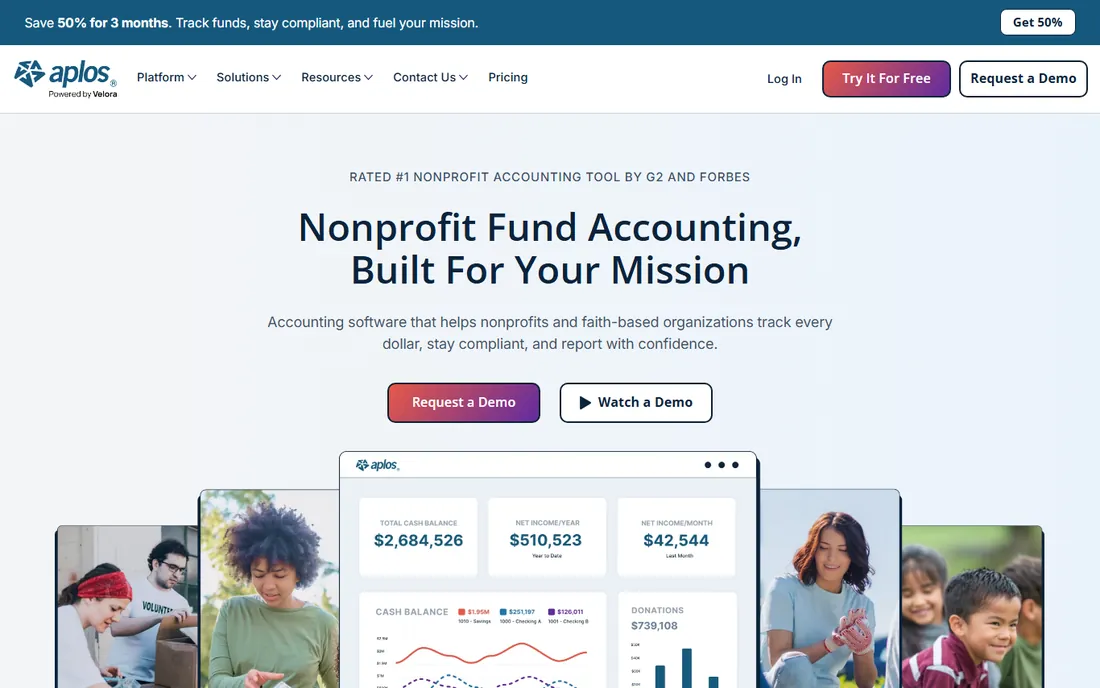
Aplos is the friendliest true fund accounting platform on this list. It tracks restricted and unrestricted funds separately, produces balance sheets and income statements by fund, and handles donation tracking, giving statements, event registration and online giving in the same system. The interface is built for people who did not study accounting, and the company has a long-standing offer of six months free for nonprofits founded in the past year.
Pricing is refreshingly public. Lite runs $79/month for two users with core fund reports, bank reconciliation and custom reports. Core is $129/month and adds budgeting, AP/AR, recurring transactions and user roles. Advanced starts at $229/month, adding budgeting by fund or grant and dimensional reporting, with custom plans above $1 million in revenue. The honest limit is scale: reviewers praise the approachability but note thinner advanced features and occasional renewal increases, and third-party fundraising integrations sometimes need manual fixes. For a church, arts group or small nonprofit, it is the value pick.
What we like- Published pricing starting at $79/month with unlimited support included
- Designed for non-accountants with a 15-minute setup wizard
- Donor management and online giving built in
Watch out for- Advanced features like dimensional reporting require the $229/month Advanced tier
- Larger nonprofits may outgrow it
#4
Sage Intacct
Best for: Growing and multi-entity nonprofits that need dimensional reporting
Visit sageintacct.com
Starting priceSee website
Free planSee website
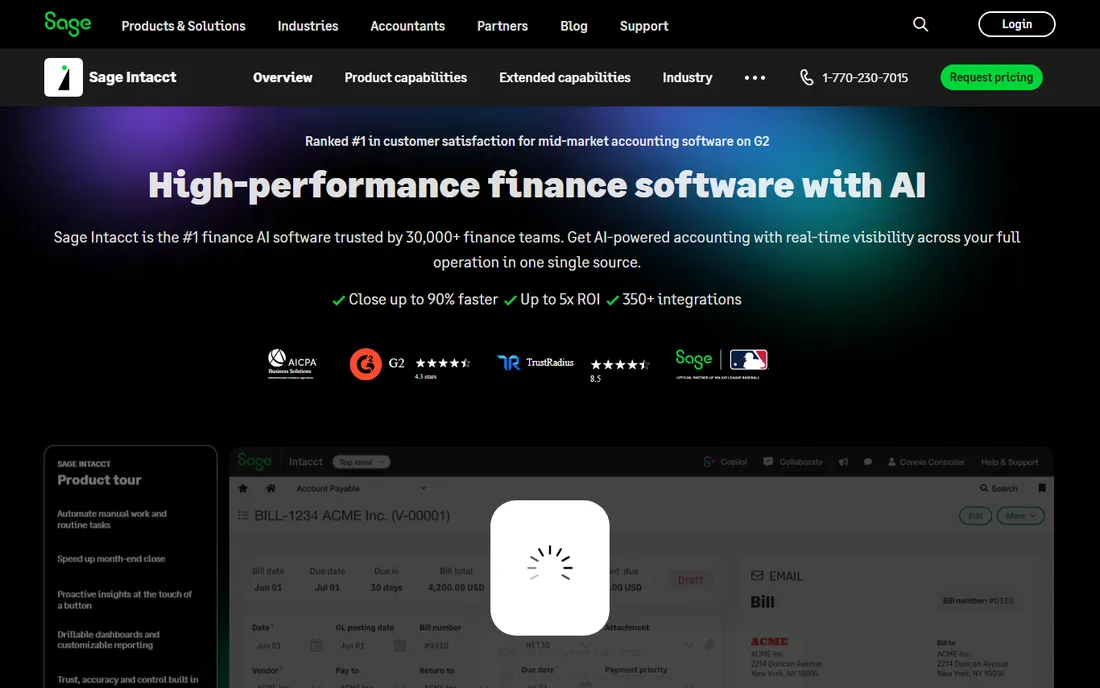
Sage Intacct is the cloud financial management platform nonprofits graduate to when QuickBooks-style tools run out of room. Its dimensional general ledger lets you tag transactions by fund, grant, program, location and department without exploding your chart of accounts, and multi-entity consolidations run with push-button aggregation across entities, currencies and locations. Grant tracking and billing is a dedicated module: you associate entries with grants, flag reimbursable costs at entry, bill indirect costs at negotiated rates, and report budget-to-actuals even when grant periods cross your fiscal year.
The platform is the AICPA-preferred cloud solution for nonprofits and carries strong G2 satisfaction ratings, including a 2026 TrustRadius Buyer's Choice award. Sage Copilot, its AI assistant, is now included for asking questions and automating routine work. The trade-offs are familiar for this tier: pricing is quote-based and modules add up, and most buyers implement through a Sage partner, which adds services cost. If your nonprofit spans multiple entities, grants and locations, this is the most capable cloud option short of a full ERP.
What we like- Dimensional general ledger built for multi-entity consolidations
- Strong grant tracking and billing with automated revenue recognition
- Ranked #1 in nonprofit customer satisfaction on G2
Watch out for- Quote-based pricing that climbs with modules
- Implementation typically needs a partner
#5
AccuFund
Best for: Nonprofits and government agencies wanting a modular, economical system
Visit accufund.com
Starting priceSee website
Free planNo
AccuFund has served nonprofits and government agencies for decades with a straightforward proposition: more sophistication than off-the-shelf accounting, far less cost and complexity than the enterprise tier. The Accounting Suite covers general ledger, accounts payable, cash receipts, bank reconciliation, payroll, HR and grants management, with modules you add as needed. AccuFund Anywhere is the browser-based version for organizations that want cloud access without replatforming.
The product is sold through value-added resellers, who also provide installation and training. Third-party listings cite a starting point around $2,995 one-time for the on-premise suite, with the cloud version historically priced per user per month, but confirm current numbers with a reseller. Reviewers rate it well for value and customer service, with the consistent complaint being an interface that shows its age. If your organization wants proven fund accounting, on-premise control, and a price well below MIP or Blackbaud, AccuFund deserves a look.
What we like- Modular suite so you buy only what you need
- Available as on-premise or browser-based cloud
- Integrates with DonorPerfect, Salesforce, Docusign and Dropbox
Watch out for- No public pricing
- Dated interface compared with cloud-native competitors
- Sold through resellers, which adds a layer to support
#6
Araize FastFund
Best for: Small to midsize nonprofits wanting accounting, payroll and fundraising in one system
Visit araize.com
Starting priceSee website
Free planSee website
FastFund from Araize (in business since 1985) is built specifically for nonprofits, and the homepage makes the commercial terms unusually clear: free support and onboarding, no setup fees, cancel anytime. The platform combines true fund accounting, grant tracking and budgeting with payroll that allocates by fund, grant or program, plus a fundraising module with donor management, pledges, events and payment processing. Reports comply with FASB 116 and 117 out of the box, including multi-year reports and budgets, which matters for audit readiness.
The honest weaknesses: Araize does not publish pricing, so you will need a demo and a quote, and reviewers say the system assumes some accounting knowledge, with a real learning curve at the start. There is also no native mobile app. For a small nonprofit that wants one vendor for the books, payroll and donor management, it is a practical all-in-one.
What we like- Integrated accounting, payroll and fundraising in one cloud platform
- Free support and onboarding with no setup fees
- True fund accounting with FASB 116/117 compliant reporting
Watch out for- Pricing is not published
- Reviewers note a learning curve for users without accounting background
- No native mobile app
#7
Fund EZ
Best for: Budget-conscious small to midsize nonprofits that want control of their data
Visit fundez.com
Starting priceSee website
Free planSee website
Fund EZ from FUND E-Z Development has been doing nonprofit accounting since 1991, and its reputation rests on two things: ease of use and price. The software uses a nonprofit chart of accounts that tracks programs, funding sources, grants, sites and departments, with transactions splittable across segments and financials printable by segment or segment combination. Data integrity features include forced balancing rules, batch posting for review before posting, and audit trails tracking every change.
The product comes in Standard and Pro editions, with Pro adding a customizable chart of accounts, balance sheets and custom reports, and it is available both cloud-hosted and on-premise. Pricing is not published on the site, though third-party listings cite around $125/month for the cloud Standard edition with one user. The trade-offs are a dated look and a smaller ecosystem than the big names. For a small nonprofit that wants dependable fund accounting with real audit controls at a modest price, it has a loyal following for a reason.
What we like- Logical, easy-to-navigate interface praised by small nonprofits
- Cloud-hosted and on-premise options with different pricing models
- Strong audit features including forced balancing and full audit trails
Watch out for- No published pricing
- The interface looks dated next to modern cloud tools
- Smaller vendor with a thinner integration ecosystem
#8
Xledger
Best for: Mid-market nonprofits that want a unified cloud finance system
Visit xledger.com
Starting priceSee website
Free planSee website
Xledger is a cloud ERP rather than a pure fund accounting tool, and that is its appeal for nonprofits that have outgrown bookkeeping software but do not want the Blackbaud price tag. The platform handles unlimited transaction volumes, multi-entity structures with real-time in-system consolidation, multi-currency, and fund accounting with donor management, all in one system. Because it is a unified cloud product, there is no Excel-based consolidation and no stack of add-ons to keep in sync.
Implementation is handled with Xledger's consultants, and the system is designed to be configured rather than customized. Pricing is quote-based. The honest catch is fit: if you only need fund accounting for a single entity, Xledger's ERP breadth is more than you need, and its nonprofit-specific depth is thinner than MIP's or Blackbaud's. For a mid-market nonprofit with multiple entities or international operations, it is a strong alternative.
What we like- True-cloud ERP with unlimited transaction volumes
- Real-time multi-entity consolidation without Excel
- Strong charity-sector presence in the UK with fund reporting focus
Watch out for- Quote-based pricing
- Broader ERP scope than pure fund accounting, so implementation is a project
- Less nonprofit-specific depth than MIP or Blackbaud
#9
MoneyMinder
Best for: Volunteer treasurers, PTAs, clubs and very small nonprofits
Visit moneyminder.com
Starting price$299/year
Free planFree trial (30 days)
MoneyMinder is the anti-enterprise option, and proud of it. Built by treasurers for treasurers, it gives volunteer-run groups one simple system for bookkeeping, budgeting, dues, donations, reimbursements, contacts and compliance, with one-click treasurer reports and audit-ready financials. The company has served volunteer treasurers for over 23 years.
The pricing is the whole pitch: $299 per year, flat, with unlimited users, free setup, included support and no hidden fees. The 30-day trial asks for no credit card. The honest limit is scope: MoneyMinder handles restricted and reserved funds, but it is not a replacement for MIP or Sage Intacct once you have grants, multiple entities or audit complexity. For a PTA, booster club, small church or association with straightforward finances, it is the obvious pick.
What we like- One flat $299/year with unlimited users and no per-seat fees
- 30-day free trial with no credit card required
- Built specifically for non-accountants with treasurer reports
Watch out for- Not a full fund accounting system for larger organizations
- Limited advanced features like dimensional reporting
- Best for simple finances
Starting priceSee website
Free planSee website
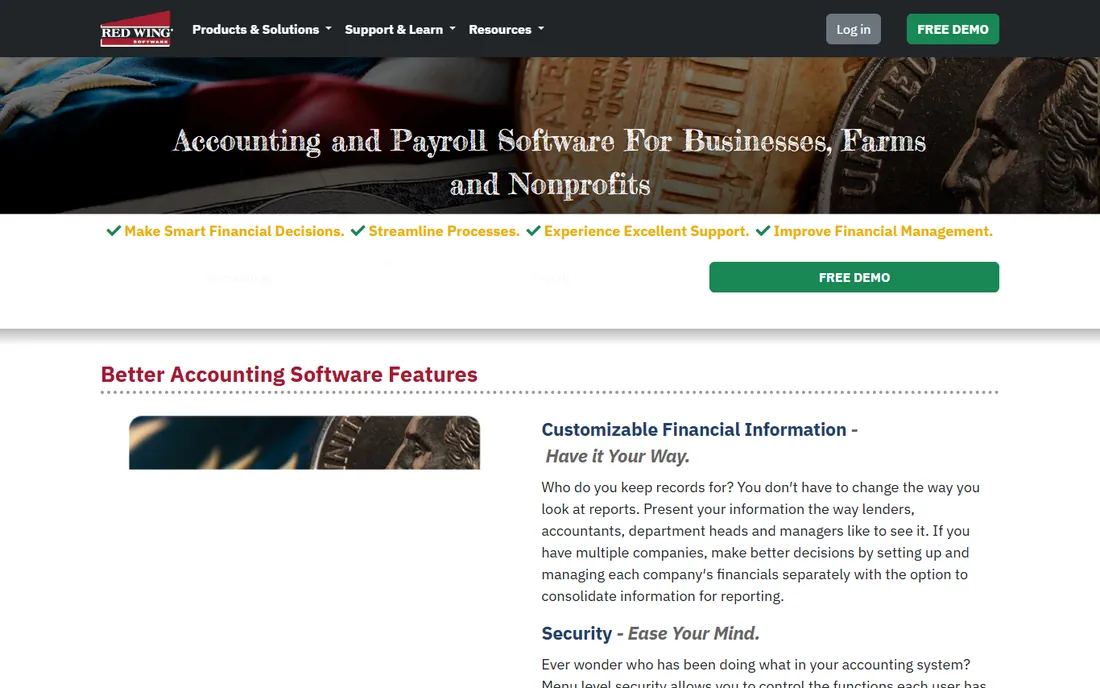
CenterPoint Fund Accounting from Red Wing Software (founded 1979, based in Minnesota) is the on-premise answer for small to midsize nonprofits and municipalities. It tracks income and expense by fund, department and location, with budget-vs-actual reporting, ratio analysis, purchase order management and a strong audit trail.
The defining characteristic is deployment: this is Windows desktop software, with no web or mobile access. For organizations that want their data on their own machines, or that operate where internet access is unreliable, that is a feature. For everyone else, it is the main drawback. Pricing is available by contacting the vendor directly. A Customer Care Membership is required for downloads and updates. If your nonprofit is outgrowing QuickBooks but your board will not put financials in the cloud, CenterPoint is one of the few serious on-premise options left.
What we like- On-premise control with a customizable interface
- Strong budget-vs-actual and departmental reporting
- Integrated payroll module from the same vendor
Watch out for- No cloud or mobile access
- Pricing requires contacting the vendor
- Windows-only desktop software
How to pick fund accounting software without overbuying
Match the software to your organization's actual complexity, not its aspirations. A volunteer-run group with dues and donations should be looking at MoneyMinder at $299/year, not sitting through enterprise demos. A small nonprofit with restricted grants and an audit coming up fits Aplos at $79 to $229/month or Fund EZ or FastFund. Multi-entity organizations, government agencies and nonprofits managing federal grants belong in the MIP, Blackbaud, Sage Intacct or Xledger conversation, where quote-based pricing reflects real implementation work.
Then verify three practical things. First, restricted fund tracking: can the system separate restricted and unrestricted dollars, enforce donor intent, and produce the statement of activities, statement of financial position and Form 990 schedules your auditor expects. Second, the deployment and data model: cloud versus on-premise, per-user versus flat pricing, and who owns your data if you leave. Third, the total first-year cost: license or subscription plus implementation, training, data migration and any required add-on modules. For MIP and Blackbaud especially, the module list is where budgets surprise people.
Mistakes nonprofits make when buying accounting software
The most expensive mistake is buying for the finance director instead of the daily users. A system with every feature fails if the bookkeeper finds it unusable, and several tools on this list, MIP and AccuFund included, carry real learning curves that reviewers mention by name. Budget for training time, not just license cost, and ask each vendor how long onboarding actually takes.
The second mistake is ignoring the grant calendar. If your grants run on periods that cross your fiscal year, or you bill indirect costs at negotiated rates, you need grant tracking built in, not bolted on. Sage Intacct, MIP and Blackbaud handle this natively; lighter tools may not. The third is treating the cheapest quote as the cheapest system: per-user pricing, required modules and annual maintenance can turn a bargain into a burden by year two. Ask for the three-year total, in writing, before you sign.
How we chose
We built a longlist from nonprofit accounting roundups on Software Connect, Capterra, G2, SourceForge and SelectHub, then verified each vendor's site to confirm the product is current and genuinely serves fund accounting. Pricing comes only from vendor pricing pages (Aplos, MoneyMinder) or is marked as quote-based where vendors do not publish it. We checked public reviews for recurring strengths and complaints, favoring tools with clear nonprofit focus across sizes: volunteer groups, small nonprofits, mid-market organizations and large enterprises. No vendor paid for placement, and we did not run hands-on trials.
Frequently asked questions
What is fund accounting software?
Fund accounting software tracks money by its source and restriction rather than just by account. Nonprofits, churches, schools and government agencies use it to separate restricted donations and grants from unrestricted funds, prove to donors and grantors that money was spent as directed, and produce FASB-compliant financial statements. Regular accounting software can approximate this with classes or tags, but true fund accounting builds it into the ledger.
How much does fund accounting software cost?
It spans from $299/year flat (MoneyMinder) to $79-$229/month (Aplos) up to quote-based enterprise pricing for MIP, Blackbaud Financial Edge NXT and Sage Intacct, where first-year costs with implementation can reach five figures. Mid-range options like Fund EZ, FastFund and AccuFund sit between. Always ask for the three-year total including modules, implementation and training, not just the subscription.
Do small nonprofits really need fund accounting software?
If you take restricted donations or grants, yes, or something close to it. Even a small nonprofit needs to show donors that restricted gifts were spent correctly, and auditors expect proper fund tracking. Tools like MoneyMinder and Aplos Lite are priced for small organizations and far cheaper than fixing a failed audit. Spreadsheets work until the first restricted grant, then they become a liability.
Can QuickBooks handle fund accounting?
QuickBooks Online can approximate fund accounting with classes and locations, and many small nonprofits use it that way. But it is not true fund accounting: there is no native restricted-fund enforcement, grant compliance reporting is manual, and auditors often push back. If your nonprofit is growing into grants and audits, purpose-built tools like Aplos, MIP or Sage Intacct save pain later.
What is the difference between cloud and on-premise fund accounting?
Cloud systems (Aplos, Sage Intacct, MoneyMinder, Xledger) run in your browser with automatic updates and remote access, usually on subscription pricing. On-premise systems (CenterPoint, AccuFund's desktop version, MIP's on-premise option) run on your own computers, which some boards prefer for data control but means you handle updates, backups and remote access yourself. Most new buyers choose cloud.
How long does implementation take?
It ranges from same-day to several months. MoneyMinder and Aplos are designed for self-serve setup in hours or days. Mid-range tools like FastFund and Fund EZ typically take a few weeks with vendor help. Enterprise platforms like MIP, Blackbaud and Sage Intacct usually need one to three months including chart-of-accounts design, data migration and training. Ask each vendor for a written timeline.
Sources we checked (0)
Is your product missing or out of date?
We review this list regularly. Vendors can request a listing, send updated pricing or ask about featured placement.

Shihab Mia · Founder, Rankite
Shihab has spent more than a decade helping SaaS and e-commerce brands grow through search. He writes Rankite's software buying guides from pricing pages, documentation and public user reviews. More about Shihab.