How we make this list: we compare pricing pages, product documentation and public user reviews. Ratings come from G2, Capterra or Trustpilot, with the date we checked them.
What is FPGA design software and who should buy it?
FPGA design software turns a hardware description into a working chip configuration. You write RTL in VHDL, Verilog, or SystemVerilog, then the tool checks the code, synthesises it into logic, places and routes it on the target device, checks timing, and produces a bitstream that programs the FPGA. Most suites also include a simulator, a timing analyser, a pin planner, and on-chip debug tools, so you can test a design before you load it onto hardware.
Buyers fall into three groups. Hardware engineers at product companies need the full vendor flow for the chip family on their board, plus reliable timing closure and debug. Students and hobbyists need a free edition that supports a low cost board and a clear path from code to a blinking LED. Verification engineers need a strong simulator that can run large testbenches, check coverage, and debug failing tests fast.
For most buyers, AMD Vivado is the best FPGA design software, provided the design targets an AMD device. It is the default flow for 7 Series, UltraScale, UltraScale Plus, and Versal parts, and it bundles design entry, synthesis, implementation, simulation, and hardware debug in one install. The free BASIC tier covers 7 Series and low end UltraScale and UltraScale Plus devices, which is enough for many student, hobby, and small product designs.
If your board uses an Altera device, Quartus Prime is the equivalent pick. Its free Lite edition covers high volume families, while Standard and Pro add support for larger and newer families. Lattice Radiant is the best pick for low power Lattice designs, and it is free for many common devices. Microchip Libero SoC is the pick for PolarFire, IGLOO 2, and SmartFusion 2 designs, with a free Silver licence for smaller parts. Efinix Efinity and Gowin EDA serve their own low cost families, and both start free.
How much does FPGA design software cost in 2026?
Most FPGA design software costs nothing to start and charges only for larger devices or team features. The table below uses the entry point for each tool, checked on 21 November 2026. Quote means the vendor does not publish a list price and sells through sales or a distributor.
| Tool |
Starting price |
Free plan |
Best for |
Licence type |
| AMD Vivado |
0 dollars, CORE from 1,200 dollars per year |
BASIC tier free |
AMD FPGA and Versal designs |
Annual or perpetual |
| Altera Quartus Prime |
Quote, Lite free |
Lite edition free |
Altera FPGA and SoC designs |
Annual subscription |
| Lattice Radiant |
0 dollars, subscription quote |
Free licence, many devices |
Low power Lattice designs |
Free or subscription |
| Microchip Libero SoC |
0 dollars, Gold and Platinum by quote |
Silver licence free |
PolarFire and IGLOO 2 designs |
Annual licence |
| Efinix Efinity |
0 dollars |
Free licence |
Efinix Trion and Titanium designs |
Annual renewal |
| Gowin EDA |
0 dollars, one year on registration |
Education Edition free |
Low cost Gowin designs |
Annual licence |
| Aldec Active-HDL |
Quote, EDU from 150 dollars per seat per year |
Student Edition free |
Mixed language simulation |
Annual licence |
| Siemens Questa |
Quote, Starter editions free |
Starter editions free via vendors |
Large scale verification |
Annual licence |
The cheapest way to start is to install the free edition for your chip and build a small design end to end. That test shows whether the device support, simulation limits, and debug tools fit your work before you spend anything.
What will a small team pay in the first year?
A small team of three engineers can often start at zero licence cost and still ship a real product, if the device fits a free tier. Take a team building a sensor interface on a Lattice Certus-NX part. Radiant is free for that device, so the licence cost is zero, and the team spends its money on boards, a programmer, and engineering time instead. If the same team moves to a larger Lattice Avant part, Radiant needs a subscription, so the team should ask Lattice for a written quote before it commits to the part.
Now take a team of three on AMD UltraScale Plus parts. Full simulation and full debug need CORE at 1,200 dollars per year for a node locked seat, or 1,800 dollars per year for a floating seat, according to the AMD licensing page checked on 21 November 2026. Three node locked CORE seats cost 3,600 dollars in the first year, while three floating seats cost 5,400 dollars, A team on Versal parts needs PRO at 2,400 dollars per year node locked, so three seats cost 7,200 dollars in the first year.
How do I choose between a vendor suite and a separate simulator?
A vendor suite is required for synthesis, place and route, and bitstream generation for that vendor's chips. A separate simulator is optional, but it becomes important when your testbenches grow. Vendor simulators often limit design size, UVM support, or coverage features in the free tier. A separate simulator such as Questa or Active-HDL gives you stronger debugging, faster simulation, and mixed language support across projects, but it adds licence cost and a second tool to maintain. Choose the vendor suite first, then add a simulator only when you can name the problem it solves.
Quick comparison
| Tool | Best for | Starting price | Free plan |
|---|
 AMD Vivado | AMD FPGA and Versal designs, from student boards to data centre work | 0 dollars for BASIC; CORE from 1,200 dollars per year, node locked | BASIC free, annual renewal; covers 7 Series and low end UltraScale Plus |
 Altera Quartus Prime | Altera FPGA and SoC designs, including Agilex, Stratix 10, and Cyclone families | Quote for Standard and Pro editions; Lite edition free | Lite free, no licence file required; covers high volume device families |
 Lattice Radiant | Low power Lattice designs on iCE40 UltraPlus, Certus-NX, and MachXO5-NX parts | 0 dollars for the free licence; subscription quote for larger devices such as Avant | Free licence for many devices; full bitstream for supported parts, evaluation mode for larger parts |
 Microchip Libero SoC | Microchip PolarFire, PolarFire SoC, IGLOO 2, SmartFusion 2, and RTG4 designs | 0 dollars for the Silver licence; Gold and Platinum by quote via microchipDIRECT | Silver licence free with annual renewal; limited device and IP support |
 Efinix Efinity | Efinix Trion and Titanium designs in cost sensitive and edge products | 0 dollars for a free licence; kit purchase includes a licence with one year of upgrades | Free licence for the full RTL to bitstream flow; updates for one year, free renewal on request |
 Gowin EDA | Low cost Gowin designs on Tang and GW1N, GW2A, and GW5A parts, for students and makers | 0 dollars for a one year free licence on registration; Education Edition free | Education Edition free, fewer devices and IP cores; Standard Edition free for one year on registration |
 Aldec Active-HDL | Mixed language FPGA design entry and simulation in Windows based team environments | Quote for commercial licences; EDU from 150 dollars per seat per year for one seat | Student Edition free for coursework; free evaluation copies available on request |
 Siemens Questa | Large scale HDL verification, UVM testbenches, coverage closure, and debug for FPGA and SoC teams | Quote for full Questa licences; Starter editions free via FPGA vendors, zero cost licence | Questa Intel FPGA Starter Edition free, zero cost licence; QuestaSim Lattice Edition included with Radiant |
Is your product missing or out of date?
We review this list regularly. Vendors can request a listing, send updated pricing or ask about featured placement.
These eight tools cover every current FPGA family, from free vendor suites to full verification platforms.
#1
AMD Vivado
Best for: AMD FPGA and Versal designs, from student boards to data centre work
Visit amd.com
Starting price0 dollars for BASIC; CORE from 1,200 dollars per year, node locked
Free planBASIC free, annual renewal; covers 7 Series and low end UltraScale Plus
AMD Vivado is the standard design suite for AMD FPGAs and adaptive SoCs, and it is the first tool to install if your board uses a 7 Series, UltraScale, UltraScale Plus, or Versal part. The new tiered licensing model starts with the 2026.1 release, and AMD lists BASIC at zero cost, CORE at 1,200 dollars per year node locked, PRO at 2,400 dollars per year node locked, and ENTERPRISE at 4,395 dollars perpetual node locked, checked on 21 November 2026.
What we like- Single install for synthesis, simulation, and debug
- Strong timing analysis
- Wide IP catalogue
Watch out for- Free tier limits simulation and debug
- Install is large and needs a powerful workstation
#2
Altera Quartus Prime
Best for: Altera FPGA and SoC designs, including Agilex, Stratix 10, and Cyclone families
Visit altera.com
Starting priceQuote for Standard and Pro editions; Lite edition free
Free planLite free, no licence file required; covers high volume device families
Altera Quartus Prime is the design suite for Altera FPGAs, now sold by Altera after its separation from Intel, and it remains the only full synthesis and place and route flow for Agilex, Stratix 10, Arria 10, and Cyclone parts. The suite offers three editions. Lite is free and suits high volume families. Standard supports earlier families plus Cyclone 10 LP and MAX 10. Pro supports the newest families and the latest performance features.
What we like- Clear edition split for old and new families
- Platform Designer for system integration
- Free Questa Starter Edition
Watch out for- No current list price for Standard or Pro, so buyers need a distributor quote
- Pro install is large
#3
Lattice Radiant
Best for: Low power Lattice designs on iCE40 UltraPlus, Certus-NX, and MachXO5-NX parts
Visit latticesemi.com
Starting price0 dollars for the free licence; subscription quote for larger devices such as Avant
Free planFree licence for many devices; full bitstream for supported parts, evaluation mode for larger parts
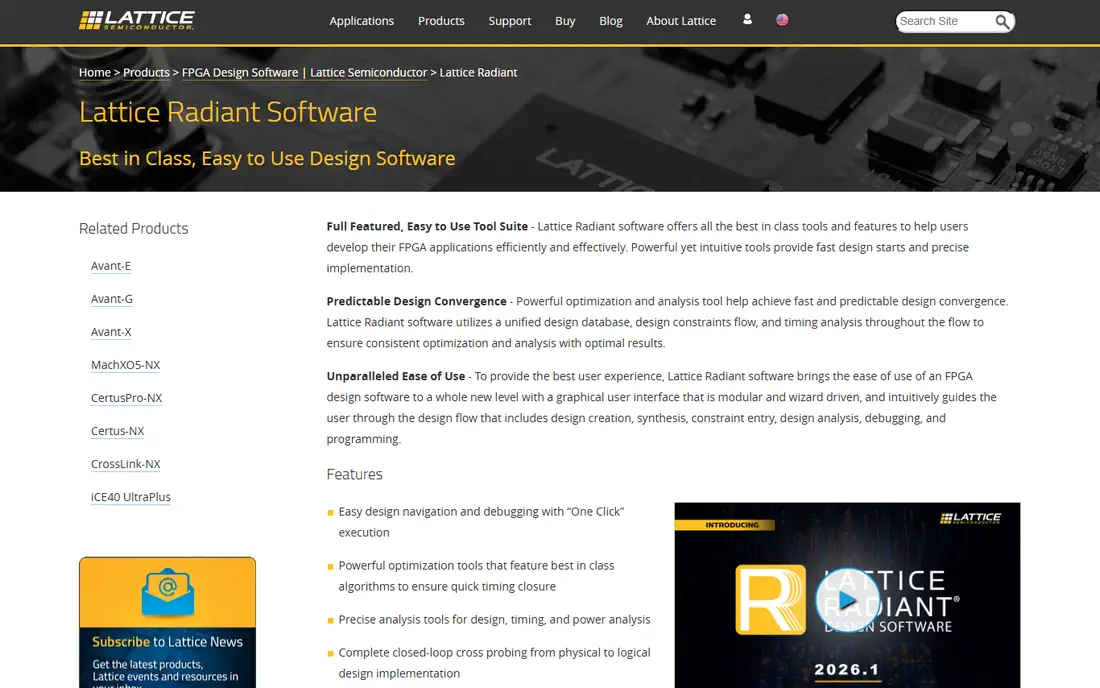
Lattice Radiant is the current design suite for Lattice low power FPGAs, and it is the natural pick for sensor, vision, bridging, and always on designs that need low power and a small footprint. Lattice publishes a licensing table that shows which devices are free and which need a subscription, and the Radiant page states that the free licence enables design and evaluation across Radiant supported devices. Check the licensing table for your exact part and package before you commit, because the free and subscription boundary is set per device and package.
What we like- Free for many common low power devices
- Light install
- Includes QuestaSim Lattice Edition
- Clear licensing table
Watch out for- Larger devices need a paid subscription
- Some parts run only in evaluation mode with a four hour timer
#4
Microchip Libero SoC
Best for: Microchip PolarFire, PolarFire SoC, IGLOO 2, SmartFusion 2, and RTG4 designs
Visit microchip.com
Starting price0 dollars for the Silver licence; Gold and Platinum by quote via microchipDIRECT
Free planSilver licence free with annual renewal; limited device and IP support
Microchip Libero SoC is the design suite for Microchip FPGAs, covering PolarFire, PolarFire SoC, IGLOO 2, SmartFusion 2, RTG4, and older SmartFusion, IGLOO, ProASIC3, and Fusion families. Microchip documentation states that the Silver licence is free with limited IP and device support, while Gold and Platinum licences are paid and add devices and features. It suits teams that need low power, security, or radiation tolerance, and it also covers older families that many long life industrial products still use.
What we like- Bundles Synplify Pro synthesis and a ModelSim based simulator
- Strong support for low power flash FPGAs
Watch out for- Paid Gold and Platinum prices are not published
- Licence setup needs registration and a DiskID or MAC address
#5
Efinix Efinity
Best for: Efinix Trion and Titanium designs in cost sensitive and edge products
Visit efinixinc.com
Starting price0 dollars for a free licence; kit purchase includes a licence with one year of upgrades
Free planFree licence for the full RTL to bitstream flow; updates for one year, free renewal on request
Efinix Efinity is the design software for Efinix Trion and Titanium FPGAs, and it covers the complete RTL to bitstream flow in one install. Independent checks in November 2026 list Efinity as a free licence product, and Efinix documentation describes kit purchases as including a licence with one year of upgrades, with a further free licence available on request after that year.
What we like- Free licence for the full flow
- Compact install
- Interface Designer, floorplan viewer, and timing browser
- Python API
Watch out for- No simulator of its own, so pair it with ModelSim, iVerilog, or Verilator
- Targets Efinix parts only
#6
Gowin EDA
Best for: Low cost Gowin designs on Tang and GW1N, GW2A, and GW5A parts, for students and makers
Visit gowinsemi.com
Starting price0 dollars for a one year free licence on registration; Education Edition free
Free planEducation Edition free, fewer devices and IP cores; Standard Edition free for one year on registration
Gowin EDA is the design suite for Gowin FPGAs, and it is the cheapest route into a working FPGA flow for many students and makers. The suite ships in two editions. The Education Edition is free and needs no licence, but it supports fewer devices and fewer IP cores. The Standard Edition needs a licence, which Gowin provides free for one year on registration, according to secondary guides checked in November 2026, with a licence application on the Gowin support site.
What we like- Very low cost entry point
- Small install
- Free IP for MIPI, RGB to HDMI, and USB 2.0 device control
Watch out for- Standard Edition needs a licence request from Gowin
- English documentation is thinner than AMD or Altera guides
#7
Aldec Active-HDL
Best for: Mixed language FPGA design entry and simulation in Windows based team environments
Visit aldec.com
Starting priceQuote for commercial licences; EDU from 150 dollars per seat per year for one seat
Free planStudent Edition free for coursework; free evaluation copies available on request
Aldec Active-HDL is a Windows based design creation and simulation suite for FPGA teams, and it is best used beside a vendor flow, not instead of one. The integrated environment includes HDL and graphical design entry, a mixed language RTL and gate level simulator, waveform viewing, testbench generation, code coverage, and design documentation in HTML and PDF. Aldec publishes EDU pricing on its university page, with Active-HDL EDU at 150 dollars for one seat and 70 dollars per seat for four to nine seats, checked on 21 November 2026.
What we like- Mixed language VHDL, Verilog, SystemVerilog, and SystemC simulation from one kernel
- Graphical design entry
Watch out for- Commercial pricing is quote only
- Windows based
- No synthesis or place and route, so you still need a vendor suite
#8
Siemens Questa
Best for: Large scale HDL verification, UVM testbenches, coverage closure, and debug for FPGA and SoC teams
Visit siemens.com
Starting priceQuote for full Questa licences; Starter editions free via FPGA vendors, zero cost licence
Free planQuesta Intel FPGA Starter Edition free, zero cost licence; QuestaSim Lattice Edition included with Radiant
Siemens Questa, formerly ModelSim, is the simulation platform that most FPGA vendors bundle in a limited form, and the full version is the standard choice for large verification work. Altera documentation states that Questa Intel FPGA Starter Edition is free but needs a zero cost licence, while the full Questa Intel FPGA Edition needs a purchased licence. It suits teams that verify safety critical designs every day.
What we like- Industry standard simulation and debug
- UVM, coverage, assertion, and formal verification support
- Strong waveform debug
Watch out for- Full Questa pricing is quote only and aimed at professional teams
- Steep learning curve, needs verification expertise
Frequently asked questions
How do I pick FPGA design software for my board?
Start from the chip on your board, not from a feature list. Each vendor suite only synthesises its own devices, so an AMD board needs Vivado, an Altera board needs Quartus Prime, a Lattice board needs Radiant, a Microchip board needs Libero SoC, an Efinix board needs Efinity, and a Gowin board needs Gowin EDA.
Can I design an FPGA for free?
Yes, in most cases you can start free. Vivado BASIC, Quartus Prime Lite, Radiant, Libero SoC Silver, Efinity, and Gowin EDA all offer a free edition or a free licence, and vendor Starter editions of Questa are free with a zero cost licence. Free tiers often limit device support, simulation size, or debug features, and some need an annual renewal or registration.
Do I need a separate simulator such as Questa or Active-HDL?
You need a separate simulator only when your testbenches outgrow the vendor simulator. Small designs usually simulate well inside Vivado, Quartus Prime, Radiant, or Libero SoC. Large designs with UVM testbenches, assertions, and coverage goals gain from Questa or Active-HDL, which offer faster simulation and stronger debug. Keep the vendor suite for synthesis, place and route, and the bitstream, and use the separate simulator for functional verification.
What is the difference between Vivado and Quartus Prime?
Vivado and Quartus Prime do the same job for different chips. Vivado targets AMD FPGAs and Versal adaptive SoCs, while Quartus Prime targets Altera FPGAs and SoCs. Both cover design entry, synthesis, place and route, timing analysis, simulation, and debug. Both offer a free edition and paid editions for larger devices.
How much should a small team budget for FPGA tools in year one?
A small team can often budget zero for licences in year one if its device fits a free tier, as many Lattice, Gowin, and Efinix designs do. A team on AMD UltraScale Plus parts should budget 1,200 dollars per year for each node locked CORE seat, or 1,800 dollars per year for each floating seat, using AMD prices checked on 21 November 2026. Teams on Versal parts should budget 2,400 dollars per year per node locked PRO seat.
How we picked
We picked tools that are still sold in November 2026, that cover synthesis, place and route, or simulation for a current FPGA family, and that have a working official vendor page. We checked vendor licensing pages on 21 November 2026 for Vivado, Quartus Prime, Radiant, and Libero SoC, and we used secondary sources only where a vendor does not publish a price, and we said so in the text.
Sources we checked (12)
- https://www.amd.com/en/products/software/adaptive-socs-and-fpgas/vivado/vivado-licensing-options.html
- https://www.altera.com/products/development-tools/quartus
- https://docs.altera.com/r/docs/683472/26.1/altera-fpga-software-installation-and-licensing/quartus-prime-software-license
- https://www.latticesemi.com/latticeradiant
- https://www.latticesemi.com/licensing
- https://www.microchip.com/en-us/products/fpgas-and-plds
- https://microchip.com/content/dam/mchp/documents/FPGA/swdocs/libero/libero_soc_faq.pdf
- https://www.efinixinc.com/
- https://www.gowinsemi.com/en/support/download_eda/
- https://www.aldec.com/Products/Active-HDL
- https://www.aldec.com/en/products/university_programs
- https://www.siemens.com/en-us/products/ic/questa-one/simulation/
Is your product missing or out of date?
We review this list regularly. Vendors can request a listing, send updated pricing or ask about featured placement.

Shihab Mia · Founder, Rankite
Shihab has 5+ years in B2B and SaaS SEO. He writes Rankite's software buying guides from pricing pages, documentation and public user reviews. More about Shihab.