How we make this list: we compare pricing pages, product documentation and public user reviews. Rankite is independent; if a vendor ever pays for a featured spot, that listing is clearly labeled Partner.
Key takeaways
- APIS IQ-FMEA is the automotive industry standard-bearer, deeply aligned with AIAG-VDA methodology.
- Relyence FMEA at £140 per user monthly offers AI-assisted authoring with modern collaboration.
- DataLyzer FMEA at $1,495 links DFMEA, process flow, PFMEA, and control plans in one suite.
- FMEA Studio at $89 per user monthly is the accessible cloud option for smaller teams.
- ReliaSoft XFMEA anchors reliability engineering with advanced statistical modeling.
Quick comparison
| Tool | Best for | Starting price | Free plan |
|---|
 APIS IQ-FMEA APIS IQ-FMEA | automotive suppliers needing AIAG-VDA compliance | See website | No |
 Relyence FMEA Relyence FMEA | teams wanting modern collaborative FMEA | £140 per user/month | No |
 ReliaSoft XFMEA ReliaSoft XFMEA | reliability engineers needing statistical depth | See website | No |
 DataLyzer FMEA DataLyzer FMEA | manufacturers linking FMEA to SPC | $1,495 | No |
 PLATO e1ns PLATO e1ns | engineering teams wanting AI-assisted DFMEA | See website | No |
 FMEA Studio FMEA Studio | smaller teams needing accessible cloud FMEA | $89 per user/month | No |
 Qualio Qualio | medical device and pharma quality systems | See website | No |
 BQR BQR | electronics reliability and FMECA | See website | No |
Is your product missing or out of date?
We review this list regularly. Vendors can request a listing, send updated pricing or ask about featured placement.
The best fmea software
#1
APIS IQ-FMEA
Best for: automotive suppliers needing AIAG-VDA compliance
Visit apis.de
Starting priceSee website
Free planNo
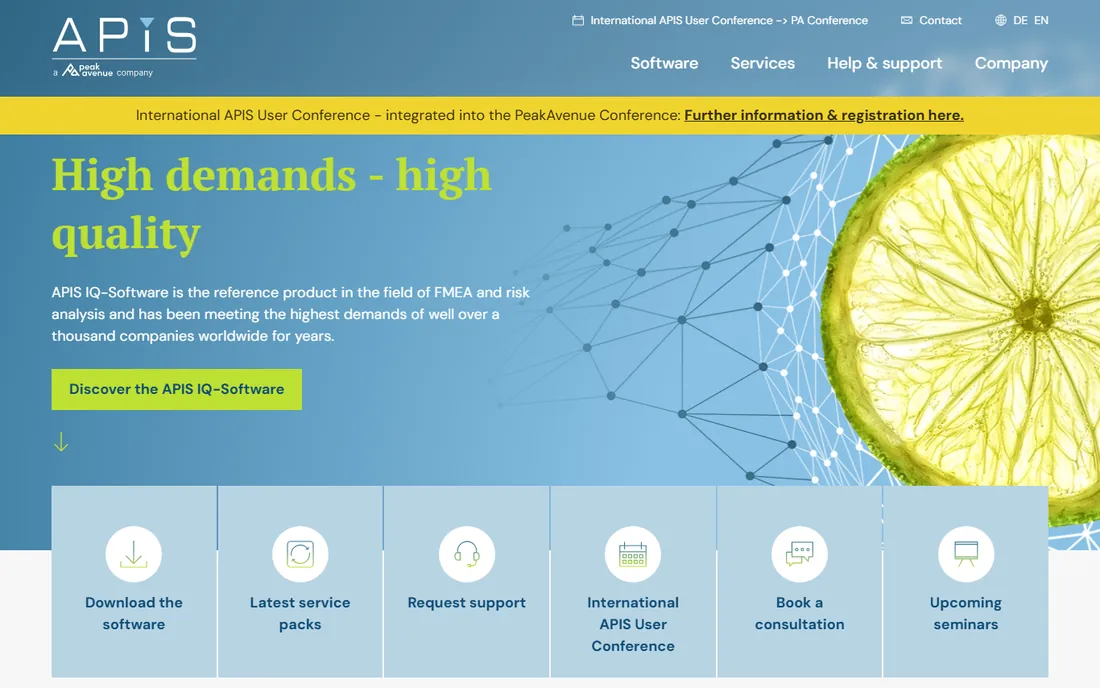
APIS IQ-FMEA is the standard-bearer that automotive FMEA is measured against. Instead of flat spreadsheets, it builds structural graphs: function nets, failure trees, and boundary diagrams that show how failures propagate through the product. The methodology follows the AIAG-VDA 7-step process completely, which matters enormously when your OEM customer audits your FMEA.
The structural approach is both the strength and the barrier. Teams trained in spreadsheet FMEA face a real learning curve, and the software demands methodological discipline that casual users resist. Professional-tier pricing runs roughly €5,200 per license plus about 21% annual maintenance, firmly enterprise territory.
For automotive suppliers where the FMEA is a contractual deliverable, there is no substitute. The tool your customer expects, built around the standard they audit against, is worth the cost and the learning curve.
What we like- Industry benchmark for structural FMEA
- Full AIAG-VDA 7-step methodology
- Maps functional nets and failure trees
Watch out for- Steep learning curve
- Enterprise pricing around €5,200 per license plus maintenance
Starting price£140 per user/month
Free planNo
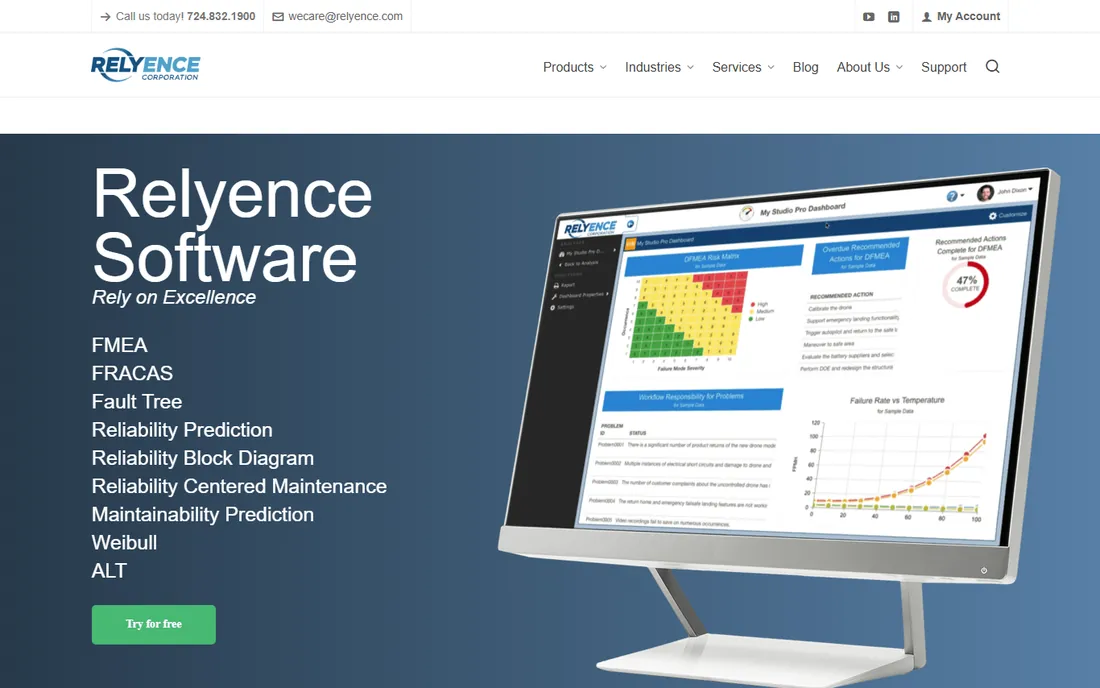
Relyence is the premium modern FMEA platform. The software supports DFMEAs, PFMEAs, boundary diagrams, P-diagrams, control plans, and more, with AI-driven features like SmartSuggest for automated data generation and a Knowledge Bank for reusing failure data across projects. The Always-in-Sync technology keeps PFMEAs, control plans, and process flow diagrams consistent automatically.
Pricing is £140 per user per month, which positions it firmly in the professional tier. The collaboration features justify the cost for distributed teams: multiple engineers working on the same FMEA with controlled updates and full traceability.
The depth can overwhelm teams that just need straightforward FMEA documentation. For organizations where FMEA is a core engineering process and collaboration across sites matters, Relyence's modern approach beats the legacy desktop tools.
What we like- AI-assisted authoring with SmartSuggest
- Always-in-Sync across FMEAs, control plans, and flow diagrams
- User-friendly interface
Watch out for- £140 per user monthly adds up
- Enterprise-grade depth can overwhelm small teams
#3
ReliaSoft XFMEA
Best for: reliability engineers needing statistical depth
Visit hbkworld.com
Starting priceSee website
Free planNo
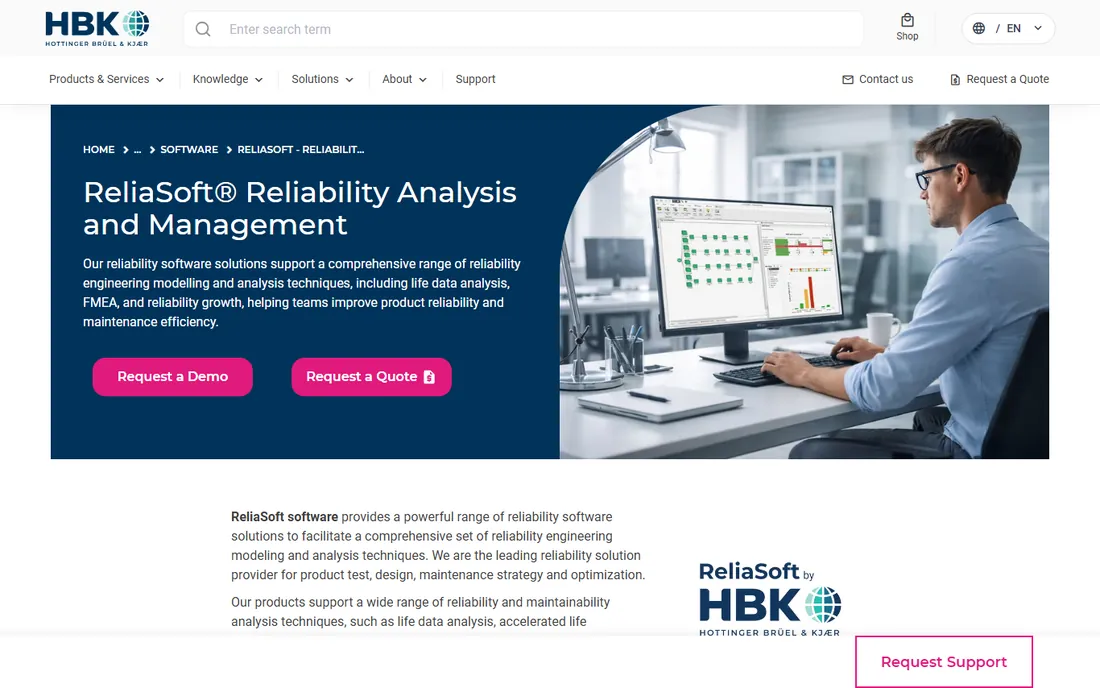
ReliaSoft XFMEA, now under Hottinger Brüel and Kjær, is the reliability-engineering anchor of the FMEA world. Beyond standard FMEA documentation, it connects to the statistical machinery of reliability engineering: fault tree analysis, reliability block diagrams, and the modeling tools that quantify failure probability rather than just ranking it. The centralized library management keeps failure data consistent across global engineering teams.
This is the tool for organizations where reliability is a quantitative discipline, not just a documentation exercise. Aerospace, defense, and complex systems engineering teams use XFMEA as part of a broader reliability program that includes life data analysis and system modeling.
The complexity is real, and licensing is enterprise-gated. Teams that need FMEA documents for compliance will find simpler tools faster. Teams that need to engineer reliability will find XFMEA's depth unmatched.
What we like- Deep statistical reliability modeling
- Links to fault trees and reliability block diagrams
- Centralized engineering library
Watch out for- Complex and license-gated
- Overkill for basic FMEA documentation
Starting price$1,495
Free planNo
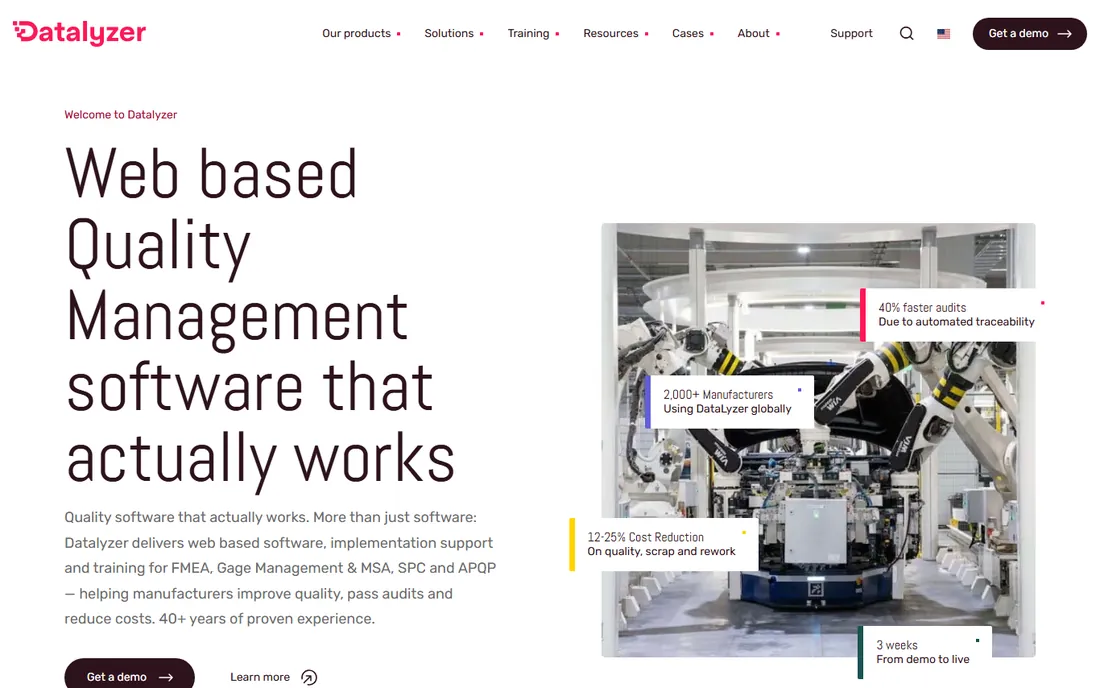
DataLyzer FMEA is built for manufacturers who see FMEA as part of a connected quality system. The module links DFMEA, process flow, PFMEA, and control plan in one chain, and the SPC setup can be automatically created from the control plan. Reference FMEAs, action management, document control, and automatic translation support global manufacturing operations. Pricing starts at $1,495.
The linked structure eliminates the synchronization busywork that plagues spreadsheet FMEA: change the process flow and the PFMEA follows. For automotive and general manufacturing teams already in the DataLyzer ecosystem, the integration with SPC software completes the loop from risk analysis to production monitoring.
The interface reflects its desktop heritage rather than modern cloud design. But the one-time pricing and the DFMEA-to-SPC linkage make it the value choice for manufacturers who want connected quality without enterprise subscriptions.
What we like- Links DFMEA, process flow, PFMEA, and control plan
- SPC setup auto-created from control plan
- $1,495 one-time pricing
Watch out for- Interface less modern than cloud competitors
- Suite approach assumes DataLyzer ecosystem
#5
PLATO e1ns
Best for: engineering teams wanting AI-assisted DFMEA
Visit plato.de
Starting priceSee website
Free planNo
PLATO e1ns brings AI assistance to DFMEA authoring. The platform helps engineers draft failure analyses faster while staying compliant with AIAG-VDA, ISO 26262, and DRBFM methodologies. The standout capability is synchronization with engineering documents: when design components change in CAD or system architecture, the FMEA updates accordingly, keeping the analysis honest as the design evolves.
Founded in 1992 in Germany, PLATO serves the European automotive and engineering market with deep methodological roots. The AI assistance addresses the real bottleneck in FMEA practice: the time engineers spend writing analyses that the software can now help draft.
Pricing is enterprise and quote-based, and the US presence is smaller than the American vendors'. For engineering organizations where design changes constantly threaten FMEA accuracy, the CAD synchronization is a genuine differentiator.
What we like- AI-assisted FMEA authoring
- Syncs with CAD and system architecture
- Standards-compliant including DRBFM
Watch out for- Enterprise procurement
- German vendor with less US presence
Starting price$89 per user/month
Free planNo
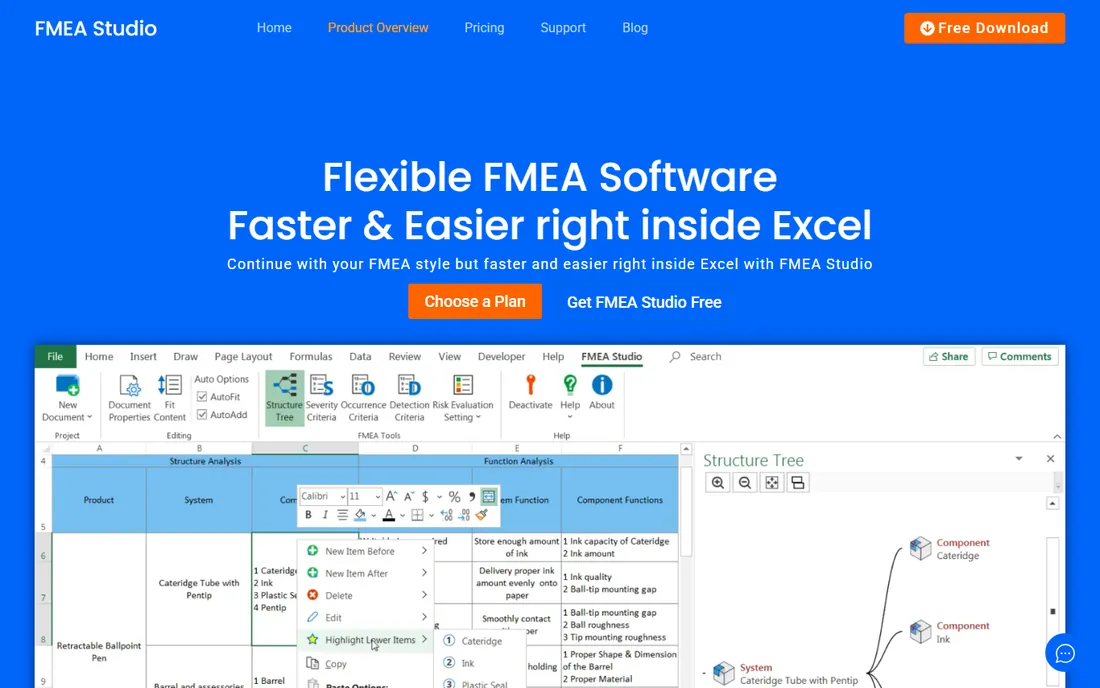
FMEA Studio from IQA System is the accessible entry to professional FMEA software. At $89 per user per month, it undercuts Relyence significantly while providing cloud-based FMEA with collaboration features and Excel integration. For small teams and suppliers who need real FMEA software without enterprise budgets, the pricing opens a door that the €5,200 licenses keep closed.
The cloud architecture means no IT infrastructure and easy collaboration across sites. Excel integration eases the transition for teams migrating from spreadsheets, the most common starting point in the industry.
The depth does not match APIS or Relyence for complex automotive programs, and the user community is smaller. But for teams moving off spreadsheets, FMEA Studio offers the best price-to-capability ratio in the category.
What we like- $89 per user monthly is the most accessible professional pricing
- Cloud-based collaboration
- Excel integration
Watch out for- Less depth than the enterprise leaders
- Newer with smaller user community
Starting priceSee website
Free planNo
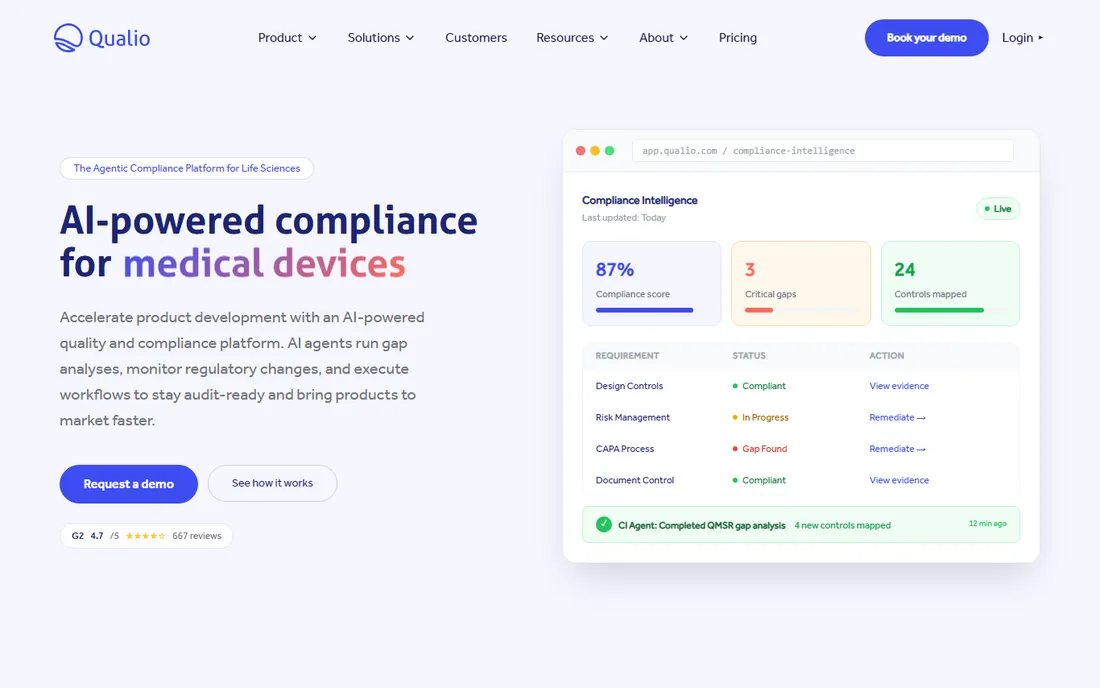
Qualio serves the regulated industries where FMEA is one part of a larger quality system. The cloud-based QMS builds FMEA capabilities directly into a framework that also handles document control, training records, supplier management, and CAPA. For medical device and pharmaceutical teams, the value is the single source of truth: risk management connected to every other quality activity, audit-ready at all times.
The integrated approach suits FDA-regulated environments where auditors expect to trace a risk from identification through mitigation to training and verification. Standalone FMEA tools cannot provide that traceability; Qualio's QMS context can.
Pricing is enterprise, and teams that need only FMEA will find dedicated tools more focused. For regulated companies building or modernizing their quality system, Qualio's integrated FMEA is the compliant choice.
What we like- FMEA inside a full cloud QMS
- Connects risk to training, documents, and suppliers
- Audit-ready by design
Watch out for- Enterprise pricing
- FMEA is one module among many
Starting priceSee website
Free planNo
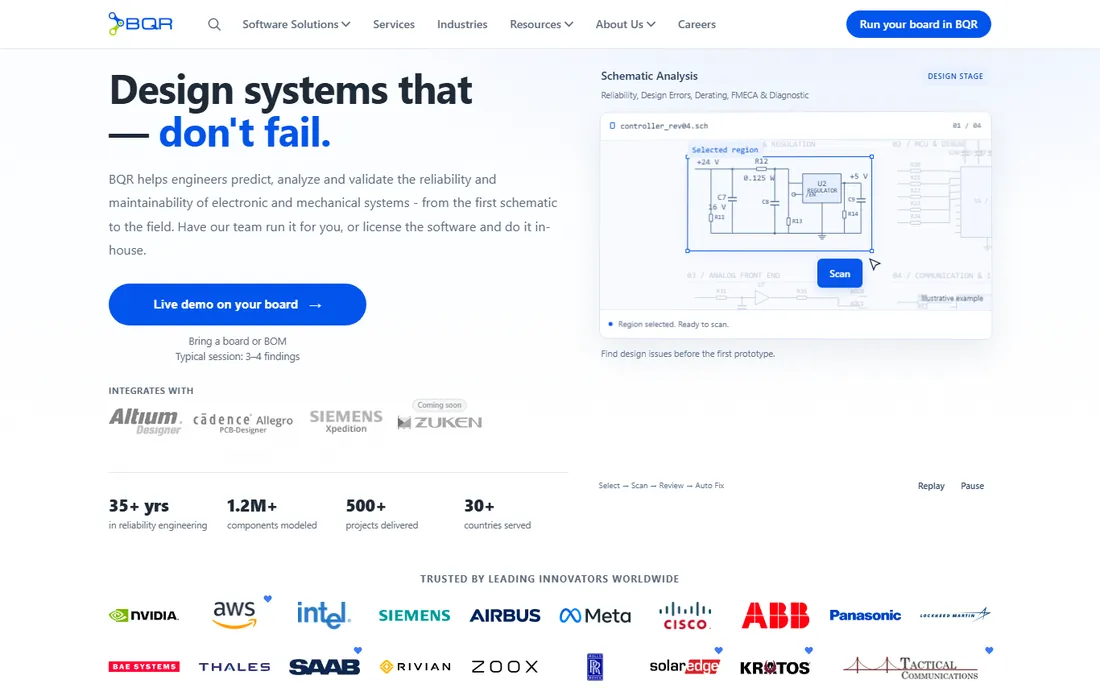
BQR Reliability Engineering serves the electronics industry with patented automated design analysis tools. The suite includes FMECA capabilities alongside stress analysis, derating, thermal simulation, and MTBF prediction, with ECAD integration that brings reliability analysis into the PCB design workflow. Founded in 1989 in Israel, BQR has deep roots in electronic design reliability.
The automation is the differentiator: rather than manually brainstorming failure modes for electronic assemblies, BQR's tools analyze the design data directly, predicting component lifespan and identifying overstress conditions. For electronics teams, this catches failures that manual FMEA sessions miss.
The electronics focus limits applicability to mechanical or process FMEA. Pricing is enterprise and quote-based. For electronics manufacturers serious about design reliability, BQR's automated approach complements traditional FMEA practice.
What we like- Patented automated electronic design analysis
- FMECA with stress and failure prediction
- ECAD integration
Watch out for- Electronics-focused, less suited to mechanical FMEA
- Enterprise pricing
How we chose
We compared FMEA software on methodology compliance (AIAG-VDA, SAE J1739, MIL-STD-1629A), DFMEA and PFMEA support, Action Priority versus RPN handling, collaboration features, integration with quality systems, and pricing accessibility. We checked each vendor's documentation and current 2026 reviews, read practitioner discussions on reliability engineering forums, and weighed the total cost including licenses and maintenance. We did not run live FMEA projects; assessments reflect current documentation and industry consensus as of October 2026.
RPN is dead; Action Priority replaced it
The 2019 AIAG-VDA FMEA handbook replaced the Risk Priority Number with Action Priority, and the change matters more than it sounds. RPN multiplied severity, occurrence, and detection into a single number that teams gamed: a high-severity failure could hide behind a low RPN if detection scored well. Action Priority uses logic tables that prioritize severity first, forcing action on dangerous failures regardless of the math.
Check your tool's default methodology. Modern platforms like Relyence, APIS IQ-FMEA, and PLATO support Action Priority natively. Older tools and spreadsheets still center RPN, which means your FMEA follows a superseded standard. If your customer audits against AIAG-VDA 7th edition, RPN-based documentation is a finding waiting to happen. The standard moved; make sure your software moved with it.
How to pick FMEA software for your industry standard
Start with the standard your customers audit against. Automotive means AIAG-VDA: APIS IQ-FMEA, Relyence, DataLyzer, or PLATO. Aerospace and defense mean MIL-STD-1629A or ARP5580: ReliaSoft XFMEA or Relyence. Medical devices mean ISO 14971 within a QMS: Qualio. Electronics reliability means automated analysis: BQR.
Then match the tool to your team size and budget. Enterprise automotive suppliers absorb €5,200 licenses; small suppliers should look at FMEA Studio's $89 monthly or DataLyzer's $1,495 one-time. The methodology matters more than the brand: any tool that supports your standard correctly beats a prestigious tool configured wrong.
Finally, trial with a real FMEA, not the demo data. Import one of your existing analyses and see how the tool handles your failure modes, your rating scales, and your reporting needs. The demo always looks good; your actual FMEA reveals the truth.
Frequently asked questions
What is FMEA software?
FMEA software documents failure mode and effects analysis: identifying how products or processes can fail, rating the severity, occurrence, and detection of each failure, and tracking actions to reduce risk. It replaces spreadsheets with structured methodology, collaboration, and audit trails required by automotive, aerospace, and medical standards.
How much does FMEA software cost?
Professional FMEA software is expensive: APIS IQ-FMEA runs roughly €5,200 per license plus maintenance, Relyence costs £140 per user monthly, FMEA Studio $89 per user monthly, and DataLyzer FMEA $1,495 one-time. Enterprise tools like ReliaSoft, PLATO, and Qualio are quote-based. Budget training alongside licenses; the methodology learning curve is real.
What is the difference between DFMEA and PFMEA?
DFMEA (Design FMEA) analyzes potential failures in the product design: what can go wrong with the thing itself. PFMEA (Process FMEA) analyzes potential failures in the manufacturing or assembly process: what can go wrong while making it. Most quality standards require both, linked so that design risks flow into process controls.
APIS IQ-FMEA vs Relyence: which is better?
Choose APIS IQ-FMEA for the deepest AIAG-VDA methodology and structural analysis, the choice automotive OEMs expect. Choose Relyence for modern cloud collaboration, AI-assisted authoring, and a more approachable interface. APIS suits large automotive suppliers; Relyence suits distributed teams across industries.
Do I need FMEA software or will Excel work?
Excel works until it does not: version control chaos, no methodology enforcement, painful collaboration, and audit trails that do not exist. Most companies start in Excel and migrate when an audit finding, a customer requirement, or a missed failure mode forces the issue. If your customer requires AIAG-VDA compliance, dedicated software is effectively mandatory.
What is Action Priority in FMEA?
Action Priority is the risk ranking system from the 2019 AIAG-VDA FMEA handbook that replaced RPN. It uses logic tables prioritizing severity first, assigning High, Medium, or Low priority to each failure mode-cause combination. Unlike RPN's single multiplied number, Action Priority cannot hide high-severity failures behind favorable detection scores.
Sources we checked (5)
- https://datamyte.com/blog/best-fmea-software/
- https://github.com/siddardth7/quality-platform/blob/HEAD/apps/fmea/FUTURE_SCOPE_AND_MARKET_RESEARCH.md
- https://sourceforge.net/software/fmea/
- https://softrel.com/requs-fmea-comparison.html
- https://slashdot.org/software/comparison/DataLyzer-FMEA-vs-FMEA-Studio-vs-Relyence-FMEA/
Is your product missing or out of date?
We review this list regularly. Vendors can request a listing, send updated pricing or ask about featured placement.

Shihab Mia · Founder, Rankite
Shihab has spent more than a decade helping SaaS and e-commerce brands grow through search. He writes Rankite's software buying guides from pricing pages, documentation and public user reviews. More about Shihab.