How we make this list: we compare pricing pages, product documentation and public user reviews. Rankite is independent; if a vendor ever pays for a featured spot, that listing is clearly labeled Partner.
Key takeaways
- Fleetio ($4/vehicle/month Essential, 5-vehicle minimum) is the purpose-built fleet maintenance pick, with transparent pricing and no hardware to buy.
- DOT-regulated operators on a budget should look at Whip Around ($5/asset/month Standard, free Basic tier for one asset): digital DVIR inspections without the maintenance-suite price tag.
- For shops that also run plant equipment, the CMMS tools fit better: Fiix (free plan, $45/user/month Basic), MaintainX ($20/user/month Essential) and Limble ($28/user/month Standard).
- eMaint ($69/user/month Team) and RTA Fleet360 (from $6/asset/month) target bigger operations: multi-site fleets, municipalities and teams that need FMIS-grade reporting.
Quick comparison
| Tool | Best for | Starting price | Free plan |
|---|
 Fleetio Fleetio | Fleets that want maintenance software built for vehicles, not adapted from factories | $4/vehicle/month (Essential, billed annually; $5 month-to-month) | Free trial (14 days) |
 Whip Around Whip Around | DOT-regulated operators that need digital inspections fast | $5/asset/month (Standard) | Yes (Basic, free forever for 1 asset and 1 user) |
 MaintainX MaintainX | Mixed fleets and shops that also maintain plant equipment | $20/user/month (Essential, billed annually; $25 month-to-month) | Yes (Basic, free) |
 Fiix Fiix | Small shops that want a free CMMS with real capability | $45/user/month (Basic) | Yes (free plan, no end date) |
 Limble Limble | SMB teams that want the easiest CMMS to run | $28/user/month (Standard) | Yes (Basic, free with limited features) |
 UpKeep UpKeep | Small maintenance teams that want to be live this week | $24/user/month (Essential) | Free trial (no credit card required) |
 eMaint eMaint | Mid-market fleets that need configurability and integrations | $69/user/month (Team) | Free trial |
 RTA Fleet360 RTA Fleet360 | Municipal, government and transit fleets | From $6/asset/month | No (demo available) |
Is your product missing or out of date?
We review this list regularly. Vendors can request a listing, send updated pricing or ask about featured placement.
The best fleet maintenance software
Picture a fleet manager with 40 trucks, a stack of paper inspection forms, and a spreadsheet that supposedly tracks oil changes. The breakdown that strands a truck on the highway was preventable: the service was due at 45,000 miles and the truck is at 52,000. Fleet maintenance software exists to close exactly that gap, turning mileage, engine hours and inspection results into scheduled work before the failure happens.
#1
Fleetio
Best for: Fleets that want maintenance software built for vehicles, not adapted from factories
Visit fleetio.com
Starting price$4/vehicle/month (Essential, billed annually; $5 month-to-month)
Free planFree trial (14 days)
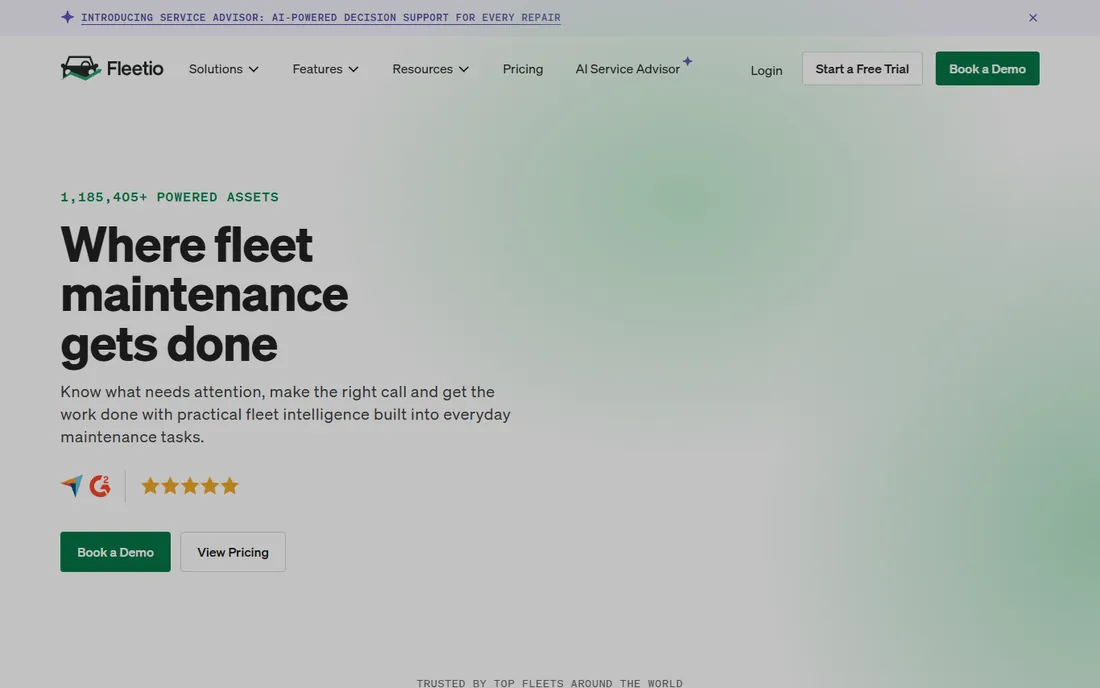
Fleetio is the rare fleet vendor that publishes its prices, and that alone sets the tone. Essential at $4 per vehicle per month covers service schedules, work orders, inspections, parts and fuel logs, with a five-vehicle minimum that puts the entry cost at $20 a month. Because it is software-only, there is no GPS hardware to install; fleets that already run Samsara or Geotab pipe mileage data in through integrations and let Fleetio trigger service from actual odometer readings.
The honest catch is scope. Fleetio does maintenance and inspections, not tracking, cameras or ELD compliance. If you need the full stack you are buying two vendors and an integration between them. Professional at $7 and Premium at $10 per vehicle add automated workflows, deeper inventory and cost reporting. For fleets whose first problem is missed services and paper DVIRs, Essential is the right starting point, and the monthly rolling terms mean you are not locked into a multi-year contract to try it.
What we like- Transparent published pricing with a 5-vehicle minimum and no hardware purchase
- Unlimited users on every plan, so drivers, techs and managers all get access
- Pulls odometer and location data from Samsara, Geotab and Motive via integrations
Watch out for- No telematics of its own, so GPS tracking means a second vendor
- The feature set that grows with larger fleets sits on Professional and Premium, doubling the per-vehicle price
#2
Whip Around
Best for: DOT-regulated operators that need digital inspections fast
Visit whiparound.com
Starting price$5/asset/month (Standard)
Free planYes (Basic, free forever for 1 asset and 1 user)
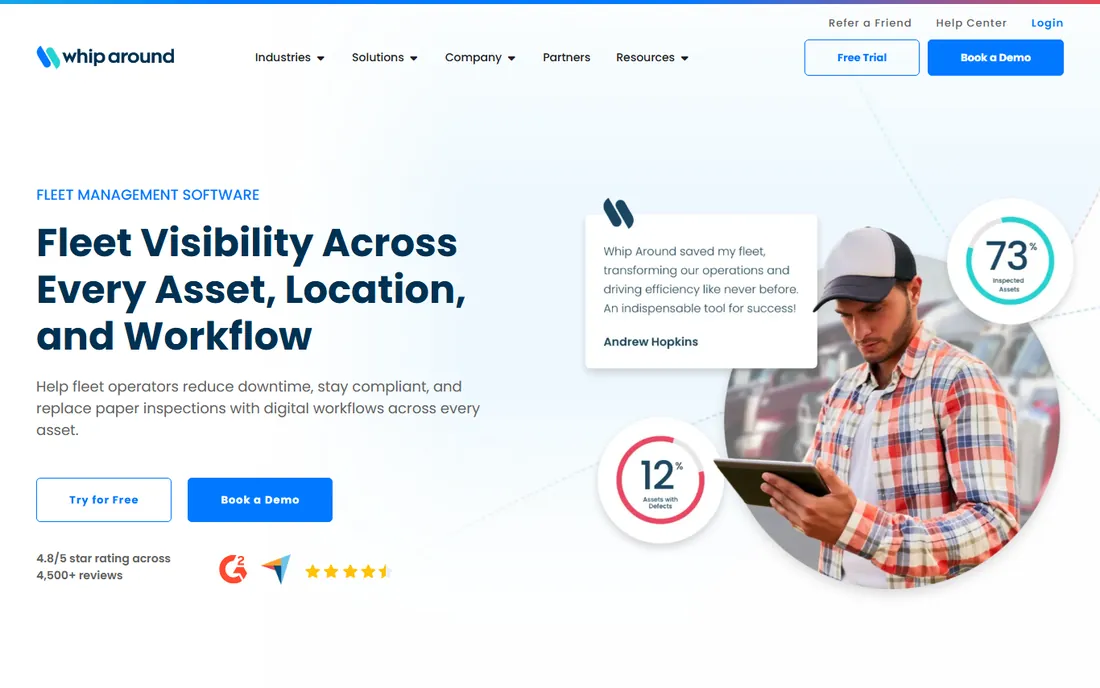
Whip Around starts where most fleets actually hurt: the daily vehicle inspection. Drivers complete DVIRs on their phones with photos, defects route to managers and mechanics in real time, and the paper trail exists when DOT asks for it. Standard at $5 per asset per month covers unlimited users, customizable forms, dashboards and telematics integrations. The free Basic tier handles one asset and one user, enough for an owner-operator to test the workflow for real.
The pricing step that matters is Pro. At $9 per asset per month (the vendor's own pricing page lists $9; some third-party directories still show $10), it adds maintenance schedules, work orders, service history, cost and time tracking, parts inventory and purchase orders. That is the full maintenance product, and it costs nearly twice Standard. For fleets whose compliance need is inspections first and maintenance second, the two-tier structure is fair. Fleets that need both from day one should price Pro, not Standard.
What we like- The cheapest real entry point in this set, with a genuinely free Basic tier
- Digital DVIRs with photo capture built for DOT and FMCSA compliance
- Integrates with Motive, Samsara, Verizon Connect and Geotab for mileage data
Watch out for- Maintenance scheduling, work orders and parts tracking are Pro-only at $9 per asset per month, nearly double Standard
- Reviewer feedback notes per-vehicle costs add up fast for small fleets
Starting price$20/user/month (Essential, billed annually; $25 month-to-month)
Free planYes (Basic, free)
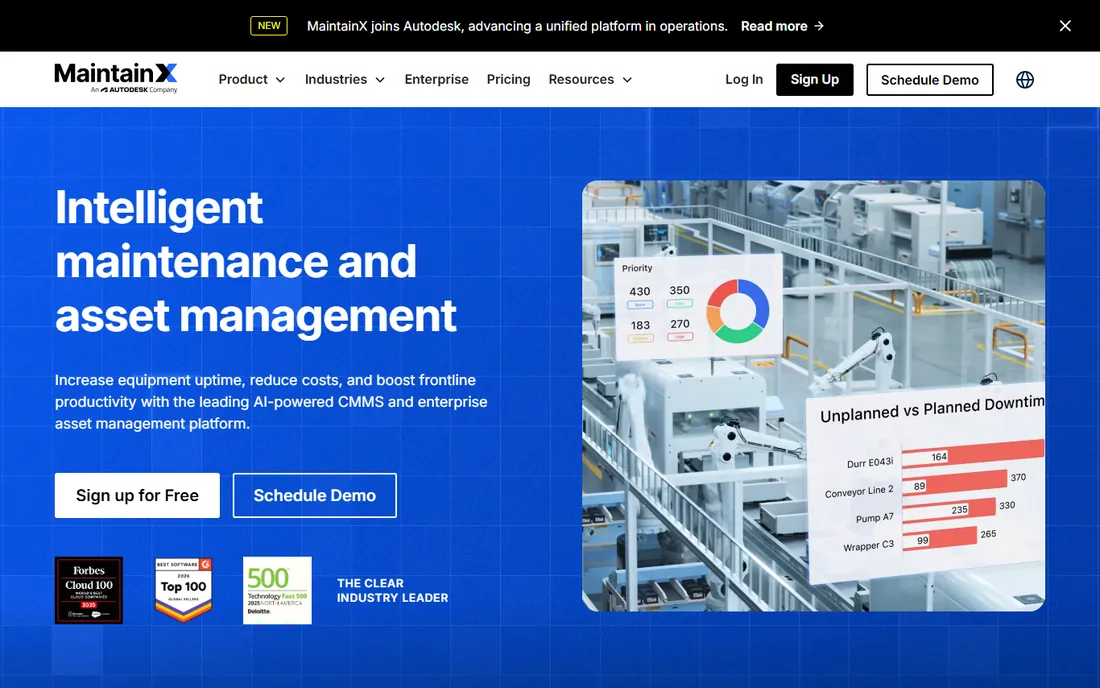
MaintainX was built for the shop floor and it shows. Technicians pick up work orders on their phones, photograph the problem, message the planner and close the job without leaving the bay. The free Basic tier digitizes work orders with no commitment, and Essential at $20 per user per month adds repeating work orders and meter-based PMs, which is what vehicle fleets need for mileage and engine-hour triggers. Drivers with free requester accounts can file defects without consuming paid seats.
The cost curve is the thing to model. At $65 per user per month, Premium adds parts inventory, purchasing, advanced analytics and API access, and a 50-person shop pays $3,250 a month before Enterprise features. For fleet-plus-facility operations where one team maintains trucks and another maintains the plant, the shared asset records justify it. For a pure vehicle fleet under 20 people, Fleetio or Whip Around cost less.
What we like- Mobile-first design that technicians adopt in days, with real-time messaging on work orders
- Free Basic tier covers unlimited work orders for small teams
- Requester accounts are free, so drivers can submit issues without a license
Watch out for- Per-user pricing climbs fast for large frontline teams
- Parts, purchasing and the open API sit on Premium at $65 per user per month
Starting price$45/user/month (Basic)
Free planYes (free plan, no end date)
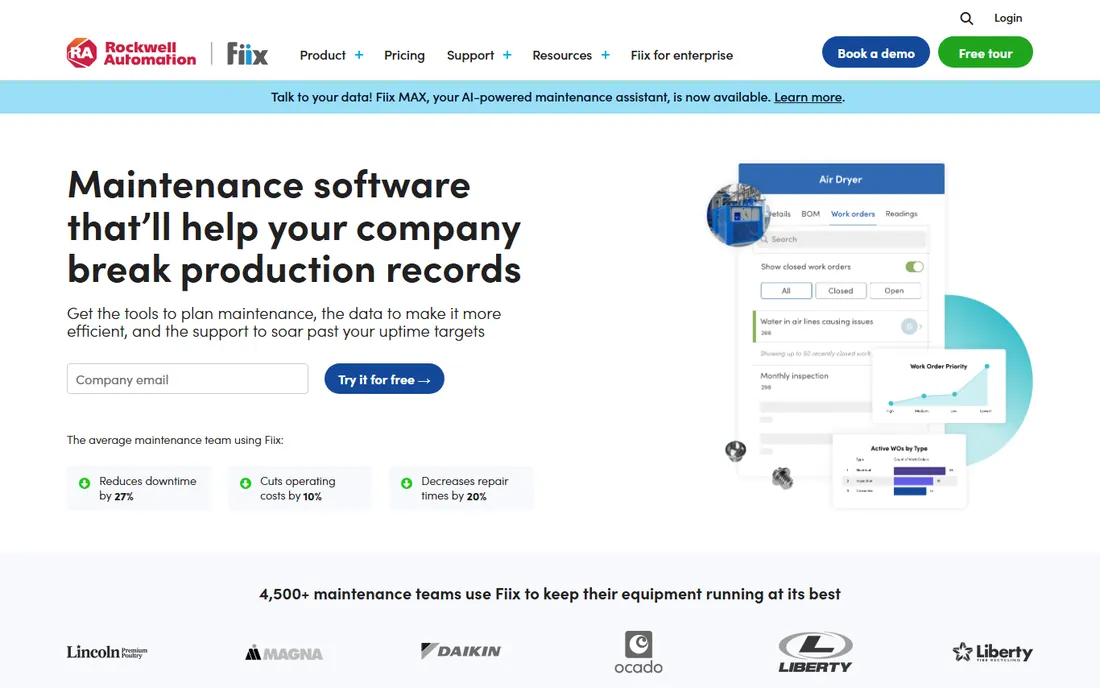
Fiix offers the most capable free plan in maintenance software. Work orders, 25 active PMs, asset management, downtime tracking, inventory and the mobile app all work at $0, and meter readings are included from day one, so engine hours can trigger PMs without paying anything. Basic at $45 per user per month adds unlimited PMs, tool crib tracking and reporting. Professional at $75 brings multi-site management, Fiix Foresight AI, purchasing and nested PMs.
The tradeoff is the enterprise ceiling. Condition-based triggers, failure codes, SSO, custom workflows and ERP integrations all sit on Enterprise, which is custom-quoted. Implementation typically runs four to eight weeks, longer than the mobile-first tools. For a small fleet shop moving off paper with no budget, the free plan is the cheapest credible start in the category. When the operation grows into integrations and multi-site governance, price Enterprise before committing.
What we like- The free plan includes work orders, asset management, inventory and meter readings, rare depth at $0
- Published pricing with no setup or hardware fees
- Backed by Rockwell Automation, which matters for vendor stability
Watch out for- Pass/fail inspections, SSO and custom workflows need Enterprise
- ERP and custom API integrations are Enterprise add-ons at extra cost
Starting price$28/user/month (Standard)
Free planYes (Basic, free with limited features)
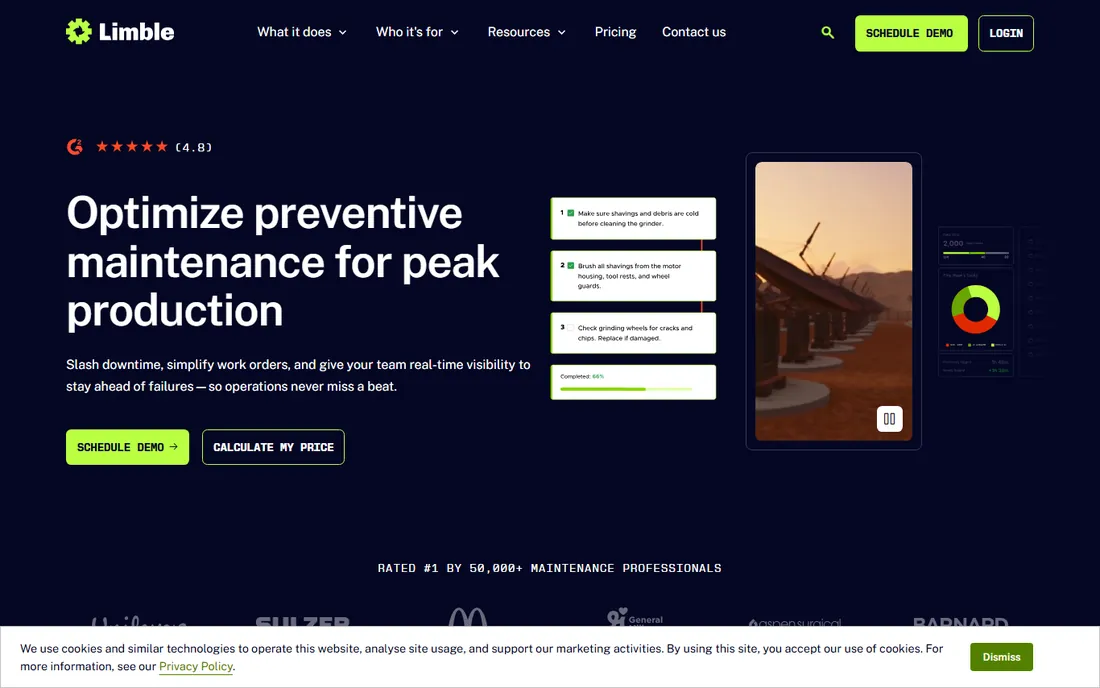
Limble wins on the human factors. The interface is the one reviewers call easiest to learn, work requests arrive by QR code scan, and the mobile app handles the field work. Standard at $28 per user per month covers work orders, PM scheduling, asset tracking, downtime reporting and unlimited custom dashboards. Premium+ at $69 adds meter and threshold scheduling, parts inventory, purchase orders, API access and a dedicated success manager. A free Basic tier and 14-day trial make evaluation painless.
The ceiling is familiar in this category: advanced reporting, multi-site portfolio views and deep ERP integrations are where growing teams feel the limits, and per-user pricing at scale makes the math less friendly than flat-rate alternatives. For fleets and shops under 50 users that want to be productive in the first week, Limble's combination of usability and support is hard to beat. Budget at least one tier upgrade if multi-site analytics or integrations are on the roadmap.
What we like- Consistently top-rated for usability, with QR-code work requests anyone can submit
- Unlimited assets and work orders on paid plans
- 24/7 support with sub-60-second response times claimed across paid tiers
Watch out for- Reporting depth and enterprise integrations arrive late, API access needs Premium+
- Per-user pricing compounds quickly past 50 users
#6
UpKeep
Best for: Small maintenance teams that want to be live this week
Visit upkeep.com
Starting price$24/user/month (Essential)
Free planFree trial (no credit card required)
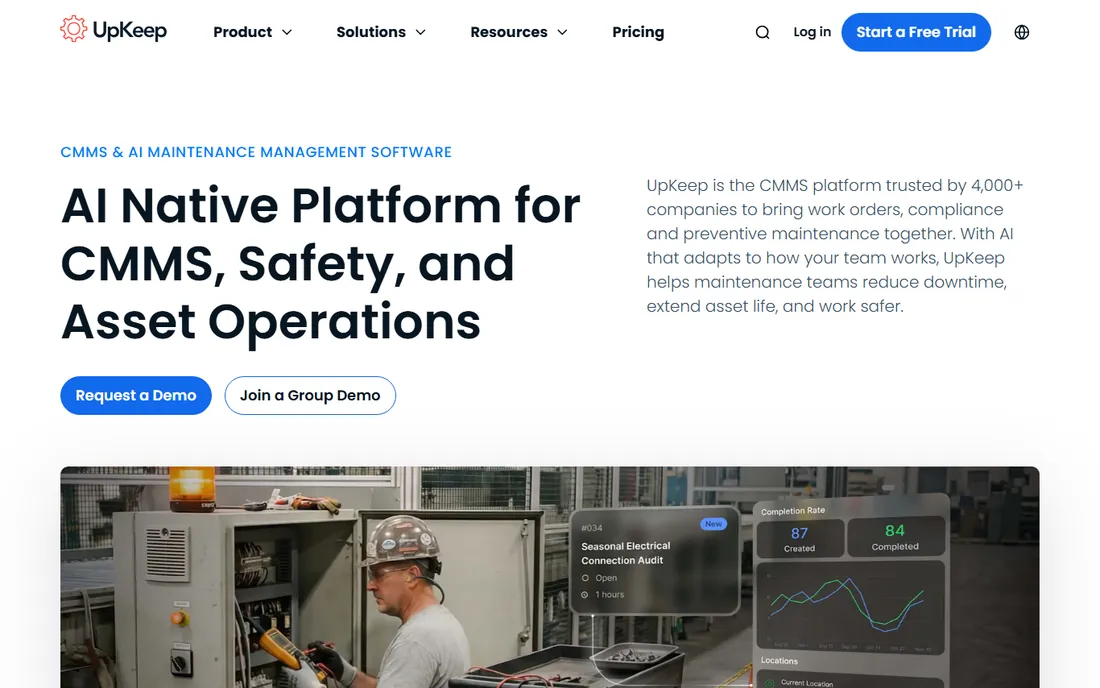
UpKeep's pitch is speed. The mobile app is clean, the request portal lets non-technical staff file issues without a license, and the vendor claims teams are creating work orders within days of signup. Essential at $24 per user per month covers unlimited work orders and locations plus Nova AI with 250 monthly credits. The platform extends beyond core CMMS into safety, fleet, IoT sensors and learning products on shared asset records.
Read the tier map before buying. Essential has no PM scheduling, which is the core of fleet maintenance, so most fleets need Premium at $55 per user per month. Meter readings and offline mobile mode are Professional features with custom pricing. Implementation packages run from $500 for training to $5,000 for advanced onboarding. For a single-site fleet that wants the gentlest on-ramp and will pay for Premium, UpKeep works. For fleets that need meter-based PMs at a published price, look at Fiix or MaintainX first.
What we like- The fastest onboarding in the category, with teams productive in days
- Free unlimited view-only and requester users keep rollout costs down
- Nova AI credits bundled on every plan, with voice-to-work-order features
Watch out for- PM scheduling does not exist on Essential at all, it starts on Premium at $55
- Meter readings and mobile offline mode sit on Professional, which is quote-only
#7
eMaint
Best for: Mid-market fleets that need configurability and integrations
Visit emaint.com
Starting price$69/user/month (Team)
Free planFree trial
eMaint is the grown-up choice. Owned by Fluke, it has served maintenance operations for forty years, and the platform shows that maturity: configurable workflows, multi-site standardization, deep reporting and integrations with the systems a mid-market operation already runs. Team at $69 per user per month is the entry point, Professional at $85 adds depth, and Enterprise at $120 brings the full governance stack. Implementation is guided, with pre-built modules and a dedicated team targeting go-live in 90 days.
This is not a tool for a 15-truck fleet. The price, the implementation effort and the configurability all assume an operation with real complexity: multiple sites, dozens of technicians, audit requirements. For that buyer, eMaint's stability and depth justify the premium over the mobile-first tools. For smaller fleets, the same money buys Fleetio plus change, with faster onboarding.
What we like- Four decades of maintenance software history with Fluke backing, the most established vendor here
- Deep configuration, multi-site governance and API-based IoT integrations
- Dedicated implementation team with 90-day go-live targets
Watch out for- The priciest starting tier in this set at $69 per user per month
- No free plan, and the feature set can be more system than a small fleet needs
Starting priceFrom $6/asset/month
Free planNo (demo available)
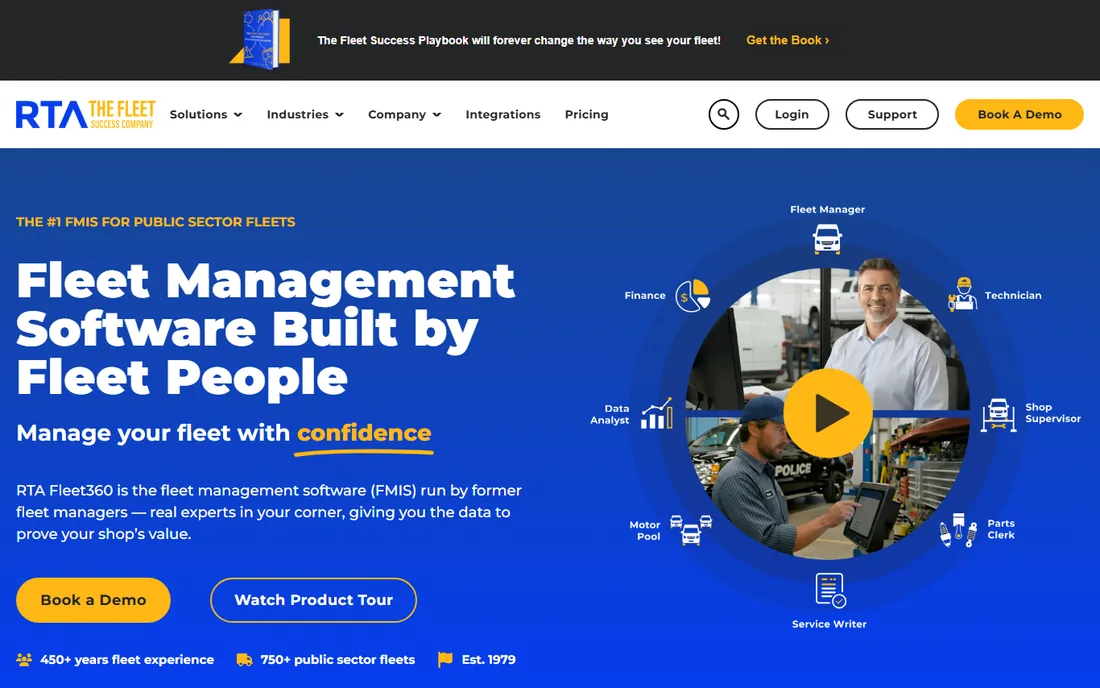
RTA is the name city fleet managers know cold. Fleet360 is an enterprise FMIS built by fleet professionals: preventive and predictive maintenance scheduling, work order and parts management, fuel tracking and FMIS-grade reporting, with per-department chargeback rates that municipal fleets need. Pricing starts at $6 per asset per month across three tiers up to $7.65, with no hidden fees and capped price increases, which matters when the buyer answers to taxpayers.
The fit question is organizational. RTA's depth in maintenance accountability, lifecycle costing and replacement planning is exactly what public works, transit agencies and universities buy software for. Commercial fleets that just need tracking and basic maintenance will find more system than they need, and some workflows assume a government structure. For the municipal buyer, though, nothing else on this list speaks their language as fluently.
What we like- The most widely adopted fleet management information system in the US public sector
- Cost-per-mile, lifecycle and chargeback reporting built for defending budgets to councils
- Ron360 conversational AI assistant for plain-English operational questions
Watch out for- Public-sector orientation means some workflows assume a government structure
- Pricing starts low per asset but the full FMIS depth is aimed at organizations, not small commercial fleets
What fleet maintenance software actually does (and what it does not)
Fleet maintenance software schedules and tracks the work that keeps vehicles running: preventive maintenance by mileage, engine hours or calendar date; work orders for repairs; digital inspections (DVIRs); parts inventory; fuel logs; and cost-per-vehicle reporting. The best tools trigger service from actual odometer or telematics data instead of a calendar guess.
What it usually does not do is track where the vehicles are. GPS tracking, dash cameras and ELD compliance belong to telematics platforms like Samsara, Motive or Geotab, which is why Fleetio and Whip Around integrate with them rather than replace them. Some CMMS tools (MaintainX, Fiix, Limble, UpKeep, eMaint) also maintain plant and facility equipment, which makes them the right pick when the shop services both trucks and production machinery. Buy the maintenance layer for maintenance, and the tracking layer for tracking.
The pricing math: per-vehicle vs per-user
This category bills two different ways, and the difference decides your budget. Fleetio, Whip Around and RTA charge per vehicle or asset: a 30-vehicle fleet pays $120 a month on Fleetio Essential or $150 on Whip Around Standard, no matter how many drivers and mechanics use the system. The CMMS tools charge per user: the same fleet with 8 technicians pays $160 on MaintainX Essential or $192 on UpKeep Essential, but 20 technicians pay $400 or $480.
Count both sides before comparing. Per-asset pricing favors fleets with many users per vehicle (drivers doing inspections). Per-user pricing favors fleets with few technicians covering many vehicles, and free requester or view-only accounts stretch it further. Then add the tier reality: PM scheduling, meter readings and offline mode frequently sit one tier above the advertised starting price. Model your vehicle count, your technician count and the tier you will actually need, and compare those three numbers, not the headline.
How we chose
We started with the categories fleet buyers actually search: fleet maintenance software, fleet CMMS, and DVIR inspection software. For each candidate we opened the vendor's own pricing page, checked per-asset versus per-user pricing and free tier limits, and compared features against public reviews on G2 and Capterra and practitioner discussion on fleet forums. Where a price could not be verified on the vendor's page we wrote "See website" rather than guessing.
Frequently asked questions
How much does fleet maintenance software cost?
For a 30-vehicle fleet, expect $120 to $300 a month on per-asset pricing: Fleetio Essential ($120), Whip Around Standard ($150), RTA Fleet360 (from $180). Per-user CMMS tools depend on technician count: 8 techs run $160 to $440 a month on entry tiers. Implementation is usually included for SMB plans; enterprise onboarding can add thousands.
Do I need telematics too, or is maintenance software enough?
They solve different problems. Maintenance software schedules service and tracks repairs. Telematics tracks location, speed, cameras and ELD compliance. Most fleets run both, connected by integration: Fleetio and Whip Around both pull odometer data from Samsara, Motive, Geotab and Verizon Connect. If your first problem is missed services, start with maintenance software.
What is a DVIR and which tools handle it?
A DVIR (driver vehicle inspection report) is the federally required daily inspection for commercial motor vehicles in the US. Whip Around is built around digital DVIRs with photo capture. Fleetio, MaintainX and RTA also support inspection workflows. Paper DVIRs are still legal, but digital ones create the defect trail that protects you in an audit.
Can small fleets use this software, or is it for enterprises?
Small fleets are well served. Fleetio's 5-vehicle minimum starts at $20 a month, Whip Around's free Basic tier covers one asset, and Fiix's free plan handles work orders and PMs at $0. The enterprise tools (eMaint, RTA) target bigger operations, but nothing here requires a large fleet to start.
Per-vehicle or per-user pricing: which is cheaper for my fleet?
Per-vehicle pricing (Fleetio, Whip Around, RTA) wins when many people touch each vehicle, since users are unlimited or free. Per-user pricing (MaintainX, Fiix, Limble, UpKeep, eMaint) wins when a small crew maintains many vehicles. Multiply both by your actual vehicle and technician counts, on the tier that includes PM scheduling, and compare the totals.
How long does implementation take?
Mobile-first tools (Whip Around, MaintainX, UpKeep, Limble) get teams creating work orders in days, sometimes the same week. Fiix typically takes four to eight weeks. eMaint targets 90 days with a dedicated team. The variable is never the software: it is how clean your asset list and service history are when you start.
Sources we checked (8)
- https://www.fleetio.com/pricing
- https://whiparound.com/pricing/
- https://getmaintainx.com/pricing
- https://www.fiixsoftware.com/pricing/
- https://www.limblecmms.com/pricing
- https://upkeep.com/pricing
- https://www.emaint.com/pricing/
- https://rtafleet.com/pricing
Is your product missing or out of date?
We review this list regularly. Vendors can request a listing, send updated pricing or ask about featured placement.

Shihab Mia · Founder, Rankite
Shihab has spent more than a decade helping SaaS and e-commerce brands grow through search. He writes Rankite's software buying guides from pricing pages, documentation and public user reviews. More about Shihab.