How we make this list: we compare pricing pages, product documentation and public user reviews. Ratings come from G2, Capterra or Trustpilot, with the date we checked them.

Key takeaways
- SMBs on Xero or QuickBooks needing cash-flow visibility should start with Float (14-day trial) or Fathom (14-day trial).
- Founders writing lender-ready plans should look at LivePlan (Standard $20/month; 35-day money-back guarantee).
- Excel-centric finance teams needing governance should evaluate Datarails, Cube, and Vena; all are quote-based.
- Multi-department organizations that budget collaboratively should look at Budgyt (from $399/month, unlimited users).
Quick comparison
| Tool | Best for | Starting price | Free plan |
|---|
 LivePlan LivePlan | Founders and small businesses writing lender-ready plans | Standard $20/month monthly ($15/month billed annually); Premium $40/month ($30 annual) | No free plan or trial; 35-day money-back guarantee, no contracts |
 Float Float | SMBs and agencies on Xero or QuickBooks needing cash visibility | See website (vendor pricing page did not render during research) | 14-day free trial, no credit card required |
 Budgyt Budgyt | Nonprofits, schools, and multi-department businesses budgeting collaboratively | From $399/month, unlimited users (verified on vendor homepage) | No (demo; vendor offers a free spreadsheet rebuild) |
 Datarails Datarails | Mid-market finance teams that refuse to leave Excel | See website (quote-based) | No (demo only) |
 Cube Cube | FP&A teams wanting one governed source of truth across tools | See website (quote-based) | No (demo only) |
 Vena Vena | Mid-market to enterprise finance teams standardized on Microsoft 365 | See website (quote-based; Professional and Complete plans) | No (demo only) |
 Fathom Fathom | Accounting firms and multi-entity businesses needing reporting plus forecasting | See website (pricing not published on vendor site) | 14-day free trial (no credit card required) |
 Jirav Jirav | Small to midsize companies and firms offering FP&A advisory | See website (vendor schema lists a $100-$750/month range; tiers not published) | No (demo only) |
Is your product missing or out of date?
We review this list regularly. Vendors can request a listing, send updated pricing or ask about featured placement.
The best financial forecasting software
Financial forecasting tools answer different questions for different buyers. A founder needs a lender-ready plan with believable financials. A finance team needs driver-based models that roll up without broken formulas. An SMB owner needs to know whether payroll clears next month. Buying a full FP&A suite for a cash-flow question, or a planning tool for a consolidation problem, wastes money and months.
The eight tools below span the real buying bands, from $20-per-month planning to quote-based enterprise FP&A. Two vendors had verifiable 2026 pricing; the rest price by quote or keep numbers off the site.
#1
LivePlan
Best for: Founders and small businesses writing lender-ready plans
Visit liveplan.com
Starting priceStandard $20/month monthly ($15/month billed annually); Premium $40/month ($30 annual)
Free planNo free plan or trial; 35-day money-back guarantee, no contracts

LivePlan is the planning tool that takes financials seriously. The guided plan builder produces the narrative investors and banks expect, while the connected forecast keeps P&L, balance sheet, and cash flow consistent. AI-assisted market research with citable sources strengthens the plan's credibility, and plan-vs-actual dashboards sync with QuickBooks and Xero.
The commercial terms are refreshingly simple: Standard $20 per month ($15 annual), Premium $40 ($30 annual), no contracts, 35-day money-back guarantee instead of a trial. The honest limit is depth; complex multi-entity FP&A belongs in the suites below. For founders who need a credible plan with real numbers fast, this is the purpose-built answer.
What we like- Business planning plus connected forecasting (P&L, balance sheet, cash flow) with AI assistance
- 550-plus sample plans and industry benchmarks
- Plan-vs-actual dashboards syncing QuickBooks and Xero
Watch out for- No free trial (money-back guarantee instead)
- Forecasting depth lighter than dedicated FP&A suites
#2
Float
Best for: SMBs and agencies on Xero or QuickBooks needing cash visibility
Visit floatapp.com
Starting priceSee website (vendor pricing page did not render during research)
Free plan14-day free trial, no credit card required
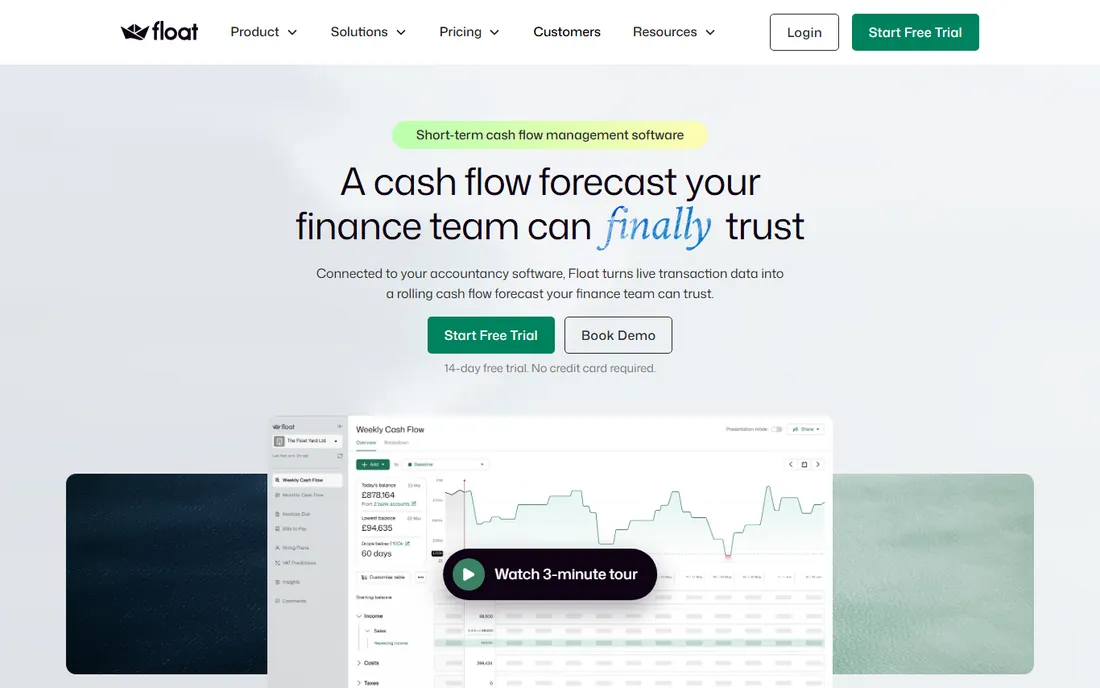
Float answers the question every SMB owner asks: what does cash look like next month? The rolling forecast syncs daily from reconciled Xero or QuickBooks transactions, so the numbers stay current without spreadsheet maintenance. Scenario planning and receivables/payables visibility turn the forecast into decisions.
The integration footprint is the qualifier. If you run Xero or QuickBooks Online, it works beautifully; anything else, and it does not work at all yet. This is cash-flow forecasting, not FP&A: no consolidation, no driver models across departments. Setup is quick: connect accounting, categorize, forecast. For the cash question on the right stack, nothing beats the always-current view.
What we like- Live rolling cash-flow forecast synced daily from accounting
- 13-week operational view plus monthly forecast to 3 years
- Scenario planning with AR and AP visibility
Watch out for- Integrations limited to Xero and QuickBooks Online
- Cash-flow focused, not full FP&A
#3
Budgyt
Best for: Nonprofits, schools, and multi-department businesses budgeting collaboratively
Visit budgyt.com
Starting priceFrom $399/month, unlimited users (verified on vendor homepage)
Free planNo (demo; vendor offers a free spreadsheet rebuild)
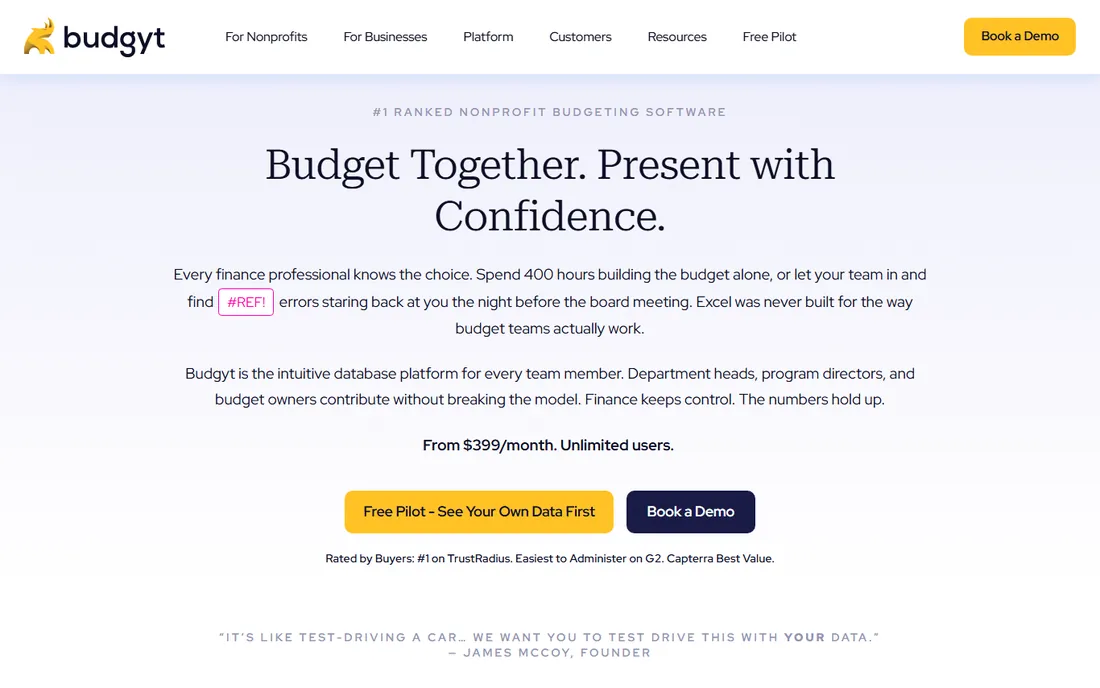
Budgyt solves the collaborative budgeting problem: department heads contribute their numbers without breaking formulas, finance keeps control with permissions, and roll-ups happen automatically. Unlimited users with no per-seat fees makes the economics work for organizations where dozens of people touch the budget.
The $399-per-month floor is honest positioning: this is for organizations, not solo founders. Forecasting and consolidation beyond budgeting run lighter than the FP&A suites. Setup is fast with API mapping to accounting data. For nonprofits, schools, hospitals, and multi-department businesses where the budget process itself is the pain, the database-backed model ends spreadsheet chaos.
What we like- Purpose-built multi-department budgeting with automatic roll-ups and zero broken formulas
- Unlimited users with no per-seat fees
- Rolling reforecasts and full audit trail
Watch out for- Budgeting-focused rather than full FP&A
- $399/month floor is steep for very small organizations
Starting priceSee website (quote-based)
Free planNo (demo only)
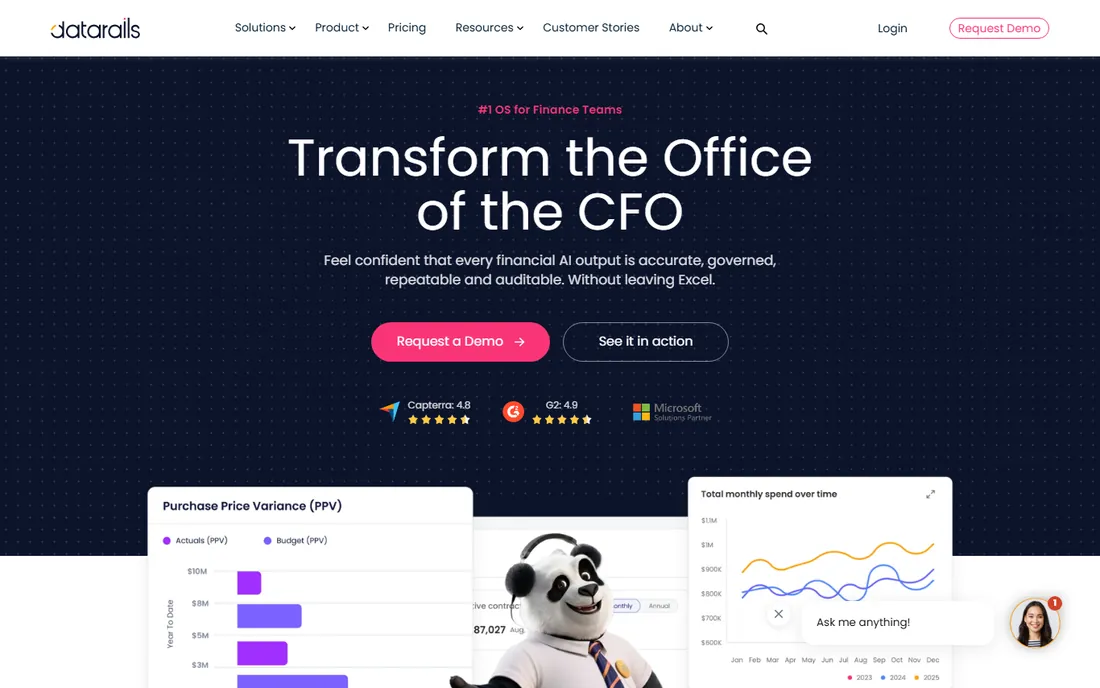
Datarails' insight is that finance teams will not abandon Excel, so it fixes Excel instead. The spreadsheets teams trust keep working, while the platform handles consolidation, permissions, version control, and audit trails behind the scenes. Automated data connections replace the monthly copy-paste ritual.
The fit is specific: Excel-centric finance teams at mid-market scale. Google Workspace shops and teams wanting a new planning UI should look elsewhere. Pricing is quote-only and value scales with team size. Setup involves connecting ERPs and mapping charts of accounts with vendor help. For the large population of finance teams living in workbooks, this is governance without retraining.
What we like- Excel-native FP&A with automated consolidation and live planning
- Connects hundreds of data sources with version control and audit trails
- AI connector links governed data to AI tools
Watch out for- Enterprise quote-only pricing
- Best suited to Excel-centric teams
Starting priceSee website (quote-based)
Free planNo (demo only)
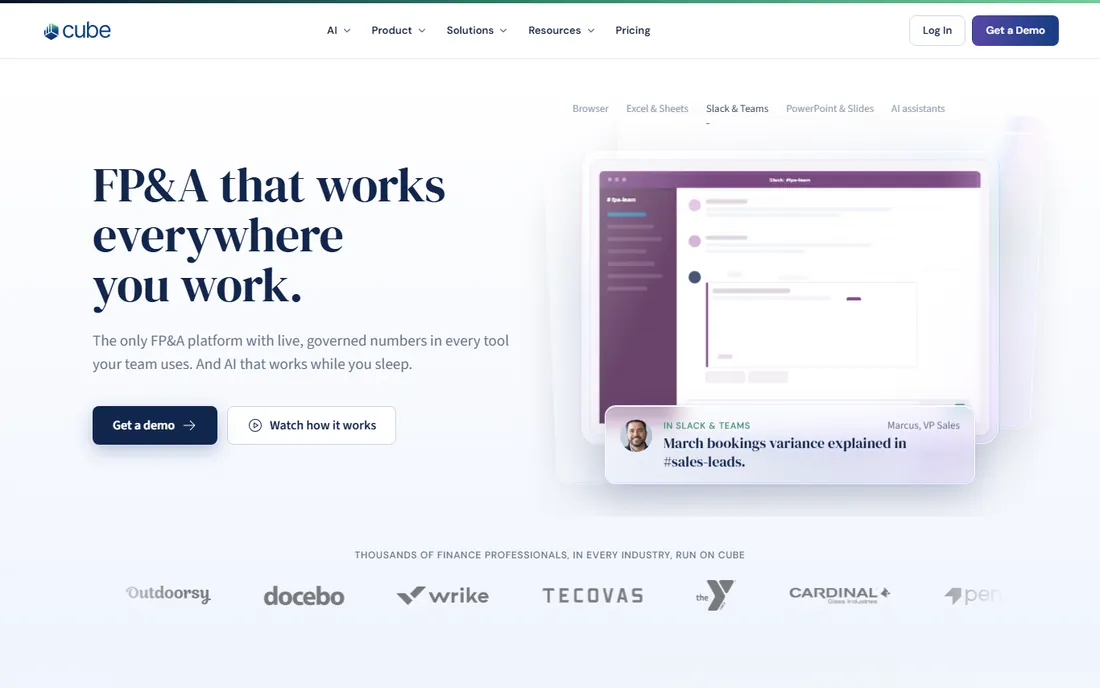
Cube inverts the usual FP&A pitch: instead of a new interface, it puts a governed data layer underneath the tools teams already use. Numbers stay consistent whether someone works in Excel, Google Sheets, PowerPoint, or Slack. Driver-based planning with rolling forecasts and scenarios runs on that single source of truth.
The honest requirement is model design. The platform does not eliminate the need for finance ownership of drivers and logic; implementation quality depends on it. Setup starts with one workflow and expands. For FP&A teams tired of reconciling five versions of the truth across tools, the "work where you already work" model is the appeal.
What we like- Governed finance layer syncing into Excel, Sheets, PowerPoint, Slack, and AI assistants
- Top-ranked for ease of use and setup
- Driver-based planning with rolling forecasts
Watch out for- Quote-only pricing
- Model design still needs real finance ownership
Starting priceSee website (quote-based; Professional and Complete plans)
Free planNo (demo only)
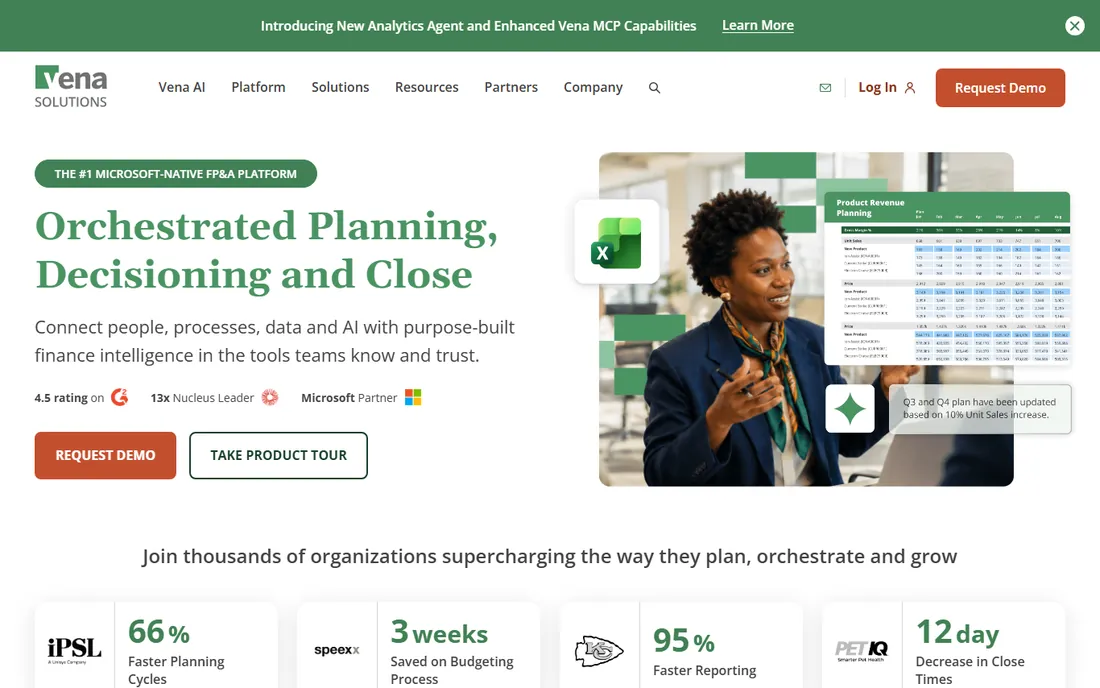
Vena plans inside Excel but runs on a real database. The CubeFLEX OLAP engine replaces fragile linked workbooks with governed dimensionality, while finance keeps the interface they know. AI agents surface planning, reporting, and scenario help in Teams and Excel, and Power BI dashboards complete the reporting loop.
The ecosystem commitment is total: this is for organizations standardized on Microsoft 365, full stop. Pricing is sales-led with Professional and Complete plans. Setup is a guided implementation. For Microsoft shops wanting Excel familiarity with database integrity, Vena is the native choice. For everyone else, the lock-in outweighs the familiarity.
What we like- Microsoft-native planning inside Excel backed by a real OLAP engine
- AI agents for planning and scenarios in Teams and Excel
- Complete planning from budgeting to close with Power BI dashboards
Watch out for- Quote-only pricing
- Microsoft-centric approach disadvantages Google Workspace shops
#7
Fathom
Best for: Accounting firms and multi-entity businesses needing reporting plus forecasting
Visit fathomhq.com
Starting priceSee website (pricing not published on vendor site)
Free plan14-day free trial (no credit card required)
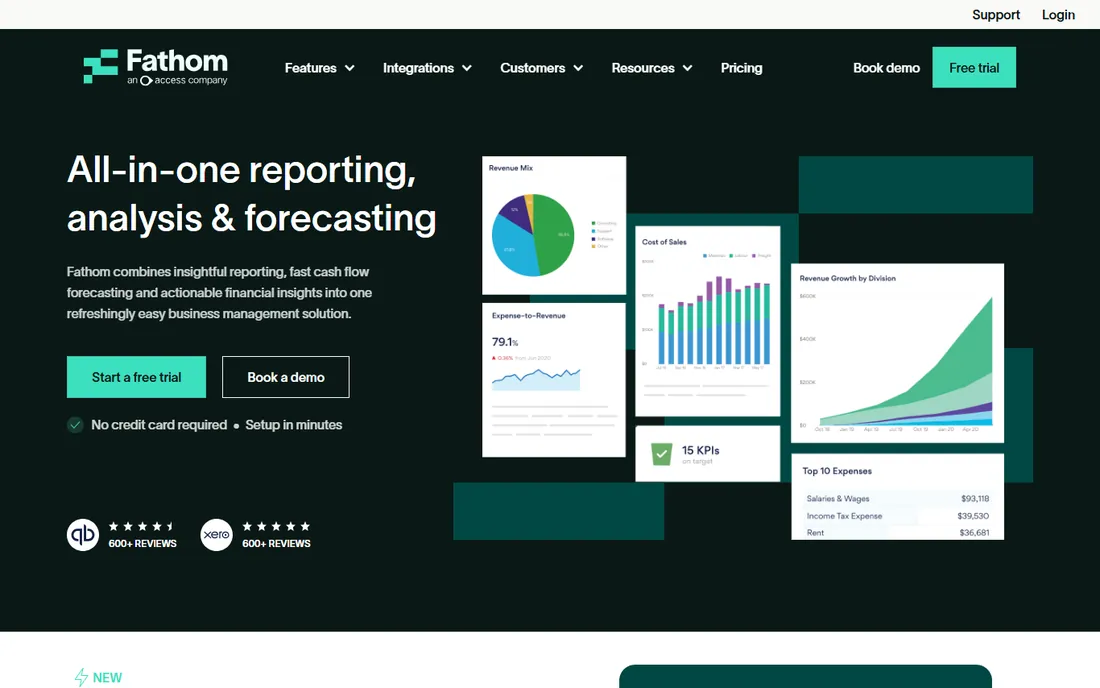
Fathom serves the advisor channel and the businesses they advise: board-ready reporting with visual KPI analysis that clients actually read, plus consolidation with intercompany eliminations and cash-flow forecasting. Multi-entity businesses get group views and benchmarking without a separate consolidation tool.
Pricing opacity is the friction; talk to sales, and note the packaging leans toward accounting firms, which can confuse direct business buyers evaluating it standalone. Setup takes minutes via accounting integration. For firms offering advisory services or multi-entity groups needing credible reporting plus forecasting, the combination is strong.
What we like- Reporting, analysis, consolidation, and cash-flow forecasting in one platform
- Multi-entity consolidation with group benchmarking
- Direct Xero, QuickBooks, and MYOB integrations
Watch out for- Pricing not published
- Advisor-oriented packaging can confuse direct buyers
#8
Jirav
Best for: Small to midsize companies and firms offering FP&A advisory
Visit jirav.com
Starting priceSee website (vendor schema lists a $100-$750/month range; tiers not published)
Free planNo (demo only)
Jirav gets small companies from accounting data to a dynamic forecast fast: driver-based P&L, balance sheet, and cash flow with actuals-vs-budget reporting in days rather than months. Industry templates give startups and firms a head start on KPIs and board reporting.
The pricing transparency gap is the annoyance: a published range exists but plan tiers do not, so the real number comes from sales. Positioned above simple budgeting tools, it needs to earn the premium with forecasting depth. Setup connects accounting, workforce, and operational data quickly. For SMBs outgrowing spreadsheets and firms productizing FP&A advisory, Jirav hits the middle band well.
What we like- Driver-based 3-statement forecasting with scenario planning
- Industry best-practice templates for KPIs
- Strong fit for SMBs, startups, and accounting firms
Watch out for- Exact plan pricing requires a sales conversation
- Premium positioning versus simpler tools
Frequently asked questions
How much does financial forecasting software cost?
LivePlan runs $15 to $40 per month; Budgyt starts at $399 per month flat. The FP&A suites (Datarails, Cube, Vena) and several others price by quote, typically annual contracts scaling with company size. Cash-flow tools (Float, Fathom) offer trials; confirm current pricing on each vendor's site.
Should we buy FP&A software or build spreadsheet models?
Spreadsheets work until they do not: the breaking points are multi-entity consolidation, version chaos, and permission control. If two people have ever edited "the final model" simultaneously, you have outgrown spreadsheets. FP&A tools keep the spreadsheet interface (Datarails, Vena, Cube) while fixing the governance underneath.
What is driver-based forecasting?
Models built on business drivers (headcount, conversion rates, unit costs) rather than flat growth percentages. Change a driver and the whole forecast updates consistently. It takes more setup than trend extrapolation but produces forecasts that survive contact with operational reality. Jirav, Cube, and Vena lead here.
Do we need cash-flow forecasting or full FP&A?
Cash-flow forecasting answers "can we make payroll"; FP&A answers "where should we invest." SMBs usually need the first; growing companies need both; enterprises need the second with consolidation. Buy for the question you actually ask monthly.
How long does implementation take?
Days for LivePlan, Float, or Budgyt. Weeks for Jirav or Fathom with data connections. Months for Datarails, Cube, or Vena with driver-model design and ERP integration. The chart of accounts mapping is the usual long pole; clean it before the project starts.
Can these tools replace our accountants?
No. They replace spreadsheet drudgery and give advisors better numbers faster. The judgment (which drivers matter, what scenarios to run, what the numbers mean) stays human. Firms using Fathom or Jirav productively sell more advisory, not less accounting.
How we chose
We started with the searches buyers actually run: best financial forecasting software and its variants. For each candidate we opened the vendor's own homepage and pricing page, recorded verified 2026 prices where the vendor publishes them (LivePlan, Budgyt) and marked "See website" elsewhere, and compared forecasting depth, integration footprint, and company-size fit against practitioner discussion and public reviews.
Sources we checked (8)
- https://floatapp.com/
- https://www.fathomhq.com/
- https://www.liveplan.com/pricing
- https://www.datarails.com/
- https://www.cubesoftware.com/
- https://venasolutions.com/
- https://jirav.com/
- https://budgyt.com/
Is your product missing or out of date?
We review this list regularly. Vendors can request a listing, send updated pricing or ask about featured placement.

Shihab Mia · Founder, Rankite
Shihab has 5+ years in B2B and SaaS SEO. He writes Rankite's software buying guides from pricing pages, documentation and public user reviews. More about Shihab.