How we make this list: we compare pricing pages, product documentation and public user reviews. Ratings come from G2, Capterra or Trustpilot, with the date we checked them.
Key takeaways
- BlackLine is the best enterprise pick for automating account reconciliations, transaction matching, and close task management at scale.
- FloQast is the best fit for mid-market accounting teams that want to organize the close without a heavy implementation.
- Numeric suits high-growth startups that want a modern, fast-to-deploy close platform with real-time visibility.
- AutoRek is the specialist for financial services firms reconciling high volumes of cash, securities, and fee transactions.
- ReconArt is worth a look for teams that want user-configurable matching rules without heavy IT involvement.
Quick comparison
| Tool | Best for | Starting price | Free plan |
|---|
 BlackLine BlackLine | enterprise reconciliation and close automation | See website | See website |
 FloQast FloQast | mid-market close management | See website | See website |
 AutoRek AutoRek | financial services reconciliation | See website | See website |
 Trintech Trintech | record-to-report for mid-market and enterprise | See website | See website |
 Numeric Numeric | modern close platform for growing companies | See website | See website |
 Solvexia Solvexia | automating reconciliations and reporting processes | See website | See website |
 ReconArt ReconArt | configurable reconciliation for finance teams | See website | See website |
Is your product missing or out of date?
We review this list regularly. Vendors can request a listing, send updated pricing or ask about featured placement.
The best financial reconciliation software
Starting priceSee website
Free planSee website
BlackLine pioneered the cloud financial close market, and its reconciliation module remains the benchmark for large companies. Account reconciliations, transaction matching, journal entries, and close task management live in one controlled environment with approval workflows and a complete audit trail. Auditors like it because every balance ties to supporting documentation.
That depth comes with enterprise weight. Pricing is quote-based, implementations run for months, and the platform assumes a sizable accounting organization. Smaller teams will find simpler tools faster to value. For multi-entity enterprises with strict control requirements, though, BlackLine is the safe default.
What we like- Comprehensive reconciliation, matching, and task management
- Strong controls and audit trail for compliance
- Deep ERP integrations
Watch out for- Enterprise pricing and implementation effort
- Complexity can overwhelm smaller teams
Starting priceSee website
Free planSee website
FloQast was built by accountants who were frustrated with generic workflow tools, and it shows. The close checklist, reconciliation templates, and flux analysis map to the actual month-end routine, and because it layers onto your ERP and Excel rather than replacing them, adoption is unusually smooth. Mid-market teams often go live in weeks.
It is primarily a close management platform with reconciliation features, not a matching engine first. Teams with very high transaction volumes or complex matching logic may need a specialist like AutoRek alongside it. But for organizing and accelerating the close, FloQast's usability advantage is real.
What we like- Accountant-designed workflows that mirror how teams actually close
- Fast implementation measured in weeks
- Integrates with existing ERPs and Excel
Watch out for- Advanced matching rules trail dedicated reconciliation engines
- Pricing scales with entity count
Starting priceSee website
Free planSee website
AutoRek has spent three decades on one problem: reconciling the massive, messy transaction flows of financial institutions. Its rules-driven engine handles cash, securities, fees, and intercompany reconciliations at volumes that break generic tools, and the regulatory reporting features address the compliance burden banks and asset managers live under. The Glasgow-based vendor serves some of the world's largest financial firms.
Corporate accounting teams outside financial services will find the positioning narrow. This is not a general close management tool; it is a reconciliation specialist for regulated, high-volume environments. If that describes your world, few tools match its depth.
What we like- Purpose-built for banking, asset management, and insurance volumes
- Rules-driven matching handles complex scenarios
- Strong regulatory reporting
Watch out for- Financial services focus means less fit for general corporate accounting
- Enterprise sales process
Starting priceSee website
Free planSee website
Trintech covers the record-to-report process end to end, with Cadency serving large enterprises and the Adra suite aimed at mid-market teams. Reconciliation, transaction matching, close task management, and compliance reporting come as an integrated set, which appeals to finance leaders who want one vendor for the whole close. The customer base includes thousands of organizations across industries.
The breadth creates some complexity in choosing the right product and edition. Prospects should get a clear mapping of which modules fit their size during evaluation. Once deployed, though, Trintech's combination of reconciliation depth and close management breadth competes directly with BlackLine at the enterprise tier.
What we like- Broad record-to-report suite covering reconciliation and close
- Cadency for enterprise, Adra for mid-market
- Long track record with large customers
Watch out for- Product lineup can be confusing to navigate
- Implementations vary by module
#5
Numeric
Best for: modern close platform for growing companies
Visit numeric.io
Starting priceSee website
Free planSee website
Numeric is the modern challenger in close management, built for companies that find legacy platforms heavy and spreadsheets chaotic. The interface is clean, the close dashboard shows real-time status across entities, and AI features help explain variances and flag anomalies. Implementation is measured in weeks rather than quarters.
As a newer vendor, Numeric cannot match BlackLine's decades of audit-trail refinement or its deepest enterprise controls. Regulated multi-nationals should evaluate carefully. But for high-growth companies that want a close platform their accountants will actually enjoy using, Numeric is the most interesting option on this list.
What we like- Modern interface with real-time close visibility
- Fast deployment compared with legacy platforms
- AI-assisted flux analysis and anomaly detection
Watch out for- Younger vendor with a shorter track record
- Enterprise-grade controls still maturing
#6
Solvexia
Best for: automating reconciliations and reporting processes
Visit solvexia.com
Starting priceSee website
Free planSee website
Solvexia automates the data processes around reconciliation: blending data from multiple sources, running matching logic, and generating reports, all through a no-code interface finance teams control. Companies use it for bank reconciliations, balance sheet recs, and the reporting packs that surround them. The flexibility appeals to teams whose processes do not fit standard templates.
That generality is also the caveat. Solvexia is a process automation platform applied to finance, not a reconciliation pure-play, so teams wanting deep matching engines should compare carefully. For finance leaders with several spreadsheet-driven processes to automate, the broader toolkit is a genuine advantage.
What we like- Flexible automation beyond reconciliation, including reporting
- Handles complex multi-source data blending
- No-code approach for finance users
Watch out for- Broader automation positioning can blur the reconciliation focus
- Smaller vendor footprint
Starting priceSee website
Free planSee website
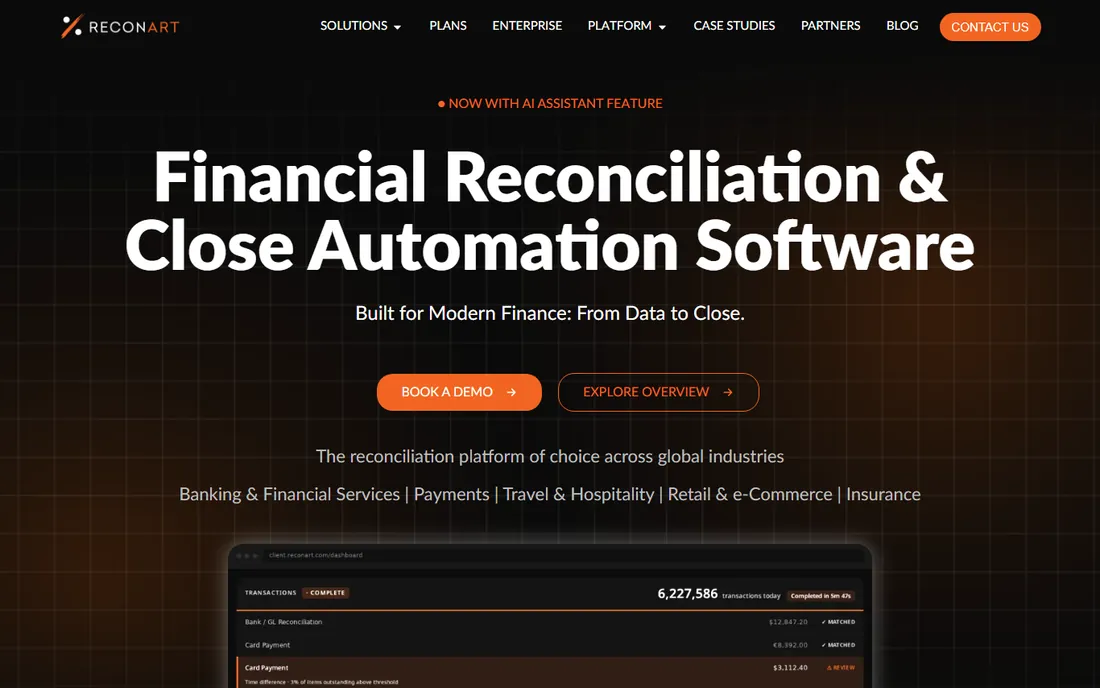
ReconArt gives finance teams control over their reconciliation logic. Users configure matching rules, exception workflows, and approval chains themselves, covering bank, balance sheet, intercompany, and GL reconciliations in one system. The pricing is accessible enough for mid-market teams that find BlackLine out of reach.
It lacks the marketing presence of the leaders, which means fewer peer reviews to consult and a smaller partner ecosystem. But the product itself is capable, and the user-owned configuration model reduces the IT bottleneck that slows many reconciliation projects. Worth including in any mid-market shortlist.
What we like- User-configurable matching rules without IT dependency
- Covers the full reconciliation lifecycle including journals
- Accessible pricing for mid-market
Watch out for- Brand recognition trails the market leaders
- Interface less polished than newer entrants
What to check before you buy
Start by separating close management from transaction matching. Some tools organize the close checklist and reconciliations; others run high-volume matching engines. Many teams need both, which means either a suite or a combination. Map your pain first: if the problem is missed deadlines and messy sign-offs, prioritize close management; if it is millions of unmatched transactions, prioritize matching.
Then evaluate matching logic against your data. Bring real samples of your trickiest reconciliations to the demo: multi-currency transactions, partial payments, timing differences, fee structures. Generic demos use clean data; your evaluation should not. Ask how the system handles exceptions, who configures the rules, and what happens when volumes spike at quarter-end.
Finally, confirm the controls story. Reconciliation software exists to prove numbers are right, so segregation of duties, approval workflows, and audit trails are not nice-to-haves. Ask your auditors what evidence they expect, and make sure the platform produces it without manual workarounds. A short pilot with your own data will reveal more than any sales demo.
Implementation: the part vendors downplay
Reconciliation software fails more often from implementation shortcuts than from product gaps. The most common mistake is underestimating data preparation: mapping chart of accounts, standardizing transaction feeds, and defining matching rules takes real accounting time, not just IT time. Budget your team's hours honestly.
Run a parallel close before going live. Reconcile one full period in both the old and new systems, investigate every difference, and only then switch over. This takes an extra month but catches configuration errors that would otherwise surface during your first audited close. And assign a clear owner on your side; vendor-led projects without an internal champion drift.
Frequently asked questions
What is financial reconciliation software?
It is software that compares financial records from different sources, such as bank statements against the general ledger, to confirm they agree. It automates transaction matching, flags exceptions for investigation, manages approval workflows, and maintains audit trails for the close process.
How much does reconciliation software cost?
Pricing varies widely. Mid-market close tools typically run from tens of thousands per year, while enterprise platforms like BlackLine and Trintech are quote-based and can reach six figures annually depending on entity count and modules. Always get pricing tied to your specific scope.
Can reconciliation software replace spreadsheets?
For standard reconciliations, yes, and that is the main value proposition. Complex or one-off analyses may still live in spreadsheets during transition. The goal is to move recurring, rules-based reconciliations into the system while keeping ad-hoc analysis flexible.
How long does implementation take?
Mid-market tools like FloQast and Numeric typically go live in weeks. Enterprise platforms like BlackLine and Trintech often take several months including data preparation, rule configuration, and parallel close testing. Financial services specialists like AutoRek vary by data complexity.
What is transaction matching?
Transaction matching automatically pairs related records from two sources, such as a bank feed and the cash ledger, based on rules for amounts, dates, and references. Unmatched items become exceptions for accountants to investigate. Good matching engines handle partial matches, timing differences, and multi-currency rounding.
Do auditors accept these systems?
Yes, provided the system enforces proper controls: segregation of duties, approval workflows, and immutable audit trails. Most leading platforms are designed with audit requirements in mind. Involve your auditors early to confirm the evidence format they expect.
How we chose
We selected reconciliation tools that appear consistently in finance technology shortlists on G2, Capterra, and accounting community discussions, covering enterprise suites, mid-market close platforms, and financial services specialists. Each vendor's site was checked to confirm the product is current in 2026. Pricing details come from vendor pages where published; enterprise quote-based pricing is noted as such. No hands-on reconciliation testing was conducted for this guide.
Sources we checked (11)
- https://www.blackline.com
- https://www.floqast.com
- https://www.autorek.com
- https://www.trintech.com
- https://www.numeric.io
- https://www.solvexia.com
- https://www.reconart.com
- https://slashdot.org/software/comparison/FloQast-vs-Trintech/
- https://slashdot.org/software/comparison/Cadency-vs-FloQast/
- https://slashdot.org/software/comparison/AutoRek-vs-ReconArt/
- https://www.g2.com/products/autorek/competitors/alternatives
Is your product missing or out of date?
We review this list regularly. Vendors can request a listing, send updated pricing or ask about featured placement.

Shihab Mia · Founder, Rankite
Shihab has 5+ years in B2B and SaaS SEO. He writes Rankite's software buying guides from pricing pages, documentation and public user reviews. More about Shihab.