How we make this list: we compare pricing pages, product documentation and public user reviews. Rankite is independent; if a vendor ever pays for a featured spot, that listing is clearly labeled Partner.
Key takeaways
- Budgeting and forecasting software splits into two worlds: spreadsheet-based FP&A tools (Datarails, Cube, LiveFlow) that finance teams adopt in weeks, and full enterprise planning suites (Vena, Planful, Prophix, Anaplan-style platforms) that take months to implement.
- Almost nothing in this category publishes pricing. Cube is the exception that anchors expectations: its own site cites plans starting at $30,000 a year. Treat every other quote as negotiable.
- Fathom is the affordable entry point at $59 a month for one company, built for reporting and three-way cash-flow forecasting rather than full FP&A planning.
- Mosaic (the FP&A platform at mosaic.tech, not the unrelated resource-management app with the same name) and Abacum are the modern mid-market picks; Datarails is the safest choice for Excel-first finance teams that do not want to relearn their workflow.
Quick comparison
| Tool | Best for | Starting price | Free plan |
|---|
 Datarails Datarails | Finance teams that refuse to leave Excel | See website (custom quote) | No |
 Mosaic Mosaic | Mid-market FP&A teams that want live business metrics | See website (custom quote) | No |
 Cube Cube | Finance teams that want planning in native Excel and Google Sheets | $30,000/year (starting, per Cube's site) | No |
 Vena Vena | Growing companies that want governed Excel planning | See website (custom quote) | No |
 Planful Planful | Mid-market to enterprise continuous planning | See website (custom quote) | No |
 Prophix Prophix | Finance teams that prioritize reporting depth | See website (custom quote) | No |
 Abacum Abacum | Startups and scale-ups that need FP&A without the enterprise weight | See website (custom quote) | No |
 Fathom Fathom | Small businesses that need reporting and cash-flow forecasting | $59/month (1 company) | Free trial |
 LiveFlow LiveFlow | Finance teams consolidating QuickBooks data in Google Sheets | See website (custom quote) | No |
Is your product missing or out of date?
We review this list regularly. Vendors can request a listing, send updated pricing or ask about featured placement.
The best budgeting and forecasting software
It is the third week of the quarter and the CFO asks a simple question: if revenue lands 10 percent below plan, where does the cash position end up? In a spreadsheet, the answer takes two analysts three days and arrives with a caveat. Budgeting and forecasting software exists to make that answer take ten minutes. The nine tools below cover the real market: spreadsheet-native FP&A platforms, enterprise planning suites and two adjacent-category tools for smaller teams. Prices are quote-only across most of the category, so the honest numbers are the ones vendors publish.
Starting priceSee website (custom quote)
Free planNo
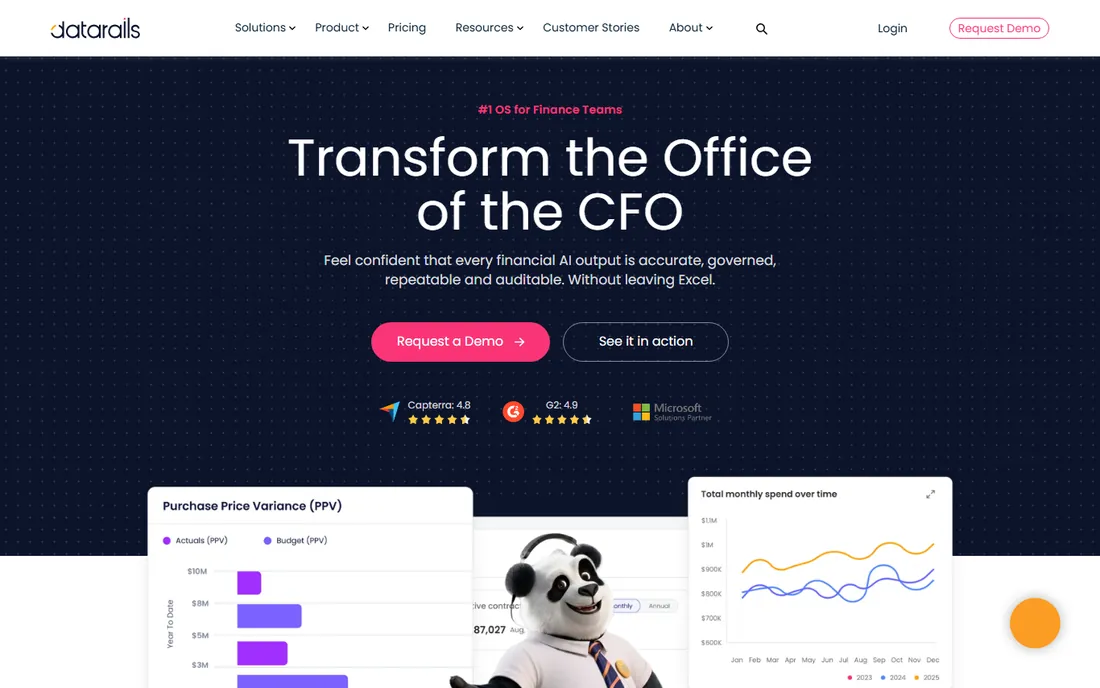
Datarails understood one thing about finance teams: they will not abandon Excel. The platform keeps the spreadsheet as the modeling surface while automating everything around it: data pulls from the ERP and CRM, consolidation across entities, version control and audit trails. Budgets, forecasts and dashboards update when the source data changes instead of when somebody remembers to refresh the file. It is the least disruptive way to get FP&A automation into a team that thinks in workbooks.
The trade-off is that disruption has its price anyway. Datarails is quote-only, implementations typically involve the vendor's team, and annual contracts reflect mid-market software economics rather than SaaS-tool pricing. If your finance team is two people and your model fits in one workbook, this is overkill. If it is ten people maintaining forty interlinked files, the consolidation alone justifies the demo.
What we like- Real Excel integration, so models stay in the tool finance already knows
- Automated data consolidation replaces manual copy-paste from ERP exports
- Strong story for mid-market teams that cannot justify a full EPM suite
Watch out for- Quote-only pricing with implementation services commonly required
- Excel-centric design means teams wanting a modern planning UI should look at Mosaic or Abacum
- Advanced AI features are newer and less proven than the core consolidation engine
#2
Mosaic
Best for: Mid-market FP&A teams that want live business metrics
Visit mosaic.tech
Starting priceSee website (custom quote)
Free planNo
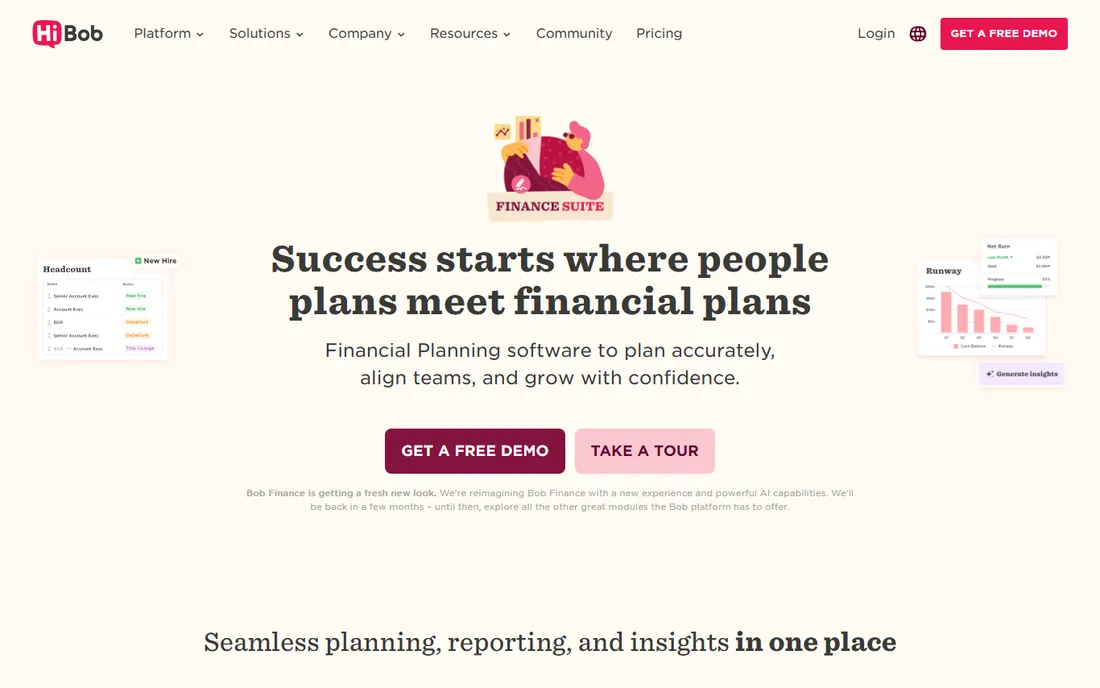
Mosaic is the FP&A platform built for the way modern finance teams actually operate: metrics first, models second. It pulls actuals from the ERP, headcount from the HRIS and pipeline from the CRM, then presents them in live dashboards alongside forecasts and scenarios. The pitch is that the monthly close-to-forecast cycle stops being a manual rebuild and becomes a continuous view. Reviewers praise the speed of getting from raw data to a board-ready forecast.
What it is not: cheap, or instant. Mosaic does not publish pricing, quotes are customized by user count and integrations, and the data-modeling phase takes real calendar time before the dashboards mean anything. It fits mid-market companies with a dedicated FP&A function. A startup with one finance hire gets more value from Abacum or even Fathom until the headcount justifies the platform.
What we like- Real-time metrics and dashboards that update as source systems change
- Purpose-built for FP&A rather than adapted from a generic planning platform
- Strong integrations with NetSuite, QuickBooks and HRIS systems
Watch out for- Custom-quote pricing with no published numbers
- Implementations take weeks of data-modeling work
- Do not confuse it with Mosaic resource management, a different product with a similar name
Starting price$30,000/year (starting, per Cube's site)
Free planNo
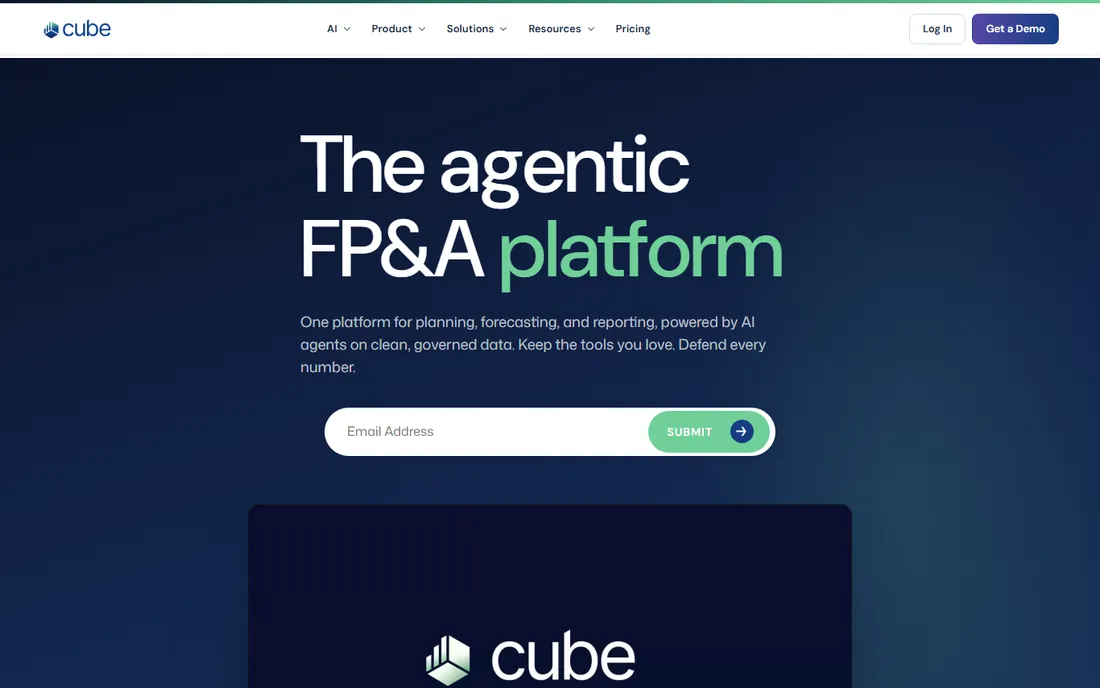
Cube takes the Datarails insight one step further: instead of wrapping Excel, it becomes part of it. Finance teams write familiar spreadsheet formulas that read from Cube's managed multi-dimensional model, so every version of the forecast draws from one controlled dataset instead of forty files. The vendor publishes a starting figure of $30,000 a year, which makes Cube the only tool in this category where the first conversation can start from a number.
That number is also the honest filter. Cube is built for mid-sized and commercial businesses with real FP&A headcount, not for pre-Series A startups. Reviewers consistently praise the Excel integration and fast fetch times, and note that permission management is strong enough for finance-owned models. If your team lives in spreadsheets and has outgrown them, shortlist Cube against Datarails and Mosaic on implementation timeline and integration depth.
What we like- Native Excel and Google Sheets integration with Cube formulas, so the planning surface is already familiar
- Multi-dimensional models without the spreadsheet sprawl
- Its published $30,000-a-year starting point makes budgeting honest
Watch out for- The entry price rules out early-stage startups
- Implementation is quoted as five times faster than legacy competitors but still takes weeks
- Mac compatibility and very large datasets draw occasional reviewer complaints
Starting priceSee website (custom quote)
Free planNo
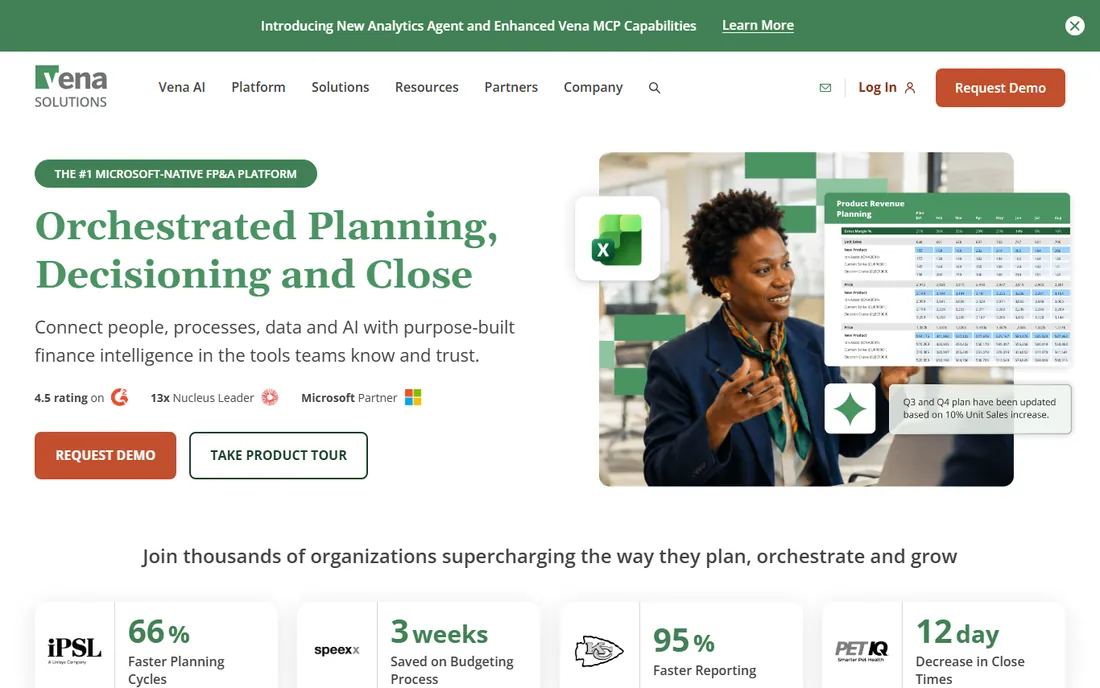
Vena occupies the middle ground between spreadsheet chaos and enterprise EPM. The interface is Excel, which means adoption friction is near zero, but the numbers live in Vena's managed database with workflows, approvals and audit trails. Budget templates, revenue planning and workforce planning ship as starting points rather than blank workbooks. Companies that choose Vena typically say the same thing: we wanted better planning without retraining the entire finance team.
The economics are mid-market enterprise: custom quotes, implementation with the vendor or a partner, annual contracts. Vena's strength is the balance between familiarity and governance, which makes it a natural step up from pure spreadsheets. It is a weaker fit for companies that have already decided to leave Excel behind entirely, where Mosaic or Abacum's native interfaces feel more current.
What we like- Excel remains the interface, with a managed database underneath for control and audit
- Pre-built templates for budgeting, forecasting and financial close shorten implementation
- Scales from mid-market toward enterprise without a re-platform
Watch out for- Quote-only pricing with implementation services typically involved
- Excel-based at heart, so teams wanting a modern web-native planning UI may prefer Mosaic
- Ongoing admin needs a finance owner, not a casual user
Starting priceSee website (custom quote)
Free planNo
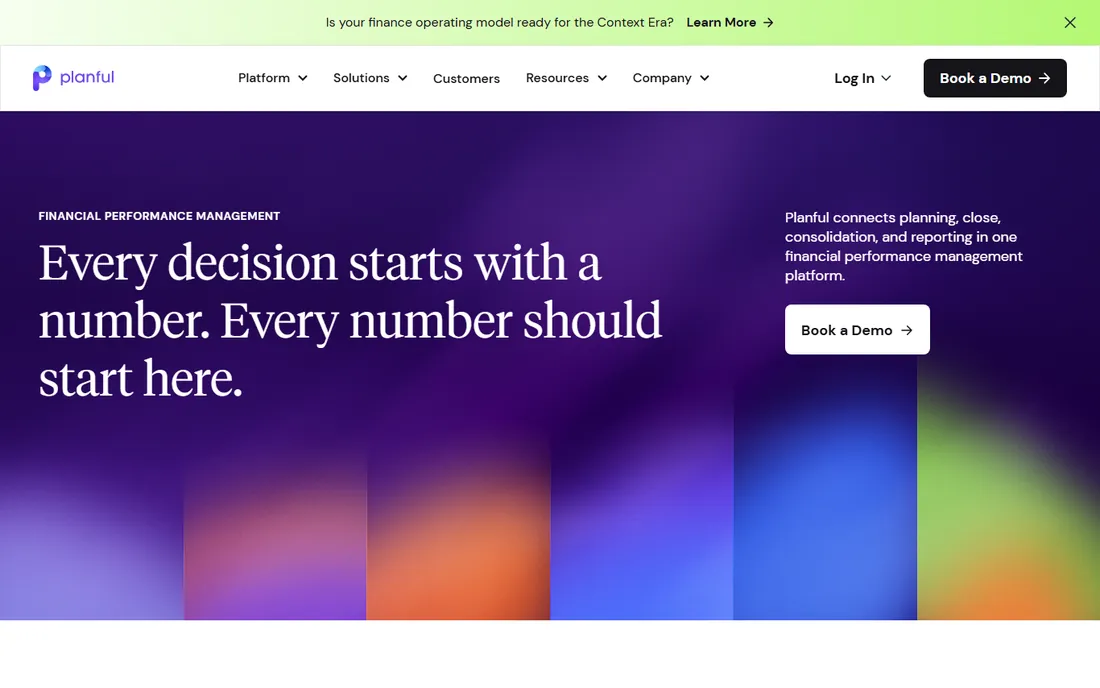
Planful is the full-suite answer: budgeting, forecasting, consolidation, close management, reporting and workforce planning in one platform. Its defining idea is continuous planning, where forecasts roll forward and update as actuals land rather than being rebuilt once a year. For multi-entity companies, the consolidation engine handles intercompany eliminations and currency translation that would take weeks in spreadsheets.
This is a platform purchase, not a tool purchase. Pricing is quote-only, implementations run through the vendor or partners, and the contract reflects enterprise software economics. Planful fits companies with a real FP&A department and multiple entities. A single-entity business with straightforward budgeting gets the same outcomes from Datarails or Cube in less time and for less money.
What we like- Continuous planning model with rolling forecasts, not just annual budgets
- Strong consolidation and close management for multi-entity companies
- Broad integration footprint across ERP, CRM and HRIS
Watch out for- Enterprise pricing and implementation timelines
- The platform's breadth means a longer learning curve than focused FP&A tools
- Smaller teams will pay for capability they never touch
Starting priceSee website (custom quote)
Free planNo
Prophix has been in corporate performance management for decades, and the reporting depth shows it. Ad-hoc analysis, detailed financial statements and management reporting are where reviewers consistently say it outperforms. The platform automates data collection from ERP systems, applies AI-assisted anomaly detection to the numbers and supports detailed budgeting and forecasting workflows. It is the choice of finance teams that produce serious reporting packs every month.
The buying experience is traditional enterprise: custom quotes, services-led implementation, annual contracts. Younger competitors market faster time to value, and on that axis Prophix does not win. But for finance leaders who care most about the quality and auditability of the reporting output, the depth here is hard to match. Shortlist it against Planful and Vena on reporting requirements, not on speed.
What we like- Deep financial reporting and ad-hoc analysis, frequently cited as the product's strongest area
- Automated data integration from ERP and other sources
- AI-assisted anomaly detection and forecasting in recent releases
Watch out for- Quote-only enterprise pricing
- Implementations are services-led and measured in months for complex deployments
- The interface feels more traditional than Mosaic or Abacum
#7
Abacum
Best for: Startups and scale-ups that need FP&A without the enterprise weight
Visit abacum.com
Starting priceSee website (custom quote)
Free planNo

Abacum is what happens when FP&A software is designed for companies with one to five finance people instead of fifty. Headcount planning, which is the first thing that breaks in a startup spreadsheet, is a first-class feature. Forecasts connect to live actuals from the accounting system, scenarios model fundraising and hiring plans, and the interface is modern enough that founders and department heads can read the numbers without a finance translator. Implementation is measured in weeks.
The trade-off is ceiling. Abacum does not match the consolidation depth of Planful or the reporting engine of Prophix, and companies with dozens of entities will outgrow it. Pricing is quote-only, though deal sizes reflect the mid-market positioning. For a Series A to Series C company hiring its first FP&A analyst, Abacum is the most natural fit on this list.
What we like- Built for lean finance teams, with faster implementation than the enterprise suites
- Native headcount planning, a common startup pain point
- Modern interface that non-finance stakeholders can actually read
Watch out for- No published pricing
- Less depth than Planful or Prophix for complex multi-entity consolidation
- Newer vendor, so the reference customer base is thinner than the incumbents
#8
Fathom
Best for: Small businesses that need reporting and cash-flow forecasting
Visit fathomhq.com
Starting price$59/month (1 company)
Free planFree trial
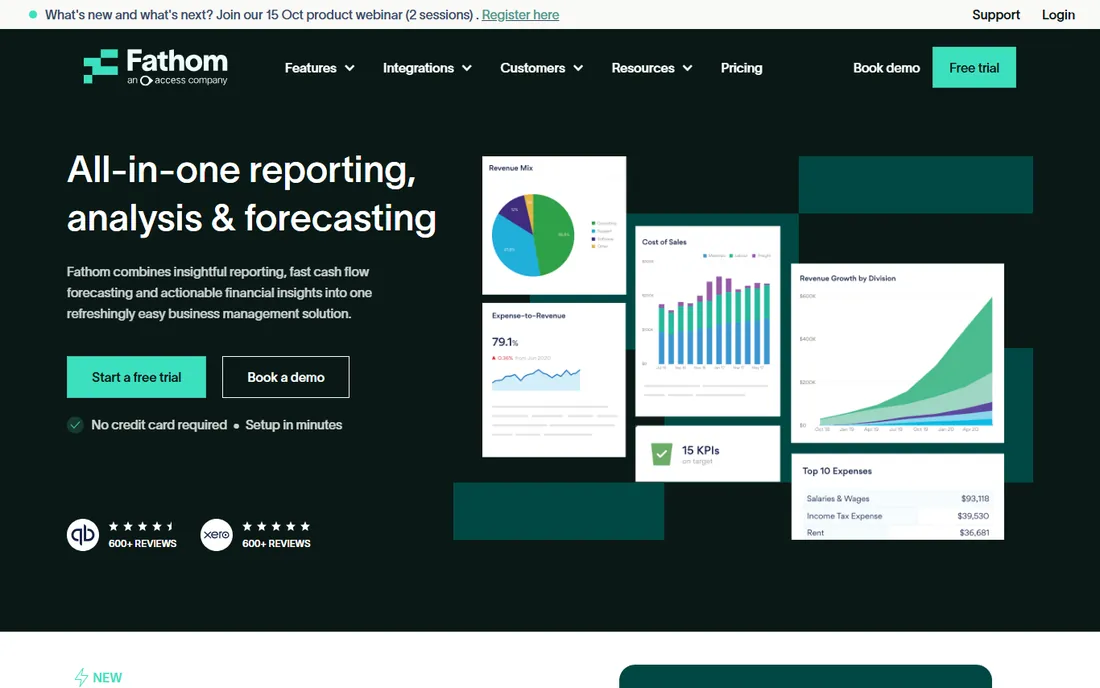
Fathom is the honest adjacent-category entry for smaller businesses. It connects to QuickBooks, Xero, MYOB and Sage, then produces board-quality reports, KPI dashboards and three-way cash-flow forecasts. Pricing is published and per-company: $59 a month for one company on the vendor's pricing calculator, with tiered plans for firms managing multiple companies and unlimited users throughout. A free trial is available.
What it does not do is replace an FP&A platform. There is no workforce planning, no driver-based modeling, no scenario engine beyond the forecasting tools, and it only reads accounting data, so the "why" behind the numbers (pipeline, headcount, marketing spend) stays in other systems. For a small business or an accounting firm serving small clients, that scope is exactly right. For a company hiring FP&A staff, look at the tools above.
What we like- Published per-company pricing with unlimited users on every plan
- Three-way cash-flow forecasting (profit, cash flow, balance sheet) that small businesses actually use
- Group benchmarking and consolidation for up to 300 entities
Watch out for- A reporting and forecasting tool, not a full FP&A planning platform
- Connects only to accounting systems, not CRM, HRIS or other operational data
- No free plan, and multi-company pricing climbs with each entity
#9
LiveFlow
Best for: Finance teams consolidating QuickBooks data in Google Sheets
Visit liveflow.io
Starting priceSee website (custom quote)
Free planNo

LiveFlow solves one problem well: getting live accounting data into Google Sheets without CSV exports. Finance teams build consolidation models, management reports and forecast templates in Sheets, and LiveFlow keeps the underlying numbers refreshed from QuickBooks or Xero across entities and currencies. For firms and finance teams that have standardized on Google Workspace, it removes the most tedious part of the monthly reporting cycle. The newer FinanceIQ product adds AI-assisted analysis on top.
The pricing is the catch. LiveFlow does not publish prices, and third-party sources report custom quotes with minimums around $500 a month and first-year totals near $8,500 including implementation, which is steep for what is essentially a data connector. It also connects only to QuickBooks Online and Xero, and the sync is one-way, so approved budgets cannot flow back into the ledger. Evaluate it against the cost of the manual work it replaces before signing.
What we like- Live QuickBooks and Xero data inside Google Sheets, where finance already works
- Multi-entity consolidation with automated refresh
- FinanceIQ adds AI-assisted analysis on top of the numbers
Watch out for- Custom-quote pricing with reported minimums that surprise small teams
- Connects only to QuickBooks Online and Xero, not NetSuite or Sage Intacct
- Read-only data flow, so budgets cannot be pushed back into the accounting system
Almost nobody in this category publishes pricing, which tells you something about the margins. The anchors that exist: Cube cites plans starting at $30,000 a year, Fathom publishes $59 a month per company, and LiveFlow's reported minimums sit near $500 a month. Everything else is a custom quote, and third-party benchmarks suggest mid-market FP&A contracts commonly land in the mid-five to low-six figures annually once implementation is included. Implementation is the hidden line item: two to six weeks for the modern tools, two to six months for the enterprise suites, with services fees to match. Always ask for the all-in first-year number, including onboarding, integrations and support, before comparing. And negotiate: discounting is common at quarter-end and for multi-year commitments.
How to pick without overbuying
The most expensive mistake in this category is buying the platform you will need in three years instead of the tool you need now. Start from your actual planning process. If the budget lives in one Excel file maintained by one person, you need Fathom or better spreadsheet discipline, not Planful. If forty interlinked workbooks break every quarter, Datarails or Cube will pay for themselves in the first close cycle. If you have a dedicated FP&A hire and live metrics matter, Mosaic or Abacum fit. Multi-entity consolidation with intercompany eliminations points to Planful, Vena or Prophix. The second filter is your source systems: confirm the tool connects to your ERP natively, not through a CSV workaround, and ask whether the sync is scheduled or live. The third filter is ownership: somebody on your team has to own the model after implementation, because a planning platform without an owner becomes an expensive spreadsheet within a year.
How we chose
We worked from vendor pricing pages for the two tools that publish prices (Cube's starting figure and Fathom's per-company pricing), and marked the rest as custom-quote where the vendors do not publish. We checked product documentation for what the planning engines actually do: driver-based modeling, consolidation, scenario planning, headcount planning and cash-flow forecasting. We weighed public review data from G2 and Capterra, analyst coverage and finance-team discussions, and we filtered for fit with US small and mid-size companies: implementation time, Excel compatibility, integration depth with common ERPs and whether the pricing model fits the buyer's stage. No tool on this list was tested hands-on; the ranking reflects documented capabilities, verified prices and realistic buyer fit.
Frequently asked questions
How much does budgeting and forecasting software cost?
Mostly quote-only. The published anchors: Cube cites plans starting at $30,000 a year, Fathom publishes $59 a month per company, and LiveFlow's reported minimums sit near $500 a month. Third-party benchmarks suggest mid-market FP&A contracts commonly land in the mid-five to low-six figures annually including implementation. Always get the all-in first-year number in writing.
What is the difference between FP&A software and budgeting software?
Budgeting software typically covers the annual budget cycle. FP&A software is broader: rolling forecasts, scenario modeling, headcount planning, management reporting and analytics on top of the budget. Most tools on this list cover both, but Fathom and LiveFlow sit closer to reporting while Planful and Prophix cover the full FP&A scope.
Can we just keep using Excel for budgeting?
Many companies do, well past the point where they should stop. The signals to switch: version-control chaos across linked workbooks, a close process that takes weeks, forecasts that are stale before they are finished, or headcount planning that breaks every quarter. Tools like Datarails and Cube keep Excel as the interface while fixing the underlying problems.
Which budgeting tool is best for a startup?
Abacum is built for lean finance teams at startups and scale-ups, with headcount planning as a first-class feature. Fathom at $59 a month covers reporting and cash-flow forecasting for very small teams. Mosaic fits once there is a dedicated FP&A function. The enterprise suites are overkill before Series C in most cases.
How long does implementation take?
Modern FP&A tools like Abacum, Mosaic and Cube typically go live in two to eight weeks. Datarails and Vena commonly take longer because of data-modeling work. Enterprise suites like Planful and Prophix are measured in months for complex multi-entity deployments. Ask the vendor to commit to a go-live date.
Do these tools replace our ERP's planning module?
Sometimes. ERP planning modules are convenient but rarely best-in-class for forecasting and scenario modeling. Dedicated FP&A tools offer deeper planning logic, better reporting and faster model changes. The trade-off is another system to integrate and another contract to manage. Companies with simple planning needs often stay with the ERP module.
Sources we checked (13)
- https://www.cubesoftware.com/pricing
- https://www.fathomhq.com/lp/accounting-management-na-1
- https://www.datarails.com/
- https://www.mosaic.tech/
- https://www.venasolutions.com/
- https://www.planful.com/
- https://www.prophix.com/
- https://www.abacum.com/
- https://www.liveflow.io/
- https://www.vendr.com/marketplace/mosaic-tech
- https://coefficient.io/liveflow-pricing
- https://coefficient.io/liveflow-vs-fathomhq
- https://www.cubesoftware.com/blog/mosaic-tech-alternatives?hs_amp=true
Is your product missing or out of date?
We review this list regularly. Vendors can request a listing, send updated pricing or ask about featured placement.

Shihab Mia · Founder, Rankite
Shihab has spent more than a decade helping SaaS and e-commerce brands grow through search. He writes Rankite's software buying guides from pricing pages, documentation and public user reviews. More about Shihab.