How we make this list: we compare pricing pages, product documentation and public user reviews. Ratings come from G2, Capterra or Trustpilot, with the date we checked them.
What is a feature store and why do ML teams need one
A feature store is the shared layer between raw data and machine learning models. It stores features in two places at once: an offline store for model training, and an online store that serves the same features at low latency for live predictions. One feature definition drives both paths, so the values a model saw in training match the values it sees in production.
The problem it solves is training-serving skew. Without a feature store, a data scientist builds features in a notebook, an engineer reimplements them in a serving service, and the two versions drift apart. Point-in-time correctness is the other core job: a team training a model must join each example to the feature values that existed at that moment, not to the latest values. Features also get versioned, documented, and shared across teams, with access control and lineage on top, which matters once a model touches regulated decisions such as credit or fraud. For a small team with one batch model, a feature store may be more machinery than needed.
How to choose a feature store for your team
Start with where your data already lives. A team on Databricks gets the most from the Databricks feature store, a team on Snowflake from the Snowflake feature store, and a team on AWS or Google Cloud from the matching cloud option.
Next, decide how much real-time serving you actually need. Batch scoring once a day needs little more than a warehouse table and a scheduled job. Fraud detection, recommendations, and personalization need features in single-digit milliseconds, which calls for a dedicated online store such as Redis, DynamoDB, or Bigtable, plus streaming ingestion. Ask each vendor how fast a new value becomes visible and what latency a lookup takes under load.
Check the transformation story and the governance. Some feature stores compute features in SQL, some in Python, and some in Spark or Flink, and the language your data scientists already use matters. Windowed aggregates over event streams are the hardest part of feature engineering, and not every product handles streaming well. Confirm that features are versioned, that training sets can be reproduced, and that access can be restricted per feature or per team. On cost, most feature stores bill in two parts, offline and online, and the online store is usually the expensive half at high query volume.
What does feature store software cost in 2026
There is no single price for a feature store, because the products bill in different ways. Open source options such as Feast and Featureform cost nothing for the software itself, and the bill is the cloud infrastructure underneath plus the engineering time to run it. Cloud native options such as SageMaker, Vertex AI, Snowflake, and Databricks bill by usage: storage, read and write units, node hours, or compute credits. Managed platforms such as Tecton publish no public price and quote per deployment.
The honest way to compare them is to price the same workload on each: the same number of features, the same read rate, and the same freshness requirement. A small team serving 50,000 predictions a day can run an open source feature store for roughly the cost of a small database and a server. A large team will find the online store dominates the bill on every platform. Always ask for the online serving cost at your peak rate before signing.
Quick comparison
| Tool | Best for | Starting price | Free plan |
|---|
 Tecton | Enterprise teams that need managed real-time feature pipelines | quote (no public price; checked 21 Nov 2026) | No free plan; trial available on request |
 Feast | Teams that want a free open source feature store they control | Free (open source, Apache 2.0; checked 21 Nov 2026) | Yes, the full software is free and open source |
 Databricks Feature Store | Teams already running their data and ML work on Databricks | Usage-based, billed at cost with no premium on top (checked 21 Nov 2026) | No free plan; a 14-day Databricks trial is available |
 Hopsworks | Teams that want a feature store with full MLOps in one platform | Free tier; managed pay-as-you-go from $0.35 per compute credit (checked 21 Nov 2026) | Yes, a free tier with one project and capped capacity |
 Snowflake Feature Store | Teams whose data and ML work already live in Snowflake | Usage-based; Feature Store Online Service from 0.76 Platform Credits per hour (XS), with on-demand Platform Credits from $2.00 each (Standard, AWS US East; checked 21 Nov 2026) | No free plan; Snowflake offers trial credits for new accounts |
 Amazon SageMaker Feature Store | AWS teams that want feature storage inside SageMaker | Usage-based; standard online store storage $0.45 per GB-month, writes $1.25 per million units, reads $0.25 per million units (US East; checked 21 Nov 2026) | No free plan; covered by the AWS free tier only for the first steps |
 Google Vertex AI Feature Store | Google Cloud teams using BigQuery as their offline store | Usage-based; data processing node from $0.08 per hour, optimized serving node $0.30 per hour including 200 GB, Bigtable serving node $0.94 per hour (checked 21 Nov 2026) | No free plan; new Google Cloud accounts get $300 in trial credits |
 Featureform | Teams that want a virtual feature store over infrastructure they already run | Free open source core; managed Redis Feature Form is quote only (checked 21 Nov 2026) | Yes, the open source version is free under the Mozilla Public License 2.0 |
Is your product missing or out of date?
We review this list regularly. Vendors can request a listing, send updated pricing or ask about featured placement.
#1
Tecton
Best for: Enterprise teams that need managed real-time feature pipelines
Visit tecton.ai
Starting pricequote (no public price; checked 21 Nov 2026)
Free planNo free plan; trial available on request
Tecton was founded by the creators of Uber Michelangelo, and it remains the most mature managed feature platform for real-time use cases. Teams define features in Python, and Tecton handles materialization, serving through a gRPC and REST API, and monitoring for freshness and errors. Databricks acquired Tecton in August 2025, so buyers should ask how the roadmap relates to the Databricks feature store before signing. The platform suits enterprises with strict latency needs and the budget for a managed service.
What we like- Fully managed materialization and online serving, strong streaming and time-windowed aggregations, built-in monitoring and data quality checks
Watch out for- No public pricing, so budgeting requires a sales conversation, and the managed platform creates vendor lock-in that export tooling only partly eases
#2
Feast
Best for: Teams that want a free open source feature store they control
Visit feast.dev
Starting priceFree (open source, Apache 2.0; checked 21 Nov 2026)
Free planYes, the full software is free and open source
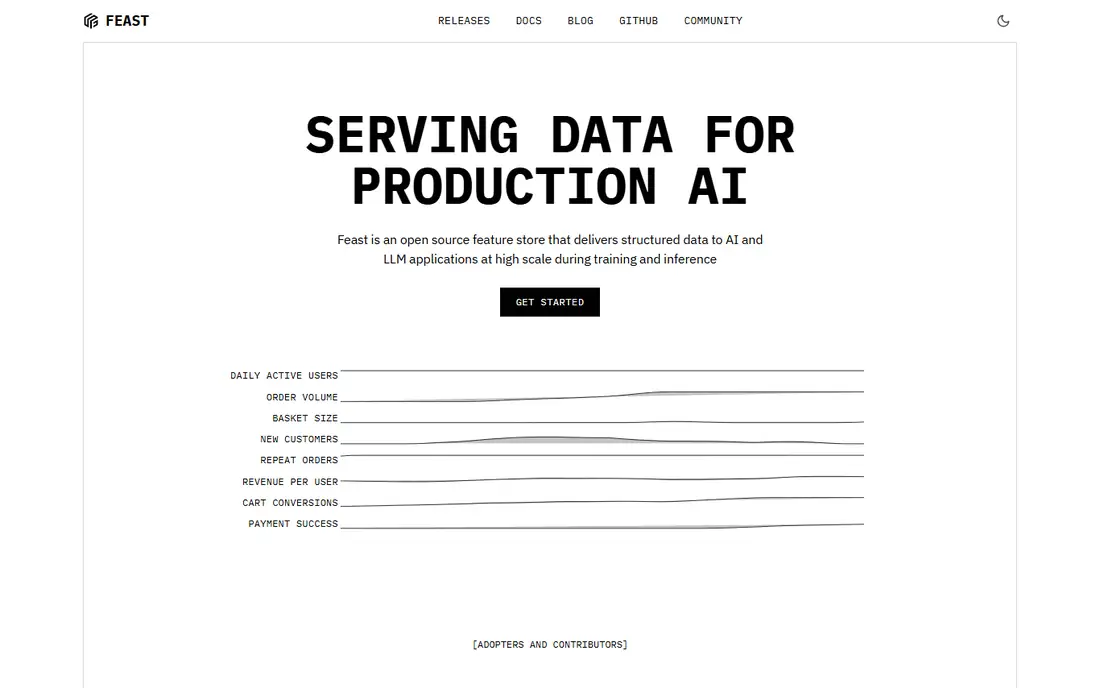
Feast is the open source reference feature store, governed under LF AI and Data, and the default choice for teams that want control without a vendor bill. Features are defined in Python, stored in a registry, materialized into an offline store such as Snowflake, BigQuery, or S3, and served from an online store such as Redis or DynamoDB. Point-in-time joins are built in, with streaming ingestion and a feature server for online reads. The trade is operational: there is no managed Feast service, so the team runs the servers and fixes failed jobs itself.
What we like- No licence cost, wide choice of offline and online stores, large community, point-in-time joins built in, definitions in Python
Watch out for- You operate the infrastructure yourself, so materialization failures, upgrades, and monitoring fall on your own engineers
#3
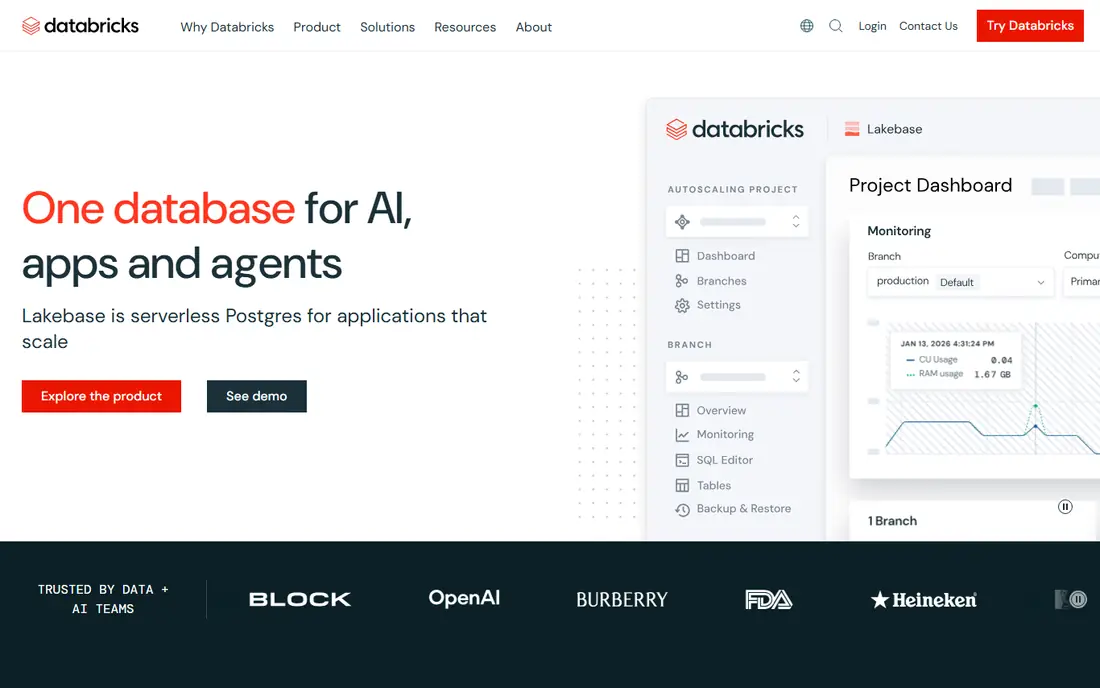
Databricks Feature Store
Best for: Teams already running their data and ML work on Databricks
Visit databricks.com
Starting priceUsage-based, billed at cost with no premium on top (checked 21 Nov 2026)
Free planNo free plan; a 14-day Databricks trial is available
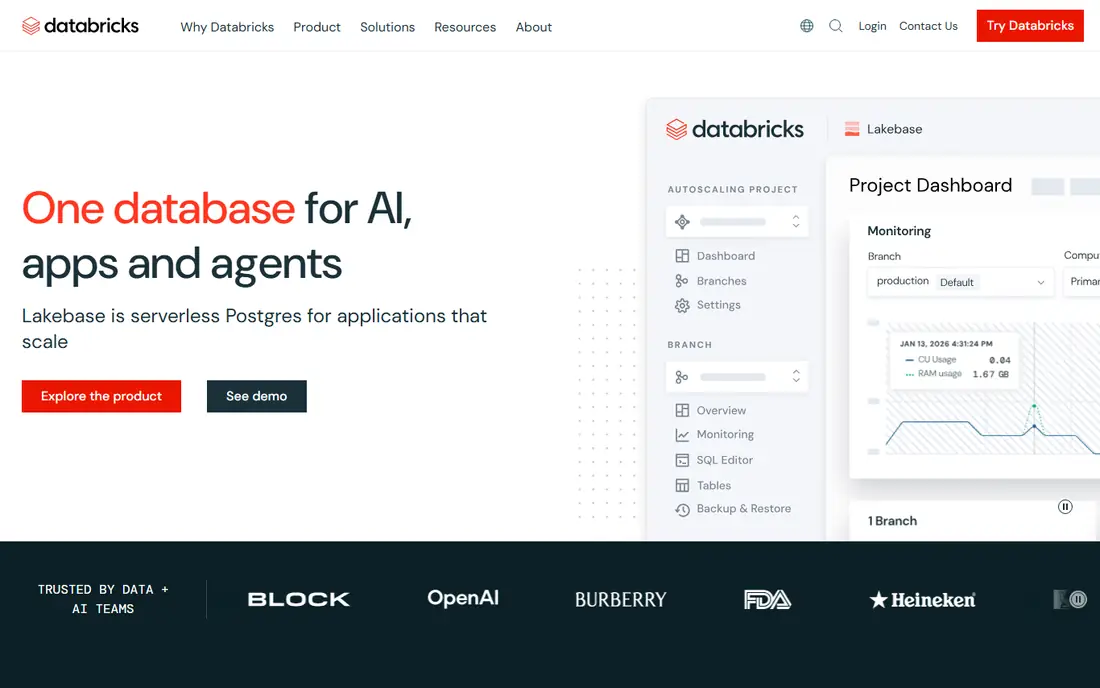
Databricks Feature Store is the lakehouse-native option, and the depth choice now that Databricks owns Tecton. Feature tables are Delta tables governed by Unity Catalog, which gives lineage, access control, and sharing across workspaces. Materialization runs as serverless compute and is billed at cost with no premium, feature serving endpoints bill against the Model Serving SKU, and online stores bill against Lakebase compute. The catch is the platform commitment: the feature store only makes sense inside a Databricks workspace. Databricks is retiring legacy Online Tables after 15 January 2026, with Synced Tables as the migration target.
What we like- Native Unity Catalog governance and lineage, any Delta table with a primary key can act as a feature table, feature serving endpoints built in
Watch out for- Tied to the Databricks platform, so teams outside Databricks get little value, and the usage bill is hard to forecast without careful tagging
#4
Hopsworks
Best for: Teams that want a feature store with full MLOps in one platform
Visit hopsworks.ai
Starting priceFree tier; managed pay-as-you-go from $0.35 per compute credit (checked 21 Nov 2026)
Free planYes, a free tier with one project and capped capacity
Hopsworks is an open source feature store and ML platform built around the first feature store for ML, and it bundles the MLOps tooling most teams need next. Features are defined in Python or SQL, stored in an offline store, and served from an online store with low-latency reads. The platform adds a model registry, feature monitoring, pipelines, and managed notebooks, so a team can run the whole ML lifecycle in one place. A free tier lets a small team start without paying, and managed pay-as-you-go starts at 0.35 dollars per compute credit.
What we like- Feature store plus model registry, pipelines, and notebooks in one platform, open source core, managed serverless option, strong support for streaming features
Watch out for- The full platform is heavier than a standalone feature store, and the enterprise tier is quote-only, so large deployments need a sales conversation
#5
Snowflake Feature Store
Best for: Teams whose data and ML work already live in Snowflake
Visit snowflake.com
Starting priceUsage-based; Feature Store Online Service from 0.76 Platform Credits per hour (XS), with on-demand Platform Credits from $2.00 each (Standard, AWS US East; checked 21 Nov 2026)
Free planNo free plan; Snowflake offers trial credits for new accounts
Snowflake Feature Store keeps features inside the warehouse, so there is no need to copy data into a separate system for training. Feature views are defined in SQL, versioned, and governed by the same roles and masking policies as the rest of Snowflake. Point-in-time correctness comes from ASOF joins over the feature view, and an online service serves features at low latency. Pricing is usage-based: the online service starts at 0.76 Platform Credits per hour for an XS service, and on-demand credits cost 2.00 dollars each on Standard in AWS US East.
What we like- Features live next to the warehouse data, governed by Snowflake roles and masking, ASOF joins for point-in-time correctness, online serving built in
Watch out for- The online service is expensive at high request volume, and feature definitions are immutable, so every edit recomputes the full history
#6
Amazon SageMaker Feature Store
Best for: AWS teams that want feature storage inside SageMaker
Visit aws.amazon.com
Starting priceUsage-based; standard online store storage $0.45 per GB-month, writes $1.25 per million units, reads $0.25 per million units (US East; checked 21 Nov 2026)
Free planNo free plan; covered by the AWS free tier only for the first steps
Amazon SageMaker Feature Store is the central repository for ML features inside AWS, and it fits teams that already train and deploy models in SageMaker. Feature groups hold the data, the offline store sits in S3 for training, and the online store serves features to live endpoints. Teams can choose a standard online store or an in-memory store for lower latency, and throughput can be on-demand or provisioned capacity. Pricing is usage-based: the standard online store charges 0.45 dollars per GB-month for storage, 1.25 dollars per million write units, and 0.25 dollars per million read units in US East.
What we like- Deep integration with SageMaker training and endpoints, choice of standard or in-memory online store, on-demand or provisioned throughput, offline store in S3
Watch out for- Pricing has many meters, so the bill is hard to predict, and the in-memory store carries a minimum storage charge of 5 GiB per hour
#7
Google Vertex AI Feature Store
Best for: Google Cloud teams using BigQuery as their offline store
Visit cloud.google.com
Starting priceUsage-based; data processing node from $0.08 per hour, optimized serving node $0.30 per hour including 200 GB, Bigtable serving node $0.94 per hour (checked 21 Nov 2026)
Free planNo free plan; new Google Cloud accounts get $300 in trial credits
Google Vertex AI Feature Store is the Google Cloud path, and the current version is built directly on BigQuery. Feature views are defined over BigQuery tables, and online serving runs on one of three tiers: a data processing node at 0.08 dollars per hour, an optimized serving node at 0.30 dollars per hour including 200 GB, or a Bigtable serving node at 0.94 dollars per hour. The offline side is BigQuery, billed separately for storage and queries. The legacy feature store will be fully sunset on 17 February 2027, so new projects should use the BigQuery-native version only.
What we like- BigQuery-native offline store, point-in-time serving built in, three serving tiers to match latency and scale, tight integration with Vertex AI training and endpoints
Watch out for- The legacy feature store is sunset on 17 February 2027, so teams must use the BigQuery-native version, and idle serving nodes still bill
#8
Featureform
Best for: Teams that want a virtual feature store over infrastructure they already run
Visit featureform.com
Starting priceFree open source core; managed Redis Feature Form is quote only (checked 21 Nov 2026)
Free planYes, the open source version is free under the Mozilla Public License 2.0
Featureform takes a different angle: instead of standing up new storage, it acts as a virtual layer over the data systems a team already runs. Feature definitions, transformations, and serving are orchestrated on top of Snowflake, Databricks, Spark, Postgres, and other providers, with versioning, lineage, and access control added on top. The open source core is free under the Mozilla Public License 2.0 and runs locally in Docker or on Kubernetes. Redis acquired Featureform in October 2025 and integrated it as Redis Feature Form, and the managed version is quote only.
What we like- No data migration needed, works over Snowflake, Databricks, Spark, and Postgres, versioning and lineage included, open source core
Watch out for- Smaller community than Feast, the managed product is quote-only, and the company was acquired by Redis in October 2025, so the roadmap now runs through Redis
Feature store comparison table
| Tool |
Starting price |
Free plan |
Best for |
Online store |
| Tecton |
Quote |
No |
Managed real-time pipelines |
Managed, Redis or DynamoDB under the hood |
| Feast |
Free, open source |
Yes |
Open source control |
Redis, DynamoDB, Bigtable, and others |
| Databricks Feature Store |
Usage-based, billed at cost |
No |
Databricks teams |
Lakebase online store |
| Hopsworks |
Free tier, from $0.35 per compute credit |
Yes |
Feature store with MLOps |
Managed online store |
| Snowflake Feature Store |
Usage-based, from 0.76 credits per hour |
No |
Snowflake teams |
Snowflake online service |
| Amazon SageMaker Feature Store |
Usage-based, from $0.45 per GB-month |
No |
AWS and SageMaker teams |
Standard or in-memory online store |
| Google Vertex AI Feature Store |
Usage-based, from $0.08 per hour |
No |
Google Cloud and BigQuery teams |
Optimized serving or Bigtable |
| Featureform |
Free open source, managed quote only |
Yes |
Virtual store over existing stack |
Redis online store |
The table shows the real divide in this market. Open source options cost nothing for the software and charge through infrastructure, cloud native options bill by usage inside a platform, and managed platforms quote per deployment. The cheapest starting price is not the cheapest total cost at scale.
We picked real, currently available feature stores with an online and an offline store, point-in-time joins, and a working official site, checked on 21 November 2026. Cloud native options were included because most teams buy the feature store that matches their cloud. Open source options were included because they are the cheapest way to start and the easiest to leave. Prices were taken from vendor pricing pages and documentation where available, and marked quote where the vendor publishes no price.
Frequently asked questions
What is the best feature store software for a small ML team
Feast is the best starting point for a small ML team, because the software is free and open source, the community is large, and the team can run it on a small database and a single server. Hopsworks is the best managed alternative, with a free tier for one project and pay-as-you-go pricing from 0.35 dollars per compute credit. A small team should only pay for a managed platform such as Tecton when it needs strict latency guarantees and has the budget for a quote-only product.
How much does a feature store cost per month
The cost depends on the product and the read volume. An open source feature store such as Feast can run for roughly 90 dollars a month in cloud infrastructure at small scale, plus the engineering time to operate it. Cloud native options bill by usage: SageMaker charges 0.45 dollars per GB-month for storage plus per-million read and write units, Vertex AI serving nodes run from 0.08 dollars per hour, and Snowflake online service starts at 0.76 Platform Credits per hour. Managed platforms such as Tecton publish no price and quote per deployment.
What is the difference between a feature store and a data warehouse
A data warehouse stores raw and cleaned data for analytics, while a feature store stores engineered features for machine learning, with an online store for live serving and an offline store for training. The feature store adds point-in-time joins, feature versioning, and a serving API, which a warehouse does not provide on its own. Many feature stores use a warehouse or lakehouse as their offline store.
Do I need a feature store if I only train models in batch
A team that only trains models in batch and scores them once a day can often manage with a warehouse, scheduled SQL, and a versioned feature table. A feature store becomes worth the investment when the team serves predictions in real time, when training and serving must use identical feature values, or when several teams need to share and reuse features. If none of those apply, a feature store adds machinery without solving a real problem.
Can I migrate from one feature store to another
Migration is possible but takes planning, because feature definitions, transformation code, and historical data all need to move. Open source options such as Feast make migration easier, since the definitions are Python files and the stores are standard databases. Managed and cloud native options tie features to their platform, so moving means rewriting definitions and backfilling history. Before choosing, check whether the offline store uses an open format such as Delta, Iceberg, or Parquet.
Sources we checked (12)
- https://www.tecton.ai
- https://feast.dev
- https://docs.databricks.com/aws/en/machine-learning/feature-store/cost-management
- https://www.databricks.com
- https://www.hopsworks.ai
- https://www.snowflake.com/legal-files/CreditConsumptionTable.pdf
- https://www.snowflake.com
- https://aws.amazon.com/sagemaker/ai/pricing/
- https://cloud.google.com/vertex-ai/pricing
- https://cloud.google.com/vertex-ai
- https://featureform.com
- https://redis.io
Is your product missing or out of date?
We review this list regularly. Vendors can request a listing, send updated pricing or ask about featured placement.

Shihab Mia · Founder, Rankite
Shihab has 5+ years in B2B and SaaS SEO. He writes Rankite's software buying guides from pricing pages, documentation and public user reviews. More about Shihab.