How we make this list: we compare pricing pages, product documentation and public user reviews. Rankite is independent; if a vendor ever pays for a featured spot, that listing is clearly labeled Partner.
Key takeaways
- Almost nobody in family office software publishes a price. That tells you everything about how this category sells: every deal is a custom quote after a sales process.
- FundCount (from $34,099 per year, published) is the only vendor here with a public starting price, and the only true accounting-grade system of record on the list.
- Addepar is the reporting and analytics leader for complex offices; Masttro offers flat feature-based pricing that does not grow with assets.
- European and cross-border families should shortlist QPLIX, Altoo and WealthArc for regional data coverage and multi-currency entity modeling.
Quick comparison
| Tool | Best for | Starting price | Free plan |
|---|
 Addepar Addepar | Single and multi-family offices with complex, multi-entity portfolios | See website (quote-based; third parties estimate $50K-$70K/year entry, unverified) | No |
 FundCount FundCount | Family offices wanting one accounting-grade system of record | From $34,099 per year (Single Family Office, published) | No |
 QPLIX QPLIX | European and cross-border families with complex ownership structures | See website (quote-based; no published pricing) | No |
 Masttro Masttro | Large, complex, multi-jurisdictional family offices | See website (flat annual license; third parties estimate $50K-$250K+/year, unverified) | No |
 Eton Solutions (AtlasFive) Eton Solutions (AtlasFive) | Large family offices wanting software plus outsourced operations | See website (quote-based; no published pricing) | No |
 FINARTIS (Prospero) FINARTIS (Prospero) | Family offices wanting one integrated front-to-back suite | See website (no published pricing) | No |
 Altoo Altoo | Wealthy families and small offices wanting Swiss-hosted consolidation | See website (quote-based; priced by banking relationships) | No |
 WealthArc WealthArc | External asset managers and family offices wanting cloud portfolio management | See website (quote-based; onboarding fee plus AuM-based subscription) | No |
Is your product missing or out of date?
We review this list regularly. Vendors can request a listing, send updated pricing or ask about featured placement.
The best family office accounting software
Almost nobody in family office software publishes a price. That tells you everything about how this category sells: every deal is a custom quote after a sales process, pricing scales with assets or entities or users (sometimes all three), and implementations run months. The products are serious: multi-entity accounting, custodian aggregation, alternative investment tracking, and reporting that satisfies principals, trustees and auditors. But you cannot comparison-shop the way you would for ordinary accounting software. These eight are the platforms family offices actually evaluate, with the pricing reality stated plainly for each.
#1
Addepar
Best for: Single and multi-family offices with complex, multi-entity portfolios
Visit addepar.com
Starting priceSee website (quote-based; third parties estimate $50K-$70K/year entry, unverified)
Free planNo
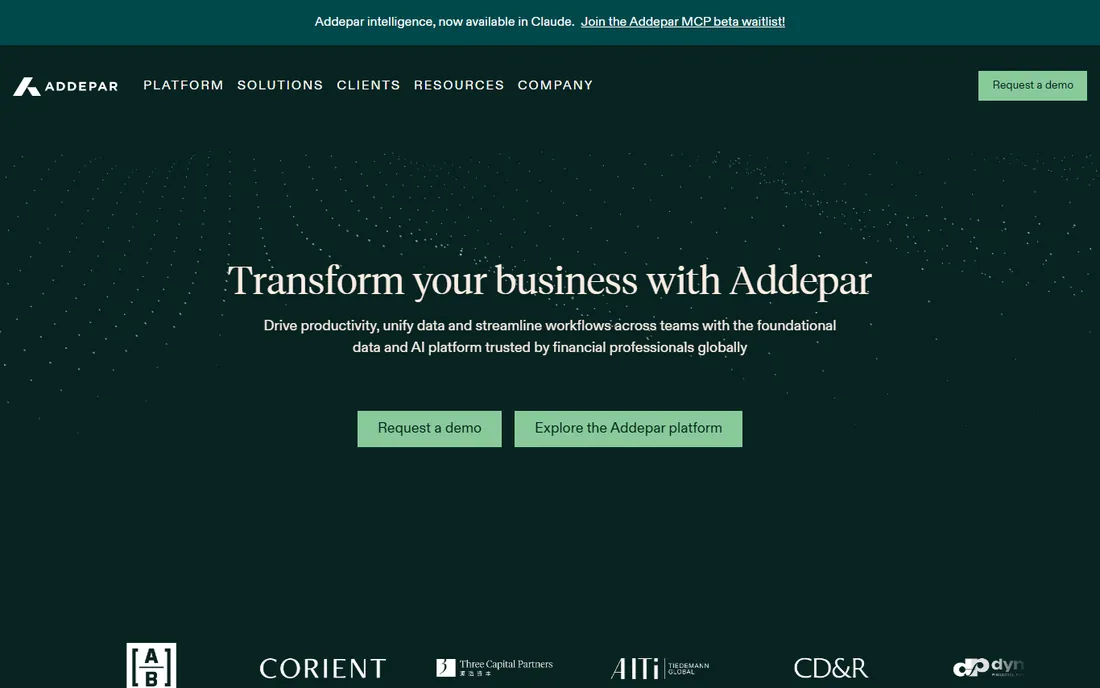
Addepar is the reporting and analytics leader. For an office with many entities, several custodians, meaningful alternatives exposure and multiple generations or jurisdictions, its data aggregation and performance attribution are the deepest in the category. The 2026 launch of Addison AI and a $230 million Series G signal continued investment.
It is primarily a reporting platform rather than a general ledger, so most offices pair it with separate accounting and planning tools. Pricing scales with assets on platform (roughly 0.8 to 3 basis points per third parties, unverified) plus modules and feeds. Smaller offices with simple liquid portfolios will find the depth and implementation lift more than they need.
What we like- Deepest custodian feed and alternative-investment coverage
- Strong performance attribution and flexible reporting
- Large integration ecosystem with APIs
Watch out for- Opaque AUM-scaled pricing among the most expensive
- Implementation runs 60-90 days on clean books, up to a year on complex ones
#2
FundCount
Best for: Family offices wanting one accounting-grade system of record
Visit fundcount.com
Starting priceFrom $34,099 per year (Single Family Office, published)
Free planNo
FundCount is the accountant's choice. Where Addepar reports, FundCount accounts: an integrated multicurrency general ledger, partnership accounting, investment accounting, multi-book support and nested-entity auto-reconciliation, handling equities, derivatives, private equity, real estate and debt in one portfolio view. Contributions, distributions, series and waterfalls come from the same underlying data.
It is also the only vendor here that publishes a starting price ($34,099 per year for a single family office), though final quotes depend on your entities, users, funds and assets. The interface feels institutional next to newer platforms. For offices that run accounting workflows internally and need reconcilable books-to-reporting outputs, this is the system of record.
What we like- Publishes starting prices, unique in this category
- True accounting core with multicurrency GL and partnership accounting
- Multi-book accounting (IFRS and GAAP) with look-through reporting
Watch out for- Institutional, dated UI next to reporting-first platforms
- Pricing scales with entities, users, funds and assets
#3
QPLIX
Best for: European and cross-border families with complex ownership structures
Visit qplix.com
Starting priceSee website (quote-based; no published pricing)
Free planNo

QPLIX is the German-built answer to total-wealth consolidation. Family offices and banks use it to consolidate accounts, custodians, asset classes and ownership structures across countries and currencies, with investment guidelines, forecasting and distribution analysis in one view. The entity modeling suits cross-border families particularly well.
Pricing is entirely custom and unpublished, and US custodian coverage is thinner than Addepar's. Buyers comparing QPLIX should weigh data coverage by region and confirm which custodians are natively integrated before committing to implementation. For a European family with complexity across borders, the regional depth matters more than the brand.
What we like- Strong European data coverage with multi-custodian, multi-currency consolidation
- Granular ownership and entity modeling
- API access for banks and advisors
Watch out for- No public pricing
- US custodian coverage is thinner than US-built competitors
#4
Masttro
Best for: Large, complex, multi-jurisdictional family offices
Visit masttro.com
Starting priceSee website (flat annual license; third parties estimate $50K-$250K+/year, unverified)
Free planNo
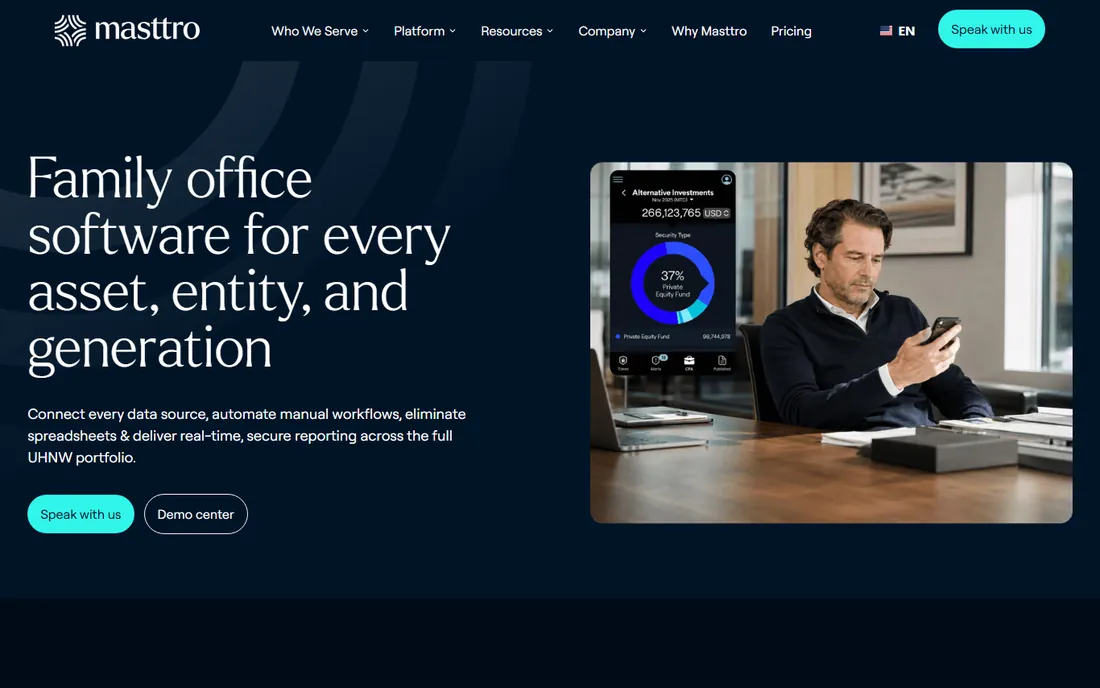
Masttro's pitch is structural: a flat annual license scaled to modules and complexity rather than a percentage of assets, so growth does not raise the bill. Built inside a family office, it models multi-jurisdiction entities well, with client-held encryption keys and Tier 4 Swiss data center hosting for the privacy-conscious. The vendor cites 400-plus family offices across 40-plus countries.
The catch is a long, effortful implementation (6 to 9 months for complex structures) and opaque list pricing until you engage sales. The integration ecosystem is smaller than Addepar's. For a large office that resents AUM-scaled pricing, the flat model is the reason to endure the implementation.
What we like- Flat feature-based pricing that does not grow with AUM
- Built inside a family office with strong multi-jurisdiction modeling
- Client-owned data architecture with Swiss hosting
Watch out for- Implementation typically takes 6 to 9 months
- Smaller integration ecosystem than Addepar
#5
Eton Solutions (AtlasFive)
Best for: Large family offices wanting software plus outsourced operations
Visit eton-solutions.com
Starting priceSee website (quote-based; no published pricing)
Free planNo
Eton Solutions sells the office, not just the software. AtlasFive covers accounting, entity management, trust and fund workflows and reporting, and the Administrative Family Office service bundles the platform with Eton's own middle- and back-office team. The AFO line targets emerging offices from $25 million in assets with deployment in about 30 days.
Pricing is opaque with an enterprise sales process, and it is not a fit for small offices or DIY teams. For a family that wants institutional operations without building them, the software-plus-services bundle is unique on this list. For everyone else, it is more vendor than needed.
What we like- Full front-to-back platform plus outsourcing services in one vendor
- Administrative Family Office targets families from $25M in assets
- Serverless architecture with strong audit controls
Watch out for- No published pricing
- Geared toward larger offices and overkill for simple portfolios
#6
FINARTIS (Prospero)
Best for: Family offices wanting one integrated front-to-back suite
Visit finartis.com
Starting priceSee website (no published pricing)
Free planNo
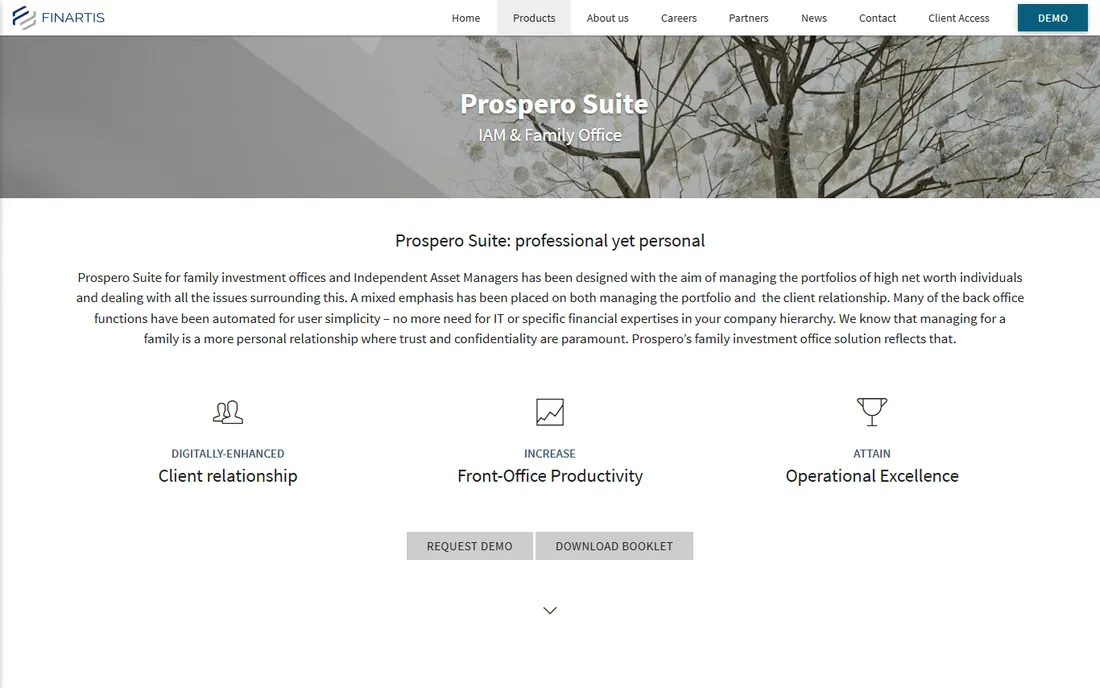
Prospero is the old Swiss hand. One integrated suite for transactional, processing, financial and reporting needs from front office to back office, with two licensing routes: a one-time perpetual license with yearly maintenance (self-hosted or FINARTIS-hosted) or a SaaS monthly fee. For offices that want to own and host the system themselves, the perpetual option is rare in this category.
The interface and deployment model feel legacy next to cloud-native competitors, and independent reviews are scarce. A third-party directory figure of $1,760 per month per user is unverified; treat it as a rough benchmark. Clarify which modules are included and how multi-entity accounting is scoped before signing anything.
What we like- Integrated suite covering wealth management, fund administration and asset management
- Perpetual on-premise license option
- Swiss vendor with tenure since 1986
Watch out for- Legacy interface and deployment model
- Very small public footprint with scarce independent reviews
#7
Altoo
Best for: Wealthy families and small offices wanting Swiss-hosted consolidation
Visit altoo.io
Starting priceSee website (quote-based; priced by banking relationships)
Free planNo
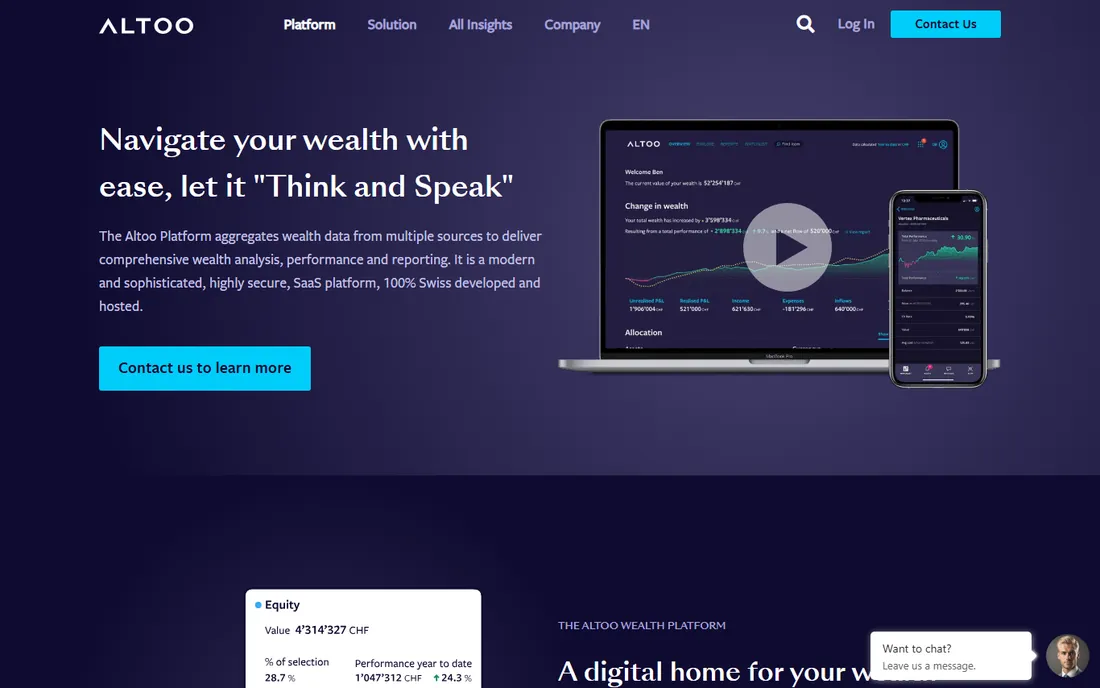
Altoo prices on banking relationships rather than assets, which suits families whose wealth is concentrated in a few custodians. The Swiss-hosted private cloud keeps encryption in-house with nothing outsourced, and the platform covers bankable and non-bankable assets including art, collectibles and vintage cars. Onboarding runs 4 to 8 weeks.
Pricing is opaque (a yearly license by module plus a per-bank data-hygiene fee), and the integration footprint is smaller than the category leaders. Confirm exactly which of your banks are natively supported before signing. For a privacy-focused family that values the Swiss hosting model, the architecture is the selling point.
What we like- Swiss-hosted private cloud with in-house encryption
- Pricing by number of banking relationships, not net worth
- Covers non-bankable assets like art and collectibles
Watch out for- No published pricing
- Smaller vendor with less ecosystem coverage
#8
WealthArc
Best for: External asset managers and family offices wanting cloud portfolio management
Visit wealtharc.com
Starting priceSee website (quote-based; onboarding fee plus AuM-based subscription)
Free planNo
WealthArc is the accessible cloud option. WA Essentials serves smaller family offices and external asset managers while WA Exclusive carries full functionality, and cloud-native deployment means activation in days rather than months of IT work. Portfolio management, governance, KYC, CRM and reporting come bundled, with a limited proof-of-concept period before committing.
Pricing has two components (an onboarding fee plus an annual subscription based on assets under management and portfolio count), and the AuM scaling penalizes growth. US custodian coverage is less proven than the Swiss/European footprint. Get the portfolio-count math in writing before signing.
What we like- Two editions for different office sizes
- Cloud-native with activation in days
- Bundled portfolio management, governance, KYC, CRM and reporting
Watch out for- No published pricing and AuM-based subscription penalizes growth
- Primarily a Swiss/European vendor
The category splits into two jobs. Reporting platforms (Addepar, Masttro, QPLIX, Altoo, WealthArc) aggregate custodian data and produce analytics, attribution and client reporting. Accounting systems (FundCount, Prospero, AtlasFive) run the general ledger, partnership accounting and reconcilable books.
Most family offices need both, which is why Addepar-plus-accounting-tool is such a common stack. Before you buy, decide which job is the bottleneck. If your reporting is spreadsheets and your books are fine, buy the reporting platform. If your books cannot reconcile to your reports, buy the accounting system first. Buying a reporting platform to fix an accounting problem is the most expensive mistake in this category.
How to evaluate family office software
Start with data coverage, because everything else depends on it. List every custodian, bank and alternatives portal the family uses, and confirm native feeds for each: manual uploads will erode whatever the demo promised. Then map the entity structure: multiple generations, trusts, jurisdictions and ownership layers are where weak platforms break.
Next, model the pricing honestly. AUM-scaled pricing (Addepar, WealthArc) grows with the family; flat licensing (Masttro, FundCount's published base) does not; per-entity and per-user scaling (FundCount, FINARTIS) grows with complexity. Get the three-year cost under your actual growth assumptions. Finally, reference-check the implementation: ask two clients at your complexity how long onboarding really took and what internal effort it required. In this category, the implementation is the product as much as the software.
How we chose
We started with the platforms family offices actually evaluate: the reporting leaders, the accounting-grade systems, the European specialists, and the cloud-native options. For each candidate we checked the vendor's own pricing page, compared the architecture (reporting vs. accounting core) and data coverage, and read practitioner discussion and industry directories. Almost no vendor here publishes prices, so where a price could not be verified on the vendor's page we wrote "See website" rather than guessing, and third-party figures are flagged as unverified estimates.
Frequently asked questions
How much does family office software cost?
Almost every vendor is quote-only. FundCount publishes from $34,099 per year. Third-party estimates (unverified) put Addepar entry around $50,000 to $70,000 per year, Masttro at $50,000 to $250,000-plus per year, and the European platforms anywhere from five to six figures annually. Budget six figures for the enterprise platforms plus implementation.
What is the difference between Addepar and FundCount?
Addepar is primarily a reporting and analytics platform: it aggregates custodian data and produces performance attribution and client reporting. FundCount is an accounting-grade system of record: general ledger, partnership accounting and reconcilable books. Many offices use both, with FundCount (or similar) as the books and Addepar as the reporting layer.
Do I need family office software or will QuickBooks work?
QuickBooks handles the bookkeeping for simple structures, but it cannot aggregate custodian feeds, track alternative investments with look-through reporting, or produce consolidated multi-entity family reporting. Once you have multiple custodians, entities or illiquid holdings, purpose-built software earns its keep.
How long does implementation take?
It varies widely. Cloud-native tools (WealthArc, Altoo) activate in days to weeks. Addepar runs 60 to 90 days on clean books and up to a year on complex ones. Masttro typically takes 6 to 9 months for complex structures. The driver is data cleanliness and entity complexity, not the vendor's speed.
Should a small family office buy enterprise software?
Usually not at full scale. A small office with liquid holdings at one or two custodians gets little from Addepar or Masttro beyond cost and implementation pain. Start with the accounting-grade or cloud options (FundCount, WealthArc, Altoo), and graduate when entity complexity or reporting demands justify it.
Sources we checked (9)
- https://addepar.com
- https://fundcount.com/best-family-office-wealth-accounting-software
- https://www.qplix.com
- https://masttro.com
- https://eton-solutions.com
- https://www.finartis.com/iam-family-office/
- https://altoo.io
- https://www.wealtharc.com/faq
- https://www.g2.com/categories/family-office-software
Is your product missing or out of date?
We review this list regularly. Vendors can request a listing, send updated pricing or ask about featured placement.

Shihab Mia · Founder, Rankite
Shihab has spent more than a decade helping SaaS and e-commerce brands grow through search. He writes Rankite's software buying guides from pricing pages, documentation and public user reviews. More about Shihab.