How we make this list: we compare pricing pages, product documentation and public user reviews. Rankite is independent; if a vendor ever pays for a featured spot, that listing is clearly labeled Partner.
Key takeaways
- Oil and gas ERP is really two markets: general ERP giants (SAP, Oracle, Microsoft, Infor) that need industry configuration, and energy-only specialists (Quorum, PakEnergy, Enertia) that ship with upstream accounting built in.
- IFS is the standout for asset-intensive operators: it leads the category among large oil, gas and chemicals companies and absorbed P2 Energy Solutions' upstream products.
- Independent operators should start with the specialists: PakEnergy and Enertia were built for upstream land, production and revenue distribution, not adapted from manufacturing.
- Every vendor here quotes custom pricing, so budget for implementation at two to four times the license cost and ask each vendor for a fixed-scope bid.
Quick comparison
| Tool | Best for | Starting price | Free plan |
|---|
 IFS IFS | Asset-intensive operators and majors needing ERP plus enterprise asset management | See website (custom quote) | No |
 SAP S/4HANA SAP S/4HANA | Large integrated operators standardizing globally on SAP | See website (custom quote) | No |
 Oracle NetSuite Oracle NetSuite | Smaller operators and service companies wanting cloud ERP fast | See website (custom quote) | Free trial (3-day test drive) |
 Microsoft Dynamics 365 Microsoft Dynamics 365 | Companies already running Microsoft 365 and Azure | See website (custom quote) | No |
 Infor Infor | Operators wanting an industry-specific CloudSuite | See website (custom quote) | No |
 Quorum Software Quorum Software | Energy-only workflows across upstream, midstream and downstream | See website (custom quote) | No |
 PakEnergy PakEnergy | Independent upstream and midstream operators | See website (custom quote) | No |
 Enertia Software Enertia Software | Upstream operators wanting one integrated system | See website (custom quote) | No |
 Epicor Epicor | EPC contractors and oilfield service companies | See website (custom quote) | No |
 Aptean Aptean | Asset-heavy operations pairing ERP with maintenance | See website (custom quote) | No |
Is your product missing or out of date?
We review this list regularly. Vendors can request a listing, send updated pricing or ask about featured placement.
The best ERP software for oil and gas industry
An oil company does not buy ERP the way a retailer does. The retailer needs inventory and point of sale. The operator needs joint interest billing, division orders, AFE tracking, revenue distribution to hundreds of royalty owners, and production volumes that reconcile to the dollar with the general ledger. Get any of that wrong and the state auditor or the royalty owner finds it before you do.
That is why generic ERP shortlists fail in this industry. The right question is not which ERP is biggest, but which one understands a division order. The ten platforms below split into the global ERP vendors with dedicated oil and gas industry solutions and the specialists that only serve energy. Both can work. They fail in different ways, and at very different prices.
#1
IFS
Best for: Asset-intensive operators and majors needing ERP plus enterprise asset management
Visit ifs.com
Starting priceSee website (custom quote)
Free planNo

IFS is the vendor oil and gas majors actually standardize on. Independent industry data puts it at the top of the oil, gas and chemicals ERP category among large enterprises, ahead of every generalist. The reason is fit: IFS Cloud was built for asset-intensive industries, so maintenance, turnarounds, projects and field service are first-class citizens rather than add-on modules.
The P2 Energy Solutions acquisition brought proven upstream products (BOLO, Excalibur, Merrick, ProCount) under the IFS name, giving IFS something rare: credible upstream production accounting alongside enterprise ERP and EAM. The catch is scale. IFS implementations are enterprise projects with enterprise timelines and budgets. A 50-well independent will drown in the scope; a major will find it the most complete platform on this list.
What we like- Deep strength in maintenance, projects and field service for asset-heavy operations
- Absorbed P2 Energy Solutions, adding proven upstream accounting (BOLO, Excalibur, Merrick) to the portfolio
- Leads the oil, gas and chemicals ERP category among large enterprises
Watch out for- Enterprise pricing and implementation scope
- The P2 product integration is still settling, so ask which product line fits your need
- Overkill for small independents
#2
SAP S/4HANA
Best for: Large integrated operators standardizing globally on SAP
Visit sap.com
Starting priceSee website (custom quote)
Free planNo

SAP S/4HANA is the safe enterprise answer. If your company already runs SAP, or plans to operate in a dozen countries with shared services, the oil and gas industry solutions for S/4HANA cover the full value chain: exploration and production, midstream logistics, downstream refining and retail, with hydrocarbon management and production accounting built for the industry's quirks.
Safe does not mean cheap or fast. SAP licenses are negotiated per deal, and implementation costs routinely run two to four times the license value. The partner matters as much as the software: ask for oil and gas references in your segment. For supermajors and large independents with global operations, nothing else matches the depth. For a regional operator, the cost and complexity will bury the benefits.
What we like- The deepest global ERP footprint, with dedicated oil and gas industry solutions (IS-OIL heritage) covering upstream through downstream
- Unmatched partner ecosystem for implementation
- Strong hydrocarbon accounting and joint venture accounting
Watch out for- The most expensive option to buy and to implement
- Implementations routinely run 12 to 24 months
- Complexity means you need serious internal IT or a top-tier partner
#3
Oracle NetSuite
Best for: Smaller operators and service companies wanting cloud ERP fast
Visit netsuite.com
Starting priceSee website (custom quote)
Free planFree trial (3-day test drive)
NetSuite is the outlier here: cloud ERP for smaller operators. Where SAP and IFS sell transformation programs, NetSuite sells a working system in months. Financials, procurement, inventory, project accounting and CRM come unified, which suits oilfield service companies, equipment distributors and small E&P firms that need real accounting discipline without an enterprise IT department.
The honest limit is industry depth. NetSuite does not ship with joint interest billing, division orders or production allocation. Partners have built oil and gas extensions, but an upstream operator with complex revenue distribution will eventually hit walls the specialists never had. Buy NetSuite when your problem is general business management and your oil and gas needs are light.
What we like- True cloud ERP with fast deployment compared to the enterprise names
- Unified financials, inventory and CRM in one system
- The only vendor here with a free trial of the actual product
Watch out for- Not oil and gas specific, so upstream accounting needs configuration or partner add-ons
- Per-user pricing adds up as headcount grows
- Limited depth in production accounting and land
Starting priceSee website (custom quote)
Free planNo
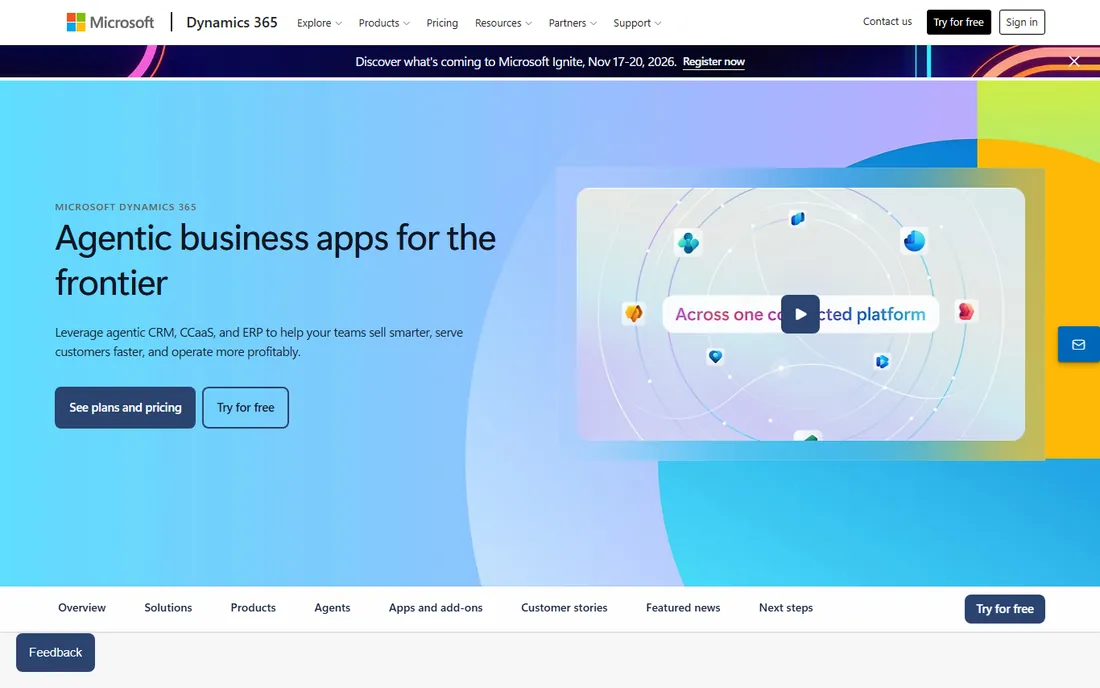
Microsoft's case is the ecosystem you already live in. Most oil and gas companies run Microsoft 365, and Dynamics 365 extends that into ERP: Finance, Supply Chain Management, Project Operations and Human Resources as separate apps you license individually. The integration story is genuinely good, with Power BI, Teams and Azure sitting underneath.
The industry fit, however, is partner-delivered. Microsoft does not build upstream accounting; its energy partners do, through add-ons for land, production and joint interest billing. That can work well or badly depending on the partner, so evaluate the partner's product as carefully as the platform. Dynamics suits mid-size operators and service companies that want ERP inside their Microsoft world and are willing to assemble the oil and gas layer from proven add-ons.
What we like- Per-app licensing lets you buy only Finance or Supply Chain Management
- Natural fit for Microsoft shops with single sign-on and Power BI
- Large partner network with energy-specific add-ons
Watch out for- Oil and gas depth comes from partners, not Microsoft
- The per-app model gets expensive when you need many apps
- Production accounting and land management are not native
#5
Infor
Best for: Operators wanting an industry-specific CloudSuite
Visit infor.com
Starting priceSee website (custom quote)
Free planNo

Infor builds one CloudSuite per industry instead of one ERP for everyone. That philosophy matters in oil and gas, where a generic chart of accounts and a generic work order do not cut it. Infor's CloudSuites bundle ERP with industry workflows, analytics and AI agents, running on a multi-tenant cloud that takes upgrades out of your hands.
The caveat is vertical depth. Infor's strongest stories are in manufacturing, distribution and process industries; its oil and gas presence is real but thinner than IFS or the specialists. Upstream operators will need partner-built extensions for land, division orders and production accounting. Where Infor fits best is midstream and downstream operations, terminals, and oilfield equipment manufacturers: asset-heavy businesses that look more like process manufacturing than exploration. Ask for references in your exact segment.
What we like- CloudSuites are built per industry rather than configured from a generic core
- Strong in asset management and process industries adjacent to oil and gas
- Multi-tenant cloud keeps upgrades painless
Watch out for- Oil and gas is not Infor's deepest vertical compared to manufacturing or distribution
- Upstream production accounting needs partner extensions
- Pricing and packaging vary by CloudSuite
Starting priceSee website (custom quote)
Free planNo
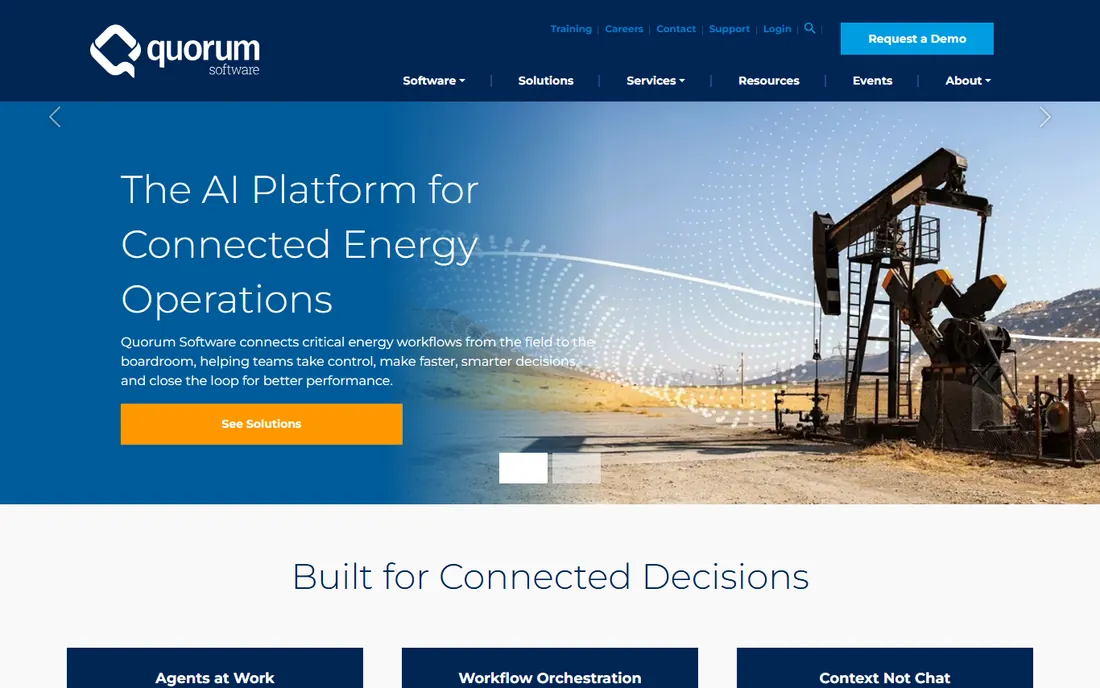
Quorum is the energy-only vendor on this list. The 2021 merger with Aucerna, plus the acquisition of TietoEVRY's oil and gas software business, made it the largest pure-play energy software company: upstream accounting and land (OGsys), planning and reserves (Aucerna), midstream and marketing, and downstream hydrocarbon management (Energy Components) under one roof, serving more than 1,800 energy customers in 55 countries.
That single-industry focus is the entire argument. Every product was built for energy workflows, so division orders, gas balancing and settlements behave the way your accountants expect. The tradeoff is a broad portfolio that takes work to scope. Get Quorum's architects to map your workflows to specific products in writing before you sign.
What we like- Serves only the energy industry, with 1,800+ energy customers across 55 countries
- Covers the full value chain from wellhead to market
- Absorbed Aucerna's planning and reserves tools plus TietoEVRY's Energy Components
Watch out for- Breadth of the portfolio means implementations touch many products
- Pricing is custom and enterprise-grade
- Smaller operators may find the full platform more than they need
Starting priceSee website (custom quote)
Free planNo
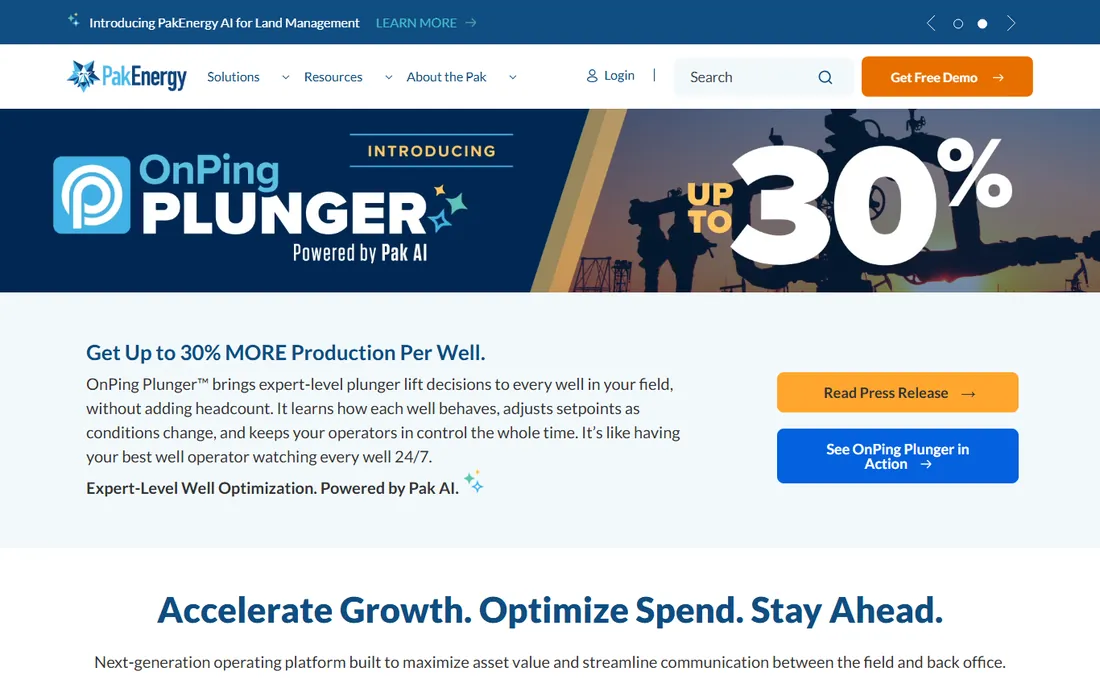
PakEnergy is the independent operator's ERP. Founded as WolfePak in 1986 and rebranded, the company has spent nearly four decades building exactly what a small to mid-size E&P company runs on: land management, production and field data capture, oil and gas accounting with joint interest billing and revenue distribution, and transportation. More than 2,300 customers, mostly independents, run on it.
The fit is the selling point and the boundary. PakEnergy understands a division order the way SAP understands a purchase order: natively. Implementation is measured in months, not years, and support comes from people who speak your land department's language. What it is not is a global enterprise platform. For the independent producing thousands to hundreds of thousands of barrels a day, it is the most natural fit on this list.
What we like- Built specifically for independents, with land, production, accounting and transportation in one platform
- 2,300+ customers, mostly North American operators
- 24/7 support from people who know oil and gas accounting
Watch out for- No published pricing, so every deal starts with a sales call
- The product depth suits independents better than majors
- US-centric customer base
Starting priceSee website (custom quote)
Free planNo
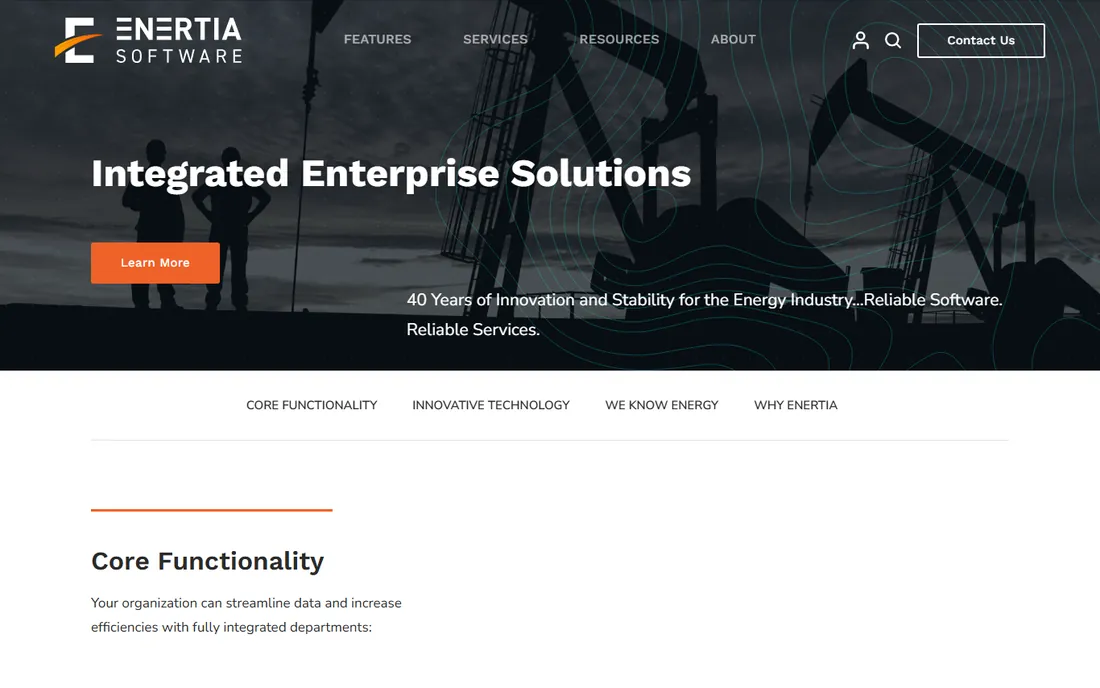
Enertia does one thing: upstream ERP. For 40 years the Houston company has built a single integrated system where land, accounting, production and operations share one database, so a production volume entered in the field flows through allocation into the general ledger and out to royalty owners without rekeying. That field-to-financials integration is the whole product.
Single-vendor integration is also the risk profile. You get one database of truth, but also one vendor's pace of innovation and a smaller ecosystem than the giants. Enertia suits upstream operators from small independents to mid-caps that want everything in one system. If you run significant midstream or downstream assets, you will need something else alongside it.
What we like- Single-vendor, fully integrated upstream ERP: accounting, land, production and operations share one database
- 40 years focused exclusively on upstream oil and gas
- Handles the full well lifecycle from AFE to revenue distribution
Watch out for- Upstream only, so midstream and downstream needs go elsewhere
- Smaller vendor with a smaller partner ecosystem
- The Microsoft-stack technology shows its age in places
#9
Epicor
Best for: EPC contractors and oilfield service companies
Visit epicor.com
Starting priceSee website (custom quote)
Free planNo
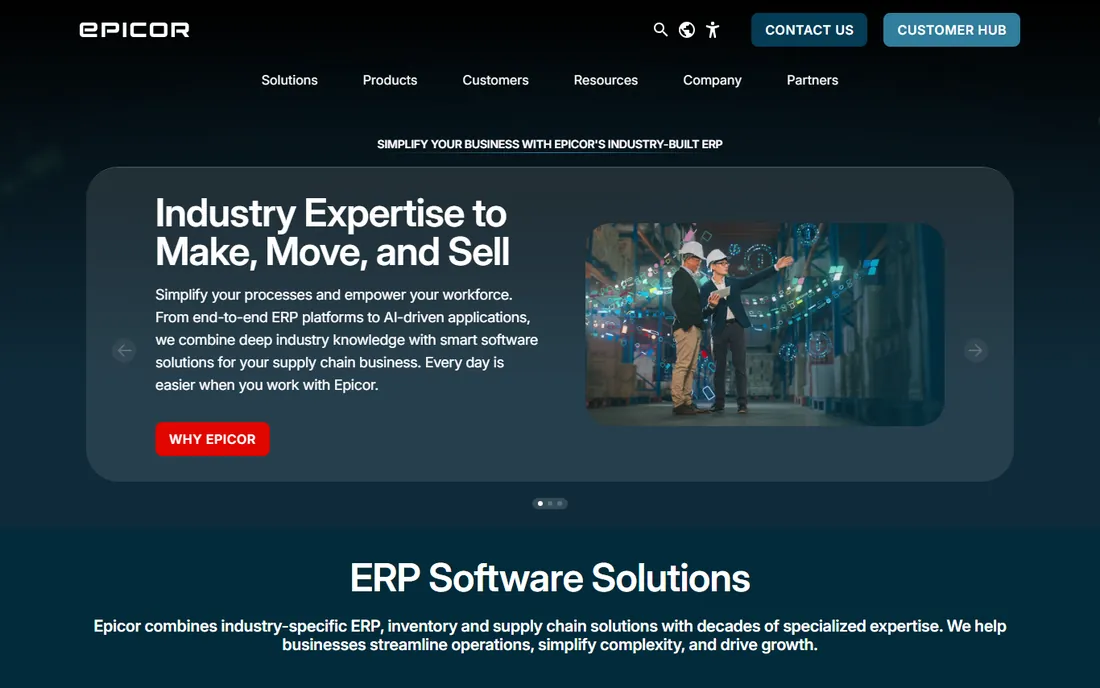
Epicor wins oil and gas deals through EPC contractors and service companies. Its Kinetic ERP has documented deployments with firms like EMDAD and OilSERV, where the requirements are project management, procurement, inventory across yards, equipment tracking and multi-entity financials rather than division orders. For that buyer, Epicor's manufacturing and project depth fits well at a mid-market price.
Do not buy Epicor expecting upstream production accounting. It is a horizontal ERP with energy experience, not an energy ERP, and the distinction matters the moment you need revenue distribution or land. Evaluate it against IFS and Infor for service-company and equipment scenarios, and against the specialists for anything touching production. The 23,000-customer installed base means a deep partner bench, which cuts both ways: good partners are excellent, weak ones will configure you into a corner.
What we like- Proven deployments with oil and gas EPC contractors and service companies
- Strong project management, supply chain and job costing
- Cloud and on-premise options with a mid-market price point
Watch out for- Not upstream-production-accounting software
- Industry fit comes through configuration and partners
- The oil and gas story is strongest in services, weakest in E&P operations
#10
Aptean
Best for: Asset-heavy operations pairing ERP with maintenance
Visit aptean.com
Starting priceSee website (custom quote)
Free planNo

Aptean's oil and gas story is maintenance first, ERP second. The company's TabWare EAM (from the AssetPoint acquisition) is a legitimate enterprise asset management product with oil and gas deployments, covering work orders, preventive maintenance, reliability and compliance for plants, terminals and facilities. Around it sits Aptean's broad industry-specific ERP portfolio.
That makes Aptean a fit for a specific buyer: the downstream or midstream operator, terminal, or oilfield equipment company whose core system-of-record problem is assets and maintenance, with ERP alongside. It is not the pick for upstream production accounting or land. As with any broad-portfolio vendor, the critical step is scoping: get the exact product names, the integration points between them and the EAM-to-ERP data flow documented before pricing, or you will buy shelfware.
What we like- Industry-specific ERP portfolio with genuine depth in manufacturing and distribution
- TabWare EAM gives it real oil and gas maintenance credibility
- Cloud delivery with regular updates
Watch out for- The oil and gas story is maintenance-led, not production-accounting-led
- The portfolio is broad, so pin down exactly which products you are buying
- Upstream E&P fit is the weakest on this list
Oil and gas ERP demos blur together because every vendor shows the same screens: a dashboard, a work order, a financial report. The selection happens before the demo, in the segment match.
Upstream producers: buy the accounting, not the ERP
If you operate wells, your system of record is production accounting: volumes, allocations, division orders, joint interest billing, revenue distribution, severance tax. The specialists (Quorum, PakEnergy, Enertia) were built around exactly this. General ERP vendors can be configured to do it, but you will pay for the configuration and maintain it forever. Start with the three specialists, add IFS if you are large, and only then look at the generalists.
Midstream and downstream: buy operations and assets
Pipelines, terminals, refineries and plants live on nominations, scheduling, inventory, maintenance and compliance. Here the generalists and asset-led vendors earn their place: IFS and Infor for asset intensity, SAP for global scale, Aptean where maintenance is the core problem, Quorum for energy-specific midstream workflows. Upstream production accounting depth matters less; EAM and logistics matter more.
Service companies and EPC contractors: buy projects
If you sell services to operators, you need project costing, equipment tracking, procurement and multi-entity financials. Epicor, NetSuite, Dynamics 365 and IFS all fit, roughly in ascending order of deal size. The specialists will be overkill: you do not need division orders to run a wireline crew.
Everyone: count the integrations
Whichever segment you are in, list the systems the ERP must talk to before you shortlist: SCADA and historians, production accounting, land systems, payroll, tax engines, banking. Then ask each vendor which integrations ship as supported connectors and which are custom projects. The connector list, more than the feature list, predicts whether your implementation finishes on time.
Specialists vs. generalists: the real buying decision
Strip away the branding and this list offers two philosophies. The specialists (Quorum, PakEnergy, Enertia) assume oil and gas is different and build for it directly. The generalists (SAP, Oracle, Microsoft, Infor, IFS, Epicor, Aptean) assume business processes rhyme across industries and configure for the differences.
Specialists win on time to value and fit. An independent can be live on PakEnergy or Enertia in months, with division orders and JIB working on day one, at a fraction of an SAP program's implementation cost. The risk is ceiling: if the company doubles in size or goes international, the specialist may not stretch.
Generalists win on ceiling and ecosystem. SAP or IFS can run the whole enterprise across countries and segments, with a partner market that outlives any single vendor relationship. The risk is the floor: years of implementation, seven-figure services bills and a system your team experiences as complicated because it was built for everyone.
The practical rule: buy the specialist if your operations fit inside one segment and your growth stays inside it. Buy the generalist if you operate across segments or countries, or if corporate already standardized on one. And whichever you choose, keep your production accounting and land data portable, because the next acquisition or divestiture will test that decision.
How we chose
We started with the categories buyers search: ERP software for oil and gas, upstream ERP and oil and gas accounting software. For each candidate we opened the vendor's own site, checked whether pricing was published (no enterprise vendor on this list publishes it), reviewed product and documentation pages for oil and gas specific functionality, and cross-checked against public reviews on G2 and Capterra and practitioner discussion on Reddit. Where a product had been acquired, we used the current owner and name: P2 Energy Solutions now sits inside IFS, and Aucerna merged into Quorum Software, so neither appears as a standalone entry. Anything we could not verify on the vendor's own page is marked "See website" rather than guessed.
Frequently asked questions
How much does oil and gas ERP cost?
Expect custom quotes across the board. Specialist platforms for independents typically land in the tens of thousands per year; enterprise deployments of SAP, IFS or Oracle run into seven figures including implementation. Budget implementation at two to four times the license cost, and get fixed-scope bids from at least two vendors.
Does it matter whether we are upstream, midstream or downstream?
Yes, more than the brand name. Upstream lives on production accounting and land; midstream and downstream live on logistics, scheduling and asset maintenance. A vendor that is excellent for one segment can be a poor fit for another, so shortlist by segment first.
Should a small operator buy a specialist or a general ERP?
Usually the specialist. PakEnergy, Enertia and Quorum ship with upstream accounting built in, deploy faster and cost less to implement than configuring a general ERP for oil and gas. Consider a general ERP only if you operate across segments or plan to.
How long does implementation take?
Specialist deployments for independents typically take three to nine months. Enterprise ERP programs (SAP, IFS, Oracle) run twelve to twenty-four months at operator scale. Data migration from legacy land and production systems is usually the longest phase, so start it early.
Can we keep our production accounting system and add ERP around it?
Yes, and many operators do exactly that: keep Quorum, PakEnergy or a legacy system for production accounting and land, and run SAP, IFS or NetSuite for corporate financials. It works when the integration between the two is a supported connector with clear ownership, not a spreadsheet.
Sources we checked (12)
- https://ifs.com/
- https://www.sap.com
- https://netsuite.com/
- https://dynamics.microsoft.com
- https://www.infor.com
- https://quorumsoftware.com/
- https://pakenergy.com/
- https://www.enertia-software.com/
- https://epicor.com/
- https://www.aptean.com
- https://www.g2.com/categories/erp-systems
- https://www.capterra.com/enterprise-resource-planning-software/
Is your product missing or out of date?
We review this list regularly. Vendors can request a listing, send updated pricing or ask about featured placement.

Shihab Mia · Founder, Rankite
Shihab has spent more than a decade helping SaaS and e-commerce brands grow through search. He writes Rankite's software buying guides from pricing pages, documentation and public user reviews. More about Shihab.