How we make this list: we compare pricing pages, product documentation and public user reviews. Rankite is independent; if a vendor ever pays for a featured spot, that listing is clearly labeled Partner.
Key takeaways
- Oracle NetSuite is the default cloud ERP for mid-size product companies, with finance, inventory, CRM and ecommerce in one system.
- SAP Business One and Microsoft Dynamics 365 Business Central serve smaller companies that want enterprise-grade financials through partners.
- Acumatica, Odoo and ERPNext give growing businesses ERP power without per-user pricing that scales with headcount.
- Sage Intacct and Oracle Fusion Cloud ERP target companies whose needs are primarily financial rather than operational.
Quick comparison
Is your product missing or out of date?
We review this list regularly. Vendors can request a listing, send updated pricing or ask about featured placement.
The best erp accounting software
Starting priceSee website
Free planFree 3-day test drive
NetSuite has defined cloud ERP for two decades, and the homepage now positions it as the number one AI cloud ERP, with a free three-day test drive of the new NetSuite Next experience. The core pitch is unchanged: financials, inventory, CRM, professional services automation and ecommerce running on one database, so the number the CFO sees matches the number the warehouse sees. NetSuite Next adds conversational intelligence and agentic workflows on top of that foundation.
The catch is that NetSuite is sold like enterprise software even when the buyer is mid-size. Pricing is quote-based, and a real implementation takes months of partner work. Companies that outgrow QuickBooks usually land here when they need multi-entity consolidation and real inventory, not just bookkeeping. It remains the benchmark the others are measured against.
What we like- True unified suite across ERP, CRM and ecommerce
- Strong multi-subsidiary and multi-currency support
- AI-powered NetSuite Next generation available
Watch out for- Quote-only pricing
- Implementation is a serious project

#2
SAP Business One
Best for: Small businesses wanting SAP
Visit sap.com
Starting priceSee website
Free planNo
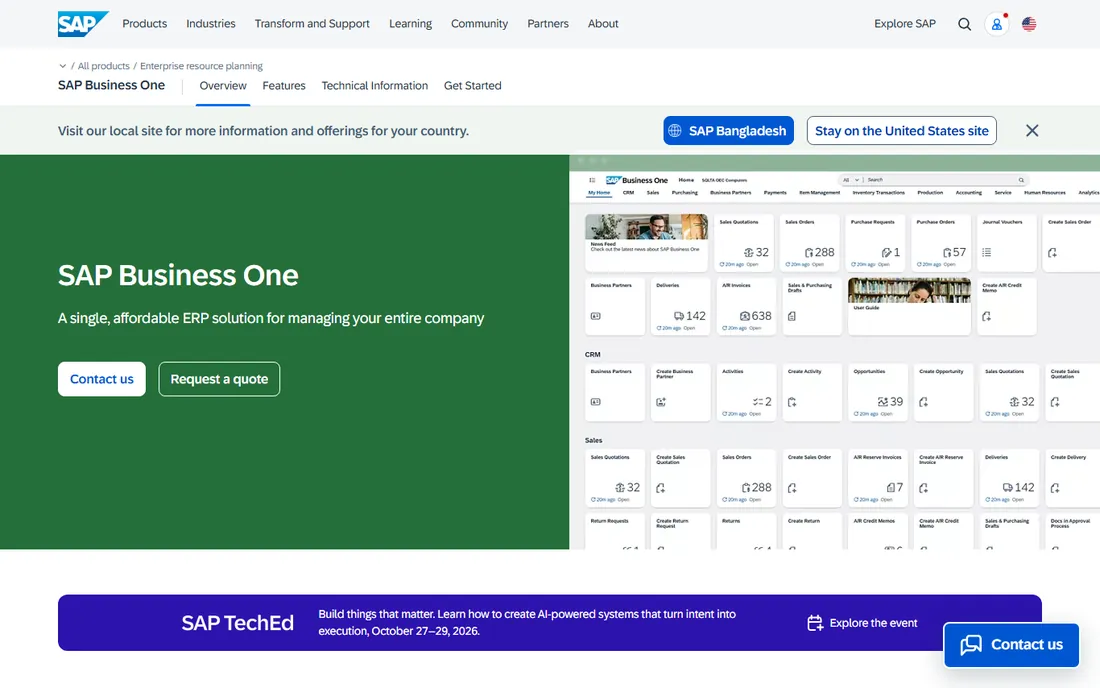
SAP Business One is SAP's answer for companies that are too small for S/4HANA: accounting and financials, purchasing, inventory, sales, CRM, reporting and analytics in one affordable package. SAP positions it as quick to deploy and extensible as the business grows, with HANA-powered analytics and a mobile client for any deployment method. It is sold exclusively through SAP partners, which means local implementation help is available almost everywhere.
That partner model is also the tradeoff. There is no self-serve signup, no public pricing and no free trial; you talk to a partner and get a quote. The desktop client remains the workhorse while new innovation flows to the web client, so ask about the web client roadmap during evaluation. Choose it when you want the SAP ecosystem at small-business scale.
What we like- Full ERP depth in a small-business package
- SAP HANA analytics
- Huge global partner network
Watch out for- Sold only through partners
- Pricing not published
Starting price$80 per user/month
Free planFree trial (30 days)
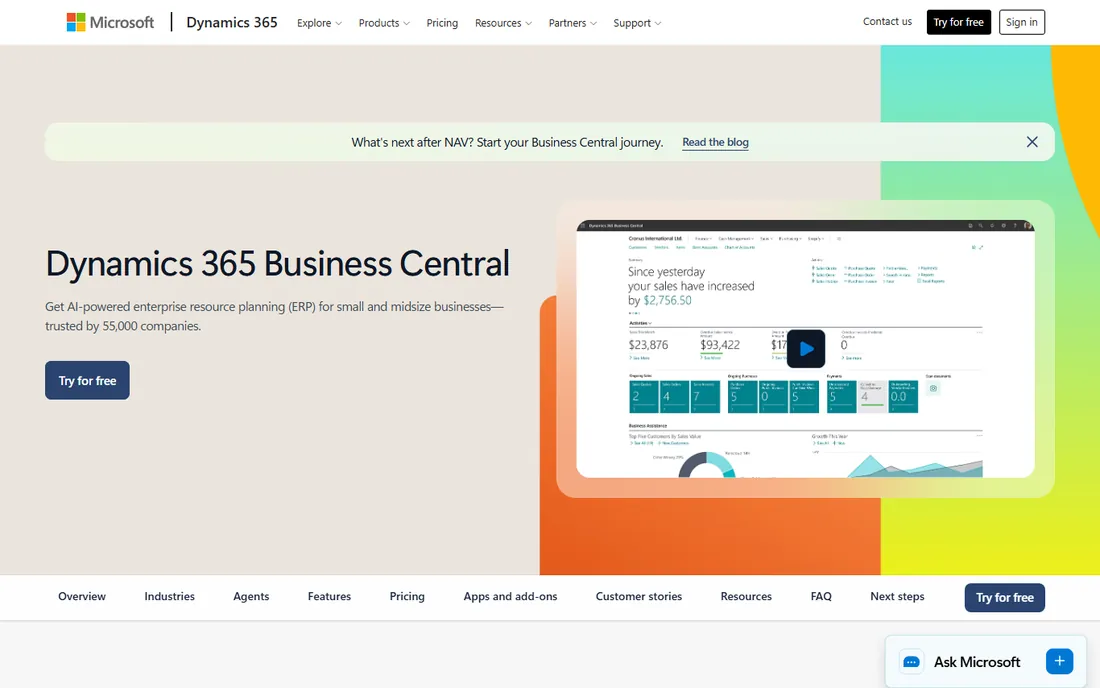
Business Central is Microsoft's ERP for small and mid-size companies, and it wins on integration: finance, operations, sales and service connected to Outlook, Excel, Teams and Copilot, with Power Platform and thousands of AppSource add-ons for the rest. Pricing is refreshingly public: Essentials at $80 per user per month and Premium at $110 as of the November 2025 update, with a free 30-day trial. Over 55,000 SMBs run on it.
Like SAP Business One, it is sold and supported exclusively through a partner network, so the license price is only part of the bill. The Essentials versus Premium choice matters too, since manufacturing and service management sit in Premium. For companies already on Microsoft 365, the familiarity of the stack shortens training and makes this the low-friction pick.
What we like- Deep Microsoft 365 and Teams integration
- Published per-user pricing
- 55,000+ SMB customers
Watch out for- Partner-led sales add implementation cost
- Essentials vs Premium tier decisions
Starting priceSee website
Free planNo
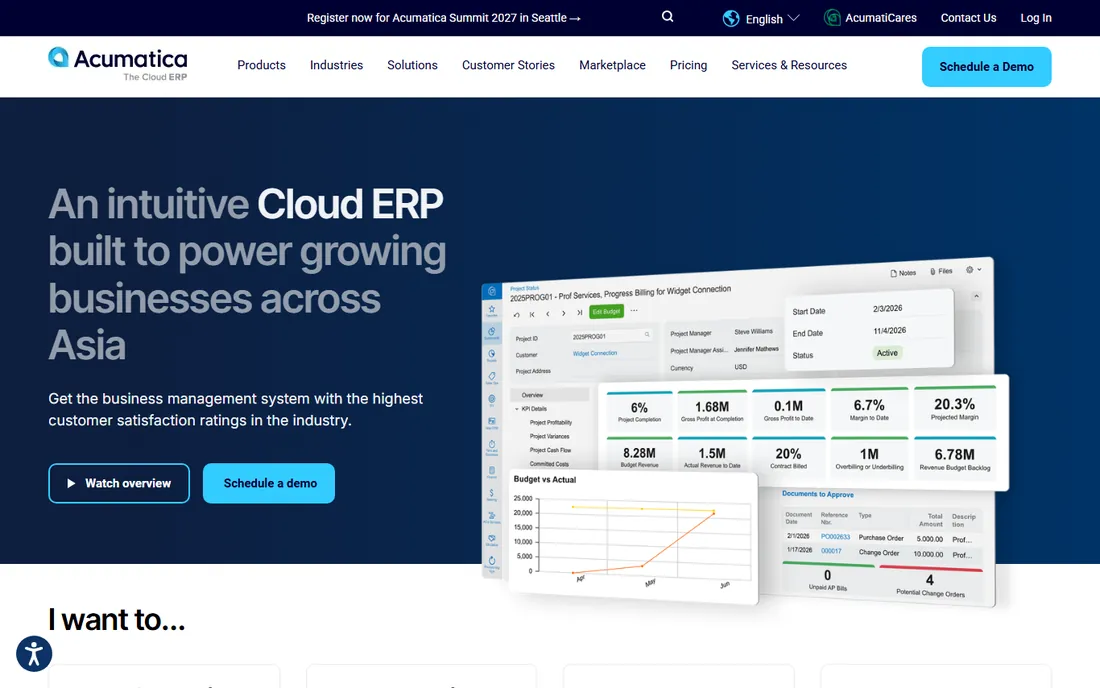
Acumatica is the cloud-native ERP built for companies tired of per-user licensing. Its pricing is based on resources consumed, so adding users does not raise the bill, and the homepage leans hard on usability, AI-powered automation and industry editions for construction, distribution, manufacturing, retail and professional services. Recent releases added AI-assisted workflows for anomaly detection and document automation.
The honest catch is opacity: Acumatica does not publish prices, and every deal runs through a partner. Third-party comparisons put entry around $1,000 per month, but that is not a vendor figure, so budget accordingly. It fits manufacturers, distributors and contractors that have outgrown entry-level accounting and want a real ERP without NetSuite's enterprise sales motion.
What we like- Unlimited users on resource-based pricing
- Strong industry editions
- Consistently high satisfaction ratings
Watch out for- Pricing not published
- Implementation through partners
Starting price$0 (Community)
Free planYes
Odoo is the outlier: a suite of open-source business apps, from accounting and inventory to CRM, POS and manufacturing, that install with one click and share one database. The Community edition is 100 percent free and open source, built by a community of 100,000-plus developers, while Enterprise adds extra apps, hosting and professional services. With 28 million users claimed and pricing described as a single all-inclusive per-user price, it is the most approachable ERP on this list.
The tradeoff is that cheap software still needs good implementation. Odoo's quality varies by partner and module maturity, and the Enterprise per-user fee means a 100-person company pays real money. Start with Community when you have in-house technical skill, or budget for a solid partner. For cost-conscious companies that refuse vendor lock-in, nothing else comes close.
What we like- Open-source Community edition is completely free
- One app per process with clean integration
- No vendor lock-in on your data
Watch out for- Enterprise pricing per user adds up
- Quality depends on implementation partner

#6
Sage Intacct
Best for: Finance-led mid-size companies
Visit sage.com
Starting priceSee website
Free planNo
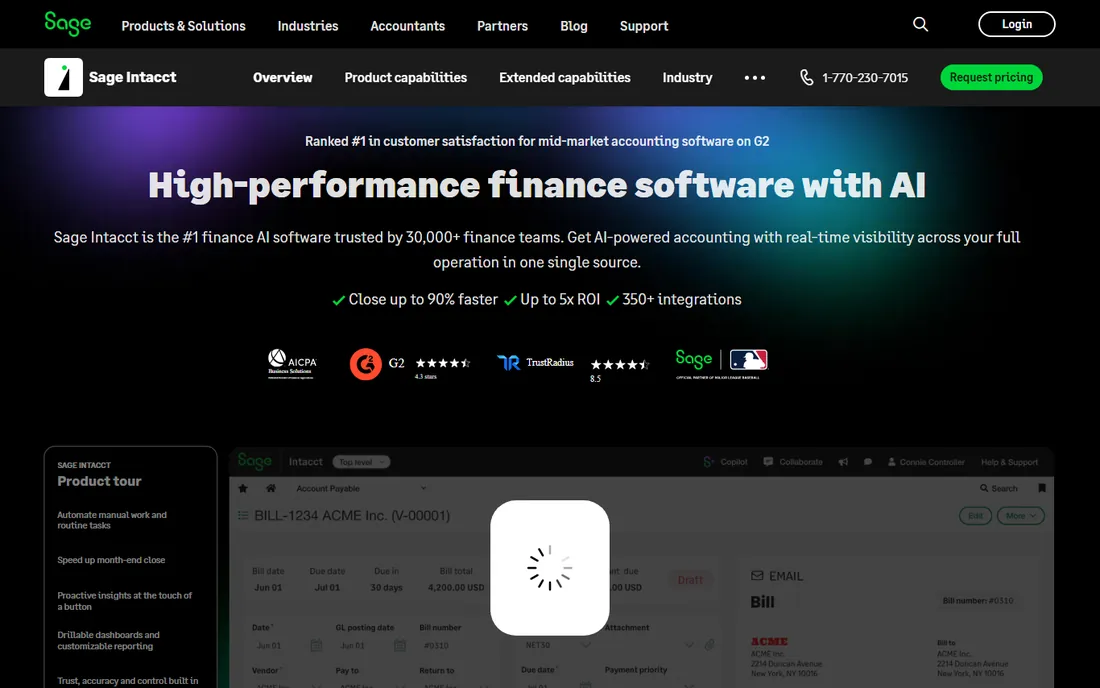
Sage Intacct is the finance-first choice: cloud accounting built for companies, typically 20-plus employees or over $4 million in revenue, that need multi-entity consolidation, dimensional reporting and audit-ready controls. Built-in finance AI agents now answer questions about reports, guide the month-end close, scan journal entries for anomalies and automate AP matching. Pricing is customized by quote on annual subscriptions, and Sage says implementations typically run three to six months.
It is less of an operational ERP than NetSuite or Acumatica. Manufacturing and deep inventory are not its strengths; financial accuracy is. Nonprofits, SaaS companies and services firms with multiple entities are the classic fit. Choose Intacct when the accounting team is driving the purchase and consolidation is the pain.
What we like- Deep multi-entity financial consolidation
- Finance AI agents for close and AP
- AICPA-preferred cloud accounting
Watch out for- Quote-only annual pricing
- Implementation typically 3 to 6 months
Starting priceSee website
Free planNo
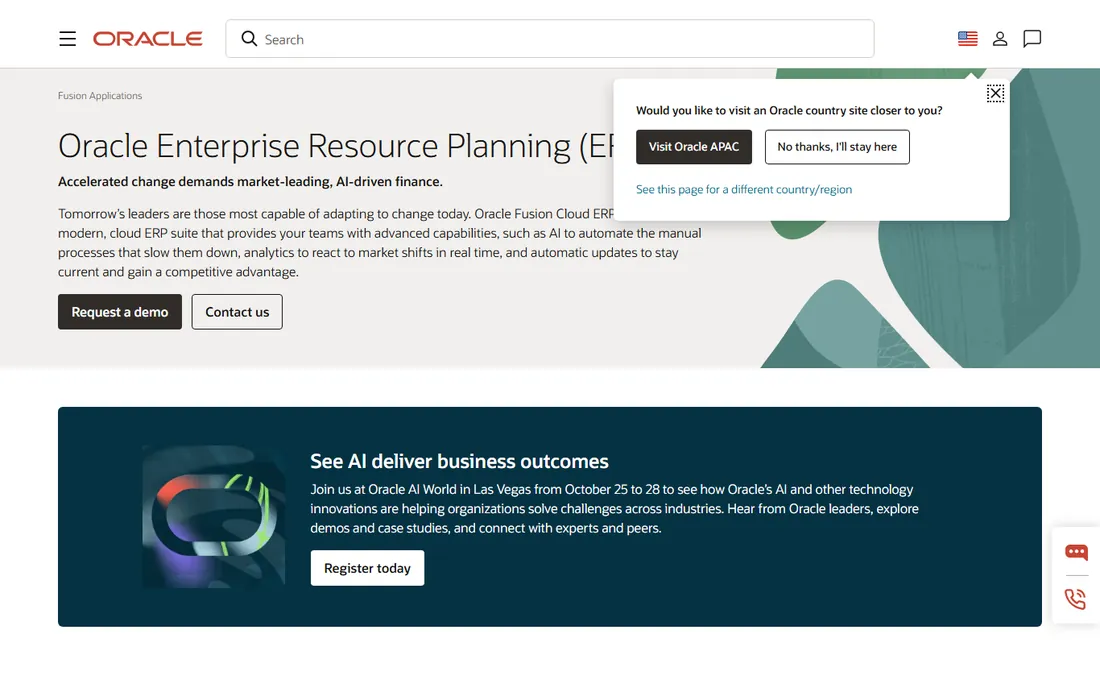
Oracle Fusion Cloud ERP is the big sibling of NetSuite: a complete modern cloud suite covering financial management, procurement, project management, risk, EPM and supply chain, with AI agents embedded across workflows rather than bolted on. Oracle positions it as the central nervous system of the enterprise, and named customers like DHL, Hearst and Heathrow run on it. Continuous updates keep every customer current without upgrade projects.
Everything about it is enterprise scale, including the cost and the implementation timeline. Companies under a few hundred employees will find NetSuite or Intacct a better fit. This belongs on the shortlist when a growing enterprise needs one suite across finance, HR and supply chain with Oracle's ecosystem behind it.
What we like- Complete suite across finance, supply chain and HCM
- Embedded AI agents
- Continuous quarterly updates
Watch out for- Enterprise pricing and timelines
- Overkill below mid-market scale
Starting price$0 self-hosted
Free planYes
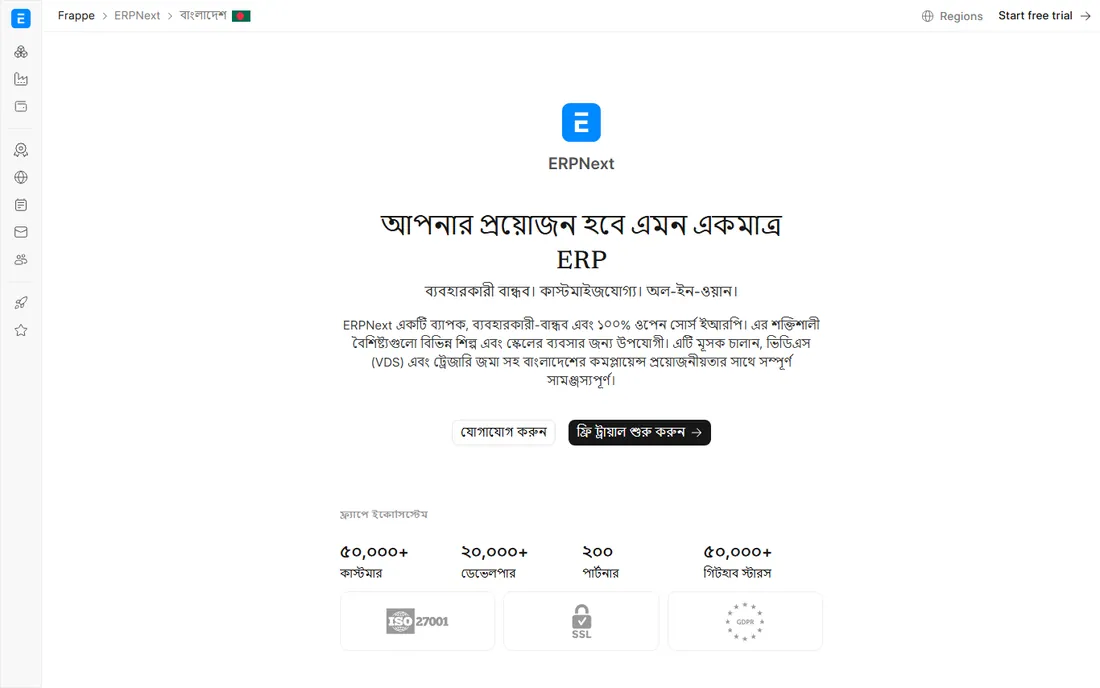
ERPNext is the purist's open-source ERP: accounting with multi-subsidiary and multi-currency support, procurement, sales, CRM, stock, manufacturing, projects, POS, HR and payroll, all free to use, modify and even resell. There is no per-user fee at all; costs do not grow linearly with headcount. Frappe Cloud hosting starts at $14 a month for those who want managed infrastructure, and the vendor claims 30,000-plus companies run on it.
The catch is expertise. ERPNext expects either in-house technical capacity or a relationship with one of its 200-plus global partners, and the US partner bench is thinner than Odoo's. But for companies philosophically opposed to license fees, or operating in countries where proprietary ERP pricing is prohibitive, it is a genuinely complete system at hosting cost.
What we like- 100 percent open source with no per-user fees
- Full accounting, stock, manufacturing and HR modules
- Pay only for hosting on Frappe Cloud
Watch out for- Needs technical skill or a partner
- Smaller US partner network than Odoo
How we chose
We opened every vendor's official homepage and recorded the current pricing, trial and plan details each company publishes about itself, using only first-party pages. We cross-checked positioning and fit against G2, Capterra and Reddit's ERP communities, and we excluded any product whose homepage could not be verified. The list spans the best ERP companies for mid-size buyers: unified cloud suites, finance-led platforms and open-source options. No hands-on testing was involved.
Buying guide: choosing ERP accounting software
Start with the accounting pain, not the ERP label. If month-end close and multi-entity consolidation are the problem, Sage Intacct deserves the first call. If inventory, orders and operations drive the complexity, NetSuite, Acumatica or Business Central fit better. If the budget is the constraint, Odoo Community or ERPNext get you running for the cost of implementation.
Then budget the whole project. License or subscription fees are typically less than half the first-year cost; implementation, data migration, training and integrations are the rest. Quote-based vendors like NetSuite, SAP Business One, Acumatica, Intacct and Oracle Fusion all sell through partners, so compare partner proposals, not just software. Public pricing from Microsoft and the open-source options makes budgeting easier but does not remove the services bill.
Finally, think about headcount growth. Per-user pricing from Microsoft, Odoo Enterprise and most SaaS ERPs means every hire raises the bill; Acumatica's resource model and ERPNext's zero license fees break that link. Model the three-year cost at your planned headcount, not today's. And run the demo with your own chart of accounts and a real month-end scenario: ERP sales demos always look smooth until they meet your data.
When accounting software is enough
Not every company needs an ERP, and buying one too early is an expensive mistake. If you have one entity, simple inventory and under twenty employees, QuickBooks Online or Xero handle the books for a fraction of the cost and effort. The classic graduation triggers are real: multiple entities that need consolidating, inventory across warehouses, revenue recognition rules you cannot model, or auditors asking for controls your current system cannot provide. Until two of those are true, an ERP project will cost more than the problems it solves. The tools on this list are for companies that have outgrown accounting software, not ones hoping software will make them grow up.
Frequently asked questions
What is the best ERP accounting software for mid-size companies?
Oracle NetSuite is the most common answer: a unified cloud suite for financials, inventory, CRM and ecommerce with strong multi-entity support. Acumatica suits companies that want cloud ERP without per-user pricing, and Sage Intacct suits finance-led teams whose main pain is consolidation. The right pick depends on whether operations or accounting drives the purchase.
How much does ERP software cost?
It varies enormously. Microsoft Dynamics 365 Business Central publishes pricing at $80 to $110 per user per month. NetSuite, SAP Business One, Acumatica, Sage Intacct and Oracle Fusion are quote-based and typically run into five or six figures annually including implementation. Odoo Community and ERPNext are free as software; you pay for hosting and implementation.
What are the best ERP companies for small businesses?
SAP Business One, Microsoft Dynamics 365 Business Central and Acumatica all target the small to mid-size segment with partner-led implementations. Odoo and ERPNext serve smaller companies that want open-source flexibility. NetSuite and Sage Intacct typically fit companies a step larger.
Is there a free ERP system?
Yes. Odoo Community and ERPNext are both fully open source and free to use, with no license fees. You still pay for hosting, implementation and support, which is where the real cost sits. Neither charges per user, which makes them attractive as headcount grows.
NetSuite vs Sage Intacct: which is better?
They solve different problems. NetSuite is a full ERP with inventory, order management, CRM and ecommerce alongside financials. Sage Intacct is a deeper financial management platform with stronger consolidation and close capabilities but less operational depth. Manufacturers and distributors lean NetSuite; multi-entity services and SaaS firms lean Intacct.
How long does ERP implementation take?
Sage publishes a typical three to six month range for Intacct, and most mid-market ERP projects land between four and nine months depending on scope, data migration and customization. Open-source options can go live faster with a vanilla setup, but custom requirements stretch any timeline. Plan for the project, not just the software.
Sources we checked (8)
- https://netsuite.com/
- https://www.sap.com/products/erp/business-one.html
- https://dynamics.microsoft.com/en-us/business-central/overview/
- https://acumatica.com/
- https://www.odoo.com/
- https://www.sage.com/en-us/sage-business-cloud/intacct/
- http://oracle.com/erp/
- https://frappe.io/erpnext
Is your product missing or out of date?
We review this list regularly. Vendors can request a listing, send updated pricing or ask about featured placement.

Shihab Mia · Founder, Rankite
Shihab has spent more than a decade helping SaaS and e-commerce brands grow through search. He writes Rankite's software buying guides from pricing pages, documentation and public user reviews. More about Shihab.
 Oracle NetSuite
 Microsoft Dynamics 365 Business Central
 Acumatica
 Odoo
Odoo Oracle Fusion Cloud ERP
 ERPNext