How we make this list: we compare pricing pages, product documentation and public user reviews. Rankite is independent; if a vendor ever pays for a featured spot, that listing is clearly labeled Partner.
Key takeaways
- Contentful at $300 a month is the established headless leader for enterprises distributing content across web, mobile, and apps.
- Sanity at $15 per seat a month is the developer favorite with real-time collaboration and a genuinely useful free plan.
- Adobe Experience Manager, Sitecore, Optimizely, and Acquia are the traditional enterprise choices: quote-based, full digital experience platforms, not just content APIs.
- Strapi is the only open-source option here, free to self-host, which suits teams that want full control of their stack.
- Storyblok at $99 a month gives marketers a visual editor on a headless backend, bridging the marketer-developer gap.
Quick comparison
| Tool | Best for | Starting price | Free plan |
|---|
 Contentful Contentful | enterprises going headless at scale | $300/month | Yes |
 Sanity Sanity | developer-led teams wanting real-time collaboration | $15 per seat/month | Yes |
 Storyblok Storyblok | marketers needing visual editing on headless | $99/month | Yes |
 Strapi Strapi | teams wanting open-source self-hosted control | Free self-hosted | Yes |
 Hygraph Hygraph | GraphQL-native content federation | $199/month | Yes |
 Adobe Experience Manager Adobe Experience Manager | large enterprises on the Adobe stack | See website | No |
 Sitecore Sitecore | personalization-heavy enterprise marketing | See website | No |
 Optimizely Optimizely | experimentation plus content management | See website | No |
 Acquia Acquia | Drupal-based enterprise with strong governance | See website | No |
 WordPress VIP WordPress VIP | enterprise WordPress at scale | See website | No |
Is your product missing or out of date?
We review this list regularly. Vendors can request a listing, send updated pricing or ask about featured placement.
Only 43% of mobile sites now pass Core Web Vitals (emelia.io, 2026), and the content management system you choose directly affects that number. A slow, bloated CMS drags down every page it touches. A well-architected one lets developers ship fast front-ends while marketers publish freely. At enterprise scale, that performance gap translates into search rankings and conversion rates.
Enterprise CMS means something specific. It is not WordPress on shared hosting. It is platforms built for multiple brands, regions, and content types, with governance, permissions, audit trails, and SLAs. Some are traditional coupled systems where content and presentation live together. Others are headless: content managed in one place, delivered by API to websites, apps, and anything else.
The ten platforms below split across both architectures. The headless five suit companies with developer resources building modern front-ends. The traditional five suit marketing-led organizations that need personalization, testing, and campaign tools built in. Your architecture decision comes before your vendor decision.
Starting price$300/month
Free planYes
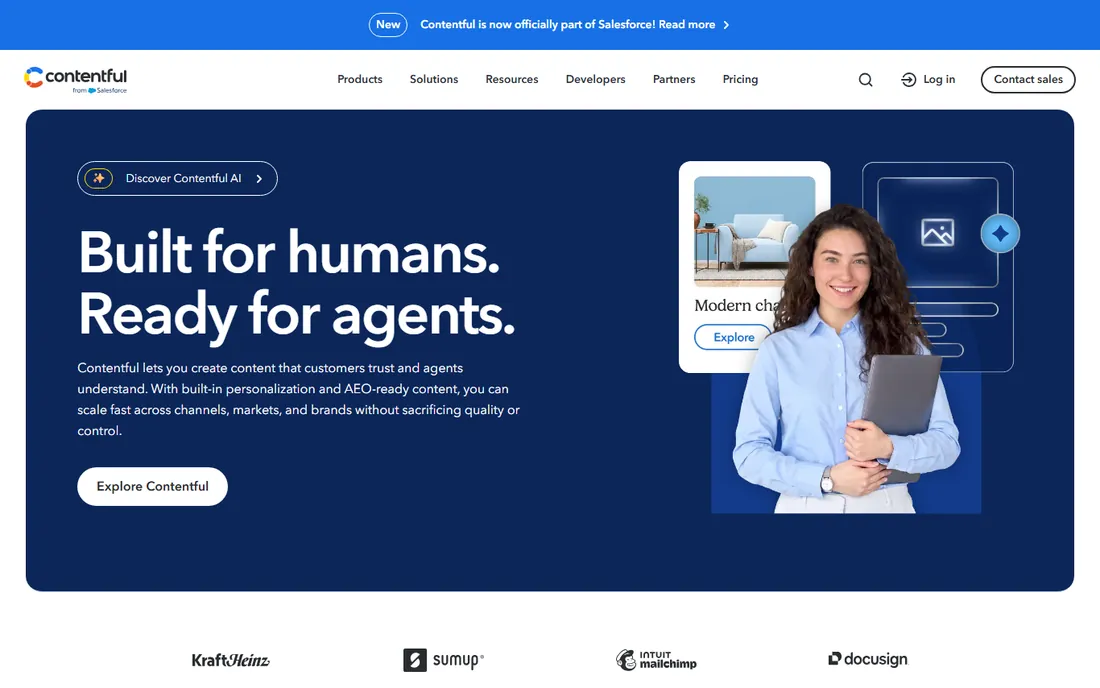
Contentful defined the headless CMS category and remains its enterprise standard. Content is modeled as structured entries, delivered by API to any front-end, which lets one content operation feed websites, mobile apps, and digital signage simultaneously. The app marketplace and integration ecosystem are the deepest in the headless world.
The Basic plan at $300 a month covers small teams, but real enterprise usage with higher API volumes, more roles, and SLAs moves to custom Premium contracts quickly. Marketers used to WordPress-style page builders face a learning curve: content modeling is powerful but abstract. Contentful fits enterprises with developer teams committed to composable architecture and the budget for custom contracts.
What we like- Most mature headless ecosystem
- Strong marketplace of integrations
- Reliable enterprise SLAs
Watch out for- Pricing jumps steeply beyond Basic
- Content modeling learning curve for marketers
#2
Sanity
Best for: developer-led teams wanting real-time collaboration
Visit sanity.io
Starting price$15 per seat/month
Free planYes
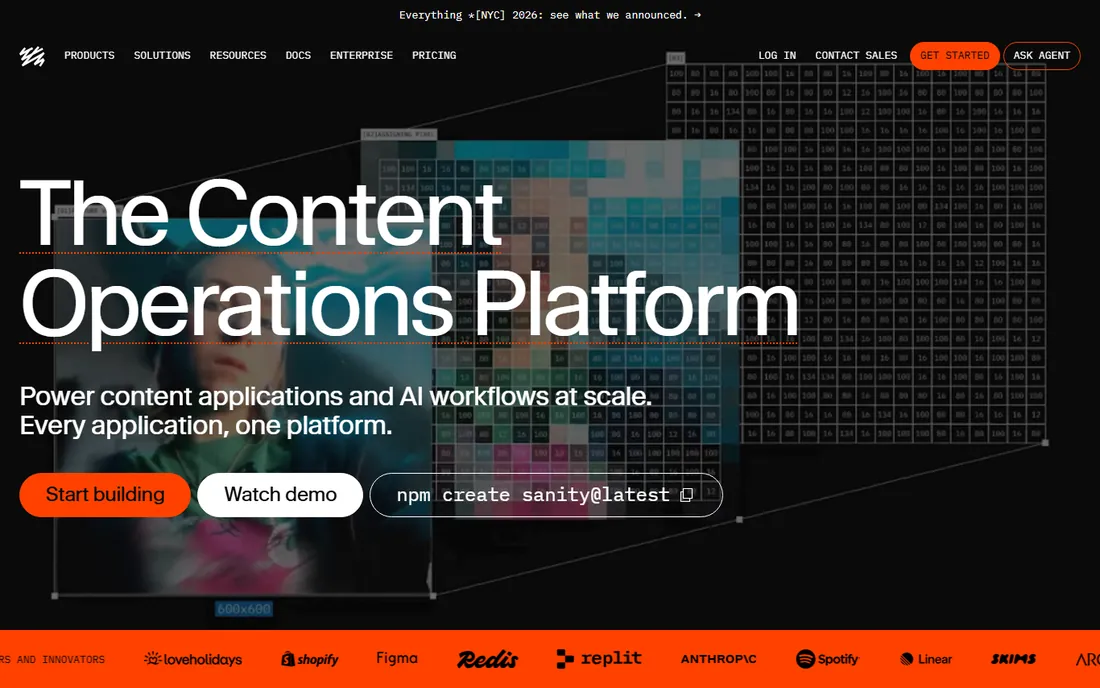
Sanity is the developer favorite in headless CMS. Its Content Lake stores structured content queryable with GROQ, its open-source Studio is fully customizable, and multiple editors can collaborate in real time the way developers expect from modern tools. The free plan covers individuals and small projects with up to 20 seats, which is generous.
Growth at $15 per seat per month adds private datasets, more roles, and scheduled publishing. The per-seat model is cheap for small teams and expensive for fifty-person editorial departments, so model your editor count. Sanity needs developers to set up and customize; marketing teams without engineering support will struggle. For product and engineering-led companies, it is the most loved option in the category.
What we like- Real-time collaborative editing
- Content lake with GROQ queries
- Generous free tier for small projects
Watch out for- Per-seat pricing punishes large editorial teams
- Requires developer setup
Starting price$99/month
Free planYes
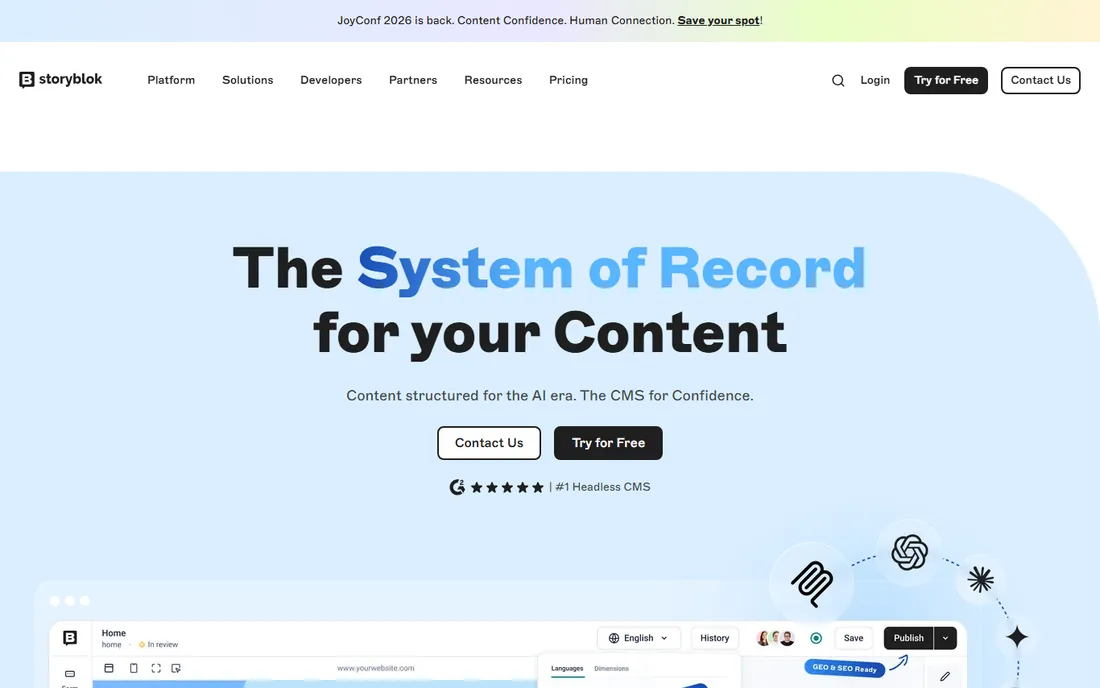
Storyblok solves headless CMS's biggest adoption problem: marketers hate it. The visual editor shows pages as they are built, with drag-and-drop components and live preview, so non-technical editors work the way they did in WordPress while developers keep the API-driven architecture. That bridge is why digital agencies recommend it so often.
The Starter plan at $99 a month covers small sites, with Growth around $299 adding more seats and API calls. Users report painful jumps when exceeding a single threshold, like asset counts forcing a tier upgrade that feels disproportionate. For marketing-led teams that need headless architecture without retraining every editor, Storyblok is the pragmatic middle ground.
What we like- Visual editor with live preview
- Component-based content marketers grasp quickly
- Multi-language support
Watch out for- Hard pricing jumps between tiers
- API limits tighter than Contentful at similar prices
#4
Strapi
Best for: teams wanting open-source self-hosted control
Visit strapi.io
Starting priceFree self-hosted
Free planYes
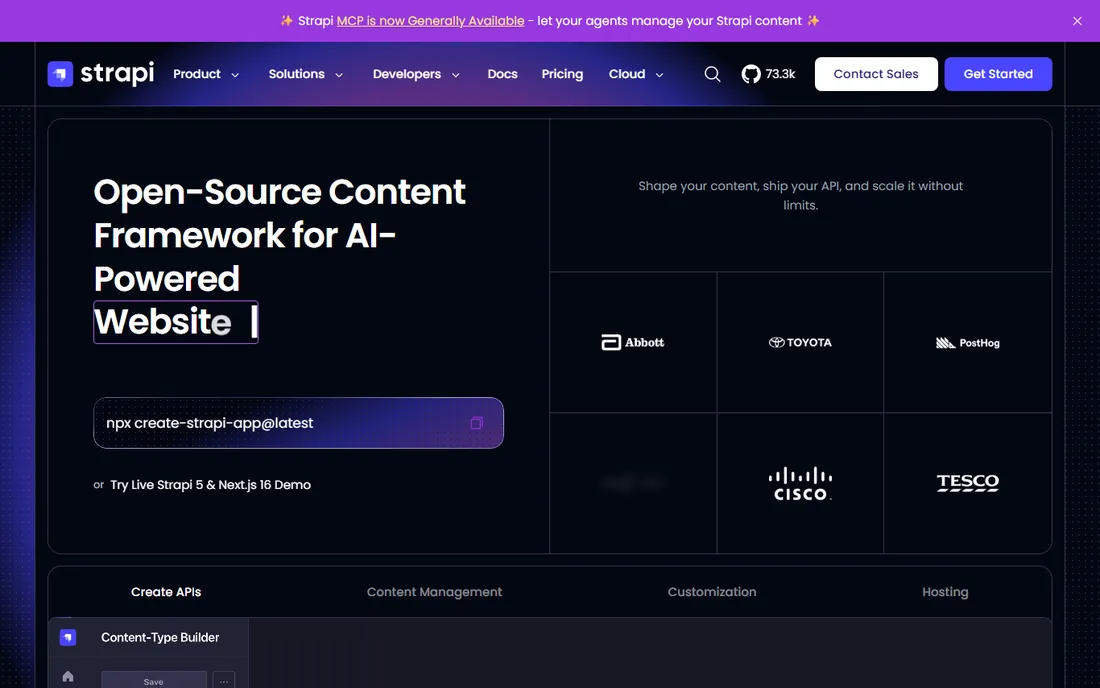
Strapi is the only fully open-source CMS on this list, and that changes the economics completely. The Community edition is free to self-host with no feature gating: you run it on your own servers, pick your database, and extend it with plugins or custom code. For teams with DevOps capacity, the total cost is infrastructure plus engineering time.
Strapi Cloud offers managed hosting for teams that want the open-source core without server duty, with paid tiers adding SSO, audit logs, and support. The tradeoff is operational: upgrades, scaling, and security are your job on self-hosted plans. Agencies and enterprises that want to own their stack, avoid vendor lock-in, and customize deeply will find nothing else here that competes on control.
What we like- Fully open-source with no lock-in
- Self-host anywhere
- Large plugin marketplace
Watch out for- You operate the infrastructure
- Enterprise features need paid Cloud plans
Starting price$199/month
Free planYes
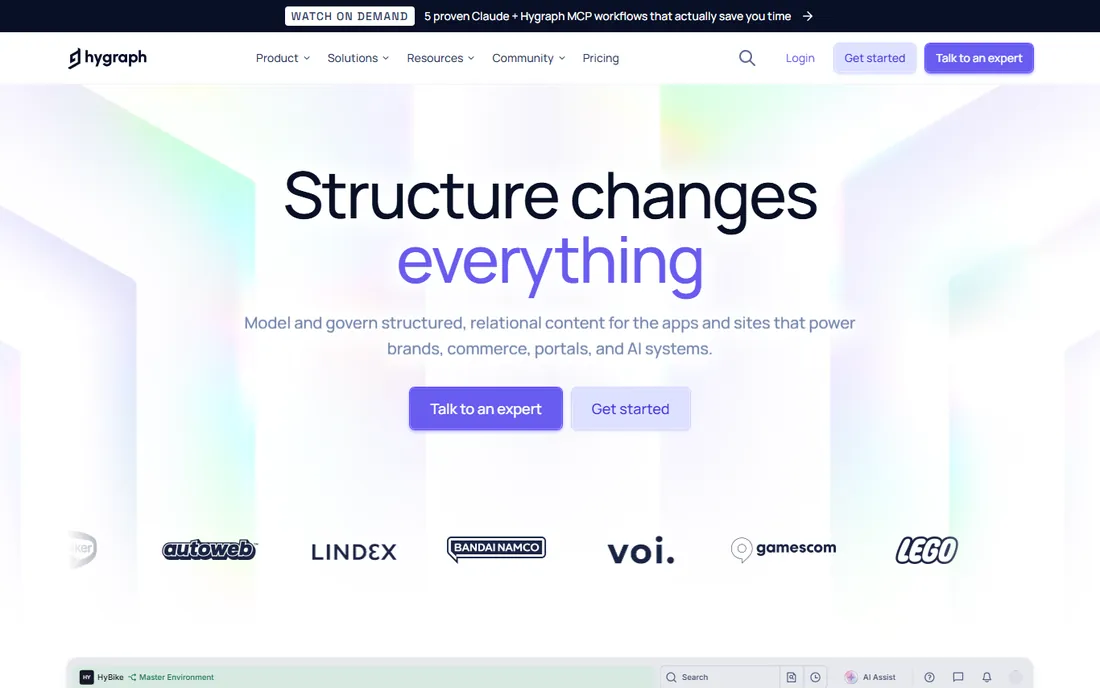
Hygraph, formerly GraphCMS, is built GraphQL-native from the ground up rather than offering GraphQL as an add-on. Its distinctive strength is content federation: pulling content from multiple backends, CMS entries, product databases, external APIs, into one unified GraphQL endpoint. For enterprises with content scattered across systems, that federation layer is genuinely valuable.
Professional plans start at $199 a month with a free Community tier for evaluation. The ecosystem is smaller than Contentful's, and teams unfamiliar with GraphQL face a learning curve. But for data-heavy applications, ecommerce with complex product content, or architectures already standardized on GraphQL, Hygraph's native design beats bolted-on alternatives.
What we like- GraphQL-first API design
- Content federation across sources
- Strong for complex data models
Watch out for- Smaller ecosystem than Contentful
- Steeper learning curve for non-GraphQL teams
Starting priceSee website
Free planNo
Adobe Experience Manager is the enterprise CMS for companies already living in Adobe's world. AEM Sites manages web content, AEM Assets handles digital asset management at enormous scale, and native integration with Adobe Analytics, Target, and Campaign connects content to measurement and personalization without middleware. Nobody else on this list matches that integrated marketing stack.
Everything about AEM is enterprise-scale, including the drawbacks. Pricing is quote-only and sits at the top of this list. Implementations run for months with specialized partners. It fits large organizations with Adobe commitments, complex multi-brand architectures, and the budget for both licenses and implementation. Everyone else should look at the headless options first.
What we like- Deep integration with Adobe Analytics, Target, and Creative Cloud
- Sites plus Assets in one
- Proven at massive scale
Watch out for- Quote-only enterprise pricing
- Heavy implementation measured in months
Starting priceSee website
Free planNo
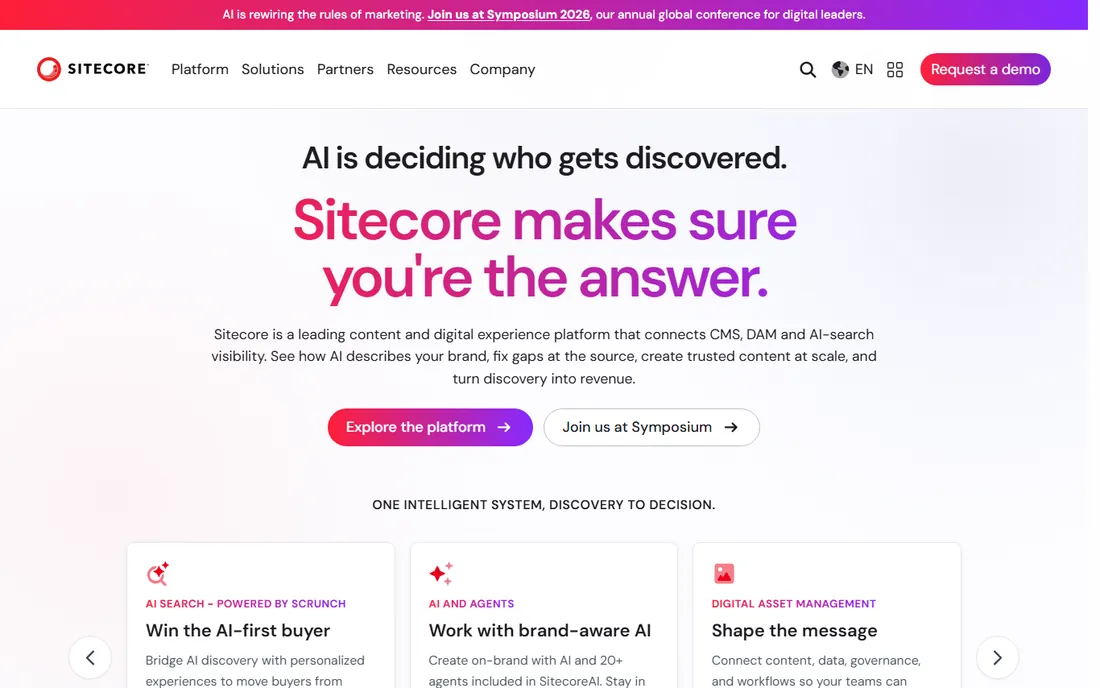
Sitecore built its reputation on personalization: rules-based content targeting, customer data integration, and testing that lets enterprise marketers tailor experiences by segment, behavior, and history. The modern Sitecore is composable, with separate modules for content management, personalization, search, and customer data that can be bought together or individually.
Like AEM, it is quote-only and implementation-heavy, sold and deployed through a partner ecosystem. Regulated industries like finance and healthcare favor Sitecore for its governance and on-premise options. Marketing teams that need sophisticated personalization without assembling a composable stack from five vendors will find Sitecore's integrated approach compelling, at enterprise prices.
What we like- Industry-leading personalization engine
- Composable DXP modules
- Strong for regulated industries
Watch out for- Quote-only pricing
- Complexity demands specialized partners
Starting priceSee website
Free planNo
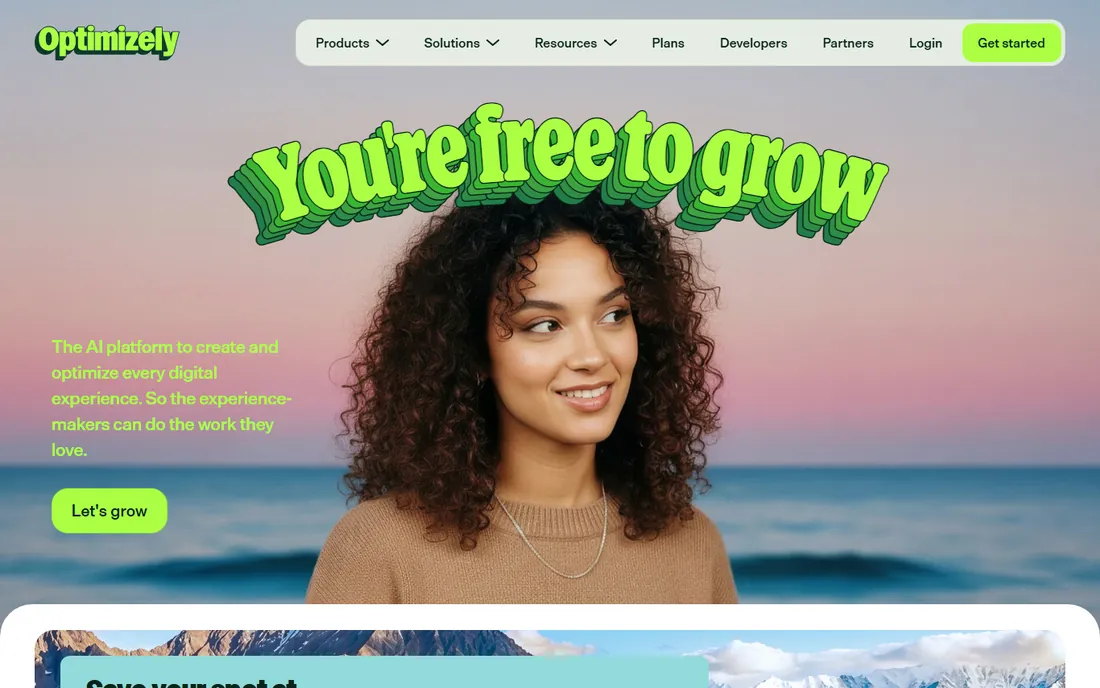
Optimizely, formerly Episerver, combines content management with the experimentation platform it acquired, and that combination is the pitch. Marketers manage content and run A/B tests from one system, closing the loop between publishing and optimization without stitching tools together. B2B commerce features add depth for manufacturers and distributors selling online.
The CMS itself is capable but not category-leading on content modeling or API flexibility compared to the headless specialists. Pricing is quote-based. Optimizely fits marketing teams where testing and optimization matter as much as content management: if your roadmap is full of experiments, having the testing engine native to the CMS removes real friction.
What we like- Best-in-class A/B testing built in
- Content management plus experimentation in one
- Strong B2B features
Watch out for- Quote-only pricing
- CMS depth lags pure-play content platforms
#9
Acquia
Best for: Drupal-based enterprise with strong governance
Visit acquia.com
Starting priceSee website
Free planNo
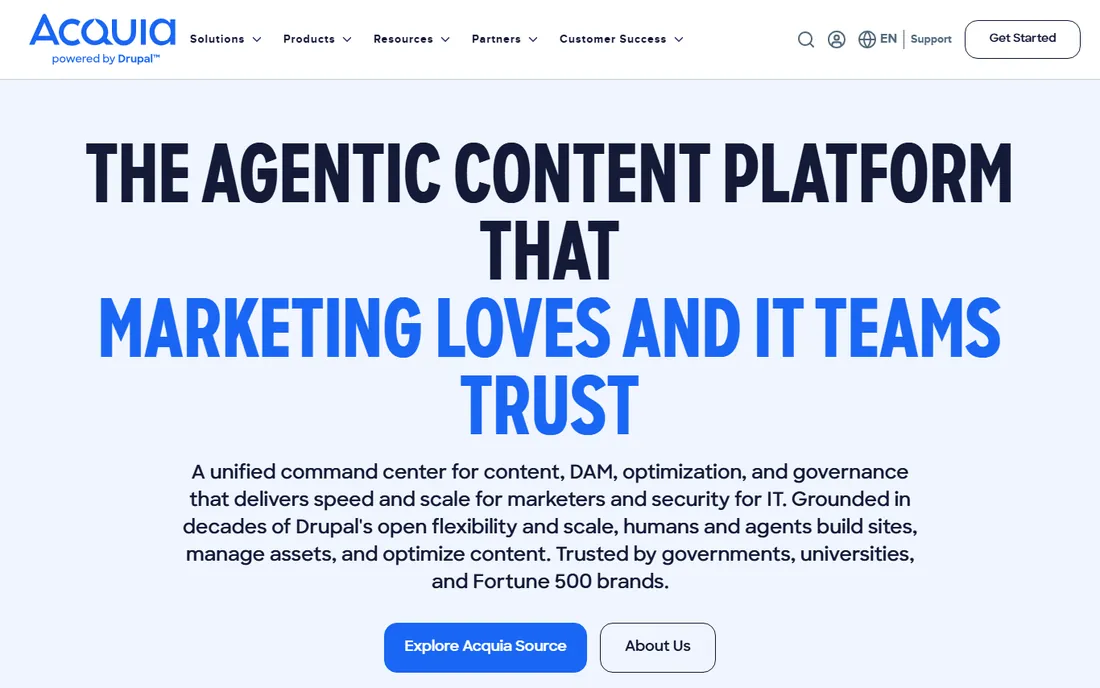
Acquia is the enterprise commercial home of Drupal, offering the open-source CMS as a managed cloud platform with governance, security, and support layered on top. Organizations get Drupal's flexibility and content modeling without operating the infrastructure, plus Acquia's tools for multi-site management, personalization, and customer data.
The Drupal foundation is both strength and constraint. Teams invested in Drupal, including many universities, governments, and nonprofits, get an enterprise upgrade path without replatforming. Organizations without Drupal history have little reason to adopt it now over headless alternatives. Pricing is quote-based. It fits enterprises that want open-source foundations with commercial support and SLAs.
What we like- Enterprise Drupal without the hosting burden
- Strong governance and workflow tools
- Open-source core
Watch out for- Tied to the Drupal ecosystem
- Quote-only pricing
Starting priceSee website
Free planNo
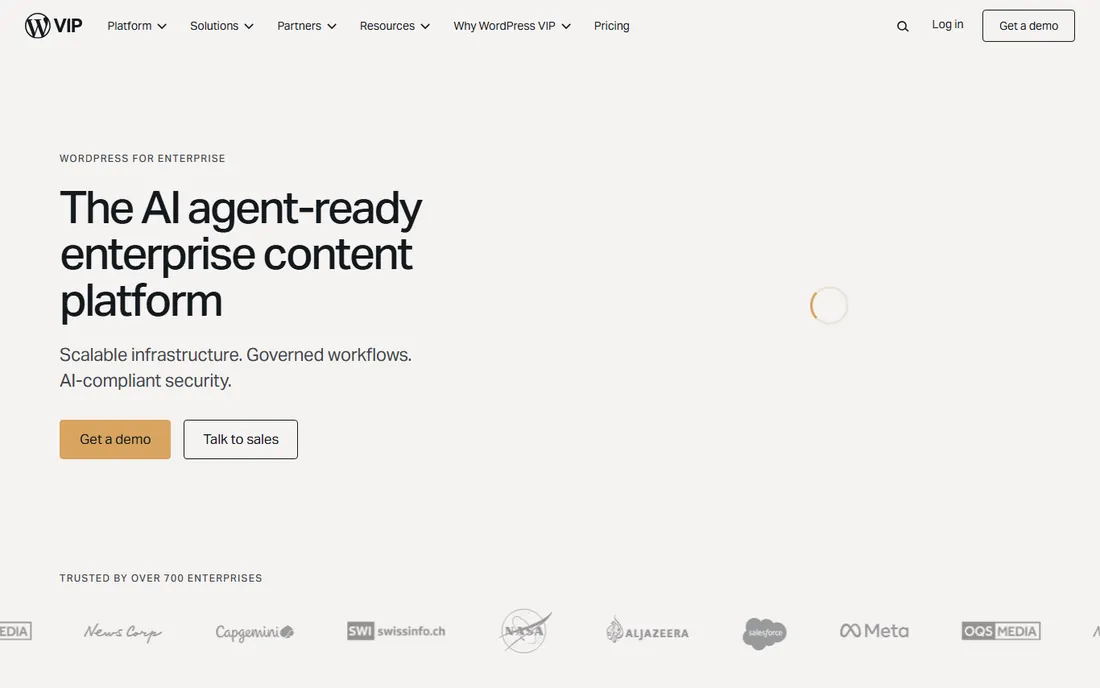
WordPress VIP takes the world's most familiar CMS and rebuilds it for enterprise scale: managed hosting, security hardening, performance optimization, and support SLAs, all on the WordPress editorial experience millions of marketers already know. For organizations with hundreds of editors trained on WordPress, that familiarity is worth more than any feature comparison.
VIP can serve headless architectures through the WordPress REST API and GraphQL, though it is less elegant than platforms designed headless from birth. Pricing is quote-based and enterprise-grade, far above WordPress.com business plans. It fits large publishers, universities, and enterprises whose content teams run on WordPress and whose IT teams want someone else handling scale and security.
What we like- WordPress familiarity for massive editor teams
- Enterprise security and scaling handled
- Huge talent pool
Watch out for- Quote-only pricing far above WordPress.com
- Headless via API less elegant than native headless
How we built this shortlist
We compared enterprise CMS platforms using vendor pricing pages, technical documentation, and review data from G2, Capterra, and developer communities. We weighted content modeling flexibility, API quality, editorial experience, governance and permissions, scalability, and total cost including implementation. We did not run hands-on trials, so workflow details come from documentation and verified user reviews rather than our own use.
What to check before you commit
Decide the architecture before the vendor. Headless suits companies with front-end developers building for multiple channels. Traditional coupled CMS suits marketing-led teams that need page building, personalization, and testing in one interface. Switching architectures later means replatforming, so get this decision right even if it delays the vendor choice by a month.
Model total cost, not the subscription. Enterprise CMS pricing has three parts: the license, the implementation, and the ongoing operation. A $300-a-month headless plan with a three-month agency build costs more in year one than it appears. A quote-based DXP with a six-month implementation costs an order of magnitude more. Ask each vendor for implementation estimates from partners who have done your use case before.
Test the editorial experience with your actual editors. Developers choose headless platforms; marketers live in them daily. Put three real editors on a trial with a real content task and watch what happens. If they cannot publish without developer help, the platform will create a bottleneck that no API elegance justifies. Storyblok exists precisely because this test fails so often.
Check API limits and overage pricing carefully. Headless CMS pricing meters API calls, and traffic spikes, rebuilds, and preview environments all consume calls. Ask for the overage rate in writing and model it against your traffic plus a bad month. The vendors with the cheapest entry tiers sometimes have the most painful overage economics.
Evaluate the ecosystem around the platform. A CMS is only as useful as its integrations with your analytics, CRM, commerce, and search tools. Browse each vendor's marketplace for your specific stack before committing. Contentful and AEM lead here; smaller headless platforms may need custom integration work that should be priced into the decision.
Headless versus traditional: the architecture decision
The headless versus traditional debate is really about who owns the front-end. Headless CMS platforms manage content and deliver it by API; your developers build the website, app, or device experience separately. That separation lets front-ends evolve without CMS constraints and lets one content hub feed many channels. The cost is developer dependence: nothing ships without engineering.
Traditional platforms couple content management with presentation. Marketers build pages visually, preview them directly, and publish without tickets. Personalization and testing come built in. The cost is flexibility: the front-end is whatever the CMS produces, and multi-channel delivery is awkward.
Most enterprises land based on team shape. Developer-heavy organizations with design systems and multiple digital properties go headless. Marketing-led organizations with campaign calendars and personalization roadmaps stay traditional. Hybrid approaches exist, with traditional platforms serving headless APIs, but they inherit complexity from both sides. Choose based on who will do the daily work, not on which architecture sounds more modern.
Frequently asked questions
What is the best CMS platform?
There is no single best CMS platform. Developer-led teams building multi-channel experiences usually pick headless options like Contentful or Sanity. Marketing-led enterprises needing personalization pick Adobe Experience Manager or Sitecore. WordPress VIP suits organizations with large WordPress-trained editorial teams.
What is a headless CMS?
A headless CMS manages content without a built-in front-end. Content is created once and delivered by API to websites, mobile apps, or any other channel. The "head" (presentation) is separate from the "body" (content management), which gives developers full control over the user experience.
How much does an enterprise CMS cost?
Headless platforms start at $99 to $300 a month for entry tiers, with Sanity at $15 per seat. Traditional enterprise platforms like Adobe Experience Manager and Sitecore are quote-based and typically run into six figures annually including implementation. Open-source Strapi is free to self-host.
Is WordPress still good for enterprise?
WordPress VIP proves it can be, with enterprise hosting, security, and SLAs on the familiar WordPress editor. Standard WordPress struggles at enterprise scale without significant engineering. Organizations choosing WordPress for enterprise should budget for VIP or equivalent managed infrastructure.
Headless CMS vs traditional CMS: which is better?
Headless is better for multi-channel delivery and developer control. Traditional is better for marketer autonomy, built-in personalization, and faster campaign execution. The right answer depends on your team's skills and how content reaches your audience.
Can I migrate from WordPress to a headless CMS?
Yes, and it is a common project. Content exports from WordPress and imports into headless platforms via API, though content modeling usually needs redesigning rather than direct mapping. Budget for both the migration and editor retraining, since the publishing workflow changes completely.
Sources we checked (5)
- https://emelia.io/hub/headless-cms-tools
- https://dev.to/nayankyada/sanity-vs-payload-cms-vs-storyblok-pricing-comparison-2026-3p7m
- https://www.saasworthy.com/product/contentful/pricing
- https://www.saasworthy.com/product/sanity/pricing
- https://www.selecthub.com/headless-cms-platforms/strapi-vs-storyblok/
Is your product missing or out of date?
We review this list regularly. Vendors can request a listing, send updated pricing or ask about featured placement.

Shihab Mia · Founder, Rankite
Shihab has spent more than a decade helping SaaS and e-commerce brands grow through search. He writes Rankite's software buying guides from pricing pages, documentation and public user reviews. More about Shihab.