How we make this list: we compare pricing pages, product documentation and public user reviews. Rankite is independent; if a vendor ever pays for a featured spot, that listing is clearly labeled Partner.
Key takeaways
- MillionVerifier and DeBounce are the cheapest credible options for bulk cleaning, at $39 and $25 per 10,000 verifications with credits that never expire.
- ZeroBounce is the most feature-rich but also the priciest, with pay-as-you-go from $39 per 2,000 and a $99 per month subscription that bundles deliverability tools.
- NeverBounce and Bouncer both charge $8 per 1,000 verifications, with strong integrations for agencies and CRM-driven teams.
- BriteVerify gives new accounts 5,000 free credits and fits enterprise teams validating inside Salesforce or Marketo.
- Credit expiry rules matter as much as price: NeverBounce and BriteVerify credits expire after 12 months, while most others never expire.
Quick comparison
| Tool | Best for | Starting price | Free plan |
|---|
 MillionVerifier MillionVerifier | cheapest bulk verification at scale | $39 per 10,000 credits (pay as you go) | Free (100 credits) |
 DeBounce DeBounce | tightest budget for straightforward list cleaning | $25 per 10,000 credits (pay as you go) | Free (100 credits) |
 ZeroBounce ZeroBounce | verification bundled with a full deliverability toolkit | $39 per 2,000 credits (pay as you go) | Free (100 credits/month) |
 NeverBounce NeverBounce | established integrations and per-address deliverability scoring | $8 per 1,000 credits (pay as you go) | No |
 Bouncer Bouncer | EU teams and careful catch-all handling | $8 per 1,000 credits (pay as you go) | Free (100 credits) |
 Emailable Emailable | fast cleaning of one-off lists | $38 per 5,000 credits (monthly) | Free (250 credits) |
 Clearout Clearout | verification combined with prospecting | $65 per 10,000 credits (pay as you go) | Free (100 credits) |
 BriteVerify BriteVerify | enterprise teams validating inside their CRM | $40 per 5,000 verifications (pay as you go) | Free (5,000 credits) |
 Mailfloss Mailfloss | automated recurring cleaning connected to your ESP | $29/month for 10,000 emails | Free (500 credits/month) |
Is your product missing or out of date?
We review this list regularly. Vendors can request a listing, send updated pricing or ask about featured placement.
The best email verifier software
Email verification buyers split into two groups with different math. The first cleans lists in batches before a campaign: they upload a CSV, download the results and care mostly about the price per thousand emails and how long credits last. The second verifies continuously: an API on signup forms, an ESP integration that cleans automatically, or a subscription that covers monthly sending. For them, integrations and real-time accuracy matter more than the bulk rate.
The batch buyers should compare MillionVerifier, DeBounce, Clearout and BriteVerify on price per email and credit expiry. The continuous buyers should look at NeverBounce, Bouncer, Emailable, Mailfloss and ZeroBounce, which lean into APIs, ESP connections and automation. This list covers both with current per-volume pricing so you can price your actual list size on each one.
Starting price$39 per 10,000 credits (pay as you go)
Free planFree (100 credits)
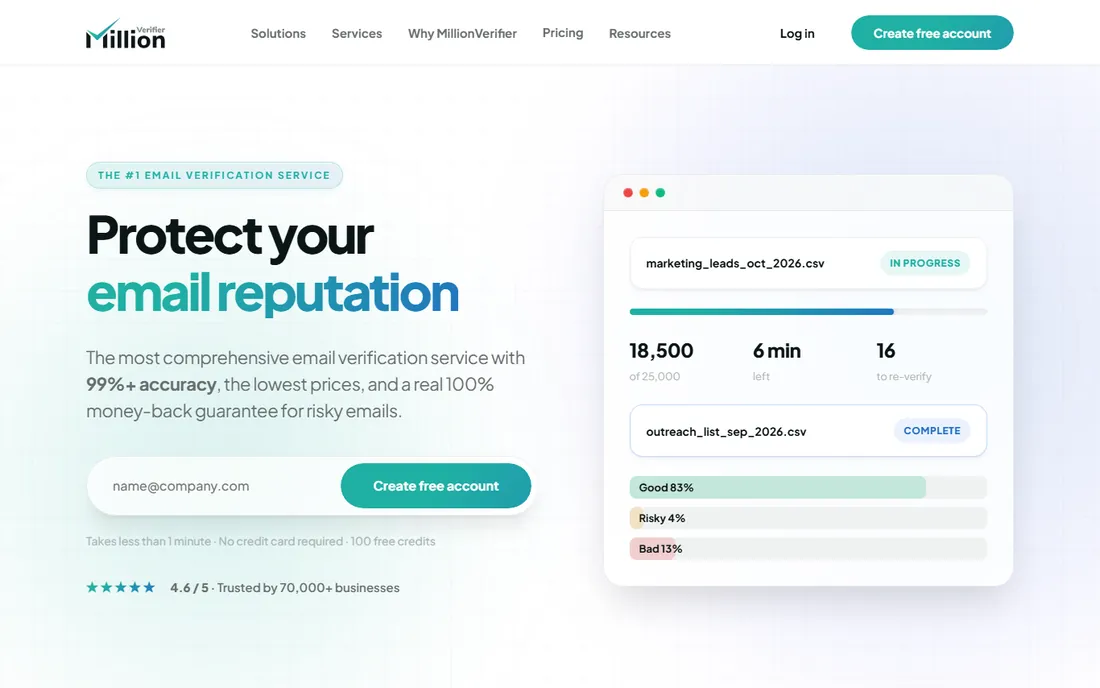
MillionVerifier competes on one axis and does not pretend otherwise. As of late 2026, pay-as-you-go pricing runs $39 for 10,000 credits, $89 for 50,000, $149 for 100,000 and $449 for one million, which works out to under a fifth of a cent per email at the 50,000 tier. Credits never expire, new accounts get 100 free credits, and the same credits work for bulk uploads and API checks. The company claims 99 percent plus accuracy and refunds credits on risky results, which is unusual in this category.
The trade is breadth. There is no inbox placement testing, no email finder and no phone or address validation, so teams needing those buy a second tool. Support reviews are mixed, with some users reporting slow responses. For agencies and senders cleaning large lists where cost per email dominates the decision, it is the hardest price in the market to beat.
What we like- Lowest per-email price among established verifiers
- Credits never expire
- Money-back guarantee including on risky results
Watch out for- No deliverability suite or prospecting layer
- Support quality gets mixed reviews
#2
DeBounce
Best for: tightest budget for straightforward list cleaning
Visit debounce.io
Starting price$25 per 10,000 credits (pay as you go)
Free planFree (100 credits)
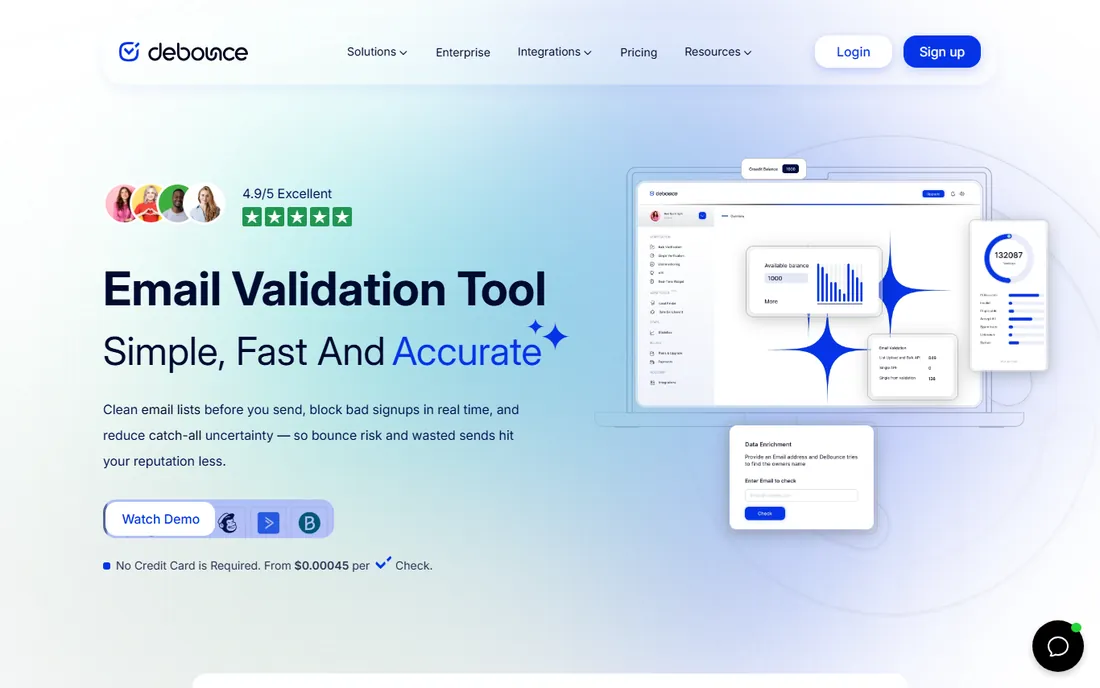
DeBounce is the budget specialist that keeps showing up at the top of price comparisons. Published one-time prices run $25 for 10,000 verifications, $135 for 100,000 and $750 for one million, undercutting nearly every established name at scale. Credits never expire, which suits teams that clean lists irregularly, and 100 free credits let you test on your own data first.
Independent accuracy audits tend to rank budget verifiers below premium ones on tricky categories like catch-all domains and greylisted servers, so run the same sample through DeBounce and a premium option before trusting a large list to it. For straightforward list hygiene where the main goal is removing obvious invalids and protecting sender reputation cheaply, the value is hard to argue with.
What we like- Among the cheapest published rates at every volume
- Credits never expire
- Simple upload-and-clean workflow
Watch out for- Thinner feature set than premium rivals
- Smaller integration catalog
Starting price$39 per 2,000 credits (pay as you go)
Free planFree (100 credits/month)
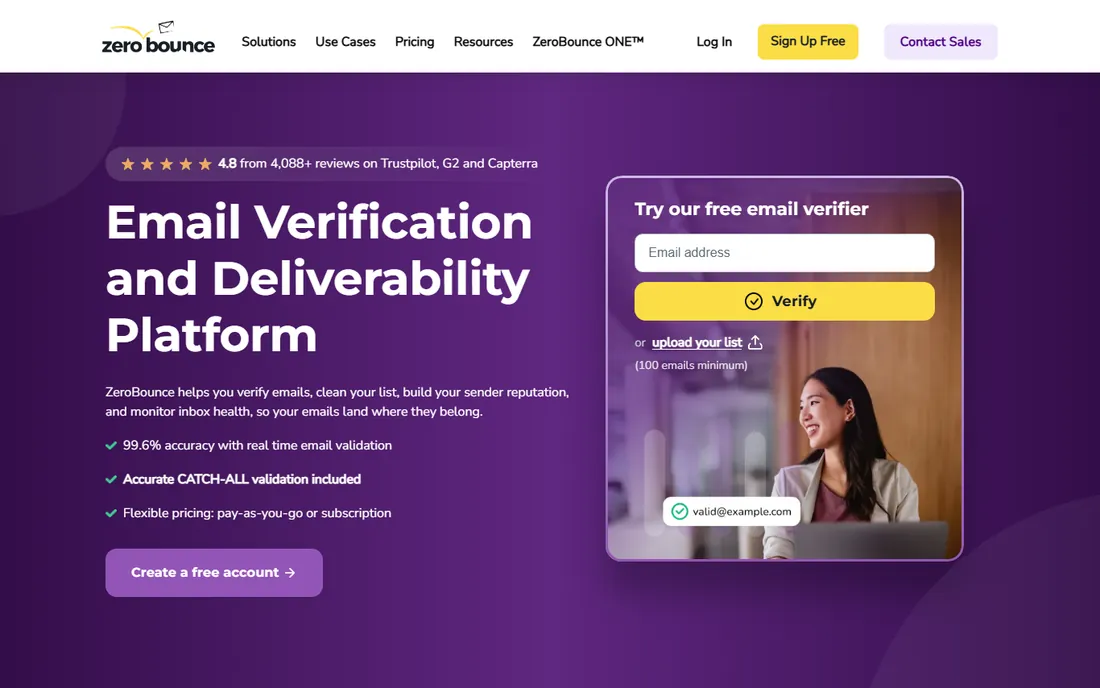
ZeroBounce positions itself as the premium option, and the pricing reflects it. Pay-as-you-go starts at $39 for 2,000 credits and runs to $129 for 10,000 and $3,199 for one million. The ZeroBounce ONE subscription at $99 per month bundles 10,000 monthly verification credits with inbox placement tests, email warmup, blacklist monitoring, server tests and DMARC monitoring. Free accounts get 100 credits a month plus sample allowances of the other tools.
Whether the premium is worth it depends on what you use beyond verification. If you only need list cleaning, MillionVerifier or DeBounce do the job for a fraction of the cost. If you run serious email programs and want deliverability monitoring in the same subscription, the bundle starts to make sense. Note that newer accounts should check credit expiry rules rather than assuming balances last forever.
What we like- 99.6 percent accuracy guarantee
- Inbox placement, blacklist and DMARC monitoring included on subscriptions
- Strong support reputation
Watch out for- Most expensive per-email pricing in the category
- Email Finder costs 20 credits per successful find
#4
NeverBounce
Best for: established integrations and per-address deliverability scoring
Visit neverbounce.com
Starting price$8 per 1,000 credits (pay as you go)
Free planNo
NeverBounce is one of the longest-running names in email verification, and its strength is ecosystem fit. Pay-as-you-go pricing runs $8 per 1,000 credits with bulk tiers down to $50 for 10,000 and $250 for 50,000, while the Growth subscription covers up to 10,000 emails a month for $49. Integrations with Salesforce, HubSpot, Marketo and major ESPs are mature, and the per-address scoring helps teams decide what to do with risky results rather than just deleting them.
The main watch-out is the 12-month expiry on pay-as-you-go credits, which penalizes teams that buy in bulk and verify slowly. There are also no free credits, so testing requires a purchase. For agencies and CRM-driven teams that verify regularly and want scoring depth, it remains a solid mainstream choice.
What we like- Deep integrations with CRMs and ESPs
- Per-address deliverability scoring
- Bulk discounts down to fractions of a cent
Watch out for- Pay-as-you-go credits expire after 12 months
- No free credits to test with
Starting price$8 per 1,000 credits (pay as you go)
Free planFree (100 credits)
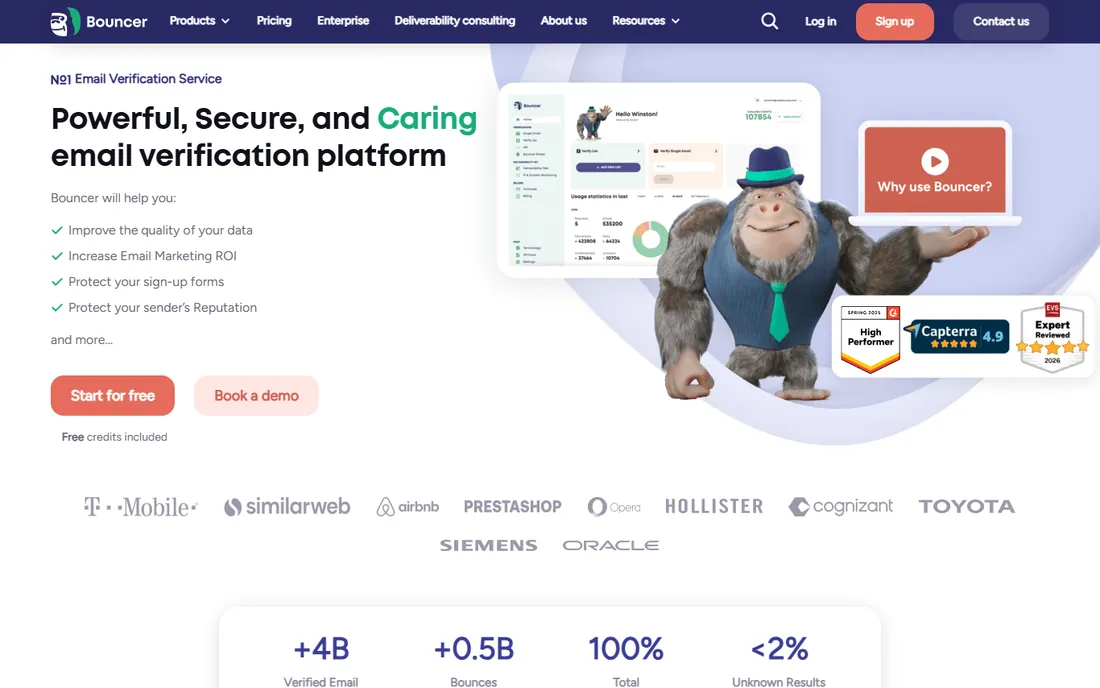
Bouncer built its reputation on two things: careful handling of catch-all domains, where most verifiers guess badly, and EU-friendly data practices including automatic data deletion. Pay-as-you-go starts at $8 per 1,000 credits and scales down to $2,000 for one million, credits never expire, and duplicates and unknown results are not charged. New accounts get 100 free credits.
The product lineup is modular rather than bundled: email verification, a separate toxicity check for spam traps, a real-time Shield product for forms, and a Deliverability Kit from $25 per month. That keeps the core price honest but makes the total bill less predictable if you need everything. For European teams and anyone whose lists are heavy on catch-all corporate domains, it is one of the most considered options.
What we like- Credits never expire
- No charge for duplicate or unknown results
- GDPR-friendly data handling with auto-deletion
Watch out for- Deliverability extras like inbox testing need a separate subscription
- Toxicity screening is a separate product
Starting price$38 per 5,000 credits (monthly)
Free planFree (250 credits)
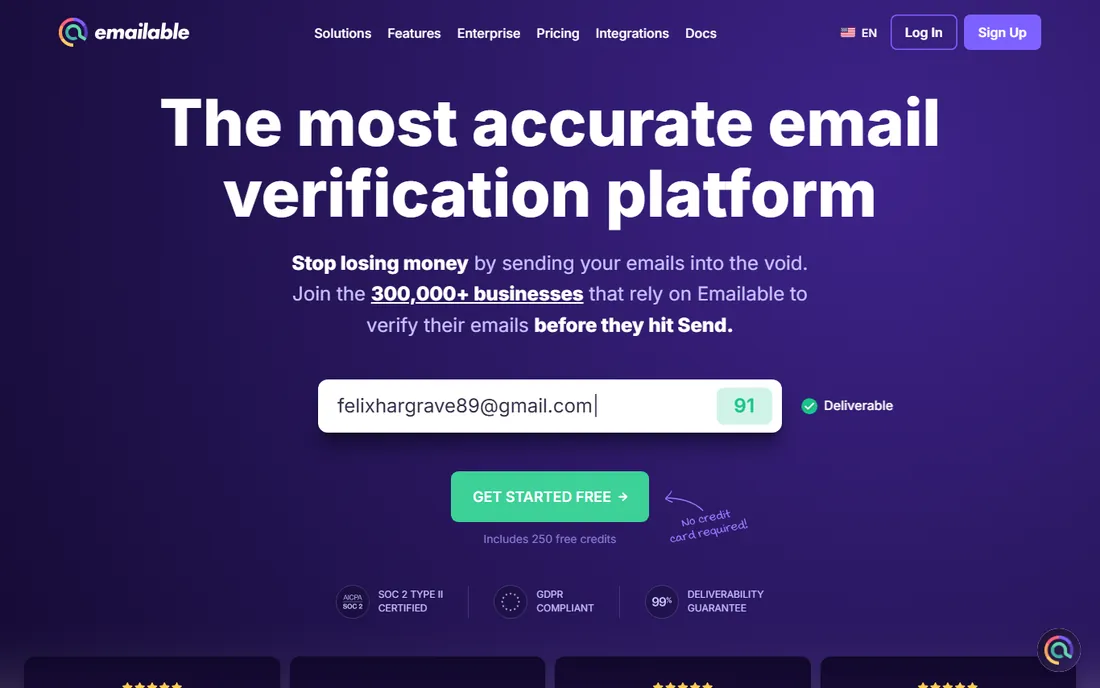
Emailable's pitch is speed: the company claims 250,000 addresses in about seven minutes, which matters when a campaign is waiting on a clean list. Pricing runs $38 per 5,000 credits monthly, with pay-as-you-go around $60 for 10,000 and $420 for 100,000, and credits never expire. The 250 free credits are more generous than most competitors, giving a real sample to judge accuracy on your own data.
At $0.0076 per email on the entry tier, it costs roughly four times MillionVerifier's rate, so it loses on pure price. It wins on turnaround and on the quality of its real-time widget for forms. Pick Emailable when you verify in bursts and want results in minutes rather than the absolute lowest per-email cost.
What we like- Very fast bulk processing
- Generous 250-credit free test
- Credits never expire on pay-as-you-go
Watch out for- Higher per-email cost than budget rivals
- Less suited to high-volume agency workflows
Starting price$65 per 10,000 credits (pay as you go)
Free planFree (100 credits)
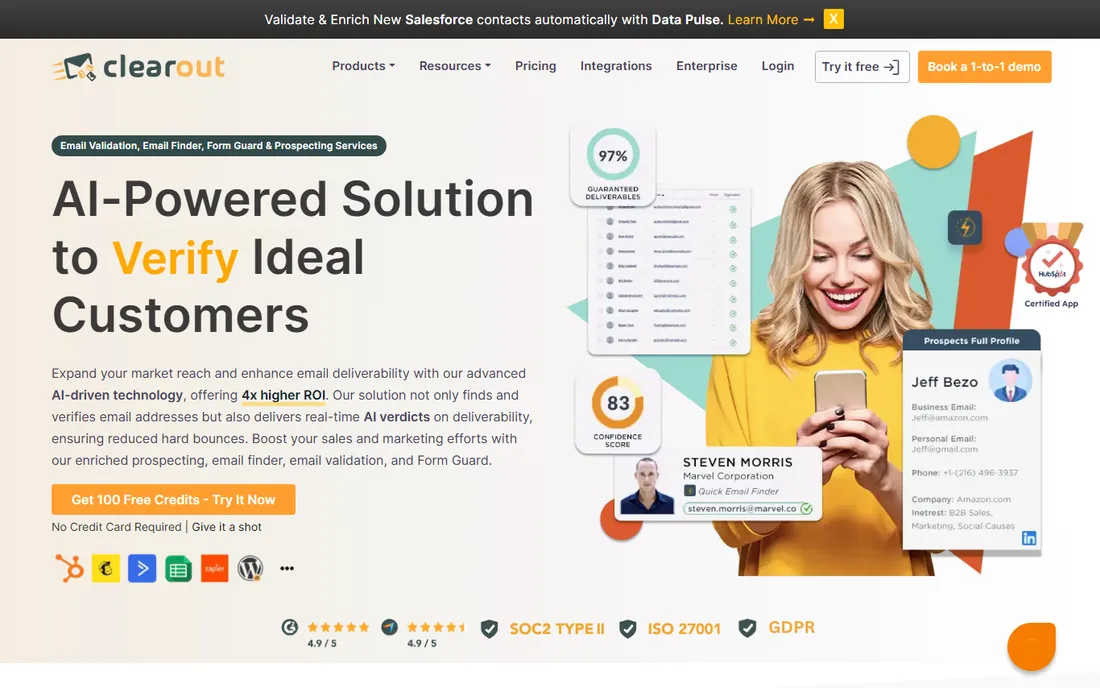
Clearout pairs email verification with an email finder, which suits teams that both build and clean prospect lists. Pay-as-you-go pricing lands around $65 for 10,000 verifications and $400 for 100,000, with credits that never expire and 100 free credits to start. Running finder and verifier in one account with one credit system removes the reconciliation headache of using two vendors.
On pure verification price it sits in the middle: cheaper than ZeroBounce and NeverBounce, more expensive than MillionVerifier and DeBounce. The value case is the combination. If you only clean lists you already own, the budget tools win. If your workflow is find, verify, then send, Clearout's single-vendor setup is worth pricing against the alternatives.
What we like- Verification plus email finder in one account
- Credits never expire
- Competitive mid-tier bulk pricing
Watch out for- Not the cheapest at any volume
- Finder credits cost more than pure verification credits
Starting price$40 per 5,000 verifications (pay as you go)
Free planFree (5,000 credits)
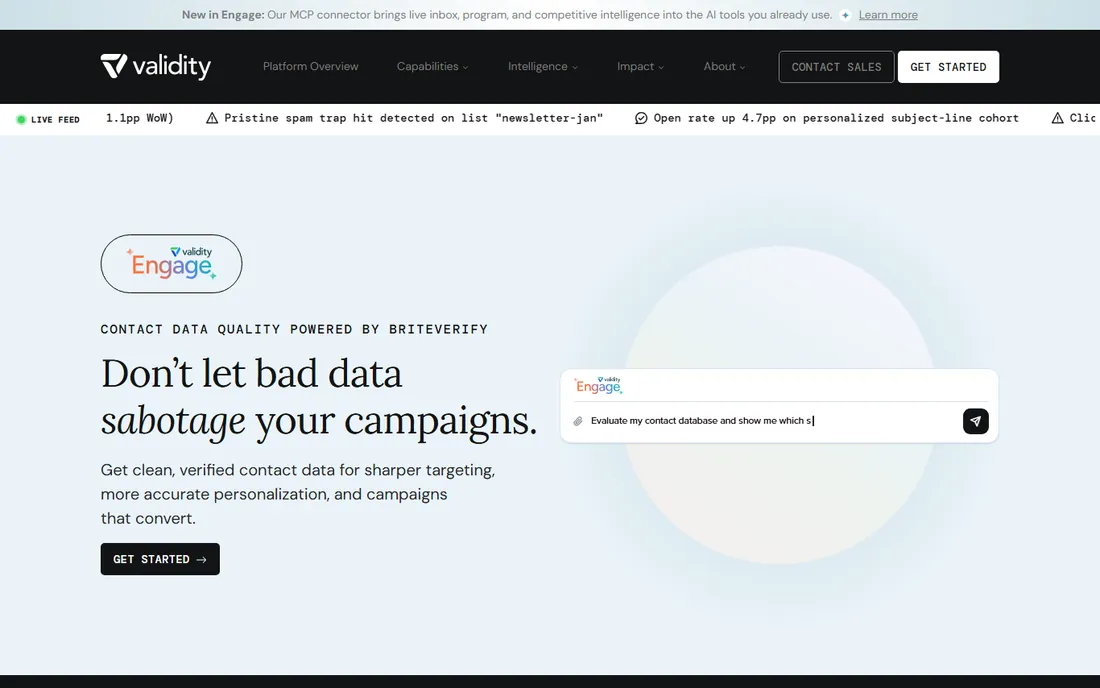
BriteVerify, part of Validity, is the enterprise incumbent. Pay-as-you-go starts around $40 per 5,000 verifications at roughly a cent per email up to 250,000, dropping toward half a cent at one to two million. The standout is the free tier: 5,000 credits on signup, enough to clean a real list before spending anything. Native integrations with Salesforce, Marketo and Eloqua put validation at the point of capture inside the CRM, which is where enterprise data quality actually gets fixed.
The catch is the 12-month credit expiry and a per-email price that compounds on repeat sends. Reviewers also flag inconsistent catch-all handling. For large organizations already on Validity's stack or validating inside Salesforce, the integration depth justifies the premium. Smaller teams get better per-email economics elsewhere.
What we like- 5,000 free credits is the most generous trial in the category
- Native Salesforce, Marketo and Eloqua integrations
- Real-time API for point-of-capture validation
Watch out for- Credits expire after 12 months
- Per-email cost rises fast on repeat verification
Starting price$29/month for 10,000 emails
Free planFree (500 credits/month)
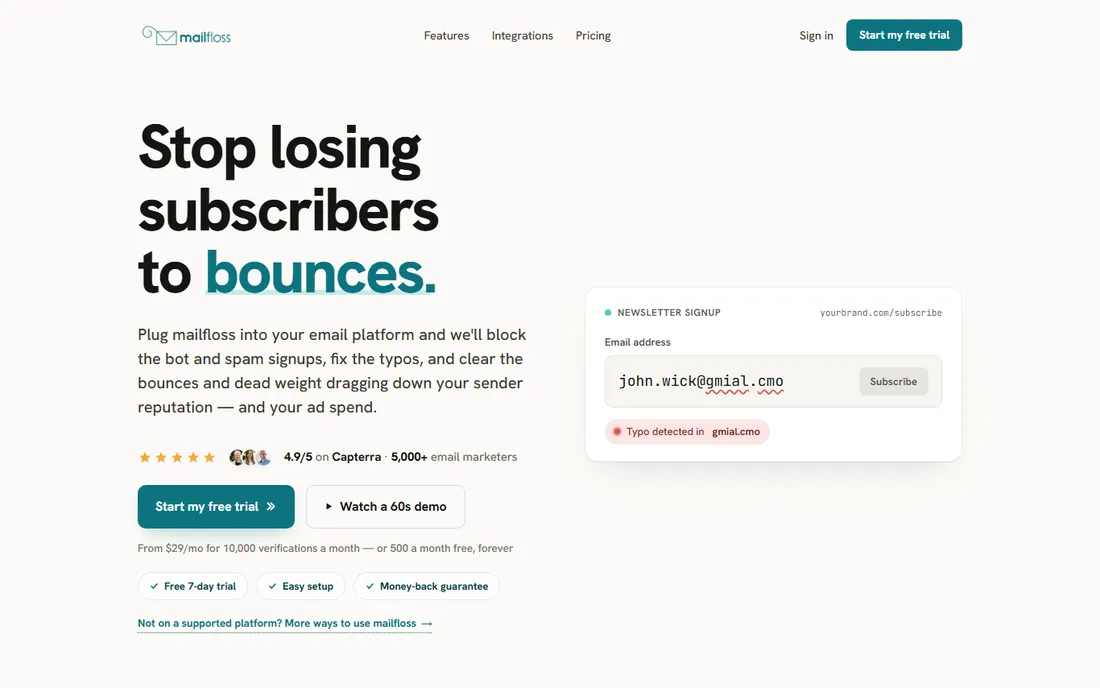
Mailfloss takes a different approach: instead of manual batch uploads, it connects to your ESP and cleans your list automatically every day. Plans start at $29 a month for 10,000 emails, with typo correction, automatic unsubscribing of hard bounces and disposable-address detection running in the background. The free tier covers 500 emails a month, which is enough for a small newsletter.
If you verify once a quarter, pay-as-you-go tools are cheaper. Mailfloss earns its subscription when list hygiene is an ongoing job and nobody on the team will remember to run manual cleans. For creators, coaches and small businesses whose list grows daily through opt-ins, the automation is the product.
What we like- Daily automatic sync with your email platform
- Fixes typos and auto-unsubscribes hard bounces
- Free tier covers 500 emails a month
Watch out for- Subscription-only model does not suit one-off cleans
- Per-month cost exceeds pay-as-you-go for infrequent use
We took pricing from each vendor's published pricing pages and cross-checked the numbers against independent pricing guides that re-verified vendor sites in September and October 2026. We compared the same verification volumes across tools rather than headline rates, checked credit expiry rules and free allowances, and weighed integration depth and real-time API quality alongside per-email cost. Reviewer feedback from G2, Capterra and Trustpilot informed the strengths and limitations. We did not run our own accuracy tests; accuracy claims here are the vendors' published figures.
What to check before you buy
Decide whether you are a batch buyer or a continuous buyer before comparing prices. Batch buyers should compute the cost per thousand at their actual list size, because volume curves differ wildly: one tool can be cheapest at 10,000 emails and expensive at one million. Check credit expiry next. Credits that never expire suit seasonal senders; 12-month expiry from NeverBounce and BriteVerify penalizes slow burn rates.
Test before you commit. Every tool with a free allowance lets you run the same few thousand addresses through two or three verifiers and compare how they classify your catch-alls and risky results, which is where accuracy actually diverges. If you capture emails on forms, check the real-time API: response speed, documentation quality and whether verification happens before or after the address enters your database. For cold email specifically, confirm the tool detects spam traps and disposable domains, since those are what damage sender reputation fastest.
Pay-as-you-go versus subscription
Pay-as-you-go wins when you verify in bursts: quarterly list cleans, purchased lists or pre-campaign hygiene. You buy credits, they sit until you need them, and most vendors here never expire them. Subscriptions win when verification is constant: daily ESP syncing through Mailfloss, monthly sending through ZeroBounce ONE, or high-volume API use. Do the math at your real monthly volume, because a $29 subscription beats a $39 credit pack only if you actually use it every month. Teams in between should start pay-as-you-go and switch when the monthly spend becomes predictable.
Frequently asked questions
How accurate are email verification tools?
Vendors claim 98 to 99.6 percent accuracy, but those figures hide the hard cases. Nearly every tool is accurate on obviously valid and invalid addresses. Results diverge on catch-all domains, greylisted servers and security-gateway-protected inboxes, which is exactly where bounces come from. Test each tool on your own list sample rather than trusting the headline percentage.
How often should I verify my email list?
Email lists decay 20 to 25 percent per year as people change jobs and abandon addresses. Clean before every major campaign, and verify new addresses at signup with a real-time API so bad data never enters your database. If you send monthly, a quarterly clean plus signup verification keeps bounce rates safely under control.
What is a catch-all domain, and why does it matter?
A catch-all mail server accepts every address at its domain, so a verifier cannot confirm whether a specific mailbox exists. Sending to unverified catch-alls is one of the biggest sources of unexpected bounces. Bouncer and ZeroBounce invest specifically in catch-all handling, and it is the category most worth testing when you trial tools.
Do unused verification credits expire?
It depends on the vendor. MillionVerifier, DeBounce, Bouncer, Emailable and Clearout credits never expire. NeverBounce pay-as-you-go credits expire 12 months after purchase, and BriteVerify credits are void one year after purchase. ZeroBounce expiry rules vary by account type, so check your purchase terms rather than assuming.
Can I verify emails in real time on my signup forms?
Yes. Most tools here offer an API or JavaScript widget that checks addresses as visitors type them, catching typos and disposable addresses before they enter your list. BriteVerify and NeverBounce lead on CRM integrations, Mailfloss automates ESP-side cleaning, and Bouncer's Shield product is built specifically for form protection.
Sources we checked (8)
- https://www.usebouncer.com/millionverifier-pricing/
- https://www.usebouncer.com/zerobounce-pricing/
- https://www.usebouncer.com/neverbounce-vs-zerobounce/
- https://www.1lookup.io/tools/email-verification-cost-calculator
- https://ecommercefastlane.com/best-email-verification-tools-compared/
- https://www.mailercloud.com/blog/best-email-verification-services
- https://smartreach.io/blog/best-email-verification-tool/
- https://www.leadgen-economy.com/blog/lead-validation-stack-trestle-modern-vendors/
Is your product missing or out of date?
We review this list regularly. Vendors can request a listing, send updated pricing or ask about featured placement.

Shihab Mia · Founder, Rankite
Shihab has spent more than a decade helping SaaS and e-commerce brands grow through search. He writes Rankite's software buying guides from pricing pages, documentation and public user reviews. More about Shihab.