How we make this list: we compare pricing pages, product documentation and public user reviews. Rankite is independent; if a vendor ever pays for a featured spot, that listing is clearly labeled Partner.

Key takeaways
- SimplePractice (from $29/month) is the default for solo and small therapy practices: notes, billing and telehealth in one polished app.
- TherapyNotes (from $49/month) fits practices that want deep clinical documentation with strong billing workflows.
- TheraNest (from $39/month) balances affordability with nonprofit and group-practice features.
- Bigger behavioral health organizations should evaluate Valant, ICANotes and PIMSY: built for scale, psychiatry and complex billing.
Quick comparison
| Tool | Best for | Starting price | Free plan |
|---|
 SimplePractice SimplePractice | Solo and small therapy practices | From $29/month | Free trial (30 days) |
 TherapyNotes TherapyNotes | Clinical documentation plus billing depth | From $49/month | Free trial |
 TheraNest TheraNest | Affordable EHR for groups and nonprofits | From $39/month | Free trial |
 Valant Valant | Behavioral health orgs and psychiatry | See website (custom quote) | No |
 ICANotes ICANotes | Fast charting with automated notes | See website | Free trial |
 PIMSY PIMSY | Mental health agencies and larger practices | See website (custom quote) | No |
 CounSol CounSol | Simple practice management for counselors | See website | Free trial |
 EHR Your Way EHR Your Way | Customizable EHR for behavioral health | See website (custom quote) | No |
Is your product missing or out of date?
We review this list regularly. Vendors can request a listing, send updated pricing or ask about featured placement.
The best EHR software for mental health
A therapy practice runs on three workflows: clinical notes, scheduling and billing. Generic medical EHRs treat therapy notes as an afterthought and bill like a hospital. Mental health EHRs are built around the 50-minute hour: DSM-aligned documentation, superbills, ERA payments and telehealth that does not need a second app. These eight cover the real options.
Starting priceFrom $29/month
Free planFree trial (30 days)
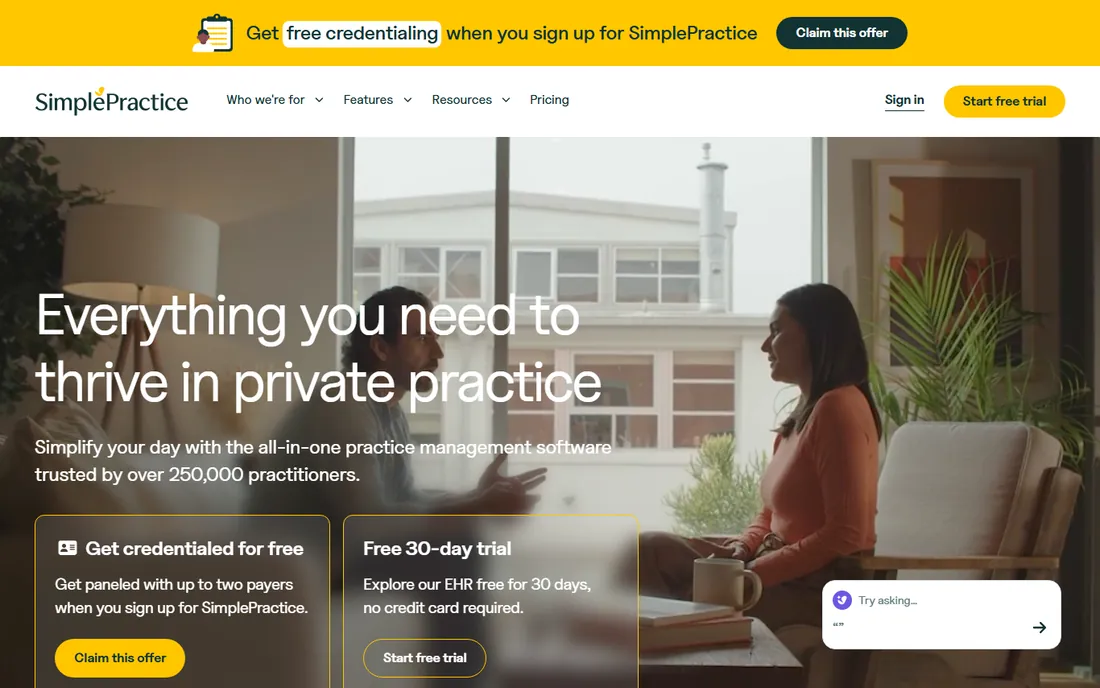
SimplePractice is the default recommendation for a reason: it does everything a small therapy practice needs without an implementation project. Intake paperwork, appointment reminders, telehealth sessions, progress notes with templates, insurance billing and a client portal all work out of the box. From $29 per month for the Starter plan, a solo practitioner gets a complete practice system.
The honest catch is scale. Per-clinician pricing means a ten-therapist group pays ten subscriptions, and the reporting and customization depth trails Valant or PIMSY. It is built for the practice, not the organization. Solo and small practices: start here. Larger groups: keep reading.
What we like- Polished all-in-one: notes, scheduling, billing, telehealth and client portal
- Easy onboarding that solo practitioners finish in days
- Good mobile app
Watch out for- Per-clinician pricing adds up for groups
- Advanced reporting is thinner than enterprise tools
Starting priceFrom $49/month
Free planFree trial
TherapyNotes leans clinical. The documentation tools (intake notes, treatment plans, progress notes with outcome measures, Wiley PracticePlanner integration) are deeper than SimplePractice's, and the billing workflow (electronic claims, ERA posting, patient billing) is built for practices that live on insurance. The to-do system surfaces what each claim needs next.
The catch is the experience. The interface is dated compared to SimplePractice, and from $49 per month per clinician it costs more. Practices that prioritize documentation depth and billing rigor over polish choose TherapyNotes. Practices that want the nicest app choose SimplePractice.
What we like- Strong clinical documentation with treatment plans and Wiley treatment planners
- Strong insurance billing with ERA
- To-do lists that keep claims moving
Watch out for- The interface is functional rather than modern
- Pricing per clinician adds up
Starting priceFrom $39/month
Free planFree trial
TheraNest positions as the affordable full-featured option: notes, scheduling, billing, telehealth and Wiley treatment planners from $39 per month. The pricing tiers scale with active clients rather than punishing small caseloads, and nonprofit organizations get attention in both features and pricing. Group practices get multi-clinician management without enterprise complexity.
The honest catch is the ecosystem. Fewer integrations and a smaller user community than SimplePractice or TherapyNotes mean less third-party support. The interface is clean but basic. For budget-conscious practices and nonprofits that need the full workflow, the value is strong.
What we like- Affordable tiered pricing that scales with caseload
- Nonprofit-friendly features and pricing
- Notes, billing, telehealth and Wiley planners included
Watch out for- Smaller vendor with a thinner integration ecosystem
- The interface is simpler than leaders
Starting priceSee website (custom quote)
Free planNo

Valant serves the larger end of behavioral health: group practices, organizations and psychiatry. E-prescribing, medication management, outcome measurement and deep analytics address needs solo-practice tools skip. The platform handles the complexity of multi-provider organizations: roles, permissions, reporting across locations.
The catch is the audience and the buying process. Custom pricing, demos and implementation planning put it out of reach for solo practitioners, who should not want it anyway. For behavioral health organizations standardizing on one platform, Valant's depth justifies the process.
What we like- Built for behavioral health at scale: psychiatry, group practices and organizations
- Strong e-prescribing and outcome measures
- Deep reporting and analytics
Watch out for- Custom pricing with enterprise sales process
- Overkill for solo practitioners
Starting priceSee website
Free planFree trial
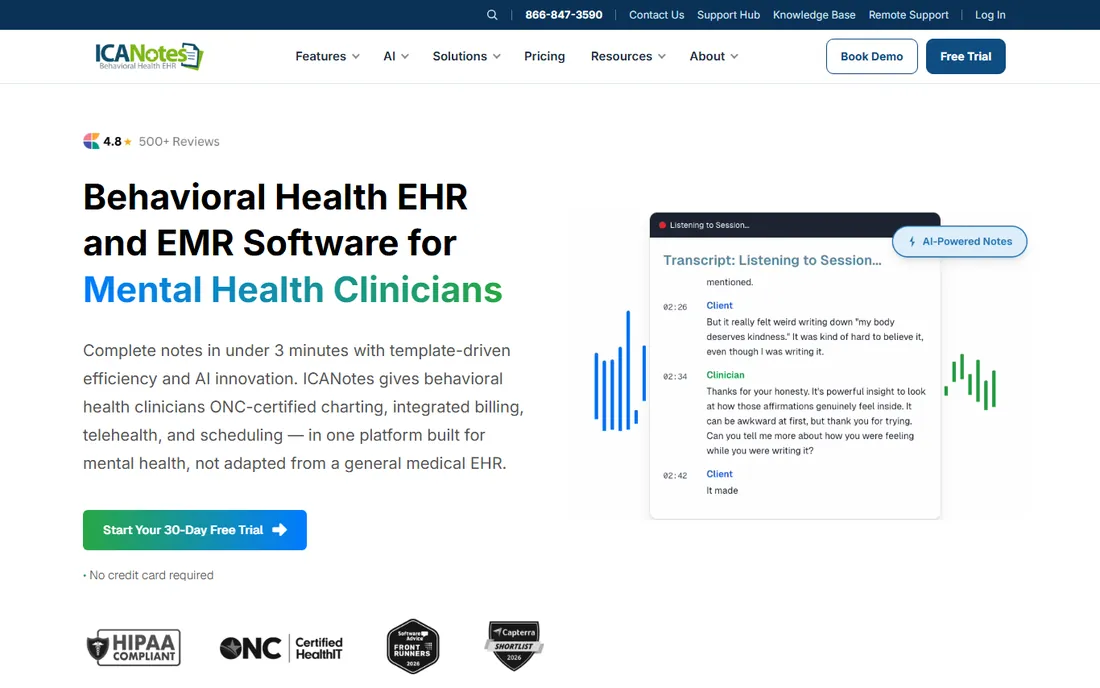
ICANotes' claim is speed: click through clinical content and it composes the narrative note for you. High-volume clinicians (community mental health, agencies) document faster than with template typing. The behavioral health content (assessments, treatment plans, progress notes) is comprehensive.
The honest catch is the writing. Generated notes read competently but uniformly, and some clinicians prefer their own prose. Pricing requires checking the site. For volume documentation where speed matters most, the charting engine is the differentiator. For boutique practices, the style may feel impersonal.
What we like- Charting engine that generates narrative notes from button clicks
- Fast documentation for high-volume clinicians
- Behavioral health templates built in
Watch out for- Pricing needs a website visit
- The generated-note style is not for everyone
Starting priceSee website (custom quote)
Free planNo

PIMSY targets mental and behavioral health agencies: organizations running multiple programs across locations with complex billing. The customization handles varied program requirements, and the billing and collections tools address the revenue cycle seriously. It is software for operations directors, not solo therapists.
The catch is the buy-in. Custom quotes, implementation planning and an agency-shaped interface. Solo and small practices will find it heavy. For agencies that need one system across programs and payers, PIMSY's fit is purpose-built.
What we like- Built for agencies: multi-program, multi-location management
- Strong billing and collections tools
- HIPAA-compliant with deep customization
Watch out for- Custom pricing and implementation
- The interface reflects its agency focus, not solo polish
Starting priceSee website
Free planFree trial

CounSol keeps it simple for counselors: online scheduling, notes, insurance billing and telehealth in a straightforward package. The learning curve is gentle, and the pricing positions affordably. Solo counselors who find SimplePractice more than they need (or want a simpler alternative) land here.
The honest catch is depth. Advanced reporting, integrations and organizational features trail the bigger platforms. It is a focused tool for focused practices. Verify your must-have features in the trial; the simplicity is either exactly right or slightly thin.
What we like- Simple, counselor-focused: scheduling, notes, billing and telehealth without bloat
- Easy learning curve
- Affordable positioning
Watch out for- Fewer advanced features than leaders
- Smaller vendor with less market presence
Starting priceSee website (custom quote)
Free planNo

EHR Your Way sells adaptability: forms, workflows and documentation that mold to how your practice actually works. Behavioral health specialization keeps the content relevant, and the onboarding is hands-on. Practices with unusual documentation needs or specific payer requirements get a system that fits instead of a system they fit into.
The catch is the effort trade. Customization means decisions, configuration and implementation time. Custom pricing follows. For practices whose workflows genuinely do not fit the standard tools, the adaptability is worth it. For standard therapy practices, the standard tools are faster.
What we like- Highly customizable forms, workflows and reports
- Behavioral health specialization
- White-glove onboarding and support
Watch out for- Custom pricing
- Customization depth means implementation effort
What to check before you buy
Start with your payer mix, because it decides the billing requirements. Insurance-heavy practices need electronic claims, ERA posting and eligibility checks done well: TherapyNotes, Valant and PIMSY lead here. Cash-pay practices can prioritize notes and client experience: SimplePractice shines. Get the billing workflow demoed with your actual payers, not a generic walkthrough.
Then check the note workflow against your documentation style. Template-driven (TherapyNotes), generated (ICANotes), or free-text with structure (SimplePractice): the method has to match how you think, because you will live in it for hours daily. Trial with real (de-identified) notes, not the sample patient.
Finally, verify telehealth and the client portal. Post-2020, these are core, not add-ons: session quality, waiting rooms, intake paperwork, secure messaging and payment collection. Test a full mock session in the trial. The EHR with the smoothest client experience reduces no-shows and admin time measurably.
The solo vs. group dividing line
Solo practitioners should optimize for simplicity and total cost: SimplePractice ($29+/month), TheraNest ($39+/month) or CounSol. One subscription, one login, everything works. The per-clinician math is trivial at one clinician.
Groups cross a line where reporting, roles and revenue cycle management matter: TherapyNotes for clinical depth, Valant or PIMSY for organizational scale. The buying process gets longer (demos, quotes, implementation), but the cost of the wrong system (billing errors, documentation gaps, clinician frustration) is larger. Do not buy group software for a solo practice, and do not stretch solo software across twenty clinicians.
How we chose
We started with the searches practices actually run: EHR for therapists, mental health EHR and SimplePractice alternative. For each candidate we checked the vendor's own pricing page, confirmed the product is current and HIPAA-positioned, and compared documentation, billing, telehealth and practice-size fit against public reviews on G2, Capterra, Software Advice and therapist communities. Where a price could not be verified on the vendor's page, we wrote "See website" rather than guessing.
Frequently asked questions
What is the best EHR for a solo therapy practice?
SimplePractice (from $29/month): notes, scheduling, billing, telehealth and client portal in one polished app with easy onboarding. TheraNest ($39/month) and CounSol are worthy alternatives. Solo practitioners should not buy enterprise platforms.
How much does mental health EHR software cost?
Solo plans run $29 to $69 per month per clinician. Group and organizational platforms (Valant, PIMSY) are custom-quoted, typically higher per clinician with implementation costs. Budget the per-clinician total at your headcount, plus any telehealth or claims add-ons.
Do I need an EHR if I am cash-pay only?
You still benefit: notes, scheduling, intake paperwork, secure messaging and payment collection in one HIPAA-compliant system. Cash-pay practices can skip the insurance billing depth and prioritize documentation and client experience. SimplePractice's lower tiers fit well.
Can these EHRs handle psychiatry and e-prescribing?
Valant is the strongest here with e-prescribing and medication management built for behavioral health. SimplePractice offers e-prescribing as an add-on in some tiers. Confirm controlled-substance (EPCS) support specifically if you prescribe them; not all platforms include it.
How long does implementation take?
Solo tools (SimplePractice, TheraNest, CounSol): days to two weeks, mostly data import and template setup. Organizational platforms (Valant, PIMSY, EHR Your Way): weeks to months with configuration and training. The timeline follows customization depth.
What happens to my data if I switch EHRs?
Reputable vendors export your clinical and billing data (usually CSV/PDF formats); confirm the export format and cost before signing. Switching EHRs is disruptive regardless: plan for dual-running during transition and verify note history transfers readably, not just as file dumps.
Sources we checked (8)
- https://www.simplepractice.com/pricing/
- https://www.therapynotes.com
- https://www.theranest.com/pricing/
- https://www.valant.io
- https://www.icanotes.com
- https://www.pimsyehr.com
- https://www.counsol.com
- https://www.ehryourway.com
Is your product missing or out of date?
We review this list regularly. Vendors can request a listing, send updated pricing or ask about featured placement.

Shihab Mia · Founder, Rankite
Shihab has spent more than a decade helping SaaS and e-commerce brands grow through search. He writes Rankite's software buying guides from pricing pages, documentation and public user reviews. More about Shihab.