How we make this list: we compare pricing pages, product documentation and public user reviews. Ratings come from G2, Capterra or Trustpilot, with the date we checked them.
What is edge computing software
Edge computing software runs workloads close to where data is created, on factory floors, in retail stores, on vehicles and on remote sites, instead of sending everything to a distant cloud region. It processes sensor data locally, filters it, runs inference and control logic, and sends only what matters back to the cloud. Teams choose it when latency is too high for a round trip, when connectivity drops, when bandwidth costs too much, or when data must stay on site. The trade off is operational complexity: instead of one cloud region, the team manages hundreds or thousands of small deployments.
Direct answer: AWS IoT Greengrass is the top pick for most teams because it extends AWS services to the edge at a published price of $0.16 per device per month, with the first three devices free for a year. Azure IoT Edge is the best option for Microsoft shops, because the runtime is free and open source and management runs through Azure IoT Hub. Cloudflare Workers is the best choice for code at the network edge, with a free plan and a paid plan from $5 a month.
Key takeaways
- AWS IoT Greengrass costs $0.16 per device per month, with the first three Core devices free for one year.
- Azure IoT Edge runtime is free and open source under the MIT licence; you pay for Azure IoT Hub, with S1 at $25 per unit per month.
- Cloudflare Workers gives 100,000 requests a day free, and the paid plan starts at $5 a month with 10 million requests included.
- Fastly Compute is free for the first 10 million requests and 100 million vCPU milliseconds each month, then $0.50 per million requests.
- Balena gives the first 10 devices free, and the Prototype plan starts at $159 a month for 30 devices.
How we picked
We compared eight tools on five points: where the workload runs, offline capability, device and fleet management, developer experience, and pricing transparency. A tool scored well when it ran real workloads at the edge rather than only caching or routing traffic. Prices come from vendor pricing pages and vendor published comparisons, checked 21 November 2026. Where sources disagree on a price, both figures are printed and the conflict is flagged. Prices are search verified; vendor homepages were not individually opened in the browser for this guide.
Comparison table
| Tool | Best for | Starting price | Free plan |
| AWS IoT Greengrass | AWS shops with device fleets | $0.16 per device per month | First 3 devices free for 1 year |
| Azure IoT Edge | Microsoft shops | Runtime free; IoT Hub S1 $25 per unit per month | IoT Hub free tier, 8,000 messages a day |
| Google Distributed Cloud Edge | Google Cloud on premises | Quote only | No free tier |
| Cloudflare Workers | Code at the network edge | Free; Paid $5 per month | 100,000 requests a day |
| Fastly Compute | WebAssembly at the edge | Free; $0.50 per million requests after allowance | 10M requests a month |
| ZEDEDA | Industrial edge orchestration | Quote only | No free tier |
| Balena | Container fleets on Linux boards | Free; Prototype $159 per month | First 10 devices free |
| Litmus Edge | Factory data at the edge | Quote only | No free tier |
Which edge computing software is best for a small team
A small team should start with Cloudflare Workers or Fastly Compute for code, and with Balena for devices. Workers gives 100,000 requests a day free, which covers prototypes and low traffic tools, and the paid plan is $5 a month with 10 million requests included. Fastly Compute gives 10 million requests and 100 million vCPU milliseconds free each month, which is generous for a small service. For device fleets, Balena gives the first 10 devices free with community support, and the Prototype plan at $159 a month covers 30 devices. Greengrass is also cheap at small scale, at $0.16 per device per month with three devices free for a year.
Do you need a paid edge computing plan
A paid plan earns its price when traffic or fleet size grows past the free allowances. Cloudflare Workers stays at $5 a month until the account passes 10 million requests, so most small services never pay more. Fastly Compute stays free until 10 million requests a month, then costs $0.50 per million. Greengrass costs $0.16 per device per month, so 100 devices cost $16 a month plus IoT Core messaging, which is cheap until message volume grows. Balena is the expensive one at scale: the Prototype plan at $159 a month covers only 30 devices, and Pilot at $329 a month covers 60, so a 1,000 device fleet needs the Production plan at $1,439 a month or a custom quote.
How to choose edge computing software for your stack
Choose by workload first. If the work is code that must run near users, such as personalisation, A/B tests or API logic, pick Cloudflare Workers or Fastly Compute. If the work is managing devices, sensors and machines, pick Greengrass, Azure IoT Edge, Balena or Litmus Edge. Next, check the cloud you already use: Greengrass fits AWS, IoT Edge fits Azure, and Distributed Cloud Edge fits Google Cloud, and fighting the existing stack costs more than any feature difference. Finally, check offline behaviour. Greengrass, IoT Edge and Balena keep working without connectivity and sync later, while Workers and Fastly Compute need the network by design.
Quick comparison
| Tool | Best for | Starting price | Free plan |
|---|
 AWS IoT Greengrass | AWS shops that want cloud services on their devices | $0.16 per device per month, or $1.49 per device per year on annual commitment | First 3 Greengrass Core devices free for one year under the AWS Free Tier |
 Azure IoT Edge | Microsoft shops that want container workloads on devices | Runtime free; Azure IoT Hub S1 $25 per unit per month | IoT Edge runtime free under the MIT licence; IoT Hub free tier allows 8,000 messages a day |
 Google Distributed Cloud Edge | Google Cloud customers that need on premises infrastructure | Quote only | No free tier |
 Cloudflare Workers | Teams that want code running at the network edge | Free; Paid plan $5 per month minimum per account | Free plan with 100,000 requests a day and 10 ms CPU per invocation |
 Fastly Compute | Teams that want WebAssembly edge compute with sub millisecond starts | Free; $0.50 per million requests after the free allowance | 10 million Compute requests and 100 million vCPU milliseconds free each month |
 ZEDEDA | Industrial teams that need edge orchestration at scale | Quote only | No free tier |
 Balena | Teams running Docker containers on fleets of Linux boards | Free; Prototype $159 per month | First 10 devices free |
 Litmus Edge | Factories that need to unify shop floor data at the edge | Quote only | No free tier |
Is your product missing or out of date?
We review this list regularly. Vendors can request a listing, send updated pricing or ask about featured placement.
These eight tools cover the main ways teams run workloads at the edge in 2026, from device runtimes to network edge compute.
#1
AWS IoT Greengrass
Best for: AWS shops that want cloud services on their devices
Visit aws.amazon.com
Starting price$0.16 per device per month, or $1.49 per device per year on annual commitment
Free planFirst 3 Greengrass Core devices free for one year under the AWS Free Tier
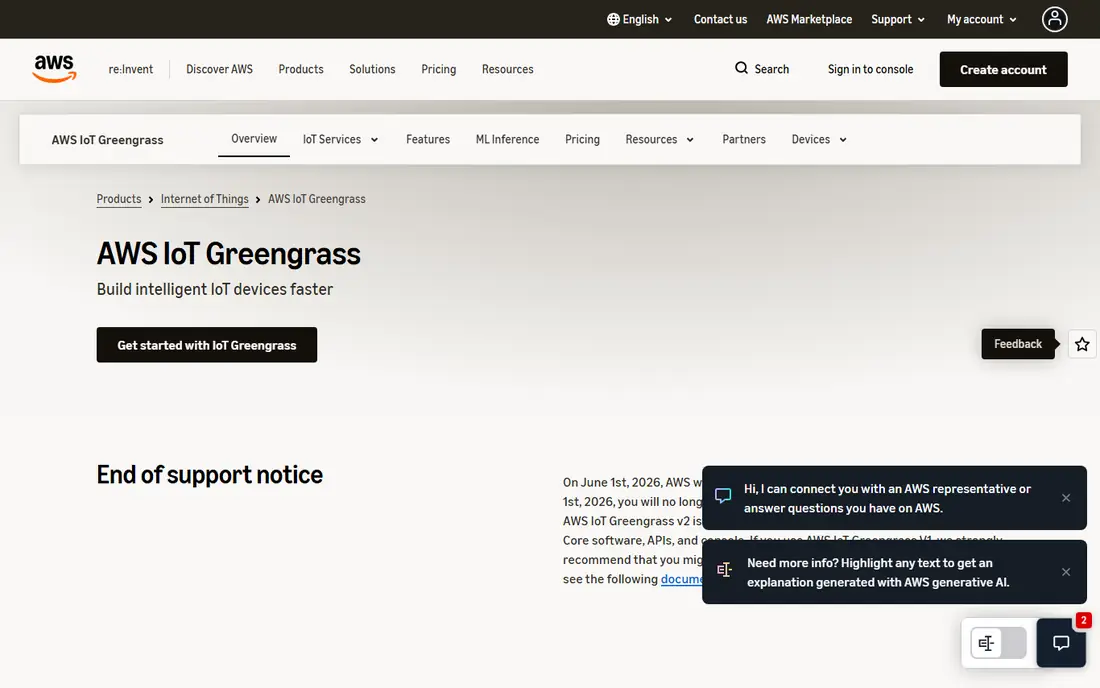
AWS IoT Greengrass extends AWS to edge devices so they can act locally on the data they generate while still using the cloud for management and durable storage. The Core runtime runs Lambda functions, Docker containers, machine learning inference and messaging on the device, and it keeps working when connectivity drops. Pricing is simple: $0.16 per Core device per month, or $1.49 per device per year on an annual commitment, with the first three devices free for one year. Devices that connect only locally to a Core carry no extra Greengrass charge. IoT Core messaging and connection charges add to the bill, and Greengrass V1 support ended 7 October 2026, so new deployments must use V2.
What we like- Published per device pricing, runs Lambda functions and Docker containers locally, works offline and syncs later, deep AWS integration
Watch out for- IoT Core messaging and connection charges add to the bill, Greengrass V1 support ended 7 October 2026, AWS centric by design
Starting priceRuntime free; Azure IoT Hub S1 $25 per unit per month
Free planIoT Edge runtime free under the MIT licence; IoT Hub free tier allows 8,000 messages a day
Azure IoT Edge is a fully managed service that deploys cloud intelligence to edge devices by running artificial intelligence, Azure services and custom logic directly on cross-platform IoT devices. The runtime is free and open sourced under the MIT licence, and it runs Docker compatible modules on Linux and Windows devices with as little as 128 MB of RAM. Management runs through Azure IoT Hub, which is required: the free tier allows 8,000 messages a day, and S1 costs $25 per unit per month for 400,000 messages a day. Edge modules such as Azure Stream Analytics on IoT Edge cost $1 per device per month, while Azure Functions and Custom Vision are free on the edge.
What we like- Runtime is free and open source, runs Docker compatible containers on Linux and Windows, offline operation built in, strong Azure AI integration
Watch out for- Requires Azure IoT Hub for management, does not work with the IoT Hub Basic tier, costs come from supporting Azure services
#3
Google Distributed Cloud Edge
Best for: Google Cloud customers that need on premises infrastructure
Visit cloud.google.com
Starting priceQuote only
Free planNo free tier
Google Distributed Cloud Edge brings Google Cloud infrastructure and services to on premises locations, so teams can run workloads where the data is created while using the same APIs, tooling and management as Google Cloud. It suits retail, manufacturing and healthcare sites that need low latency or data residency, and it is sold as managed hardware and software together. Pricing is quote only, with no published entry price and no free tier, which puts it out of reach for small teams. Pick it when the organisation already runs Google Cloud and needs edge sites under the same management plane.
What we like- Runs Google Cloud services on premises, same APIs and tooling as Google Cloud, managed hardware and software together, suits regulated industries
Watch out for- Quote only pricing with no published entry price, enterprise scale by design, Google Cloud centric, hardware commitment required
Starting priceFree; Paid plan $5 per month minimum per account
Free planFree plan with 100,000 requests a day and 10 ms CPU per invocation
Cloudflare Workers runs code on Cloudflare's global network, close to users, without servers to manage. The free plan allows 100,000 requests a day with 10 ms of CPU time per invocation, and static asset requests are free and unlimited. The paid plan has a $5 a month minimum per account and includes 10 million requests and 30 million CPU milliseconds a month, then $0.30 per additional million requests and $0.02 per additional million CPU milliseconds, with no charge for data transfer. The limits are the sandbox: 128 MB of memory per Worker, and CPU time caps that rise only on the paid plan.
What we like- Generous free plan, $5 paid plan includes 10 million requests, no egress charge, JavaScript, TypeScript, Python and WebAssembly support
Watch out for- 128 MB memory limit per Worker, CPU time limits on the free plan, Durable Objects and storage cost extra, not built for device fleets
#5
Fastly Compute
Best for: Teams that want WebAssembly edge compute with sub millisecond starts
Visit fastly.com
Starting priceFree; $0.50 per million requests after the free allowance
Free plan10 million Compute requests and 100 million vCPU milliseconds free each month
Fastly Compute, formerly Compute@Edge, runs WebAssembly workloads at Fastly's points of presence with sub millisecond cold starts. Pricing is pure usage: the first 10 million Compute requests and 100 million vCPU milliseconds each month are free, then requests cost $0.50 per million and vCPU milliseconds cost $0.05 per million, with volume tiers down to $0.20 and $0.02. Fastly removed memory time billing in April 2026, so only requests and CPU time are metered. The catch is that CDN bandwidth is billed separately from Compute, so a site that also serves content pays both meters.
What we like- Generous free allowance, sub millisecond cold starts, WebAssembly with Rust, Go, JavaScript and Python, memory time billing removed in April 2026
Watch out for- CDN bandwidth is billed separately, Compute Starter package costs $500 a month, smaller ecosystem than Cloudflare Workers
#6
ZEDEDA
Best for: Industrial teams that need edge orchestration at scale
Visit zededa.com
Starting priceQuote only
Free planNo free tier
ZEDEDA is an edge orchestration platform for industrial and distributed infrastructure. It provisions, manages and secures edge nodes at scale, with zero touch deployment, remote updates and a security model built for devices that sit outside the data centre. It runs virtual machines and containers together, which suits factories and energy sites that mix legacy and modern workloads. Pricing is quote only, with no published entry price and no free tier, so it is an enterprise purchase. The community is smaller than the cloud vendors', and it needs dedicated edge hardware rather than running on any spare server.
What we like- Purpose built for distributed edge infrastructure, zero touch provisioning, strong security model, supports virtual machines and containers together
Watch out for- Quote only pricing, enterprise focus, smaller community than the cloud vendors, needs dedicated edge hardware
#7
Balena
Best for: Teams running Docker containers on fleets of Linux boards
Visit balena.io
Starting priceFree; Prototype $159 per month
Free planFirst 10 devices free
Balena is a fleet management platform that deploys and updates Docker containers on remote embedded devices through balenaCloud, balenaOS and a command line interface. It supports more than 80 device types, from Raspberry Pi to Jetson Orin, and it pushes releases as container images with binary deltas, so updates are small and quick. The first 10 devices are free permanently with community forum support. The Prototype plan costs $159 a month, includes 30 devices and 1 user, with extra devices at $3 a month. Pilot costs $329 a month for 60 devices, and Production costs $1,439 a month for 110 devices, with extra devices at $2 a month.
What we like- First 10 devices free permanently, Docker based releases with binary deltas, supports more than 80 device types, open source balenaOS and openBalena
Watch out for- Per device pricing climbs steeply past prototyping, Prototype plan allows only 1 user, Production plan costs $1,439 a month, container runtime on every device
#8
Litmus Edge
Best for: Factories that need to unify shop floor data at the edge
Visit litmus.io
Starting priceQuote only
Free planNo free tier
Litmus Edge connects to virtually any industrial equipment and normalises the data for cloud platforms and applications. Brownfield plants with mixed machine vintages get connected fast, because the platform ships more than 250 drivers for PLCs and industrial protocols. It deploys on industrial PCs and keeps pilot data local when IT resists cloud connections, which sidesteps the security review that stalls many cloud projects. Analytics depth is lighter than Braincube or other manufacturing analytics tools, so Litmus works best as the connectivity and edge layer under a separate analytics platform. Pricing is quote only and billed per site, with no free tier.
What we like- More than 250 industrial drivers, quick deployment on industrial PCs, normalises data for cloud platforms, strong brownfield support
Watch out for- Quote only pricing with per site billing, analytics lighter than specialist tools, smaller brand, no free tier
Frequently asked questions
Is edge computing cheaper than cloud computing
It depends on what you measure. Edge compute itself is cheap: Cloudflare Workers costs $5 a month, Fastly Compute is free to 10 million requests, and Greengrass costs $0.16 per device per month. The expensive part is the hardware and the operations: buying devices, installing them, keeping them patched and replacing failures. A cloud service bills per use and needs no hardware.
What is the difference between edge computing and cloud computing
Cloud computing runs workloads in a central data centre, while edge computing runs them close to where the data is created. The edge wins on latency, because a round trip to a distant region takes tens or hundreds of milliseconds, and on resilience, because local workloads keep running when connectivity drops. The cloud wins on scale and management, because one region serves every user and the vendor owns the hardware. Most real systems use both: the edge filters and acts on data locally, and the cloud stores, analyses and manages the fleet.
Can edge devices work without internet
Device edge platforms such as Greengrass, Azure IoT Edge and Balena are built for offline operation. They run local logic, store data on the device, and sync with the cloud when connectivity returns. Network edge platforms such as Cloudflare Workers and Fastly Compute are different: they run in the vendor's points of presence and need the network by design, so they do not help a disconnected factory. Check offline behaviour before choosing, because it is the feature that decides whether a factory line keeps running through an outage.
How many devices can one edge platform manage
The cloud platforms scale furthest: Greengrass and Azure IoT Edge manage fleets of tens of thousands of devices, with Greengrass pricing published to 10,000 devices and custom pricing above that. Balena scales from 10 free devices to fleets of a million on the Production plan, though the price ladder climbs steeply. ZEDEDA and Litmus Edge are built for hundreds of industrial sites rather than tens of thousands of small devices. The practical limit is usually operations, not the platform: a team that cannot patch a thousand devices will struggle at any scale.
Which edge computing software is best for a factory
For a factory, start with the connectivity problem. Litmus Edge is the best pick when the plant has old machines that need connecting, because it ships more than 250 industrial drivers. AWS IoT Greengrass is the best pick when the factory already runs AWS, because it extends Lambda, messaging and machine learning to the floor. Azure IoT Edge is the best pick for Microsoft shops.
Sources we checked (8)
- https://aws.amazon.com/greengrass/pricing/
- https://azure.microsoft.com/en-in/pricing/details/iot-edge/
- https://cloud.google.com/distributed-cloud/edge
- https://developers.cloudflare.com/workers/platform/pricing/
- https://www.fastly.com/pricing
- https://www.zededa.com
- https://www.balena.io/pricing
- https://litmus.io
Is your product missing or out of date?
We review this list regularly. Vendors can request a listing, send updated pricing or ask about featured placement.

Shihab Mia · Founder, Rankite
Shihab has 5+ years in B2B and SaaS SEO. He writes Rankite's software buying guides from pricing pages, documentation and public user reviews. More about Shihab.