How we make this list: we compare pricing pages, product documentation and public user reviews. Ratings come from G2, Capterra or Trustpilot, with the date we checked them.
Key takeaways
- This list ranks companies, not products you buy off the shelf: most quantum access runs through cloud platforms and research programs.
- No single hardware approach leads on every measure: superconducting systems lead on qubit counts, trapped-ion systems lead on accuracy, and neutral-atom systems scale fastest.
- IBM leads on cloud access and roadmap detail, Google leads on error correction research, and Quantinuum leads on trapped-ion accuracy.
- D-Wave suits optimization problems through annealing, while gate-model companies suit general-purpose quantum algorithms.
- This article is general information only, not investment advice, and quantum stocks are volatile and speculative.
Quick comparison
| Tool | Best for | Starting price | Free plan |
|---|
 IBM Quantum | Cloud access and enterprise scale | See website | Yes |
 Google Quantum AI | Error correction research | See website | No |
 Quantinuum | Trapped-ion accuracy | See website | No |
 IonQ | High-fidelity cloud access | See website | Yes |
 Rigetti Computing | Superconducting gate-model systems | See website | No |
 D-Wave | Annealing optimization | See website | Yes |
 Microsoft Quantum | Topological research and Azure access | See website | Yes |
 PsiQuantum | Photonic fault-tolerance roadmap | See website | No |
Is your product missing or out of date?
We review this list regularly. Vendors can request a listing, send updated pricing or ask about featured placement.
The best quantum computing companies
#1
IBM Quantum
Best for: Cloud access and enterprise scale
Visit ibm.com
Starting priceSee website
Free planYes
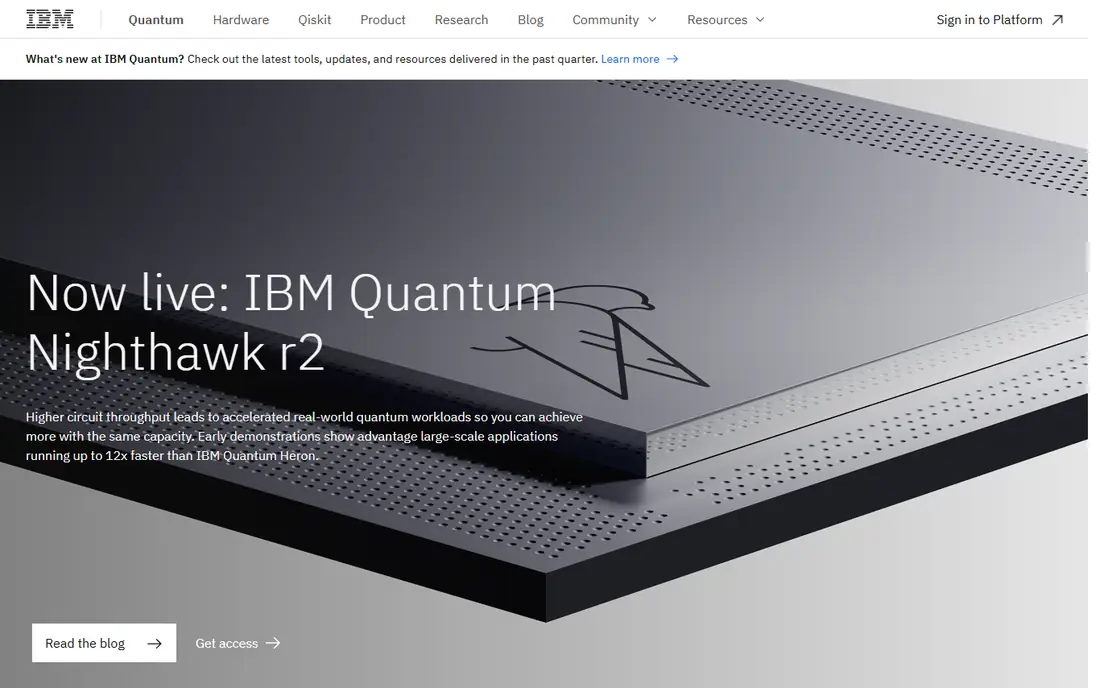
IBM Quantum operates the largest fleet of cloud-accessible quantum systems, with processors including Heron, Nighthawk, and Condor, the last reaching 1,121 physical qubits. Its public roadmap targets fault-tolerant systems, with the Starling system planned by 2029 and a stated goal of verifiable quantum advantage by the end of 2026. The IBM Quantum Network counts more than 300 organizations, giving enterprises, universities, and startups structured access to hardware, software, and training.
The limits are the same ones facing all superconducting systems: error rates and coherence times constrain useful problem sizes, and roadmap targets depend on error correction progress that is not guaranteed. Cloud pricing also varies by access tier, from free trial access to paid premium plans. For enterprises that want the broadest cloud access and the clearest roadmap today, IBM is the most practical quantum partner, and its Qiskit software stack is the most widely taught in the field.
What we like- Largest cloud-accessible fleet
- Detailed public roadmap
- 300 plus organizations in Quantum Network
Watch out for- Superconducting error rates still limit scale
- Roadmap targets are ambitious
- Cloud pricing varies by access tier
Starting priceSee website
Free planNo
Google Quantum AI runs its quantum program from a dedicated campus that integrates fabrication, testing, and data-center-scale infrastructure, a physical advantage that is hard for startups to match. Its Willow chip, with 105 qubits, demonstrated error correction below threshold, meaning errors fell as the system scaled, a key milestone on the path to fault tolerance. Earlier, the Sycamore experiment in 2019 demonstrated quantum supremacy on an abstract task, and later Willow results showed large speedups on benchmark algorithms against supercomputers.
Google quantum access is research-focused rather than a broad commercial cloud product, so enterprises cannot simply buy Willow time the way they buy IBM cloud access. There is no standalone product price, and commercial timelines remain uncertain. For researchers and enterprises tracking error correction progress, Google is the company to watch most closely, since fault tolerance, not qubit count alone, decides when quantum computers become broadly useful.
What we like- Willow chip with below-threshold error correction
- Dedicated Quantum AI campus
- Strong research record
Watch out for- Research access rather than broad commercial cloud
- No standalone product pricing
- Timelines uncertain
Starting priceSee website
Free planNo
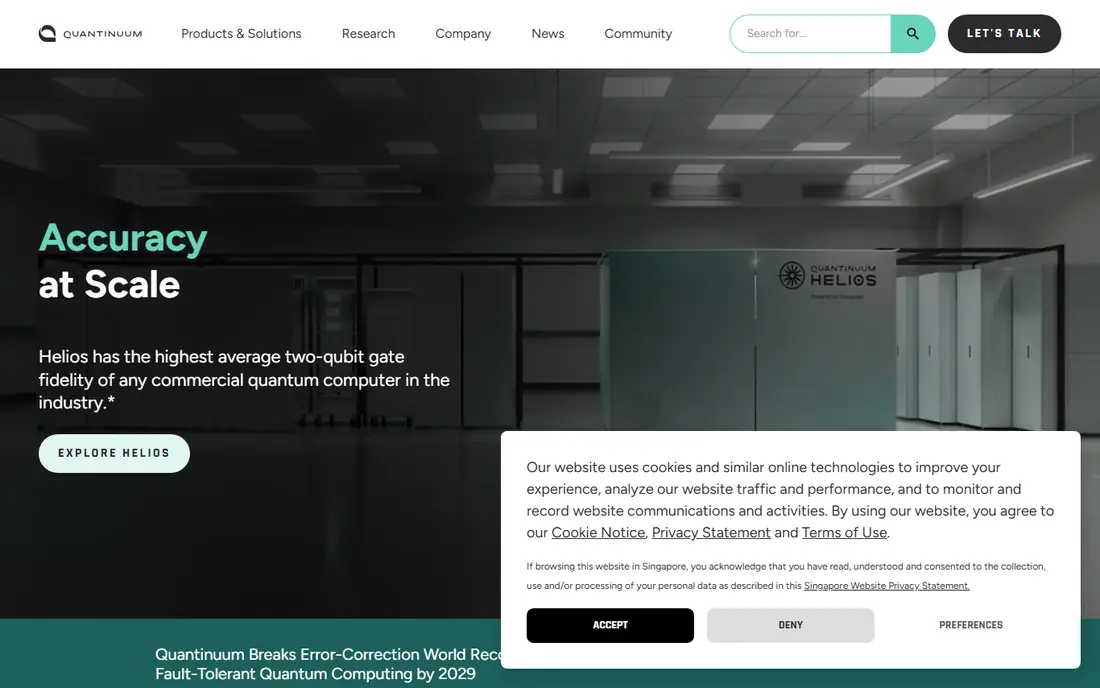
Quantinuum, formed from Honeywell Quantum Solutions and Cambridge Quantum, builds trapped-ion systems known for the highest gate fidelities in the field, meaning operations are more accurate per gate than rival approaches. Its Helios system offers 98 qubits commercially, and its trapped-ion architecture has shown strong logical qubit performance, which matters more than raw physical qubit counts for reliable computation. Quantinuum systems are available through cloud partners including Microsoft Azure Quantum, giving enterprises access without buying hardware.
The trade-off is scale: trapped-ion qubit counts trail superconducting systems, and building larger trapped-ion machines is a slower engineering path. Pricing is custom and partner-dependent, so there is no simple price to quote. For workloads where accuracy matters more than qubit count, such as chemistry simulation and optimization with tight error budgets, Quantinuum is the accuracy leader, and its logical qubit results are the closest to practical fault tolerance among commercial systems.
What we like- Highest gate fidelities
- Helios 98-qubit commercial system
- Strong logical qubit performance
Watch out for- Lower qubit counts than superconducting rivals
- Access through partners and cloud
- Pricing custom
Starting priceSee website
Free planYes
IonQ is a public trapped-ion company whose systems are available on Amazon Braket, Microsoft Azure Quantum, and Google Cloud, giving it the widest cloud distribution of any pure-play quantum company. Its Forte system offers 36 qubits with high fidelity, and its roadmap targets 256 qubits by late 2026, with longer-term goals far higher. IonQ reported annual revenue above $100 million, a notable milestone for a quantum hardware company, and its sixth-generation chip platform arrived in 2026.
Qubit counts still trail IBM superconducting systems, and cloud pricing varies by provider and by access model, so costs depend on where you run workloads. Revenue, while growing, remains small relative to the company market value, which makes the stock volatile. For enterprises that want high-fidelity trapped-ion access through their existing cloud provider, IonQ is the easiest pure-play company to work with, and its multi-cloud availability avoids lock-in to one hyperscaler.
What we like- Available on AWS, Azure, and Google Cloud
- High-fidelity trapped-ion systems
- Public company
Watch out for- Smaller qubit counts than IBM
- Cloud pricing varies by provider
- Revenue still small relative to valuation
Starting priceSee website
Free planNo
Rigetti Computing builds superconducting gate-model quantum processors, with systems reaching 108 qubits, and it offers access through cloud partners including Amazon Braket and its own cloud services. As a public company, Rigetti gives investors a pure-play superconducting bet distinct from IBM and Google diversified businesses, and its roadmap targets 1,000 plus qubits by 2027. Its systems suit general-purpose quantum algorithms, from optimization to simulation, rather than the annealing specialization of D-Wave.
Rigetti scale trails IBM and Google on qubits, funding, and ecosystem, and its roadmap targets are ambitious for a company of its size. Pricing is custom and partner-dependent. For researchers and enterprises that want a superconducting gate-model alternative to IBM, or for investors seeking a pure-play superconducting company, Rigetti is the main option, though its execution risk is higher than the diversified giants.
What we like- Superconducting gate-model systems
- Cloud access via partners
- Public company
Watch out for- Smaller scale than IBM or Google
- Roadmap targets ambitious
- Pricing custom
Starting priceSee website
Free planYes
D-Wave takes a different approach from gate-model companies: quantum annealing, which is designed for optimization problems such as scheduling, routing, and logistics rather than general-purpose algorithms. Its Advantage2 system offers more than 4,400 qubits, the highest count on this list, and its Leap cloud platform is the longest-running quantum cloud service, with free trial access for developers. Reported speedups on certain optimization benchmarks reach large multiples against classical methods for specific problem types.
Annealing is the limit as well as the strength: it does not run general quantum algorithms, so D-Wave cannot replace gate-model systems for chemistry or cryptography workloads. D-Wave is developing a gate-model roadmap targeting 100 logical qubits, but that work is still early. For optimization problems, especially logistics and scheduling, D-Wave is the most practical quantum option today, and its free Leap access makes it easy to test whether annealing helps your problem before committing.
What we like- Advantage2 with 4,400 plus qubits
- Optimization focus
- Longest-running quantum cloud
Watch out for- Annealing suits optimization, not general algorithms
- Gate-model roadmap still developing
- Pricing custom
Starting priceSee website
Free planYes
Microsoft Quantum pursues two tracks: Azure Quantum, a multi-vendor cloud that hosts IonQ, Quantinuum, Rigetti, Pasqal, and Atom Computing systems alongside its own research, and topological qubits based on Majorana particles, announced with the Majorana 1 chip in 2025. Topological qubits promise built-in error resistance, which could make fault tolerance easier if the physics holds, and Microsoft has invested heavily in that bet. Azure Quantum gives enterprises one cloud account, billing, and identity surface for several quantum vendors, which simplifies procurement.
The topological claims remain debated in the research community, and no commercial topological system exists yet, so the Majorana bet is long-term and uncertain. Microsoft quantum revenue is small relative to its overall business, and Azure Quantum pricing varies by vendor and access model. For enterprises that already run on Azure, Azure Quantum is the simplest way to test multiple quantum vendors, and for researchers, Microsoft topological work is the most ambitious long-term bet in the field.
What we like- Azure Quantum multi-vendor cloud
- Majorana topological research
- Large enterprise ecosystem
Watch out for- Topological claims remain debated
- No commercial topological system yet
- Quantum revenue small
Starting priceSee website
Free planNo
PsiQuantum builds photonic quantum computers, using particles of light rather than superconducting circuits or trapped ions, with the goal of fault-tolerant systems at utility scale. The photonic approach can use standard semiconductor fabrication techniques, which could make large-scale manufacturing easier than rival approaches that need exotic materials or extreme cooling. PsiQuantum is building large facilities aimed at fault-tolerant operation, and it works with partners and governments on infrastructure for that scale.
There is no commercial PsiQuantum system available today, so enterprises cannot run workloads on it yet, and timelines stretch years rather than months. Pricing is custom and partner-dependent. For investors and enterprises tracking the fault-tolerance race, PsiQuantum is the leading photonic bet, and its manufacturing argument is the strongest reason to watch it. For practical quantum work today, IBM, IonQ, or D-Wave offer systems you can actually use.
What we like- Photonic approach uses standard chip fabrication
- Large utility-scale facilities planned
- Fault-tolerance focus
Watch out for- No commercial system yet
- Timelines long
- Pricing custom and partner-dependent
How we chose
We compared companies on hardware approach, qubit scale, accuracy, error correction progress, and cloud availability, rather than on stock performance or marketing claims. We favored companies with systems available today or with credible roadmaps backed by published results, and we flagged where claims remain debated or where systems are not yet commercial. Prices are listed as See website because quantum access runs through cloud plans, research programs, and custom contracts rather than simple subscriptions. This article is general information only, not investment advice. We did not test any system hands-on.
Buying guide
Start from your problem, not from qubit counts. If you need optimization for logistics or scheduling, test D-Wave Leap free access first, since annealing fits those problems directly. If you need general algorithms or chemistry simulation, test IBM cloud access or IonQ through your existing cloud provider, and compare results on your actual workload rather than on benchmark claims. If accuracy matters most, test Quantinuum through Azure Quantum. If you are an enterprise planning a multi-year quantum program, join a vendor network such as IBM Quantum Network for training, software, and structured access.
Before committing, check three things: whether your workload runs on the hardware approach you chose, what error rates and coherence times mean for your problem size, and what cloud pricing looks like at your real usage volume. Quantum advantage claims vary by benchmark, so run your own problem on at least two vendors before choosing a platform. For investment decisions, remember that quantum pure-play stocks are volatile and speculative, and diversified companies such as IBM, Google, and Microsoft carry quantum exposure without survival risk.
Frequently asked questions
Which quantum computing company leads in 2026?
Leadership depends on the measure. IBM leads on cloud access and roadmap detail, Google leads on error correction research, Quantinuum leads on trapped-ion accuracy, and D-Wave leads on annealing optimization. No single company leads on every measure.
What is the difference between superconducting, trapped-ion, and photonic quantum computers?
Superconducting systems use circuits cooled to near absolute zero and lead on qubit counts. Trapped-ion systems hold charged atoms in electromagnetic traps and lead on accuracy. Photonic systems use light particles and promise easier manufacturing at scale, but no commercial photonic system exists yet.
Can I use a quantum computer today?
Yes, through cloud platforms. IBM Quantum, Amazon Braket, Microsoft Azure Quantum, and D-Wave Leap offer access to real systems, with free trial tiers on some platforms. Useful problem sizes remain limited by error rates, so most work today is research and experimentation.
Is quantum computing a good investment?
Quantum stocks are volatile and speculative, and timelines for broad commercial use remain uncertain. Diversified companies such as IBM, Google, and Microsoft offer quantum exposure inside profitable businesses, while pure-play stocks such as IonQ, Rigetti, and D-Wave carry higher risk and higher potential reward.
What is fault tolerance and why does it matter?
Fault tolerance means a quantum computer can correct its own errors faster than they accumulate, allowing reliable computation at scale. Current systems are noisy and error-prone, so fault tolerance is the milestone that decides when quantum computers become broadly useful rather than experimental.
Should my business invest in quantum now?
Most businesses should experiment rather than commit: run small pilot problems on cloud access, train a small team, and track error correction progress. Full production investment makes sense only when your specific problem shows a clear advantage on real hardware.
Sources we checked (0)
Is your product missing or out of date?
We review this list regularly. Vendors can request a listing, send updated pricing or ask about featured placement.

Shihab Mia · Founder, Rankite
Shihab has 5+ years in B2B and SaaS SEO. He writes Rankite's software buying guides from pricing pages, documentation and public user reviews. More about Shihab.