How we make this list: we compare pricing pages, product documentation and public user reviews. Ratings come from G2, Capterra or Trustpilot, with the date we checked them.

Key takeaways
- Zod is a TypeScript schema validation library, and Python has no single exact copy, but several libraries cover the same job with different styles.
- Pydantic is the closest default pick, using Python type hints to validate and parse data, and it powers FastAPI.
- Marshmallow suits serialization-heavy pipelines, Cerberus suits dynamic dictionary schemas, and Pandera suits DataFrame validation.
- Every tool here is free and open source, so the choice rests on style: type hints, explicit fields, dictionary rules, or runtime type checking.
Quick comparison
| Tool | Best for | Starting price | Free plan |
|---|
 Pydantic | Type-hint validation and APIs | Free, open source | Yes |
 Marshmallow | Serialization and transformation | Free, open source | Yes |
 Cerberus | Dynamic dictionary schemas | Free, open source | Yes |
 Voluptuous | Nested data structure validation | Free, open source | Yes |
 Pandera | DataFrame validation | Free, open source | Yes |
 attrs and cattrs | Class-based structuring | Free, open source | Yes |
 typeguard | Runtime type checking | Free, open source | Yes |
 beartype | Fast runtime type checking | Free, open source | Yes |
Is your product missing or out of date?
We review this list regularly. Vendors can request a listing, send updated pricing or ask about featured placement.
The best python alternatives to zod
Starting priceFree, open source
Free planYes
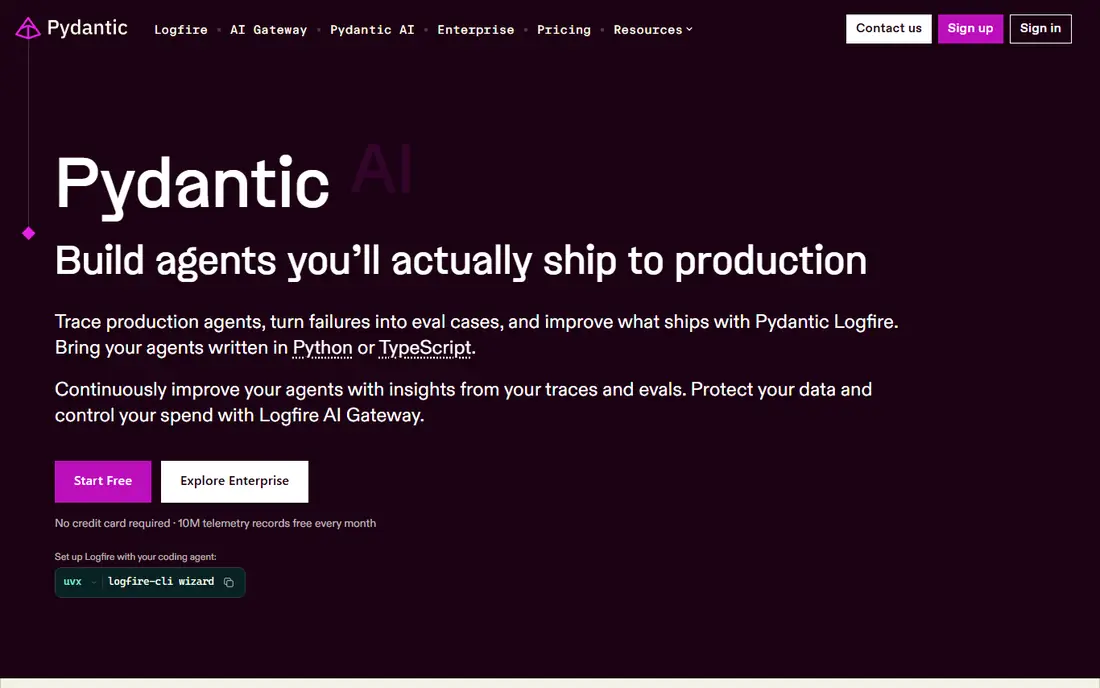
Pydantic is the closest Python equivalent to Zod for most developers. Models are defined with Python type hints, such as name as str and age as int, and Pydantic infers validation from those hints automatically, coercing compatible inputs and raising clear errors on bad data. It exports JSON Schema, which helps API documentation, and FastAPI uses it natively for request and response models.
The class-based style differs from Zod chained method calls, and the v1 to v2 migration required work for older codebases. Strict mode can also surprise users who expect coercion everywhere. Pydantic fits API data structures and microservices, where type hints already describe the data and validation should guard system boundaries.
What we like- Type hints define schemas
- Automatic coercion
- JSON Schema export
- FastAPI native
Watch out for- Class-based style differs from Zod chains
- V1 to v2 migration needed work
- Strict mode surprises
Starting priceFree, open source
Free planYes
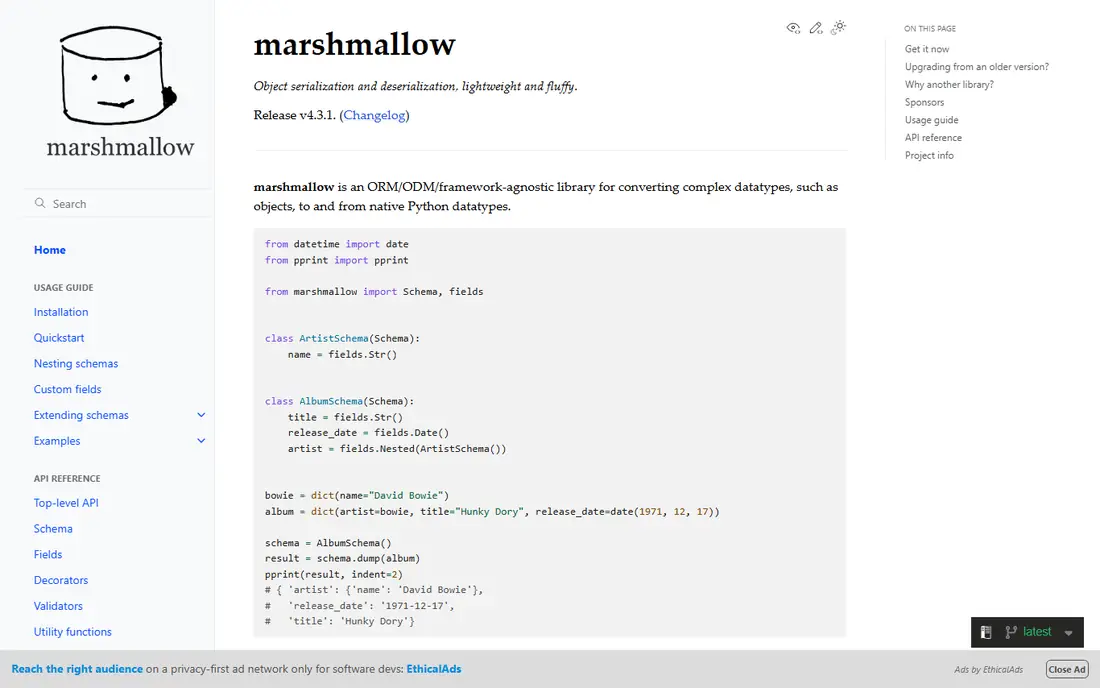
Marshmallow uses explicit field classes, such as String and Integer, for schema definitions, enabling granular validation rules and custom validators per field. It separates deserialization (load) from serialization (dump), with hooks such as pre-load and post-dump for data transformation. Marshmallow is framework-agnostic, working with Flask, Django, or standalone scripts.
The explicit style is verbose for simple schemas, and its serialization focus may be overkill when only validation is needed. Marshmallow lacks direct ORM integration but supports any data source. Marshmallow fits complex data pipelines and ORM integration, where transformation matters as much as validation.
What we like- Explicit field classes
- Load and dump separation
- Pre-load and post-dump hooks
- Framework-agnostic
Watch out for- Verbose for simple schemas
- Serialization focus may be overkill
- No native type-hint inference
Starting priceFree, open source
Free planYes
Cerberus provides lightweight dictionary schema validation using declarative schemas written as dictionaries, which makes it ideal when schemas need dynamic definition at runtime. Unlike Pydantic class-based approach, Cerberus schemas are plain Python dictionaries that can be stored in configuration files or databases, enabling runtime changes without code edits. Validation returns boolean results rather than raising exceptions, a different error paradigm some developers prefer.
Cerberus supports type checking, range validation, regex matching, and custom validator functions. It has no type-hint style, and complex nested schemas can become verbose. Cerberus fits configuration validation, user-defined rules, and scenarios where schemas must be serialized or transmitted over networks.
What we like- Schemas are plain dictionaries
- Runtime schema changes
- Boolean results instead of exceptions
- Custom validators
Watch out for- No type-hint style
- Complex nested schemas get verbose
- Less ecosystem than Pydantic
Starting priceFree, open source
Free planYes
Voluptuous is a schema-based validation library focused on data structures, with strength in validating nested dictionaries and lists. Schemas are defined as Python structures mapping keys to validators, which reads naturally for JSON-like inputs. Error messages are clear, and the library stays lightweight without framework dependencies.
Community size trails Pydantic, and API framework integration is thinner, so FastAPI-style automatic docs are missing. Voluptuous fits nested configuration and JSON validation where the data is dict-shaped and the schema should read like the data itself, rather than a class definition.
What we like- Schema-based validation for nested data
- Concise for dict structures
- Good error messages
Watch out for- Smaller community than Pydantic
- Less API framework integration
- Fewer advanced features
Starting priceFree, open source
Free planYes
Pandera protects analytical workflows by validating pandas DataFrames and statistical properties, such as column types, ranges, and uniqueness. Data science and machine learning preprocessing benefit most, since a bad column can silently corrupt a model. Pandera schemas describe expected DataFrame shape and statistics, and validation errors point to the failing columns.
Pandera is DataFrame-specific, so it does not replace Pydantic for API payloads or Cerberus for configs. Pandera fits data science teams that want data quality contracts inside preprocessing pipelines, alongside Pydantic at API boundaries.
What we like- Validates pandas DataFrames
- Statistical checks
- Integrates with data pipelines
- Clear schema errors
Watch out for- DataFrame-specific
- Not for API payloads
- Adds dependency to analytics code
Starting priceFree, open source
Free planYes
attrs provides clean class definitions without boilerplate, and cattrs adds structuring that converts dictionaries to attrs class instances with type conversion. A dict with age as a string becomes an instance with age as an integer through cattrs structuring, which covers the common Zod-style parse-and-coerce job for simple models. The combination is lightweight and fast.
Validation depth is lighter than Pydantic, with fewer built-in constraints and error details, and teams must learn two libraries. attrs and cattrs fit codebases that already use attrs classes and want simple structuring, rather than full schema validation with rich errors.
What we like- Clean class definitions
- Cattrs converts dicts to classes
- Type conversion
- No boilerplate
Watch out for- Validation is lighter than Pydantic
- Needs cattrs for structuring
- Two libraries to learn
Starting priceFree, open source
Free planYes
typeguard enforces Python type hints at runtime, checking function arguments, return values, and variable assignments against annotations. It suits teams that already annotate code heavily and want those annotations to mean something at runtime, especially in tests and debugging. No schema definitions are needed, since annotations are the schema.
typeguard is not a schema library: it does not coerce data, generate JSON Schema, or produce validation reports like Pydantic. Runtime overhead also matters in hot paths. typeguard fits teams that want annotation enforcement without a schema layer, and that use it selectively rather than on every call.
What we like- Checks type hints at runtime
- Works with existing annotations
- Good for testing and debugging
Watch out for- Runtime overhead
- Not a schema library
- Error messages are type errors, not validation reports
Starting priceFree, open source
Free planYes
beartype is the fast runtime type checker, using decorators to enforce type hints with near-zero overhead compared with heavier checkers. It suits performance-sensitive code where type safety matters but Pydantic parsing would be too slow or too much structure. Decorator-based use keeps integration simple: annotate a function, add the decorator, and calls are checked.
Like typeguard, beartype is not a schema library, so it does not coerce inputs, export JSON Schema, or validate complex constraints such as ranges and regexes. beartype fits hot paths and libraries that want cheap runtime safety, paired with Pydantic or Cerberus at system boundaries for full validation.
What we like- Very fast runtime checks
- Decorator-based
- Works with type hints
- Low overhead
Watch out for- Not a schema library
- No coercion or JSON Schema
- Limited validation semantics
How we chose
We compared these tools on schema style, coercion behavior, error quality, JSON Schema support, framework integration, and performance. Validation guides from 2026 shaped the shortlist, and we flagged every case where website fields point to project hosts rather than dedicated homepages, since several of these projects live on GitHub. We favored tools with clear Zod-like jobs: parse, validate, and report errors on untrusted data.
We also separated four buyer types. API builders should pick Pydantic, pipeline builders should pick Marshmallow, config and dynamic-schema users should pick Cerberus or Voluptuous, and data teams should pick Pandera. Runtime-checking users should pick typeguard or beartype, and attrs users should pick cattrs. The right pick follows where data enters the system, not library popularity alone.
Match the tool to the data boundary
Put validation where data enters: Pydantic at API boundaries, Pandera inside data pipelines, and Cerberus for configuration files. A single library rarely covers all three well, and mature teams often use more than one deliberately. Map each entry point to one tool before standardizing on a single library for everything.
Test coercion and error messages with real bad data
Feed each finalist the bad inputs your system actually receives, such as string numbers, missing fields, and wrong types, and compare coercion behavior and error clarity. Pydantic coerces by default with an opt-in strict mode, while Cerberus returns booleans and Marshmallow raises structured errors. The error format your team debugs fastest is the right one.
Check JSON Schema and framework needs
If API documentation or client code generation matters, Pydantic JSON Schema export is a major advantage. If the project uses Flask or Django without FastAPI, Marshmallow framework-agnostic style may fit better. Confirm framework integration before choosing, since switching validation libraries later touches every model in the codebase.
Frequently asked questions
What is Zod, in this article?
Zod is a TypeScript schema validation library that defines schemas with chained method calls and parses untrusted data with type inference. This article covers Python libraries that do the same job: validate and parse data against a schema. No Python library copies Zod syntax exactly, so pick by schema style instead.
Which Python library is closest to Zod?
Pydantic is closest for most developers, since it validates and parses data with type inference and JSON Schema export, much like Zod. The syntax differs: Pydantic uses classes with type hints, while Zod uses chained calls. For dictionary-style schemas closer to Zod object definitions, Cerberus and Voluptuous read more similarly.
Should I use Pydantic or Marshmallow?
Use Pydantic for APIs and type-hint-driven models, especially with FastAPI, where automatic docs and coercion help most. Use Marshmallow for serialization-heavy pipelines where load and dump separation and transformation hooks matter more than type-hint inference. Many teams use both in different layers. Run both on one real endpoint during evaluation, since the better fit shows up in actual model code, not in feature lists. Keep the comparison small and focused on your own data shapes. That test beats any benchmark.
Can I validate DataFrames with Pydantic?
Not directly. Pydantic validates dicts and objects, while Pandera validates pandas DataFrames with column and statistical checks. Use Pydantic at API boundaries and Pandera inside data pipelines, since each covers a different data shape.
Are these tools free?
Yes, every tool here is free and open source. Costs come from engineering time and compute, not licenses. Pydantic, Marshmallow, and the rest all install from standard package indexes without payment.
Sources we checked (9)
- https://pydantic.dev
- https://marshmallow.readthedocs.io/en/latest/
- https://docs.cerberus.readthedocs.io/en/latest/
- https://voluptuous.readthedocs.io/en/latest/
- https://github.com
- https://www.attrs.org
- https://www.kdnuggets.com/5-python-data-validation-libraries-you-should-be-using
- https://app.studyraid.com/en/read/15005/518674/comparing-marshmallow-to-other-validation-libraries
- https://copyprogramming.com/howto/how-to-validate-structure-or-schema-of-dictionary-in-python
Is your product missing or out of date?
We review this list regularly. Vendors can request a listing, send updated pricing or ask about featured placement.

Shihab Mia · Founder, Rankite
Shihab has 5+ years in B2B and SaaS SEO. He writes Rankite's software buying guides from pricing pages, documentation and public user reviews. More about Shihab.