How we make this list: we compare pricing pages, product documentation and public user reviews. Ratings come from G2, Capterra or Trustpilot, with the date we checked them.
Key takeaways
- Ares Real Estate Exchange is the largest DST sponsor by 2026 fundraising, with just under $1.5 billion raised through September.
- Blue Owl Capital and ExchangeRight follow Ares in 2026 volume, and both offer broad industrial and multifamily DST menus.
- Hines Real Estate Exchange is the fast riser, with more than $1.9 billion raised since its DST platform launched in 2022.
- DSTs suit sellers who want passive ownership and tax deferral, but they give up control over property decisions.
- Minimum investments are usually $25,000 to $100,000, and DST interests are illiquid, so this is a long-hold choice.
- This article is general information only and not tax advice: 1031 deadlines are strict, so confirm every deal with a qualified intermediary and a tax adviser.
Quick comparison
Is your product missing or out of date?
We review this list regularly. Vendors can request a listing, send updated pricing or ask about featured placement.
The best DST 1031 exchange companies
Starting priceSee website
Free planNot applicable

Ares Real Estate Exchange is the DST sponsor to beat in 2026, with just under $1.5 billion raised through September, about 19 percent of all DST activity tracked by Mountain Dell Consulting. That scale matters because larger sponsors can source institutional-grade properties and run many offerings at once, giving exchangers more replacement-property choices inside a tight deadline. Ares sits inside Ares Management, a large global alternative asset manager, which adds balance-sheet depth behind its real estate platform.
The trade-offs are standard for DSTs but worth stating plainly. Minimum investments often sit near $100,000, interests cannot be sold easily before the trust winds up, and investors give up control over leasing, financing, and sale decisions. Returns depend on the underlying properties, not on the sponsor brand, so past fundraising volume is not a promise of future income. Ares fits sellers with large gains who want the deepest offering menu and can hold for years.
What we like- Largest 2026 DST fundraising volume
- Institutional asset sourcing
- Broad property menu
Watch out for- Minimums often $100,000
- Illiquid interests
- Offering availability changes with fundraising cycles
Starting priceSee website
Free planNot applicable

Blue Owl Capital ranks second in 2026 DST fundraising, with about $626 million raised through September, and it brings a large institutional platform to the DST market. Its real estate arm offers fractional interests in commercial properties through DST structures, and its scale across credit and real assets gives it sourcing reach beyond smaller sponsors. For exchangers who want a household institutional name beside Ares, Blue Owl is the natural second look.
The same DST limits apply. Interests are illiquid, investors hold no management control, and each offering carries its own property, debt, and tenant risk. Minimums commonly sit near $100,000, though some offerings differ, so the exact figure must come from the offering documents. Blue Owl fits investors who value institutional sponsorship and want a menu that spans industrial, multifamily, and other commercial sectors.
What we like- Second-largest 2026 DST volume
- Large credit and real estate platform
- Diversified property types
Watch out for- Minimums often $100,000
- Illiquid interests
- Offering details vary by deal
Starting priceSee website
Free planNot applicable
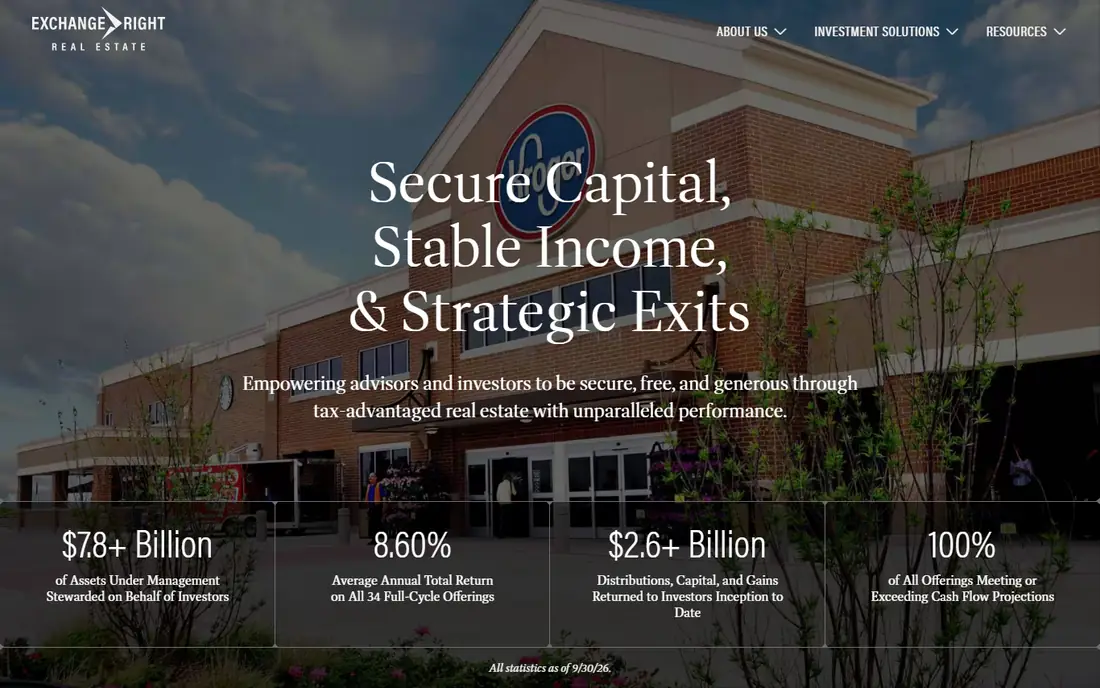
ExchangeRight holds third place in 2026 DST fundraising, with about $619 million raised through September, and it has focused on DSTs and 1031 exchanges for years rather than treating them as a side business. Its offerings span diversified portfolios across states and property types, which helps exchangers who want diversification inside a single DST or across several. The firm also runs its own asset management, which keeps property oversight in-house.
Investors should still read each offering memorandum closely, since diversification across properties does not remove market risk, tenant risk, or debt risk. Interests remain illiquid and passive, and distributions can fall if a property underperforms. ExchangeRight fits sellers who want a DST specialist with a long track record and a steady pipeline of new offerings to meet exchange deadlines.
What we like- Third-largest 2026 DST volume
- Long DST focus
- Diversified portfolios across states
Watch out for- Minimums often $100,000
- Illiquid interests
- Past performance does not predict future returns

#4
Hines Real Estate Exchange
Best for: Multifamily DST growth
Visit hines.com
Starting priceSee website
Free planNot applicable
Hines Real Estate Exchange is the growth story of the DST market. Its platform launched in September 2022 and has since raised more than $1.9 billion, including the roughly $591 million HREX 9 DST completed in October 2026, its largest offering to date. That deal gave investors exposure to two multifamily properties, Gables Station in Coral Gables and Left Bank in Chicago, totaling 946 units. Hines itself is a global real estate firm founded in 1957, with about $91 billion in assets under management.
The shorter DST track record is the honest caveat: Hines has deep real estate experience but fewer years running DST offerings than older sponsors. Minimums commonly sit near $100,000, interests are illiquid, and multifamily performance still depends on local rents and occupancy. Hines fits exchangers drawn to living-sector assets and institutional sponsorship, especially those who want newer, large-scale offerings.
What we like- Fastest-growing large DST platform
- $591 million HREX 9 offering
- Strong multifamily sourcing
Watch out for- Platform launched only in 2022
- Minimums often $100,000
- Illiquid interests
Starting priceSee website
Free planNot applicable
Passco is one of the longer-running names in the DST market, and investor guides regularly list it among the sponsors that exchangers should compare. Its offerings lean toward multifamily and industrial properties, the two sectors that dominate DST fundraising, and it runs a regular pipeline so exchangers facing a deadline can usually find a live offering. The firm also handles DST structures for investors who want to spread one exchange across several properties.
Scale is the relative weakness: Passco does not match the 2026 fundraising volume of Ares, Blue Owl, or ExchangeRight, which can mean fewer simultaneous offerings. Minimums commonly sit near $100,000, and interests remain illiquid and passive. Passco fits sellers who value sponsor tenure and a steady multifamily and industrial menu over sheer size.
What we like- Long DST sponsor history
- Multifamily and industrial focus
- Regular new offerings
Watch out for- Smaller 2026 volume than top three
- Minimums often $100,000
- Illiquid interests
Starting priceSee website
Free planNot applicable
Inland Private Capital comes from the Inland group, one of the longest-standing sponsor platforms in securitized real estate, and it offers DSTs across many property types and regions. That breadth helps exchangers who need a specific sector, such as retail, office, or industrial, inside their deadline window. The platform also brings decades of sponsor infrastructure, from acquisition to asset management and investor reporting.
Breadth cuts both ways. Terms, debt levels, and minimums vary widely from one offering to the next, so comparing two Inland DSTs takes real homework rather than a single brochure read. Interests are illiquid, investors hold no control, and fees sit inside the offering structure rather than as a simple annual charge. Inland fits exchangers who want a deep bench of offerings and are willing to compare deal documents carefully.
What we like- Very long DST sponsor history
- Large sponsor platform
- Many property types
Watch out for- Offering terms vary widely by deal
- Minimums often $100,000
- Illiquid interests
Starting priceSee website
Free planNot applicable
NexPoint is an alternative asset manager that sponsors DST offerings across varied property types, and investor guides list it among the sponsors worth comparing beside the larger names. Its platform covers real estate alongside other alternative strategies, which can appeal to investors who already hold NexPoint products and want to keep reporting in one place. Offerings appear regularly, which matters when a 45-day identification clock is running.
The honest limits are scale and liquidity. NexPoint does not match the top sponsors on 2026 DST volume, so its live menu at any given moment may be narrower. Minimums commonly sit near $100,000, interests are illiquid, and property-level risk stays with the investor. NexPoint fits exchangers who want a varied menu from an alternatives-focused sponsor and who compare offering documents rather than buying on brand alone.
What we like- Varied DST property menu
- Alternative asset platform
- Regular offerings
Watch out for- Smaller DST volume than leaders
- Minimums often $100,000
- Illiquid interests
Starting priceSee website
Free planNot applicable
Cantor Fitzgerald is a large institutional financial firm whose platform includes DST offerings for accredited investors doing 1031 exchanges. Its distribution network runs through advisers and broker-dealers, which means many investors meet Cantor DSTs through their financial adviser rather than directly. The institutional scale behind the platform gives it sourcing reach and operational depth that smaller sponsors cannot match.
Access is the caveat: availability can depend on the adviser channel, and minimums commonly sit near $100,000. Interests are illiquid and passive, and each offering must be judged on its own properties, debt, and tenant mix. Cantor fits accredited exchangers working through an adviser who want institutional sponsorship and a broad distribution network behind their replacement property.
What we like- Large institutional platform
- DST offerings for accredited investors
- Broad distribution network
Watch out for- Minimums often $100,000
- Illiquid interests
- Offering access can depend on adviser channel
How we chose
We ranked sponsors on 2026 DST fundraising volume from Mountain Dell Consulting data as reported in October 2026, sponsor tenure, property menu breadth, and offering availability for exchangers on a deadline. Volume matters because a larger live menu helps investors meet the 45-day identification deadline, but it does not predict returns, so we weighed deal-level homework heavily in the buying guide. Every company here runs a live DST platform in 2026 with a public site, and none is defunct.
How to pick a DST 1031 exchange company
Start with the calendar, because 1031 exchanges run on strict deadlines: investors generally must identify replacement property within 45 days of selling the relinquished property and complete the exchange within 180 days, under IRS rules as reported in guides. Miss either deadline and the tax deferral can fail, so line up sponsor options before closing the sale, not after. A qualified intermediary must hold the sale proceeds, and the exchange documents must be prepared correctly, which is why most investors use an intermediary plus a tax adviser.
Next, compare offering documents, not marketing summaries. Read the property list, debt level, tenant quality, fee load, and projected distributions for each DST, and ask how distributions held up in past offerings from the same sponsor. Diversify when the exchange is large: splitting one exchange across two or three DSTs in different sectors and states reduces single-property risk. Check the minimum, since most sponsors set it near $100,000, and confirm accreditation requirements, because DST offerings are generally limited to accredited investors.
Finally, plan for illiquidity. DST interests usually cannot be sold before the trust sells its properties, a horizon that can run seven to ten years or more. Only exchange money you can leave invested for that span, and keep cash reserves outside the DST for emergencies. This article is general information only and not financial or tax advice: tax law is complex and fact-specific, so confirm every exchange with a qualified intermediary and a licensed tax professional before acting.
Frequently asked questions
What is a Delaware Statutory Trust?
A Delaware Statutory Trust is a legal entity that holds real estate and sells fractional beneficial interests to investors. Under IRS Revenue Ruling 2004-86, properly structured DST interests count as direct real property interests eligible as replacement property in a 1031 exchange.
What are the 1031 exchange deadlines?
Investors generally must identify replacement property within 45 days of selling the relinquished property and complete the exchange within 180 days. These deadlines are strict, and missing them can disqualify the tax deferral.
How much do I need to invest in a DST?
Minimums commonly sit near $100,000, though some offerings set lower or higher minimums. The exact figure appears in the offering memorandum, and most DST offerings are limited to accredited investors.
Can I sell a DST interest early?
Usually not easily. DST interests are illiquid, with no public market, and investors generally hold until the trust sells its properties. Some sponsors offer limited redemption programs, but early exit is not guaranteed.
Do DST investors control the property?
No. DST investors hold passive beneficial interests, and the sponsor trustee makes leasing, financing, and sale decisions. That passivity is part of why DST interests qualify for 1031 treatment, but it means giving up landlord control.
Is a DST the same as a REIT?
No. A DST gives fractional ownership of specific properties with pass-through tax treatment for 1031 purposes, while a REIT is a traded or non-traded company holding a portfolio. DST interests are not listed on an exchange.
Sources we checked (0)
Is your product missing or out of date?
We review this list regularly. Vendors can request a listing, send updated pricing or ask about featured placement.

Shihab Mia · Founder, Rankite
Shihab has 5+ years in B2B and SaaS SEO. He writes Rankite's software buying guides from pricing pages, documentation and public user reviews. More about Shihab.
 Ares Real Estate Exchange
 Blue Owl Capital
 ExchangeRight
 Passco
 Inland Private Capital
 NexPoint
 Cantor Fitzgerald