How we make this list: we compare pricing pages, product documentation and public user reviews. Ratings come from G2, Capterra or Trustpilot, with the date we checked them.
Key takeaways
- Brightree remains the market leader for HME/DME operations, now part of ResMed, with deep pharmacy and infusion coverage.
- NikoHealth and Bonafide are the modern all-in-one challengers: NikoHealth with AI-driven intake and resupply, Bonafide with its facility and hospice portal.
- WellSky, TIMS, and Universal Software Solutions serve providers that want enterprise depth, independence, or hosted flexibility.
- Parachute Health and DMEWorks attack from the edges: digital DME ordering and owner-built affordable billing.
- No vendor publishes pricing. Expect quote-based enterprise deals and demo-led sales cycles across all eight.
Quick comparison
| Tool | Best for | Starting price | Free plan |
|---|
 Brightree Brightree | Large HME/DME providers needing full clinical and business coverage | See website | No |
 NikoHealth NikoHealth | Modern providers wanting AI-powered intake, billing, and resupply | See website | No |
 Bonafide Bonafide | Providers needing a DME ERP plus a facility and hospice portal | See website | No |
 WellSky WellSky | Enterprises standardizing on a portfolio of post-acute platforms | See website | No |
 Universal Software Solutions Universal Software Solutions | Providers wanting hosted or on-premise deployment flexibility | See website | No |
 TIMS TIMS | Independent-minded providers wanting a long-tenured ERP partner | See website | No |
 Parachute Health Parachute Health | Providers drowning in faxes who want digital DME ordering | See website | No |
 DMEWorks DMEWorks | Smaller providers wanting affordable, all-inclusive billing software | See website | No |
Is your product missing or out of date?
We review this list regularly. Vendors can request a listing, send updated pricing or ask about featured placement.
The best dme software
Your biller has been on hold with a payer for forty minutes. The delivery truck came back without signatures on two tickets. The claim you sent Tuesday just bounced for a missing modifier. This is a normal Thursday in a DME business, and it is exactly what DME software exists to fix: the handoffs between intake, documentation, inventory, delivery, billing, and collections where revenue quietly leaks.
Durable medical equipment software is a specialized category. Generic practice management tools do not understand rental billing cycles, capped rentals, resupply cadences, or payer documentation rules. The eight platforms below do, each from a different angle.
#1
Brightree
Best for: Large HME/DME providers needing full clinical and business coverage
Visit brightree.com
Starting priceSee website
Free planNo
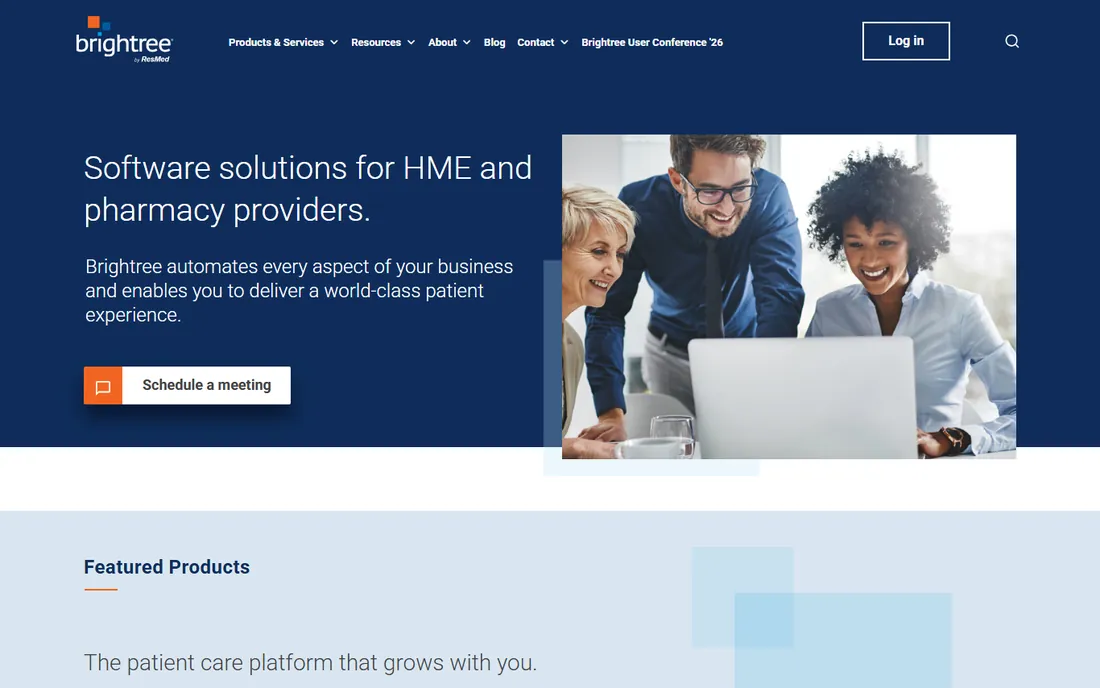
Brightree has been the default choice in HME/DME software for over two decades, and its acquisition by ResMed gave it the resources to keep expanding: HME (DME) software, pharmacy software for home infusion, intelligent document automation that reads and classifies referral documents, plus patient engagement and analytics tools. For large providers running multiple lines of business, the breadth matters: documentation, inventory, delivery, resupply, billing, and reporting in one system that follows the provider workflow.
The honest catch is that market leadership comes with enterprise characteristics: pricing is negotiated, implementations are substantial, and the interface reflects years of accumulated features. Brightree fits established HME/DME companies, especially larger ones, that want the deepest feature set and the safety of the biggest vendor in the room.
What we like- The category's most established platform, now backed by ResMed
- Covers HME/DME, pharmacy, and home infusion in one
- Intelligent document automation speeds intake
Watch out for- Enterprise pricing is quote-based and hard to predict
- The platform carries years of legacy complexity
#2
NikoHealth
Best for: Modern providers wanting AI-powered intake, billing, and resupply
Visit nikohealth.com
Starting priceSee website
Free planNo
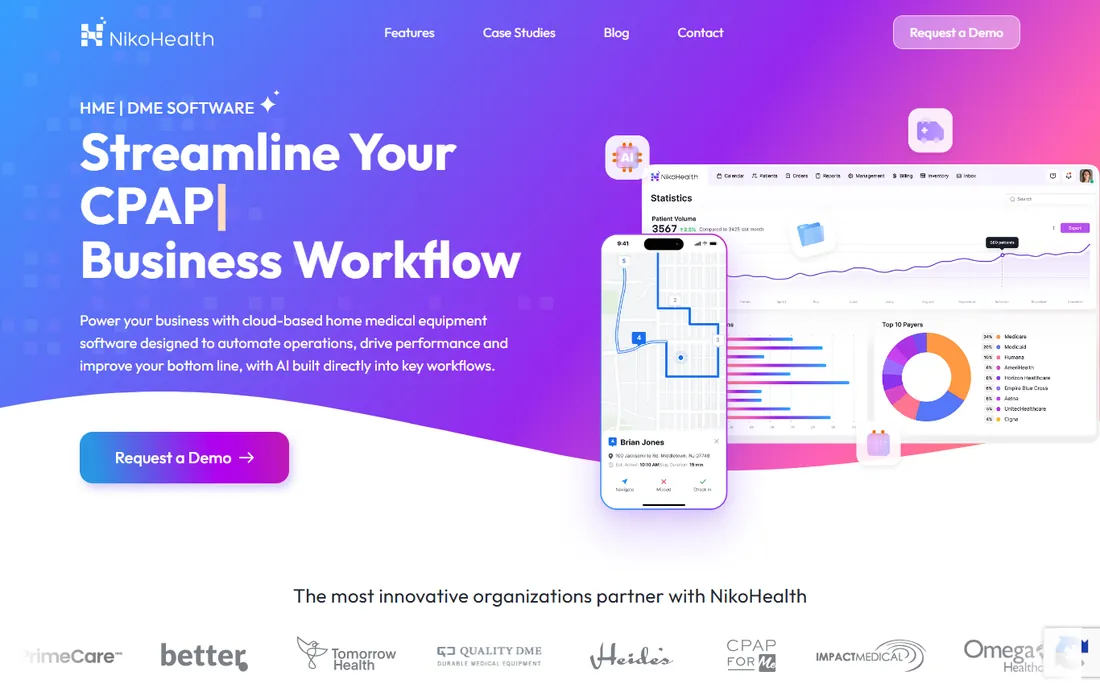
NikoHealth is the modern challenger built to replace legacy systems: a single cloud platform covering intake, document management, order workflow, fulfillment and home delivery, inventory, resupply, and billing with revenue cycle management. The AI layer is genuinely functional rather than decorative: it reads and classifies incoming faxes at intake, places natural-language phone calls to resupply patients, and pre-audits claims before submission. SOC 2 Type 2 and HIPAA-aligned security round out an enterprise-ready package.
The catch is youth: against Brightree and Bonafide, NikoHealth has fewer years of references, and the 90-to-120-day implementation timeline is real work. It fits growth-oriented providers modernizing from a legacy system who want one connected platform instead of stitched-together tools.
What we like- Modern cloud platform with AI embedded in intake, billing, and resupply
- Open APIs and a real partner ecosystem
- Dedicated named support teams instead of ticket queues
Watch out for- Newer vendor with a smaller installed base than the incumbents
- Implementation runs 90-120 days for small-to-medium providers
#3
Bonafide
Best for: Providers needing a DME ERP plus a facility and hospice portal
Visit bonafide.com
Starting priceSee website
Free planNo
Bonafide has called itself the number one ERP for DME and HME since 1981, and its acquisition by WellSky in late 2024 made it part of one of the largest post-acute software portfolios in the country. The platform covers the full order-to-cash cycle with real-time eligibility checking, claim scrubbing and denial mitigation, KPI-driven revenue cycle management, inventory with per-location replenishment, and a point of sale system. Its facility and hospice portal lets institutional customers like nursing homes order directly, which few competitors match.
The catch is the acquisition: Bonafide's future now sits inside WellSky's strategy, which is mostly good news for investment but worth watching. It fits established providers, especially those serving hospice and facility customers, that want a deep ERP with institutional ordering built in.
What we like- Full DME/HME ERP with patient intake, billing, RCM, inventory, and POS
- The facility and hospice portal is a genuine differentiator for institutional customers
- Document management and mobile delivery apps included at no extra charge
Watch out for- Now owned by WellSky, so long-term roadmap sits inside a larger portfolio
- Pricing requires a demo conversation
#4
WellSky
Best for: Enterprises standardizing on a portfolio of post-acute platforms
Visit wellsky.com
Starting priceSee website
Free planNo
WellSky is the giant in this list: a post-acute software company whose portfolio spans home health, hospice, infusion, pharmacy, and, through the Bonafide acquisition, DME/HME. For DME, WellSky offers Bonafide as the end-to-end ERP plus CareTend, its all-in-one home medical equipment solution with workflow automation, compliance tools, and mobile delivery. The scale argument is real: 20,000-plus client sites, 40-plus years of healthcare software, and analytics depth that smaller vendors cannot match.
The catch is portfolio complexity: Bonafide and CareTend overlap in DME/HME, and buyers should clarify which product fits before signing. WellSky fits large enterprises and multi-line post-acute organizations standardizing on one vendor relationship across care settings.
What we like- One of the largest post-acute software companies, serving 20,000-plus client sites
- DME/HME covered through Bonafide and CareTend
- Deep analytics and interoperability story
Watch out for- Buying into a portfolio means navigating product overlap
- Enterprise sales cycles and pricing
#5
Universal Software Solutions
Best for: Providers wanting hosted or on-premise deployment flexibility
Visit universalss.com
Starting priceSee website
Free planNo
Universal Software Solutions, based in Davison, Michigan, offers its HDMS (Healthcare Data Management System) suite across durable medical equipment, home infusion, pharmacy, and mail order. The differentiator is deployment choice: premise-based or hosted, which matters to providers with compliance or IT policies that keep them off pure SaaS. Mobile apps for drivers, technicians, and warehousing extend the system into the field, and recent AI workflow additions show the product is still moving.
The catch is scale: Universal is a regional player competing against national giants, so third-party integration breadth and peer references are thinner. It fits providers that want deployment flexibility and a direct relationship with the vendor over the biggest brand name.
What we like- HDMS suite covers DME, home infusion, pharmacy, and mail order
- Offers both premise-based and hosted deployment
- Long-tenured Michigan company with hands-on support
Watch out for- Smaller vendor footprint than the giants
- The product line spans many markets, so DME-specific depth varies
#6
TIMS
Best for: Independent-minded providers wanting a long-tenured ERP partner
Visit cu.net
Starting priceSee website
Free planNo
TIMS, from Computers Unlimited in Billings, Montana, is the independence play in DME software: a single unified ERP connecting inventory, delivery, billing, compliance, finance, and customer service, built over 48 years of partnership with customers. The company makes a point of what it is not: not a division of a conglomerate, not a private equity portfolio company. For providers burned by acquisition-driven roadmap changes, that positioning lands. Support is US-based and hands-on, with dedicated account management.
The catch is focus: Computers Unlimited also serves industrial gas and welding distributors, so DME shares the roadmap. TIMS fits established HME/DME providers that value stability and a partner-like vendor relationship over the newest interface.
What we like- 48 years in business with an explicitly independent, non-conglomerate stance
- TIMS ERP unifies inventory, delivery, billing, compliance, and finance
- US-based support with acquisition-friendly data migration
Watch out for- Serves industrial gas distributors too, so DME is one vertical among several
- Cloud delivery runs through hosted infrastructure rather than native multi-tenant SaaS
Starting priceSee website
Free planNo

Parachute Health attacks the most painful part of DME operations: getting a complete, billable order in the first place. Its digital platform lets clinicians order DME in minutes with insurance and documentation captured upfront, embedded prior authorization, EHR integration, and real-time tracking from order to delivery. With 300,000-plus prescribers and 3,000-plus supplier locations across all 50 states, it is the closest thing DME has to a standard ordering network, and suppliers report faster, cleaner orders with fewer kickbacks.
The catch is scope: Parachute Health handles ordering and intake, not billing, inventory, or delivery management. It fits providers whose order flow is fax-driven and chaotic, and it pairs with any of the ERPs above rather than replacing them.
What we like- The leading DME ePrescribing network: 300,000-plus prescribers and 3,000-plus supplier locations
- Digital orders with documentation captured upfront
- Real-time tracking from order to delivery
Watch out for- It is an ordering network, not a full ERP: you still need billing and inventory software
- Value depends on your referral sources joining the network
#8
DMEWorks
Best for: Smaller providers wanting affordable, all-inclusive billing software
Visit dmeworks.com
Starting priceSee website
Free planNo
DMEWorks, from Jacksonville, Florida, is the practitioner-built option: DME billing and management software developed by actual DME business owners, with a support team drawn from DME offices who can answer billing questions as well as technical ones. The value pitch is inclusion: document imaging, retail point of sale, purchase orders, inventory barcoding, and electronic billing for private insurance all come standard instead of as priced modules. Newer additions like a patient payment module show continued development.
The catch is polish and scale: this is a small vendor, and the integration ecosystem and mobile story trail the leaders. DMEWorks fits smaller and cost-conscious DME/HME and respiratory providers that want one affordable, all-inclusive system and value support from people who have worked the job.
What we like- Developed by actual DME business owners, with support staff who worked in DME offices
- Features competitors sell as add-ons (document imaging, POS, inventory barcoding) are standard
- Positioned as comprehensive and affordable
Watch out for- Smaller vendor with a dated web presence and thinner integration ecosystem
- Mobile field support is Windows-tablet oriented
How we chose
We started with the DME/HME software vendors that dominate buyer conversations, industry roundups, and Medtrade exhibitor lists, then narrowed to eight covering the real spectrum: enterprise ERPs, modern cloud challengers, and edge specialists. For each vendor we opened the official homepage and confirmed the product's current positioning, checked pricing and trial claims against the vendor's own pages (none publish pricing; all are demo and quote-led), and cross-checked product details against industry coverage and public reviews on G2, Capterra, and SourceForge. Two commonly listed names did not make the cut: Fastrack, whose domain now serves WellSky's CareTend page, and CPR+, whose site could not be verified. We did not run hands-on trials; our assessments come from vendor materials and verified public sources.
Buying DME software: the questions that actually matter
DME software demos all look good, so ask the questions that separate platforms.
Can it handle your payer mix and rental models?
DME billing is not generic medical billing. Confirm the platform handles your specific workflows: capped rentals, recurring resupply, oxygen, CPAP, and your mix of Medicare, Medicaid, and private payers. Ask how documentation requirements per payer are enforced in the workflow, not just where documents are stored.
Who does implementation, and how long does it really take?
NikoHealth quotes 90 to 120 days for small-to-medium providers, and that is on the fast side of the industry. Ask every vendor for a reference customer your size and call them. Implementation quality, not feature lists, decides whether the project succeeds.
What does support look like after go-live?
DME billing changes constantly as payers update rules. Ask whether you get a named team or a ticket queue, whether support staff understand DME billing or just the software, and what support costs after year one. DMEWorks' DME-experienced support and NikoHealth's named teams are the model here; a general helpdesk is a red flag.
Deployment: cloud, hosted, or on-premise?
Most vendors are cloud now, but Universal and TIMS offer hosted or on-premise options. If your IT policy or compliance posture requires it, decide this before you fall in love with a pure-SaaS product.
Why DME software costs what it costs (and the hidden modules)
No vendor in this list publishes pricing, and that is not an accident. DME software is sold as an enterprise platform with implementation, data migration, training, and ongoing support bundled into negotiated deals, and prices move with user count, locations, and modules. The number that matters is total cost over three years, not the license quote.
Watch for module pricing specifically. Several vendors sell document management, mobile delivery, resupply automation, and advanced analytics as add-ons. Bonafide includes document management and mobile delivery at no charge; DMEWorks includes imaging, POS, and barcoding as standard. When comparing quotes, normalize on the same module list, because a cheaper base price with four paid modules is the oldest trick in healthcare software sales.
Frequently asked questions
What is DME software?
DME (durable medical equipment) software is a specialized business management platform for home medical equipment providers. It handles patient intake, documentation, inventory, delivery, billing and claims, resupply, and reporting, with workflows built around rental billing cycles, payer documentation rules, and equipment tracking that generic practice management tools do not support.
How much does DME software cost?
None of the leading vendors publish pricing; all sell through demos and negotiated quotes. Costs depend on user count, locations, modules, implementation, and data migration. Budget for total cost over three years, including support renewals and add-on modules, rather than comparing base license quotes.
Should I choose cloud or on-premise DME software?
Most modern platforms (NikoHealth, Brightree, Bonafide) are cloud-based, which simplifies updates and remote access. Universal Software Solutions and TIMS offer hosted or on-premise options for providers with specific IT or compliance requirements. Cloud is the default choice unless you have a reason to host it yourself.
How long does DME software implementation take?
Plan on three to six months for most providers. NikoHealth estimates 90 to 120 days for small-to-medium DME businesses, and larger or multi-location rollouts take longer. Data migration from a legacy system, payer setup, and staff training drive the timeline more than the software itself.
Does DME software include resupply management?
Most full platforms include or offer resupply modules: NikoHealth automates resupply with AI phone outreach, Bonafide integrates resupply partners, and Brightree built resupply tooling through its SnapWorx acquisition. If recurring supply revenue is core to your business, evaluate resupply depth specifically rather than assuming it.
Brightree vs. NikoHealth: which is better for a growing DME provider?
Brightree is the established leader with the deepest feature set and the backing of ResMed, suited to large, complex operations. NikoHealth is the modern challenger with AI-driven workflows and a cleaner interface, suited to providers modernizing from legacy systems. Both are demo-led and quote-priced, so run parallel evaluations.
Sources we checked (9)
- https://brightree.com/
- https://nikohealth.com/
- https://bonafide.com/
- https://wellsky.com
- https://universalss.com/
- https://cu.net/
- https://parachutehealth.com/
- https://dmeworks.com/
- https://www.businesswire.com/news/home/20241025978404/en/WellSky-Acquires-Leading-DurableHome-Medical-Equipment-Software-Provider-Bonafide-Enhancing-Home-Care-Solutions
Is your product missing or out of date?
We review this list regularly. Vendors can request a listing, send updated pricing or ask about featured placement.

Shihab Mia · Founder, Rankite
Shihab has 5+ years in B2B and SaaS SEO. He writes Rankite's software buying guides from pricing pages, documentation and public user reviews. More about Shihab.