How we make this list: we compare pricing pages, product documentation and public user reviews. Ratings come from G2, Capterra or Trustpilot, with the date we checked them.
What is the best digital experience monitoring company?
Dynatrace is the best digital experience monitoring company, because its real user monitoring starts at $2.25 per 1,000 sessions on a published rate card and its Davis AI ties sessions to root cause. Catchpoint is the best pick for global synthetic monitoring from outside the firewall, and Datadog is the best pick for cheap sessions inside a Datadog shop.
Key takeaways
- Most DEM vendors hide list prices behind a quote, and only Dynatrace, Datadog and New Relic publish usable rates, so budget for a sales cycle with the rest.
- Per-session pricing varies by a factor of fifteen: Datadog RUM Measure costs $0.15 per 1,000 sessions, while Dynatrace RUM costs $2.25, so volume decides the winner.
- Synthetic monitoring and real user monitoring answer different questions, and most buyers end up needing both.
- New Relic has the most generous free tier here, with 100 GB of ingest a month at no cost.
- ThousandEyes and Catchpoint are the strongest choices when the fault is usually outside your own network, because both watch ISP paths, DNS, CDN and BGP.
How we picked
We picked DEM companies with a real product in this category, a global monitoring network or a published real user monitoring capability, and pricing evidence from vendor pages or independent comparisons checked on 14 Nov 2026. We ranked breadth of coverage first, then pricing transparency, then how well each tool proves where a fault sits. Every price below is third-party reported from those sources, and we flagged every price that conflicts between sources.
Best digital experience monitoring companies compared
| Company | Best for | Starting price | Free plan |
| Dynatrace | Large teams that want sessions tied to root cause | RUM $2.25 per 1,000 sessions | Free trial |
| Catchpoint | Global synthetic monitoring | Quote; small deployments typically $40,000 to $75,000 per year | Free trial |
| ThousandEyes | Proving where a fault lives | Quote, credits-based | Free trial |
| Datadog | Cheap sessions inside a Datadog shop | RUM Measure $0.15 per 1,000 sessions, annual billing | Free trial |
| New Relic | Starting free | Free up to 100 GB per month ingest | Yes, 100 GB per month |
| AppDynamics | Business transaction tracing at Cisco shops | Infrastructure from $6 per vCPU per month | Free trial |
| Splunk Observability Cloud | Log-led teams that want DEM beside search | Infrastructure tier from $15 per host per month | Free trial |
| Akamai mPulse | Real user data at CDN scale | Quote | Free trial |
How much does digital experience monitoring cost?
Digital experience monitoring costs from nothing to hundreds of thousands of dollars a year. Per-session tools start cheap: Datadog RUM Measure costs $0.15 per 1,000 sessions on annual billing, so 1 million sessions a month costs about $150, while Dynatrace RUM at $2.25 costs $2,250 for the same million sessions. New Relic charges by data ingest instead, with 100 GB a month free and $0.40 per GB beyond. Quote-based vendors sit at the other end: Catchpoint small deployments typically run $40,000 to $75,000 a year according to Vendr transaction data, and ThousandEyes estimates run near $50,000 to $75,000 a year for 100 cloud tests a minute. A mid-size team should budget $25,000 to $100,000 a year, and an enterprise should expect $150,000 to $350,000 a year.
Should you buy synthetic monitoring, real user monitoring, or both?
Buy both when the site earns money, because synthetic monitoring and real user monitoring answer different questions. Synthetic monitoring runs scripted tests from locations around the world on a schedule, so it catches outages at 3 a.m., proves an SLA, and shows whether the login page works from Berlin before any real user complains. Real user monitoring records what actual visitors experienced, so it shows the slow checkout on old Android phones, the error rate on one browser version, and the revenue lost to a bad deploy. Synthetic monitoring without real user data misses the long tail of real devices, and real user monitoring without synthetic tests goes blind when traffic stops. Catchpoint and ThousandEyes lead on synthetic reach, and Dynatrace and Datadog on real user depth.
Which DEM company is best for proving an outage is not your fault?
ThousandEyes is the best DEM company for proving an outage is not your fault, because it watches the internet path itself with BGP, DNS and ISP data from cloud and enterprise agents. When a SaaS app slows down, ThousandEyes shows the hop where packets dropped and names the provider responsible. Catchpoint is the close second, with more than 2,500 backbone, last-mile and enterprise nodes running synthetic tests that show the same fault from outside your firewall. Dynatrace and Datadog can show your own code is healthy, but they do not map the public internet path. If your team spends its weeks blaming ISPs and SaaS vendors, start with ThousandEyes or Catchpoint.
What is the difference between DEM and APM?
DEM watches the experience from the user side, while APM watches the application from the server side, and the two meet in the middle. DEM measures page loads, session errors, synthetic test results and network paths. APM measures code execution, database queries and service calls. Catchpoint, ThousandEyes and Akamai mPulse stay closer to pure DEM, which makes them easier to buy for a team that only needs experience data. Buy DEM for what users experienced, APM for why the code is slow, and a platform that does both when one team answers both questions.
Quick comparison
| Tool | Best for | Starting price | Free plan |
|---|
 Dynatrace | Large teams that want sessions tied to root cause | RUM $2.25 per 1,000 sessions, third-party reported from the vendor pricing page, checked 14 Nov 2026 | Free trial, no permanent free tier |
 Catchpoint | Global synthetic monitoring from outside the firewall | Quote; small deployments typically $40,000 to $75,000 per year, third-party reported from Vendr transaction data, checked 14 Nov 2026 | Free trial, no permanent free tier |
 ThousandEyes | Proving whether the fault is yours or the ISP | Quote, credits-based; about $50,000 to $75,000 per year for 100 cloud tests per minute, third-party reported, checked 14 Nov 2026 | Free trial, no permanent free tier |
 Datadog | Cheap sessions inside a Datadog shop | RUM Measure $0.15 per 1,000 sessions on annual billing, third-party reported, checked 14 Nov 2026 | Free trial, no permanent free tier for RUM |
 New Relic | Starting free on a low-traffic site | Free up to 100 GB per month ingest; $0.40 per GB beyond, third-party reported, checked 14 Nov 2026 | Yes, 100 GB per month ingest at no cost, no credit card required |
 AppDynamics | Business transaction tracing at Cisco shops | Infrastructure from $6 per vCPU per month, third-party reported from the Splunk pricing page, checked 14 Nov 2026 | Free trial, no permanent free tier |
 Splunk Observability Cloud | Log-led teams that want DEM beside search | Infrastructure tier from $15 per host per month, third-party reported, checked 14 Nov 2026 | Free trial, no permanent free tier |
 Akamai mPulse | Real user data at CDN scale | Quote, third-party reported, checked 14 Nov 2026 | Free trial, no permanent free tier |
Is your product missing or out of date?
We review this list regularly. Vendors can request a listing, send updated pricing or ask about featured placement.
The 8 best digital experience monitoring companies
#1Dynatrace
Best for: Large teams that want sessions tied to root cause4.5/5 on
G2 (1,371 reviews, checked Oct 2026)
Visit dynatrace.com
Starting priceRUM $2.25 per 1,000 sessions, third-party reported from the vendor pricing page, checked 14 Nov 2026
Free planFree trial, no permanent free tier
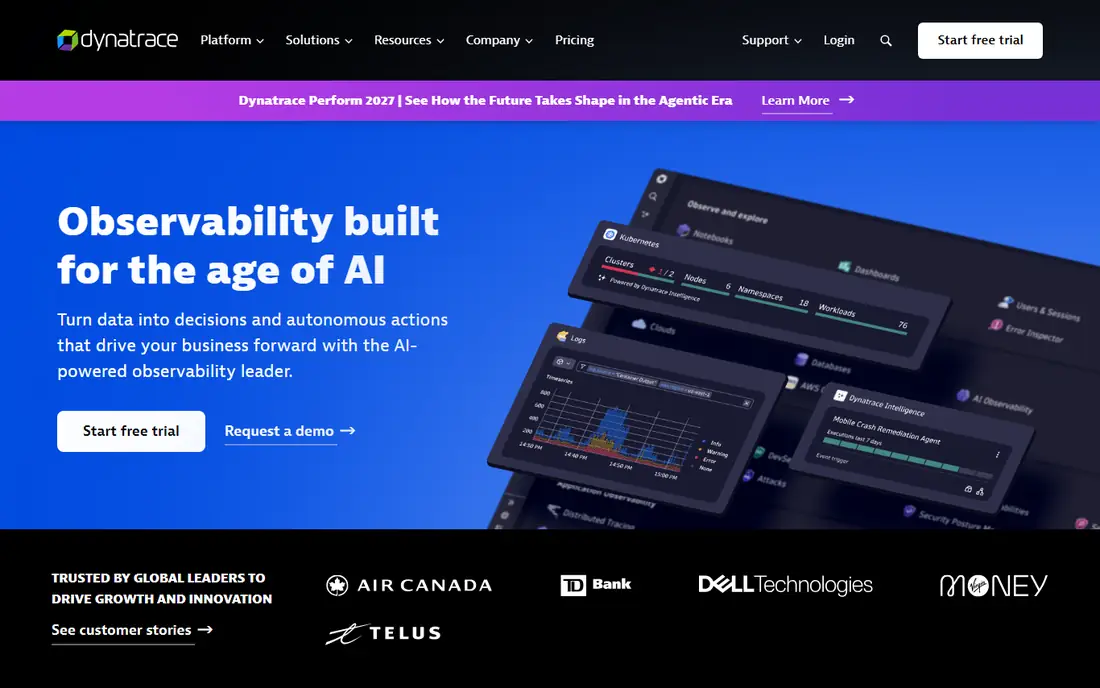
Dynatrace is the best digital experience monitoring company for most large teams, because it covers the whole chain from a real user session to the exact line of code. Its pricing page lists real user monitoring at $2.25 per 1,000 sessions with 35 days of retention, session replay at $4.50 per 1,000 sessions, and browser synthetic tests at $4.50 per 1,000 actions. The buying model is the catch: every capability draws down from one annual platform commitment.
What we like- Published rate card with RUM at $2.25 per 1,000 sessions and session replay at $4.50, Davis AI gives automatic root cause across sessions, traces and logs, full-stack monitoring from $58 a month per 8 GiB host, unlimited seats with no per-user fee
Watch out for- Everything runs through the Dynatrace Platform Subscription, a minimum annual spend commitment paid up front, which is heavy for a team that only wants to check whether the login page is up
Starting priceQuote; small deployments typically $40,000 to $75,000 per year, third-party reported from Vendr transaction data, checked 14 Nov 2026
Free planFree trial, no permanent free tier
Catchpoint is the best pick for global synthetic monitoring, because its network watches your site the way the internet sees it, from thousands of vantage points outside your firewall. Synthetic tests run on a schedule from backbone, last-mile and enterprise nodes, so a DNS failure, a CDN outage or a slow region shows up before customers report it. Real user monitoring and endpoint monitoring add the user side, and the platform is built for teams that manage a service delivery chain rather than a single app. Pricing is the weak point: there is no public list price, and enterprise deals run far higher.
What we like- More than 2,500 backbone, last-mile and enterprise nodes, the broadest synthetic reach here, strong internet stack monitoring across ISP, CDN and DNS, endpoint monitoring for real user devices
Watch out for- No published list pricing, and enterprise contracts typically run $200,000 to $500,000 a year, which puts it out of reach for small teams
Starting priceQuote, credits-based; about $50,000 to $75,000 per year for 100 cloud tests per minute, third-party reported, checked 14 Nov 2026
Free planFree trial, no permanent free tier
ThousandEyes, now part of Cisco, is the best DEM company for proving where a fault lives on the public internet. Its cloud agents sit inside major ISPs and cloud providers, enterprise agents run inside your own network, and endpoint agents watch the user device, so one incident view can show the exact hop where performance broke and which provider owns it. That evidence ends the blame game with your ISP and SaaS vendors. The pricing model is the drawback: it is quote-only and credits-based, and the bill grows with test volume.
What we like- The deepest internet path visibility here, with BGP, DNS and ISP data from cloud, enterprise and endpoint agents, a free trial to test against your own apps, strong outage mapping that names the responsible provider
Watch out for- Quote-only pricing with a credits model that is hard to forecast, and reviewers cite a price that is high for smaller organisations
#4Datadog
Best for: Cheap sessions inside a Datadog shop4.4/5 on
G2 (726 reviews, checked Oct 2026)
Visit datadoghq.com
Starting priceRUM Measure $0.15 per 1,000 sessions on annual billing, third-party reported, checked 14 Nov 2026
Free planFree trial, no permanent free tier for RUM
Datadog is the best pick for teams that already run Datadog, because its real user monitoring plugs straight into the same APM, logs and infrastructure data the team already uses. RUM Measure costs $0.15 per 1,000 sessions on annual billing and covers aggregate metrics for all traffic, which makes 1 million sessions cost about $150 a month. Session inspection costs more, so the bill depends on how many sessions you actually open. There is a price conflict to watch: some sources still list browser RUM at $1.50 per 1,000 sessions, which appears to be the older single-tier price before Datadog split measurement from investigation.
What we like- The cheapest per-session price here at $0.15 per 1,000 sessions for aggregate measurement, full correlation with APM, logs and infrastructure in one platform, session replay available as an add-on
Watch out for- The price is split across several SKUs, so the bill is hard to forecast, and one source still lists browser RUM at $1.50 per 1,000 sessions, which conflicts with the newer Measure tier price
#5New Relic
Best for: Starting free on a low-traffic site4.4/5 on
G2 (586 reviews, checked Oct 2026)
Visit newrelic.com
Starting priceFree up to 100 GB per month ingest; $0.40 per GB beyond, third-party reported, checked 14 Nov 2026
Free planYes, 100 GB per month ingest at no cost, no credit card required
New Relic is the best pick for starting digital experience monitoring without a budget, because its free tier covers 100 GB of ingest a month with no credit card, which is enough for a low-traffic site to get real browser and mobile data. Browser data correlates with backend traces and logs in the same place. The confusing part is user pricing: sources disagree, listing a core user at $49 a month and full platform users from $99 to $349 a month, so get the user count in writing before signing.
What we like- The most generous free tier here, data ingest pricing that stays cheap at low volume, browser and mobile RUM with session replay, unlimited free basic users
Watch out for- User pricing is confusing, with sources listing a core user at $49 a month and full platform users at $99 to $349 a month, and ingest bills grow fast once traffic rises
Starting priceInfrastructure from $6 per vCPU per month, third-party reported from the Splunk pricing page, checked 14 Nov 2026
Free planFree trial, no permanent free tier
AppDynamics, now a Cisco product sold through Splunk pricing, is the best pick for teams that think in business transactions rather than server metrics. It traces a checkout or a loan application end to end and ties slow performance to lost revenue, which is the language a CFO understands. Pricing is published in three editions: Infrastructure from $6 per vCPU per month, Premium from $33 per host per month, and Enterprise from $50 per host per month, all billed annually. Reviewers note a legacy interface and slower feature delivery than Dynatrace or Datadog.
What we like- Business transaction tracing links app performance to business results, Premium from $33 per host per month and Enterprise from $50, published tiers, strong fit for Cisco and Splunk customers
Watch out for- The interface is older than its rivals and innovation has slowed since the Cisco acquisition, and security and synthetics are priced as separate add-ons
#7Splunk Observability Cloud
Best for: Log-led teams that want DEM beside search4.3/5 on
G2 (55 reviews, checked Oct 2026)
Visit splunk.com
Starting priceInfrastructure tier from $15 per host per month, third-party reported, checked 14 Nov 2026
Free planFree trial, no permanent free tier
Splunk Observability Cloud is the best pick for teams that already live in Splunk logs, because its DEM data sits beside the most powerful log search in this list. Real user monitoring, synthetics and APM all feed the same platform, and the End-to-End tier at $75 per host per month adds browser checks for the full experience picture. The Infrastructure tier starts at $15 per host per month, which looks cheap until the host count grows, and Splunk is known for bills that rise with volume. The learning curve is real: Splunk rewards teams that invest in its query language.
What we like- The strongest log search and correlation here, End-to-End tier adds browser checks and full observability at $75 per host per month, deep integration with Splunk Enterprise security data
Watch out for- High cost at scale, a steep learning curve, and per-host pricing that grows with every server you add
Starting priceQuote, third-party reported, checked 14 Nov 2026
Free planFree trial, no permanent free tier
Akamai mPulse is the best pick for high-traffic sites already delivered through Akamai, because it measures real user experience from the same edge network that serves the content. It captures page loads, errors and performance from actual visitors at a scale few vendors can match, and it pairs naturally with Akamai CDN and security products the team may already run. The weakness is breadth: mPulse is a real user monitoring product, not a full observability platform. Pricing is quote-only, with no public rates to compare, so budget for a sales conversation.
What we like- Real user monitoring built on Akamai CDN data at internet scale, strong performance analytics for high-traffic sites, pairs naturally with Akamai delivery and security
Watch out for- Quote-only pricing with no public rates, and it is a narrower product than the full observability platforms, so most buyers need a second tool for APM
Frequently asked questions
What is digital experience monitoring?
Digital experience monitoring, or DEM, measures how real people and synthetic tests experience your websites, apps and services. It combines real user monitoring, which records actual visitor sessions, with synthetic monitoring, which runs scripted tests on a schedule from locations around the world. Together they show availability, page speed, errors and network paths, so a team can see a problem from the user side before it becomes a support ticket.
How is DEM different from APM?
DEM watches the experience from the user side, measuring page loads, session errors and network paths, while APM watches the application from the server side, measuring code execution, database queries and service calls. DEM answers what users experienced, APM answers why the code was slow, and the best platforms combine both so a bad session leads straight to the faulty service. Many buyers start with DEM and add APM when they need the server-side cause.
How much should a mid-size company budget for DEM?
A mid-size company should budget $25,000 to $100,000 a year for a serious DEM deployment. Per-session tools like Datadog and New Relic can start near zero and grow with traffic, while quote-based vendors like Catchpoint and ThousandEyes typically start around $40,000 to $75,000 a year for a small deployment. The final number depends on session volume, the number of synthetic test locations, and how long data is retained.
Do I need agents on user devices?
No, most DEM does not need agents on user devices. Real user monitoring works through a small JavaScript snippet on web pages or an SDK in mobile apps, and synthetic monitoring runs from the vendor network with no install at all. Endpoint agents exist for teams that want device-level data, and ThousandEyes and Catchpoint both offer them, but they are optional and most buyers start without them.
Can DEM replace uptime monitoring?
Yes, DEM can replace basic uptime monitoring, because synthetic tests check availability on a schedule from many locations and catch outages faster than a single ping check. Real user monitoring adds the missing piece: it shows when the site is up but unusably slow, which a ping check never sees. Keep a simple uptime check only if the DEM contract does not cover a location or a protocol you care about.
Sources we checked (12)
- https://www.catchpoint.com
- https://www.thousandeyes.com
- https://www.dynatrace.com/pricing/
- https://www.datadoghq.com
- https://newrelic.com
- https://www.appdynamics.com
- https://www.splunk.com
- https://www.akamai.com
- https://www.vendr.com/marketplace/catchpoint
- https://www.motadata.com/blog/top-digital-experience-monitoring-tools
- https://betterstack.com/community/comparisons/real-user-monitoring-tools/
- https://www.observeone.com/compare/dynatrace-vs-appdynamics
Is your product missing or out of date?
We review this list regularly. Vendors can request a listing, send updated pricing or ask about featured placement.

Shihab Mia · Founder, Rankite
Shihab has 5+ years in B2B and SaaS SEO. He writes Rankite's software buying guides from pricing pages, documentation and public user reviews. More about Shihab.