How we make this list: we compare pricing pages, product documentation and public user reviews. Rankite is independent; if a vendor ever pays for a featured spot, that listing is clearly labeled Partner.
Key takeaways
- WalkMe and Whatfix lead enterprise employee adoption, but expect quote-based pricing that starts around five figures a year.
- Pendo is the analytics-first choice for product teams that want adoption data and in-app guidance from one vendor.
- UserGuiding at $174/month is the cheapest credible entry point for SaaS teams that need onboarding flows fast.
- Userpilot, Appcues, and Chameleon sit in the mid-market band ($249-$299/month), each with a different strength: analytics, ease of use, or design control.
Quick comparison
| Tool | Best for | Starting price | Free plan |
|---|
 WalkMe WalkMe | large enterprise digital transformation | See website | No |
 Whatfix Whatfix | regulated enterprises needing simulation training | See website | No |
 Pendo Pendo | product teams wanting analytics plus guidance | Free plan; paid plans custom | Yes |
 Userpilot Userpilot | mid-market SaaS onboarding with analytics | $299/month (billed annually) | Free trial |
 Appcues Appcues | fast no-code onboarding for product teams | $249/month (billed annually) | Free trial |
 UserGuiding UserGuiding | budget-friendly no-code onboarding | $174/month (billed annually) | Yes |
 Chameleon Chameleon | design-focused teams wanting polished tours | $279/month (billed annually) | Yes |
 Apty Apty | CRM process compliance at mid-market firms | See website | No |
 Userlane Userlane | GDPR-friendly guided workflows for web apps | See website | No |
 Spekit Spekit | in-workflow training inside tools teams already use | See website | Free trial |
Is your product missing or out of date?
We review this list regularly. Vendors can request a listing, send updated pricing or ask about featured placement.
WalkMe's plans start at around $9,000 per year, while typical enterprise contracts average about $78,817 annually, according to Userpilot's 2026 comparison of the category. That gap between entry price and real contract value tells you most of what you need to know about digital adoption platforms: the category spans from $174-a-month SaaS tools to six-figure enterprise programs, and buying the wrong tier wastes serious money.
A digital adoption platform layers guidance directly onto the software your people or customers already use: walkthroughs, tooltips, checklists, and self-help that appear inside the workflow instead of in a training manual. The enterprise versions add process automation, sandbox simulation training, and analytics that show exactly where users get stuck.
The ten platforms below split into two camps. WalkMe, Whatfix, Apty, and Userlane target employee adoption inside enterprises, often on complex systems like SAP, Salesforce, or Oracle. Pendo, Userpilot, Appcues, UserGuiding, Chameleon, and Spekit target product and customer-facing teams at SaaS companies. Knowing which camp you are in cuts the shortlist in half before you read a single feature page.
Starting priceSee website
Free planNo
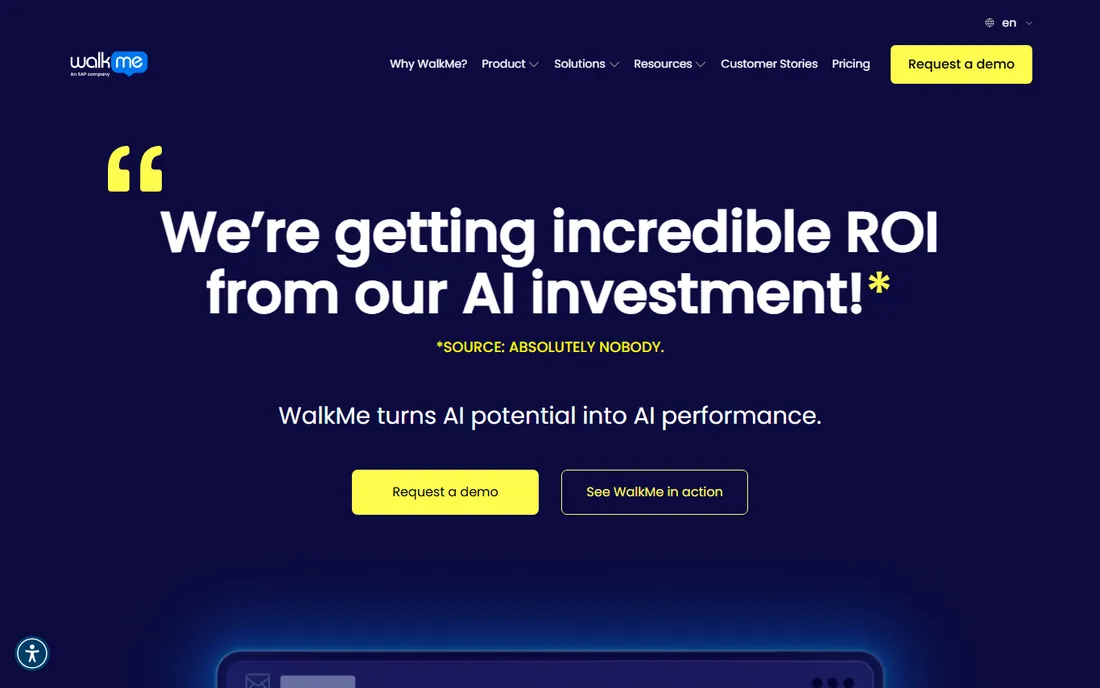
WalkMe created the digital adoption category and still leads it at the enterprise end, with an estimated 34.6% market share in Verified Market Research's 2026 analysis. Its strength is depth: automation that fills forms and completes steps for users, guidance that works across web, desktop, mobile, and virtualized applications, and native integrations with SAP environments where many competitors cannot follow.
That depth comes with enterprise weight. Implementation is a project, not a signup, and pricing starts around $9,000 a year with typical contracts far higher. WalkMe fits organizations running formal digital transformation programs with dedicated administrators. Mid-size companies usually find the cost and complexity out of proportion to their needs, and SaaS product teams wanting customer onboarding should look at Pendo or Userpilot instead.
What we like- Deepest automation in the category
- Cross-platform coverage including desktop and virtualized apps
- Strong SAP ecosystem support
Watch out for- Quote-based pricing with high minimums
- Steep learning curve and heavy implementation
#2
Whatfix
Best for: regulated enterprises needing simulation training
Visit whatfix.com
Starting priceSee website
Free planNo
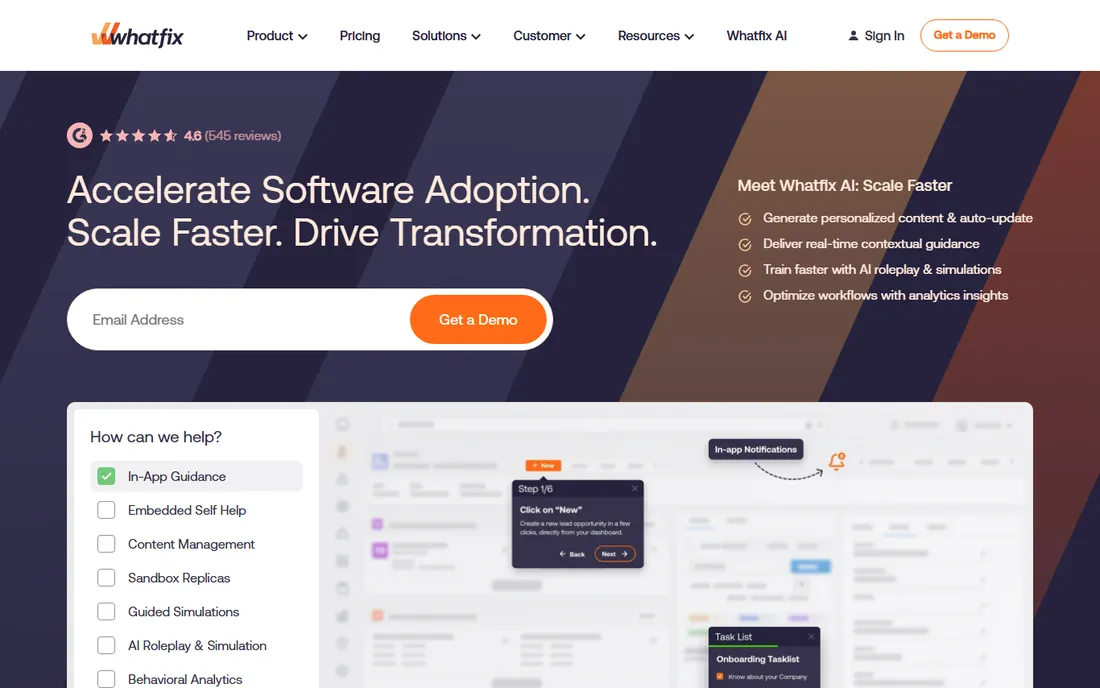
Whatfix is WalkMe's closest enterprise rival, and its signature feature is Mirror: a simulated copy of your application where employees can practice risky workflows, like financial transactions or patient data entry, without touching live systems. For regulated industries, that pre-production training layer is a genuine differentiator rather than a checkbox.
Beyond Mirror, Whatfix offers in-workflow guidance, embedded self-help, and analytics that track task completion and friction points. Content maintenance is a practical strength: when the underlying application changes its interface, Whatfix can update guidance automatically instead of forcing a manual rebuild. Pricing is quote-based and enterprise-scale. Firms choosing between the two leaders usually decide on implementation speed and support quality, where Whatfix tends to score better with mid-market buyers.
What we like- Mirror sandbox training for risk-free practice
- Content auto-updates when UIs change
- Strong analytics on adoption
Watch out for- Quote-based pricing
- Implementation effort similar to WalkMe
#3
Pendo
Best for: product teams wanting analytics plus guidance
Visit pendo.io
Starting priceFree plan; paid plans custom
Free planYes
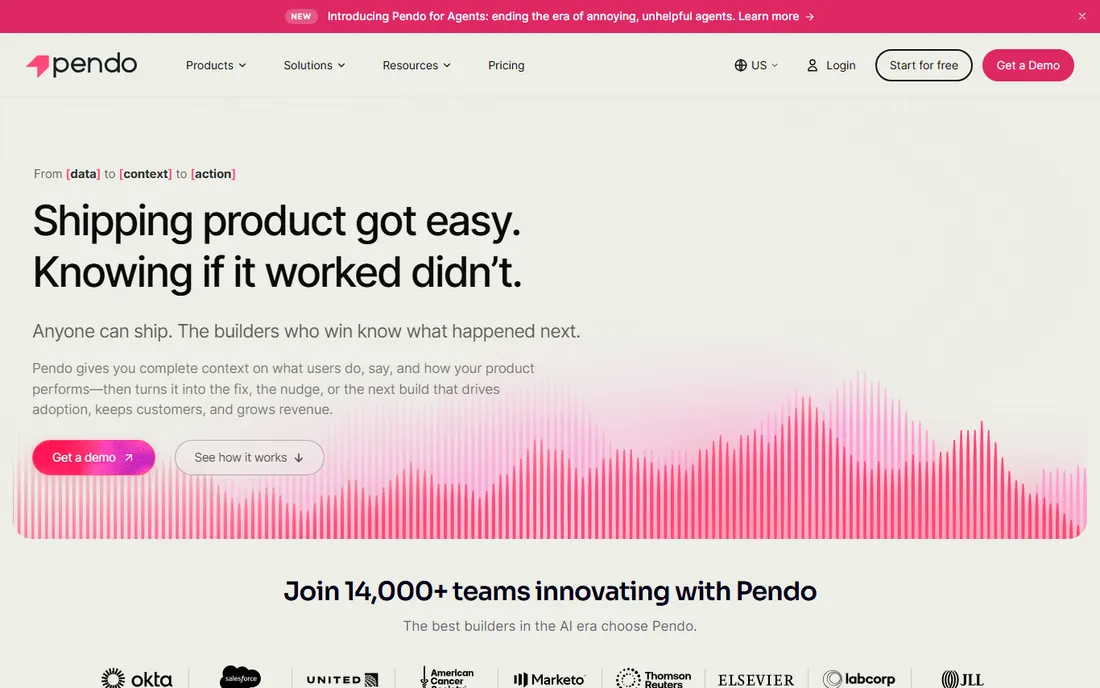
Pendo comes at adoption from the product side. Its core is analytics: retroactive event capture, funnels, cohorts, and path analysis that show how users actually move through your application. In-app guides, tooltips, and surveys sit on top of that data layer, so teams target interventions at real friction instead of guessing.
The free tier, covering up to 500 monthly active users, makes Pendo the easiest platform on this list to try. Paid plans are quote-based and the price climbs fast as MAUs grow, which is the standard complaint in reviews. Pendo fits product-led SaaS companies that want one vendor for "what are users doing" and "how do we guide them." It is less suited to employee training on third-party enterprise software, which is WalkMe and Whatfix territory.
What we like- Deep product analytics built in
- Free tier up to 500 MAUs
- Guides, polls, and roadmaps in one platform
Watch out for- Paid pricing is custom and scales steeply
- Guidance features less deep than pure DAPs
Starting price$299/month (billed annually)
Free planFree trial
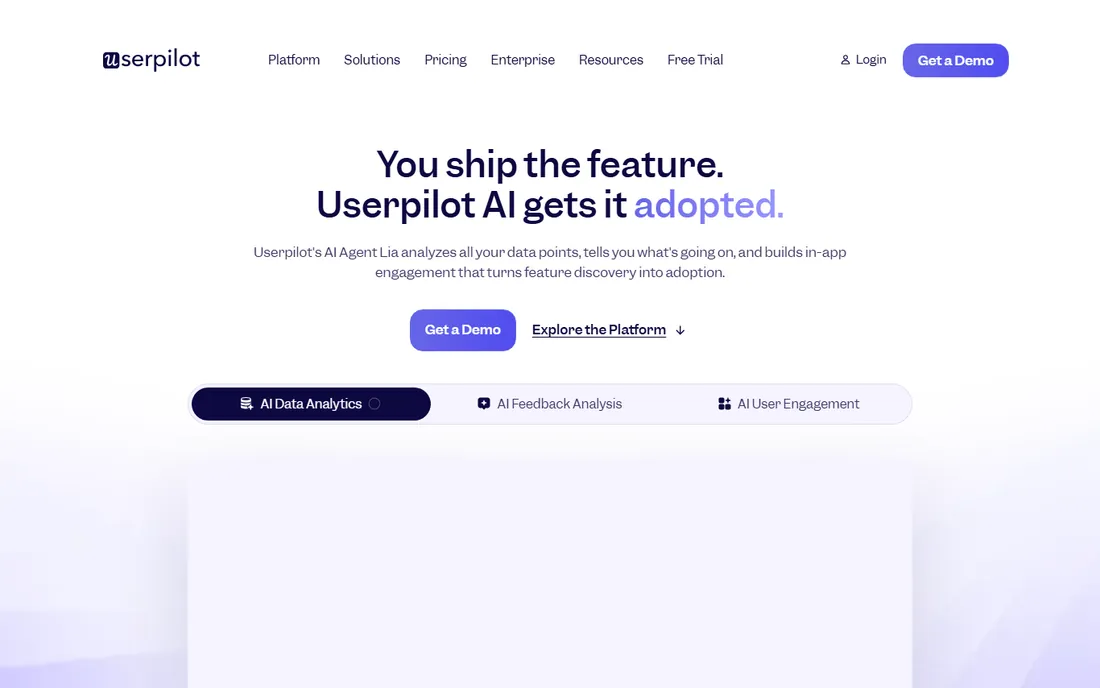
Userpilot positions itself as the mid-market alternative to both Pendo and the enterprise DAPs. The Starter plan at $299 a month covers up to 2,000 monthly active users with guides, hotspots, checklists, segmentation, and NPS surveys. Growth, starting around $799 a month, adds product analytics, session replays, resource centers, and A/B testing.
The analytics depth is the reason teams pick Userpilot over Appcues: autocapture, funnels, and cohorts reduce the need for a separate analytics tool. The catch is tiering. Mobile analytics, integrations like HubSpot and Salesforce, and several add-ons are restricted to Growth and Enterprise, so the headline Starter price can mislead teams that need the full stack. Mobile app support is a real plus at this price point.
What we like- Transparent per-MAU pricing
- Built-in analytics with funnels and cohorts
- Web and mobile support
Watch out for- Advanced features gated behind Growth
- Add-ons restricted to higher tiers
Starting price$249/month (billed annually)
Free planFree trial
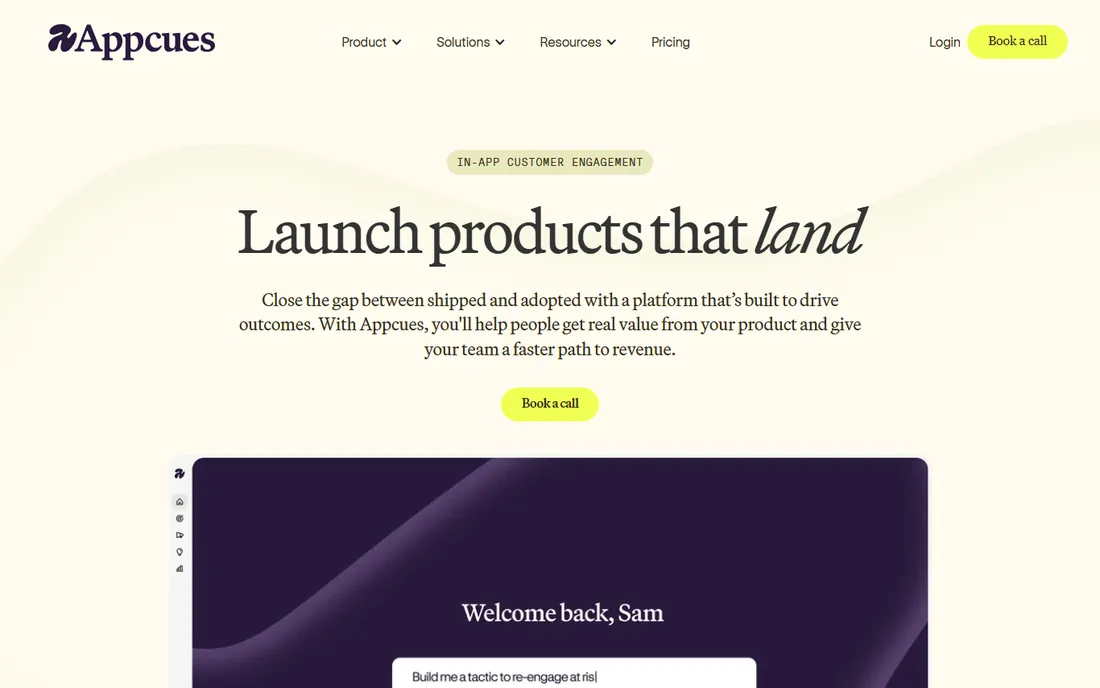
Appcues wins on time to value. Product teams routinely ship their first onboarding flow within days using the drag-and-drop builder and a library of proven patterns for checklists, modals, and tooltips. The Essentials plan at $249 a month covers 2,500 monthly active users, and native iOS and Android SDKs mean mobile apps are first-class rather than an afterthought.
The tradeoff against Userpilot is analytics. Appcues covers flow completion and basic reporting, but teams that want deep behavioral analysis pair it with a separate analytics tool. Pricing above Essentials moves to custom quotes, and mid-market contracts land in the $12,000 to $40,000 a year range. Appcues fits teams that prioritize shipping onboarding quickly over studying it deeply.
What we like- Fastest setup in the mid-market band
- Proven onboarding patterns
- Mobile SDKs included
Watch out for- Analytics lighter than Userpilot
- Pricing turns custom above Essentials
Starting price$174/month (billed annually)
Free planYes
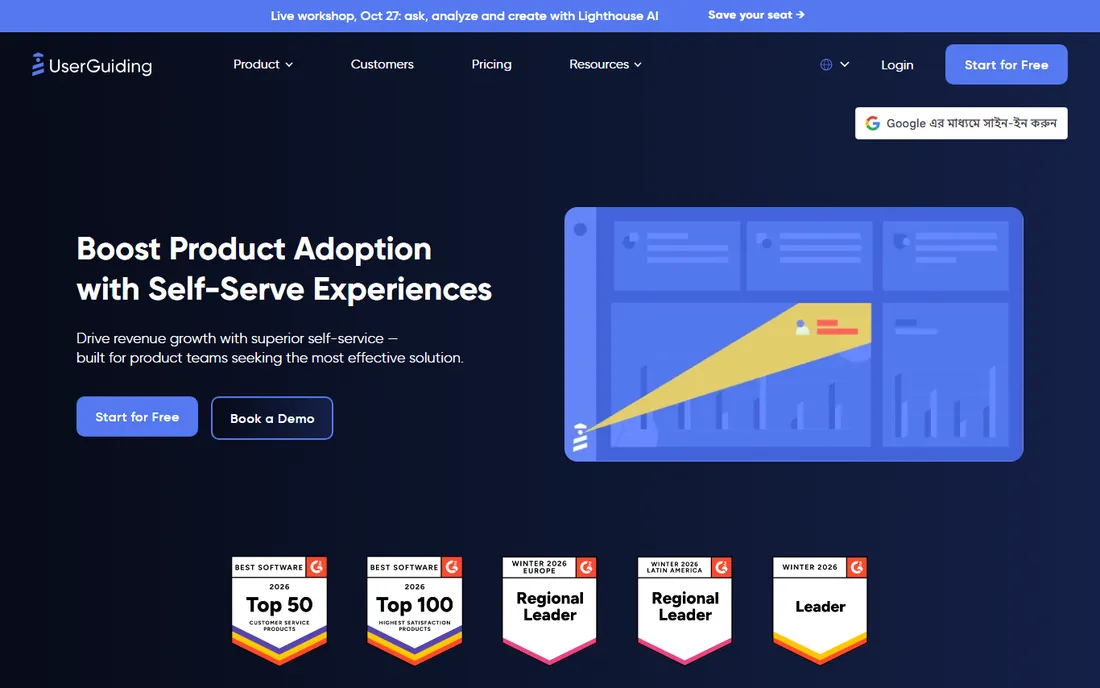
UserGuiding is the value pick of the SaaS onboarding group. The Starter plan at $174 a month for 2,000 monthly active users undercuts Userpilot and Appcues by a wide margin, and the feature set covers the essentials: product tours, checklists, hotspots, a resource center, NPS surveys, and even a standalone knowledge base with an AI assistant on some plans.
Setup is genuinely no-code through a Chrome extension builder, and small teams report going live the same day. The limitations are honest ones at this price: no native mobile app support, and the builder interface feels less refined than Appcues. For bootstrapped or early-stage SaaS companies that need proper onboarding without a $300 monthly commitment, UserGuiding is the serious option.
What we like- Lowest paid starting price here
- Genuine no-code same-day setup
- Knowledge base and AI assistant included
Watch out for- No native mobile support
- Interface less polished than pricier rivals
Starting price$279/month (billed annually)
Free planYes
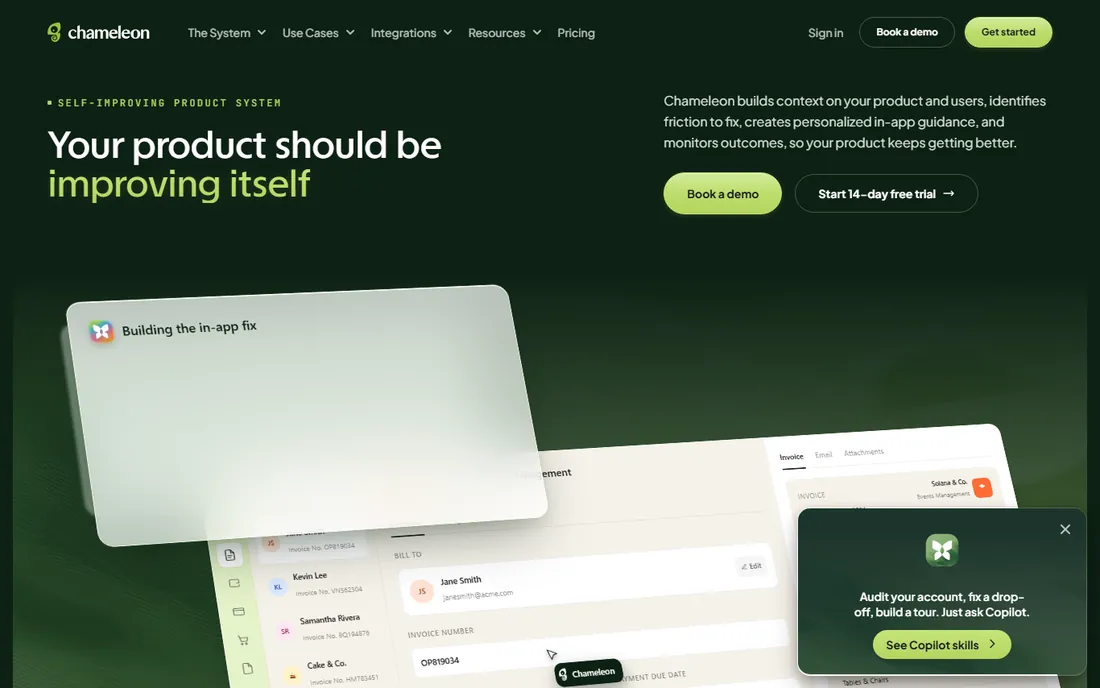
Chameleon is the choice for teams where the in-app experience has to look pixel-perfect. Full CSS control, embedded banners and cards, and advanced targeting let designers build guidance that feels native to the product rather than overlaid on it. The platform also covers interactive product demos, which lets marketing and sales reuse the same tooling.
The Startup plan at $279 a month covers 2,000 monthly tracked users, and a free plan covers interactive demos. Growth plans run about $15,000 a year. Chameleon is web-only, so mobile-first products should look elsewhere, and the flexibility costs setup time: expect days to weeks rather than Appcues-style hours. Teams that care deeply about brand experience in their onboarding will find the tradeoff worthwhile.
What we like- Highest customization with CSS support
- Interactive demos plus onboarding in one platform
- Microsurveys and A/B testing
Watch out for- Web only, no mobile SDKs
- Setup takes longer than Appcues
#8
Apty
Best for: CRM process compliance at mid-market firms
Visit apty.com
Starting priceSee website
Free planNo
Apty takes a narrower position than the enterprise leaders: it focuses on process compliance inside browser-based business applications, especially CRM. Instead of general guidance, Apty enforces workflows: validation rules that stop users entering bad data, step-by-step execution paths for complex processes, and analytics on where teams deviate from the defined process.
That focus makes it a strong fit for sales operations teams rolling out Salesforce or similar systems to hundreds of reps, where the problem is not learning the software but following the process. The scope is deliberately narrower than WalkMe or Whatfix, which keeps implementations lighter but means it is not the tool for company-wide digital transformation. Pricing is quote-based.
What we like- Focused on process adherence inside browser business apps
- Strong for Salesforce and CRM rollouts
- Validation rules that enforce correct data entry
Watch out for- Narrower scope than WalkMe or Whatfix
- Quote-based pricing
Starting priceSee website
Free planNo
Userlane is the European answer to enterprise digital adoption, and its pitch leads with GDPR compliance and data residency. For EU-based companies in regulated sectors, that positioning matters more than any feature comparison. The product focuses on guided interactive workflows for web applications with basic analytics, deliberately trading advanced features for simplicity.
Implementation and administration are lighter than WalkMe or Whatfix, which suits mid-size European firms that need adoption support without an enterprise program around it. The tradeoff is depth: automation, simulation training, and analytics sophistication all lag the category leaders. US buyers without compliance constraints will usually get more capability per dollar elsewhere.
What we like- Strong European data compliance posture
- Simple guided workflows
- Lower complexity than enterprise DAPs
Watch out for- Feature set thinner than WalkMe or Whatfix
- Quote-based pricing
#10
Spekit
Best for: in-workflow training inside tools teams already use
Visit spekit.com
Starting priceSee website
Free planFree trial
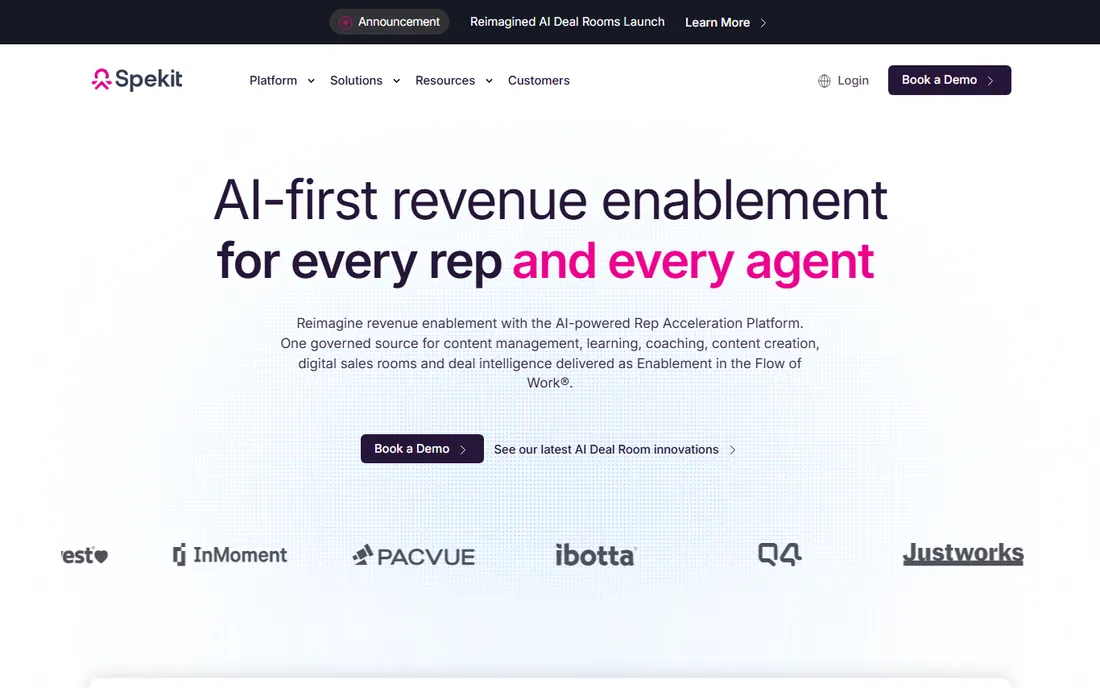
Spekit approaches adoption from the knowledge side. Instead of overlaying guides on applications, it injects training content, definitions, process docs, and playbooks directly into the tools employees already use: Salesforce records, Slack, Chrome, and other daily surfaces. The idea is that learning happens at the moment of need without opening a separate system.
This makes Spekit a strong fit for sales enablement and revenue teams, where the adoption problem is really a knowledge problem: reps who do not know the talk track, the process, or where the content lives. It is narrower than a full DAP and will not automate workflows or provide simulation training. Pricing is not published, so expect a sales conversation.
What we like- Training surfaces inside Salesforce, Slack, and browsers
- Reduces context switching
- Good for sales enablement
Watch out for- Narrower than full DAPs
- Pricing not published
How we built this shortlist
We compared digital adoption platforms using vendor pricing pages, feature documentation, and review data from G2, Capterra, and analyst coverage. We weighted deployment model (employee training versus customer onboarding), implementation effort, pricing transparency, analytics depth, and mobile and cross-platform support. We did not run hands-on trials, so workflow details come from documentation and verified user reviews rather than our own use.
What to check before you sign
Decide first whether you are buying employee adoption or customer onboarding, because the two halves of this market barely overlap. Employee adoption means training staff on software the company chose: Salesforce rollouts, ERP migrations, internal tools. Customer onboarding means guiding your own users through your product. WalkMe, Whatfix, Apty, and Userlane serve the first. Pendo, Userpilot, Appcues, UserGuiding, and Chameleon serve the second. Buying across the line is the most expensive mistake in this category.
Pricing models need careful reading. Most platforms price per monthly active user, and the definition of "active" varies: some count anyone who loads the app, others count anyone who sees a guide. Ask for the exact definition and model it against your real user counts, including seasonal spikes. Enterprise contracts in this category discount heavily, often 20 to 40 percent off list for multi-year commitments, so treat the first quote as a starting point.
Implementation effort is the hidden cost. No-code builders from UserGuiding or Appcues go live in days. WalkMe and Whatfix implementations are measured in weeks to months and usually need a dedicated administrator. Ask each vendor for a realistic timeline with reference customers at your company size, and ask who maintains the guides when your application updates. Content that rots after every UI change quietly kills adoption programs.
Data residency and compliance deserve a direct question if you operate in Europe or a regulated industry. Ask where guide content and analytics data are stored, whether the vendor offers EU data residency, and which certifications (SOC 2, GDPR, HIPAA) are current rather than planned. Security reviews can add months to enterprise deals, so start them early.
Employee adoption versus customer onboarding
The split deserves emphasis because vendors blur it deliberately. Employee adoption platforms assume the software is fixed and the users must adapt: the company bought Salesforce, and three hundred reps need to use it correctly. Success is measured in process compliance, data quality, and reduced support tickets. Customer onboarding platforms assume the product must win the user: a trial signup needs to reach value in minutes. Success is measured in activation rates, feature adoption, and conversion.
The buying process differs too. Employee adoption is usually bought by IT, operations, or enablement teams with formal requirements and security reviews. Customer onboarding is bought by product or growth teams who want to try something this sprint. If your buying process looks like the second but you are evaluating WalkMe, something has gone wrong. Match the vendor's sales motion to your reality and the evaluation will go much faster.
Frequently asked questions
What is a digital adoption platform?
Software that layers guidance, automation, and self-help directly onto other applications so users learn in the flow of work. Typical features include interactive walkthroughs, tooltips, checklists, in-app announcements, and analytics on where users struggle.
How much does a digital adoption platform cost?
SaaS onboarding tools start around $174 to $299 a month for a few thousand monthly users. Enterprise platforms like WalkMe and Whatfix are quote-based, with entry points around $9,000 a year and typical enterprise contracts averaging far higher.
WalkMe vs Whatfix: which is better?
They are more alike than different at the enterprise level. Choose Whatfix if simulation-based training matters, since its Mirror feature lets employees practice in a sandbox copy of the application. Choose WalkMe for the deepest automation and the broadest platform coverage, including desktop and virtualized apps.
Do I need a DAP or just product analytics?
If you only need to understand user behavior, a product analytics tool is cheaper and simpler. A DAP earns its price when you need to act on that understanding inside the product: guided walkthroughs, targeted nudges, and in-app training that analytics alone cannot deliver.
Can a small team use these tools?
Yes, on the SaaS side. UserGuiding, Appcues, and Chameleon all offer plans under $300 a month with free trials, and Pendo has a free tier up to 500 monthly active users. The enterprise DAPs are generally out of reach for small teams on both price and implementation effort.
How long does implementation take?
No-code SaaS tools go live in days. Mid-market platforms like Userpilot and Chameleon typically take days to weeks. Enterprise DAPs like WalkMe and Whatfix are measured in weeks to months and usually need a dedicated administrator or implementation partner.
Sources we checked (6)
- https://userpilot.com/blog/walkme-vs-whatfix/
- https://userpilot.com/blog/saas-product-walkthrough/
- https://www.appcues.com/blog/15-best-product-tour-software
- https://Userguiding.com/blog/appcues-alternatives-competitors
- https://www.verifiedmarketresearch.com/blog/top-digital-adoption-platform-software/
- https://www.g2.com/products/walkme/competitors/alternatives
Is your product missing or out of date?
We review this list regularly. Vendors can request a listing, send updated pricing or ask about featured placement.

Shihab Mia · Founder, Rankite
Shihab has spent more than a decade helping SaaS and e-commerce brands grow through search. He writes Rankite's software buying guides from pricing pages, documentation and public user reviews. More about Shihab.