How we make this list: we compare pricing pages, product documentation and public user reviews. Rankite is independent; if a vendor ever pays for a featured spot, that listing is clearly labeled Partner.
Key takeaways
- Supademo at $38 per creator per month is the most versatile self-serve option, with screenshot, HTML, video, and Figma demos in one library.
- Storylane at $40 per month is the broadest fit for B2B SaaS teams that need screenshot, HTML, and video demos plus deal intelligence.
- Navattic at $500 per month is the HTML-first choice for marketing teams, but its free plan covers only one demo.
- Arcade and Guideflow are the cheapest ways to start, with free tiers and entry plans around $32 to $35 per month.
- Enterprise teams needing cloned product environments should look at Reprise, Demostack, Walnut, or Consensus, all priced by quote.
Quick comparison
| Tool | Best for | Starting price | Free plan |
|---|
 Storylane Storylane | B2B SaaS teams needing format versatility | $40/month (Starter) | Yes |
 Supademo Supademo | Multi-format demos across teams | $38/creator/month (Pro) | Yes |
 Navattic Navattic | HTML-first marketing demos | $500/month (Base) | Yes |
 Arcade Arcade | Polished screenshot demos for marketing | See website | Yes |
 Guideflow Guideflow | Guided product tours for onboarding | $35/month (Solo) | Yes |
 HowdyGo HowdyGo | Flat-rate HTML demos, unlimited users | $159/month (Starter) | Free trial |
 Consensus Consensus | Video demo automation for buying committees | See website | No |
 Walnut Walnut | Sales-led demo personalization | See website | No |
 Reprise Reprise | Enterprise sandbox environments | See website | No |
Is your product missing or out of date?
We review this list regularly. Vendors can request a listing, send updated pricing or ask about featured placement.
The best best demo software
How many of your website visitors actually book a sales call? That is the question interactive demo software answers. A growing share of B2B buyers would rather click through your product themselves than sit through a discovery call, and the companies winning those buyers are the ones with a self-serve demo on the website.
The second question is what kind of demo you need. Marketing teams want polished, guided tours that convert visitors. Sales teams want personalized demos for specific accounts. Presales engineers want full sandbox environments where prospects can touch a live-feeling product. The tools below cover all three motions, from free screenshot demos to enterprise product clones.
Pricing splits into two worlds: self-serve tools at $35 to $500 per month, and enterprise platforms priced by quote in the tens of thousands per year. The right world depends on deal size, not team size.
Starting price$40/month (Starter)
Free planYes
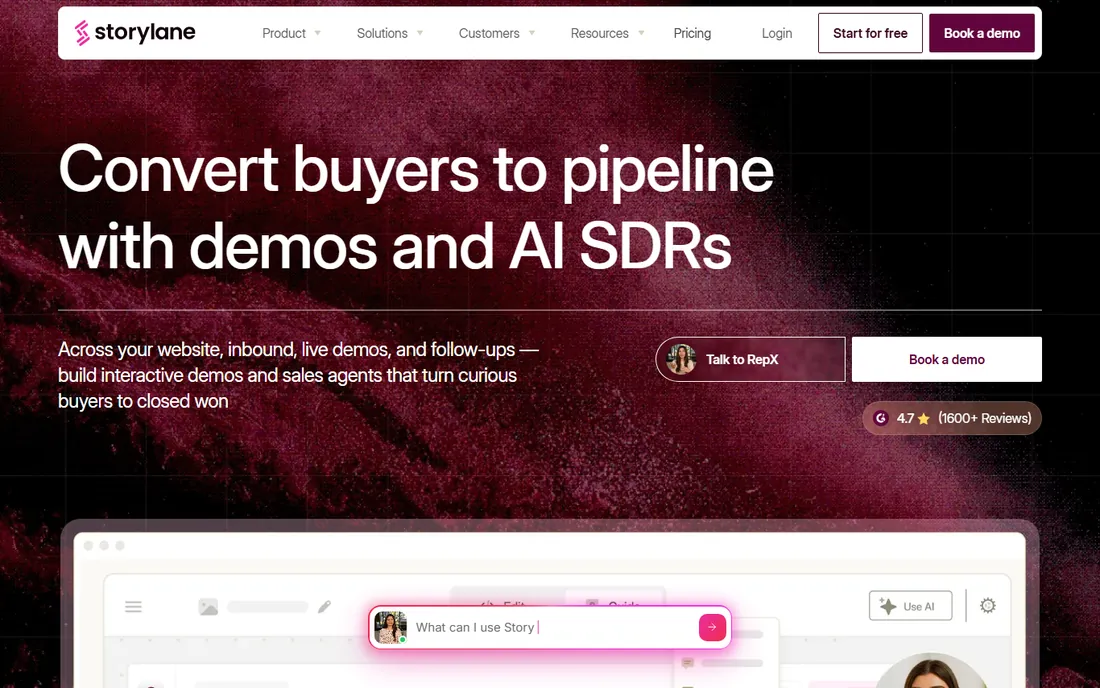
Storylane is the broadest self-serve demo platform for B2B SaaS go-to-market teams. It handles screenshot demos, HTML demos, and video demos natively, so one tool covers the website tour, the sales leave-behind, and the launch video. The Starter plan at $40 per month makes it accessible to small teams, with higher tiers adding deal intelligence and personalization.
The platform's differentiator is the RepX live AI sales agent, which engages demo viewers conversationally, a capability no direct competitor matches. Multi-format Hubs let teams build demo centers and digital sales rooms from the same content library. With over 1,400 G2 reviews, it is the most reviewed tool in the category.
The honest trade-off is tiering. HTML demos require the Growth tier rather than Starter, and per-seat pricing means costs scale with the team. Sandbox-style demos are enterprise-only. For marketing-led teams that live in screenshot and HTML demos, it is the most complete package under $500 a month.
What we like- Screenshot, HTML and video demos as first-class formats
- Strong G2 standing
- AI sales agent add-on
Watch out for- HTML demos require the Growth tier
- Per-seat pricing adds up
- Enterprise features gated high
Starting price$38/creator/month (Pro)
Free planYes
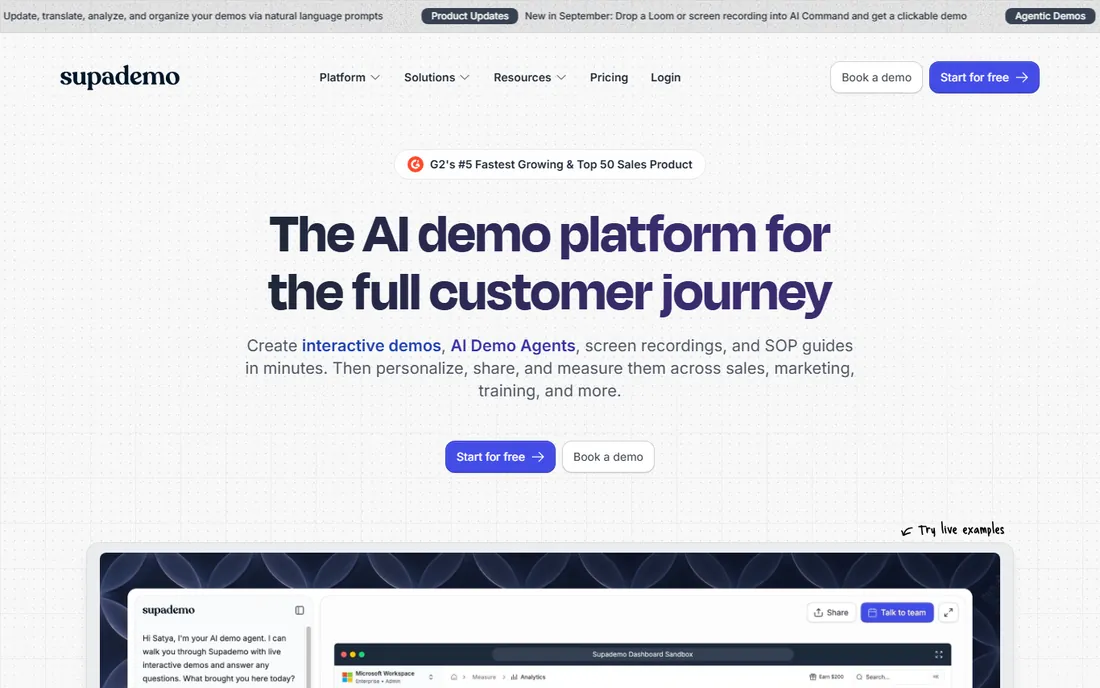
Supademo is the all-rounder. One library supports screenshot demos, HTML demos, video recordings, desktop capture, and Figma imports, which means sales, onboarding, support, and training teams can all work from the same platform. The Pro plan at $38 per creator per month keeps AI translation, branching, and analytics ungated, unlike competitors that reserve AI for premium tiers.
The free plan is genuinely useful: 5 demos with unlimited views and in-app embedding, no credit card required. That makes Supademo the lowest-risk way to test whether interactive demos move the needle for your funnel. A 14-day trial covers the paid tiers.
The catch is the Growth tier. HTML demos, sandbox demos, and workspace-level AI editing start at $350 per month for 5 creators, which is a real jump from Pro. Teams that only need screenshot and video demos will never feel it; teams that need HTML should budget for Growth from the start.
What we like- Most demo formats in one library
- Generous free plan with 5 demos
- AI features not gated by tier
Watch out for- HTML and sandbox demos need the $350 Growth tier
- Brand recognition lags Storylane
- Analytics less deep
Starting price$500/month (Base)
Free planYes
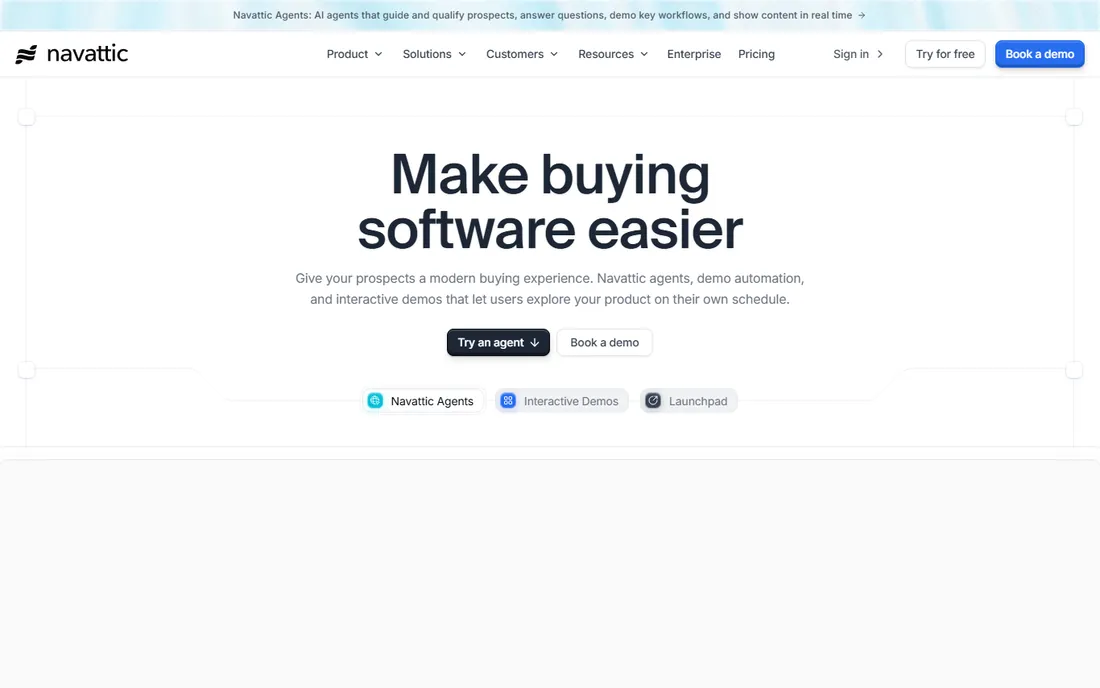
Navattic pioneered the HTML demo category: instead of screenshots, it captures your actual product interface as editable HTML, so demos look and feel like the real thing. Marketing teams use it for website tours, interactive leave-behinds, and ABM campaigns where realism converts.
The Base plan at $500 per month includes 5 seats, HTML and sandbox demos, and engagement analytics. Annual billing brings it to $500 monthly versus $600 month-to-month. The platform integrates with the sales stack for lead capture and routing, which suits teams running demos as a pipeline source.
The honest downside is price positioning. At $500 per month entry with a free plan covering a single demo, Navattic costs more than most competitors charge for their mid tiers, and features like demo translation sit in the $1,000 Growth tier. It earns the premium for HTML-first teams with mature demo programs; smaller teams get more for less elsewhere.
What we like- Native HTML demo capture
- Strong engagement analytics
- Trusted by large marketing teams
Watch out for- Most expensive self-serve entry
- Free plan limited to 1 demo
- Key features gated behind $500 to $1,000 tiers
Starting priceSee website
Free planYes
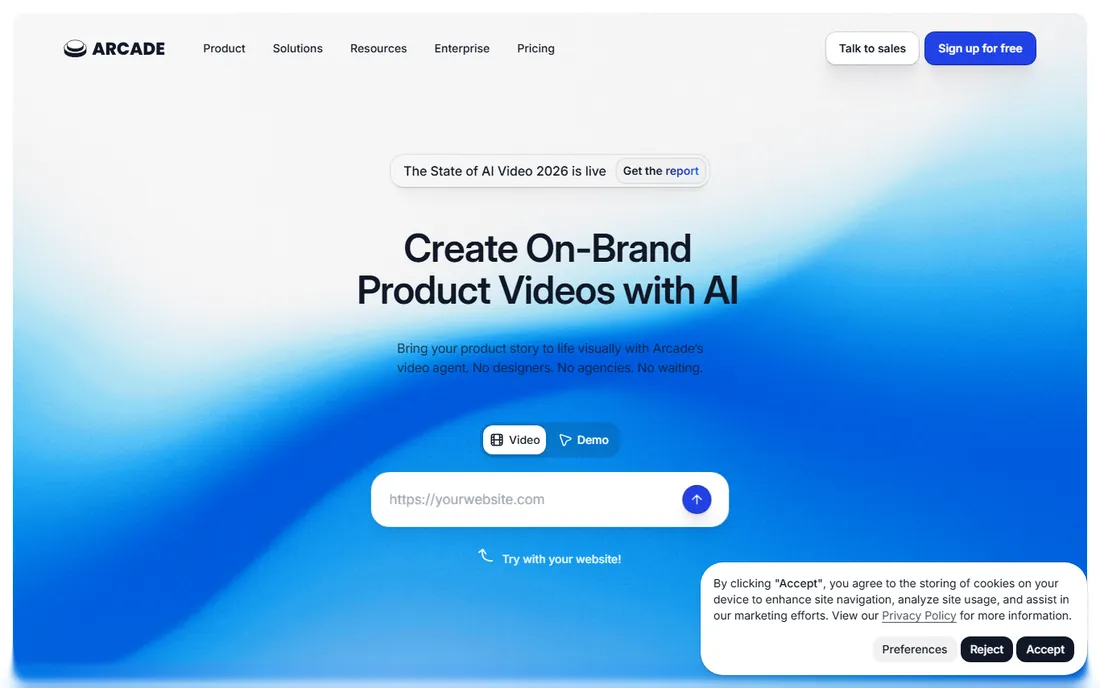
Arcade is the design-led pick. Capture your product, and Arcade produces a polished, on-brand interactive demo in minutes, with styling that looks deliberate rather than default. Marketing teams use it for launch content, social clips, and product-led growth motions where visual quality matters.
The free tier lets small teams start immediately, and paid plans add collaboration, analytics, and AI video features. In 2026 Arcade added HTML capture at the Growth tier and above, moving into direct competition with the HTML-first platforms, though screenshot demos remain its strength.
The caveats are real. Pricing shifted notably in 2026, with the Growth plan moving to a flat monthly rate that raised costs for small teams, and sandbox demos are not offered at any tier. Teams scaling a serious demo program with HTML and sandbox needs will hit the ceiling. For beautiful marketing demos produced fast, it remains excellent.
What we like- Fastest demo creation workflow
- Beautiful default styling
- AI video generation for social
Watch out for- HTML capture requires higher tiers
- Sandbox demos not offered
- Pricing changed significantly in 2026
Starting price$35/month (Solo)
Free planYes
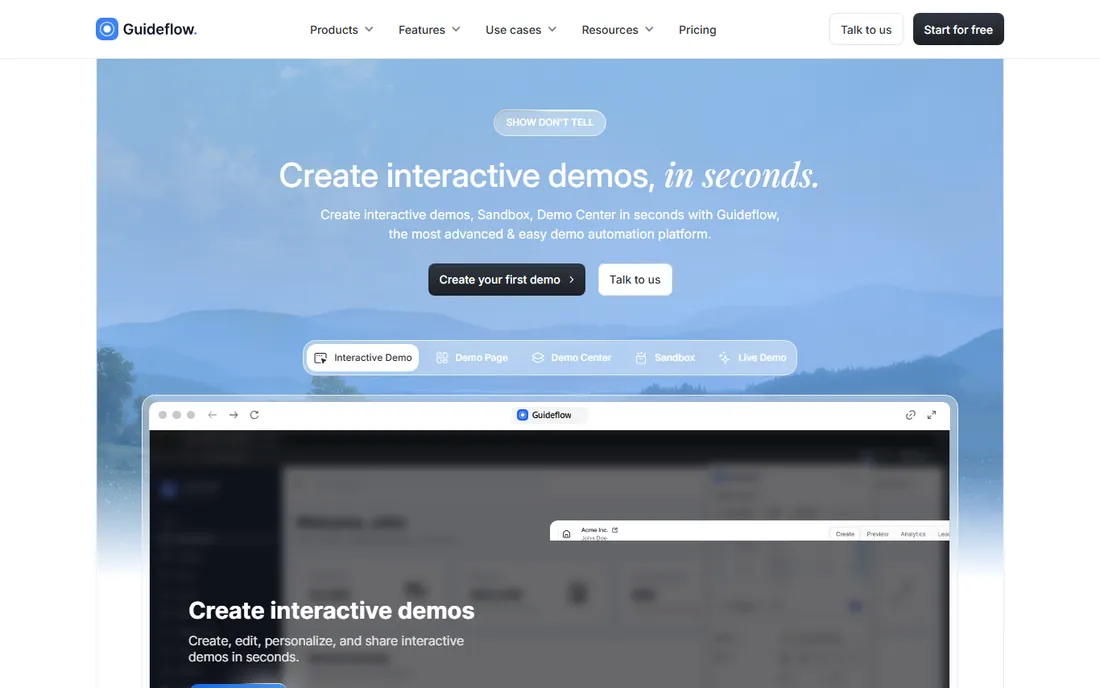
Guideflow is the freemium pick for product and onboarding teams. The no-code builder creates guided product tours quickly, and the free plan is generous enough for real use, not just evaluation. The Solo plan at $35 per month adds the features a small team needs.
The product focus is guided tours rather than full demo programs: onboarding flows, feature announcements, and in-app guidance. For that job, the simplicity is a virtue. Teams can publish tours without involving engineering or design.
The limitations show at scale. HTML demos require the $499 tier and sandbox demos the $1,499 tier, which are steep jumps from Solo. There is no multi-format hub or deal intelligence story. Guideflow is the right tool for tours and onboarding, not for a company-wide demo program.
What we like- Generous free plan
- Simple no-code builder
- Affordable entry at $35 per month
Watch out for- HTML demos gated to the $499 tier
- Sandbox only at $1,499
- Limited enterprise features
Starting price$159/month (Starter)
Free planFree trial
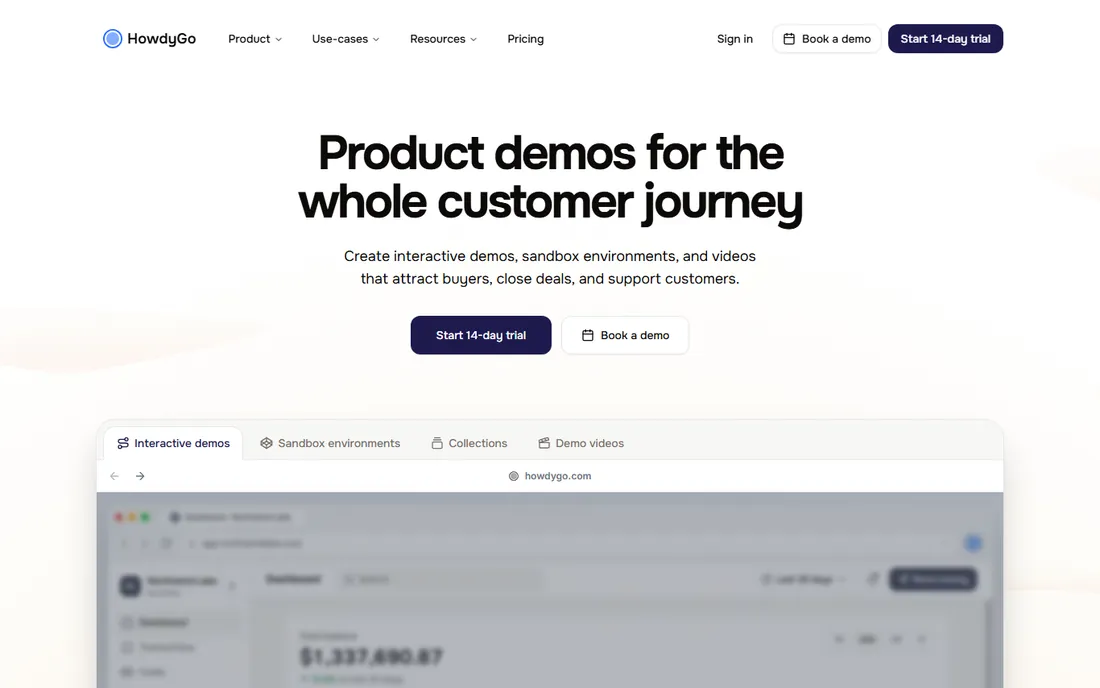
HowdyGo's pitch is pricing simplicity: $159 per month for the Starter plan with unlimited users, no per-seat math, no user caps to negotiate. For small teams that want HTML demos without the $500 entry price of Navattic, that flat rate is the whole argument.
The product itself is deliberately simple: capture HTML demos, edit them lightly, and publish. There is no bloat, which means new users are productive immediately. The 14-day trial lets teams validate the output quality before paying.
The honest trade-off is scope. HowdyGo does not do video demos, sandbox demos, or mobile capture, and the AI features are limited. It is a focused tool for teams that know they want simple HTML demos at a flat price, not a platform that grows into new use cases.
What we like- Unlimited users on every paid plan
- Simple HTML demo creation
- Flat predictable pricing
Watch out for- No free plan, only a 14-day trial
- No video or sandbox demos
- Smaller feature set
Starting priceSee website
Free planNo
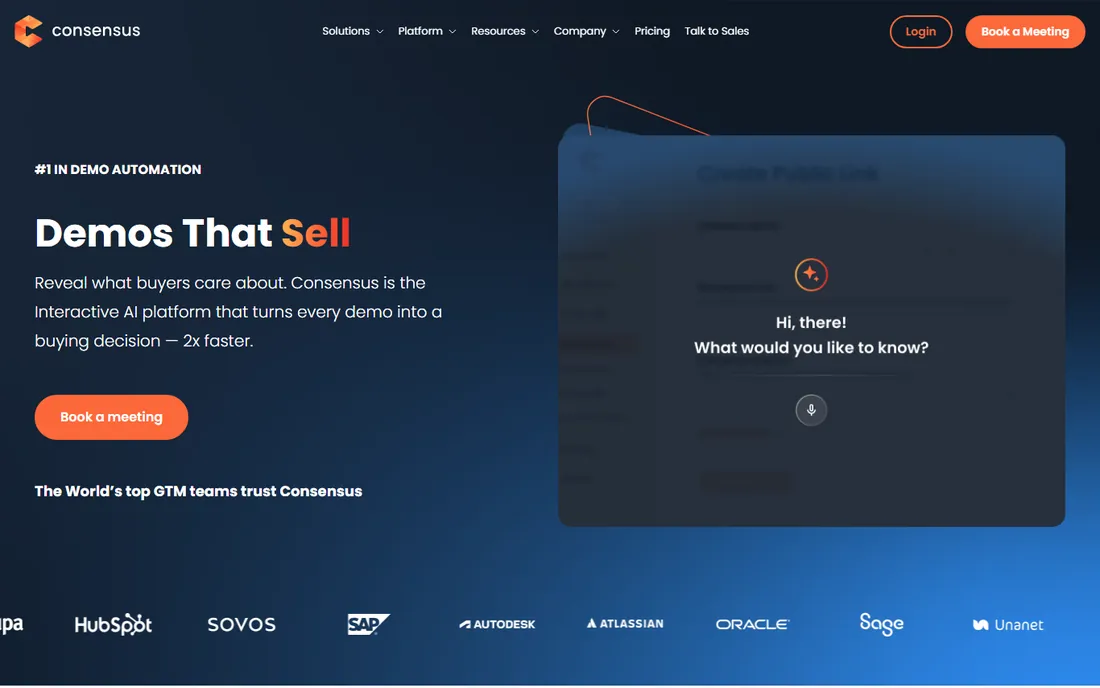
Consensus serves enterprise sales teams selling to buying committees. Its demo automation is video-led: personalized video demos that stakeholders can watch asynchronously, with engagement analytics showing which parts of the demo each buyer watched. For deals with six decision-makers who never attend the same call, that visibility is valuable.
Pricing is quote-only and annual, with third-party reports putting the starter tier around $7,200 per year for a small team. There is no free trial, which is standard for this segment but means evaluation happens through guided pilots.
The limitation is interactivity. Consensus demos are closer to personalized video than to clickable product experiences; buyers watch rather than explore. Teams that need prospects clicking through real workflows should look at Reprise or Demostack instead.
What we like- Built for complex B2B buying committees
- Buyer intent analytics
- Strong enterprise customer base
Watch out for- Quote-only pricing around $7,200 per year to start
- No free trial
- Video-led, less interactive
Starting priceSee website
Free planNo
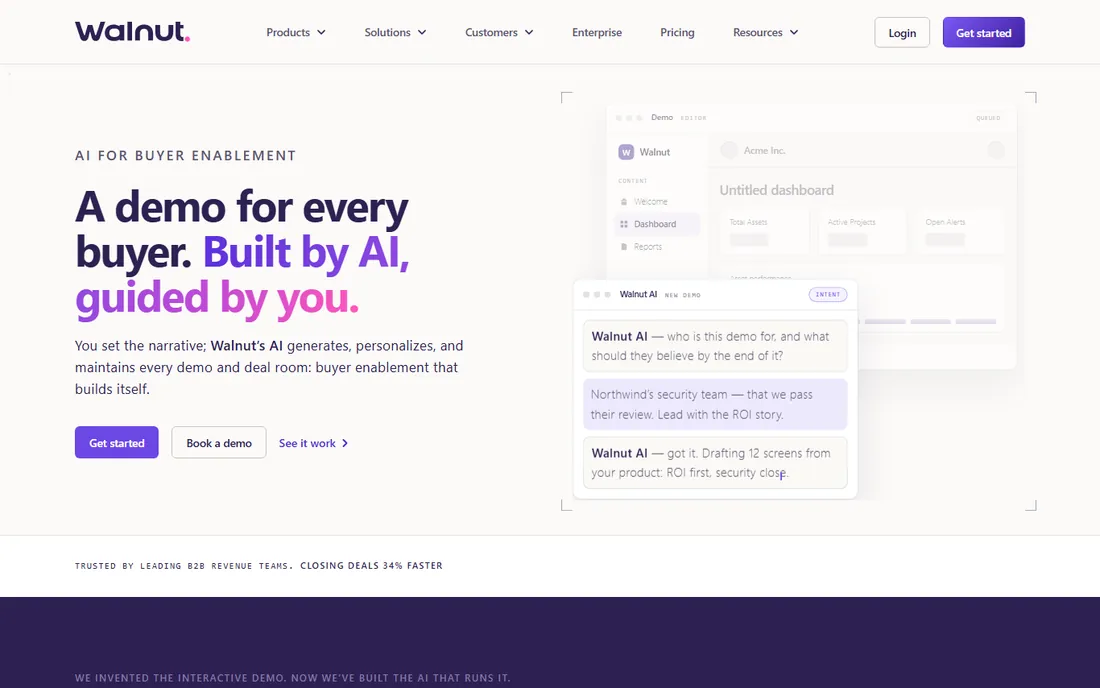
Walnut is built for sales-led organizations that personalize every demo. Reps create tailored demo experiences per account, share them in deal rooms, and track engagement through a deep Salesforce integration. The platform assumes a sales process where the demo is a crafted asset, not a self-serve tour.
Entry pricing is reported around $9,000 per year for the starter tier, with higher tiers adding sandbox capabilities and more editors. Contracts are annual, and there is no free plan, which positions Walnut firmly in the mid-market and enterprise sales segment.
The honest fit question is team structure. Walnut shines when sales engineers or AEs own demo creation for specific deals. Marketing teams wanting website tours or product teams wanting onboarding content will find it narrow. Buy it for the sales motion it was designed around.
What we like- Deep Salesforce integration
- Personalized demos per account
- Deal rooms for buyers
Watch out for- Quote-only pricing from around $9,000 per year
- Annual contracts only
- Sales-team focus
Starting priceSee website
Free planNo
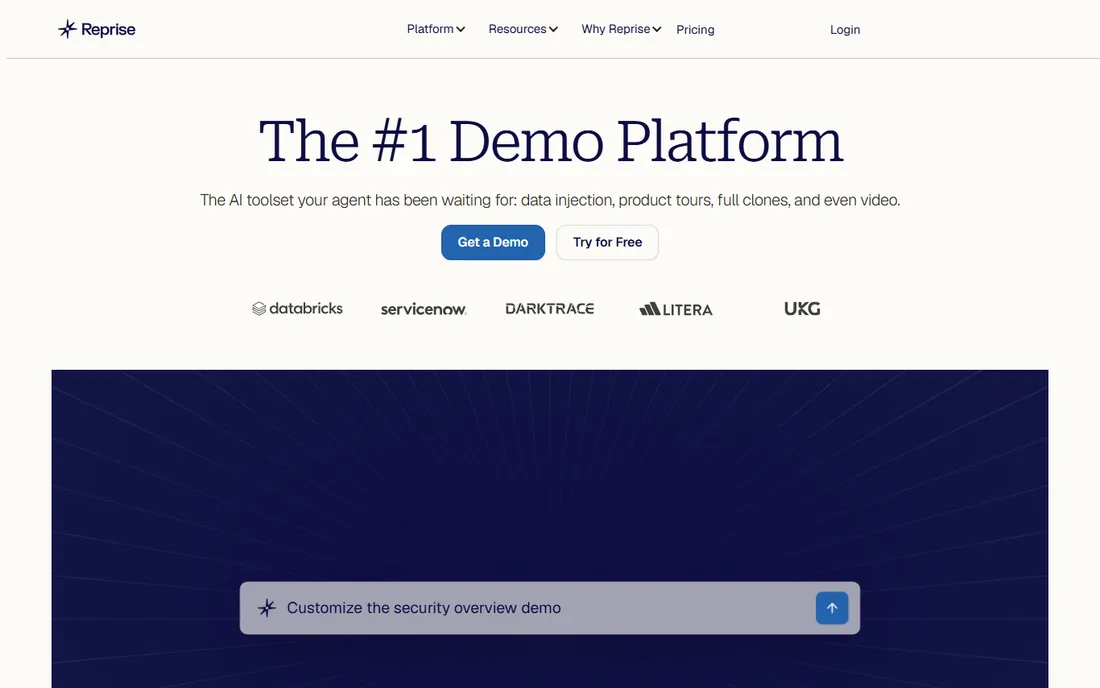
Reprise is the enterprise presales platform for companies whose products cannot be faked with screenshots. It creates guided tours, live demo environments, and fully cloned sandboxes where prospects interact with a realistic copy of the product, complete with representative data.
That capability matters for complex B2B products with deep workflows, integrations, and role-based views. Presales teams can give every prospect a stable, resettable environment without touching production systems or maintaining fragile demo tenants.
The cost and complexity match the capability. Pricing is custom and typically lands between $30,000 and $50,000 per year, evaluation is consultative rather than self-serve, and implementation takes real work. Reprise is the right answer when the demo is the product experience; it is massive overkill for a marketing tour.
What we like- Full product clones and live data environments
- Presales-grade control
- Handles complex enterprise products
Watch out for- Custom pricing around $30,000 to $50,000 per year
- Slow self-serve evaluation
- Overkill for simple tours
Screenshot demos vs HTML demos vs sandboxes
Screenshot demos are fastest to build and easiest to maintain: capture screens, add hotspots and text, publish. They look slightly less real than the product but update in minutes when the UI changes. Arcade and Guideflow lead here.
HTML demos capture the actual product interface as editable code, so the demo feels like the real application. They convert better but take more effort to build and maintain, and product UI changes can break them. Navattic pioneered this format; Storylane, Supademo, and HowdyGo all offer it at various tiers.
Sandbox demos give prospects a live-feeling environment with real data interactions. They are the most convincing and the most expensive to build and maintain, requiring ongoing environment management. Reprise and Demostack specialize here, with Supademo and Navattic offering lighter versions.
Choose the format your buyers need, not the most impressive one. Most website visitors convert fine on a good screenshot tour. Reserve HTML and sandbox demos for high-intent prospects and enterprise deals where the investment pays back.
How to pick the right tier without overpaying
Start with the free plan and publish one real demo. Measure views, click-through, and influenced pipeline for a month before spending anything. The free tiers of Supademo, Storylane, Arcade, and Guideflow are all capable enough for a genuine pilot.
Map the tier to the format, not the feature list. The most common overbuy is paying for HTML or sandbox demos when screenshot tours would convert the same traffic. Check which tier unlocks the format you actually need, because vendors consistently gate formats higher than features.
Count creators, not viewers. Most platforms charge per creator or editor while viewers are free or cheap. A 50-person sales team might need only 5 creator seats, which changes the math dramatically versus per-seat pricing. Confirm the creator definition before signing, since some vendors count anyone who personalizes a demo as a creator.
How we compared these nine
We started with the platforms that dominate the demo automation category on G2 and in buyer shortlists: Storylane, Supademo, Navattic, and Arcade, plus the value options Guideflow and HowdyGo, and the enterprise platforms Consensus, Walnut, and Reprise. We reviewed current pricing pages, product documentation, and public review summaries on G2 and vendor comparison content.
Pricing comes from vendor-published figures wherever available; vendors that sell by quote are marked as See website rather than estimated. We did not build demos in each platform; this guide reflects documentation, published pricing, and aggregated user feedback. Confirm tier features directly before purchasing, since vendors gate demo formats differently across plans.
Frequently asked questions
What is interactive demo software?
Interactive demo software lets prospects click through a guided experience of your product without a sales call or a trial signup. Formats range from screenshot-based tours to HTML captures of your real interface to full sandbox environments. The goal is letting buyers experience value on their own schedule.
How much does demo software cost?
Self-serve tools start free with paid plans from $35 to $500 per month depending on format and seats. Enterprise platforms for personalized sales demos and sandbox environments are quote-only, typically $7,000 to $50,000 or more per year. Most teams start under $100 per month and upgrade when the demo program proves its pipeline impact.
What is the difference between a product tour and an interactive demo?
A product tour usually guides users inside your actual product, often for onboarding new signups. An interactive demo is a standalone clickable experience, usually on your website, for prospects who have not signed up yet. Some tools do both, but most specialize in one side of that line.
Do interactive demos really increase conversions?
They consistently outperform static screenshots and videos for mid-funnel engagement, because prospects self-qualify by interacting. The lift depends on placement and quality: a demo buried on a resources page does little, while one on the pricing page or in outbound sequences can measurably increase demo requests and trial starts.
Can I personalize demos for specific accounts?
Yes, and it is one of the highest-ROI uses. Most platforms let you clone a demo and customize text, data, and branding per account for ABM campaigns. Walnut and Storylane are particularly strong here, with deal rooms and account-level analytics. Personalization effort should match deal size.
How do I keep demos updated when my product changes?
Screenshot demos update fastest, often in minutes per screen. HTML demos need re-capture when the UI changes significantly. Sandbox environments need ongoing maintenance. Before buying, ask how the platform detects product changes and how much manual work an update requires, because stale demos hurt more than no demos.
Sources we checked (10)
- https://www.storylane.io/pricing/
- https://www.supademo.com/pricing/
- https://www.navattic.com/pricing/
- https://www.arcade.software/pricing/
- https://www.guideflow.com/pricing/
- https://www.howdygo.com/pricing/
- https://www.goconsensus.com/pricing/
- https://www.walnut.io/pricing/
- https://www.getreprise.com/pricing/
- https://supademo.com/blog/interactive-product-demo-software
Is your product missing or out of date?
We review this list regularly. Vendors can request a listing, send updated pricing or ask about featured placement.

Shihab Mia · Founder, Rankite
Shihab has spent more than a decade helping SaaS and e-commerce brands grow through search. He writes Rankite's software buying guides from pricing pages, documentation and public user reviews. More about Shihab.