How we make this list: we compare pricing pages, product documentation and public user reviews. Rankite is independent; if a vendor ever pays for a featured spot, that listing is clearly labeled Partner.

#1
Altova MapForce
Best for: Developers mapping complex XML, EDI, and database schemas visually
Visit altova.com
Starting priceSee website (perpetual license)
Free planNo (30-day free trial)
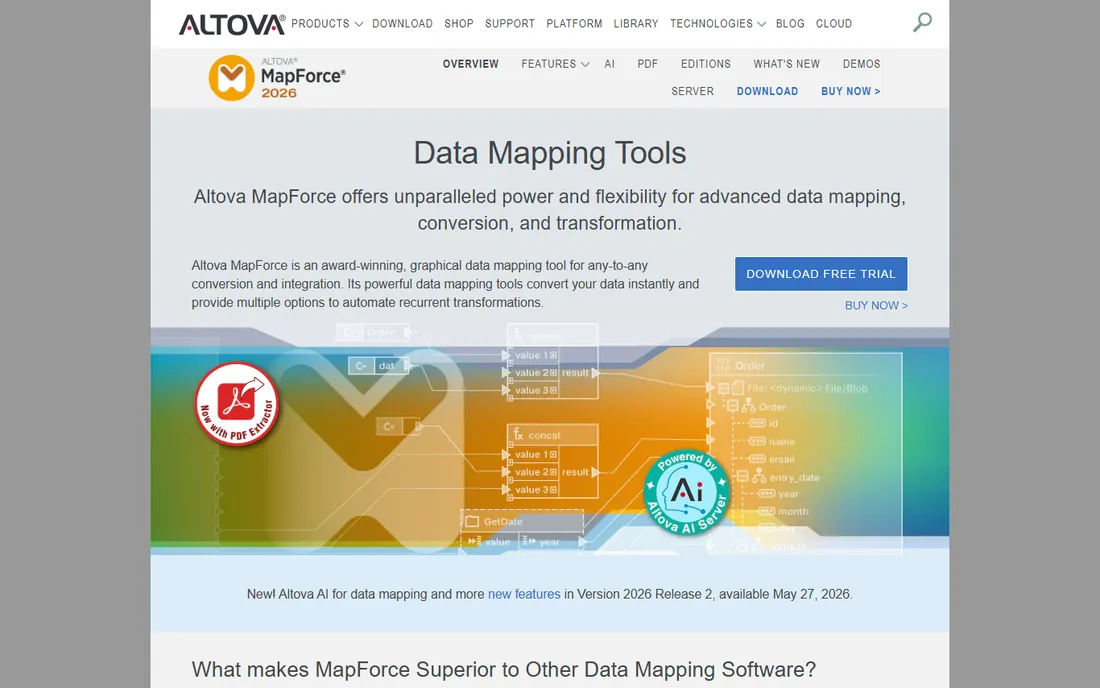
MapForce is the specialist's tool. You draw lines between source and target schemas on a canvas, add functions for reformatting and filtering, and the product either runs the transformation or generates royalty-free code (XSLT, Java, C#) to run it anywhere. For teams dealing with EDI documents, HL7 healthcare messages, or gnarly XML schemas, that visual approach beats writing parsers by hand by a wide margin.
The catch is scope. MapForce maps and transforms; it is not a scheduler, a cloud pipeline runner, or a SaaS connector library. Buy it when your problem is complex transformations between structured formats. If your problem is moving rows from a hundred SaaS apps into a warehouse, the ELT tools further down this list fit better.
What we like- True any-to-any visual mapping across XML, JSON, EDI, databases, and flat files
- Generates executable code for repeat runs
- Mature debugger for tracing transformations
Watch out for- Desktop-oriented and developer-focused, not a cloud pipeline platform
- Pricing requires a quote or reseller check

#2
CloverDX
Best for: Data engineers building governed, reusable data pipelines
Visit cloverdx.com
Starting priceSee website (custom pricing)
Free planNo
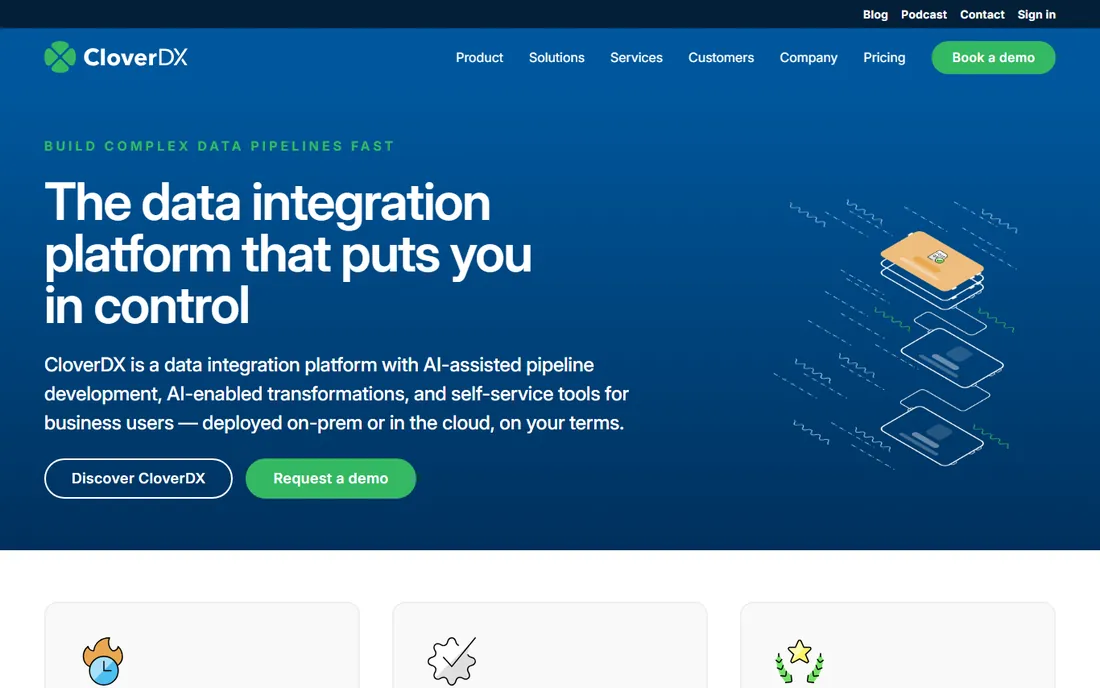
CloverDX treats data mapping as software engineering, which is exactly what it becomes at scale. Mappings are components you version, test, and reuse. The designer handles the visual work, but underneath there is a real execution engine with scheduling, monitoring, and data quality checks. Teams that outgrow hand-rolled scripts without wanting a heavyweight enterprise suite land here.
That engineering discipline is also the learning curve. A solo analyst mapping one CSV a month will find CloverDX more ceremony than necessary. A data team supporting dozens of sources with audit requirements will find the governance features are the reason to buy.
What we like- Visual pipeline designer with strong version control and reusability
- Built-in data quality and profiling
- Scales from laptop to server clusters
Watch out for- Custom pricing only
- More platform than a small team needs for simple mappings

#3
Astera
Best for: Business teams that want no-code data preparation and mapping
Visit astera.com
Starting priceSee website (custom pricing)
Free planNo (14-day free trial)
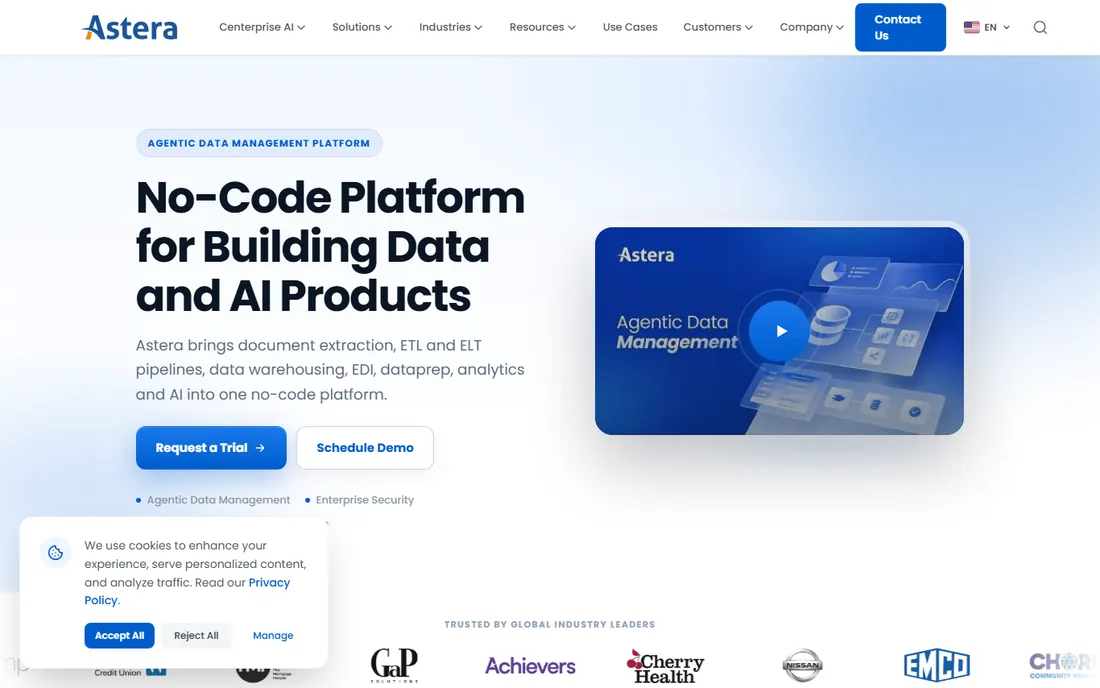
Astera aims at the gap between IT and the business: mapping and data preparation powerful enough for real work, simple enough that an operations analyst can build flows without writing code. The visual designer covers extraction, transformation, and loading, with data quality rules you can apply as part of the mapping rather than as an afterthought.
The pricing model reflects the enterprise positioning. Expect a conversation with sales rather than a self-serve checkout, and make sure the quote matches the deployment you need. For mid-size companies where business users own data prep, the no-code story is the selling point.
What we like- No-code visual designer usable by non-developers
- Strong data quality and validation features
- Handles EDI and complex formats well
Watch out for- Custom pricing only
- Enterprise sales process for larger deployments

#4
Adeptia
Best for: Enterprises automating B2B data exchange with partners
Visit adeptia.com
Starting priceSee website (custom pricing)
Free planNo
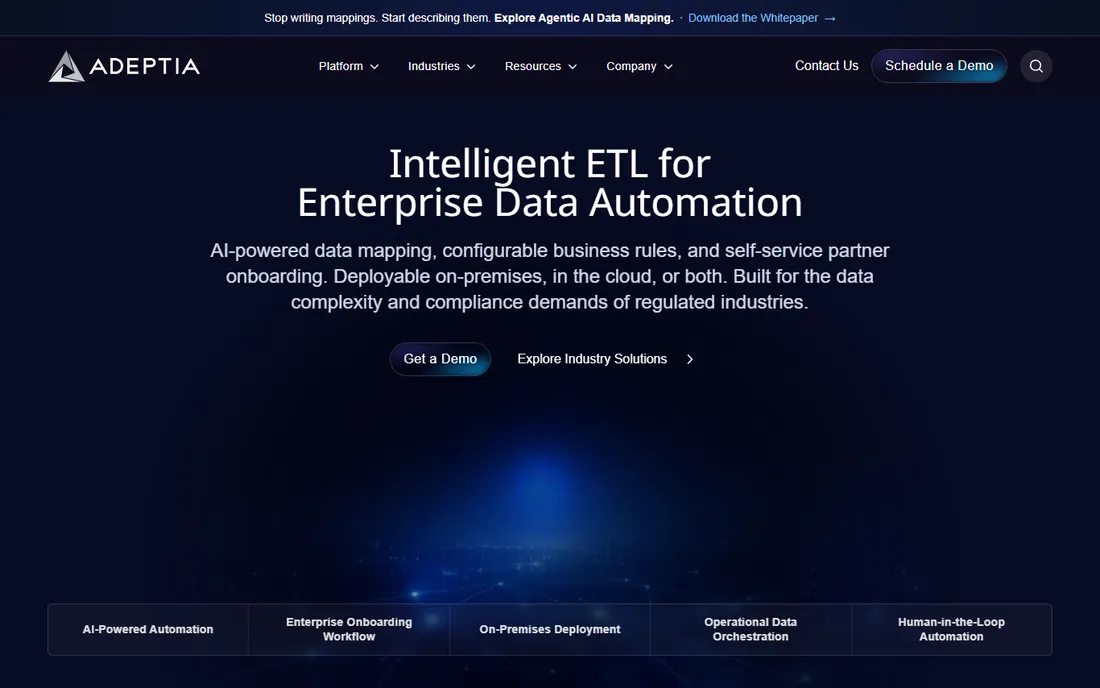
Adeptia lives in the world of partner data: suppliers sending EDI orders, customers pushing files, systems exchanging documents that must map correctly every time. Its differentiator is letting business users and even partners build and manage these connections through guided, AI-assisted mapping, instead of routing every change through IT.
If your mapping problem is internal analytics, Adeptia is the wrong shape. If it is onboarding trading partners and keeping B2B document flows running without a ticket queue, few tools are built for that job as directly.
What we like- Self-service partner onboarding for B2B data flows
- AI-assisted mapping suggestions
- Strong EDI and API integration support
Watch out for- Custom pricing only
- Geared toward B2B integration scenarios rather than general analytics pipelines

#5
Hightouch
Best for: Marketing and operations teams syncing warehouse data to SaaS tools
Visit hightouch.com
Starting priceSee website
Free planYes (free tier with first destination free)

Hightouch flips the usual direction. Instead of pulling data into a warehouse, it pushes clean warehouse data out to Salesforce, HubSpot, ad platforms, and support tools. The mapping work is defining which warehouse columns feed which SaaS fields, and the audience builder lets marketers create segments without SQL. For teams whose warehouse is the source of truth, this closes the last mile.
The prerequisite is real: no warehouse, no Hightouch. It is also a purpose-built tool, so do not expect general ETL or complex transformation logic. As a reverse ETL mapper with a free tier, though, it is the easiest way to activate warehouse data in the tools your teams actually use.
What we like- Reverse ETL from your warehouse to 200+ destinations
- Marketer-friendly audience builder
- Free tier for getting started
Watch out for- Assumes you already have a cloud data warehouse
- Advanced features move to higher tiers quickly

#6
Matillion
Best for: Cloud data warehouse teams on Snowflake, BigQuery, or Redshift
Visit matillion.com
Starting priceSee website (consumption-based pricing)
Free planYes (free to start)
Matillion is where data mapping meets cloud data engineering. The visual designer builds ELT jobs that push transformations down into Snowflake, BigQuery, or Redshift, so heavy lifting happens in the warehouse, not in a middle tier. The mapping interface is approachable, but the architecture underneath is serious.
Pricing is consumption-based, which suits variable workloads and punishes nobody for starting small. The honest limit is focus: Matillion is a data pipeline tool for warehouse-centric teams, not a SaaS-to-SaaS sync tool. If your data lives in a cloud warehouse, it is a natural fit. If it does not, look elsewhere.
What we like- Purpose-built for cloud warehouses with pushdown ELT
- Visual job designer
- Consumption pricing scales with use
Watch out for- Tied to the warehouse ecosystem
- Not a general-purpose integration platform

#7
Integrate.io
Best for: Teams that want predictable flat-rate ETL pricing
Visit integrate.io
Starting price$1,999/month
Free planNo
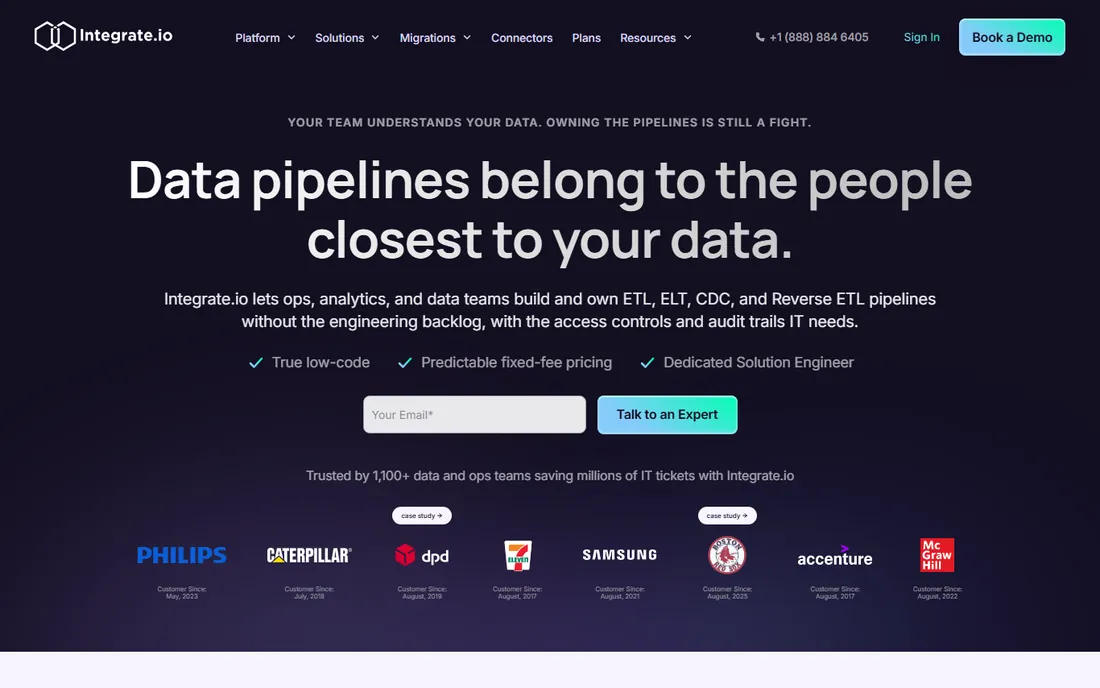
Integrate.io's headline is the pricing model: a flat $1,999 per month instead of per-row or per-connector metering. For companies moving serious volume, that predictability is worth real money, because usage-based bills are where ETL budgets go to die. The platform itself is a capable visual ETL with a broad connector catalog covering databases, warehouses, and SaaS apps.
The flat rate cuts both ways. A startup moving a few thousand rows a month will find $1,999 steep next to Hevo's free tier or Airbyte's open source. This is a tool for established businesses with real data volume who are tired of watching the meter run.
What we like- Flat monthly price with no per-row surprises
- Large connector library
- Visual pipeline builder
Watch out for- Entry price is steep for small teams
- Less suited to code-first data engineers

#8
Hevo Data
Best for: Small teams that need no-code ELT from SaaS sources into a warehouse
Visit hevodata.com
Starting price$239/month (Starter, billed annually)
Free planYes (free plan)
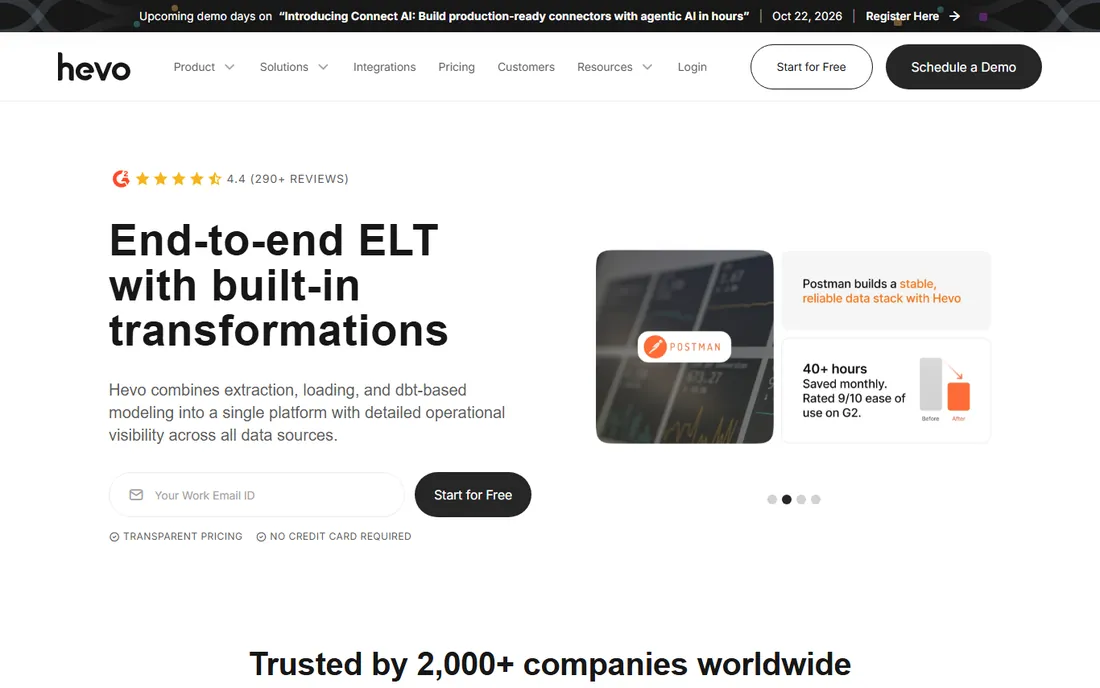
Hevo is the friendly on-ramp to ELT. Connect a SaaS app, pick a warehouse, and Hevo handles extraction, loading, and automatic schema mapping with minimal configuration. The free plan covers small volumes, and Starter at $239 per month billed annually is a reasonable step up for growing teams. For a small company that needs Stripe, Shopify, or HubSpot data in BigQuery without hiring a data engineer, it just works.
Volume is the watch item. Hevo prices on events and destinations, so costs rise as data grows, and teams with complex transformation logic will eventually want a code-friendly tool like Airbyte or Matillion. Start here for speed; graduate when the transformations outgrow the interface.
What we like- Genuinely no-code setup with 150+ connectors
- Free plan for small volumes
- Automatic schema mapping
Watch out for- Pricing scales with data volume and destinations
- Deep custom transformations are limited

#9
Airbyte
Best for: Engineers who want open-source connectors and full control
Visit airbyte.com
Starting price$10/month (Airbyte Cloud)
Free planYes (open-source self-hosted version)
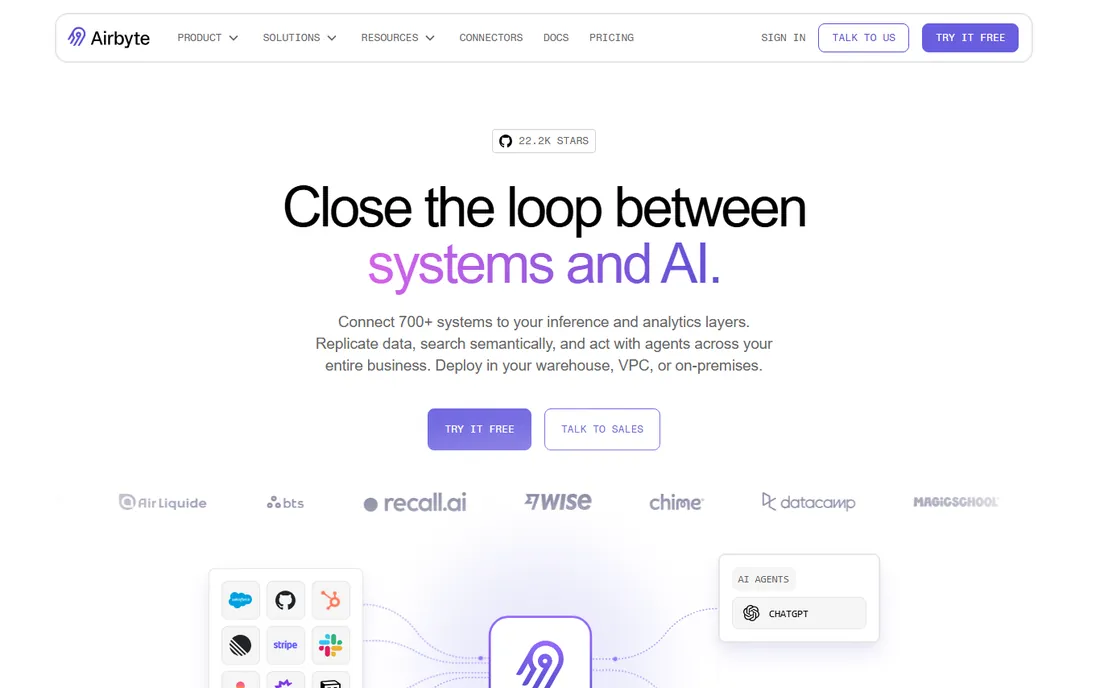
Airbyte took the open-source route: hundreds of connectors maintained by a community, a self-hosted version you run yourself, and a managed Cloud starting at $10 per month. For engineers, the appeal is control and transparency. You can read the connector code, fix it, and run everything inside your own infrastructure, which matters for regulated data.
The trade is operational. Self-hosting means upgrades, monitoring, and scaling are yours. Connector quality is uneven, so test the specific sources you need before committing. If your team has engineering bandwidth and values openness over hand-holding, Airbyte is the most flexible option on this list.
What we like- Open source with a huge community connector library
- Self-host for full control
- Cloud option from $10/month
Watch out for- Self-hosting means you own operations
- Connector quality varies across the community catalog
Starting priceSee website (custom pricing)
Free planNo
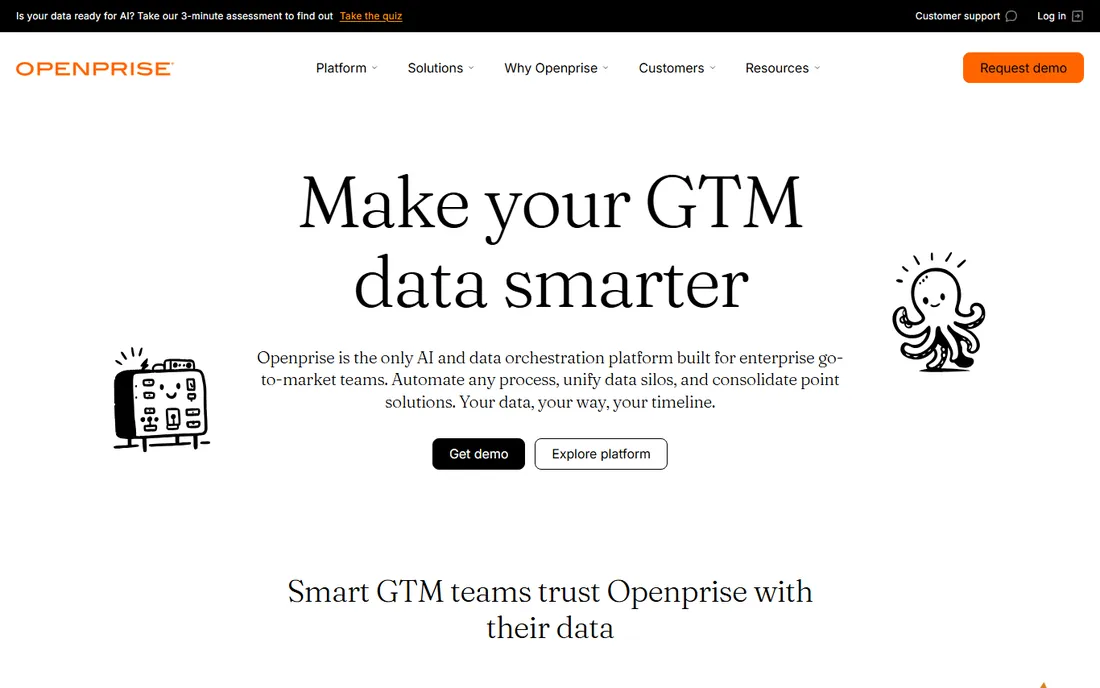
Openprise is data mapping for the revenue team. Leads come in messy from forms, lists, and enrichment vendors; Openprise dedupes, normalizes, enriches, scores, and routes them to the right owner in Salesforce or Marketo. The mapping work is field normalization and business rules, automated on schedules that marketing ops controls without engineering tickets.
Do not evaluate it as a general ETL tool. It will not move your product database into a warehouse. But if your problem is CRM data quality and lead routing, it is purpose-built in a way none of the general tools are, and RevOps teams tend to become loyal once the automation is running.
What we like- Built for RevOps: deduping, enrichment, lead routing, and data cleansing
- No-code automation for marketing ops
- Strong Salesforce and Marketo alignment
Watch out for- Custom pricing only
- Narrowly focused on go-to-market data rather than general mapping
Quick comparison
| Tool | Best for | Starting price | Free plan |
|---|
| Altova MapForce | Developers mapping complex XML, EDI, and database schemas visually | See website (perpetual license) | No (30-day free trial) |
| CloverDX | Data engineers building governed, reusable data pipelines | See website (custom pricing) | No |
| Astera | Business teams that want no-code data preparation and mapping | See website (custom pricing) | No (14-day free trial) |
| Adeptia | Enterprises automating B2B data exchange with partners | See website (custom pricing) | No |
| Hightouch | Marketing and operations teams syncing warehouse data to SaaS tools | See website | Yes (free tier with first destination free) |
| Matillion | Cloud data warehouse teams on Snowflake, BigQuery, or Redshift | See website (consumption-based pricing) | Yes (free to start) |
| Integrate.io | Teams that want predictable flat-rate ETL pricing | $1,999/month | No |
| Hevo Data | Small teams that need no-code ELT from SaaS sources into a warehouse | $239/month (Starter, billed annually) | Yes (free plan) |
| Airbyte | Engineers who want open-source connectors and full control | $10/month (Airbyte Cloud) | Yes (open-source self-hosted version) |
 Openprise Openprise | Revenue operations teams cleaning and routing CRM data | See website (custom pricing) | No |
Is your product missing or out of date?
We review this list regularly. Vendors can request a listing, send updated pricing or ask about featured placement.
Key takeaways
- Developer-led teams mapping complex formats (XML, EDI, HL7) should start with Altova MapForce; it is the most precise visual mapping tool here.
- Business teams that want no-code mapping should compare Astera and Hevo Data, with free or trial options to test before buying.
- If your warehouse is already the source of truth, Hightouch (warehouse to SaaS) and Matillion (warehouse ELT) cover the two directions that matter.
- Open-source fans get Airbyte; predictable-budget buyers get Integrate.io's flat $1,999 per month.
- RevOps-specific data quality belongs to Openprise, which is narrower but deeper than any general tool for CRM data.
We defined data mapping software as tools whose core job includes defining how fields move and transform between systems, and we excluded general integration platforms that treat mapping as a side feature. For each candidate we opened the vendor's homepage to confirm the current product name and URL, checked pricing against the vendor's own pricing page or vendor-published materials, and compared mapping depth, connector coverage, and team fit against practitioner reviews. Where pricing could not be verified on the vendor's own materials we wrote "See website" rather than guessing.
What to check before you buy
Start by naming your mapper. Are you a developer transforming EDI documents, an analyst loading SaaS data into a warehouse, a marketer activating warehouse segments, or a RevOps lead cleaning CRM records? Each of those is a different tool on this list, and buying the wrong shape is the most expensive mistake.
Then test with your actual data, not the demo dataset. Mapping tools behave differently on messy real-world fields: inconsistent dates, nested JSON, duplicate records, encoding quirks. Run a trial on a representative sample and check the output row by row. Ask how the tool handles schema changes in the source, because sources change constantly and brittle mappings break silently.
Finally, price the growth path. Volume-based pricing (Hevo, Matillion) rewards starting small and punishes success; flat pricing (Integrate.io) does the opposite. Model your data volume a year from now and compare totals, not entry prices.
Data mapping vs. data integration: where the line sits
Data mapping and data integration overlap, but they are not the same purchase. Integration platforms move data between systems and happen to include mapping screens. Mapping tools start from the transformation itself: the schema design, the field logic, the data quality rules.
In practice, the line is about who owns the work. If engineers own pipelines end to end, a mapping-first tool like MapForce or CloverDX gives them precision. If business users own the logic, a no-code mapper like Astera or Hevo keeps them independent. If the warehouse owns the truth, reverse ETL like Hightouch finishes the job. Buy the tool that matches the owner, and the integration part usually takes care of itself.
Frequently asked questions
Sources we checked (10)
- https://www.altova.com/mapforce
- https://www.cloverdx.com
- https://www.astera.com
- https://www.adeptia.com
- https://www.hightouch.com
- https://www.matillion.com
- https://www.integrate.io
- https://hevodata.com/pricing
- https://www.airbyte.com
- https://www.openprisetech.com
Is your product missing or out of date?
We review this list regularly. Vendors can request a listing, send updated pricing or ask about featured placement.

Shihab Mia · Founder, Rankite
Shihab has spent more than a decade helping SaaS and e-commerce brands grow through search. He writes Rankite's software buying guides from pricing pages, documentation and public user reviews. More about Shihab.