How we make this list: we compare pricing pages, product documentation and public user reviews. Rankite is independent; if a vendor ever pays for a featured spot, that listing is clearly labeled Partner.
Key takeaways
- Enterpret, Chattermill, and Thematic are the AI-first picks for analyzing feedback at scale, with theme detection across dozens of channels.
- Qualtrics and Medallia are enterprise experience management suites; choose them when surveys, operations, and closed-loop action need one platform.
- Dovetail ($30/month), Productboard ($19/maker/month), and Survicate (free plan available) publish pricing and are the easiest to start without a sales call.
- UserTesting answers a different question, what users do with your product, through moderated and unmoderated human testing rather than feedback analysis.
Quick comparison
| Tool | Best for | Starting price | Free plan |
|---|
 Enterpret Enterpret | Product and CX teams that need theme-level analysis tied to revenue context | See website | No |
 Qualtrics Qualtrics | Enterprises running large-scale experience management programs | See website | Free trial |
 Medallia Medallia | Enterprises wanting surveys, reviews, and social feedback in one CX view | See website | No |
 Thematic Thematic | Insights teams that want hands-on control over AI-generated themes | See website | No |
 Dovetail Dovetail | UX and product teams building a searchable home for all customer research | $30/month | Free trial |
 Productboard Productboard | Product teams that want feedback flowing directly into prioritization and roadmaps | $19/maker/month (Plus, billed annually) | Free trial |
 Chattermill Chattermill | Enterprise CX teams running mature multi-region feedback programs | See website | No |
 Survicate Survicate | Teams that want multi-channel surveys with AI analysis and transparent pricing | Free plan; paid from $56/month (Growth, billed annually) | Free trial |
 UserTesting UserTesting | Teams that need to watch real users interact with their product | See website | No |
Is your product missing or out of date?
We review this list regularly. Vendors can request a listing, send updated pricing or ask about featured placement.
The best customer insights software
#1
Enterpret
Best for: Product and CX teams that need theme-level analysis tied to revenue context
Visit enterpret.com
Starting priceSee website
Free planNo
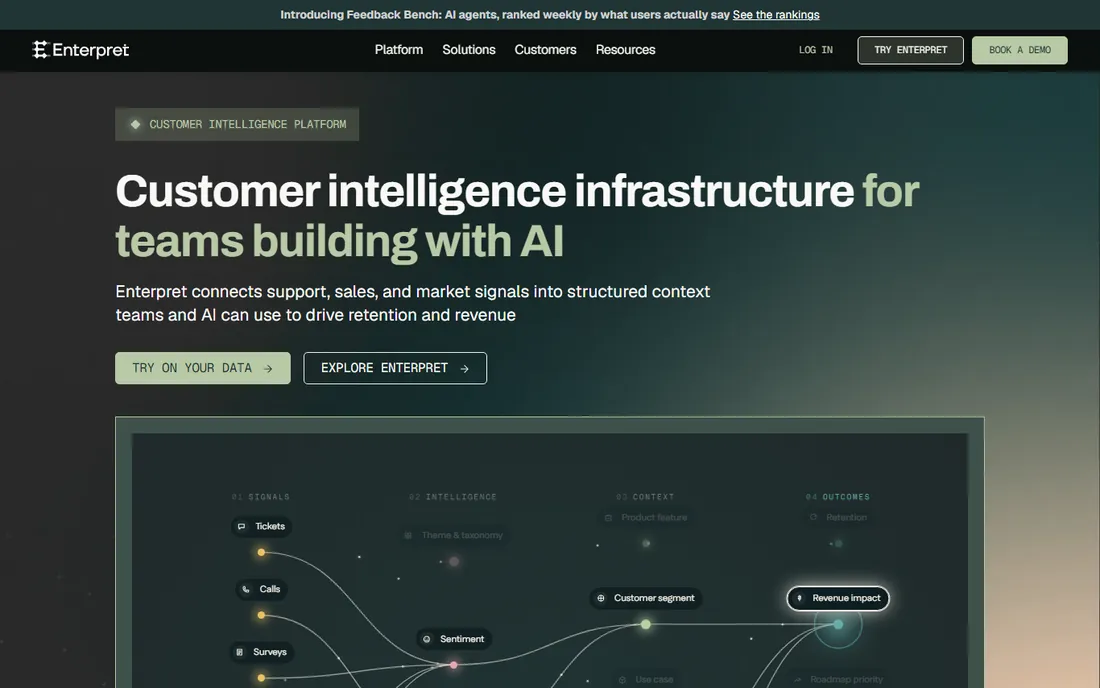
Enterpret is the AI-native answer to the feedback pile. It unifies feedback from more than 50 sources, support tickets, call transcripts, reviews, surveys, community posts, even TikTok comments, and auto-tags it into themes using an adaptive taxonomy that learns from your data. The differentiator is the "reasons" layer: instead of just sentiment polarity, the model identifies why the customer gave the feedback, like "unable to add members to account," at a granularity human tagging rarely reaches.
The customer context graph then ties every theme to the account, segment, and revenue behind it, so a rising theme can be filtered to the enterprise accounts approaching renewal. Customers include Notion, whose product ops team uses it as a second brain for trend detection. Pricing is usage-based and quoted through sales. The honest boundary: Enterpret analyzes feedback brilliantly but doesn't run your survey program. Pair it with a survey tool if you need both.
What we like- Adaptive taxonomy learns themes from your data instead of predefined categories
- Customer context graph ties every theme to account, segment, and ARR
- 50+ feedback sources unified
Watch out for- Usage-based pricing through sales
- Built for analysis, not for running survey programs
#2
Qualtrics
Best for: Enterprises running large-scale experience management programs
Visit qualtrics.com
Starting priceSee website
Free planFree trial
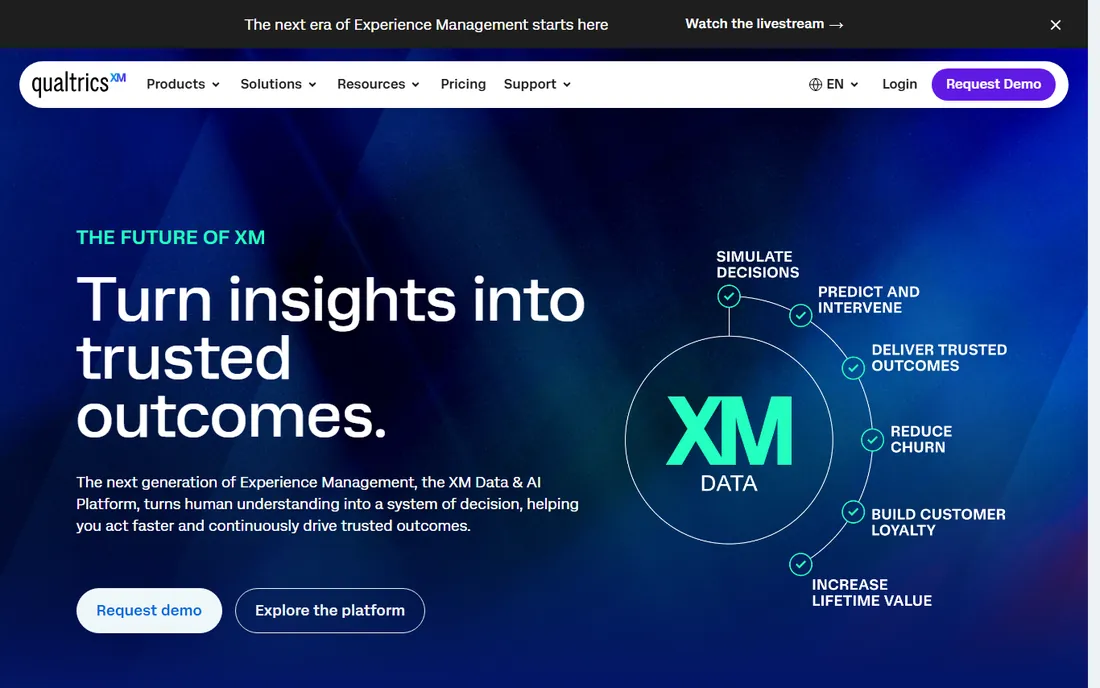
Qualtrics is the enterprise standard for experience management: surveys, research, and analytics across customer, employee, product, and brand experience. The survey engine is the deepest here, with expert-designed templates, sophisticated logic, and AI-powered analysis, plus the customization large organizations demand. When the program spans regions, business units, and millions of responses, Qualtrics is built for that scale.
The tradeoffs are well known. Pricing is quote-based and climbs with advanced features, and the platform's depth comes with a steeper learning curve than tools like Survicate. There's a free plan with limited capabilities for evaluation. Choose Qualtrics when experience management is a company-wide program with dedicated owners. For a product team that just needs to understand feedback themes, the AI-first tools above deliver faster.
What we like- Deepest survey and research toolkit in the category
- Pre-built templates designed by industry experts
- Enterprise-grade security and customization
Watch out for- Pricing is quote-based and high for advanced features
- Steeper learning curve than simpler tools
#3
Medallia
Best for: Enterprises wanting surveys, reviews, and social feedback in one CX view
Visit medallia.com
Starting priceSee website
Free planNo
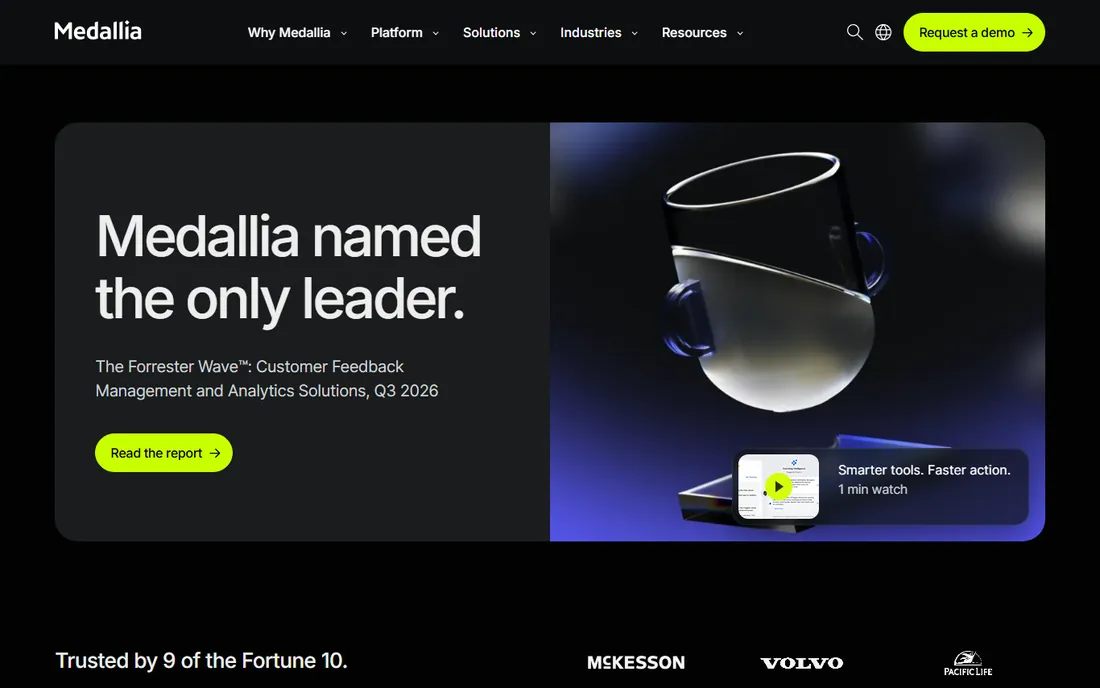
Medallia's pitch is the unified view: surveys plus in-app feedback plus online reviews plus social mentions, analyzed together to show customer sentiment as one picture. Teams use it to aggregate third-party review data alongside solicited feedback, which matters in industries where Google and app-store reviews drive buying decisions. Survey templates speed up program setup, and the platform pushes insights toward operational action, not just dashboards.
Like Qualtrics, it's an enterprise sale with custom pricing and real implementation weight. Smaller teams will find it heavy. The fit is the large organization that needs one CX system of record spanning every feedback channel, with the workflow muscle to act on what it finds. For pure feedback theme analysis, the AI-native tools are leaner.
What we like- Unifies surveys, in-app feedback, online reviews, and social mentions
- Strong operational closed-loop workflows
- Mobile apps for frontline access
Watch out for- Custom pricing through sales
- Enterprise complexity for smaller teams
#4
Thematic
Best for: Insights teams that want hands-on control over AI-generated themes
Visit getthematic.com
Starting priceSee website
Free planNo
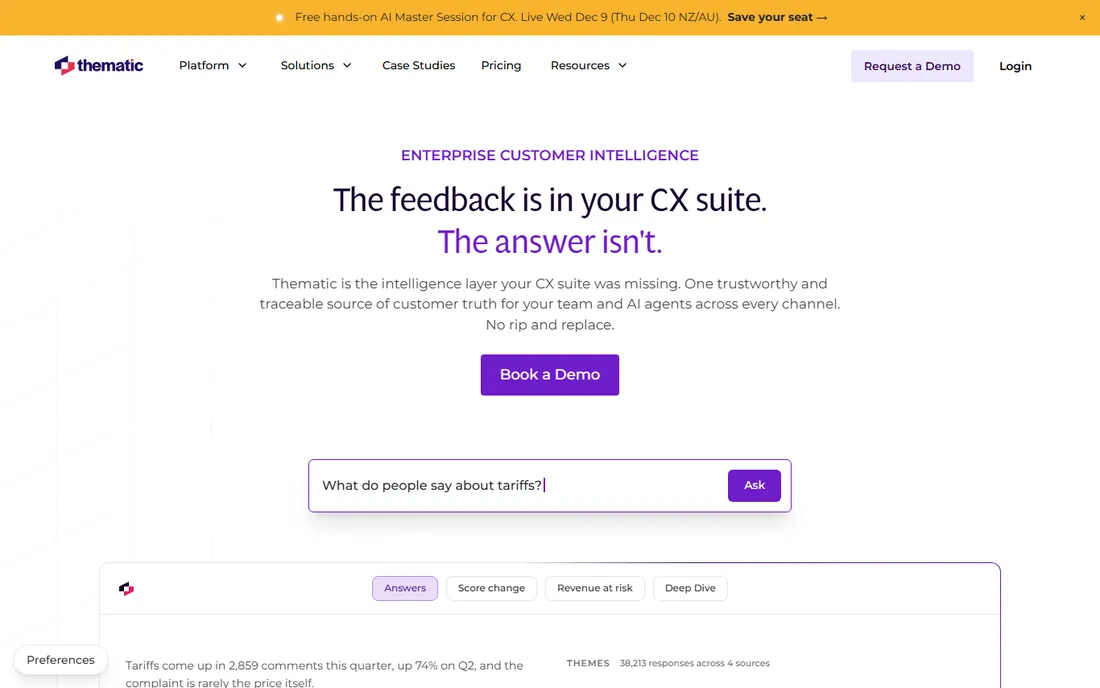
Thematic takes a different philosophical stance from Enterpret: AI proposes the themes, but analysts curate and edit them. For research and insights teams that need to defend their taxonomy to stakeholders, that control matters. The platform turns open-ended feedback into structured themes with sentiment and satisfaction drivers, and the team can reshape themes as understanding evolves.
The heritage is survey-first, so it's strongest on open-ended survey responses. Cross-channel signals from support tickets and call transcripts take more setup than with Enterpret or Chattermill. Pricing is quote-based through sales. Pick Thematic when theme quality and analyst control are the priority, and your team has the research maturity to curate. Pick the adaptive-taxonomy tools when you want the system to discover themes on its own.
What we like- Editable, analyst-curated themes rather than black-box tagging
- Strong on open-ended survey feedback
- Transparent about how themes are shaped
Watch out for- Survey-first heritage means tickets and calls need more setup
- Quote-based pricing
#5
Dovetail
Best for: UX and product teams building a searchable home for all customer research
Visit dovetail.com
Starting price$30/month
Free planFree trial
Dovetail is where customer research lives. Interviews, survey responses, support feedback, and notes go into one searchable repository, and AI features summarize, cluster by theme, and surface patterns across it all. Highlight reels stitch video clips into shareable evidence, and templates standardize research practice across the team. For product and UX teams, it's the difference between research that dies in slide decks and research anyone can query.
Pricing is refreshingly public: plans start at $30 per month, with a free plan for limited use and a 14-day trial. The limitations: quantitative analysis is thin compared to product analytics tools, and very large organizations may need the enterprise tier for governance. For teams whose insight work is qualitative, interviews, open-ended feedback, usability notes, Dovetail is the most loved repository in the category.
What we like- Centralized repository for interviews, surveys, and feedback with AI summarization
- Magic Search and thematic clustering
- Published pricing from $30/month
Watch out for- Limited quantitative analysis
- Can need scaling care for very large organizations
#6
Productboard
Best for: Product teams that want feedback flowing directly into prioritization and roadmaps
Visit productboard.com
Starting price$19/maker/month (Plus, billed annually)
Free planFree trial
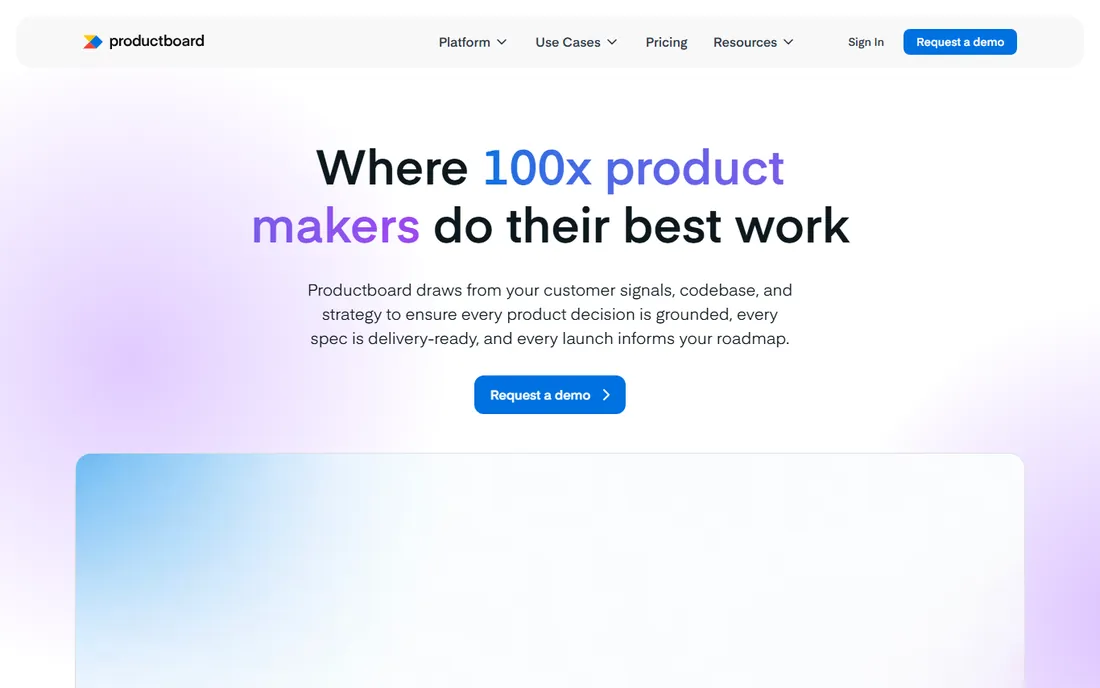
Productboard closes the gap between "customers said" and "we're building." Feedback notes from every channel land in one repository, get AI-summarized with sentiment and trending topics, and link directly to features, prioritization criteria, and roadmaps. When a PM asks why something is on the roadmap, the evidence trail is right there. Contributors across the company can submit feedback free; only makers, the people shaping the product, are paid seats.
Pricing is public: a free plan with 500 feedback notes and real functionality, Plus at $19 per maker per month billed annually, Business at $59, and Enterprise custom. The watch-outs: per-maker pricing scales with team size, and AI features consume credits with monthly allowances per tier. For product-led organizations, it's the best tool here at turning insight into shipped decisions.
What we like- Feedback notes feed directly into feature prioritization and roadmaps
- AI summaries, sentiment analysis, and trend detection
- Free plan with real functionality
Watch out for- Per-maker pricing adds up as the team grows
- AI features run on a credit system
#7
Chattermill
Best for: Enterprise CX teams running mature multi-region feedback programs
Visit chattermill.com
Starting priceSee website
Free planNo
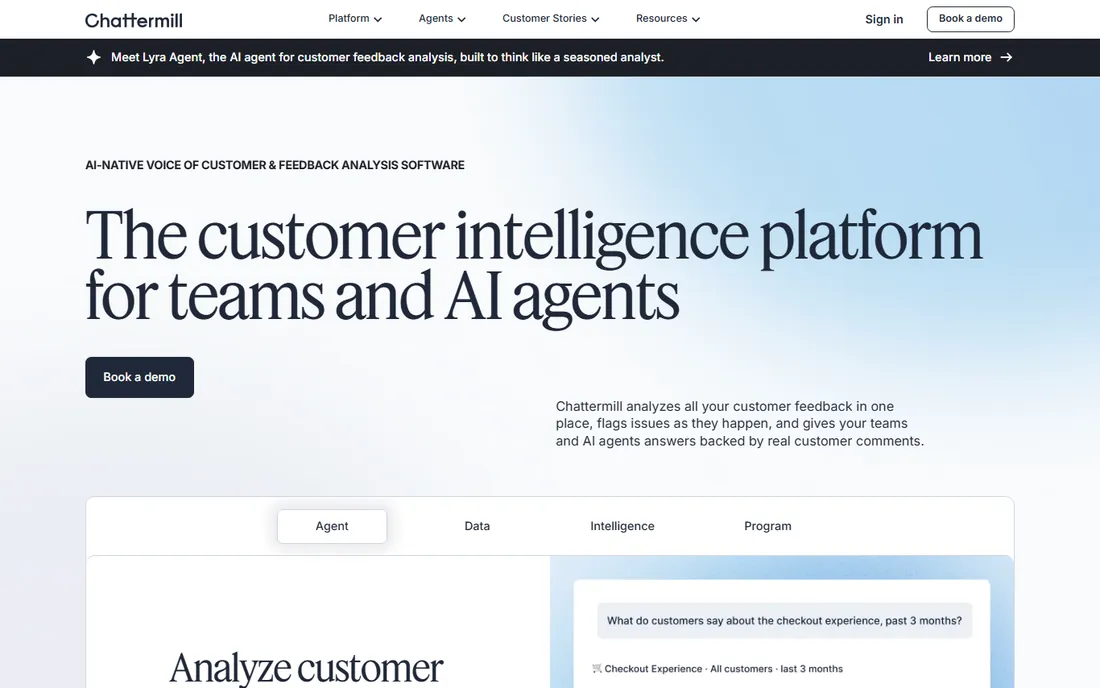
Chattermill applies deep-learning text analysis across the full feedback estate: surveys, support tickets, reviews, and conversations. Its strength is driver analysis, connecting themes to movement in NPS and CSAT so CX teams can show which issues actually move the score. For established insights teams running cross-channel programs across regions, that analytical depth is the selling point.
It's an enterprise product with enterprise pricing through sales, and smaller teams will find it more than they need. The fit is the mature CX operation that has outgrown survey-only analysis and needs every channel unified with rigorous theme-to-metric linkage. For AI-first theme discovery with less implementation, compare Enterpret.
What we like- Deep-learning analysis across surveys, tickets, reviews, and support conversations
- Strong driver analysis tying themes to NPS and CSAT movement
- Built for scale
Watch out for- Enterprise pricing and sales process
- More platform than smaller teams need
#8
Survicate
Best for: Teams that want multi-channel surveys with AI analysis and transparent pricing
Visit survicate.com
Starting priceFree plan; paid from $56/month (Growth, billed annually)
Free planFree trial
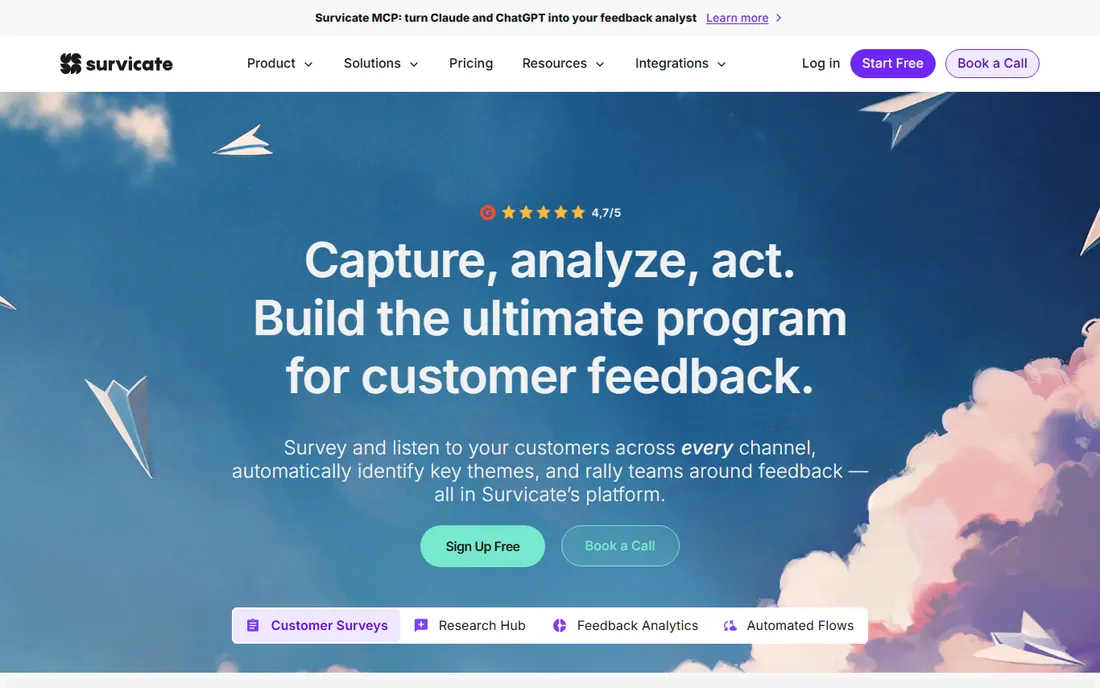
Survicate is the survey tool that grew into insights. It runs surveys across email, link, web, in-product, and mobile SDKs, then applies AI tagging, sentiment analysis, and a Research Hub that pulls in feedback from other sources. The Research Assistant answers questions about your feedback data directly. For teams that need both collection and analysis without an enterprise platform, it's a strong middle ground.
Pricing is fully public: a free plan with 25 responses per month, Starter at $89, Growth from $56 per month billed annually with unlimited surveys and AI insights, Pro from $349, and Enterprise from $569. The constraint is volume: tiers scale on responses, so high-traffic properties should model their usage. For everyone else, it's the most transparent way to buy survey-driven insights.
What we like- Surveys across email, web, in-product, and mobile with AI tagging and sentiment analysis
- Free plan with 25 responses/month
- Clear published pricing
Watch out for- Response-volume limits define the tiers
- Advanced enterprise features need Pro or Enterprise
#9
UserTesting
Best for: Teams that need to watch real users interact with their product
Visit usertesting.com
Starting priceSee website
Free planNo
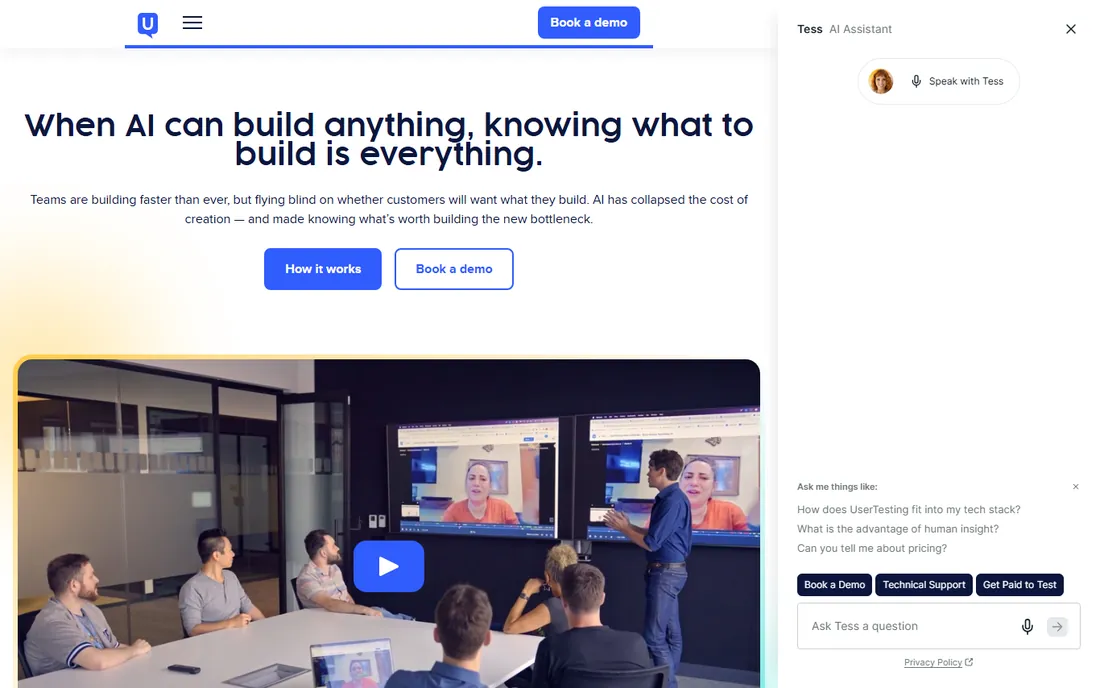
UserTesting belongs on this list as the complement to everything above. Instead of analyzing feedback you've already collected, it generates new insight: real users attempting real tasks on your product, recorded and narrated. Moderated and unmoderated formats cover everything from prototype validation to live-site usability, and the turnaround can be hours. Nothing replaces watching a user struggle with the flow your analytics said was fine.
The tradeoffs: it's a research method, not a feedback repository, so it won't tell you what ten thousand tickets are saying. Pricing is quote-based through sales. Use UserTesting to answer "what do users actually do and why," and pair it with a feedback intelligence platform for the always-on signal. Teams that only do one or the other are seeing half the picture.
What we like- Moderated and unmoderated tests with real users
- Video plus survey plus task-based methods
- The fastest way to see usability problems
Watch out for- Quote-based pricing
- Answers "what do users do," not "what does all our feedback say"
Survey data vs feedback data: know what you're buying
These tools collect two fundamentally different things, and the buying mistake is confusing them. Survey data is answers to questions you asked: NPS, CSAT, structured product feedback. It's clean, comparable, and limited to what you thought to ask. Survicate, Qualtrics, and Medallia live here.
Feedback data is what customers say unprompted: support tickets, reviews, community posts, call transcripts. It's messy, voluminous, and full of things you never thought to ask about. Enterpret, Chattermill, and Thematic live here, and AI is what makes it analyzable at all.
Most mature teams need both. Surveys validate a hypothesis; unprompted feedback discovers the ones you didn't have. Positioning and messaging insight, in particular, comes from the words customers use on their own, not from your multiple-choice options. When vendors blur the two, ask which one their AI was actually built to analyze.
Pricing: the two models
Customer insights pricing splits into seat-based and volume-based, and the difference decides your budget conversation. Dovetail ($30/month), Productboard ($19/maker/month), and Survicate (from $56/month) charge for access: predictable, scales with team size. Enterpret charges on feedback volume: scales with how much customers talk, which is fairer but harder to forecast. Qualtrics, Medallia, Thematic, Chattermill, and UserTesting quote custom.
Watch the metering. Productboard's AI runs on monthly credits per tier, Survicate's tiers hinge on response counts, and Enterpret's usage pricing needs a volume estimate before sales can quote. Get the overage terms in writing for all three. And confirm data retention and export: your historical feedback is an asset, and leaving a platform shouldn't mean losing it.
How we chose
We focused on software whose core job is turning customer feedback into usable insight: AI theme analysis, experience management, research repositories, and user testing. Every product above is live today and serves product, CX, or research teams at scale. Pricing comes from each vendor's own published materials where available; several enterprise vendors sell through quotes, so we say "see website" rather than repeating third-party estimates. Strengths and weaknesses draw on vendor documentation and public product information. We did not run research programs on these platforms; this guide reflects documented capabilities, the same evidence a buyer would gather before requesting demos or trials.
Frequently asked questions
What is customer insights software?
It's software that collects customer feedback and turns it into structured insight. That includes AI platforms that auto-tag themes across support tickets and reviews (Enterpret, Chattermill, Thematic), experience management suites that run survey programs (Qualtrics, Medallia), research repositories (Dovetail), product feedback tools (Productboard), survey platforms (Survicate), and user testing (UserTesting). The common job: know what customers think, at scale, without reading everything manually.
What's the difference between customer insights and customer feedback software?
Feedback software collects the raw material: surveys, reviews, tickets. Insights software analyzes it into themes, trends, and drivers. Many tools do both now, Survicate collects and analyzes, Enterpret analyzes from any source, but the distinction matters when buying. If you already collect feedback everywhere, you need analysis. If you're starting from zero, you need collection first.
Do we need AI for feedback analysis?
At any real volume, yes. A human can read hundreds of responses; nobody reads tens of thousands of tickets and reviews. AI theme detection, sentiment analysis, and summarization are what make unprompted feedback analyzable. The question isn't whether to use AI but which kind: adaptive taxonomies that discover themes (Enterpret), analyst-curated themes (Thematic), or driver analysis tied to metrics (Chattermill).
How much does customer insights software cost?
Published entry points: Dovetail from $30/month, Productboard from $19/maker/month, Survicate free to $56/month and up. The enterprise platforms (Qualtrics, Medallia, Thematic, Chattermill, UserTesting) and Enterpret are quote-based, priced on seats, volume, or program scope. Budget for the analysis need, not just the collection: the AI tier is usually where the price steps up.
Should we buy one platform or combine tools?
Most teams combine. A common stack: Survicate or Qualtrics for surveys, Enterpret or Chattermill for cross-channel theme analysis, Dovetail for research storage, Productboard for product decisions, UserTesting for usability validation. Overlap is fine; gaps are the problem. Map your feedback sources first, then buy to cover analysis of all of them.
Sources we checked (4)
- https://dovetail.com/ux/customer-experience-software/
- https://www.productboard.com/pricing/?ref=saaspo.com
- https://survicate.com/blog/surveymonkey-alternatives/
- https://www.enterpret.com/integrations/slack-inbound
Is your product missing or out of date?
We review this list regularly. Vendors can request a listing, send updated pricing or ask about featured placement.

Shihab Mia · Founder, Rankite
Shihab has spent more than a decade helping SaaS and e-commerce brands grow through search. He writes Rankite's software buying guides from pricing pages, documentation and public user reviews. More about Shihab.