How we make this list: we compare pricing pages, product documentation and public user reviews. Rankite is independent; if a vendor ever pays for a featured spot, that listing is clearly labeled Partner.
Key takeaways
- Gainsight and ChurnZero are the two enterprise anchors: Gainsight wins on depth and ecosystem, ChurnZero on a friendlier interface for mid-market teams.
- Totango has rebranded to Odie after merging with Catalyst, and Planhat has pivoted toward an AI agent called Pi, so check current positioning before you buy.
- Vitally and Custify are the strongest picks for small to mid-sized B2B SaaS teams that want health scoring and playbooks without a six-month implementation.
- ClientSuccess suits teams that prize usability and fast adoption, while EverAfter takes a different angle: customer-facing hubs and digital journeys rather than internal dashboards.
Quick comparison
| Tool | Best for | Starting price | Free plan |
|---|
 Gainsight Gainsight | large enterprise customer success organizations | See website | No |
 ChurnZero ChurnZero | mid-market teams focused on renewals and expansion | See website | No |
 Totango (now Odie) Totango (now Odie) | teams evaluating the combined Totango and Catalyst platform | See website | No |
 Vitally Vitally | B2B SaaS teams that want to go live in weeks | See website | Free trial |
 Planhat Planhat | data-first teams that want flexibility | See website | No |
 Custify Custify | mid-market B2B SaaS with lean CS teams | See website | No |
 ClientSuccess ClientSuccess | usability-first customer success teams | See website | No |
 EverAfter EverAfter | digital and scaled customer success programs | See website | No |
Is your product missing or out of date?
We review this list regularly. Vendors can request a listing, send updated pricing or ask about featured placement.
The best csm software
Which customer success platform actually fits a team your size, instead of one built for a company ten times bigger? That is the question that matters, because CSM software ranges from heavyweight enterprise suites to lightweight tools a three-person team can run. The eight options below cover both ends and the middle, with honest notes on where each one fits and where it does not.
Starting priceSee website
Free planNo
Gainsight is the name every enterprise CS leader already knows. Its platform covers health scoring, churn prediction, journey orchestration, and success planning, with an AI layer that powers automated alerts and "Calls to Action" when an account needs attention. The health score models are highly customizable, which matters when your definition of a healthy account is genuinely complicated.
The trade-off is the investment required. Pricing is quote-based and implementations commonly run three to six months, so Gainsight makes sense when you have a dedicated CS operations function to feed it. For a team of three CSMs managing a few hundred accounts, most of that power sits unused.
What we like- Most complete feature set in the category
- Deep Salesforce integration
- Large partner and integration ecosystem
Watch out for- Enterprise pricing with long implementations
- Heavy product that can be overkill for smaller teams
Starting priceSee website
Free planNo

ChurnZero positions itself as the customer success platform for customer growth, and renewals are where it earns that claim. The playbook builder is one of the better ones in the category, and reviewers consistently call out the interface as easier to learn than the legacy enterprise tools. If your CS org lives and dies by expansion revenue, the workflow design reflects that.
It still plays in the enterprise pricing tier, with custom quotes rather than published plans. Teams that need deep platform customization or a massive integration marketplace may find Gainsight's ecosystem broader, but for mid-market SaaS companies ChurnZero is often the more practical choice.
What we like- Strong playbook builder and renewal workflows
- Praised for usability
- 60+ integrations
Watch out for- Custom quote pricing with no public rates
- Less ecosystem depth than Gainsight
#3
Totango (now Odie)
Best for: teams evaluating the combined Totango and Catalyst platform
Visit totango.com
Starting priceSee website
Free planNo
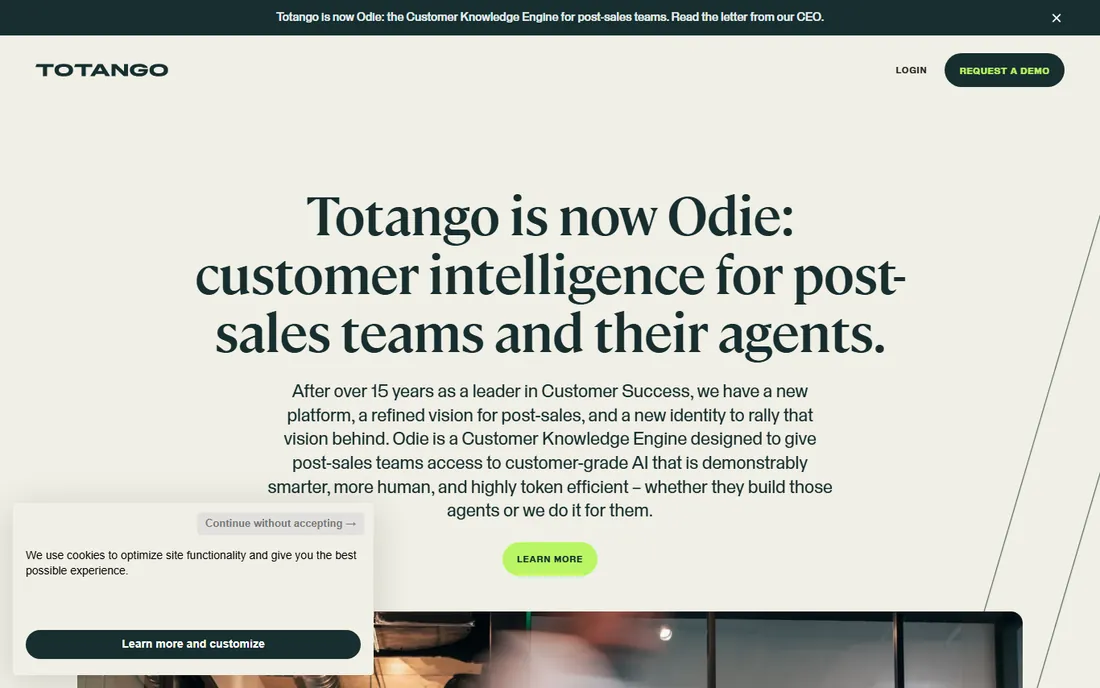
Totango's homepage now announces that it is becoming Odie, following its merger with Catalyst, the customer success platform that raised over $45 million before the combination. That history matters: you are buying into a merged product line, and the roadmap reflects both companies' strengths in health scoring and CS workflows.
Evaluate it on what it is today rather than old Totango reviews. Ask for a demo of the current Odie experience, confirm which Catalyst capabilities are included in your tier, and get the migration story in writing if you are an existing customer of either product.
What we like- Long-established CS platform now merged with Catalyst
- Composable approach to customer data
Watch out for- Rebrand to Odie is still settling, which may confuse buyers and slow third-party coverage
#4
Vitally
Best for: B2B SaaS teams that want to go live in weeks
Visit vitally.io
Starting priceSee website
Free planFree trial
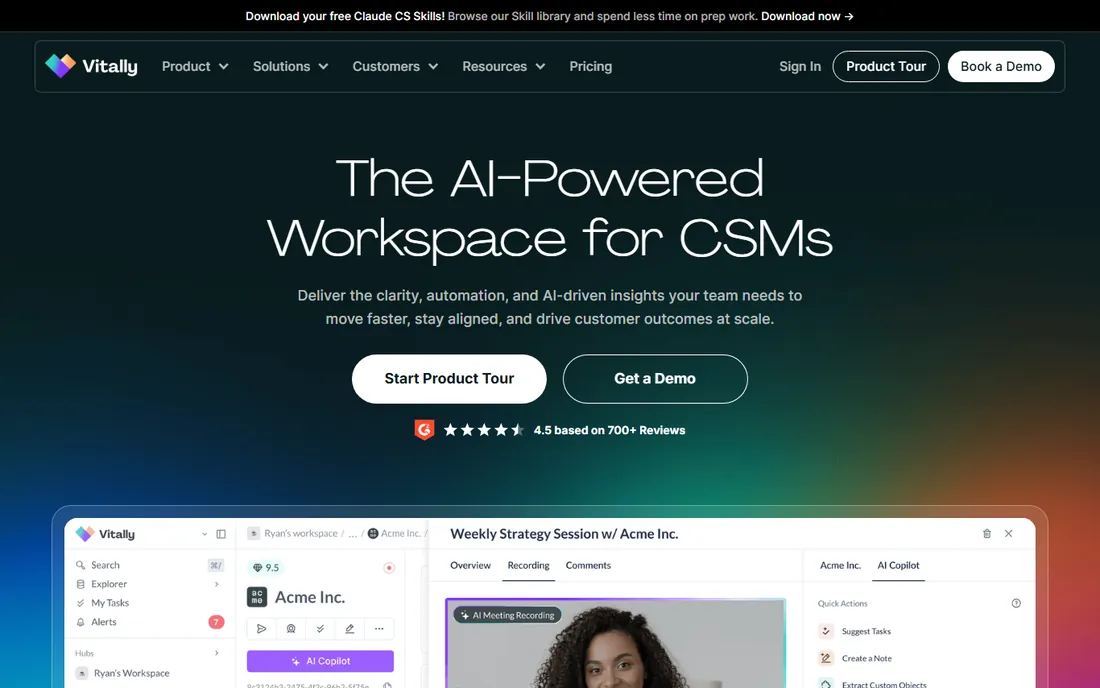
Vitally is the tool teams pick when they need a CS stack live quickly and actually used. Implementations run two to four weeks rather than months, and the interface is genuinely modern, which shows up in reviews where CSMs say they choose to use it rather than treating it as an obligation. Health scoring, account 360 views, workflow automation, and collaborative workspaces cover the core.
The pricing model is quote-based across three tiers built around your CS motion (tech-touch, hybrid-touch, high-touch), and AI capabilities such as the meeting recorder and account copilot come as add-ons. That is fine if you budget for it, but confirm total cost with AI included before you sign.
What we like- Fast implementation
- Clean modern interface CSMs actually adopt
- Strong product analytics integrations
Watch out for- Less mature for very large enterprise teams
- AI features priced as add-ons
Starting priceSee website
Free planNo
Planhat has been building customer success software from Stockholm since 2014, and its pitch has always been flexibility: combine customer data in one place, automate the busywork, and run your CS workflows your way. That appeals to teams with unusual data models or multi-product account structures that rigid platforms handle poorly.
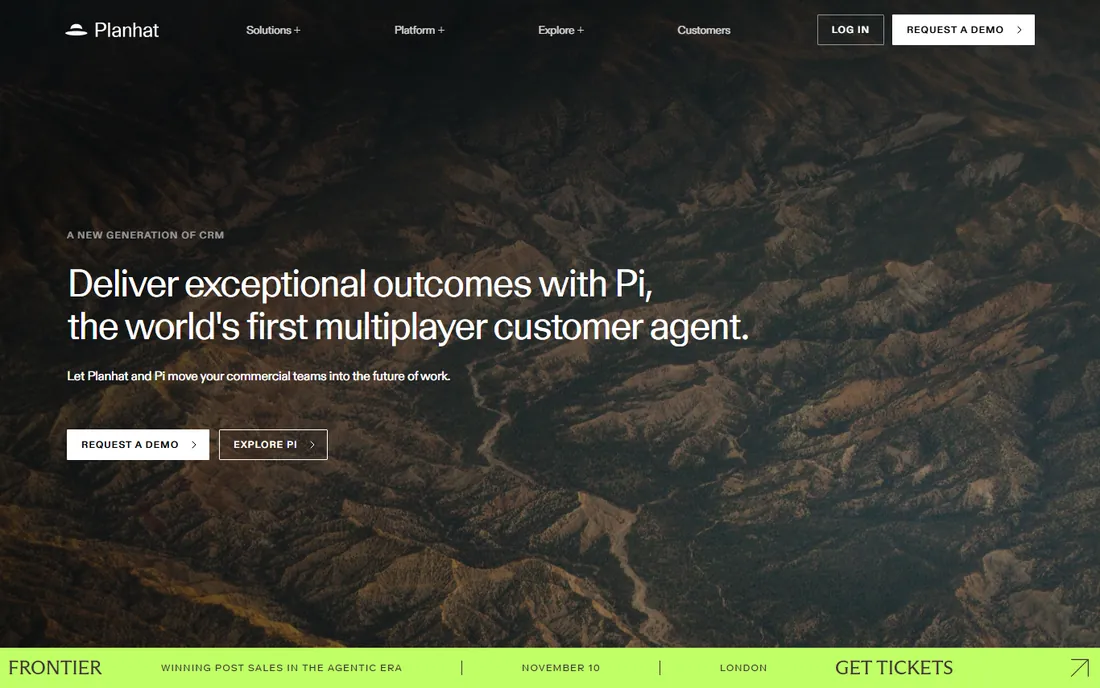
One thing to know before you evaluate: the homepage now leads with Pi, described as a multiplayer customer agent, which signals a real product pivot toward AI agents. That could be exactly what you want, or a reason to ask hard questions about the classic platform's future. Either way, get the current roadmap on the record during your trial.
What we like- Flexible platform combining data, automation, and workflows
- Strong for complex account structures
Watch out for- Recent pivot toward the "Pi" AI agent changes the product story
- Pricing not public
Starting priceSee website
Free planNo
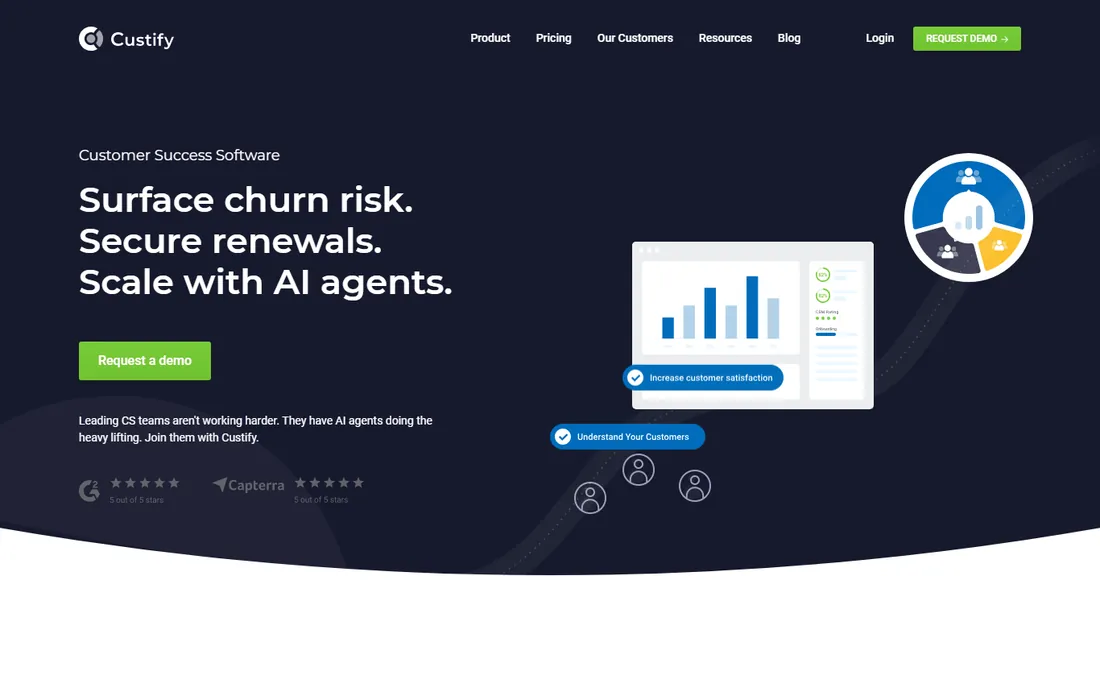
Custify, founded in 2017 and based in Munich, is designed specifically for B2B SaaS companies. It unifies product usage data with CRM, support, and billing information into one view, flags accounts that get stuck during onboarding or show declining usage, and runs automated playbooks for low-touch workflows. Third-party estimates put entry pricing around several hundred dollars per month, but plans are quote-based, so treat those figures as directional.
The company also runs Custify Academy, a free customer success course with certification, which tells you something about how it thinks about the profession. For a mid-market SaaS team that wants health scores and automation without enterprise complexity, it is one of the most natural fits on this list.
What we like- Purpose-built for B2B SaaS with out-of-the-box dashboards
- Strong automation engine
- Fast time to value
Watch out for- Quote-based pricing with no public plans
- No permanent free tier
Starting priceSee website
Free planNo
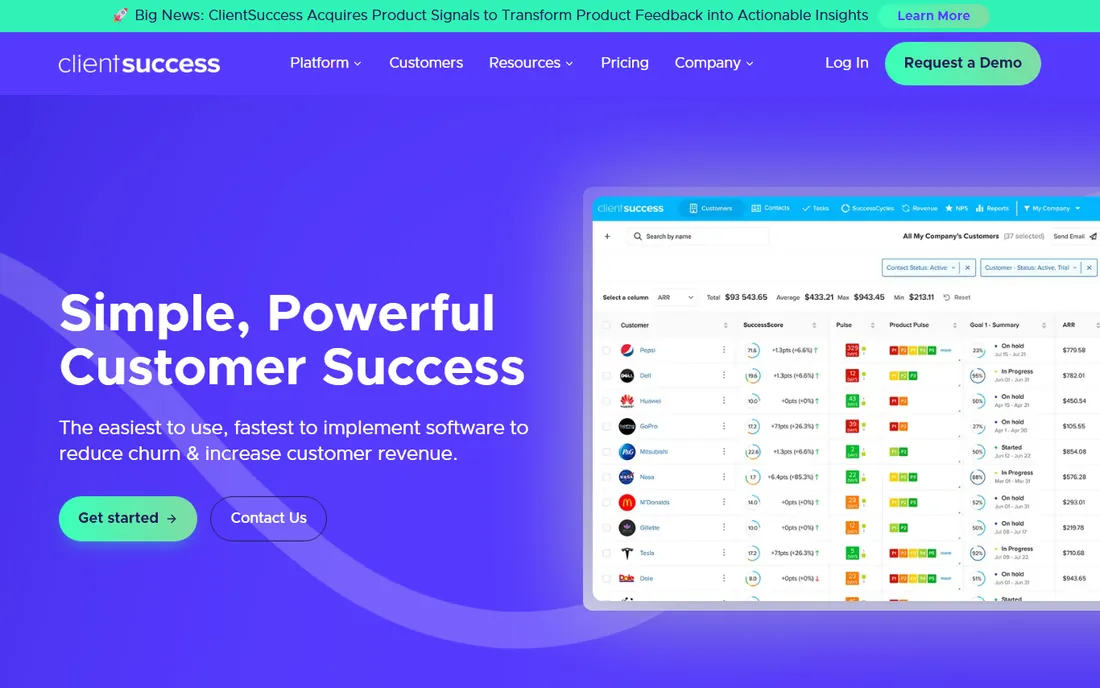
ClientSuccess has been in this market since 2014, and its calling card has always been ease of use. The platform gives front-line CSMs health dashboards, automated engagement workflows, and reporting without the heavy implementation lift, while giving CS executives the portfolio-level insights they need for renewal forecasting. It has won industry awards for usability multiple times over the years.
It does not try to be everything. If you need the deepest possible customization or a giant integration marketplace, the larger platforms offer more. But for teams where adoption is the risk, meaning the tool fails if CSMs do not live in it, ClientSuccess's simplicity is a genuine advantage.
What we like- Long-standing reputation for usability and fast implementation
- Actionable health and revenue insights
Watch out for- Smaller ecosystem than the enterprise giants
- Quote-based pricing
Starting priceSee website
Free planNo
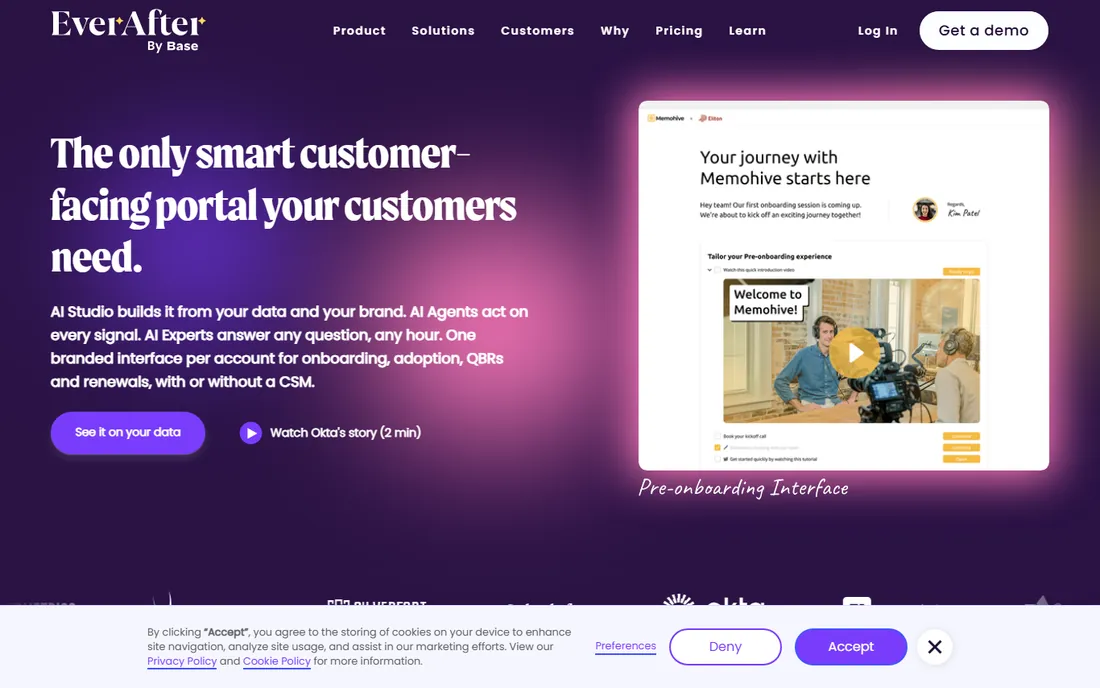
EverAfter takes a different angle from every other tool here. Instead of starting with an internal dashboard for CSMs, it builds customer-facing hubs: personalized portals where each customer sees their onboarding plan, KPIs, shared documents, meeting agendas, and success tasks. The company has added AI agents that extract goals from meeting notes, send executive digests, and automate onboarding touchpoints.
That makes EverAfter strongest for scaled and digital CS motions, where one CSM covers hundreds of accounts and the product has to do the heavy lifting. If you need classic internal health scoring and portfolio management as your primary system, pair it with a platform like Vitally or Custify rather than treating it as a one-to-one replacement.
What we like- Customer-facing hubs and personalized journeys
- AI agents for onboarding and follow-up
- Distinct from dashboard-only tools
Watch out for- Different model from classic CSM platforms, so it may complement rather than replace one
- Pricing not public
CSM software is not a CRM with a new label
One source of confusion in this category is the overlap with CRMs. A CRM tracks your sales pipeline and contact history. CSM software tracks what happens after the deal closes: product usage, health scores, onboarding progress, renewal risk, and expansion signals. Salesforce and HubSpot can hold some of this data, but they do not score account health or run CS playbooks natively.
That distinction matters for budgeting. If your CS team is working out of spreadsheets and CRM reports, you are probably missing at-risk accounts until they churn. A dedicated platform pays for itself through earlier risk detection and more consistent onboarding, but only if the team actually uses it. Usability is not a soft criterion here; it is the whole game.
Start with your CS motion, not the feature list. A high-touch enterprise team with named CSMs needs deep account planning and customizable health models. A tech-touch team covering thousands of accounts needs automation, self-serve journeys, and integrations with product analytics. Buying a high-touch platform for a tech-touch motion, or the reverse, is the most expensive mistake in this category.
Count your accounts and CSMs honestly
Platform pricing and implementation effort both scale with account volume and team size. A team of four CSMs managing 200 accounts does not need Gainsight's enterprise tier, and a team of 40 CSMs will outgrow the simpler tools. Write down your account-to-CSM ratio before you take a single demo.
Test the health score with your own data
Every vendor will show you a beautiful health score. Ask them to build one from your actual product usage data during the trial, with your definitions of red, yellow, and green. If the platform cannot ingest your usage events cleanly, nothing downstream works.
Check the integrations you actually use
At minimum, confirm native connections to your CRM, billing system, support desk, and product analytics tool. Ask whether integrations are real-time or batched, because a health score built on week-old usage data will miss the accounts that are churning right now.
Ask about AI pricing separately
Several vendors now charge extra for AI features like call transcription, risk copilot, and automated follow-ups. Get the AI add-on price in writing during procurement. Reviewers have flagged this as the main expansion blocker on some platforms.
How we chose
We compared customer success platforms against the needs of small and mid-sized US B2B companies, looking at vendor pricing pages and documentation, feature coverage for health scoring, playbooks, onboarding, and renewals, integration ecosystems, and public reviews on G2, Capterra, TrustRadius, and Reddit. We favored tools with transparent positioning and a clear fit for teams under 50 CSMs, and we noted where vendors have recently rebranded or merged so you evaluate the current product. We did not test any of these tools hands-on.
Frequently asked questions
What is CSM software?
CSM software, short for customer success management software, helps companies retain and grow existing customers after the sale. It tracks product usage, scores account health, automates onboarding and renewal playbooks, and surfaces at-risk accounts before they churn.
How much does CSM software cost?
Pricing ranges widely. Mid-market tools typically start around a few hundred dollars per month, while enterprise platforms like Gainsight run into the tens of thousands per year. Most vendors use quote-based pricing tied to account volume and team size, so always get a formal quote.
Is CSM software the same as a CRM?
No. A CRM manages sales pipelines and contact records, while CSM software manages post-sale relationships: health scores, onboarding, renewals, and expansion. The two usually integrate, with the CRM feeding account data into the CS platform.
Do small teams need CSM software?
A team with a handful of CSMs can start with a CRM and spreadsheets, but once you pass roughly 100 accounts per CSM, manual tracking breaks down. Lighter platforms like Vitally and Custify are built for exactly that transition point.
What happened to Totango?
Totango merged with Catalyst and is rebranding to Odie. The website at totango.com now announces the change. If you are evaluating it, ask for a demo of the current Odie product rather than relying on older Totango reviews.
Can CSM software replace CSMs?
No. These platforms make each CSM more effective by automating routine work and flagging risks earlier, but they do not replace the relationship work. Tools like EverAfter extend a CSM's reach across more accounts, which is different from replacing the role.
Sources we checked (15)
- https://www.gainsight.com
- https://churnzero.com/
- https://www.totango.com
- https://vitally.io/
- https://planhat.com/
- https://custify.com/
- https://www.clientsuccess.com/
- https://www.everafter.ai/
- https://awesomeagents.ai/tools/best-ai-customer-success-tools-2026/
- https://github.com/nio85/superdots-blog/blob/HEAD/src/content/blog/ai-customer-success-tools.md
- https://www.getapp.com/customer-service-support-software/a/vitally/
- https://saleshive.com/vendors/custify/
- https://content.fans/news/hubspot-zendesk-churnzero-custify-ai-to-resolve-50-of-support-cases-by-2027
- https://www.preqin.com/data/profile/asset/catalyst-software-corporation/274608
- https://www.everafter.ai/
Is your product missing or out of date?
We review this list regularly. Vendors can request a listing, send updated pricing or ask about featured placement.

Shihab Mia · Founder, Rankite
Shihab has spent more than a decade helping SaaS and e-commerce brands grow through search. He writes Rankite's software buying guides from pricing pages, documentation and public user reviews. More about Shihab.