How we make this list: we compare pricing pages, product documentation and public user reviews. Ratings come from G2, Capterra or Trustpilot, with the date we checked them.
Key takeaways
- The higher-ed CRM market in 2026 is split between purpose-built platforms (Slate, TargetX, Element451) and ecosystem plays (Salesforce Education Cloud, Ellucian CRM, Jenzabar) that tie into an existing SIS or Salesforce investment.
- Only two vendors on this list publish any starting price: Salesforce Education Cloud (from $525/user/month in its commercial pricing guide) and HubSpot (free CRM, paid from $15/seat/month). Everyone else sells by custom quote.
- Anthology, long a major name here, went through Chapter 11 restructuring in 2026 and sold its Lifecycle Engagement and Student Success portfolio (Reach, Engage, Encompass, Advance) to Encoura, which now sells them alongside Encoura Connect, a CRM built with Element451.
- HubSpot is the only tool with a real free plan, which makes it a workable starting point for small colleges that are not ready for a six-figure CRM contract.
Quick comparison
| Tool | Best for | Starting price | Free plan |
|---|
 Salesforce Education Cloud Salesforce Education Cloud | Large universities already running Salesforce elsewhere on campus | $525/user/month (Education Cloud Unlimited Edition, billed annually, per Salesforce's commercial pricing guide) | Free trial (Education Cloud trial, per Salesforce's signup page) |
 Slate (Technolutions) Slate (Technolutions) | Admissions-led institutions that want one system for the whole funnel | See website (custom quote) | No (no free plan or trial advertised) |
 TargetX (Liaison) TargetX (Liaison) | Colleges on Salesforce that want a ready-made higher-ed CRM layer | See website (custom quote) | No (no free plan or trial advertised) |
 Element451 Element451 | Enrollment and marketing teams that want AI doing the outreach work | See website (custom quote) | No (no free plan or trial advertised) |
 HubSpot HubSpot | Small colleges and departments that need a working CRM without a quote process | Free CRM; paid Starter from $15/seat/month | Yes (free CRM with contact management, email tools and basic automation) |
 Ellucian CRM Ellucian CRM | Banner and Colleague institutions that want CRM inside their Microsoft investment | See website (custom quote) | No (no free plan or trial advertised) |
 Enrollment Rx Enrollment Rx | Mid-size institutions that want Salesforce's power with higher-ed templates ready | See website (custom quote) | No (no free plan or trial advertised) |
 Jenzabar Jenzabar | Small to mid-size private colleges already running Jenzabar One or SONIS | See website (custom quote) | No (no free plan or trial advertised) |
 Encoura (Reach / Connect) Encoura (Reach / Connect) | Advancement offices and enrollment teams inheriting the Anthology CRM portfolio | See website (custom quote) | No (no free plan or trial advertised) |
Is your product missing or out of date?
We review this list regularly. Vendors can request a listing, send updated pricing or ask about featured placement.
The best CRM software for higher education
A college applicant compares four or five schools at once. The institution that answers first with the right information usually wins the visit, and often the enrollment. That is the job a higher-ed CRM exists for: track every inquiry, automate the follow-up, manage applications, and keep engaging students through graduation and into alumni giving.
The nine tools below cover the real market. Some were built only for colleges. Others are enterprise CRMs wearing an education costume. Price transparency is thin, most contracts are custom-quoted, and the wrong pick can take a year to undo. Read the tradeoffs before you book the demo.
#1
Salesforce Education Cloud
Best for: Large universities already running Salesforce elsewhere on campus
Visit salesforce.com
Starting price$525/user/month (Education Cloud Unlimited Edition, billed annually, per Salesforce's commercial pricing guide)
Free planFree trial (Education Cloud trial, per Salesforce's signup page)
Salesforce's education offering is the heavyweight of the list. Education Cloud covers the whole constituent relationship from first inquiry to alumni donation, and the vendor's own commercial pricing guide lists the Unlimited Edition at $525 per user per month billed annually, with Agentforce 1 editions for recruitment/admissions or student success at $750. For a large university with a dedicated CRM team, this is the platform with the deepest feature set and the most third-party partners, including purpose-built higher-ed products like TargetX and Enrollment Rx that run on it.
The honest catch is that Salesforce pricing multiplies. Per-user licensing means a 40-person enrollment team pays over $250,000 a year before add-ons, and integrations with your SIS, email and event systems add consultant fees on top. Implementation timelines measured in months, not weeks, are normal. If your campus already lives on Salesforce, the case is strong. If it does not, one of the purpose-built tools below gets you live faster for less.
What we like- Full student-lifecycle coverage (recruitment and admissions, student success, advancement, academic operations, student financials) on one platform
- AI agents and predictive analytics built into the higher Agentforce 1 editions ($750/user/month)
- The largest partner ecosystem in higher ed
Watch out for- The price is per user per month and every module adds licensing complexity
- Implementations are long and almost always need consultants
- Small colleges will find it oversized for what they pay
#2
Slate (Technolutions)
Best for: Admissions-led institutions that want one system for the whole funnel
Visit technolutions.com
Starting priceSee website (custom quote)
Free planNo (no free plan or trial advertised)
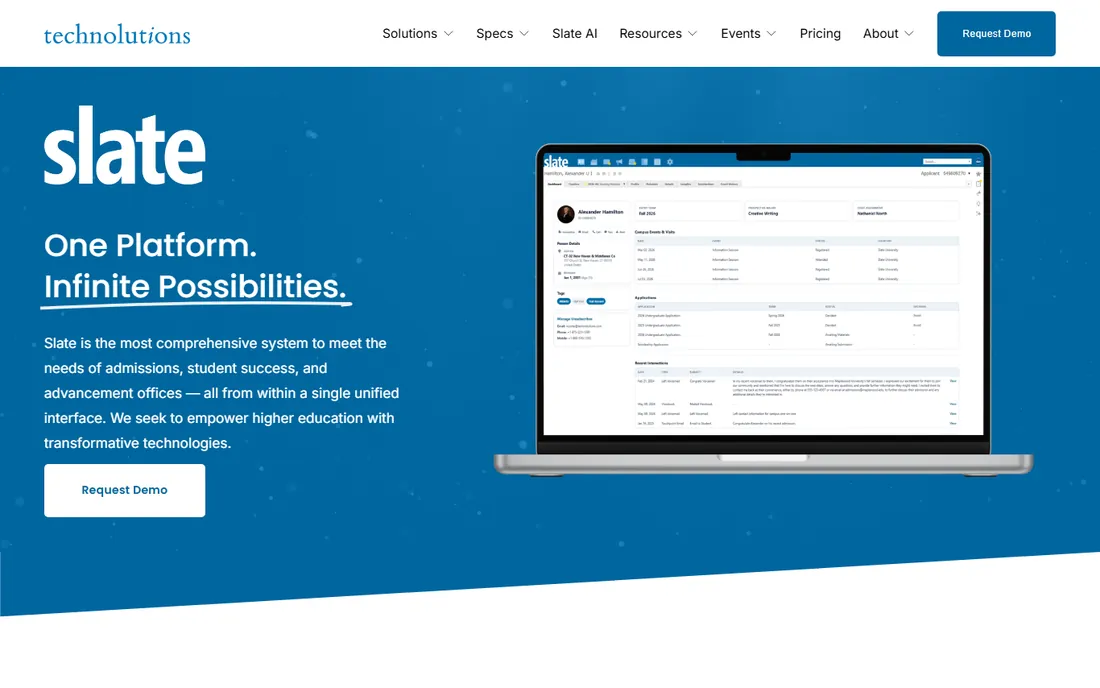
Ask any US admissions office which CRM they envy and Slate is usually the answer. Technolutions' platform says it serves more than 2,000 colleges and universities, and its pitch is a single system that handles CRM, outreach, travel management, online applications, application reading, event management and alumni engagement. Everything sits behind one license: there are no module gates added later.
The tradeoff is effort. Reviewers consistently say Slate takes dedicated staff time to set up and run well, and small teams without a CRM administrator struggle. Pricing is quotation-only, and public review sources describe it as premium-priced. For an admissions-heavy institution willing to invest in the implementation, it is the category standard. For a school that wants to be live in a month with two people, it is not.
What we like- One unified interface for admissions, student success and advancement instead of three tools
- Deep customizability in forms, workflows and communications
- All features included under one comprehensive license with no module upsells
Watch out for- Custom-quoted pricing with no public numbers, and reviewers call it a premium product
- The configurability that makes it strong also means a steep learning curve and a serious setup effort
#3
TargetX (Liaison)
Best for: Colleges on Salesforce that want a ready-made higher-ed CRM layer
Visit targetx.com
Starting priceSee website (custom quote)
Free planNo (no free plan or trial advertised)
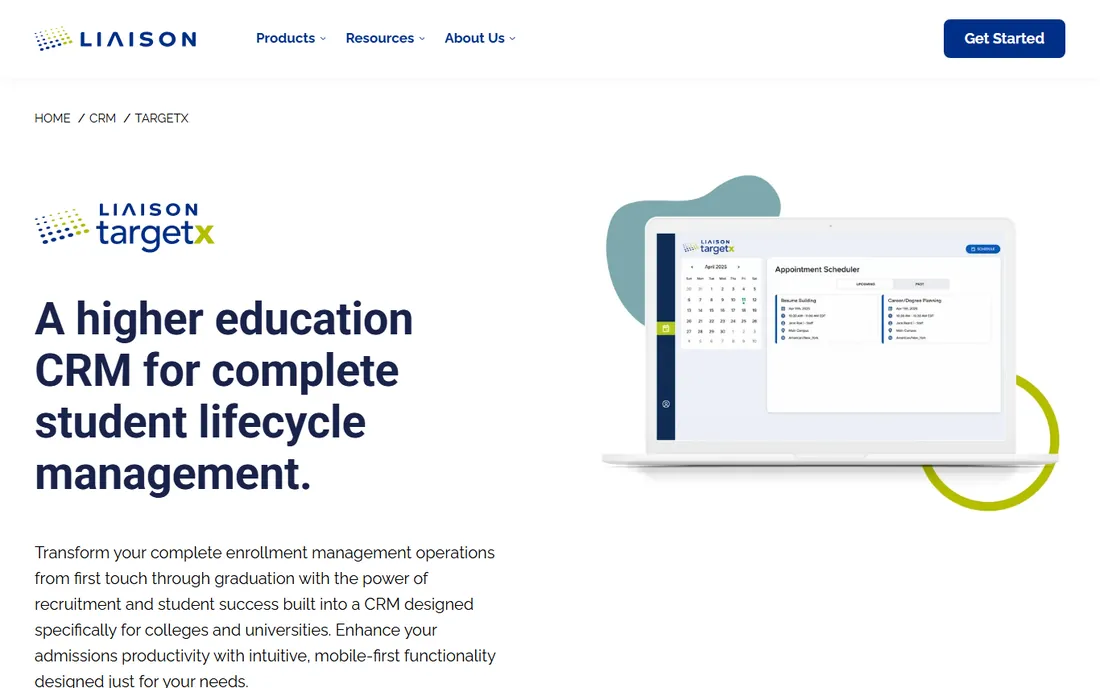
TargetX has been in this market since 1998 and is now part of Liaison International, which also runs the CAS centralized application services. The product is a full lifecycle CRM built natively on Salesforce: mobile-first applications, a student portal, AI-assisted campaign building, texting, appointment scheduling and early-alert tools for retention. Its own site reports clients sending millions of emails and SMS messages through the platform each year.
The buying reality is a two-part bill: Salesforce licenses plus the TargetX subscription. That makes it a natural fit for institutions already committed to Salesforce, where TargetX shortens the build-out. If your campus is not on Salesforce, you are buying both the platform and the education layer, and the total will look a lot like buying Salesforce Education Cloud with a different wrapper.
What we like- Built on the Salesforce platform, so it inherits Salesforce security and upgrade paths
- Covers recruitment, marketing communications, student engagement and retention in one suite
- Liaison ownership adds predictive analytics (Othot) and the CAS application ecosystem
Watch out for- You pay for Salesforce licenses plus TargetX, so the stack is expensive
- Acquired by Liaison in 2020, so long-term product direction follows Liaison's roadmap, not an independent one
#4
Element451
Best for: Enrollment and marketing teams that want AI doing the outreach work
Visit element451.com
Starting priceSee website (custom quote)
Free planNo (no free plan or trial advertised)
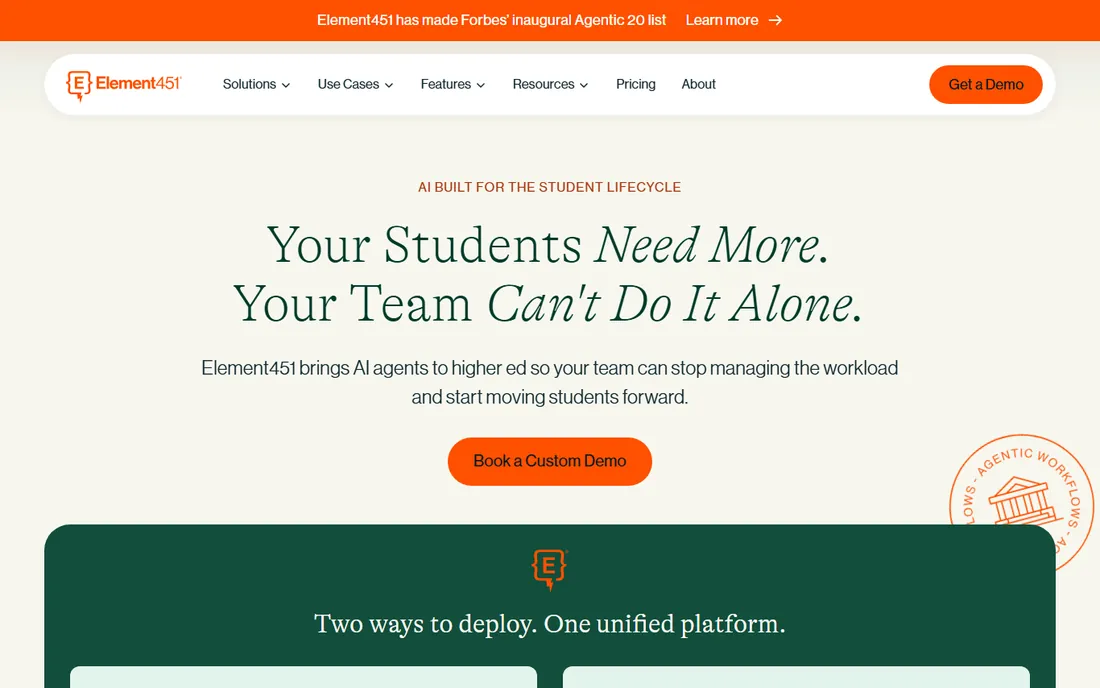
Element451 positions itself as the AI-driven CRM for higher ed, and its homepage leads with agents rather than records. Bolt agents handle marketing, admissions, student success and continuing education workflows: answering questions around the clock, evaluating transcripts, detecting application fraud, and spotting at-risk students early. The vendor says more than 400 institutions use the platform, and it raised a $175 million strategic investment from PSG in late 2024 to push further into AI.
Where it wins is speed and labor savings: the site advertises most institutions going live in days, and its case examples focus on enrollment growth and staff workload reduction rather than configuration flexibility. The risk is opacity. Pricing is not published, and a CRM that reads applications with AI deserves hard questions about data handling and bias review. Ask for those answers in writing during the demo.
What we like- AI-first by design, with Bolt agents that answer inquiries 24/7, read applications, flag fraud and nudge incomplete applicants
- Its site reports more than 400 institutions and 60 million AI-powered student journeys
- Fast to launch, with most institutions up in days
Watch out for- No public pricing, so budget planning means a sales conversation
- The AI-heavy approach is the opposite of Slate's control-everything philosophy, which can worry compliance-minded teams
#5
HubSpot
Best for: Small colleges and departments that need a working CRM without a quote process
Visit hubspot.com
Starting priceFree CRM; paid Starter from $15/seat/month
Free planYes (free CRM with contact management, email tools and basic automation)
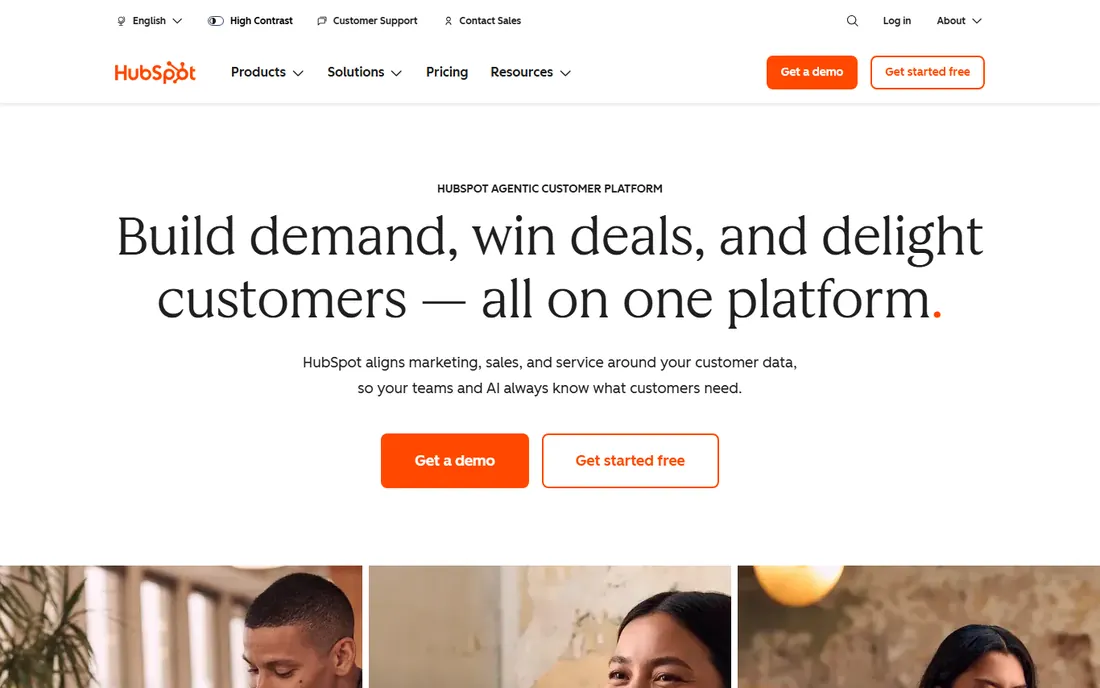
HubSpot is the odd one out: a general CRM in a list of education specialists. Its inclusion is practical. The free CRM covers contact management, deal (or applicant) tracking, live chat, basic email and reporting, which is enough for a small college, a single graduate program or a department to run real recruitment campaigns this week. Paid tiers start at $15 per seat per month for Starter, and the HubSpot blog confirms paid features from that level.
The limits are category limits. Admissions workflows, application review and SIS integration are not native; you build them with custom objects and integrations. At scale the pricing jumps: Professional tiers for Marketing Hub run into the high hundreds per month, and growing contact lists inflate the bill. For a small institution, HubSpot is often the right first CRM. For a university running a 50,000-record funnel, the specialists above fit better.
What we like- A genuinely useful free tier with no credit card required, rare in this category
- Paid plans start cheap and scale per seat
- Strong marketing automation and landing pages that admissions teams actually use
Watch out for- Not built for higher ed: no native Common App integration or admissions workflows, so enrollment teams configure around it
- Costs climb fast into Professional tiers as contacts and users grow
#6
Ellucian CRM
Best for: Banner and Colleague institutions that want CRM inside their Microsoft investment
Visit ellucian.com
Starting priceSee website (custom quote)
Free planNo (no free plan or trial advertised)
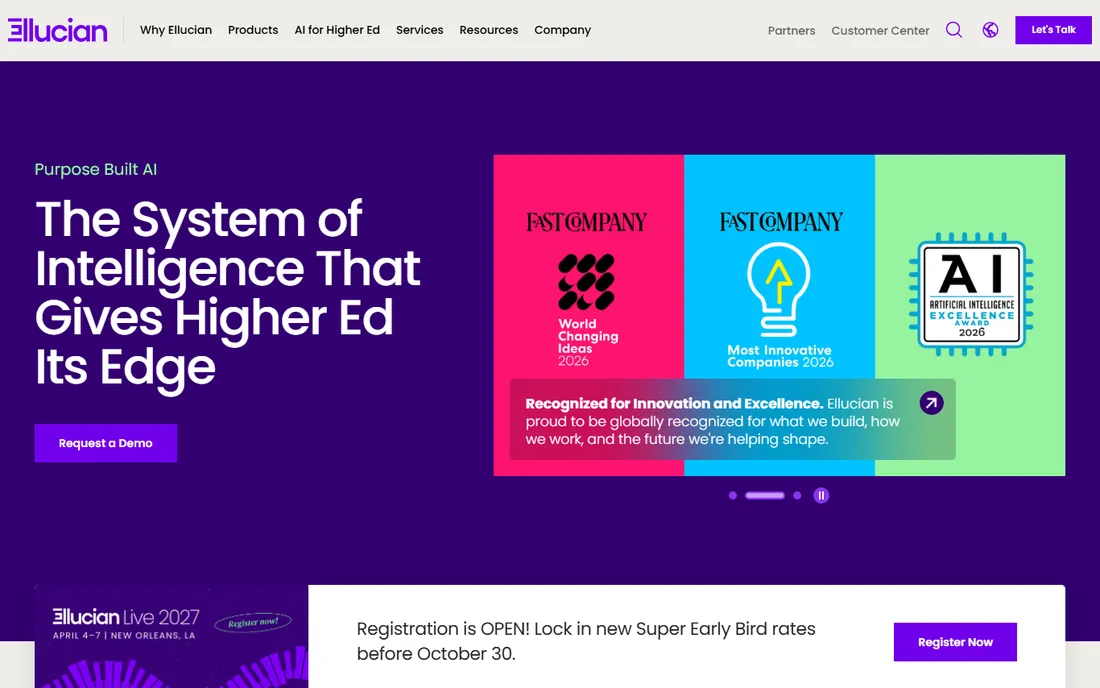
Ellucian is the largest higher-ed technology vendor, serving what its homepage describes as nearly 3,000 institutions and 21 million students. Its CRM line splits the lifecycle three ways: Recruit for enrollment, Advise for retention and advising, and Advance for alumni and donor engagement. In a 2025 expansion of its Microsoft collaboration, Ellucian moved the CRM suite onto Dynamics 365 and Power Platform, bringing Dynamics AI features into the product.
The buying logic is ecosystem logic. If your student information system is Banner or Colleague, Ellucian CRM avoids the integration project that a third-party CRM demands. If your SIS is something else, much of the value disappears, and you are choosing a Dynamics-based CRM when Salesforce-based options have the bigger higher-ed partner network. Note also that Ellucian was the stalking-horse bidder for Anthology's enterprise operations business in 2026, so expect more consolidation news in this corner of the market.
What we like- Three purpose-built modules (CRM Recruit, CRM Advise, CRM Advance) covering enrollment, retention and fundraising
- Now upgraded onto Microsoft Dynamics 365 Sales, Customer Service and Power Platform with embedded AI
- Same vendor as the SIS, so data flows without middleware
Watch out for- Best suited to institutions already in the Ellucian ecosystem
- Dynamics 365 licensing underneath means another cost layer
- Custom quotes only, with enterprise-scale pricing expectations
#7
Enrollment Rx
Best for: Mid-size institutions that want Salesforce's power with higher-ed templates ready
Visit enrollmentrx.com
Starting priceSee website (custom quote)
Free planNo (no free plan or trial advertised)
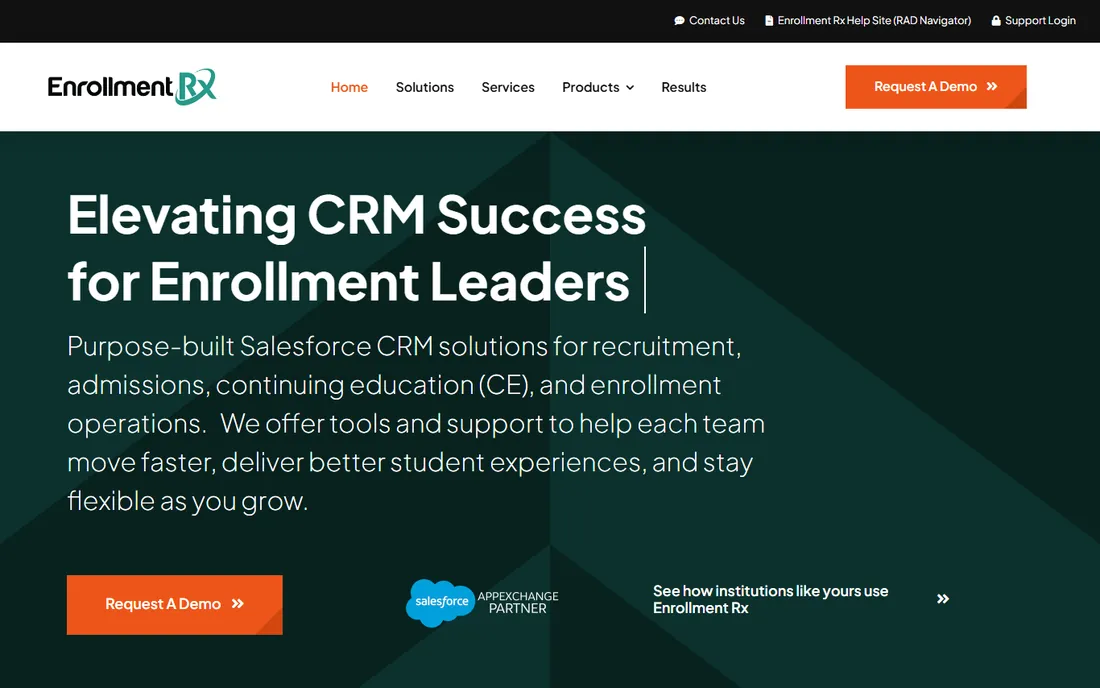
Enrollment Rx sells a middle path: Salesforce's platform without Salesforce's implementation project. Its suite covers recruitment and admissions, communications, events and applicant portals, all built to be configured without code. Customer examples on its site describe schools cutting follow-up times and increasing applications after deployment, and the company provides live training plus recorded resources as part of the deal.
For a mid-size college that chose Salesforce but has no developers, this is the most direct route to a working admissions CRM. The cost structure is the usual Salesforce-adjacent one: platform licenses plus the Enrollment Rx subscription plus implementation services. Compared with raw Salesforce Education Cloud, you trade some flexibility for a faster, more guided setup.
What we like- Prebuilt Salesforce solutions for recruitment, admissions, events and portals, so teams configure with clicks instead of building from scratch
- Full-service implementation included
- Live training and a dedicated support site
Watch out for- Still Salesforce underneath, so licensing runs alongside the Enrollment Rx subscription
- A smaller company than the platform giants, which matters for institutions buying a decade-long system
#8
Jenzabar
Best for: Small to mid-size private colleges already running Jenzabar One or SONIS
Visit jenzabar.com
Starting priceSee website (custom quote)
Free planNo (no free plan or trial advertised)
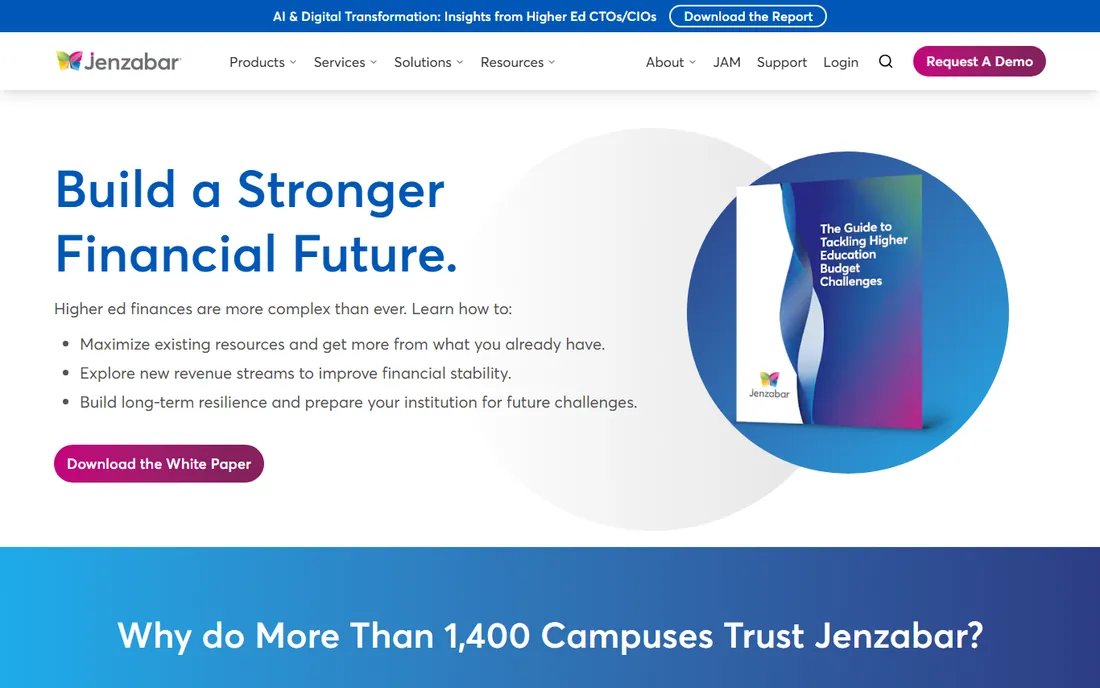
Jenzabar is one of the oldest higher-ed software companies, and its Recruitment product is the CRM piece of a broader platform that includes the Jenzabar One ERP/SIS and SONIS. The recruitment CRM handles inquiry capture, personalized messaging, engagement tracking and a student-facing application portal, and it integrates with the Jenzabar SIS so admissions data flows straight into enrollment records.
Like Ellucian, the pitch is really about the stack. A small private college running Jenzabar One gets a CRM that talks to its SIS out of the box, one support contract, and one vendor relationship. Evaluated purely as a CRM against Slate or Element451, it is a narrower product. Buy it for the ecosystem, not for the CRM feature list alone.
What we like- Jenzabar Recruitment is a cloud CRM with modern communication tools and a mobile-first applicant portal
- Sits naturally beside Jenzabar One (ERP/SIS), so one vendor covers the whole campus
- Its site cites more than 1,400 campuses using Jenzabar solutions
Watch out for- The CRM is strongest inside the Jenzabar ecosystem and less proven as a standalone against Slate or Element451
- No published pricing
- Implementation is a vendor-led services engagement
#9
Encoura (Reach / Connect)
Best for: Advancement offices and enrollment teams inheriting the Anthology CRM portfolio
Visit encoura.org
Starting priceSee website (custom quote)
Free planNo (no free plan or trial advertised)
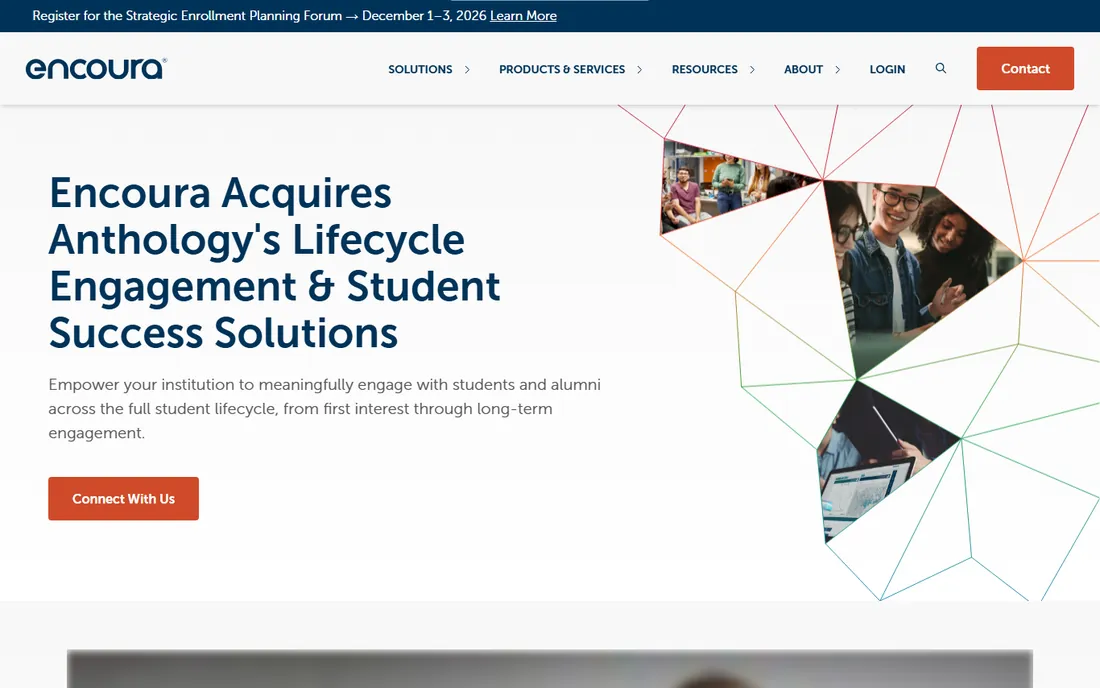
Encoura belongs on this list because of what happened to Anthology. In 2026 Anthology completed a Chapter 11 restructuring, rebranded its core teaching-and-learning business as Blackboard, and sold its Lifecycle Engagement and Student Success businesses (including the Reach, Engage, Encompass and Advance CRMs) to Encoura, effective February 2026. Encoura now supports those products and has also launched Encoura Connect, a CRM built in partnership with Element451 that combines enrollment data with AI agents.
For institutions already on Anthology Reach or Advance, the practical question is continuity, and Encoura is promising investment and support rather than migration pressure. For new buyers, the portfolio covers the full lifecycle from inquiry to alumni giving, backed by Encoura's enrollment research data. Treat the first year under new ownership as a watch period: ask for the product roadmap and support SLAs in the contract.
What we like- Now owns the former Anthology Reach, Engage, Encompass and Advance products, so existing customers keep their investment
- Encoura Connect is a new CRM built with Element451 that pairs engagement data with agentic AI
- 50-year history serving higher ed
Watch out for- A new owner for the Anthology portfolio means roadmap questions for the next year
- Encoura is a services-and-data company first, so product depth varies by module
- Pricing remains quote-based
The Anthology shake-up: what changed in 2026
For a decade, the higher-ed CRM shortlist had four names: Slate, Salesforce, TargetX and Anthology. The fourth name is now different. Anthology's financial restructuring split the company: the Blackboard LMS business continues under the Blackboard name, Ellucian picked up the enterprise operations side, and Encoura took the lifecycle engagement and student success portfolio.
What this means for buyers is mostly about due diligence. Existing Anthology Reach, Engage, Encompass or Advance customers should review their contracts for change-of-control terms and ask Encoura for a written roadmap. New buyers evaluating Reach or Advance are really evaluating Encoura now, and should judge it on Encoura's support capacity, not Anthology's history. And it is a reminder that in this market, the vendor's balance sheet matters as much as the feature list.
How higher-ed CRM pricing really works
Seven of the nine tools on this list publish no prices. That is normal in higher-ed software, but it means you need a process. Send the same RFP to three vendors at once, and require line-item pricing: software licenses, implementation services, training, data migration and annual increases, each separated. The license fee is usually the smallest number in year one and the largest by year three.
Watch for the stacked bill. Salesforce-based products (Education Cloud, TargetX, Enrollment Rx) need Salesforce licenses underneath. Microsoft-based ones (Ellucian CRM) need Dynamics licensing. Ask each vendor to quote the total platform cost, not just their layer. And budget for people: Slate, Salesforce and Ellucian implementations all assume someone on your team owns the system afterward. A CRM without an administrator becomes an expensive database within two years.
How we chose
We started with the categories buyers search: crm for higher education, higher education crm, enrollment management software and admissions crm. For each candidate we opened the vendor's own site, checked pricing pages where they exist, and compared feature coverage against public reviews on G2 and Capterra and practitioner discussion on Reddit. We also tracked 2026 market events (the Anthology restructuring and its Encoura acquisition) because a CRM is a multi-year commitment. Where a price could not be verified on the vendor's own page we wrote "See website" rather than guessing.
Frequently asked questions
What is the best CRM for higher education?
It depends on the institution. Slate is the most widely adopted admissions CRM in the US. Salesforce Education Cloud suits large universities already on Salesforce. Element451 fits enrollment teams that want AI-driven outreach. HubSpot works for small colleges on a budget. Match the tool to your SIS and your staffing, not just the feature list.
How much does a higher-ed CRM cost?
Most vendors quote custom prices. The two published numbers on this list: Salesforce Education Cloud from $525 per user per month (billed annually) and HubSpot from free to $15 per seat per month. Expect five- and six-figure annual contracts for the purpose-built platforms, plus implementation fees.
Do I need a higher-ed-specific CRM, or will HubSpot or Salesforce work?
General CRMs work for marketing and basic recruitment, and HubSpot's free tier is a legitimate starting point. Higher-ed-specific CRMs add admissions workflows, application processing, SIS integration and advancement tools that general CRMs make you build yourself. The bigger your funnel, the more the specialist pays off.
What happened to Anthology's CRM products?
Anthology restructured in 2026 and sold its Lifecycle Engagement and Student Success businesses (Reach, Engage, Encompass, Advance) to Encoura. The Blackboard LMS continues under the Blackboard name. Existing Anthology CRM customers should confirm their support and roadmap with Encoura.
How long does a higher-ed CRM implementation take?
Element451 and HubSpot advertise go-live in days to weeks. Slate, TargetX, Salesforce Education Cloud and Ellucian CRM typically take several months and involve data migration from the SIS, workflow configuration and staff training. Ask each vendor for a written timeline with milestones.
Should the CRM and the SIS come from the same vendor?
It simplifies integration: Ellucian CRM with Banner or Colleague, and Jenzabar Recruitment with Jenzabar One, share data without middleware. But it also concentrates risk with one vendor. Many large universities run Slate or Salesforce for CRM alongside a different SIS, using integrations. Choose based on your IT team's capacity, not on a rule.
Sources we checked (12)
- https://salesforce.com/
- https://technolutions.com/solutions/slate
- https://targetx.com/
- https://element451.com/
- https://hubspot.com/
- https://ellucian.com/
- https://www.enrollmentrx.com
- https://jenzabar.com/
- https://www.encoura.org/anthology/
- https://www.salesforce.com/education/cloud/
- https://www.g2.com/categories/higher-education
- https://www.capterra.com/higher-education-software/
Is your product missing or out of date?
We review this list regularly. Vendors can request a listing, send updated pricing or ask about featured placement.

Shihab Mia · Founder, Rankite
Shihab has 5+ years in B2B and SaaS SEO. He writes Rankite's software buying guides from pricing pages, documentation and public user reviews. More about Shihab.