How we make this list: we compare pricing pages, product documentation and public user reviews. Ratings come from G2, Capterra or Trustpilot, with the date we checked them.
Key takeaways
- Foundant is the best all-around pick for community foundations managing scholarships alongside grants and donor funds.
- Kaleidoscope suits organizations that want a full-cycle platform covering applications, review, fund distribution, and outcomes.
- AwardSpring is built specifically for scholarship providers and keeps the applicant experience simple.
- Submittable fits large programs that need configurable applications plus broader grants and giving management.
- SmarterSelect is the budget-friendly choice for smaller programs that need the essentials without enterprise pricing.
Quick comparison
| Tool | Best for | Starting price | Free plan |
|---|
 Foundant Foundant | community foundations managing scholarships | See website | See website |
 Kaleidoscope Kaleidoscope | full-cycle scholarship program management | See website | See website |
 AwardSpring AwardSpring | scholarship providers focused on applicants | See website | See website |
 Submittable Submittable | large configurable application programs | See website | See website |
 Blackbaud Blackbaud | nonprofits already on Blackbaud products | See website | See website |
 SurveyMonkey Apply SurveyMonkey Apply | application collection and review | See website | See website |
 Reviewr Reviewr | straightforward awards and scholarship review | See website | See website |
 SmarterSelect SmarterSelect | budget-friendly scholarship management | See website | See website |
Is your product missing or out of date?
We review this list regularly. Vendors can request a listing, send updated pricing or ask about featured placement.
The best scholarship management software
Starting priceSee website
Free planSee website
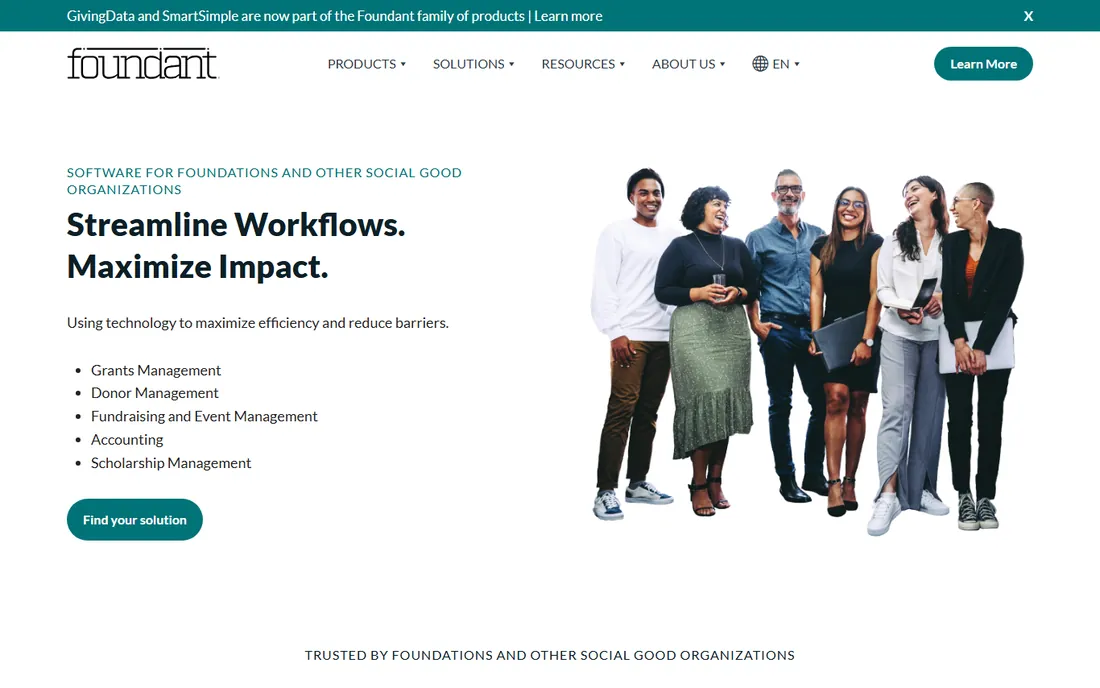
Foundant's Scholarship Lifecycle Manager is designed for community foundations and similar organizations that run scholarships as part of broader philanthropy. Applications, reviewer scoring, awarding, and fund disbursement connect to donor and grant records, so the scholarship program is not an island. Reviewers get a clean portal, applicants get status updates, and staff get reporting that satisfies boards.
The quote-based pricing reflects the foundation market, and smaller programs may find it more than they need. The interface is practical rather than beautiful. But for foundations that want scholarships integrated with grants and funds, Foundant's domain focus is difficult to replace.
What we like- Purpose-built for foundations with scholarship, grant, and fund accounting modules
- Strong applicant and reviewer portals
- Good support reputation
Watch out for- Pricing is quote-based and can be significant
- Interface prioritizes function over modern design
Starting priceSee website
Free planSee website
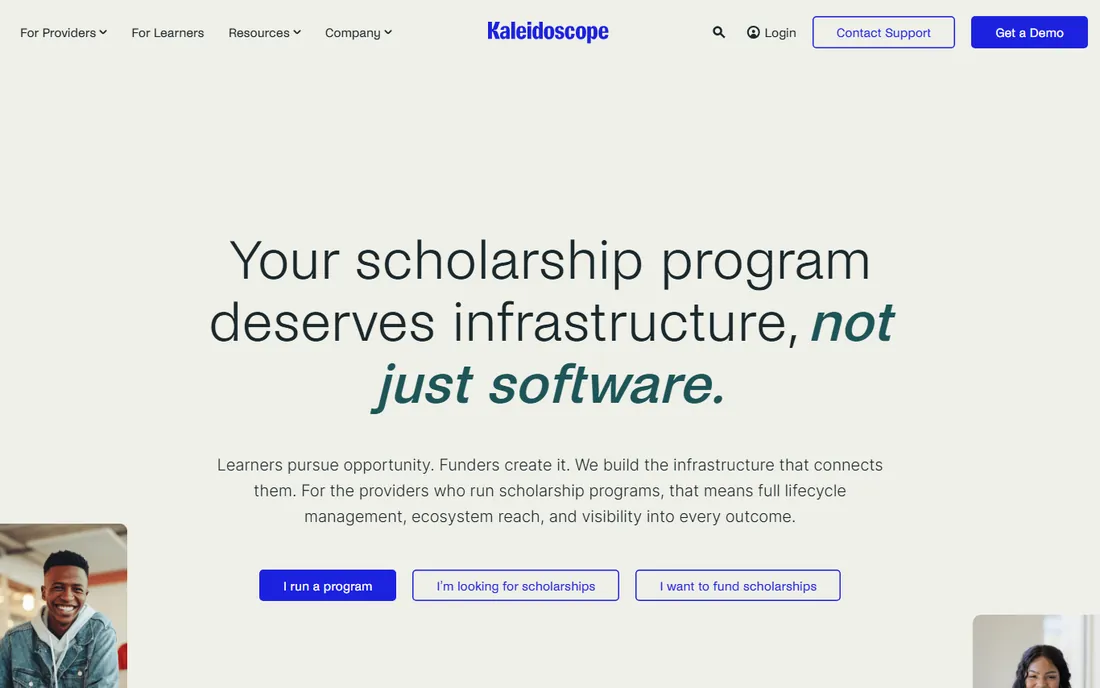
Kaleidoscope positions itself as a full-cycle scholarship platform: design the program, collect applications, run selection, distribute funds, and track outcomes in one place. The applicant experience gets real attention, which matters because confusing applications depress completion rates. Sponsors get visibility into where the money went and what it achieved.
Smaller programs may find the pricing geared toward organizations with real scholarship budgets. And as a newer vendor, it has less long-term review history than Foundant or Blackbaud. For corporations and foundations launching or scaling scholarship programs, the end-to-end coverage is the selling point.
What we like- Covers the full cycle from application to fund distribution
- Applicant-friendly design
- Reporting on outcomes and impact
Watch out for- Pricing aimed at funded programs, not tiny ones
- Newer vendor with less peer review history
Starting priceSee website
Free planSee website
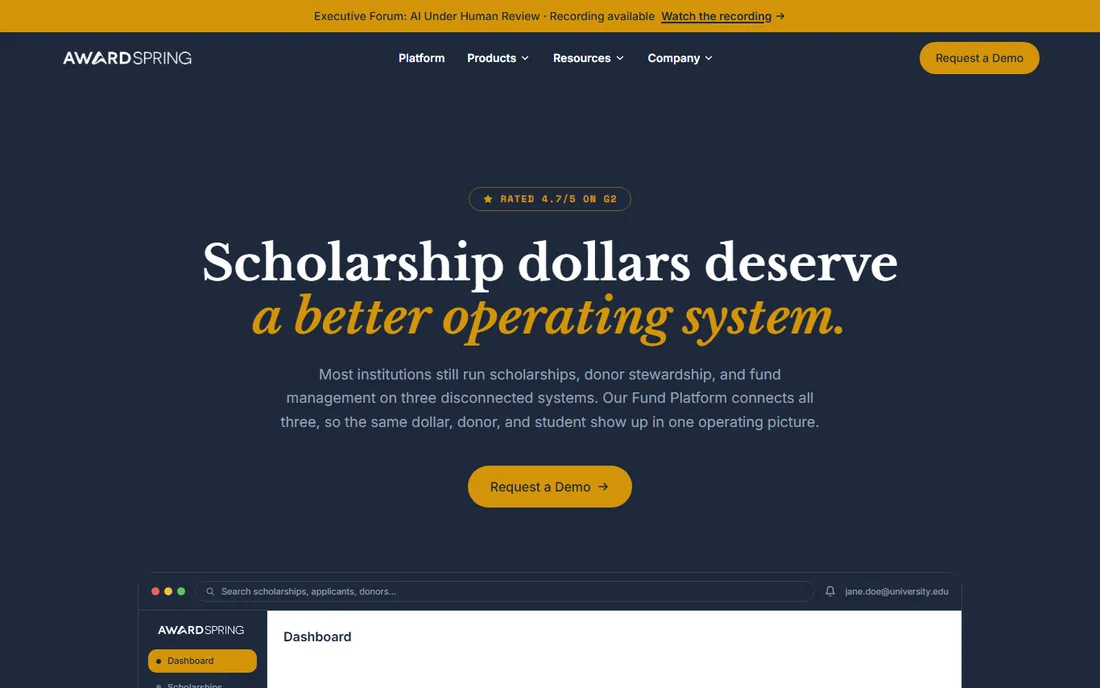
AwardSpring focuses on one thing: running scholarship programs well. Students complete one application that can match them to multiple scholarships, which raises application rates and reduces duplicate work. Administrators get review workflows, scoring, and awarding without the complexity of a broader grants platform.
Organizations that also manage grants will need a second system or a broader platform. AwardSpring does not pretend to be a foundation suite. But scholarship providers, from nonprofits to corporate programs, often prefer a tool that does their exact job over a suite that does many jobs adequately.
What we like- Built specifically for scholarships, not adapted from grants
- Simple application and matching
- Good for multi-scholarship programs
Watch out for- Narrower feature set than full foundation suites
- Less suited to organizations needing grant management too
Starting priceSee website
Free planSee website
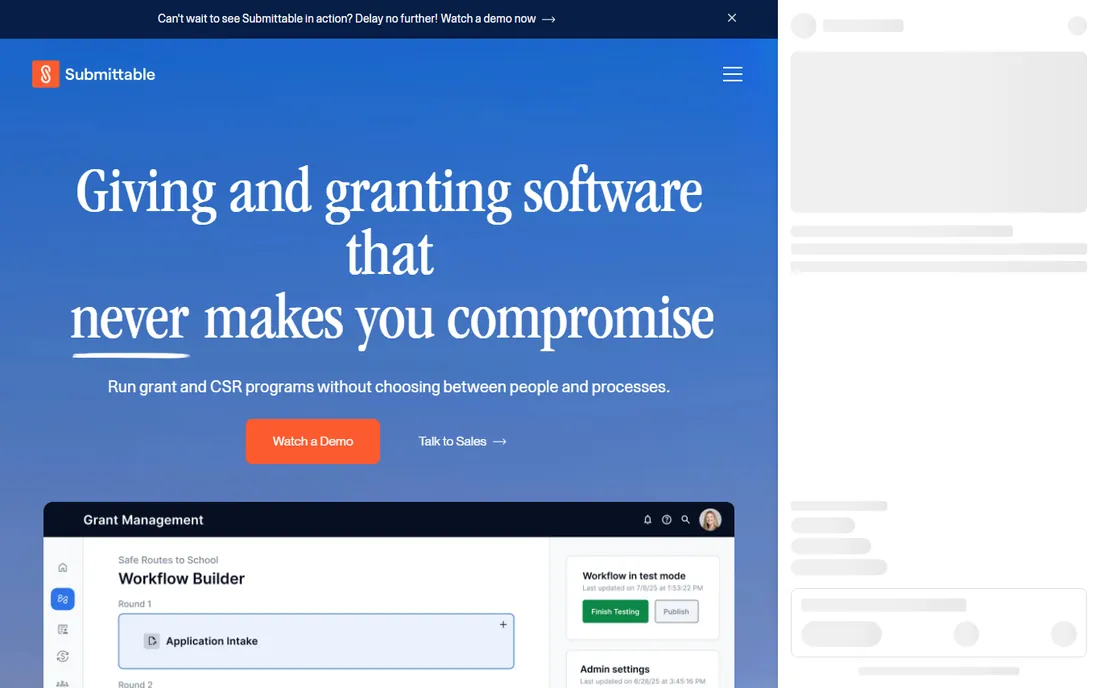
Submittable started in submissions management and grew into a platform for grants, scholarships, awards, and corporate giving. Large programs value the configurable application forms, multi-round review workflows, and the ability to handle tens of thousands of applicants. Scholarship America's adoption of the platform for its programs is a strong reference.
Small scholarship programs can find it more configurable than they need, and the pricing suits organizations with real budgets. But when the program is large, multi-stage, or part of broader social-impact work, Submittable's scale and flexibility justify the investment.
What we like- Highly configurable forms and review workflows
- Scales to very large applicant volumes
- Also handles grants and CSR programs
Watch out for- Configuration complexity for simple programs
- Pricing reflects the enterprise positioning
Starting priceSee website
Free planSee website
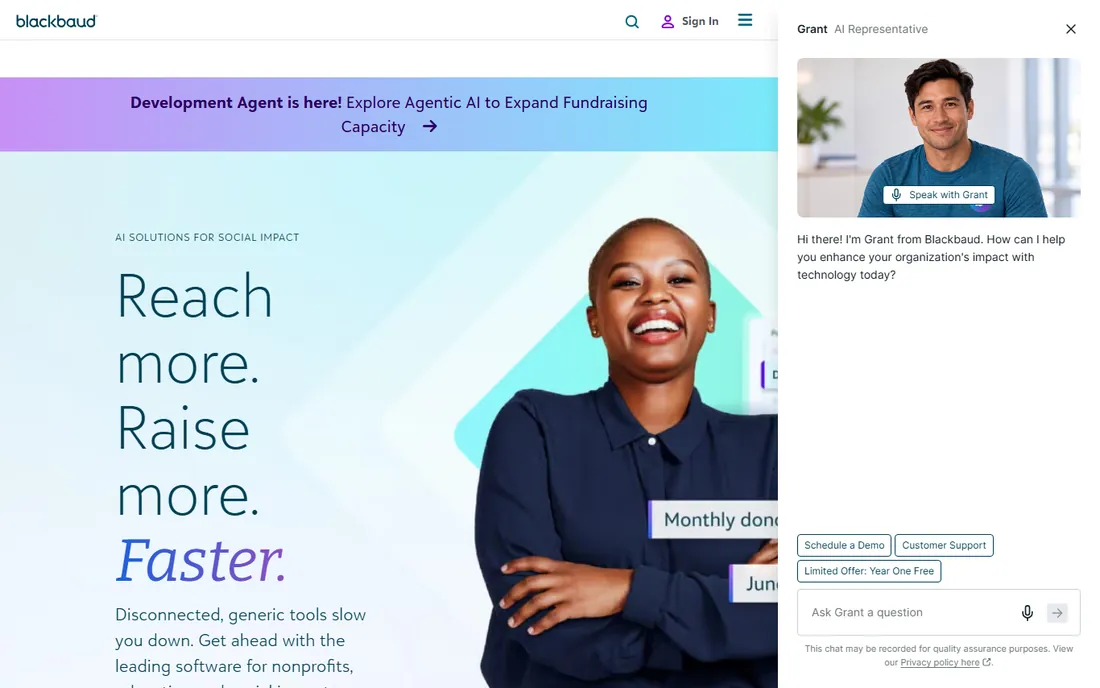
Blackbaud's Award Management product handles scholarship applications, review, and awarding, and its real strength appears inside the Blackbaud ecosystem. Nonprofits already running Raiser's Edge or Financial Edge get shared constituent data, unified reporting, and one vendor relationship. For large nonprofits and higher education institutions, that integration matters.
Outside the ecosystem, the value proposition weakens. Pricing is enterprise-grade, and standalone scholarship buyers may get more usability per dollar elsewhere. Choose Blackbaud for scholarships when you are already committed to Blackbaud for everything else.
What we like- Integrates with the broader Blackbaud nonprofit ecosystem
- Blackbaud Award Management covers the scholarship workflow
- Deep reporting
Watch out for- Enterprise pricing and contracts
- Best value only within the Blackbaud stack
Starting priceSee website
Free planSee website
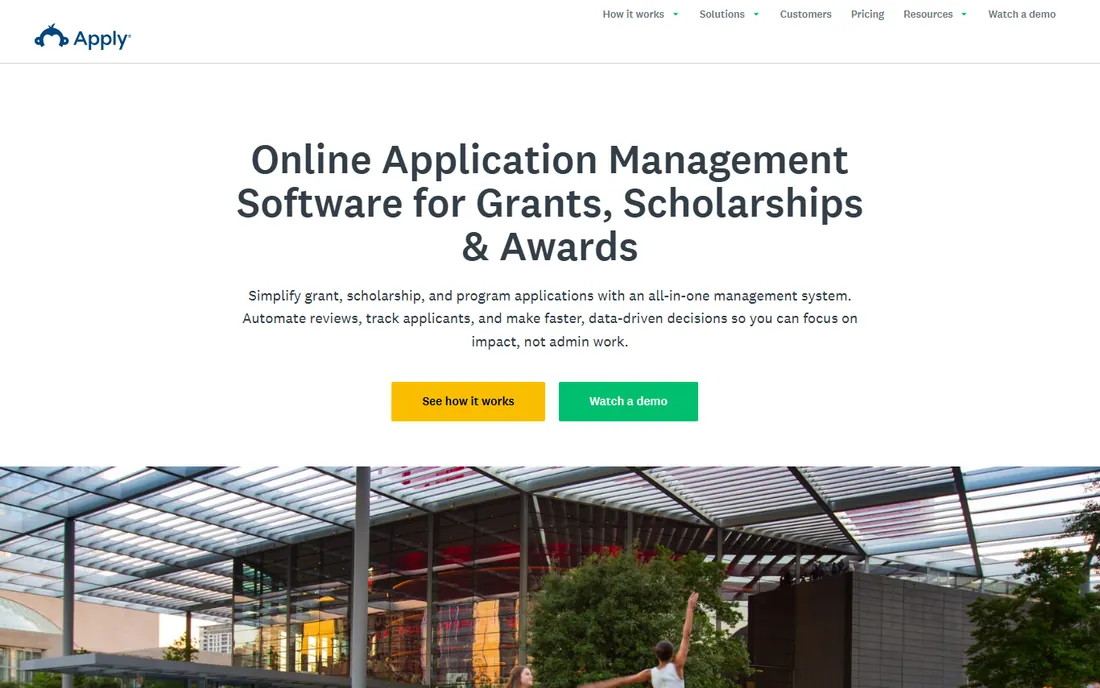
SurveyMonkey Apply (formerly FluidReview) collects applications, routes them to reviewers, and manages scoring and decisions. Teams that already know SurveyMonkey find the interface familiar, and the form builder handles everything from essays to file uploads to recommendation letters. It works for scholarships, grants, and awards alike.
It is an application management tool rather than a scholarship platform: fund disbursement, donor reporting, and scholarship-specific workflows are lighter than on Foundant or Kaleidoscope. Pricing tied to application volume needs modeling for popular programs. For the collect-review-decide portion of the work, it is efficient and proven.
What we like- Familiar application and review workflows
- Configurable forms and scoring
- Part of the SurveyMonkey family
Watch out for- Scholarship-specific features like fund distribution are thinner
- Pricing by application volume can surprise
Starting priceSee website
Free planSee website
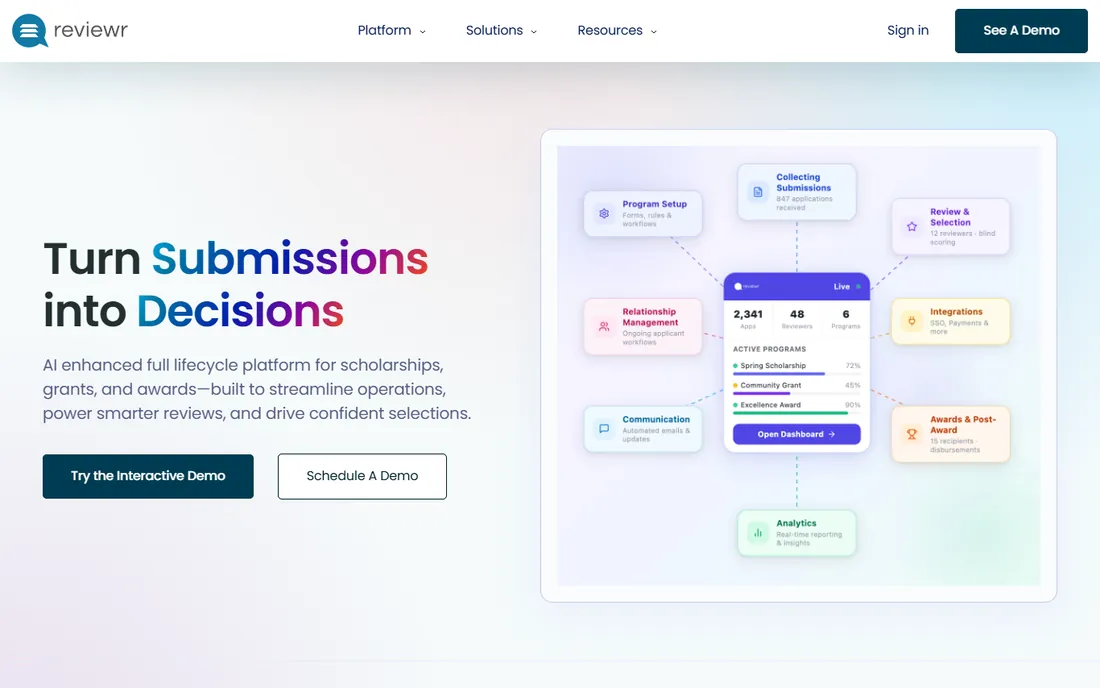
Reviewr keeps things simple: build the application, collect entries, assign judges, score, and announce winners. Small scholarship and awards programs that do not need fund accounting or donor management get a clean workflow without enterprise overhead. The reviewer experience is straightforward, which helps recruit volunteer judges.
Complex programs with multi-stage reviews, fund distribution, or deep reporting will outgrow it. Reviewr knows its lane and stays in it. For local scholarships, chapter awards, and first-time programs, that simplicity is exactly right.
What we like- Simple setup for application and judging workflows
- Affordable for small programs
- Clean reviewer experience
Watch out for- Limited advanced features for complex programs
- Smaller vendor with less ecosystem
Starting priceSee website
Free planSee website
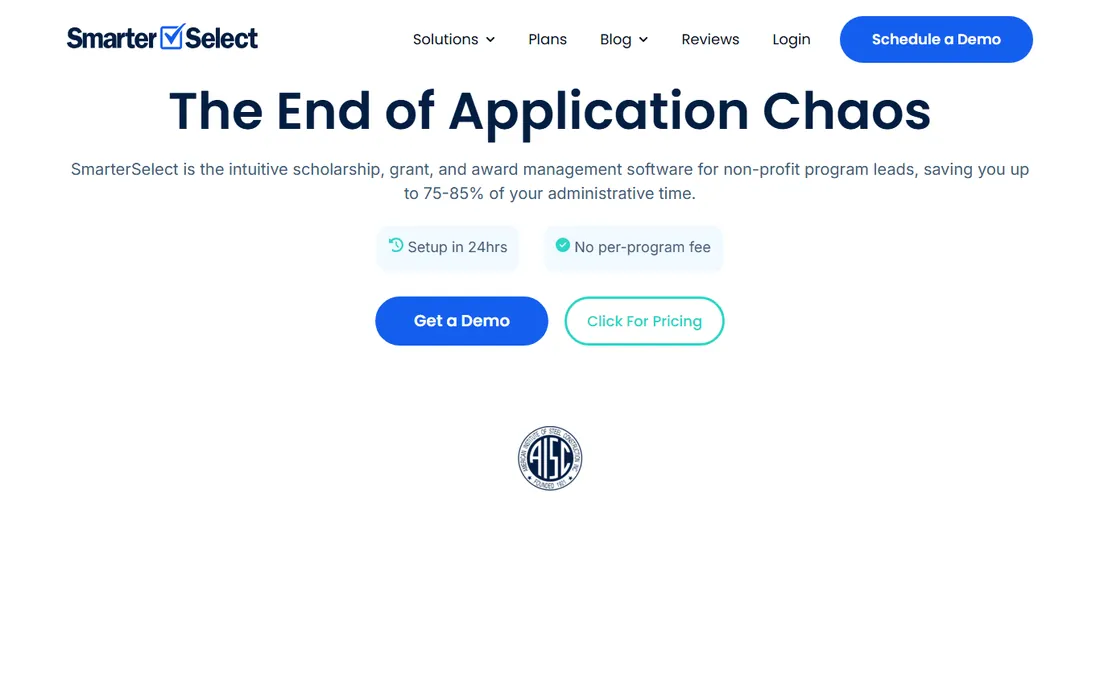
SmarterSelect serves the long tail of scholarship programs: local foundations, small nonprofits, and school districts that need real software without enterprise budgets. Applications, online evaluations, and awarding work smoothly, and both applicants and reviewers find it easy to use. The pricing is the headline feature.
Larger programs will want deeper reporting, fund integration, and more configurable workflows. But SmarterSelect does not try to be Foundant; it tries to be the tool a small program can actually afford and adopt. On those terms, it succeeds.
What we like- Affordable pricing for small programs
- Covers applications, evaluation, and awarding
- Easy for applicants and reviewers
Watch out for- Feature depth trails enterprise platforms
- Reporting is adequate rather than rich
What to check before you buy
Start with the applicant experience, because it drives your application numbers. Complete a test application yourself on each shortlisted platform, on a phone, since many students apply on mobile. Count the clicks, check whether recommenders get a smooth workflow, and see if one application can match to multiple scholarships. A confusing portal costs you applicants you never hear from.
Then map the reviewer workflow. How do reviewers get assigned, do they score on rubrics, can they compare applications side by side, and does the system prevent conflicts of interest? Volunteer reviewers are doing you a favor; the software should make their job pleasant. Ask for a demo of the reviewer portal specifically, not just the admin dashboard.
Finally, follow the money. How do awards get disbursed, does the system track payments to schools or students, and can it produce the financial reports your board and auditors expect? Scholarship programs live or die on trust, and clean fund tracking is what proves the money reached students.
Common mistakes first-time buyers make
The biggest mistake is buying for the application and forgetting the review. Teams evaluate the applicant portal carefully, then discover during the first cycle that reviewer assignment, scoring normalization, and committee workflows are painful. Weight the reviewer experience equally in your evaluation.
The second mistake is underestimating change management. Moving from email and spreadsheets to a platform changes how staff, reviewers, and applicants work. Budget time for training reviewers, writing applicant guidance, and running a small pilot program before the main cycle. A phased rollout beats a big-bang launch.
The third is ignoring total cost. Beyond the subscription, factor in implementation fees, data migration, training, and the staff time to configure the first cycle. Ask vendors for a first-year total, not just the license line, and get renewal pricing in writing.
Frequently asked questions
What is scholarship management software?
It is software that runs scholarship programs end to end: building applications, collecting submissions, coordinating reviewer scoring, selecting recipients, disbursing funds, and reporting outcomes. Foundations, nonprofits, corporations, and schools use it to replace spreadsheets and email.
How much does scholarship management software cost?
Pricing ranges from affordable plans for small programs to quote-based enterprise contracts for foundations. Some vendors price by program size or application volume, others by flat subscription. Always model the cost against your expected applicant numbers and get first-year totals including implementation.
Can one application work for multiple scholarships?
Yes, on platforms designed for it. Universal or common applications let students apply once and get matched to every scholarship they qualify for, which raises completion rates. Ask specifically about matching logic during evaluation, since implementations differ.
How do reviewers score applications?
Most platforms support rubric-based scoring, side-by-side comparison, and blind review options. Administrators assign applications to reviewers, set scoring criteria, and normalize scores across reviewers. Good systems also handle conflicts of interest and reviewer recusal.
Does the software handle fund disbursement?
Scholarship-focused platforms like Foundant and Kaleidoscope track awards through disbursement to schools or students. Application-only tools may stop at the decision stage, leaving payments to your accounting system. Confirm the disbursement workflow matches your process.
How long does implementation take?
Simple programs can launch in weeks on tools like Reviewr or SmarterSelect. Foundation suites like Foundant typically take a few months including configuration and training. Large programs on Submittable or Blackbaud should plan for a full implementation project.
How we chose
We selected scholarship management tools that appear consistently in nonprofit technology shortlists on Capterra, G2, and foundation community discussions, covering foundation suites, scholarship specialists, and application platforms. Each vendor's site was checked to confirm the product is current in 2026. Pricing details come from vendor pages where published; quote-based pricing is noted as such. No hands-on program administration was conducted for this guide.
Sources we checked (11)
- https://www.foundant.com
- https://www.mykaleidoscope.com
- https://www.awardspring.com
- https://www.submittable.com
- https://www.blackbaud.com
- https://apply.surveymonkey.com
- https://www.reviewr.com
- https://www.smarterselect.com
- https://sourceforge.net/software/compare/Blackbaud-Grantmaking-vs-Grant-Lifecycle-Manager-vs-Submittable/
- https://slashdot.org/software/comparison/Foundant-Technologies-vs-Scholarship-Lifecycle-Manager/
- https://www.morningstar.com/news/pr-newswire/20251022cg03365/scholarship-america-nations-largest-scholarship-administrator-selects-submittable-as-new-technology-provider
Is your product missing or out of date?
We review this list regularly. Vendors can request a listing, send updated pricing or ask about featured placement.

Shihab Mia · Founder, Rankite
Shihab has 5+ years in B2B and SaaS SEO. He writes Rankite's software buying guides from pricing pages, documentation and public user reviews. More about Shihab.