How we make this list: we compare pricing pages, product documentation and public user reviews. Ratings come from G2, Capterra or Trustpilot, with the date we checked them.
Key takeaways
- Ansible is the easiest starting point for most teams, thanks to agentless SSH based execution and plain YAML playbooks.
- Puppet and Chef suit large estates that need strict enforcement, reporting, and a long lived module or cookbook ecosystem.
- SaltStack stands out for speed at very large scale, with event driven execution across thousands of nodes.
- Terraform and AWS Systems Manager cover provisioning and cloud native operations, but they are not full replacements for a classic configuration tool.
- Enterprise pricing for Puppet, Chef, and SaltStack varies by node count and support tier, so confirm the current quote before budgeting.
Quick comparison
| Tool | Best for | Starting price | Free plan |
|---|
 Ansible | Agentless automation for small and mid size teams | Free | Yes |
 Puppet | Enterprise enforcement and reporting | See website | Free trial |
 Chef Infra | Custom infrastructure coded in Ruby | See website | Free trial |
 SaltStack | Event driven automation at large scale | See website | Yes |
 Terraform | Multi cloud provisioning as code | Free | Yes |
 CFEngine | Lightweight agents and compliance | Free | Yes |
 Rudder | Centralized management with a clear UI | See website | Yes |
 AWS Systems Manager | AWS estates and patch operations | Free | Yes |
Is your product missing or out of date?
We review this list regularly. Vendors can request a listing, send updated pricing or ask about featured placement.
The best configuration management software
#1Ansible
Best for: Agentless automation for small and mid size teams4.6/5 on
G2 (377 reviews, checked Oct 2026)
Visit ansible.com
Starting priceFree
Free planYes
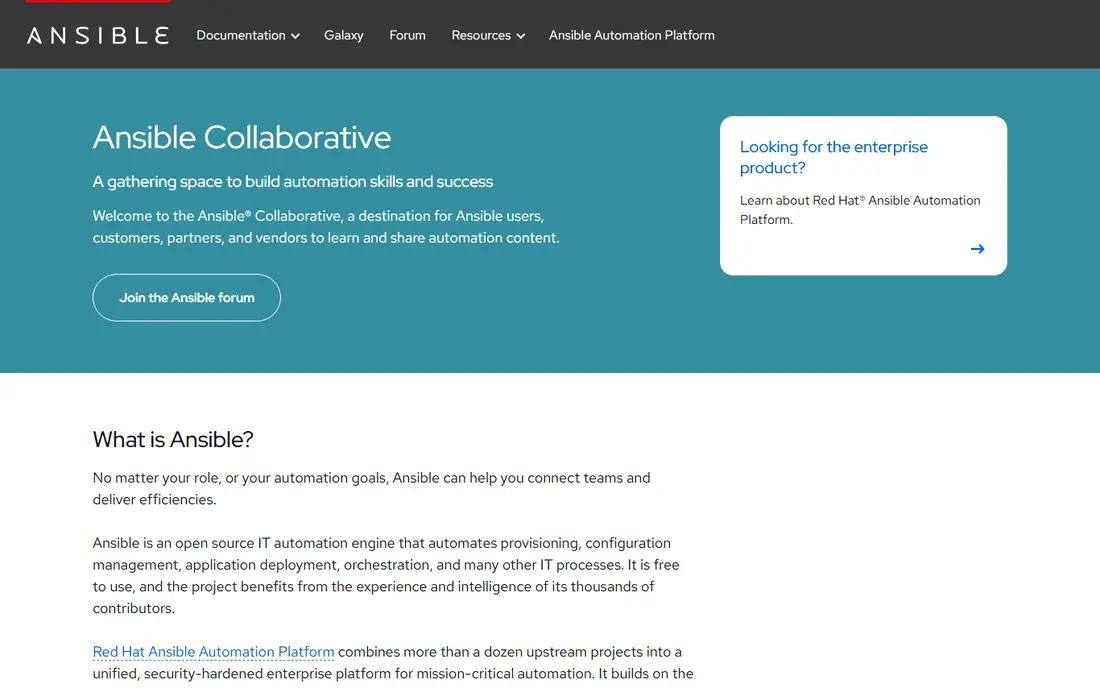
Ansible works over SSH, so managed machines need no agent software installed. A team writes playbooks in YAML that describe packages, files, services, and users, then runs them against an inventory of hosts. The agentless design makes first setup fast, and the module library covers most common tasks without custom code. For a team that is starting with automation, Ansible has the shortest path from zero to a working run.
The limits show up at scale. Execution is largely sequential across hosts unless the team tunes forks and strategies, and very large estates often need the paid Red Hat Ansible Automation Platform for role based access, scheduling, and audit logs. The community edition is free and open source, which keeps entry cost at zero. For small and mid size teams, Ansible remains the default first choice.
What we like- No agents to install on managed nodes
- YAML playbooks are easy to read
- Large collection of ready made modules
Watch out for- Sequential execution can slow very large runs
- Enterprise platform pricing is not published plainly
- Windows support is thinner than Linux support
#2Puppet
Best for: Enterprise enforcement and reporting4.2/5 on
G2 (43 reviews, checked Oct 2026)
Visit puppet.com
Starting priceSee website
Free planFree trial
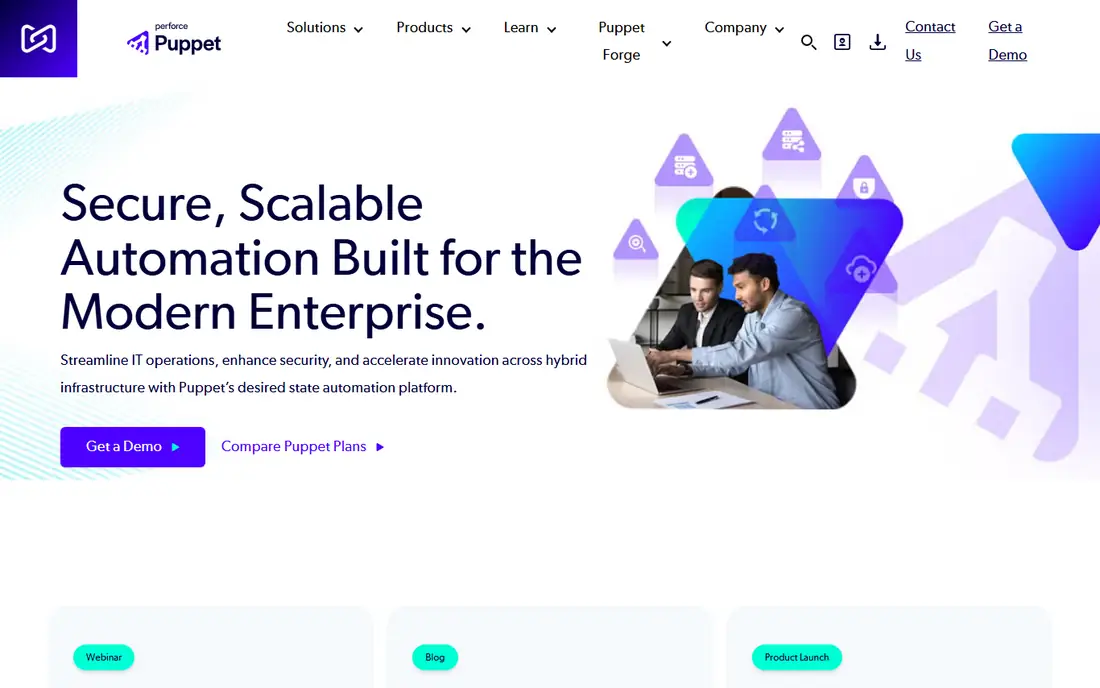
Puppet defines desired state in its own declarative language and uses agents that check in on a schedule, report drift, and correct it. That pull based model suits enterprises that need proof of compliance, since every run produces reports on what changed and what stayed in line. The Forge module library covers common software and platforms, so teams rarely start from scratch.
The cost is complexity and price opacity. Puppet's language has a learning curve, and published prices conflict across sources, with figures quoted per month and per year for different node counts. Treat the entry price as "See website" and request a quote for your node count. For regulated estates that need steady enforcement and audit trails, Puppet is a proven pick.
What we like- Mature model driven approach with strong reporting
- Large Forge module ecosystem
- Agents enforce state on a schedule
Watch out for- Published pricing varies by source and node count
- Learning its declarative language takes time
- Agent setup adds overhead
#3
Chef Infra
Best for: Custom infrastructure coded in Ruby
Visit chef.io
Starting priceSee website
Free planFree trial
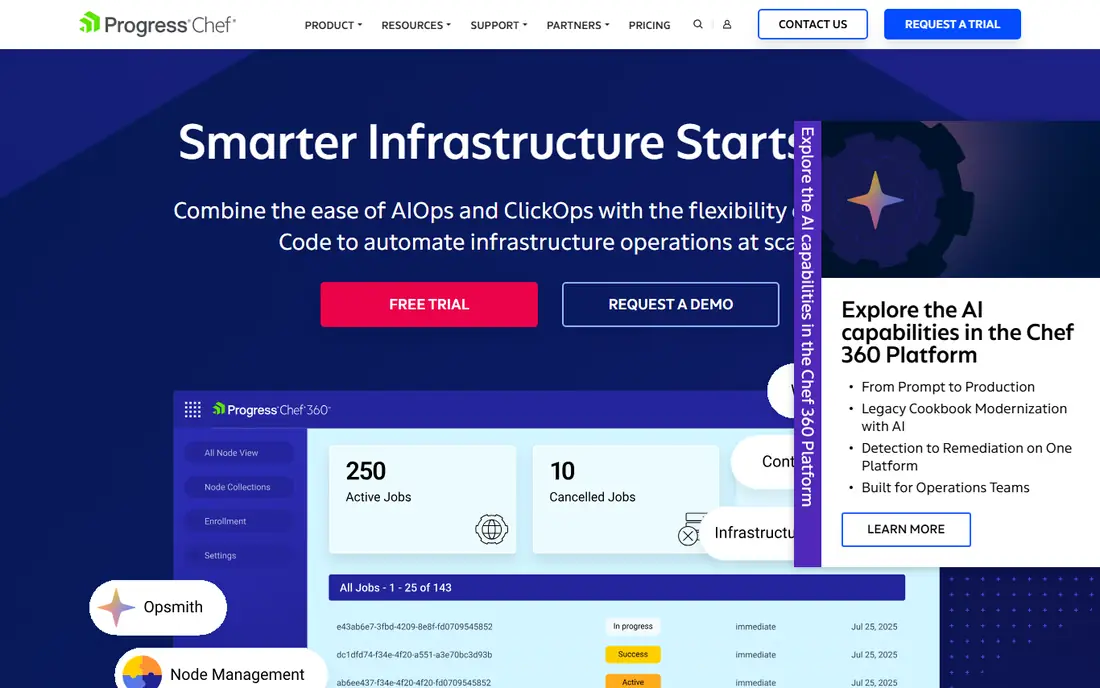
Chef Infra treats infrastructure as code written in Ruby, with cookbooks and recipes that describe exactly how a node should look. That programmability suits teams with complex logic, conditional setup, and custom resources that a simpler YAML tool cannot express cleanly. Its testing tools let teams validate cookbooks before they touch production, which matters when a bad recipe can break hundreds of machines.
The trade is skill and cost. Teams need Ruby comfort to get full value, and published pricing varies widely by source and node count, so confirm the current price on the vendor site. Chef is best for organizations already standardized on it or with strong Ruby skills in house. New teams without Ruby experience will likely move faster with Ansible.
What we like- Full programming power through a Ruby based DSL
- Strong test tooling for cookbooks
- Long track record in large enterprises
Watch out for- Ruby skills are needed for serious use
- Published pricing varies by source
- Community activity has cooled in network automation
Starting priceSee website
Free planYes
SaltStack, now packaged by Broadcom as Aria Automation Config with Salt Open as the free core, is built for speed. Its event bus lets nodes react to changes in near real time, and its parallel execution handles thousands of machines far faster than sequential tools. For homogeneous Linux estates at large scale, that speed is a real advantage.
The gaps are coverage and price clarity. Salt's network device module count is far smaller than Ansible's, so multi vendor network teams may need custom work. Enterprise pricing is custom and not published plainly. For large, mostly Linux estates where speed matters more than breadth, SaltStack earns a close look.
What we like- Very fast parallel execution across thousands of nodes
- Event driven reactions to changes
- Free open source core
Watch out for- Enterprise pricing is not published plainly
- Network module coverage is thinner than Ansible
- Smaller community than the top two
#5Terraform
Best for: Multi cloud provisioning as code4.6/5 on
G2 (120 reviews, checked Oct 2026)
Visit terraform.io
Starting priceFree
Free planYes
Terraform is the default tool for provisioning cloud infrastructure as code. Teams declare servers, networks, and services in configuration files, review a plan of changes, and apply it across clouds. The provider ecosystem is the widest available, so nearly every cloud service can be managed from one workflow.
Terraform is not a classic configuration manager. It provisions resources well but does not continuously enforce package versions or file contents on running servers the way Puppet or Chef do. Many teams pair it with Ansible: Terraform builds the machines, Ansible configures them. The open source edition is free, while HCP Terraform adds collaboration and governance at paid tiers. Note that Terraform's licence is now BUSL 1.1, while the OpenTofu fork keeps an MPL 2.0 licence for teams that need it.
What we like- One workflow across AWS, Azure, and Google Cloud
- Clear plan output before changes apply
- Huge provider ecosystem
Watch out for- Built for provisioning, not ongoing drift enforcement
- State files need careful handling
- Licence moved to BUSL 1.1
Starting priceFree
Free planYes
CFEngine is one of the oldest tools in this space, and its strength is a tiny, efficient agent that runs on huge fleets without straining machines. Its policy language is built around desired state and self healing, so nodes converge toward policy and report deviations. For organizations with strict compliance needs and constrained hardware, that efficiency matters.
The drawback is ecosystem size. CFEngine has a smaller community than Ansible or Puppet, fewer tutorials, and fewer integrations, so teams should expect more self reliance. The core is free and open source, which keeps cost low. For large fleets where agent weight and compliance reporting matter most, CFEngine is a sound, low cost choice.
What we like- Very light agent with low resource use
- Strong policy language for compliance
- Proven on very large fleets
Watch out for- Smaller community and fewer learning resources
- Policy language has a learning curve
- Fewer third party integrations
#7Rudder
Best for: Centralized management with a clear UI4.3/5 on
G2 (18 reviews, checked Oct 2026)
Visit rudder.io
Starting priceSee website
Free planYes
Rudder gives teams a centralized web console for writing policies, grouping nodes, and watching compliance drift. Its approach is more visual than Puppet or Chef, which helps teams that want policy management without writing large amounts of code. Built in reporting shows which nodes follow policy and which ones drift, a useful view for audits.
Rudder is Linux focused, so Windows heavy estates will find less depth. Enterprise pricing is custom, so budget holders should request a quote. The open source core is free, which makes trials cheap. For Linux estates that value a clear console and compliance reporting over raw programmability, Rudder is worth testing.
What we like- Web UI makes policy visible without deep coding
- Built in compliance reporting
- Open source core available
Watch out for- Enterprise pricing is custom
- Linux focused, with less Windows depth
- Smaller module library than Puppet
Starting priceFree
Free planYes
AWS Systems Manager suits teams that already run mainly on AWS. It groups patch management, remote command execution, inventory, and automation documents under one console, with access controlled through IAM. For patching fleets, running scripts across instances, and keeping an inventory of AWS resources, it removes the need for a separate tool.
The limit is scope. Outside AWS, Systems Manager is far less useful, and some advanced features carry charges even though core use is free. Multi cloud teams will still need a tool like Ansible or Terraform beside it. For AWS first estates, Systems Manager is the natural, low cost starting point.
What we like- Deep fit with AWS services and IAM controls
- Patch, run command, and inventory in one place
- No extra agent cost for core features
Watch out for- AWS centered, weak outside AWS
- Some advanced features carry charges
- Console can feel crowded
How we chose
We ranked tools by maturity, model clarity, scale, ecosystem size, and cost transparency. We favored tools with long track records and real production use at scale, since configuration management failures can break fleets. We also weighed agent design: agentless tools start faster, while agent based tools enforce state more steadily. Free entry points scored well, but we marked enterprise pricing as "See website" wherever published figures conflicted, so readers check the vendor page rather than trusting a stale number.
We also separated provisioning from configuration. Terraform earns its place because most teams use it beside a configuration tool, but we state plainly that it does not replace ongoing enforcement. Tools that cover only one cloud or one operating system were ranked lower unless their depth in that niche was clearly best in class.
Buying guide
Start by counting nodes and operating systems. Under a few hundred mostly Linux nodes, Ansible's free edition or CFEngine will cover the work with little setup. Past a thousand nodes, or where compliance reports are required, Puppet, Chef, or SaltStack deserve a trial, and the paid platform features become worth their price. Multi cloud teams should plan for Terraform beside the configuration tool, not instead of it.
Next, test the workflow on a real slice of your estate. Write a policy that installs a package, manages a config file, and restarts a service, then apply it to a test group and check the reporting. Confirm how drift is shown, how a failed run is retried, and how access is controlled. A tool that looks simple in a demo can feel different once roles, secrets, and approvals enter the picture.
Finally, settle the cost model before rolling out widely. Node based pricing climbs fast on large fleets, and support tiers add more. Run the paid trial long enough to see reporting and access controls in use, and confirm whether pricing is per node, per user, or flat. Dropping a tool after a fleet wide rollout is costly, so a careful trial beats a quick purchase.
Frequently asked questions
What is the best configuration management software for a small team?
Ansible is the usual pick for a small team. It needs no agents, its YAML playbooks are easy to read, and the community edition is free, so a team can automate real work without a purchase.
Is Terraform a configuration management tool?
Terraform is mainly a provisioning tool. It creates cloud resources as code, but it does not continuously enforce package versions or file contents on running servers. Most teams pair it with Ansible, Puppet, or Chef for that ongoing enforcement.
Do I need agents on every server?
It depends on the tool. Ansible works over SSH without agents, while Puppet, Chef, SaltStack, CFEngine, and Rudder use agents that check in and enforce state. Agentless setup is faster, while agents give steadier enforcement and reporting.
How much does enterprise configuration management cost?
It varies sharply by node count and support tier. Published figures for Puppet and Chef conflict across sources, and SaltStack enterprise pricing is custom. Request a quote for your exact node count and confirm what support and reporting are included.
Can one tool manage Linux and Windows together?
Ansible, Puppet, Chef, and SaltStack all support Windows as well as Linux, though Windows depth is thinner than Linux depth in each. Rudder and CFEngine are more Linux focused. Test Windows coverage on your own workloads before committing.
Sources we checked (0)
Is your product missing or out of date?
We review this list regularly. Vendors can request a listing, send updated pricing or ask about featured placement.

Shihab Mia · Founder, Rankite
Shihab has 5+ years in B2B and SaaS SEO. He writes Rankite's software buying guides from pricing pages, documentation and public user reviews. More about Shihab.