How we make this list: we compare pricing pages, product documentation and public user reviews. Rankite is independent; if a vendor ever pays for a featured spot, that listing is clearly labeled Partner.
Key takeaways
- ChiroTouch is the market leader (12,500-plus practices on its own count), with AI SOAP notes and deep billing, but pricing is quote-based.
- ChiroFusion is the value pick at $129 per month with free unlimited e-claims, per its own FAQ.
- Jane suits multi-discipline clinics that also do physio or massage, with strong scheduling and a large practitioner community.
- Cash practices should weigh PayDC and ChiroSpring, both built around compliance-heavy documentation and care plans.
Quick comparison
| Tool | Best for | Starting price | Free plan |
|---|
 ChiroTouch ChiroTouch | Established practices that want the deepest feature set | See website (custom quote) | No (demo available) |
 ChiroFusion ChiroFusion | Practices that want full EHR features at a published price | $129/month (per vendor FAQ) | Free trial available |
 Jane Jane | Multi-discipline clinics (chiro plus physio, massage or acupuncture) | See website | No (demo available) |
 ChiroSpring ChiroSpring | Practices that want to customize workflows deeply | See website (custom quote) | No (demo available) |
 EZBIS EZBIS | Practices that value longevity and modular pricing | See website (custom quote) | No (demo available) |
 PayDC PayDC | Practices where documentation compliance drives revenue | See website (custom quote) | No (demo available) |
 ChiroHD ChiroHD | Practices that want cloud EHR without the learning curve | See website | No (demo available) |
 Genesis Chiropractic Software Genesis Chiropractic Software | Practices that want software bundled with billing services | See website (custom quote) | No (demo available) |
Is your product missing or out of date?
We review this list regularly. Vendors can request a listing, send updated pricing or ask about featured placement.
The best cloud-based chiropractic software
Picture the front desk at 5:40 on a Tuesday. The schedule is full, two patients are waiting on intake forms, and the biller is chasing three denied claims from last week. The software running that office decides whether the evening ends at six or at nine. These eight cloud-based platforms cover the real chiropractic market, from the 12,500-practice leader to leaner tools built for solo doctors.
Starting priceSee website (custom quote)
Free planNo (demo available)

ChiroTouch is the default choice in chiropractic for a reason: scale. The vendor counts 12,500-plus practices and 36,000 providers, which means integrations, clearinghouse relationships and payer-specific billing knowledge are battle-tested. The current platform pushes AI hard: an AI Scribe that turns conversation into SOAP notes, smart macros, and a compliance scan that flags missing documentation before claims go out.
The price of leadership is opacity. ChiroTouch publishes no prices; third-party directories estimate around $159 per month, but the vendor never confirms it. Expect a demo-led sales process. For a multi-doctor practice that needs every workflow covered, the depth justifies it. For a solo cash practice, the lighter tools below cost less and set up faster.
What we like- Largest installed base in chiropractic (12,500-plus practices per the vendor)
- AI Scribe and smart macros for SOAP notes
- Integrated payments, claim scrubbing and ERA auto-posting
Watch out for- No published pricing, so every deal goes through sales
- The depth can overwhelm a solo practice
Starting price$129/month (per vendor FAQ)
Free planFree trial available
ChiroFusion wins on honesty. The vendor's own FAQ states the starting price plainly: $129 per month for scheduling, reporting, billing and claims, payment processing and patient check-in, with updates, backups and storage included. Free unlimited e-claims with an integrated clearinghouse is genuinely rare at this price. The company claims 14,000-plus users and 1.6 million claims processed monthly.
The software shows its age in places: reviewers praise ease of use but note the interface is not the prettiest, and heavy customizers hit walls. Implementation typically takes two to three weeks with an account manager. If the budget is fixed and the must-haves are scheduling, SOAP notes and clean claims, this is the rational pick.
What we like- Published $129 per month starting price
- Free unlimited electronic claims with automatic payment posting
- 100 percent cloud-based with no hardware to maintain
Watch out for- Interface feels dated next to newer competitors
- Advanced customization is limited
#3
Jane
Best for: Multi-discipline clinics (chiro plus physio, massage or acupuncture)
Visit jane.app
Starting priceSee website
Free planNo (demo available)

Jane is the generalist that chiropractors keep choosing anyway. Built for health and wellness clinics broadly, it handles scheduling, charting, billing, payments and patient communication in one connected system. The online booking experience is the best in this set, and the 22,000-plus practitioner community means answers to workflow questions are easy to find. Support has a strong reputation.
The trade-off is specificity. Jane does not speak chiropractic billing natively the way ChiroTouch or PayDC do; insurance-heavy US chiro practices should test the claims workflow carefully. For a clinic mixing chiropractic with physio or massage, where one system must serve every discipline, Jane is usually the right answer.
What we like- Excellent scheduling and online booking patients actually use
- Strong charting across disciplines
- 22,000-plus practitioner community and genuinely helpful support
Watch out for- Not chiropractic-specific, so chiro billing workflows are less deep
- Pricing requires checking the vendor page
Starting priceSee website (custom quote)
Free planNo (demo available)

ChiroSpring's pitch is flexibility: the first "multi-flex" app built for chiropractors, with customizable SOAP templates, macros and workflows. AI is woven in, turning conversation into structured notes and flagging claim risks before submission. Review scores are excellent at 4.9 across the major directories, with particular praise for customer support.
Customization cuts both ways. Practices that know exactly how they want to work will love the control; practices that want to be up and running tomorrow may find the options overwhelming. Pricing is quote-based, so bring your must-have list to the demo and ask what is included versus add-on.
What we like- Highly customizable templates, macros and workflows
- AI-assisted documentation and billing risk checks
- 4.9 ratings across Capterra, Software Advice and GetApp
Watch out for- No published pricing
- Customization depth means more setup decisions
#5
EZBIS
Best for: Practices that value longevity and modular pricing
Visit ezbis.com
Starting priceSee website (custom quote)
Free planNo (demo available)
EZBIS has been selling chiropractic software since 1980, longer than anyone else on this list, and thousands of practices still run on it. The modular design is the differentiator: buy EHR, billing, scheduling or the combination that fits, rather than paying for an all-or-nothing suite. Support has a strong reputation among long-time users.
The honest catch is age. The interface looks like software with a 40-year history, because it is. Cloud access exists, but the experience is not as modern as ChiroFusion or ChiroHD. For a practice that values stability and a vendor that has survived every industry cycle, that trade is often acceptable.
What we like- Serving chiropractors since 1980, the longest track record here
- Modular design lets you buy only the pieces you need
- Strong reputation for customer support
Watch out for- Dated interface reflecting its long history
- No published pricing
#6
PayDC
Best for: Practices where documentation compliance drives revenue
Visit paydc.com
Starting priceSee website (custom quote)
Free planNo (demo available)
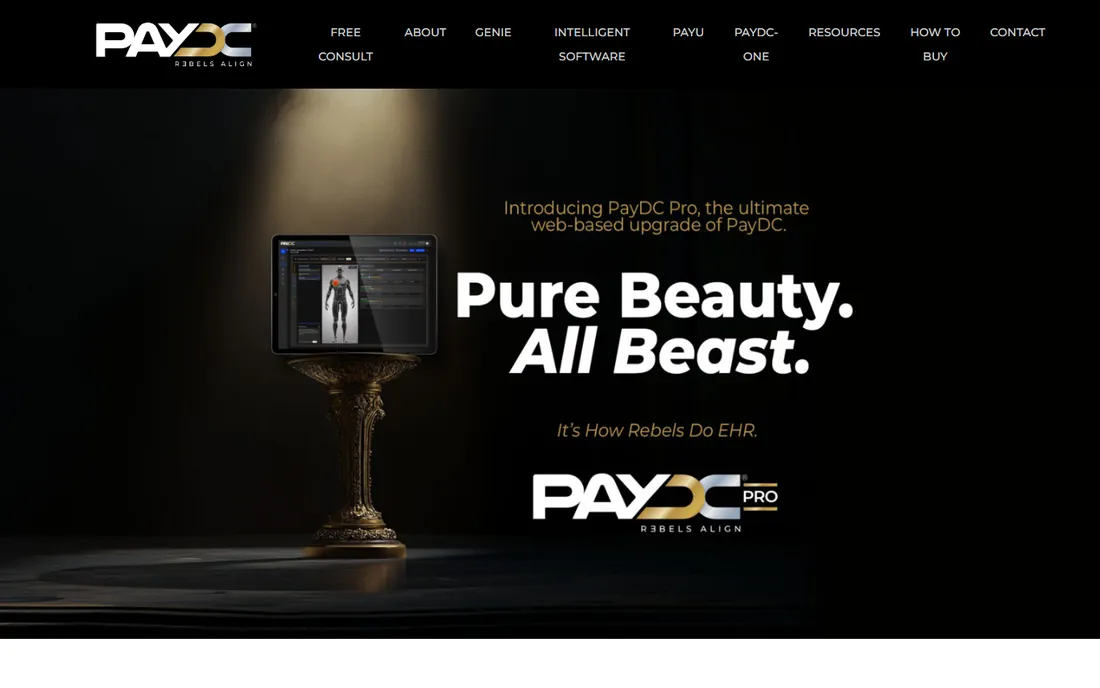
PayDC is built around one belief: clean documentation is what gets claims paid. Its SOAP note engine is chiropractic-specific, generates CMS-1500 claims directly from notes, and checks coding against CPT guidelines before submission. Care plan tools build compliant plans fast and present out-of-pocket costs clearly to patients, which helps plan acceptance. The "Genie" AI layer summarizes care and converts conversations into notes.
This is a compliance-first tool, and it shows in the marketing and the workflow. Practices that live on insurance reimbursement and worry about audits will get the most value. Pricing is quote-based. If your write-offs come from documentation problems rather than volume problems, start here.
What we like- SOAP note engine built specifically for chiropractic compliance
- Claims generated directly from documentation with CPT edit checks
- Care plan tools with patient cost estimates
Watch out for- No published pricing
- Narrower ecosystem of integrations than the giants
#7
ChiroHD
Best for: Practices that want cloud EHR without the learning curve
Visit chirohd.com
Starting priceSee website
Free planNo (demo available)
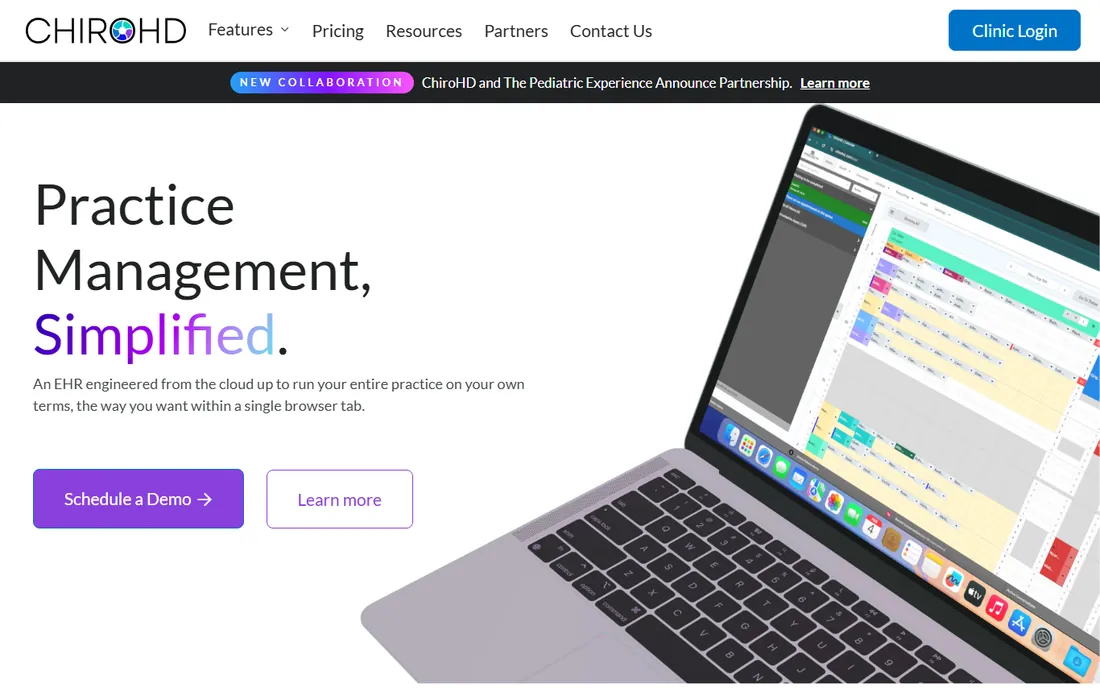
ChiroHD sells simplicity: an EHR engineered for the cloud that runs in a single browser tab, with scheduling, notes, billing and patient engagement in clean workflows. Reviewers consistently praise how fast staff learn it, and the vendor claims 4.9 out of 5 for support satisfaction across 1,500-plus practitioners. Patient outreach campaigns and diagnostic reporting are built in.
The scope is narrower than the market leaders, which is the point: fewer features, less to learn, faster go-live. Multi-location enterprises will outgrow it. For a one-to-three doctor practice that wants modern cloud software without a month of training, it deserves a demo.
What we like- Runs entirely in the browser with nothing to install
- Clean, simple interface reviewers praise
- 1,500-plus practitioners with 4.9 support satisfaction
Watch out for- Smaller vendor with a narrower feature set than ChiroTouch
- Pricing not published
Starting priceSee website (custom quote)
Free planNo (demo available)

Genesis, from Billing Precision, pairs cloud practice management with an optional billing service, which appeals to owners who would rather outsource revenue cycle entirely. The vendor counts 9,000-plus users. Automation covers patient relationship management, revenue cycle, compliance and office management, and the system was designed by chiropractic business owners.
The bundling is also the limitation: if you already have a biller you trust, you are paying for overlap. Pricing is quote-based. For an owner-operator who wants one vendor accountable for both the software and the collections, the combined offer is worth comparing against separate EHR plus billing-service contracts.
What we like- Combines cloud EHR with optional billing services from the same vendor
- 9,000-plus users
- Automation across scheduling, billing and compliance
Watch out for- No published pricing
- The billing-service bundling may not suit practices with in-house billers
How we chose
We started with the searches chiropractors actually run: chiropractic EHR software, cloud-based chiropractic software and chiropractic practice management software. For each candidate we opened the vendor's homepage to confirm it is live and current, checked pricing on the vendor's own pages (marking "See website" where the vendor publishes nothing), and weighed public reviews on Capterra, Software Advice and practitioner discussion. Only products live today made the list.
Cloud vs. server: what changes for a chiropractic office
The practical difference is who maintains the computers. Cloud platforms like all eight here need nothing installed: updates, backups and security happen on the vendor's side, and the doctor can check the schedule from home. Server-based systems keep data in the office, which some owners prefer for control, but they need IT maintenance, backups and hardware replacement.
For most practices the cloud wins on total cost once IT time is counted. The exceptions are practices with unreliable internet (rural offices should ask about offline capability) and owners with strong data-control preferences. Every tool on this list is cloud-based, so the comparison comes down to workflow fit and price, not infrastructure.
The billing question decides more than the EHR does
Chiropractors consistently report that billing, not charting, is where software earns or loses its keep. The questions that matter: does the system scrub claims before submission, does it auto-post ERAs, are e-claims included or per-claim, and who fixes rejections. ChiroFusion includes unlimited e-claims free; PayDC ties claims directly to documentation with CPT checks; ChiroTouch offers the deepest billing apparatus at an unpublished price.
Cash practices can mostly ignore this and optimize for scheduling and notes instead. Insurance-heavy practices should demo the billing workflow with three real denied claims from their own history and watch how each system handles them. The vendor that resolves your actual denials fastest is usually the right buy, regardless of the feature checklist.
Frequently asked questions
How much does chiropractic EHR software cost?
ChiroFusion publishes $129 per month as its starting price. Most competitors, including ChiroTouch, Jane and ChiroSpring, quote custom prices; third-party directories estimate $99 to $300 per month depending on the vendor and modules. Expect to pay more for integrated billing services and multi-provider setups.
Is cloud-based chiropractic software HIPAA compliant?
The reputable vendors all state HIPAA compliance with encryption, access controls and business associate agreements. Confirm the BAA is included in your contract, not just marketed, and ask where data is hosted and how backups work before signing.
Can I switch from server-based software to the cloud?
Yes. ChiroFusion advertises free data import from current systems, and most vendors offer migration assistance. Budget two to four weeks for the transition, run the old and new systems in parallel for at least one full billing cycle, and verify that historical SOAP notes and patient balances transferred correctly.
Do these systems handle insurance billing?
ChiroTouch, ChiroFusion, PayDC and Genesis all include claims management with electronic submission. ChiroFusion includes unlimited e-claims free; PayDC generates claims from documentation with compliance checks. Cash-only practices can use lighter setups focused on scheduling and notes.
What is the difference between EHR and practice management software?
EHR covers the clinical record: SOAP notes, treatment plans and documentation. Practice management covers the business: scheduling, billing, claims and reporting. All eight tools here bundle both, which is the norm in chiropractic; standalone EHR without billing is rare in this market.
Sources we checked (9)
- https://chirotouch.com/
- https://www.chirofusionsoftware.com/
- https://jane.app
- https://chirospring.com/
- https://ezbis.com/
- https://paydc.com/
- https://chirohd.com/
- https://genesischiropracticsoftware.com
- https://www.saasworthy.com/product-alternative/5642/chirotouch
Is your product missing or out of date?
We review this list regularly. Vendors can request a listing, send updated pricing or ask about featured placement.

Shihab Mia · Founder, Rankite
Shihab has spent more than a decade helping SaaS and e-commerce brands grow through search. He writes Rankite's software buying guides from pricing pages, documentation and public user reviews. More about Shihab.