How we make this list: we compare pricing pages, product documentation and public user reviews. Ratings come from G2, Capterra or Trustpilot, with the date we checked them.
What client accounting services software does, and who needs it
Client accounting services, known as CAS, is the work an accounting firm does for its clients every month: bookkeeping, bill pay, payroll support, month-end close and reporting. The software in this list is what a firm runs that work on. Some tools automate the bookkeeping itself, some automate accounts payable, and some give the firm a platform to manage every client in one place. A firm that sells CAS needs software that scales across clients, because the margin is in doing the same clean process for the tenth client as for the first.
The tools below fall into two groups. AI bookkeeping platforms such as Botkeeper, Docyt, Puzzle and Digits do the transaction work: categorisation, reconciliation and close. Practice platforms such as Xero Practice Manager and QuickBooks Online Accountant organise the client work, the staff and the billing around that bookkeeping. A firm usually needs one of each, which is why the list mixes them. Prices were checked on 22 Nov 2026.
We compared the tools on multi-client support, automation depth, integrations with QuickBooks Online and Xero, and published price. Every tool here is used by accounting firms to deliver bookkeeping or accounting services to clients, not just to run their own internal books. Pure practice management tools without a bookkeeping engine did not make the list, and neither did general accounting software sold to a single business. Prices are starting prices from the vendor pricing page where published, and quote where the vendor does not publish a price.
Which client accounting services software is best for a small firm
A small firm starting a CAS line should look at Puzzle or Botkeeper. Puzzle has a free Starter plan, with Core at $30 a month and Complete at $50 a month, which makes it cheap enough to run for a single client while the firm learns the workflow. Botkeeper costs $69 per client entity a month, with volume discounts, and handles transaction categorisation, bank reconciliations, journal entries and close management across a client roster. Both sit on top of the general ledger the client already uses, so the firm does not have to move the client to a new system to start.
How much does client accounting services software cost
Published prices run from free to about $1,490 a month. Puzzle starts free, with paid plans from $30 a month. Botkeeper starts at $69 per client entity a month. Digits starts at $65 a month for Essentials. Docyt starts at $299 a month per entity, and Dext starts at $235 a month for accounting firms. QuickBooks Online Accountant is free for accountants, and Xero Practice Manager is included with Xero partner plans. Vic.ai is quote only, with third-party reports putting the entry point near $1,490 a month. The real cost for a firm is the per-client price times the client count, plus any human bookkeeper service add-on, so compare the tools on the whole roster, not on one client.
What is the difference between CAS software and practice management software
CAS software does the client accounting work: it categorises transactions, reconciles bank accounts, pays bills and closes the books. Practice management software organises the firm: it tracks who is doing which client job, when it is due and what has been billed. The two overlap, because tools such as Karbon and TaxDome organise the work, while tools such as Botkeeper and Docyt do the bookkeeping. Most firms end up with one of each, connected by an integration, and the best CAS setups are the ones where the bookkeeping tool feeds clean numbers into the practice tool without retyping.
Quick comparison
| Tool | Best for | Starting price | Free plan |
|---|
 Botkeeper | Accounting firms automating transaction categorisation, reconciliation and close across a client roster | $69 per client a month | No |
 Vic.ai | Enterprise accounts payable automation with invoice processing, approval workflows and purchase order matching | Quote | No |
 Docyt | Multi-entity bookkeeping, real-time reporting and month-end close for accounting firms | From $299 a month | No |
 Puzzle | Startups and accounting firms that want an AI-native ledger with continuously updated books | Free, paid plans from $30 a month | Yes |
 Digits | Accounting firms that want an AI accounting platform built for firm use | From $65 a month | No |
 Dext | Accounting firms capturing receipts, invoices and bank data at the start of the bookkeeping chain | From $235 a month | No |
 Xero Practice Manager | Firms already running on Xero that want practice management built into the partner platform | Included with Xero partner plans | No |
 QuickBooks Online Accountant | Firms running clients on QuickBooks Online that want a free practice platform with client books in one place | Free for accountants | Yes |
Is your product missing or out of date?
We review this list regularly. Vendors can request a listing, send updated pricing or ask about featured placement.
The best client accounting services software
#1Botkeeper
Best for: Accounting firms automating transaction categorisation, reconciliation and close across a client roster4.4/5 on
G2 (33 reviews, checked Oct 2026)
Visit botkeeper.com
Starting price$69 per client a month
Free planNo
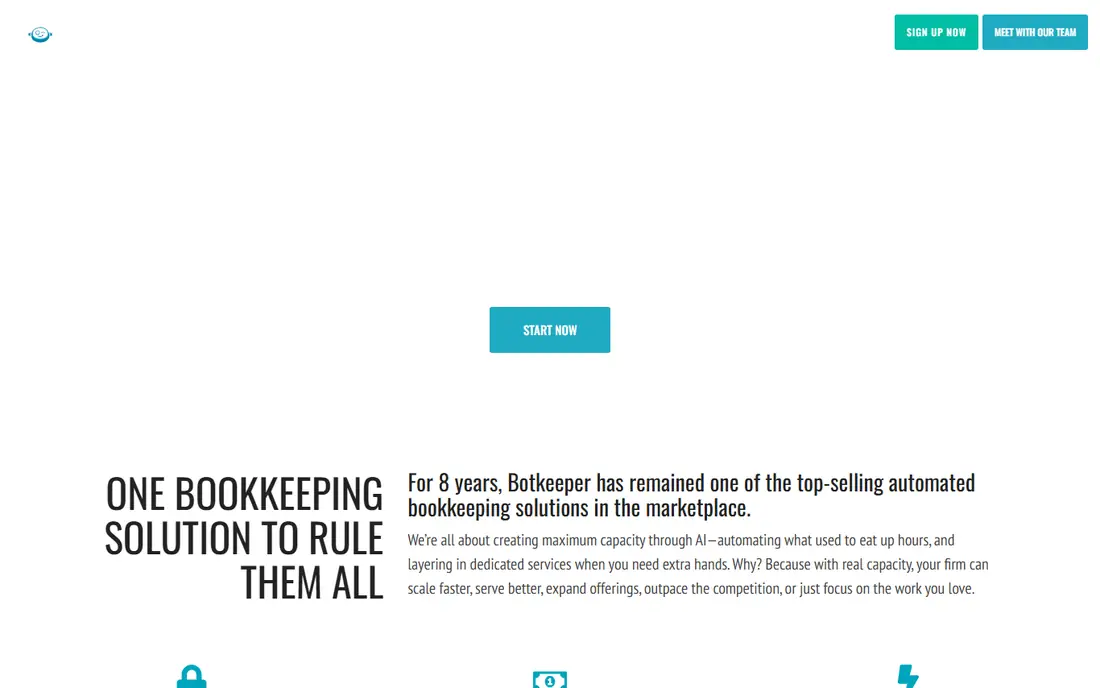
Botkeeper is the most widely deployed AI bookkeeping platform for accounting firms, and it is built as a firm-facing automation layer rather than a single-business tool. Its Infinite Platform categorises transactions, connects bank data, runs automated reconciliations and manages the close for each client entity, which is the repetitive work that eats a CAS team's hours. Pricing is published: $69 per client entity a month, with volume discounts at 5 licences for $49 each and 25 licences for $39 each when billed annually. The ownership story matters: Botkeeper announced it would shut down on 9 February 2026, and Xendoo announced on 3 March 2026 that it had acquired the platform and would keep it running, and it is selling subscriptions again under the Botkeeper name. A firm should confirm the current terms with Xendoo before signing, but the platform itself is back on sale.
What we like- Most widely deployed AI bookkeeping platform for accounting firms
- Handles categorisation, bank reconciliations, journal entries and close management
- Volume discounts bring the per-client price down to $39 a month at 25 licences
Watch out for- The company announced a permanent closure in February 2026, then was acquired by Xendoo in March 2026 and relaunched, so buyers should confirm the current ownership and roadmap
- Human bookkeeper add-ons cost $1,499 to $2,999 a month and need a minimum of 10 licences
#2
Vic.ai
Best for: Enterprise accounts payable automation with invoice processing, approval workflows and purchase order matching
Visit vic.ai
Starting priceQuote
Free planNo
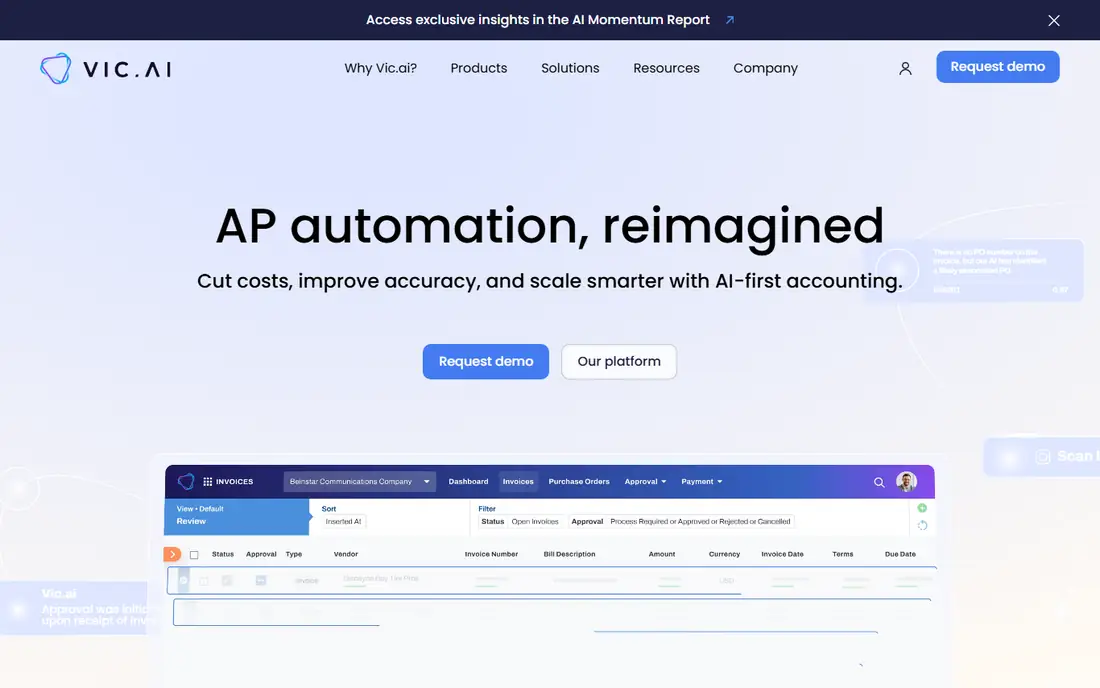
Vic.ai does one job, accounts payable, and does it at a level the general platforms cannot match. It reads invoices, codes them to the general ledger, routes them for approval, matches them against purchase orders and flags duplicates, with a claimed 99 percent accuracy on extraction and coding. The economics are clear: where manual invoice processing typically costs around $12 per invoice, Vic.ai brings it below $2, an 80 percent reduction that pays for the platform quickly when a firm processes thousands of invoices a month. Pricing is custom and quoted, and third-party reports put the entry point near $1,490 a month, so this is an enterprise tool with enterprise pricing. A firm whose CAS bottleneck is invoice volume should shortlist Vic.ai. A firm whose bottleneck is the monthly close should look at Docyt or Botkeeper instead.
What we like- Claims 99 percent accuracy on invoice data extraction, general ledger coding and approval routing
- Brings invoice processing cost below $2 per invoice, against about $12 manually
- Autonomous approval workflows and spend analytics
Watch out for- No published pricing, with third-party reports putting the entry point near $1,490 a month
- Built for high invoice volumes, so a small firm will not see the return
- Accounts payable only, not full bookkeeping
#3Docyt
Best for: Multi-entity bookkeeping, real-time reporting and month-end close for accounting firms4.7/5 on
G2 (35 reviews, checked Oct 2026)
Visit docyt.com
Starting priceFrom $299 a month
Free planNo
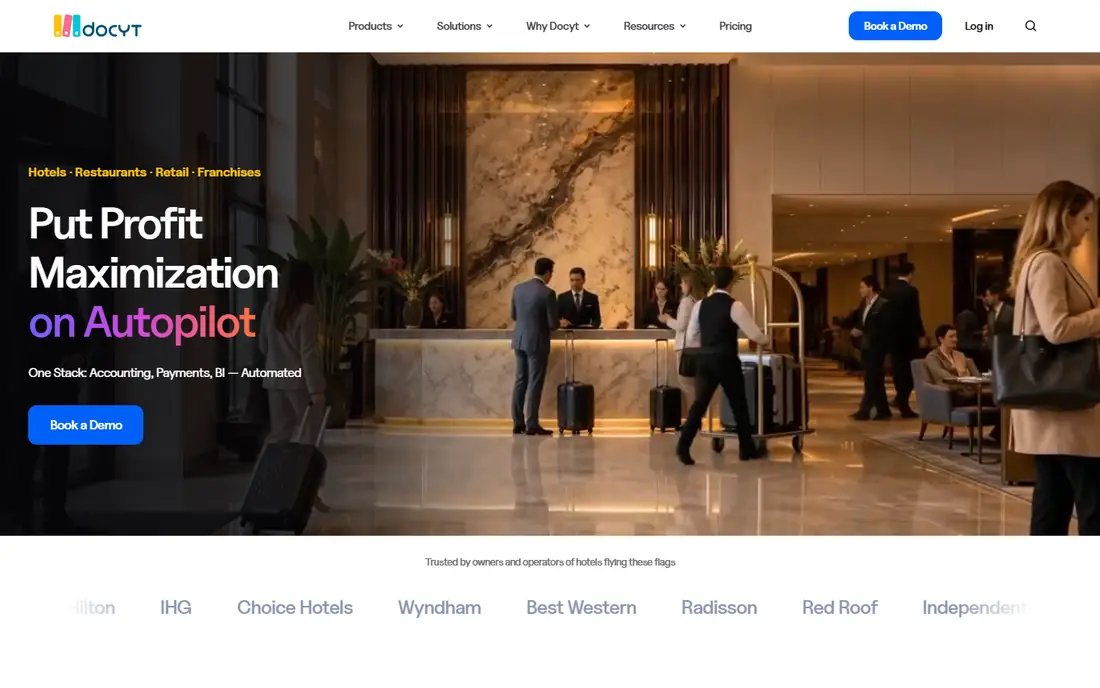
Docyt is the closest direct alternative to Botkeeper for AI bookkeeping automation, and it differs by giving the accountant AI tools to control directly rather than running a hybrid human service behind the scenes. Its Precision AI auto-categorises about 80 percent of transactions, with generative AI handling the remaining 20 percent, and it combines that with expense management, automated revenue accounting and a copilot that answers questions about the books in real time. Pricing runs from $299 to $999 a month per entity, which is a serious cost for a firm with many small clients, and there is no free version. For a firm with multi-entity clients that need real-time reporting rather than a monthly batch, Docyt is the stronger choice. For a firm with many small, simple clients, Botkeeper's per-client price is lower.
What we like- Precision AI auto-categorises about 80 percent of transactions, with generative AI handling the rest
- Real-time revenue reporting and multi-entity support
- AI copilot acts as a digital assistant for daily accounting work
Watch out for- $299 to $999 a month per entity is a high entry price for a small firm
- No free version
- The AI accounting plans are the most expensive, so the cost rises with the features a firm actually wants
#4
Puzzle
Best for: Startups and accounting firms that want an AI-native ledger with continuously updated books
Visit puzzle.io
Starting priceFree, paid plans from $30 a month
Free planYes
Puzzle is an AI-native alternative to QuickBooks, designed for businesses that want continuously updated books rather than a monthly close cycle. Its AI agents automatically categorise 90 to 95 percent of transactions, run reconciliations throughout the month and generate real-time cash flow, burn rate and runway dashboards, which is the reporting a startup founder actually reads. Pricing is published and transparent: Starter is free, Core is $30 a month, Complete is $50 a month, and Scale starts at $150 a month for advanced automation and agentic workflows. For an accounting firm, the per-entity cost is low enough to build into a $500 to $800 a month bookkeeping package with real margin. Puzzle is newer and less proven than the established platforms, but for a firm building a CAS line around startups, it is the cheapest credible start in this list.
What we like- Free Starter plan, with Core at $30 a month, Complete at $50 a month and Scale from $150 a month
- AI agents categorise 90 to 95 percent of transactions and reconcile throughout the month
- Real-time cash flow, burn rate and runway dashboards
Watch out for- Built for startups and small businesses, so a firm with large, complex clients may outgrow it
- The Scale plan is where the advanced automation lives, so the real price is higher than the headline $30
- Newer than QuickBooks, so fewer accountants know it
#5Digits
Best for: Accounting firms that want an AI accounting platform built for firm use4.9/5 on
G2 (8 reviews, checked Oct 2026)
Visit digits.com
Starting priceFrom $65 a month
Free planNo
Digits is an AI accounting platform built for accounting firms, and its pricing is published in three tiers: Essentials from $65 a month, Core from $100 a month, and a full-service plan from $350 a month that adds a dedicated accountant. That last tier is the interesting one for a firm: it pairs the software with a person, which suits a firm that wants to offer CAS without hiring the bookkeeper itself. The self-serve tiers give a firm continuously updated books, categorisation and reporting for its clients, at a per-client cost that fits a standard monthly bookkeeping package. Digits is less widely deployed than Botkeeper, so a buyer will find fewer peer reviews, but the published pricing and the firm-first design make it easy to evaluate. A firm should trial Digits against Botkeeper on the same five clients before choosing.
What we like- Built for accounting firms rather than adapted from a single-business tool
- Essentials from $65 a month, Core from $100 a month
- Full-service plan from $350 a month adds a dedicated accountant
- Real-time books and reporting
Watch out for- No free plan
- The full-service plan at $350 a month is a step up from the self-serve tiers
- Less widely deployed than Botkeeper, so fewer peer reviews from firms
#6Dext
Best for: Accounting firms capturing receipts, invoices and bank data at the start of the bookkeeping chain4.6/5 on
G2 (411 reviews, checked Oct 2026)
Visit dext.com
Starting priceFrom $235 a month
Free planNo
Dext, formerly Receipt Bank, has been a staple in accounting tech stacks for years, and it does the first step of bookkeeping: capturing, extracting and organising financial data from receipts, invoices and bank statements. That step matters because every automation tool in this list is only as good as the data it receives, and Dext is the tool most firms use to get clean data into QuickBooks Online or Xero. Pricing starts from $235 a month for accounting firms and varies by the number of clients, and there is no free version. Dext is now part of IRIS Software Group, which acquired it in December 2024, and it continues to operate independently. A firm should not buy Dext on its own and call it a CAS stack: it needs a ledger and a close tool alongside it, but as the capture layer it is the most proven option here.
What we like- Long-established data capture for receipts, invoices and bank statements
- Handles the first step of bookkeeping that every other tool in this list depends on
- Now part of IRIS Software Group, acquired in December 2024
- Pricing from $235 a month for accounting firms
Watch out for- Data capture only, so the firm still needs a ledger and a close tool
- $235 a month is a firm-level price that varies by client count
- The IRIS acquisition changed the ownership, so buyers should confirm the current product direction
#7Xero Practice Manager
Best for: Firms already running on Xero that want practice management built into the partner platform4.5/5 on
G2 (47 reviews, checked Oct 2026)
Visit xero.com
Starting priceIncluded with Xero partner plans
Free planNo
Xero Practice Manager is the practice side of the Xero ecosystem, and it is included with Xero partner plans, which makes it the cheapest practice platform in this list for a firm already on Xero. It manages jobs, time, billing and clients, and it connects directly to the Xero ledger and payroll that the firm's clients run on, so the bookkeeping and the practice management share the same data. The trade-off is scope: it is narrower than Karbon or TaxDome, and it only makes sense inside the Xero world. A firm that runs its clients on QuickBooks should pick QuickBooks Online Accountant instead. A firm that runs its clients on Xero should start here, because it costs nothing extra and it is the platform Xero's own partner programme is built around.
What we like- Included with Xero partner plans, so there is no separate per-seat price for partner firms
- Manages jobs, time, billing and clients inside the Xero ecosystem
- Deep integration with Xero ledger and payroll
Watch out for- Only makes sense for a firm already committed to Xero
- The practice management features are narrower than Karbon or TaxDome
- A firm on QuickBooks gets nothing from it
#8QuickBooks Online Accountant
Best for: Firms running clients on QuickBooks Online that want a free practice platform with client books in one place4.4/5 on
G2 (86 reviews, checked Oct 2026)
Visit quickbooks.intuit.com
Starting priceFree for accountants
Free planYes
QuickBooks Online Accountant is free for accountants, and it is the default practice platform for a firm whose clients run on QuickBooks Online. It gives the firm one dashboard for every client book, with remote access, accountant-only tools and the ProAdvisor programme, and it connects to the QuickBooks apps the clients already use. The price is the point: a firm pays nothing for the platform itself, and can spend its budget on an automation layer such as Botkeeper or Docyt instead. The limit is that it only works for QuickBooks clients, and its own bookkeeping automation is thinner than the specialist tools, so a high-volume CAS practice still needs Botkeeper or Docyt on top. For a firm starting CAS on QuickBooks, this is the free foundation everything else plugs into.
What we like- Free for accountants, with no per-seat charge
- Gives the firm one dashboard for every client book, with remote access and accountant tools
- Integrates with the QuickBooks apps and the ProAdvisor programme
Watch out for- Only works for clients on QuickBooks Online
- The bookkeeping automation is thinner than Botkeeper or Docyt, so a firm still needs an automation layer for high-volume CAS
- Intuit controls the roadmap
Frequently asked questions
What is the best client accounting services software for a small firm
Puzzle or Botkeeper suit a small firm best. Puzzle has a free Starter plan, with Core at $30 a month, which makes it cheap to run for a single client while the firm learns the workflow. Botkeeper costs $69 per client entity a month and handles categorisation, reconciliation, journal entries and close management across a client roster, with volume discounts at 5 and 25 licences.
How much does client accounting services software cost
Published prices run from free to about $1,490 a month. Puzzle starts free, Botkeeper starts at $69 per client a month, Digits starts at $65 a month, Docyt starts at $299 a month, and Dext starts at $235 a month for firms. QuickBooks Online Accountant is free for accountants, and Xero Practice Manager is included with Xero partner plans. Vic.ai is quote only, with third-party reports near $1,490 a month.
What happened to Botkeeper in 2026
Botkeeper announced a permanent closure on 9 February 2026, and Xendoo announced on 3 March 2026 that it had acquired the Botkeeper Infinite platform and would keep it running. Botkeeper is selling subscriptions again under Xendoo ownership. A firm should confirm the current terms with Xendoo before signing, because the ownership change is recent.
Does CAS software replace bookkeepers
No. The software automates categorisation, reconciliation and data capture, but a firm still needs people to review exceptions, talk to clients, handle payroll and tax, and sign off the close. Tools such as Botkeeper and Digits sell human bookkeeper services as add-ons for exactly this reason. The software changes what the bookkeeper spends time on, from data entry to review and advice, rather than removing the role.
Should a firm pick a CAS tool or a practice management tool first
Most firms need one of each. The CAS tool does the bookkeeping work, and the practice management tool organises the jobs, deadlines and billing around it. A firm starting from nothing should pick the CAS tool first if its bottleneck is doing the books, and the practice tool first if its bottleneck is knowing which client job is stuck. QuickBooks Online Accountant and Xero Practice Manager are free or included, so a firm on either ledger can start with the practice side at no extra cost.
Sources we checked (10)
- https://www.botkeeper.com
- https://www.vic.ai
- https://www.docyt.com
- https://www.puzzle.io
- https://www.digits.com
- https://www.dext.com
- https://www.xero.com
- https://quickbooks.intuit.com/accountants/
- https://www.jotform.com/ai/agents/ai-in-accounting/
- https://getuku.com/articles/botkeeper-alternatives/
Is your product missing or out of date?
We review this list regularly. Vendors can request a listing, send updated pricing or ask about featured placement.

Shihab Mia · Founder, Rankite
Shihab has 5+ years in B2B and SaaS SEO. He writes Rankite's software buying guides from pricing pages, documentation and public user reviews. More about Shihab.