How we make this list: we compare pricing pages, product documentation and public user reviews. Rankite is independent; if a vendor ever pays for a featured spot, that listing is clearly labeled Partner.
Key takeaways
- Planning Center is the most capable all-around choice, with a genuinely useful free tier and best-in-class worship planning, though costs rise as you add modules.
- ChurchTrac from $9 a month is the budget champion for small churches, and it is the only cheap option with built-in accounting.
- Breeze at $72 a month flat wins on simplicity: one price, unlimited people, easy enough for volunteers to learn.
- Tithe.ly pairs free online giving with a full ChMS, which makes it the natural pick for churches starting with digital donations.
- Pushpay, FellowshipOne, and Realm serve larger churches where giving strategy and multi-campus management matter most.
Quick comparison
| Tool | Best for | Starting price | Free plan |
|---|
 Planning Center Planning Center | all-around ChMS with worship planning | Free tier; modules from $14/month | Yes |
 Breeze Breeze | simple flat-rate ChMS for small to mid-size churches | $72/month | No |
 ChurchTrac ChurchTrac | budget all-in-one with built-in accounting | From $9/month | Free trial |
 Tithe.ly Tithe.ly | free giving plus full church management | Free giving; ChMS ~$72/month | Yes |
 Pushpay Pushpay | giving-first platform for growing churches | See website | No |
 FellowshipOne FellowshipOne | large churches needing deep member management | See website | No |
 Realm Realm | community engagement for mid-size churches | See website | No |
 Subsplash Subsplash | church apps plus media and giving | See website | No |
 Servant Keeper Servant Keeper | traditional member management for established churches | See website | No |
Is your product missing or out of date?
We review this list regularly. Vendors can request a listing, send updated pricing or ask about featured placement.
The best church management software
As of 2025, churchgoers are evenly split between digital givers and traditional givers, 50 percent each (Vanco Churchgoer Giving Study). Churches that promoted online giving saw a 32 percent increase in overall donations (Nonprofits Source, via Vanco). Those two numbers explain why church management software now centers on giving just as much as on member records: the database and the donation platform have become one job.
The best church software for small churches looks different from the best for a multi-campus megachurch. A plant of 40 needs affordable member tracking, simple giving, and check-in for kids. A church of 2,000 needs volunteer scheduling across campuses, contribution statements, small group management, and serious reporting. The nine tools below cover that whole range, with honest pricing for each.
Starting priceFree tier; modules from $14/month
Free planYes
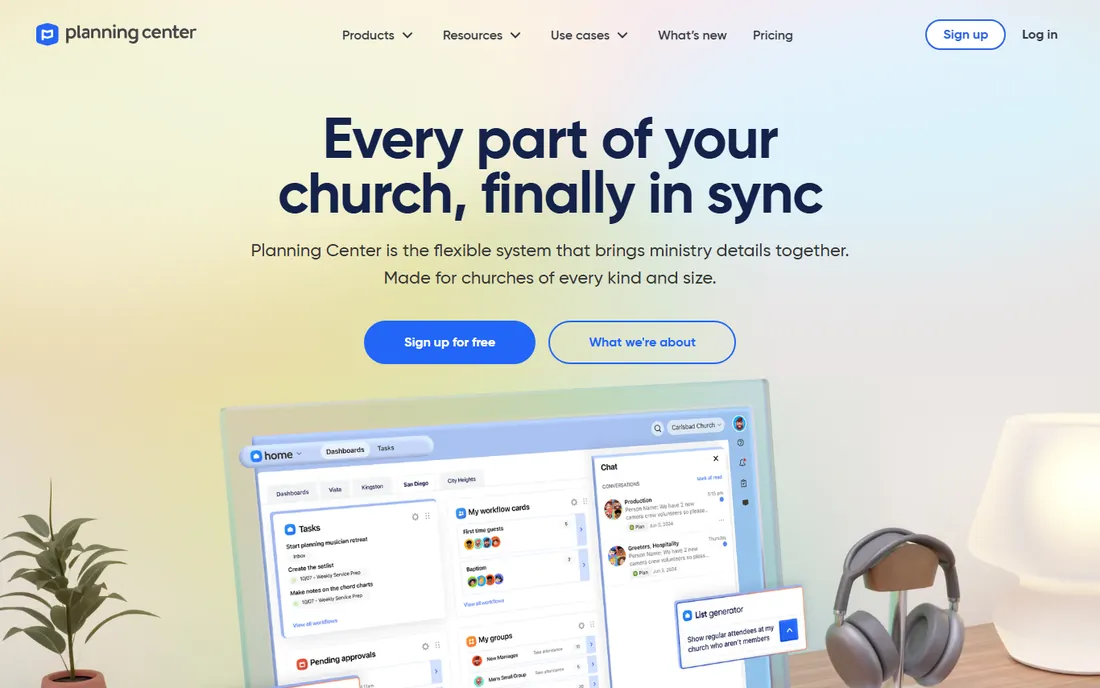
Planning Center is the top church management software pick for churches that want depth without enterprise cost. It is modular: People, Services, Giving, Check-Ins, Groups, and more, each priced separately by church size. A church plant can run meaningfully at $0 a month on the free tier, then add modules as it grows.
The Services module is the standout: worship planning, volunteer scheduling, and rehearsal coordination that no competitor matches. The free Church Center app gives members one place for giving, check-in, and groups. The catch is the bill at scale. A mid-size church running most modules pays $100 to $200 a month, and large churches cross $500. Start with the modules you need and add deliberately.
What we like- Best-in-class Services module for worship planning
- Genuinely useful free tier
- Free Church Center app for members
Watch out for- Modular pricing adds up fast
- Steeper learning curve than Breeze
Starting price$72/month
Free planNo
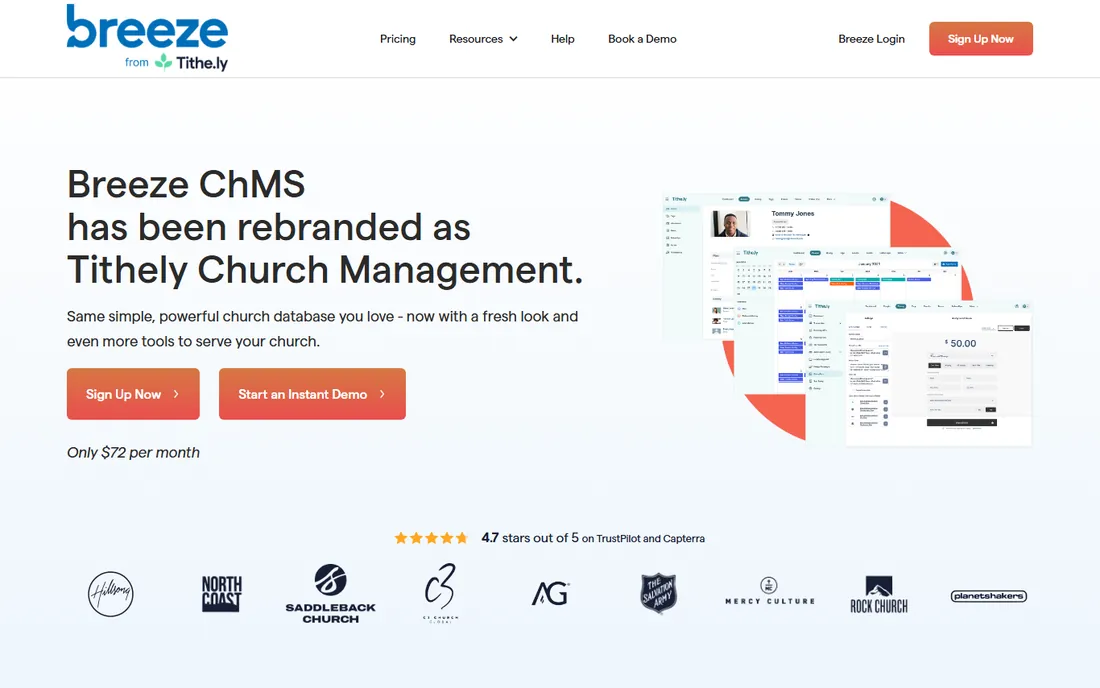
Breeze built its reputation on radical simplicity: $72 a month, every feature, unlimited people. No modules, no per-member tiers, no surprise bills as the congregation grows. Volunteers learn it in an afternoon, which matters enormously in churches where the "database administrator" is a volunteer with a full-time job elsewhere.
The feature set covers the essentials: member database, contributions, check-in, events, and communication. It will not match Planning Center's worship planning depth. Note the ownership change: Tithe.ly acquired Breeze, so long-term roadmap questions are fair to ask during evaluation. For churches that value simplicity over depth, Breeze remains the easiest yes on this list.
What we like- One flat price with unlimited people
- Easiest interface for volunteers
- No per-member math
Watch out for- Fewer advanced features than Planning Center
- No free tier
- Now owned by Tithe.ly
Starting priceFrom $9/month
Free planFree trial
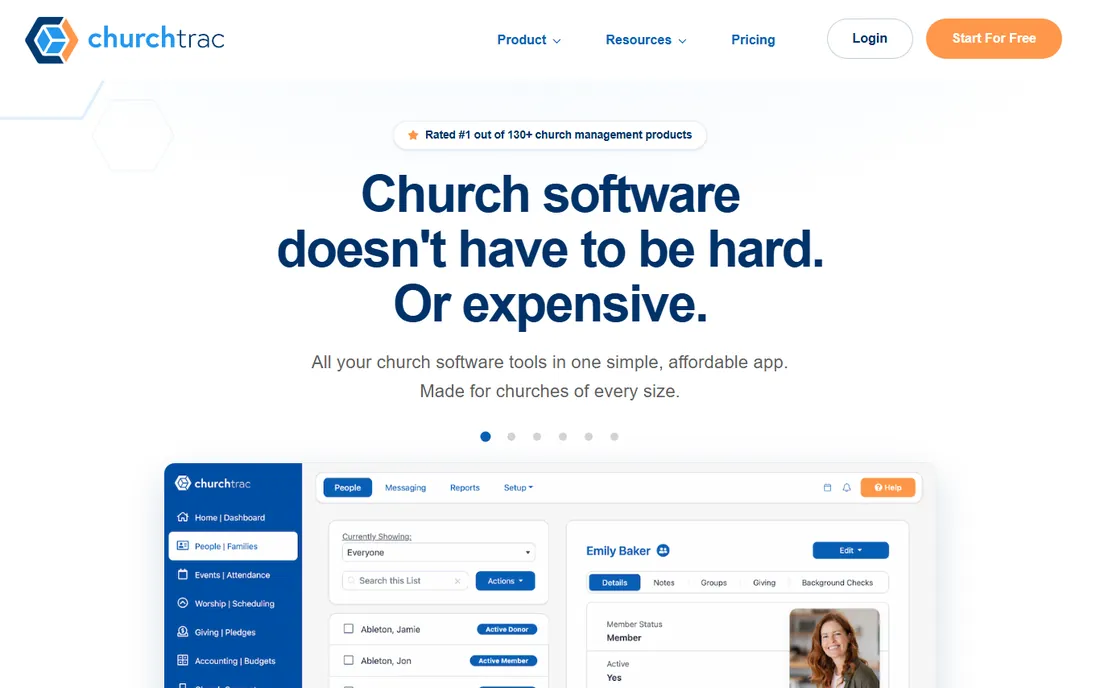
ChurchTrac is the value play: plans start at $9 a month and cap around $90 to $119 for unlimited names. For a church under 200 people, that means $29 to $39 a month for member management, giving records, check-in, communication, and, uniquely at this price, real accounting features. No other budget tool includes the books.
The tradeoffs are polish and ecosystem. The interface feels dated next to Planning Center, integrations are fewer, and worship planning is basic. But the best church accounting software question often ends here for small churches: ChurchTrac plus its built-in accounting replaces two subscriptions. Churches on genuinely tight budgets should start their search here.
What we like- Cheapest credible option at every size
- Includes accounting features
- Free church website hosting
Watch out for- Less polished interface
- Fewer integrations
- Weaker worship planning
Starting priceFree giving; ChMS ~$72/month
Free planYes
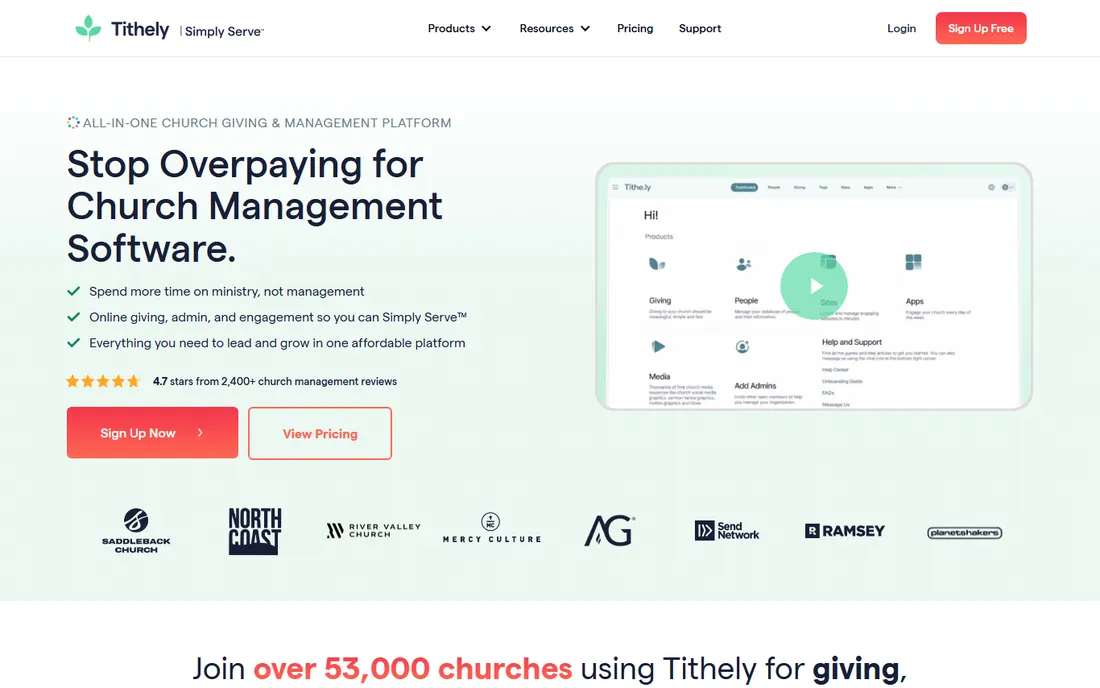
Tithe.ly attacks from the giving side. Online and mobile giving are free to set up, which lets a church accept digital donations this Sunday with no software bill. The broader platform adds church management, custom apps, websites, and messaging, making it a full ecosystem for churches that want one vendor.
The ChMS itself runs around $72 a month, comparable to Breeze. Giving processing fees apply per transaction, as with every platform. Churches that already use Breeze should note the acquisition: the two products now share an owner, and Tithe.ly's direction favors its integrated platform. For churches starting their digital journey with giving, Tithe.ly's free entry is the lowest-risk first step.
What we like- Online giving free to start
- Full ChMS, apps, and websites in one ecosystem
- Strong for digital-first churches
Watch out for- ChMS costs extra beyond giving
- Processing fees apply to donations
Starting priceSee website
Free planNo
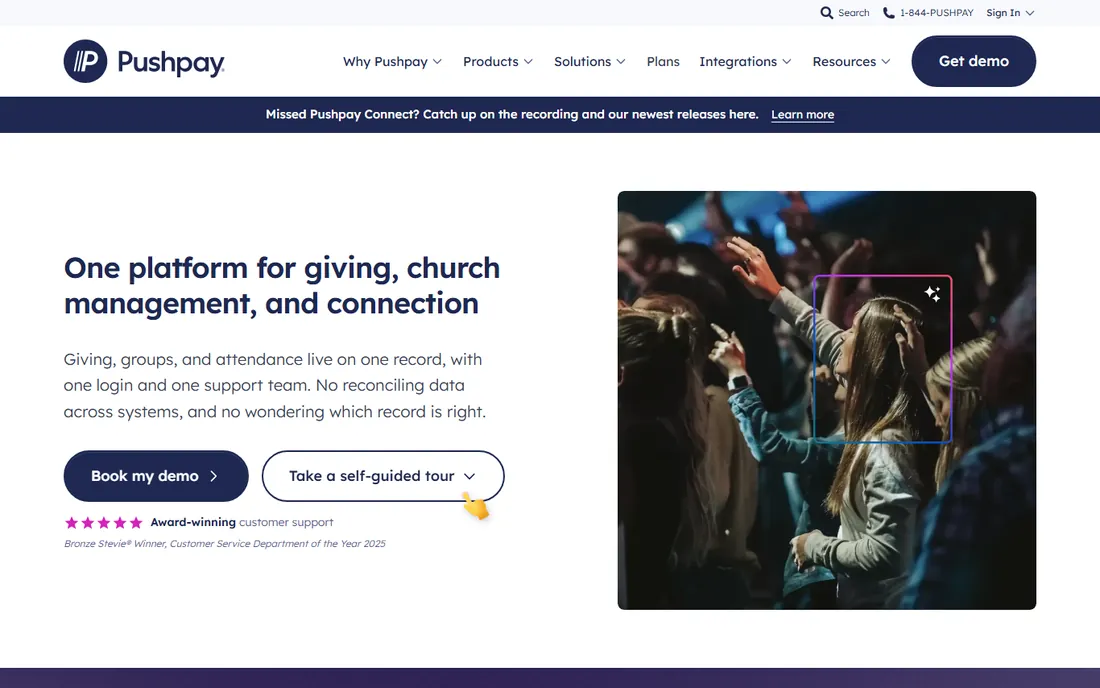
Pushpay built its name on mobile giving done exceptionally well, then expanded into a full church management platform. Growing churches choose it for the donor experience: fast mobile giving, recurring gift management, and analytics that show giving trends by campus, fund, and demographic. The 32 percent donation lift from promoting online giving is Pushpay's home territory.
Pricing is quote-based on annual plans, which signals its mid-market and large-church focus. The ChMS covers members, groups, and check-in competently but without Planning Center's worship planning depth. Churches where increasing generosity is the strategic priority, and where the budget supports an annual platform commitment, get the most from Pushpay.
What we like- Giving experience optimized for generosity
- Strong donor analytics
- Proven at large church scale
Watch out for- Quote-based annual pricing
- ChMS depth lags Planning Center
Starting priceSee website
Free planNo
FellowshipOne, part of the Ministry Brands family, serves large churches with complex needs: detailed household structures, multi-campus reporting, volunteer pipelines, and contribution management at scale. It has run some of America's largest churches for years, and that enterprise heritage shows in data depth.
It also shows in the buying experience. Pricing is quote-based, implementations take real effort, and the interface feels older than cloud-native rivals. Small churches should not bother. But a multi-campus church with 3,000 members and a database full of household complexity will find FellowshipOne's data model more capable than simpler tools that flatten everything into individual profiles.
What we like- Deep member and household data modeling
- Strong for multi-campus churches
- Long enterprise track record
Watch out for- Quote-based pricing
- Interface shows its age
- Implementation effort
Starting priceSee website
Free planNo
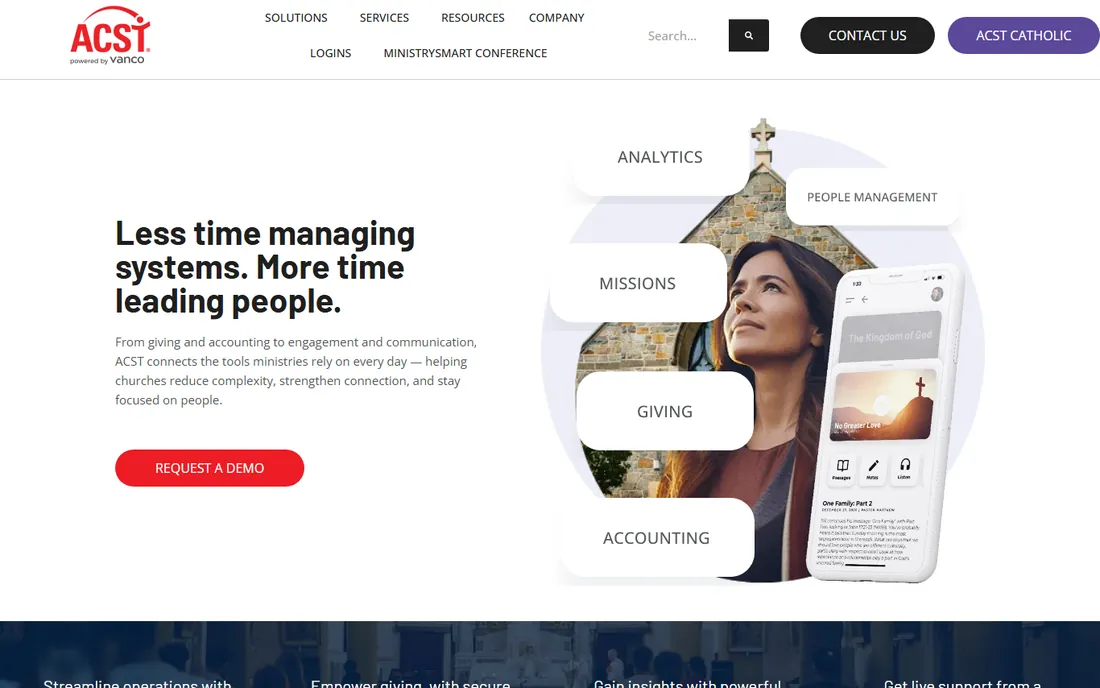
Realm comes from ACS Technologies, a long-time church software provider, and it emphasizes community: groups, communication, event management, and member engagement alongside the standard database and giving features. Mid-size churches focused on connection, not just administration, tend to like its orientation.
Pricing is quote-based and trends toward the mid-market, which prices out small churches that would do better with ChurchTrac or Breeze. The ACS backing means stability and a long support history, which matters to churches burned by startup ChMS products that pivoted or shut down. Evaluate Realm when community engagement, rather than worship production, is the church's defining need.
What we like- Strong communication and group features
- Online giving integrated
- Backed by ACS Technologies
Watch out for- Quote-based pricing
- Can be expensive for smaller churches
Starting priceSee website
Free planNo
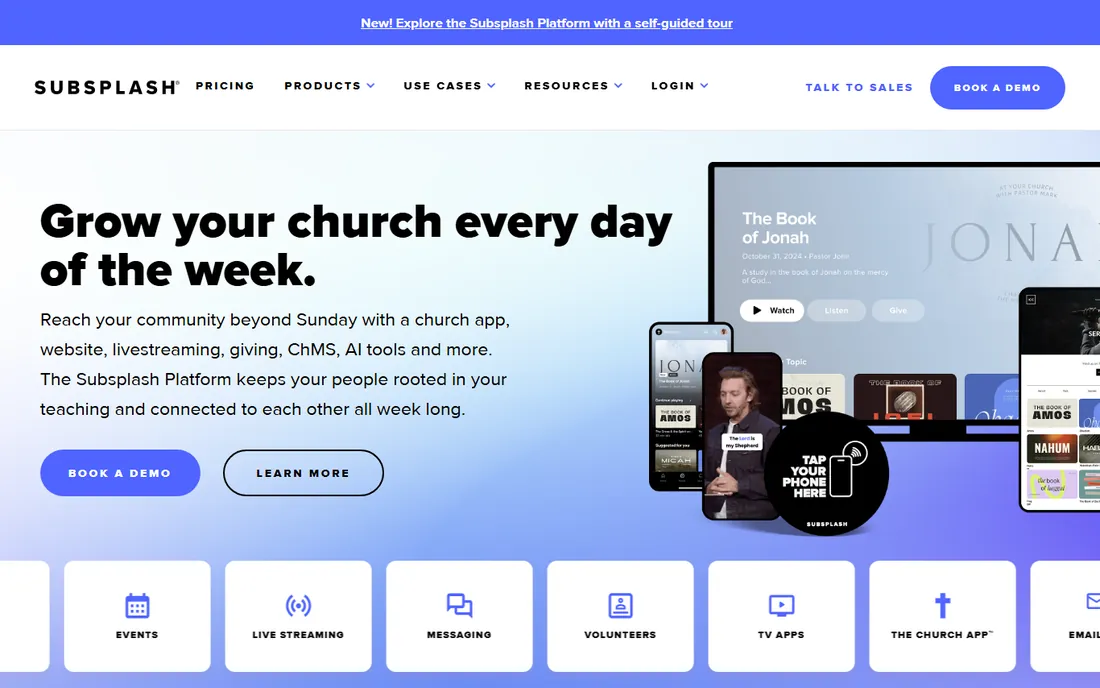
Subsplash starts from a different place than every other tool here: the church's mobile presence. Custom-branded apps with sermon media, Bible integration, push notifications, and giving come first, with church management, websites, and messaging rounding out the platform. Churches whose strategy centers on digital engagement often choose Subsplash for the app alone.
The ChMS covers people, groups, check-in, and giving without Planning Center's administrative depth. Pricing is quote-based. Media-heavy churches, those publishing sermons weekly and building digital discipleship, get value here that pure database tools cannot match. Administration-first churches should look elsewhere.
What we like- Beautiful custom church apps
- Media hosting and sermon distribution
- Giving and messaging included
Watch out for- Quote-based pricing
- ChMS depth thinner than Planning Center
Starting priceSee website
Free planNo
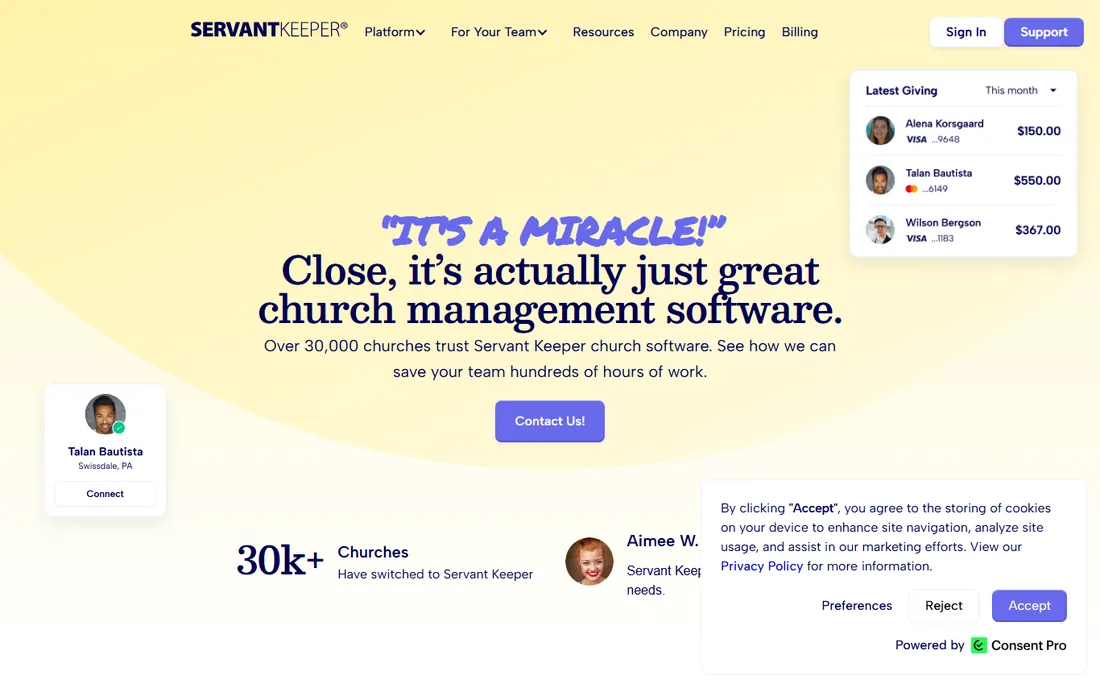
Servant Keeper has served churches for decades with dependable member management and contribution tracking. Established churches with long-tenured administrators often stay because the workflow is familiar and the data is trusted. Historically it offered purchase models rather than subscriptions, which appealed to churches that dislike monthly bills.
The honest assessment is that cloud competitors have passed it on mobile access, online giving integration, and member-facing features. Churches evaluating fresh in 2026 should compare it directly against Breeze and ChurchTrac on total cost and capability. Servant Keeper fits churches that prioritize continuity and desktop-based administration over digital engagement.
What we like- Long-established with loyal user base
- Straightforward member and contribution tracking
- One-time purchase options historically
Watch out for- Dated technology
- Limited online and mobile features compared to cloud rivals
How we built this shortlist
We compared church management tools using vendor pricing pages, feature documentation, and review data from G2, Capterra, SelectHub, and church technology publications. We weighted member database quality, giving and donation processing, check-in, volunteer scheduling, accounting integration, and fit for church size from plants to megachurches. We did not run hands-on trials, so workflow details come from documentation and verified user reviews rather than our own use.
What to check before your church commits
Start with congregation size and growth plans, because pricing models punish different sizes differently. Per-member tools like ChurchTrac stay cheap under 200 people. Flat-rate tools like Breeze win as you grow past a few hundred. Modular tools like Planning Center reward starting small and adding deliberately. Model your size in two years, not just today.
Test check-in with your actual children's ministry volunteers. Sunday morning check-in is the highest-stress workflow in church software: long lines, crying toddlers, volunteers who use the system once a week. Run a real Sunday trial before committing. The tool with the best feature list often loses to the tool the volunteers can actually operate at 9 AM.
Read the giving fee schedule completely. Software subscription cost is only half the giving economics. Processing fees per transaction, monthly gateway fees, and charges for premium giving features add up. A "free" giving platform with higher per-transaction fees can cost more annually than a paid platform with lower rates, depending on donation volume and average gift size.
Check data ownership and export terms. Member data, giving history, and contribution statements are the church's records. Confirm you can export everything, including giving history with donor attribution, in usable formats. Churches switching ChMS products report data migration as the hardest part, so negotiate export assistance before you need it.
Ask who supports the product on Sunday morning. Problems happen during services, not business hours. Confirm support hours, response times, and whether emergency support exists for check-in or giving outages. A tool with email-only support and no Sunday coverage is a risk every children's pastor understands immediately.
Giving fees: the cost nobody puts in the comparison table
Every ChMS comparison leads with subscription prices, but giving economics often decide the real cost. Consider a church receiving $20,000 a month in digital donations. A half-point difference in processing fees is $100 a month, $1,200 a year, which can exceed the price difference between whole software tiers.
The fee stack has three layers: the platform's cut, the payment processor's cut, and any monthly gateway or feature fees. Some vendors bundle processing; others pass through Stripe rates. Ask each vendor for the all-in effective rate at your donation volume, including every fee a donor's dollar passes through. Then compare that annual number against the subscription savings you are chasing.
Recurring giving changes the math further. Churches offering recurring options are twice as likely to see overall giving increase (Ministry Brands). A platform that makes recurring gifts easy can pay for its own fees in increased generosity. Evaluate giving UX, not just giving fees: the cheapest processor with a clumsy donation flow loses to a pricier one donors actually complete.
Frequently asked questions
What is the best church database software?
Planning Center's People module and Breeze both offer excellent member databases. Planning Center suits churches that will use the wider module ecosystem. Breeze suits churches that want one simple unlimited database at a flat price.
How much does church management software cost?
ChurchTrac starts at $9 a month, Planning Center runs $0 to $200+ depending on modules, and Breeze and Tithe.ly's ChMS sit at $72 a month flat. Larger platforms like Pushpay, FellowshipOne, and Realm use quote-based pricing. Most churches land between $30 and $200 a month.
Is there free church management software?
Planning Center's free tier covers small churches meaningfully, and Tithe.ly offers free online giving. ChurchTrac offers a free trial but no permanent free plan. Truly free full ChMS products are rare; the free tiers above are the practical options.
What is the best church accounting software?
ChurchTrac includes built-in accounting features at its low price, which makes it the standout for small churches. Larger churches typically integrate their ChMS with QuickBooks or use dedicated fund accounting software, since most ChMS accounting is basic.
Do I need a separate online giving platform?
Not necessarily. Tithe.ly, Pushpay, Planning Center, and Realm all include giving. Separate giving platforms make sense when your ChMS giving is weak or fees are high. Compare the all-in effective processing rate before adding a second vendor.
Can church management software handle multi-campus churches?
Planning Center, FellowshipOne, and Pushpay all support multi-campus operations with campus-level reporting and permissions. Confirm during the trial that campus scoping works the way your staff expects, since implementations vary.
Sources we checked (6)
- https://stuffplantersneed.com/best-church-management-software.html
- https://www.churchtrac.com/comparisons/churchtrac-vs-breeze
- https://pushpay.com/blog/church-software-under-50-per-month/
- https://www.selecthub.com/church-management-software/planning-center-vs-churchtrac/
- https://www.vancopayments.com/egiving/asset-church-giving-statistics-tithing
- https://subsplash.com/blog/church-giving-statistics
Is your product missing or out of date?
We review this list regularly. Vendors can request a listing, send updated pricing or ask about featured placement.

Shihab Mia · Founder, Rankite
Shihab has spent more than a decade helping SaaS and e-commerce brands grow through search. He writes Rankite's software buying guides from pricing pages, documentation and public user reviews. More about Shihab.