How we make this list: we compare pricing pages, product documentation and public user reviews. Rankite is independent; if a vendor ever pays for a featured spot, that listing is clearly labeled Partner.
Key takeaways
- Apricot and Penelope, both now under Bonterra (formerly Social Solutions), are the established enterprise choices with the deepest outcome-reporting tooling.
- Casebook, ClientTrack and FAMCare suit human services organizations that want configurability without enterprise complexity.
- CharityTracker is the collaboration pick for community coalitions coordinating assistance across agencies; Bell Data Systems fits agencies needing specialized program modules like HMIS or veterans' services.
- Every vendor here prices by quote: the real budget question is implementation and data migration, not the subscription.
Quick comparison
| Tool | Best for | Starting price | Free plan |
|---|
 Apricot by Bonterra Apricot by Bonterra | Nonprofits that need configurable case management with strong outcome reporting | See website (custom quote) | No (no free trial advertised) |
 Casebook Casebook | Human services nonprofits that want per-user pricing and real configurability | See website (custom quote) | No (no free trial advertised) |
 Penelope by Bonterra Penelope by Bonterra | Health and human service agencies that need scheduling plus billing in one system | See website (custom quote) | No (no free trial advertised) |
 CharityTracker CharityTracker | Community coalitions coordinating assistance across agencies | See website (custom quote) | No (no free trial advertised) |
 PlanStreet PlanStreet | Nonprofits that need HIPAA-compliant case management across programs | See website (custom quote) | No (no free trial advertised) |
 Exponent Case Management Exponent Case Management | Nonprofits already running on Salesforce | See website (custom quote) | No (no free trial advertised) |
 ClientTrack by CaseWorthy ClientTrack by CaseWorthy | Human services networks that need whole-person data across programs | See website (custom quote) | No (no free trial advertised) |
 FAMCare FAMCare | Agencies that live and die by defensible reporting | See website (custom quote) | No (no free trial advertised) |
 Bell Data Systems Bell Data Systems | Social service agencies that need specialized program modules | See website (custom quote) | No (no free trial advertised) |
Is your product missing or out of date?
We review this list regularly. Vendors can request a listing, send updated pricing or ask about featured placement.
The best case management software for nonprofits
A case manager spends Friday afternoon retyping client notes into a grant report because the database cannot produce the export the funder requires. Multiply that by every program, every funder and every audit, and you have the real cost of the wrong case management system. Nonprofit case management software has one job above all others: turn daily service data into defensible outcomes without drowning staff in admin. These nine platforms are the ones built for that job in 2026.
#1
Apricot by Bonterra
Best for: Nonprofits that need configurable case management with strong outcome reporting
Visit bonterratech.com
Starting priceSee website (custom quote)
Free planNo (no free trial advertised)
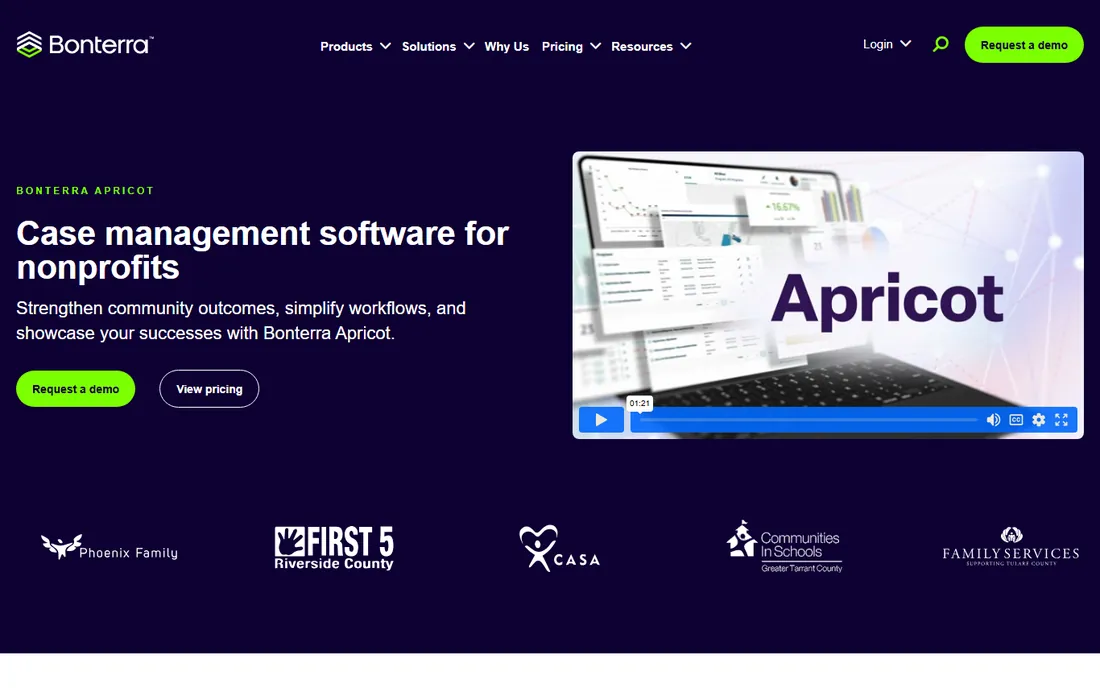
Apricot, formerly by Social Solutions and now part of Bonterra, is the reference point in nonprofit case management. The platform covers the full arc: intake, case notes, scheduling, referrals, service tracking and, most importantly, the reporting layer that turns all of it into funder-ready outcomes. The tier structure lets a small nonprofit start on Essentials and grow into Pro or Enterprise features (smart forms, advanced auditing, API access, single sign-on) without migrating platforms.
The honest caveat is that Apricot is an enterprise product wearing mid-market clothes. Pricing is entirely quote-based, and multi-program implementations need configuration work. The evaluation that matters is reporting: bring your hardest funder report to the demo and ask to see it built, not described. If the vendor builds it live, the platform will handle your reality. Bonterra's newer AI features are worth watching but should not drive the purchase decision today.
What we like- Three tiers (Essentials, Pro, Enterprise) that scale from small nonprofits to large agencies
- Form designer, workflow automation and visual analytics built for funder reporting
- AI assistant for summarizing participant history
Watch out for- Quote-only enterprise pricing with no published tiers
- Implementation needs real planning, especially for multi-program agencies
- The breadth of features means a learning curve for small teams
#2
Casebook
Best for: Human services nonprofits that want per-user pricing and real configurability
Visit casebook.net
Starting priceSee website (custom quote)
Free planNo (no free trial advertised)
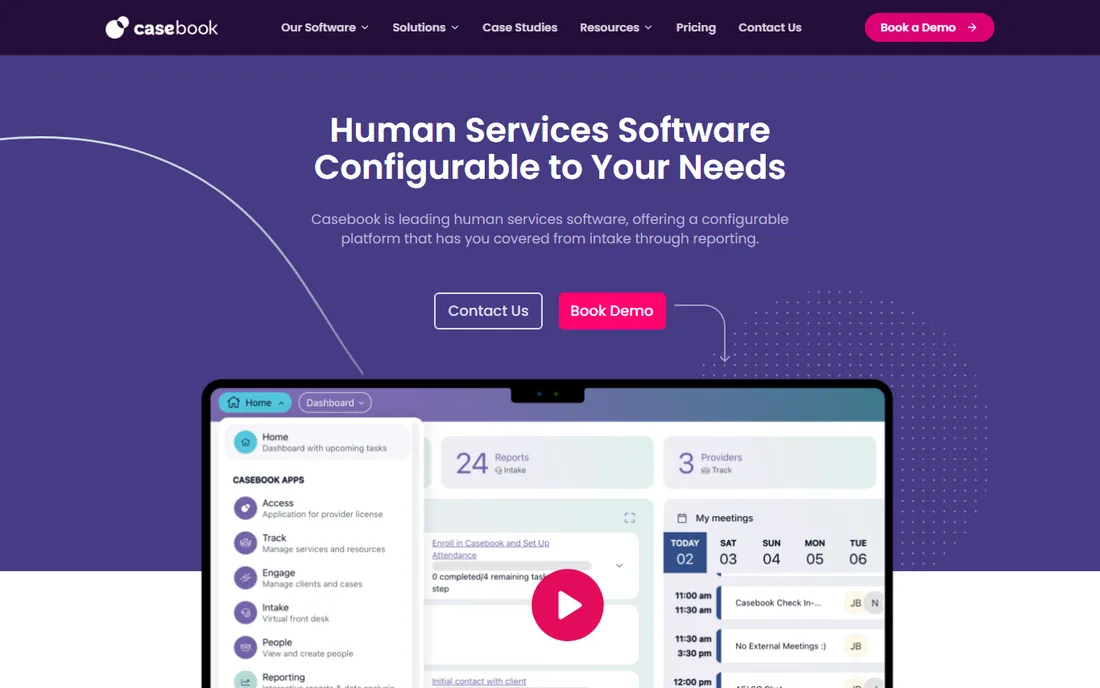
Casebook comes from an interesting origin: incubated by the Annie E. Casey Foundation for child welfare work, then rebuilt as a public-benefit corporation serving the whole human services sector. That history shows in the product's instincts. Intake, assessments, case management and reporting are configurable to program workflows rather than forcing programs into a generic mold, and the per-user pricing keeps the economics legible for nonprofits watching every dollar.
For smaller and mid-size human services organizations, Casebook often lands in the sweet spot between CharityTracker's simplicity and Bonterra's enterprise weight. The questions to ask are about your specific reporting burden: which of your funder reports can the system produce out of the box, and which need custom builds? Also ask about the implementation timeline for an organization your size. Smaller vendors can mean more attentive onboarding, but confirm the support model in writing.
What we like- Per-user pricing model that scales cost with actual staff
- Configurable program workflows without heavy custom development
- Built for both government agencies and nonprofits
Watch out for- Quote-based pricing with no published rates
- A smaller vendor than Bonterra, so the ecosystem is narrower
- Advanced reporting customization takes setup effort
#3
Penelope by Bonterra
Best for: Health and human service agencies that need scheduling plus billing in one system
Visit bonterratech.com
Starting priceSee website (custom quote)
Free planNo (no free trial advertised)
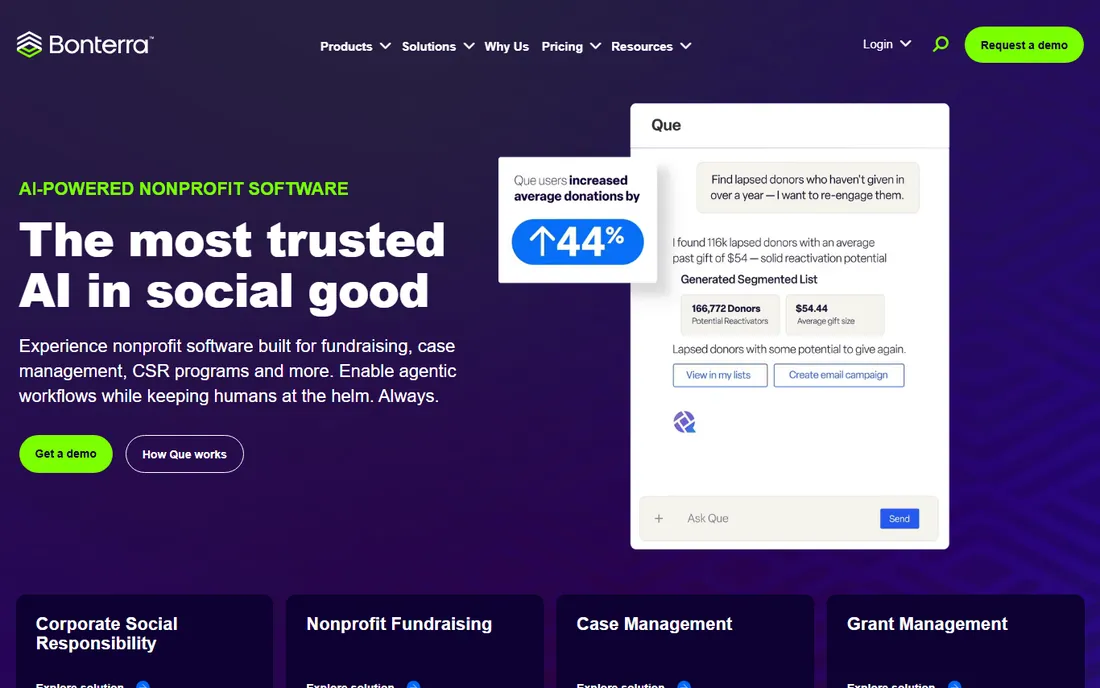
Penelope began life at Athena Software as case management for health and social service agencies, and it joined the Bonterra portfolio alongside Apricot when Social Solutions was acquired. The product's center of gravity is different from Apricot's: Penelope leans toward agencies that deliver scheduled services and bill for them, with integrated scheduling, billing, service tracking and outcome measurement in a single client record.
That makes it a natural fit for behavioral health, disability services and community health organizations where the case record and the billing record are the same thing. Pure social-service nonprofits that do not bill for services will find Apricot or Casebook more aligned. As with all Bonterra products, pricing is quote-based. Ask specifically how Penelope and Apricot differ for your use case, since Bonterra now sells both, and get the answer tied to your programs rather than to a feature matrix.
What we like- Deep scheduling, service tracking and billing in one record
- Outcome measurement tools built for clinical and social service workflows
- Client engagement portal for secure communication
Watch out for- Quote-only pricing
- Originally built for larger agencies, so small nonprofits may find it heavy
- The Athena Software heritage now sits inside Bonterra's portfolio, so confirm the product roadmap
Starting priceSee website (custom quote)
Free planNo (no free trial advertised)
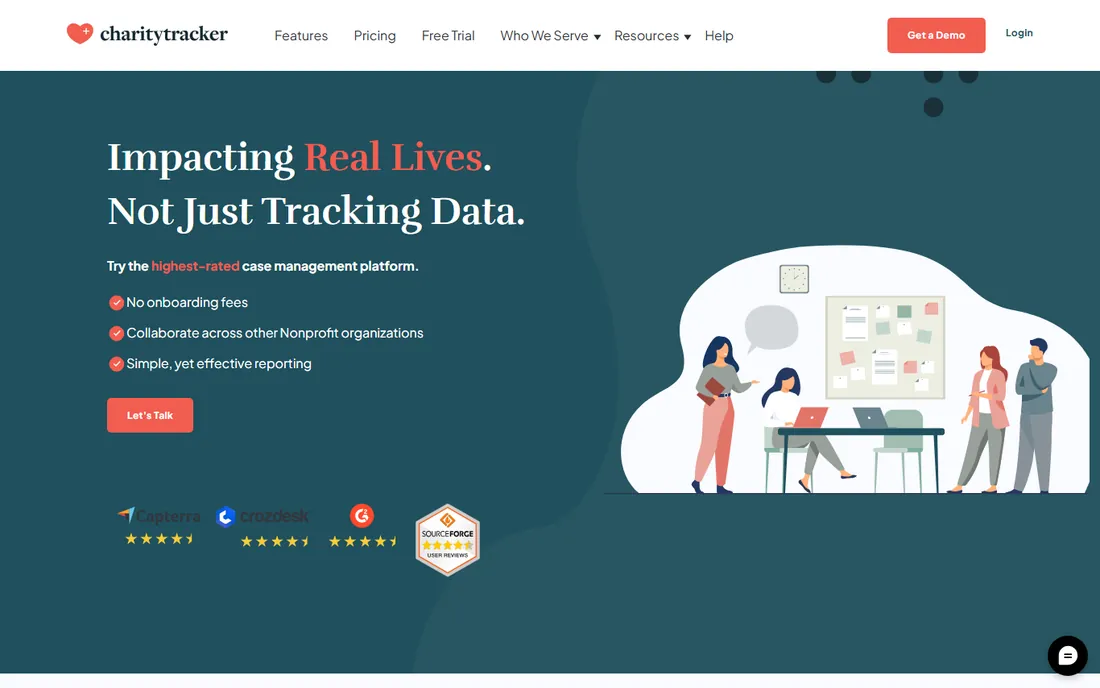
CharityTracker, by Simon Solutions, owns a specific and valuable niche: communities where many small agencies provide emergency assistance and need to coordinate. The classic use case is a network of churches, food banks and aid organizations sharing visibility into who received what, so assistance reaches more people and duplication drops. For that job, the simplicity is the feature: volunteers and part-time staff can actually use it.
Do not evaluate CharityTracker as a smaller Apricot. It is a different product for a different buyer. If your organization is one agency managing its own caseload with complex funder reporting, the enterprise tools fit better. If you are a coalition, a United Way partner network, or a community action agency coordinating dozens of small providers, CharityTracker's collaboration model is exactly the thing the bigger platforms handle awkwardly. Ask about the network pricing model, since coalition deployments price differently from single-agency ones.
What we like- Built for cross-agency collaboration, so communities can coordinate assistance and avoid duplication
- Straightforward case notes, assistance tracking and outcome reports
- Approachable for non-technical staff and volunteers
Watch out for- Quote-based pricing
- A simpler feature set than the enterprise platforms
- Agencies with complex billing or clinical workflows will outgrow it
#5
PlanStreet
Best for: Nonprofits that need HIPAA-compliant case management across programs
Visit planstreet.com
Starting priceSee website (custom quote)
Free planNo (no free trial advertised)
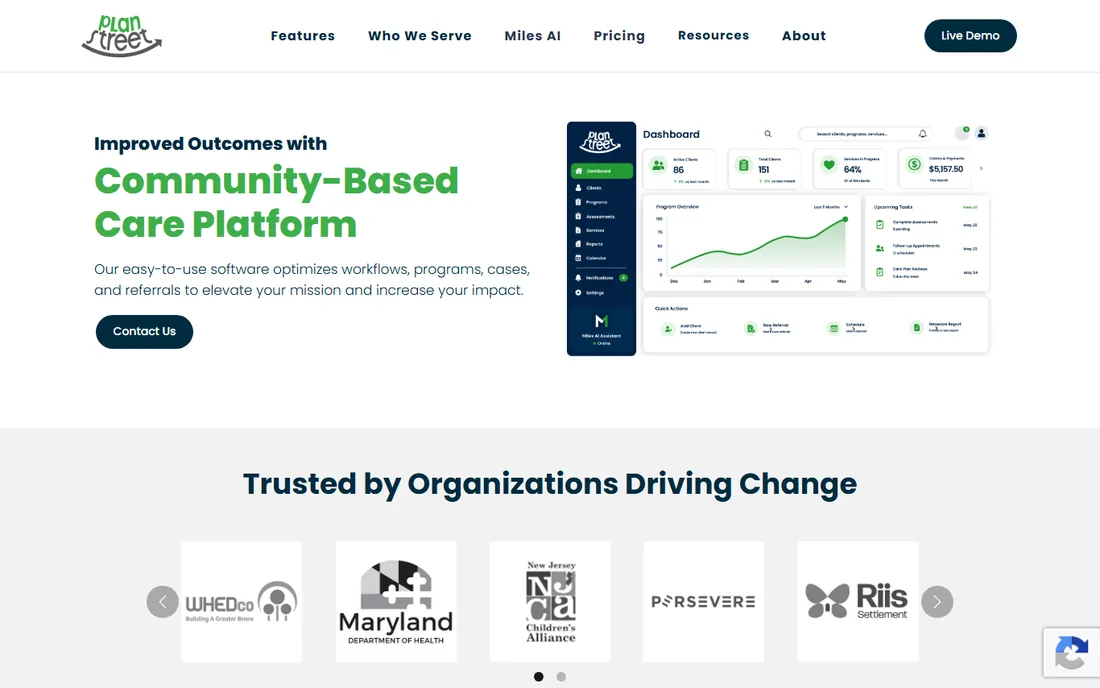
PlanStreet built its name on configurable case management for health and human services, with particular depth in programs that touch healthcare compliance: reentry, homeless services, behavioral health and community-based care. HIPAA compliance is table stakes for those programs, and PlanStreet treats it as architecture rather than a checkbox. The Medicaid billing integration is a genuine differentiator for agencies that bill public payers.
The platform's configurability is both the pitch and the project: highly customizable interfaces and reports mean the system can match your workflows, but someone has to do the configuring. Mid-size and larger agencies with an operations lead will get the most from it. Smaller nonprofits should weigh the implementation effort against simpler alternatives. As always in this category, bring your funder reports to the demo and ask for the billing workflow to be shown end to end if you bill Medicaid.
What we like- HIPAA-compliant platform suited to health-adjacent programs
- Covers reentry, homeless management (HMIS), donor management, child and family services and affordable housing
- Workflow automation plus Power BI-based reporting
Watch out for- Quote-only pricing
- The breadth across program types adds configuration complexity
- Implementation timelines need explicit commitment
Starting priceSee website (custom quote)
Free planNo (no free trial advertised)
Exponent Partners is a Salesforce consultancy for nonprofits, and its case management offering is Salesforce-native: client intake, program enrollment, service delivery and referrals running on the Salesforce platform with HIPAA-compliant configuration. For nonprofits already on Salesforce for fundraising or program management, the logic is compelling. One platform, one data model, one admin skill set, and case data that joins naturally with donor and program data.
The math only works if Salesforce is already in the building or planned for other reasons. Salesforce licensing plus consulting implementation puts the total cost above most standalone case management tools, and the implementation is a services engagement, not a signup. Nonprofits choosing between Salesforce-based case management and a standalone platform should model three-year total cost including licenses, implementation and admin staffing. If the organization is committed to Salesforce strategically, Exponent is the case management answer. If not, the standalone tools below cost less.
What we like- Built on Salesforce, so organizations invested in the ecosystem keep one platform
- Covers intake, program enrollment, service delivery and referrals
- HIPAA-compliant with outcomes and impact measurement
Watch out for- Requires Salesforce, which sets the cost floor
- Implementation is consulting-led, so budget for services
- Quote-based pricing on top of Salesforce licensing
#7
ClientTrack by CaseWorthy
Best for: Human services networks that need whole-person data across programs
Visit eccovia.com
Starting priceSee website (custom quote)
Free planNo (no free trial advertised)
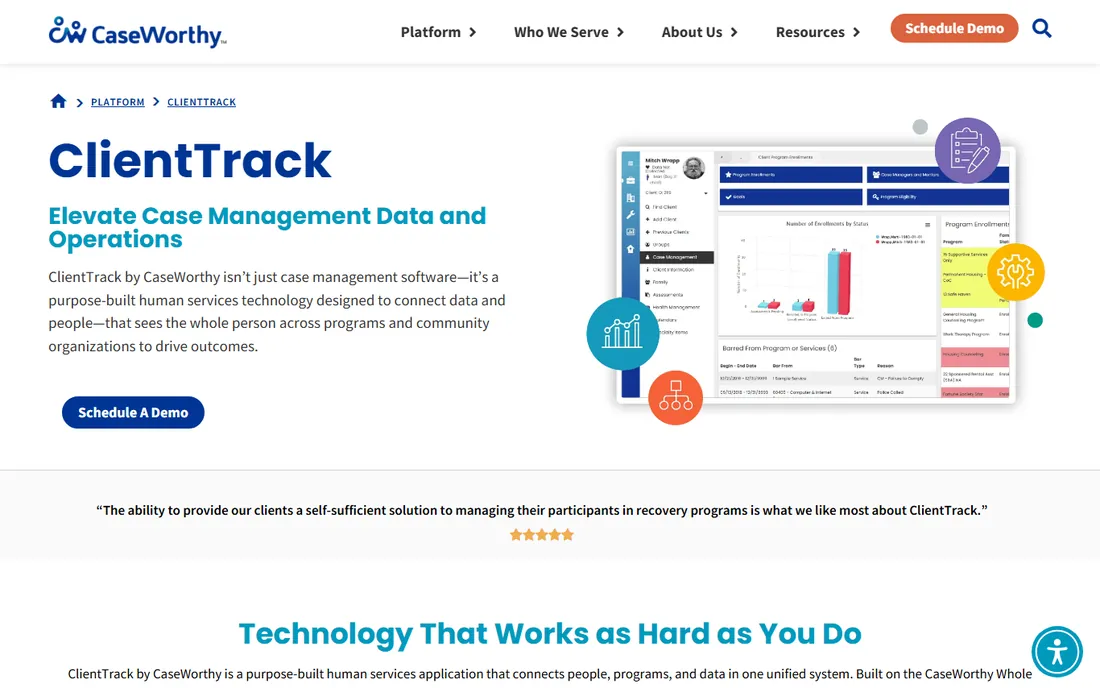
ClientTrack, long the flagship of Eccovia Solutions, now sits on the CaseWorthy platform after the two companies combined. The product's defining idea is whole-person care: instead of each program keeping its own client record, the platform maintains one unified record that follows the person across housing, employment, aging and health programs. For Continuums of Care, community action networks and multi-program agencies, that data model matches reality better than program-siloed systems.
The combined company's pitch is configurability without consultants: no-code tools for forms, workflows and assessments alongside deeper configuration for complex deployments. The merger is recent enough that buyers should ask direct questions about the roadmap: which product surfaces survive, what the migration path looks like for existing ClientTrack customers, and how support is organized. The platform's depth in HMIS and homeless services compliance reporting remains its strongest credential.
What we like- Whole-person care data model that follows clients across programs instead of fragmenting them
- Deep HMIS, aging services and workforce development heritage
- No-code configuration tools plus enterprise-grade security (SOC 2 Type II, HIPAA)
Watch out for- Quote-based enterprise pricing
- Oriented toward networks and larger agencies rather than small nonprofits
- The Eccovia and CaseWorthy combination means asking pointed questions about the product roadmap
#8
FAMCare
Best for: Agencies that live and die by defensible reporting
Visit famcare.net
Starting priceSee website (custom quote)
Free planNo (no free trial advertised)
FAMCare's whole homepage is an argument: most reporting problems are actually data collection problems, and the fix is disciplined workflows upstream, not better report builders downstream. The product follows that philosophy with structured assessments, individualized service plans, outcome tracking and multi-funder management designed so the numbers hold up under audit. For agencies whose existence depends on grant renewals, that framing resonates.
The implementations are tailored rather than templated, which means the system fits the agency's program model closely but the project takes longer than a self-serve signup. Juvenile justice, child welfare, domestic violence and tribal services show up in the customer stories, all sectors where defensible documentation is non-negotiable. Boards that want a safe, recognizable vendor name may lean Bonterra; operations leaders who want reporting they can defend tend to like FAMCare. Ask for a walkthrough of the audit trail on a sample case.
What we like- Reporting-first design philosophy, with assessments, service planning and outcomes tracking built to produce auditable results
- Multi-funder management for agencies juggling grant requirements
- Tailored implementations for specific program models
Watch out for- Quote-based pricing
- Tailored implementations take calendar time
- Less brand recognition than Bonterra, which matters for board-level comfort
Starting priceSee website (custom quote)
Free planNo (no free trial advertised)
Bell Data Systems is the specialist's specialist: instead of one generic case management product, it ships modules tuned to specific human services programs. Homeless management information systems, domestic violence case management with survivor-data safeguards, veterans' benefits claims, emergency financial assistance and food bank operations each get purpose-built workflows. For an agency whose daily work matches one of those modules, the fit is immediate in a way generic platforms cannot match.
The tradeoff is the mirror image: agencies running programs outside those specialties will do more configuration, and the integration ecosystem is narrower than the big platforms'. This is a vendor to evaluate on workflow fit rather than feature checklists. Run your actual intake and assessment process in the demo, ask how survivor and client data protections work in practice, and confirm the reporting covers your specific funder requirements. For the right agency, nothing else on this list fits as well.
What we like- Purpose-built modules for HMIS, domestic violence services, veterans' benefits claims, emergency financial assistance and food banks
- HIPAA-compliant with heavy customization
- A focused vendor that knows human services workflows
Watch out for- Quote-only pricing
- A smaller vendor with a narrower integration ecosystem
- Agencies outside its program specialties get less out-of-the-box value
Frequently asked questions
How much does case management software for nonprofits cost?
Nearly every vendor prices by custom quote based on user count, programs and modules. Third-party directories commonly show ranges from around $20 to over $100 per user per month, but treat those as rough signals, not quotes. The bigger budget line is usually implementation and data migration: budget as much for services as for the first year of subscription, and get both in writing.
What is the difference between case management software and a nonprofit CRM?
A nonprofit CRM (like a donor management system) tracks supporters, donations and fundraising. Case management software tracks clients, services, outcomes and program data. Some platforms blur the line, but funders and auditors care about the case side: service records, assessments, outcomes and compliance reporting. Buy the system that serves the funder relationship, not the fundraising team.
Do we need HIPAA-compliant software?
If your programs handle health information (behavioral health, disability services, community health, anything billing Medicaid), yes, and the compliance needs to be architectural, not a settings toggle. Pure social services without health data still benefit from strong security, but HIPAA specifically applies to covered health information. When in doubt, ask your compliance officer before you shortlist.
How long does implementation take?
Simple deployments (CharityTracker for a coalition, Casebook for a single program) can go live in weeks. Enterprise implementations with data migration, custom forms and multi-program configuration (Apricot, Penelope, ClientTrack) typically run several months. The timeline driver is data: the messier the legacy spreadsheets and the more programs involved, the longer the project.
Can we migrate our data from spreadsheets or an old system?
Yes, and every vendor on this list does migrations routinely. The quality of the migration depends on your data hygiene going in: consistent client identifiers, deduplicated records and clean program definitions. Ask each vendor what the migration process includes, what it costs, who does the data cleanup, and what a sample migrated record looks like before you sign.
What to ask on the demo call
Bring your hardest funder report and ask the vendor to build it live. This single test separates platforms that fit your reality from platforms that fit a slide deck. Second, ask who configures the system: your staff, the vendor's services team, or a third-party consultant, and what each path costs. Third, pin down the data model: can one client exist across multiple programs with a unified record, or does each program keep its own silo? Fourth, ask about user roles and permissions in detail, especially for sensitive programs like domestic violence services where data access rules are safety issues. Finally, get the support model in writing: response times, whether support staff understand human services workflows, and what training is included versus billable.
The hidden cost: implementation and data migration
The subscription is rarely the expensive part. A mid-size nonprofit can easily spend as much on implementation services as on the first year of software, and data migration is where projects stall. Legacy data lives in spreadsheets with inconsistent client IDs, duplicate records and program definitions that changed three years ago without anyone writing it down. Cleaning that up is real work, and vendors differ on how much of it they include.
Protect yourself with three contract items. First, a defined migration scope: which data, from which systems, cleaned by whom, validated how. Second, a training plan with named deliverables, not a vague promise of "onboarding." Third, a go-live date with acceptance criteria tied to your actual workflows, not the vendor's standard checklist. And keep one staff member as the internal owner of the project. Vendors implement software; only someone inside the organization can decide what the data should mean.
How we chose
We started with the searches buyers run: case management software for nonprofits, nonprofit case management software and human services case management software. For each candidate we verified it is a live product serving nonprofits or human services agencies (not a generic CRM or EHR), opened the vendor's own site to confirm the current product name and positioning, and checked the vendor's own pricing page for published prices. Where no price is published we wrote "See website" rather than repeating third-party estimates. Two notes on names: Apricot and Penelope are now Bonterra products (Apricot was Social Solutions', Penelope was Athena Software's) following the 2021 acquisitions, and ClientTrack is now part of CaseWorthy; we list each under its current name. Feature claims come from vendor documentation and product pages, cross-checked against practitioner discussion, not from hands-on testing.
Sources we checked (11)
- https://www.bonterratech.com/product/apricot
- https://casebook.net/
- https://bonterratech.com/
- https://charitytracker.com/
- https://planstreet.com/
- https://exponentpartners.com
- https://eccovia.com/clienttrack/
- https://www.famcare.net
- https://belldatasystems.com/
- https://www.g2.com/categories/case-management
- https://www.capterra.com/case-management-software/
Is your product missing or out of date?
We review this list regularly. Vendors can request a listing, send updated pricing or ask about featured placement.

Shihab Mia · Founder, Rankite
Shihab has spent more than a decade helping SaaS and e-commerce brands grow through search. He writes Rankite's software buying guides from pricing pages, documentation and public user reviews. More about Shihab.