How we make this list: we compare pricing pages, product documentation and public user reviews. Ratings come from G2, Capterra or Trustpilot, with the date we checked them.
Key takeaways
- CollX is the best free scanner for most collectors, with unlimited scans and a built-in marketplace.
- Ludex is the most accurate scanner on modern parallels, with prices drawn from actual completed sales.
- eBay app scanner suits sellers who want a free scanner built into listing.
- Card Ladder suits tracking a collection value over time with real eBay sale data.
- Sports Cards Pro suits casual collection tracking with a simple scanner.
- SlabHawk suits graded-card collectors who need values broken down by grading company and grade.
- 130 Point suits finding what a card genuinely sold for, free, from eBay sold listings.
- PreGradeCards suits the grading decision, with AI analysis of centering, corners, edges, and surface.
- Scan accuracy note: values shown by scanner apps are estimates, not appraisals. Condition and grade move real prices far more than a quick scan can tell, and a PSA 10 of a card can sell for ten times what the same card sells for raw. Always check recent sold prices before you buy, sell, or pay to grade.
Quick comparison
| Tool | Best for | Starting price | Free plan |
|---|
 CollX | Free scanning and marketplace | Free | Yes |
 Ludex | Accurate parallels and pricing | Free | Yes |
 eBay | Free scanner for listing | Free | Yes |
 Card Ladder | Collection value tracking | Free | Yes |
 Sports Cards Pro | Casual collection tracking | Free | Yes |
 SlabHawk | Graded-card values by grade | Free | Yes |
 130 Point | Real eBay sold prices | Free | Yes |
 PreGradeCards | AI pre-grading for grading decisions | Free | Yes |
Is your product missing or out of date?
We review this list regularly. Vendors can request a listing, send updated pricing or ask about featured placement.
The best card scanner apps
Starting priceFree
Free planYes
CollX is the best free scanner for most collectors. The free tier covers unlimited scans and collection tracking, the database covers over 20 million cards across sports and trading card games, and a built-in marketplace lets you buy and sell without leaving the app. Scanning takes 2 to 4 seconds per card, with bulk mode for commons.
The limits are parallels and pricing. Parallel accuracy runs near 65 percent in independent testing, prices run about 22 percent above real eBay sold values because they blend asking prices, and CollX skips population reports from PSA, BGS, or SGC. For casual collectors, CollX is the best free pick.
What we like- Free tier with unlimited scans
- 20M+ cards across sports and TCG
- Built-in marketplace
Watch out for- Weaker on parallels at about 65% accuracy
- Prices run about 22% above eBay sold
- No population reports
Starting priceFree
Free planYes
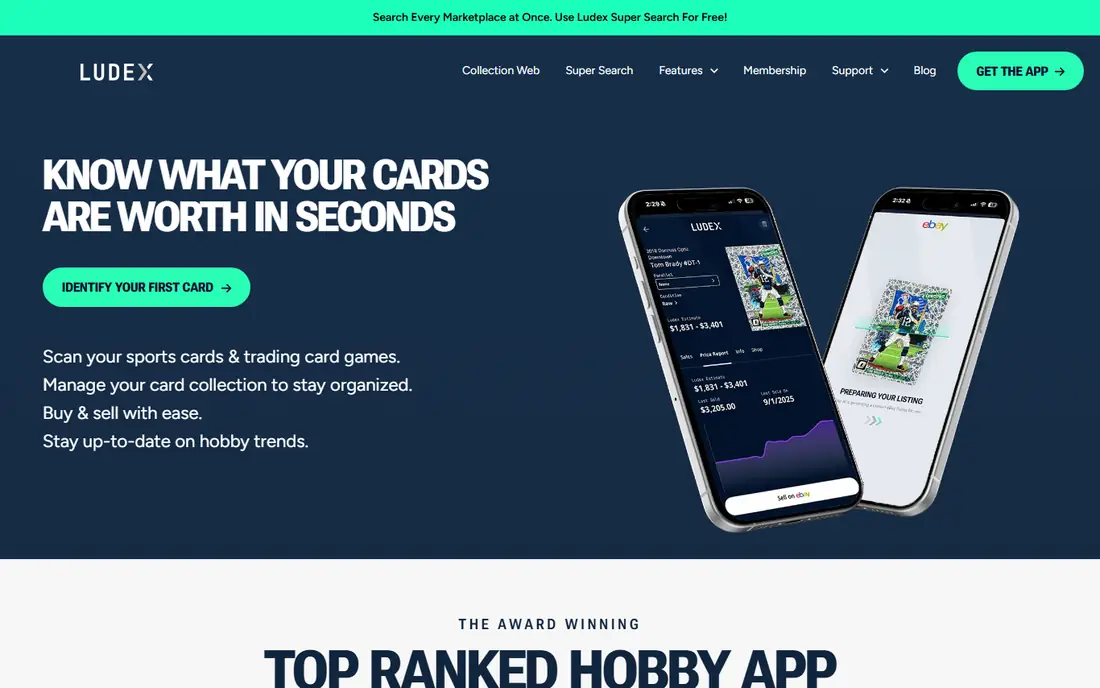
Ludex is the most accurate trading card scanner in the hobby, deciphering complex variations and parallels with market values based on actual completed sales from marketplaces. It covers sports cards and trading card games such as Pokemon, Magic: The Gathering, and Yu-Gi-Oh in one app, with real-time price updates and a List-It feature for eBay selling.
The trade off is cost and caps. The free tier allows unlimited scans but caps collection at 60 cards, Lite costs $4.99 per month for one category, and Standard costs $9.99 per month, while some third-party sources cite $19.99 per month for premium tiers, so confirm on the vendor site. For dealers and modern-set collectors, Ludex is the best scanner.
What we like- Most accurate on parallels at about 85%
- Prices from actual completed sales
- Fast scans at 1.5 to 2 seconds
Watch out for- Free tier caps collection at 60 cards
- Paid plans from $4.99 per month
- Published premium prices conflict across sources
Starting priceFree
Free planYes
eBay app scanner suits sellers who want a free scanner built into listing. Scan a card, match it to a listing, and list it for sale without a separate app. The sold-listings filter shows what cards actually sold for, which is the number that matters before you buy, sell, or pay to grade.
The limits are tracking and analysis. The scanner is built for listing, not collection tracking, and it offers no parallel accuracy claims or condition analysis. Selling fees apply on completed sales. For sellers, eBay scanner plus sold listings is the most honest value check.
What we like- Free in-app scanner for listing
- Largest buyer pool
- Sold-listings filter shows real prices
Watch out for- Scanner built for listing, not collection tracking
- No parallel accuracy claims
- Selling fees apply
Starting priceFree
Free planYes
Card Ladder suits tracking a collection value over time with real eBay sale data. Rather than scanning for identity, it pulls sale data to value a tracked collection, with player index tools that follow market trends. For collectors who want portfolio-style tracking, Card Ladder is the best dedicated tracker.
The trade off is volatility. Player index weighting can swing valuations by large amounts in a day with no real market event, and full features sit behind paid tiers. Pair Card Ladder tracking with a scanner for identity and a sold-listings check for value.
What we like- Collection value from real eBay sale data
- Tracks value over time
- Player index tools
Watch out for- Player index weighting can swing valuations sharply
- Paid tiers for full features
- Less a scanner than a tracker
Starting priceFree
Free planYes
Sports Cards Pro suits casual collection tracking with a simple scanner and easy manual adds. It covers a broad card database and lets collectors log collections quickly without deep analysis tools.
The limits are pricing accuracy. Its proprietary algorithm tends to inflate values, there is no grade-specific pricing, and parallel accuracy is weaker than Ludex. For casual tracking, Sports Cards Pro is fine, but verify values against sold listings before any transaction.
What we like- Simple collection tracking
- Broad card database
- Easy manual adds
Watch out for- Proprietary algorithm tends to inflate values
- No grade-specific pricing
- Weaker on parallels
Starting priceFree
Free planYes
SlabHawk suits graded-card collectors who need values broken down by grading company and grade. It shows what a PSA 9 sells for versus a PSA 10 or an SGC 9.5, which matters because a PSA 10 can sell for five to ten times a PSA 9. Data pulls directly from eBay sold listings without heavy algorithmic manipulation.
The trade off is scope. SlabHawk is less useful for raw cards, and its curated database covers only about 49,000 cards, small compared with CollX or Ludex. For graded cards, SlabHawk is the most precise value tool here.
What we like- Values broken down by grading company and grade
- Pulls from eBay sold listings
- Graded-card focus
Watch out for- Less useful for raw cards
- Smaller curated database near 49,000 cards
- Newer platform
Starting priceFree
Free planYes
130 Point suits finding what a card genuinely sold for, free, from eBay sold listings. It is not a scanner and offers no collection tracking, but it answers the most important question in the hobby: what did this card actually sell for, not what an algorithm estimates.
The limits are function. You need a scanner for identity and a separate tool for tracking, since 130 Point covers only sold data. Pair it with CollX or Ludex for identity and with SlabHawk for graded values, and you have the full stack for free.
What we like- Free access to eBay sold listings
- Shows what cards genuinely sold for
- No subscription needed
Watch out for- Not a scanner
- No collection tracking
- Interface is basic
Starting priceFree
Free planYes
PreGradeCards suits the grading decision, which scanners alone cannot answer. A scanner tells you identity and raw price, but the grading decision needs condition: a $30 raw card might be a $200 PSA 10 or a $45 PSA 9. PreGradeCards analyzes the same photo for centering, corners, edges, and surface and returns a predicted grade so you can run real return math before paying grading fees.
The trade off is certainty. A predicted grade is an estimate, not a guarantee, and grading company standards vary. For deciding whether to grade, PreGradeCards plus a scanner is the best combination.
What we like- AI analysis of centering, corners, edges, and surface
- Free first scan with no account
- Predicted grade for ROI math
Watch out for- Predicted grade is an estimate, not a guarantee
- Grading company standards vary
- Paid tiers for volume
How we chose
We compared scan accuracy, database size, pricing data sources, collection tracking, graded-card support, and free-tier generosity. Apps that pull from actual eBay sold listings scored higher than apps using proprietary algorithms that inflate values. We favored apps with genuinely useful free tiers and noted where premium prices conflict across sources. We did not test any app hands-on, and prices here reflect published list prices that vendors change often.
Buying guide: what to check before you pay
Start with your job. Identity scanning suits CollX or Ludex, collection tracking suits Card Ladder, value checks suit 130 Point and eBay sold listings, and grading decisions suit PreGradeCards. Next, check parallel accuracy if you collect parallels and refractors, since that is where value lives and where apps differ most. Ask about pricing sources too, since apps that blend asking prices inflate values while apps that use completed sales stay closer to reality. Check collection caps as well, since Ludex free caps at 60 cards while CollX free is unlimited. Finally, remember values are estimates, not appraisals. Condition, grade, and recent sold prices decide real value, so check sold listings before you buy, sell, or pay to grade, and never treat a scan value as a sale price.
Frequently asked questions
What is the best free app to scan sports cards?
CollX is the best free scanner for most collectors, with unlimited scans, collection tracking, and a built-in marketplace. Ludex free allows unlimited scans but caps collection at 60 cards, and eBay scanner is free for listing.
How accurate are card scanner apps?
On base card identification, the top apps are highly reliable. On parallels, independent testing puts Ludex near 85 percent accuracy and CollX near 65 percent. On pricing, Ludex runs about 8 percent above real eBay sold values while CollX runs about 22 percent above.
Can I scan a card to see if it is worth grading?
Partially. A scanner tells you identity and raw price, which are inputs to the grading decision. The actual decision needs condition, which AI pre-grading tools such as PreGradeCards analyze for centering, corners, edges, and surface to return a predicted grade.
Why do different apps show different prices for the same card?
Most apps show algorithmic estimates, not actual prices. Each tool uses different data sources, time windows, and aggregation methods. Tools that pull directly from eBay sold listings without heavy manipulation, such as SlabHawk and eBay itself, show the most accurate data.
Should I trust the value a scanner app shows?
Treat it as an estimate, not an appraisal. Condition and grade move real prices far more than a quick scan can tell. Check recent sold prices on eBay or 130 Point before you buy, sell, or pay to grade.
Sources we checked (0)
Is your product missing or out of date?
We review this list regularly. Vendors can request a listing, send updated pricing or ask about featured placement.

Shihab Mia · Founder, Rankite
Shihab has 5+ years in B2B and SaaS SEO. He writes Rankite's software buying guides from pricing pages, documentation and public user reviews. More about Shihab.