How we make this list: we compare pricing pages, product documentation and public user reviews. Ratings come from G2, Capterra or Trustpilot, with the date we checked them.
Key takeaways
- Goodreads still has the largest community, but StoryGraph gives better free statistics and recommendations.
- Bookmory and Bookly suit private readers who want timers, streaks, and a quiet tracker.
- Fable is the strongest free option for book clubs and social reading.
- Most apps here import a Goodreads library, so switching costs little time.
Quick comparison
| Tool | Best for | Starting price | Free plan |
|---|
 Goodreads | Largest reading community | Free | Yes |
 StoryGraph | Stats and mood-based recommendations | Free | Yes |
 Bookmory | Quiet offline habit tracking | See website | Yes |
 Bookly | Reading timer and motivation | $4.99/month | Yes |
 Hardcover | Social tracking with strong lists | $4.99/month | Yes |
 Fable | Book clubs and social reading | $5.99/month | Yes |
 Literal | Minimal social tracking | Free | Yes |
 Libib | Home library cataloging | Free | Yes |
Is your product missing or out of date?
We review this list regularly. Vendors can request a listing, send updated pricing or ask about featured placement.
The best free book tracking apps
Starting priceFree
Free planYes
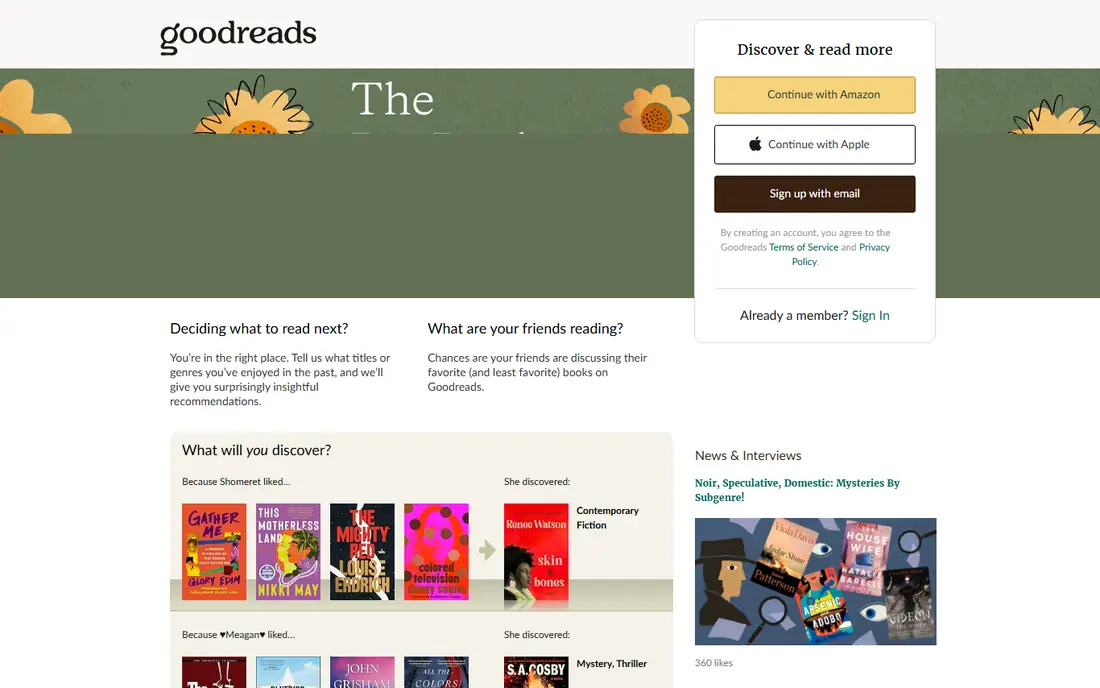
Goodreads remains the default book tracker because its community and database are the largest anywhere. Finding a book, reading reviews, and joining a challenge takes seconds, and the yearly reading goal gives a simple target. For readers who already have years of history here, that record alone is a reason to stay.
The interface feels dated, and recommendations often miss the mark compared with StoryGraph. Some readers also dislike the Amazon connection. Even so, no other app matches its database depth or its community size, which makes it the safe starting point for social readers.
What we like- Huge book database and reviews
- Reading challenge and yearly goals
- Kindle and Alexa integration
Watch out for- Dated interface and weak recommendations
- Owned by Amazon, which bothers some readers
Starting priceFree
Free planYes
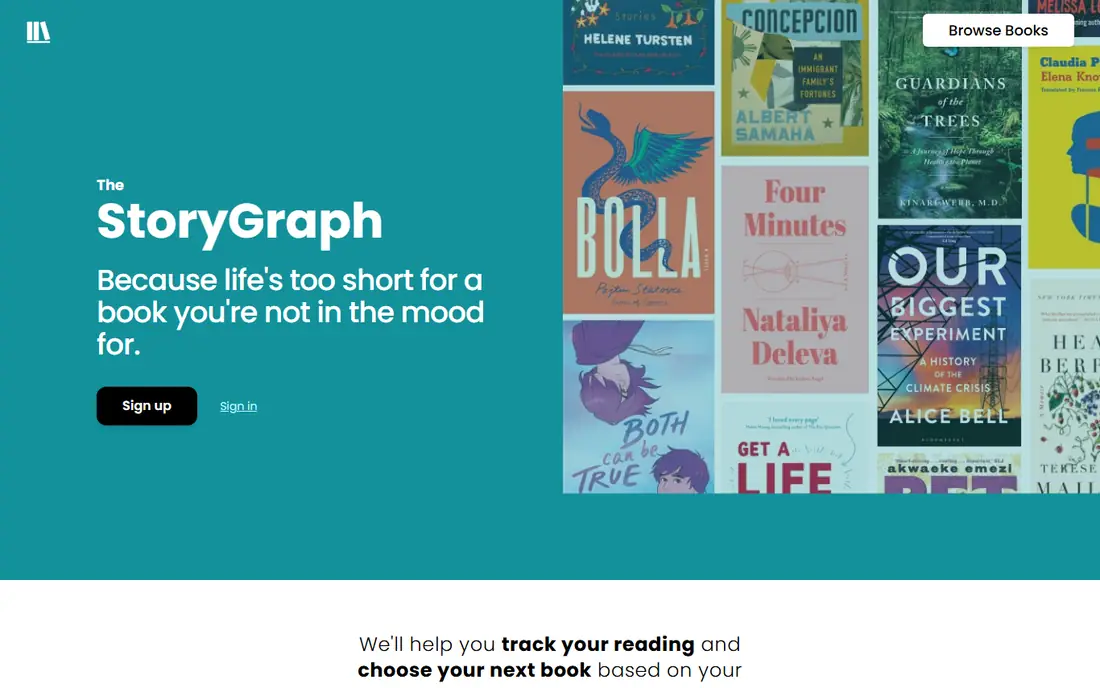
StoryGraph appeals to readers who want to understand their own habits. Its free statistics break reading down by mood, pace, genre, and page count, and its recommendations use those same signals instead of popularity alone. Importing a Goodreads library is straightforward, which lowers the switching cost.
The community is smaller, so reviews and buddy reads feel quieter than on Goodreads. Plus adds extra stats and features for a monthly fee, but the free tier already covers the core tracking well. Readers who love data will likely prefer StoryGraph within a week.
What we like- Detailed reading statistics for free
- Mood and pace based recommendations
- Goodreads import built in
Watch out for- Smaller community than Goodreads
- Some features need the Plus plan
Starting priceSee website
Free planYes
Bookmory suits a reader who wants a private tracker and nothing else. It works offline, needs no account, and shows reading on a calendar with a built-in timer. Notes and memos can be attached to a book, which helps a reader remember a thought without opening a social app.
The trade is a smaller book database and almost no community, so discovering new books happens elsewhere. Premium adds extra features, but the free version covers daily tracking fully. For a reader who dislikes social noise, that quiet focus is the point.
What we like- Works offline without an account
- Reading timer and calendar view
- Clean, minimal design
Watch out for- No social features to speak of
- Book database is smaller than Goodreads
Starting price$4.99/month
Free planYes
Bookly turns reading into a timed session, tracking pages, speed, and streaks in a way that motivates a daily habit. Ambient sounds and a clean timer make it pleasant to open, and badges reward consistency without turning reading into a chore. Habit-focused readers tend to stick with it longer than with a plain list.
The free version covers basic tracking, but the richer statistics and sounds need the paid plan. It is also a personal tracker, not a community, so book discovery stays limited. Readers who need a nudge to read daily will find the timer worth trying.
What we like- Session timer with pages-per-minute stats
- Streaks, badges, and goals
- Ambient sounds for focus
Watch out for- Best features sit behind the subscription
- Social features are limited
Starting price$4.99/month
Free planYes
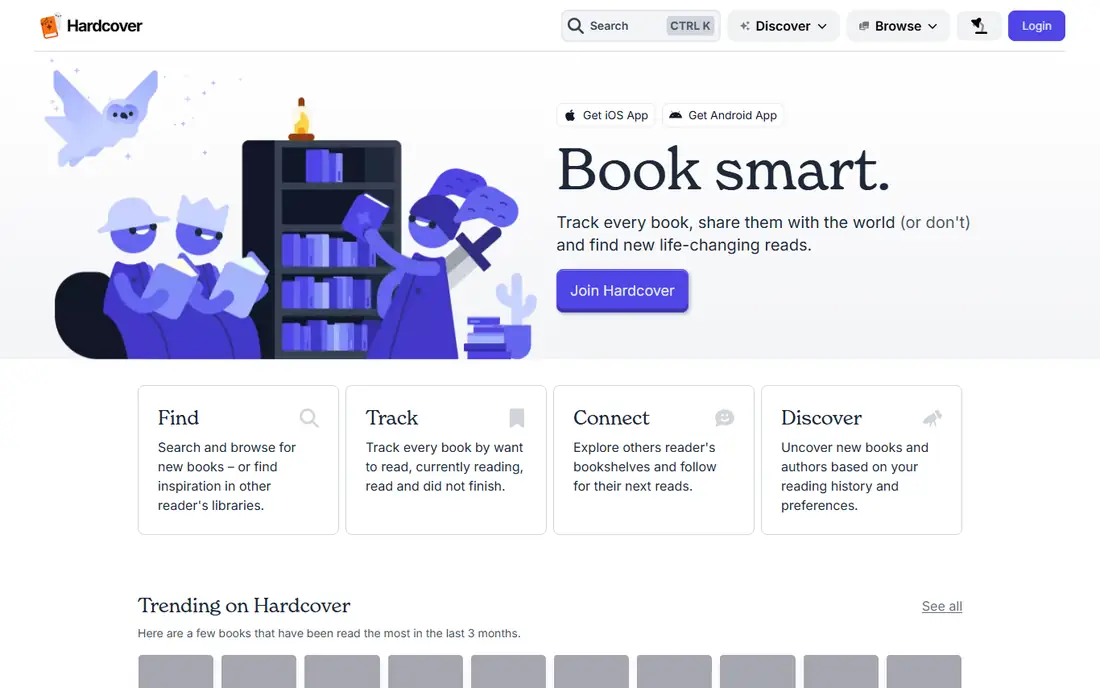
Hardcover combines a fast, clean tracker with social features that feel modern. Lists are easy to build, journals capture thoughts per book, and the feed shows what friends are reading without the clutter of older apps. Search is quick, which matters when adding several books at once.
Its community is still growing, so niche books may have fewer reviews than on Goodreads. Paid plans add extras, but free tracking, lists, and journals cover most readers. Hardcover is the best pick for a reader who wants Goodreads-style social features with a fresher design.
What we like- Fast search and clean lists
- Social feed and reading journals
- Goodreads import supported
Watch out for- Smaller community than Goodreads
- Some advanced features need a paid plan
Starting price$5.99/month
Free planYes
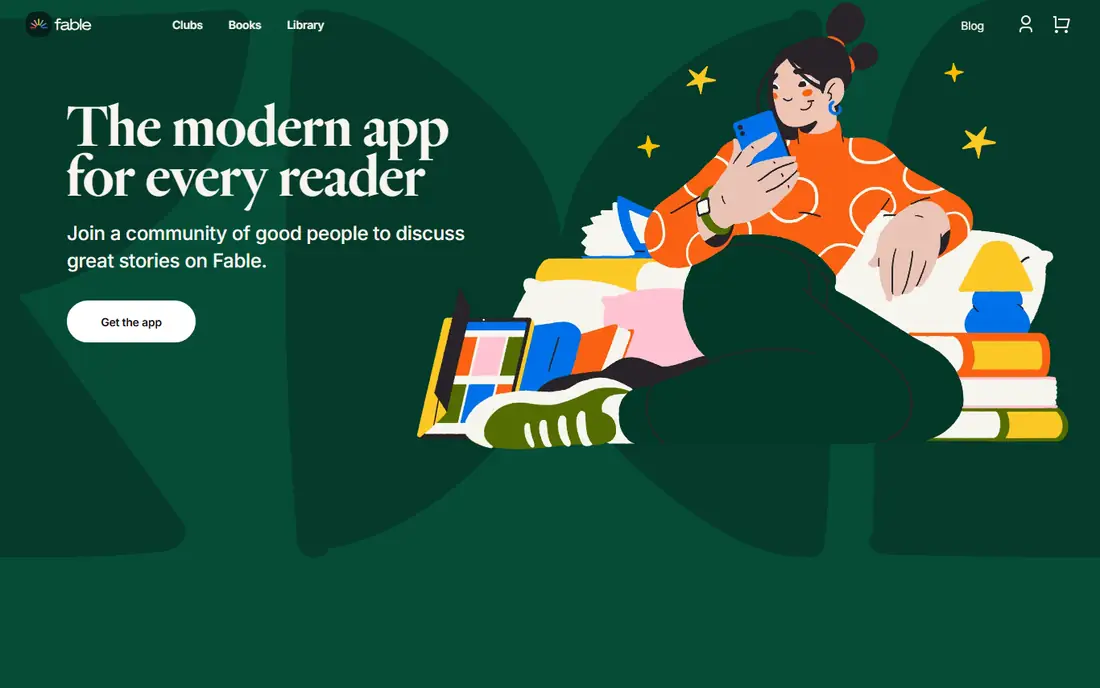
Fable is the app for readers who read together. Book clubs run inside the app with chapter-by-chapter discussion, and the feed keeps friends' progress visible without spoilers. That structure suits a reader whose main joy is talking about books, not just logging them.
Pure tracking is lighter here than in StoryGraph or Bookmory, and some club extras sit behind a paid plan. The free version still supports clubs and basic tracking well. Join Fable when the social side matters more than statistics.
What we like- Built-in book clubs with chapter discussions
- Social feed for friends reading
- TV and film watch parties in the app
Watch out for- Tracking features are lighter than StoryGraph
- Some club features need a subscription
Starting priceFree
Free planYes
Literal keeps book tracking simple and fast, with a clean design that gets out of the way. Adding books, building lists, and following friends takes little effort, and Goodreads import makes switching painless. Readers who found Goodreads busy often settle here quickly.
It lacks the timers and streaks of habit apps and the statistics of StoryGraph, so data lovers may want a second app. The review community is also smaller. As a single, calm tracker with a social side, Literal does its job well.
What we like- Clean, fast tracking with lists
- Goodreads import
- Social feed without clutter
Watch out for- Smaller library of reviews
- Fewer habit features than Bookly or Bookmory
Starting priceFree
Free planYes
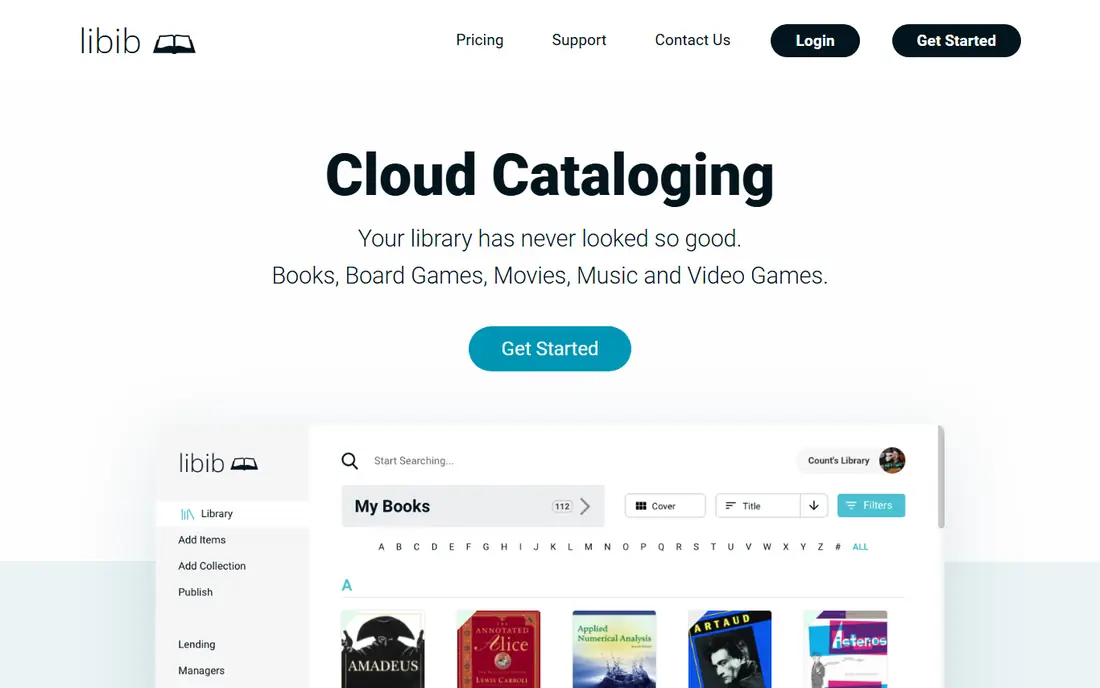
Libib fits readers with shelves to organize rather than streaks to chase. Barcode scanning adds books fast, and the same catalog can hold movies and music, which suits a household library. The web version makes bulk organizing easier than a phone-only app.
Progress tracking is basic, with no timer or detailed statistics, and social features are thin. Libib is a catalog first and a reading tracker second. For a reader who wants to know what is owned and where it sits, it is the most practical free choice here.
What we like- Catalog books, movies, and music together
- Barcode scanning for fast entry
- Works on web and mobile
Watch out for- Reading progress tracking is basic
- Social features are minimal
How we chose
We compared each app on its public pricing page, its feature documentation, and public reviews on G2, Capterra, Reddit, and the app stores. We checked what the free version actually includes, what sits behind a subscription, and where the app falls short for its stated audience. We did not run hands-on trials, so this guide weighs published facts and reported user experience rather than personal testing. Apps that were hard to verify, had no clear official home, or did not fit the category were left out.
We also read the complaints, not just the praise. Repeated reports about a paywall, a thin local pool, or a feature that stopped working weighed against an app, even when its marketing looked strong. That balance is why some well-known names sit lower in a list than a smaller app with fewer complaints and a clearer price.
Choosing by reading style
Before paying for anything, list the three features that would actually change daily use. If an app cannot name those three clearly on its pricing or features page, it is probably selling a feeling rather than a function. A short trial with a calendar reminder at the renewal date keeps that test honest, and a note about what was used each day makes the renewal decision easy.
One more check helps before committing: read the app's help pages for the feature that matters most, and confirm it works on the device that will actually be used. A feature listed on a desktop page sometimes behaves differently on a phone, and that gap only shows up after paying. A few minutes on the help pages prevents most subscription regrets.
Price alone rarely decides a good pick. An app that costs nothing but goes unused is worse value than a modest subscription that becomes part of a routine. Judge the choice after two weeks of real use, not after the first evening, and be ready to switch when a better fit appears. The lists above are a starting point, and the right answer is the app that still gets opened when the novelty fades.
Match the app to the habit, not to the hype. A social reader needs friends and clubs, a data reader needs statistics, and a private reader needs quiet and speed. Trying to force one app to cover all three usually ends with a tracker that gets abandoned.
Import before judging
Import the existing library first, then use the app for a week of real reading. An empty tracker always feels worse than a full one, and most apps here make import a one-time task.
Keep the tracker light
Log a book when it is finished, not every page turn, unless a timer app is the point. Heavy logging kills the habit it was meant to support, so pick the lightest workflow that still feels satisfying.
One tracker, one discovery source
Use one app for the list and another source, like a library newsletter or a friend, for discovery. Apps that try to do both often do the second job badly, and a separate discovery habit keeps the tracker honest.
Frequently asked questions
What is the best completely free book tracking app?
Goodreads and StoryGraph both offer strong free tracking with no book limit. Goodreads wins on community size, while StoryGraph wins on free statistics and recommendations.
Can I move my Goodreads library to another app?
Yes. StoryGraph, Hardcover, Literal, and Fable all support Goodreads import, usually through a CSV export. The process takes a few minutes and keeps shelves, ratings, and read dates.
Which app is best for building a reading habit?
Bookly and Bookmory are the strongest habit apps, with timers, streaks, and goals. Bookly adds gamification, while Bookmory works offline without an account.
Do I need a paid plan for any of these apps?
No. Every app here tracks books for free. Paid plans add extra statistics, sounds, or club features, but the core list, goals, and progress tracking work without payment.
Which app is best for book clubs?
Fable is the best pick for book clubs, with chapter discussions built in. Hardcover and Goodreads also support groups and shared lists, though their club tools are less structured.
Sources we checked (8)
- https://www.goodreads.com
- https://www.thestorygraph.com
- https://bookmory.net
- https://bookly.app
- https://hardcover.app
- https://fable.co
- https://literal.club
- https://www.libib.com
Is your product missing or out of date?
We review this list regularly. Vendors can request a listing, send updated pricing or ask about featured placement.

Shihab Mia · Founder, Rankite
Shihab has 5+ years in B2B and SaaS SEO. He writes Rankite's software buying guides from pricing pages, documentation and public user reviews. More about Shihab.