How we make this list: we compare pricing pages, product documentation and public user reviews. Ratings come from G2, Capterra or Trustpilot, with the date we checked them.
Key takeaways
- Pentera and NodeZero lead for autonomous network validation, with proof that a finding can actually be exploited, not just scanned.
- Invicti, Acunetix, and Burp Suite suit web and API testing best, where application logic matters more than network reach.
- Intruder and Astra fit smaller teams that need continuous testing without a large security staff.
- Automated tools reduce false positives and speed up retesting, but they do not replace human testers for business logic flaws and complex chains.
- Pricing is often quote-based for enterprise platforms, so budget for a sales cycle and a proof of concept before you commit.
Quick comparison
| Tool | Best for | Starting price | Free plan |
|---|
 Pentera | Autonomous network validation | See website | No |
 Horizon3 NodeZero | Continuous external and internal testing | See website | No |
 Intruder | Continuous external attack surface checks | See website | Free trial |
 Invicti | Proof-based web and API scanning | See website | No |
 Acunetix | Web app and API vulnerability scanning | See website | Free trial |
 Burp Suite Professional | Web app testing with manual control | See website | Yes |
 Tenable Nessus | Broad network vulnerability scanning | See website | Free trial |
 Astra | Continuous web and cloud pentesting | See website | No |
 XBOW | Autonomous web app pentesting | See website | No |
Is your product missing or out of date?
We review this list regularly. Vendors can request a listing, send updated pricing or ask about featured placement.
Starting priceSee website
Free planNo
Pentera is built to answer a specific question: can an attacker actually reach a critical asset from a given starting point. It maps the network, tests attack paths, and validates exploitable weaknesses, rather than listing every possible vulnerability. That proof-based approach helps security teams prioritize fixes that matter.
The platform is aimed at mid-size and large organizations, and pricing reflects that focus. Smaller teams may find the cost and setup heavy for a first automated testing tool. For teams with a complex internal network and Active Directory, Pentera offers depth that simpler scanners do not.
What we like- Runs autonomous attack paths across networks and Active Directory
- Validates findings by exploitation
- Supports continuous testing
Watch out for- Enterprise pricing is quote-based
- Setup and scoping need security staff time
#2
Horizon3 NodeZero
Best for: Continuous external and internal testing
Visit horizon3.ai
Starting priceSee website
Free planNo
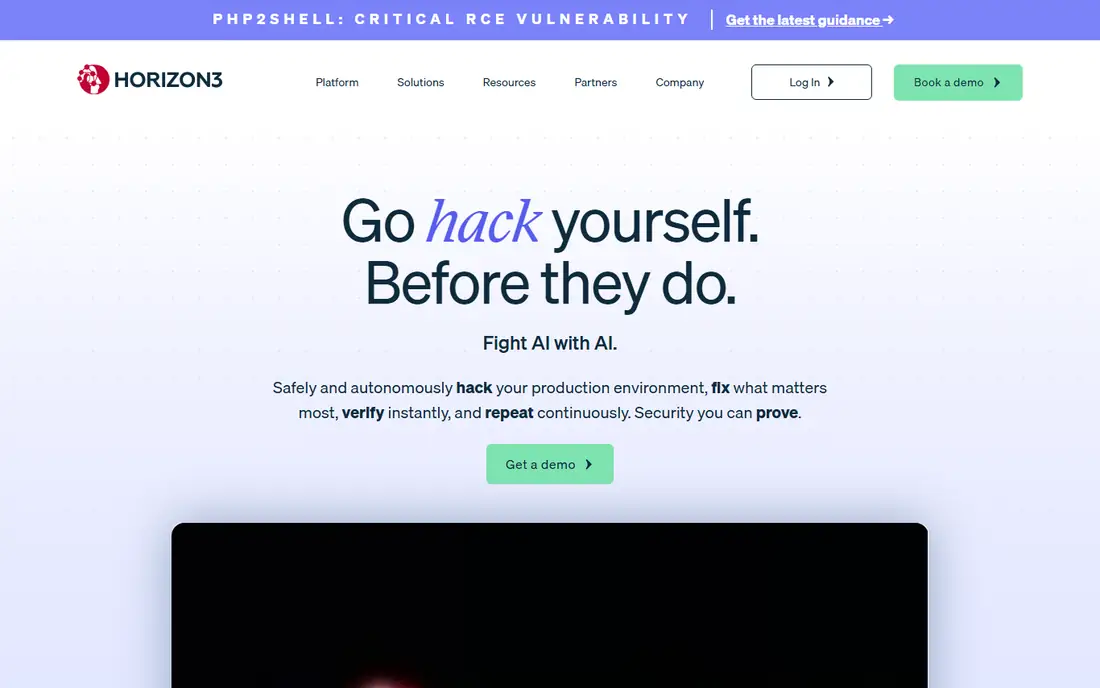
NodeZero, from Horizon3.ai, runs autonomous pentests that mimic an attacker moving through a network. It finds misconfigurations, weak credentials, and exploitable paths, then shows the chain an attacker could follow. That view helps teams fix root causes, not just single findings.
NodeZero is often positioned as more accessible than some enterprise rivals, but pricing is still quote-based and varies by scope. Teams that mainly need web application testing should pair it with a web scanner, since its strength is network and infrastructure validation.
What we like- Autonomous pentesting for external and internal networks
- Shows exploitable attack paths
- Regular retesting without manual setup
Watch out for- Quote-based pricing
- Web app depth is less than dedicated web scanners
#3Intruder
Best for: Continuous external attack surface checks4.8/5 on
G2 (221 reviews, checked Oct 2026)
Visit intruder.io
Starting priceSee website
Free planFree trial
Intruder suits teams that need regular external testing without hiring a full security team. It scans public-facing systems, checks for new exposures, and produces reports that non-specialists can act on. Setup is straightforward, which matters for small IT and engineering teams.
The limit is scope. Intruder is strongest on the external attack surface, not on deep internal adversary simulation or complex web logic. Larger teams often use it beside an internal validation platform, rather than as a single replacement for a full pentest program.
What we like- Continuous external scanning with clear reports
- Easy setup for small teams
- Good for compliance-driven testing
Watch out for- Less depth for complex internal networks
- Advanced pentesting features require higher tiers
#4Invicti
Best for: Proof-based web and API scanning4.5/5 on
G2 (72 reviews, checked Oct 2026)
Visit invicti.com
Starting priceSee website
Free planNo
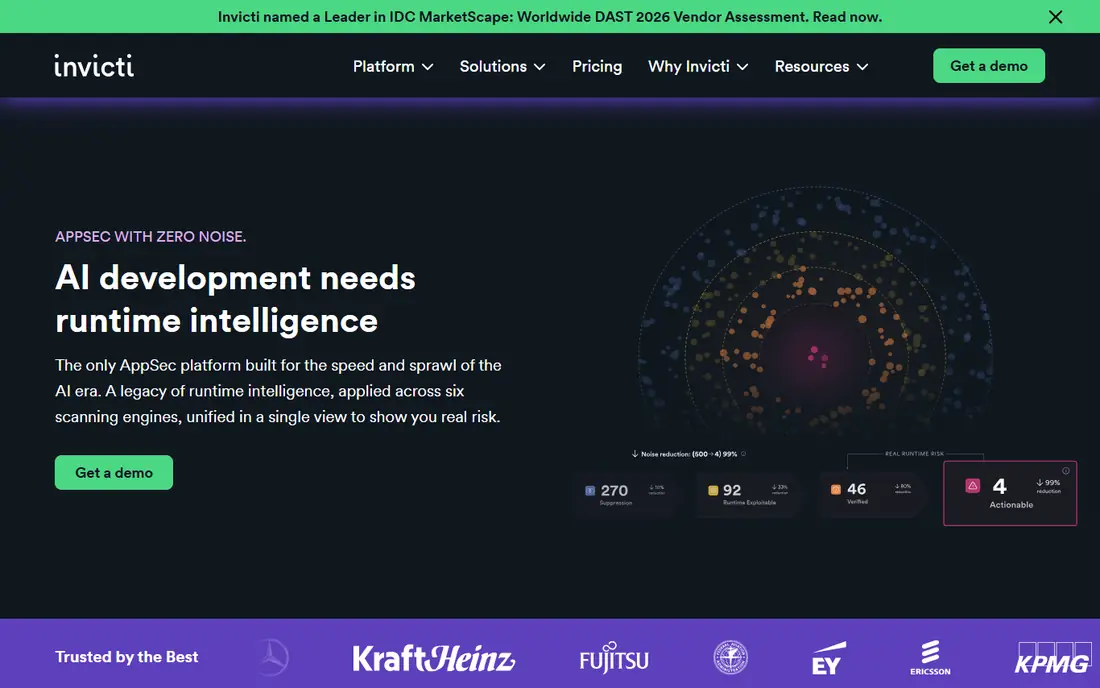
Invicti focuses on web applications and APIs, where false positives waste developer time. Its proof-based approach confirms many findings by safe exploitation, so teams spend less time chasing issues that do not exist. That accuracy is valuable for organizations with many web apps and frequent releases.
Invicti is an enterprise product, with pricing and deployment that reflect that position. Small teams with one or two apps may find it more than they need. For larger portfolios, the accuracy and reporting justify a closer look.
What we like- Proof-based scanning reduces false positives
- Covers web apps, APIs, and modern frameworks
- Enterprise reporting and integrations
Watch out for- Enterprise pricing is quote-based
- Configuration takes time for large app portfolios
#5Acunetix
Best for: Web app and API vulnerability scanning4.1/5 on
G2 (105 reviews, checked Oct 2026)
Visit acunetix.com
Starting priceSee website
Free planFree trial
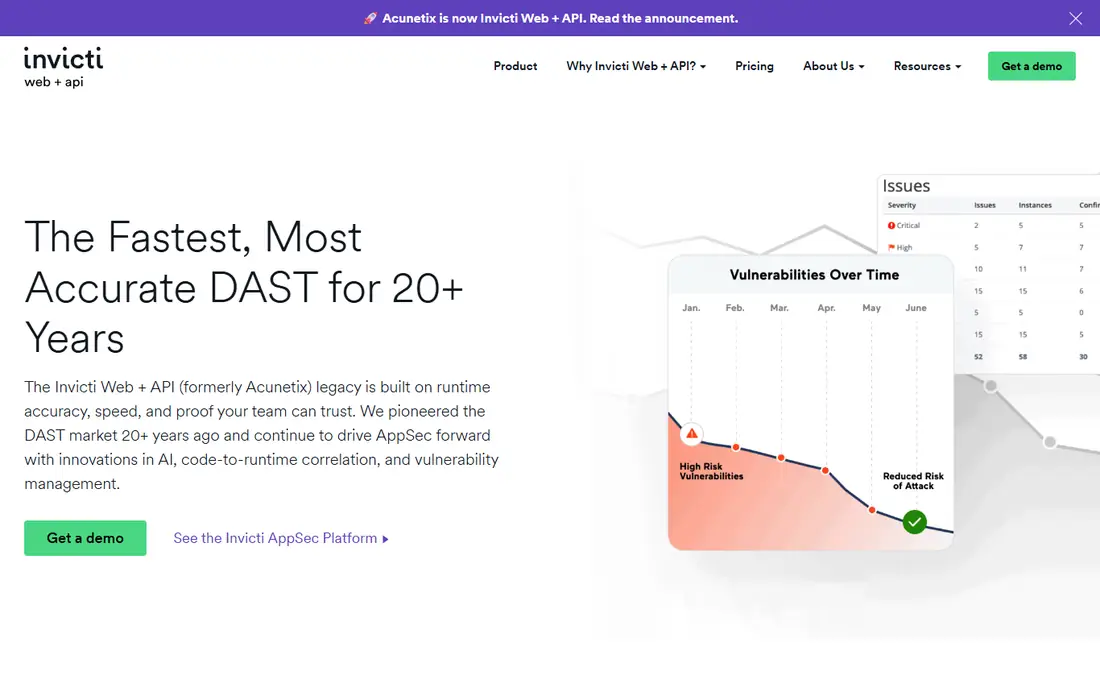
Acunetix, now part of Invicti, remains a widely used web scanner in its own right. It crawls web apps and APIs, tests for common vulnerabilities, and confirms findings where possible. Teams value its coverage of modern frameworks and its reports for developers and auditors.
Scanning a production app always carries risk, and Acunetix is no exception. Teams should test in staging first and tune scan settings to avoid performance issues. With that care, Acunetix gives small and mid-size teams a practical path to continuous web testing.
What we like- Automated web and API scanning with proof of exploit
- Broad technology coverage
- Clear remediation guidance
Watch out for- Pricing is not fully public
- Heavy scanning needs tuning to avoid disrupting apps
Starting priceSee website
Free planYes
Burp Suite Professional is the standard tool for practitioners who test web apps by hand and with automation. The proxy lets testers intercept, modify, and replay traffic, while the scanner finds common issues at scale. Extensions add coverage for specific frameworks and workflows.
Burp is not a set-and-forget platform. It rewards skill, and a team without web security experience may miss complex flaws that automation alone cannot find. For teams with at least one skilled tester, Burp offers control that fully automated platforms cannot match.
What we like- Industry-standard proxy for web testing
- Strong manual and automated scanning mix
- Large extension library
Watch out for- Requires web security skill to use well
- Automated scanning alone is not a full pentest
#7Tenable Nessus
Best for: Broad network vulnerability scanning4.5/5 on
G2 (320 reviews, checked Oct 2026)
Visit tenable.com
Starting priceSee website
Free planFree trial
Nessus is the default network vulnerability scanner for many organizations. It checks systems, network devices, and cloud assets against a large library of checks, and produces reports mapped to compliance frameworks. For baseline coverage and audit evidence, it is hard to replace.
Nessus finds potential issues, but it does not prove every finding is exploitable in the way Pentera or NodeZero do. Teams should treat Nessus as the broad net, and add validation tools or manual testing for the findings that matter most. That combination gives both coverage and confidence.
What we like- Wide vulnerability coverage across systems
- Mature compliance reporting
- Strong plugin library
Watch out for- Scanning is not the same as exploitation proof
- Large environments need tuning and staff time
Starting priceSee website
Free planNo
Astra combines automated scanning with human-led validation for web apps, APIs, and cloud setups. That mix helps teams that want continuous coverage but also want a person to check complex findings. The dashboard tracks remediation, which helps engineering teams close issues over time.
Astra is positioned for SaaS and engineering-led companies that ship often. Pricing depends on scope, so a proof of concept helps clarify what is included. Teams that need only a one-time test may prefer a point-in-time pentest instead of a continuous plan.
What we like- Continuous pentesting for web apps, APIs, and cloud
- Combines automated scans with human validation
- Clear dashboard
Watch out for- Pricing is quote-based
- Smaller teams should check scope before committing
Starting priceSee website
Free planNo
XBOW represents a newer wave of autonomous web pentesting, using automated agents to find and validate vulnerabilities in web apps. It can test many apps quickly, which helps teams that release often and cannot wait for a manual test cycle. For startups and SaaS teams, that speed is the main appeal.
Because the category is newer, buyers should check coverage for their specific frameworks, authentication methods, and APIs during a trial. XBOW does not replace manual testing for business logic flaws, but it adds a strong layer between scheduled human pentests.
What we like- Autonomous testing that validates web exploits
- Fast coverage for many apps
- Useful between manual pentests
Watch out for- Newer category, so review coverage for your stack
- Pricing is per engagement or platform scope
How we chose
We compared pricing pages, product documentation, and public reviews on G2, Capterra, and Reddit, and checked each tool for automation depth, proof of exploit, coverage type, and fit for different team sizes. We focused on tools that run tests on a repeatable basis, not one-time consulting alone, and we excluded tools that were discontinued or lacked a current automated offering. We did not claim hands-on testing.
Building an automated testing program that works
Buying a tool is the easy part. Getting value from it requires scoping, safe testing, and a clear process for fixing what it finds.
Start with scope and safety
Define which systems, apps, and networks are in scope, and which are out of bounds. Test in staging where possible, and agree on scan windows for production systems. Automated exploitation, even when safe by design, should never run against systems you do not own or have permission to test.
Pair scanning with validation and manual work
Use broad scanners for coverage, validation platforms for exploit proof, and human testers for business logic, authentication flaws, and complex chains. No single tool covers all three well. A program that mixes them finds more real risk and wastes less developer time.
Track fixes, not just findings
A report with hundreds of findings helps no one if fixes are not tracked. Assign owners, set deadlines by severity, and retest after fixes. Automated tools make retesting cheap, so use that advantage to prove that a fix worked, rather than assuming it did.
Frequently asked questions
Can automated pentesting replace a human pentest?
No, not fully. Automated tools are strong for known vulnerabilities, misconfigurations, and repeatable checks, and they run far more often than a human test. Human testers are still better for business logic flaws, complex attack chains, and creative abuse cases. Most mature programs use both.
How often should automated pentesting run?
Continuous or weekly testing suits teams that ship often or face internet exposure, while monthly testing may suit stable internal systems. The right cadence depends on change rate, risk, and compliance needs. At minimum, test after major releases, infrastructure changes, and new public exposures.
Is automated pentesting safe for production systems?
Reputable tools use safe checks, but any active testing carries some risk, especially for fragile apps. Test in staging first, agree on scope and timing, and monitor systems during the first runs. Never run exploitation tools against systems without written permission.
What is proof-based scanning?
Proof-based scanning confirms a finding by safely demonstrating that it is exploitable, rather than only matching a pattern. That step reduces false positives and helps developers trust the report. Not every finding can be proven safely, so reports should distinguish proven issues from possible ones.
Do small teams need enterprise pentesting platforms?
Most small teams do not need the largest enterprise platforms at first. Intruder, Acunetix, and Burp Suite offer practical starting points, while Astra and XBOW add continuous coverage. Start with external exposure and web apps, then add internal validation as the team and budget grow.
How much do automated pentesting tools cost?
Costs range from a few hundred dollars per year for single-user scanners to five-figure annual contracts for enterprise validation platforms. Many enterprise prices are quote-based, so request a scoped quote and a trial. Compare cost per asset and per app, not just the headline price.
Sources we checked (9)
- https://www.pentera.io
- https://www.horizon3.ai
- https://www.intruder.io
- https://www.invicti.com
- https://www.acunetix.com
- https://www.portswigger.net
- https://www.tenable.com
- https://www.getastra.com
- https://www.xbow.com
Is your product missing or out of date?
We review this list regularly. Vendors can request a listing, send updated pricing or ask about featured placement.

Shihab Mia · Founder, Rankite
Shihab has 5+ years in B2B and SaaS SEO. He writes Rankite's software buying guides from pricing pages, documentation and public user reviews. More about Shihab.