How we make this list: we compare pricing pages, product documentation and public user reviews. Ratings come from G2, Capterra or Trustpilot, with the date we checked them.
Key takeaways
- For engineering teams that want security testing inside CI/CD, StackHawk and Akto are the practical starting points, with published per-contributor pricing and free entry points.
- Burp Suite Professional remains the standard for manual testing and bug bounty work, but it is a toolkit for testers, not an automated program for a whole API estate.
- 42Crunch is the pick when your problem starts with bad OpenAPI contracts, since it audits the spec itself before it ever sends traffic.
- Traceable AI, Salt Security and Wallarm sell runtime protection and discovery to larger companies, all on custom quotes, so budget a sales cycle.
Quick comparison
| Tool | Best for | Starting price | Free plan |
|---|
 StackHawk StackHawk | Engineering teams that want DAST scans running in CI/CD | See website (per-contributor plans, billed annually) | Free trial (14 days) |
 Burp Suite Professional Burp Suite Professional | Pentesters, security researchers and bug bounty hunters | See website (annual per-user license) | Community Edition free (manual tools only, no automated scanner) |
 Akto Akto | Security teams that want an open source starting point | See website (tiered by API endpoints) | Yes (limited free tier, up to 25 API endpoints per month per vendor materials) |
 42Crunch 42Crunch | Teams that want to catch API flaws in the contract, before code | See website (Enterprise plans custom-quoted) | Free trial (14 days) |
 APIsec APIsec | Compliance-driven teams that need automated penetration test reports | See website (custom quote) | Free API security test (vendor offers a free initial test) |
 Traceable AI Traceable AI | Large companies that need API discovery plus runtime protection | See website (custom quote) | Free trial (reported by reviewers) |
 Salt Security Salt Security | Enterprises that want ML-driven API runtime protection | See website (custom quote) | No (demo available) |
 Wallarm Wallarm | Teams that want API security bundled with WAF protection | See website (custom quote) | Free trial (reported by reviewers) |
 Escape Escape | European teams wanting DAST plus attack surface monitoring | See website (custom quote) | Free trial (via sales) |
Is your product missing or out of date?
We review this list regularly. Vendors can request a listing, send updated pricing or ask about featured placement.
Most API breaches are not exotic zero-days. They are broken object-level authorization on an endpoint nobody inventoried, a staging API that leaked into production, or a GraphQL mutation that nobody tested for abuse. The tools below attack that problem from different directions: some scan APIs inside your build pipeline, some audit the contract before code ships, and some watch live traffic for attacks. Nine made the cut, from developer-first scanners to enterprise runtime platforms.
#1
StackHawk
Best for: Engineering teams that want DAST scans running in CI/CD
Visit stackhawk.com
Starting priceSee website (per-contributor plans, billed annually)
Free planFree trial (14 days)
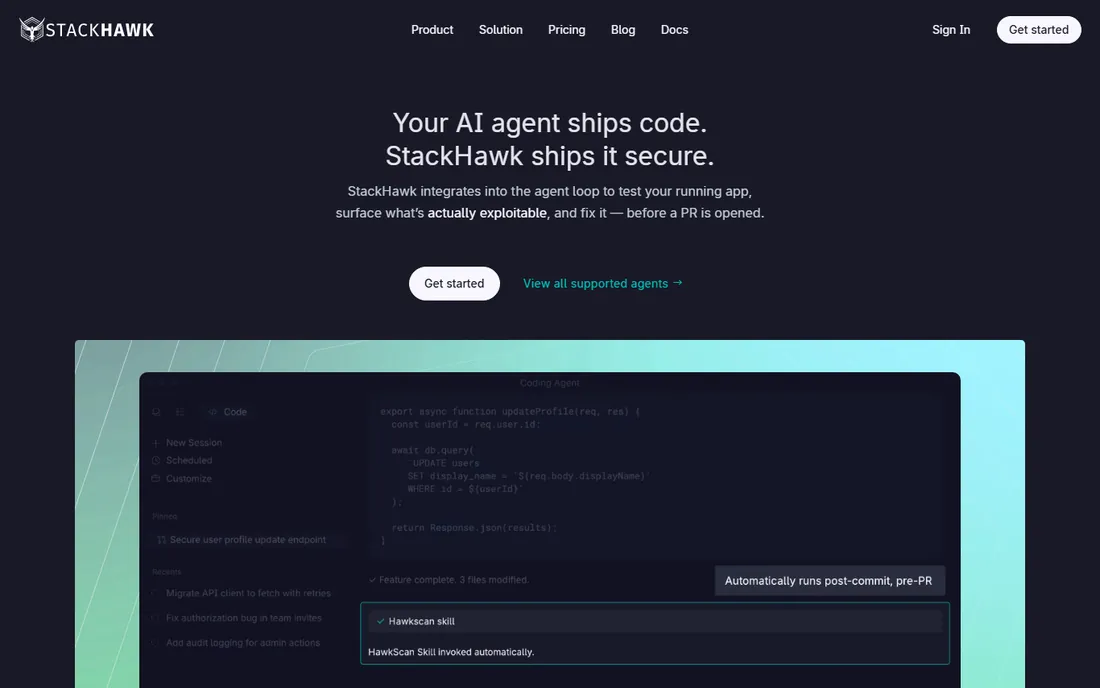
StackHawk is the most natural first scanner for a team that ships code daily. It runs as part of the build, reads your OpenAPI spec, and reports findings where developers already work, including pull requests. Configuration lives in code, so security policy travels with the repository instead of sitting in a dashboard nobody opens.
The honest catch is who it is not for. StackHawk automates scanning for engineering teams; it does not replace a human pentester poking at business logic. Third-party listings put the per-contributor price in the $39 to $59 per month range, which adds up fast past 20 contributors. Confirm the current numbers on their pricing page before you budget.
What we like- Built for developers, with YAML configuration and pull-request findings
- Unlimited scans and applications on paid plans
- Deep OpenAPI spec integration for REST, GraphQL, gRPC and SOAP
Watch out for- Per-contributor pricing gets expensive as the team grows
- It is a developer tool first, so manual pentesters will miss Burp-style workflows
#2
Burp Suite Professional
Best for: Pentesters, security researchers and bug bounty hunters
Visit portswigger.net
Starting priceSee website (annual per-user license)
Free planCommunity Edition free (manual tools only, no automated scanner)
If your job is to think like an attacker, Burp Suite Professional is still the tool you reach for. The intercepting proxy, Repeater and Intruder give you total control over requests, which is exactly what API testing needs when business logic flaws are the target. Review sites widely list Professional around $449 per user per year, but PortSwigger sets the price, so check the vendor page.
The honest catch is that Burp is a testing toolkit, not a testing program. It finds nothing on its own schedule; someone has to drive it. For continuous coverage of a growing API estate, pair it with one of the automated scanners on this list rather than treating it as the whole strategy.
What we like- The industry-standard toolkit for hands-on web and API testing
- Huge extension ecosystem through the BApp Store
- Free Web Security Academy training from the same vendor
Watch out for- Manual by design, so coverage depends entirely on tester skill
- The automated scanner lives only in the paid edition
- Per-user annual licensing adds up for teams
#3
Akto
Best for: Security teams that want an open source starting point
Visit akto.io
Starting priceSee website (tiered by API endpoints)
Free planYes (limited free tier, up to 25 API endpoints per month per vendor materials)

Akto grew out of the open source community, which shows in how it works. It discovers your APIs by watching traffic, builds an inventory, then runs its test library against what it found. The free tier is genuinely usable for a small team learning API security, not a crippled demo. Recent versions added agentic AI features for discovery and MCP server security.
The honest catch is operational. Discovery quality depends on your traffic connectors (AWS mirroring, gateways, Kubernetes), and misconfigured connectors mean missed APIs. Paid plans scale with endpoint count, and vendor pricing has moved around, so treat any number you see online as a starting point for a conversation, not a contract.
What we like- Open source core with API discovery from traffic
- Over 1,000 built-in security tests covering OWASP API Top 10
- CI/CD integrations with GitHub Actions and Jenkins
Watch out for- Paid-tier pricing has shifted over time, so get a current quote
- Traffic-based discovery needs connectors configured correctly
- Documentation is thinner than enterprise rivals
#4
42Crunch
Best for: Teams that want to catch API flaws in the contract, before code
Visit 42crunch.com
Starting priceSee website (Enterprise plans custom-quoted)
Free planFree trial (14 days)
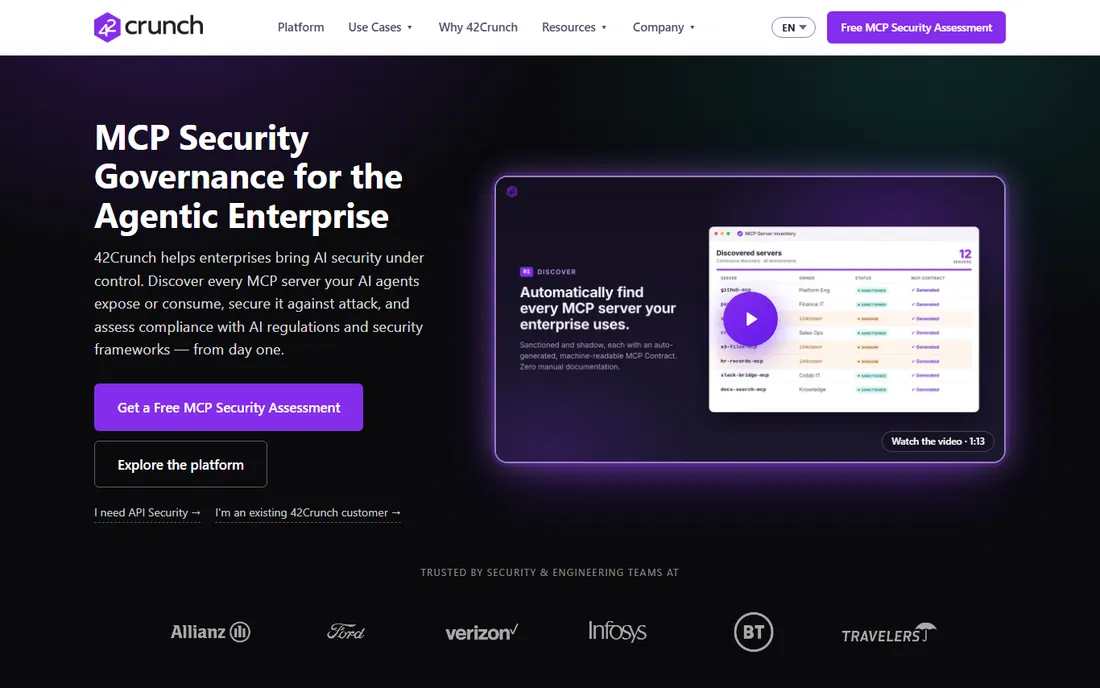
42Crunch takes the unfashionable position that most API vulnerabilities are designed in, not coded in. Its audit scores your OpenAPI definition against hundreds of checks for weak authentication schemes, excessive data exposure and missing security definitions. The IDE integration means a developer sees the finding while the spec is open, which is the cheapest moment to fix it.
The honest catch is the commercial model. The vendor's current pricing page leads with custom enterprise quotes, and the old low-cost individual plans are gone from the public page. If your team does not keep OpenAPI specs current, the core value proposition weakens considerably.
What we like- Audits OpenAPI contracts for security design flaws, not just runtime bugs
- IDE plugins bring findings to developers as they write
- Firewall and protection options for runtime
Watch out for- Enterprise pricing is now quote-based with no self-serve tier for teams
- The contract-first approach assumes you actually maintain OpenAPI specs
- Smaller vendor than the runtime giants
#5
APIsec
Best for: Compliance-driven teams that need automated penetration test reports
Visit apisec.ai
Starting priceSee website (custom quote)
Free planFree API security test (vendor offers a free initial test)
APIsec's pitch is simple: a penetration test that runs itself on every release. It learns your API's structure, generates thousands of attack playbooks covering the OWASP API Top 10, and runs them continuously. The differentiator is the output: automated penetration test reports formatted for compliance, which the vendor says auditors have accepted for SOC 2 work.
The honest catch is the black box. You are buying their automation, which means trusting their coverage of your specific business logic. Pricing is entirely quote-based, and the sales process will size the deal to your API count. Ask for the free test on your own APIs before committing; it is the fastest way to judge coverage.
What we like- Fully automated continuous testing with AI-generated attack playbooks
- Produces compliance-ready pen-test reports accepted by auditors
- Tests every release without manual effort
Watch out for- No public pricing at all
- The fully automated model suits standard REST APIs best
- Onboarding requires registering and mapping your APIs first
#6
Traceable AI
Best for: Large companies that need API discovery plus runtime protection
Visit traceable.ai
Starting priceSee website (custom quote)
Free planFree trial (reported by reviewers)
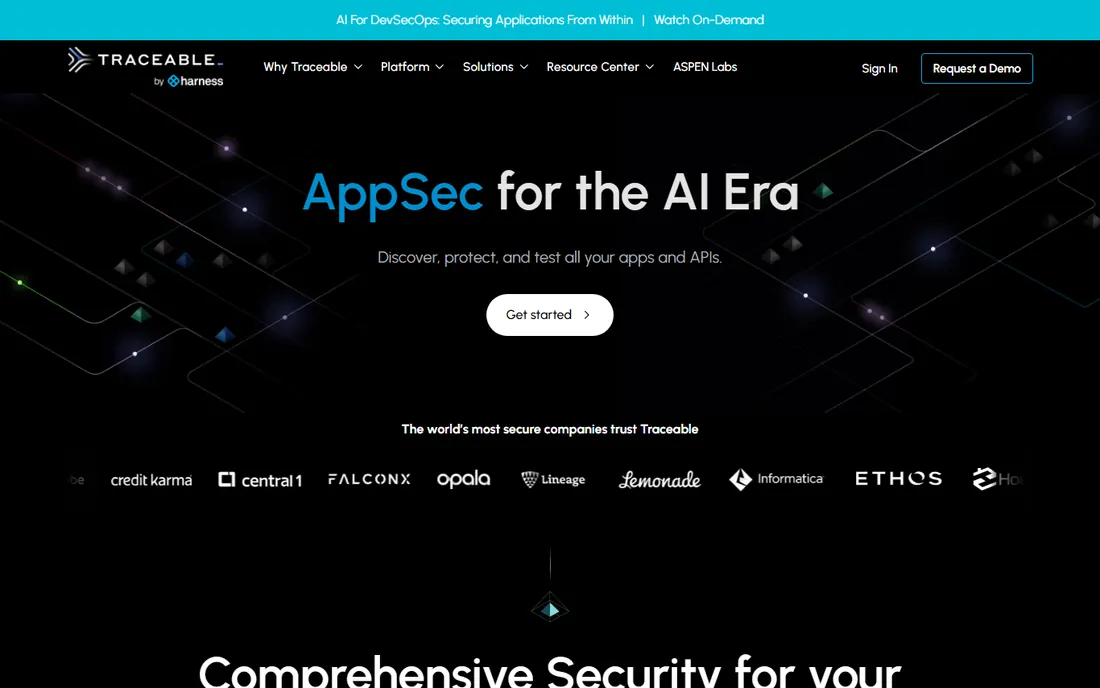
Traceable comes from the team behind distributed tracing technology, and it shows. It watches your API traffic, builds a complete inventory including the shadow APIs your documentation forgot, scores risk, and can block attacks at runtime. For a large enterprise with hundreds of services, that combination of discovery and protection is the whole point.
The honest catch is fit. This is an enterprise platform with enterprise procurement attached. Small teams will drown in the deployment and the price. If your API count is under 50 and you have no dedicated AppSec staff, the developer-first tools above will serve you better.
What we like- Discovers shadow and zombie APIs from traffic with ML-based analysis
- Combines testing with runtime blocking in one platform
- Deep distributed tracing roots
Watch out for- Enterprise sales motion with no public pricing
- Implementation is a project, not a signup
- Overkill for teams with a handful of APIs
#7
Salt Security
Best for: Enterprises that want ML-driven API runtime protection
Visit salt.security
Starting priceSee website (custom quote)
Free planNo (demo available)
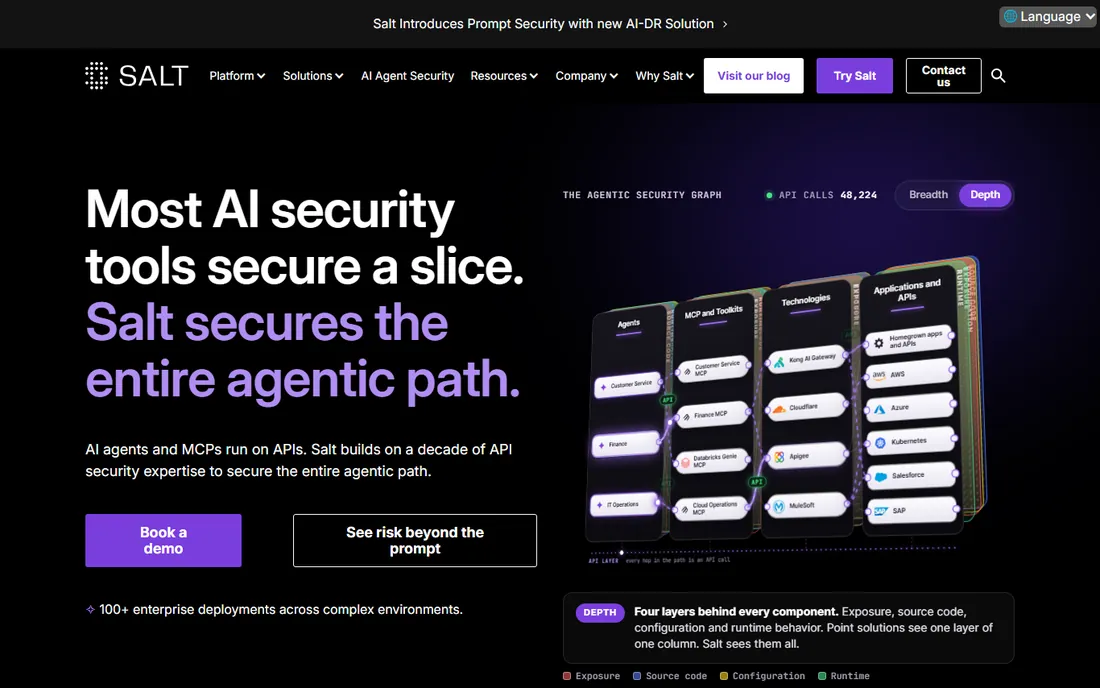
Salt Security helped define the API security category, and its platform reflects that maturity. It learns the normal behavior of each API from traffic, then flags and blocks deviations, which catches the low-and-slow attacks that signature tools miss. The posture governance engine adds policy enforcement across large API estates.
The honest catch is accessibility. There is no self-serve path, no trial you can start today, and no price to model. Everything goes through sales, which tells you the target buyer. It is a strong platform for a large security team; it is not a tool a startup evaluates over a weekend.
What we like- Patented approach to API attack detection using behavioral analysis
- Discovers APIs automatically from traffic
- Posture governance for API security policy at scale
Watch out for- No public pricing and no free tier
- Squarely enterprise, with the sales cycle that implies
- Recent pivots into AI agent security may dilute API focus
#8
Wallarm
Best for: Teams that want API security bundled with WAF protection
Visit wallarm.com
Starting priceSee website (custom quote)
Free planFree trial (reported by reviewers)
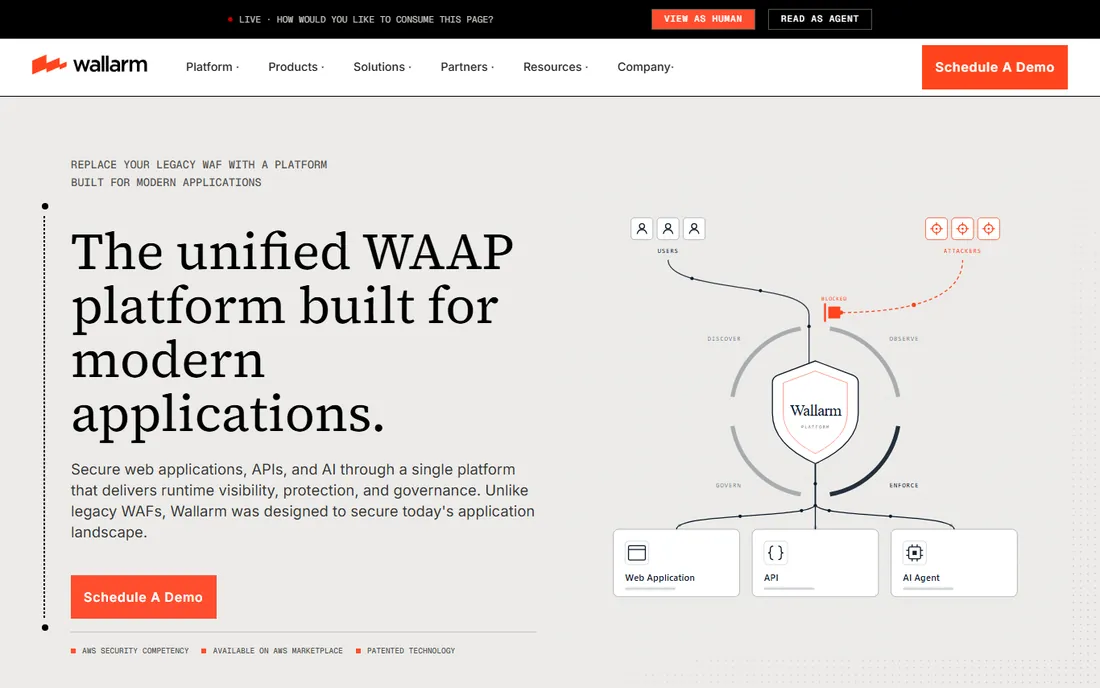
Wallarm appeals to infrastructure teams that would rather consolidate than collect tools. It deploys as part of your traffic path, discovers APIs, enforces their specifications, and blocks abuse, all alongside traditional WAF duties. For cloud-native shops already running Envoy or Kong, the deployment model feels natural.
The honest catch is that breadth has a price in complexity. You are deploying and operating security infrastructure, which needs someone who owns it. Pricing is quote-based, and the sales conversation will revolve around traffic volume. Teams that want a pure testing tool with no runtime footprint should look elsewhere on this list.
What we like- Combines API discovery, testing and WAAP in one deployment
- Runs inline on NGINX, Envoy, Kong and cloud infrastructure
- API specification enforcement
Watch out for- No public pricing
- Deployment is infrastructure work, not a SaaS signup
- The broad scope means API-specific depth varies
#9
Escape
Best for: European teams wanting DAST plus attack surface monitoring
Visit escape.tech
Starting priceSee website (custom quote)
Free planFree trial (via sales)
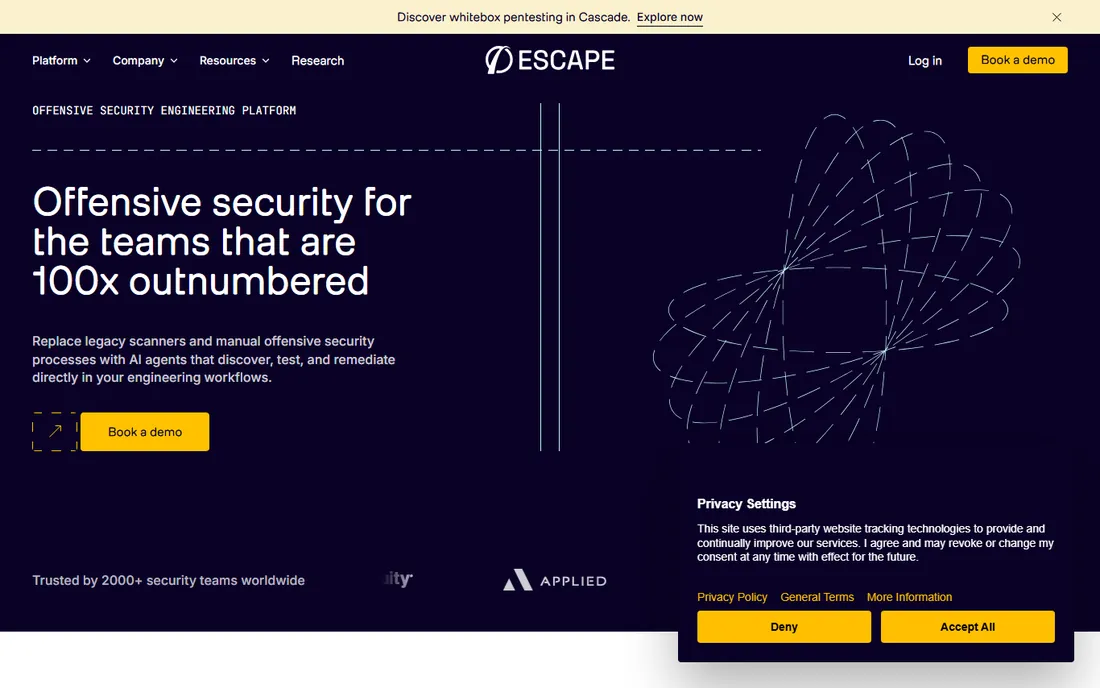
Escape is the newcomer that earned its place by doing two jobs at once. It scans your APIs for vulnerabilities and separately monitors your external attack surface, so the API you forgot to decommission shows up before an attacker finds it. The GraphQL testing is genuinely good, and the team ships fast, including IDE integrations for fixing findings where developers work.
The honest catch is maturity. Founded in 2020, Escape has thousands of users but not the decade-long enterprise track record of a Salt or Traceable. Pricing goes through sales with no public numbers. For a mid-market team that wants modern tooling without enterprise bloat, that tradeoff can be worth it.
What we like- Combines DAST scanning with external attack surface monitoring
- Strong GraphQL API testing
- Developer-friendly with public API and IDE integrations
Watch out for- Young company with a smaller track record than the leaders
- Pricing is custom enterprise
- The platform is still building out enterprise compliance features
How we chose
We started with the searches buyers actually run: API security testing tools, API vulnerability scanner, DAST for APIs. For each candidate we checked the vendor's own pricing page and documentation, read public reviews on G2 and practitioner threads on Reddit, and compared feature lists, integration options and company-size fit. Where a price could not be verified on the vendor's own page we wrote "See website" rather than repeating a third-party estimate as fact. We favored tools with distinct approaches over near-duplicates, so the list covers pipeline scanning, manual testing, contract auditing, continuous pentesting and runtime protection.
What to check before you buy
Start with the inventory question, because every tool on this list is only as good as the APIs it knows about. Ask the vendor exactly how discovery works: traffic mirroring, gateway integration, code scanning, or manual registration. If the answer is manual registration and you have more than 30 APIs, you will have coverage gaps on day one.
Then match the tool to your team's shape. A five-person startup with no security staff needs a scanner that runs in CI/CD and explains findings to developers; that is StackHawk, Akto or Escape territory. A company with a dedicated AppSec team and hundreds of microservices needs discovery plus runtime protection; that is where Traceable, Salt and Wallarm earn their price.
Price the whole thing, not the license. Quote-based enterprise tools carry implementation and integration costs that dwarf the first-year license. Per-contributor and per-endpoint models punish growth, so model your headcount and API count twelve months out. And confirm what "testing" means: a DAST scanner finds implementation bugs, a contract auditor finds design flaws, and neither replaces a human looking at business logic. Most mature teams end up with two of these, not one.
Free tiers and trials worth knowing about
If budget is zero, start with Akto's free tier, which covers up to 25 API endpoints per month with real scanning, not a demo. Burp Suite Community Edition is free forever for manual testing, and it is the same proxy the professionals use, minus the automated scanner. StackHawk's 14-day trial is enough to run a real pipeline scan and show the results to your team.
For everyone else, the trials are sales-led. Traceable, Wallarm and Escape all offer evaluations through their sales teams, and APIsec will run a free test against your APIs, which doubles as a proof of value. Salt Security offers demos but no self-serve trial. Whatever you evaluate, run it against your own messiest API, not the vendor's demo target; that is where the buying decision gets made.
Frequently asked questions
What is API security testing?
It is the practice of probing your APIs for vulnerabilities, from broken authentication and authorization to injection flaws and data exposure. Tools do it automatically by sending crafted requests and analyzing responses, usually mapped to the OWASP API Security Top 10. Manual testing with a proxy like Burp Suite covers the business logic flaws automation misses.
Do I need a dedicated API security tool if I have a WAF?
A WAF blocks known attack patterns at the edge, but it does not understand your API's business logic or find vulnerabilities before release. API security testing tools discover flaws in development and test for logic issues like broken object-level authorization. Many teams run both: testing tools in the pipeline, WAF or WAAP in production.
What is the difference between DAST and API discovery?
DAST (dynamic application security testing) sends requests at a running API and looks for vulnerabilities in the responses. API discovery finds the APIs themselves, including undocumented shadow APIs, usually by analyzing traffic. You need discovery first; a scanner can only test the APIs it knows exist.
How much do API security testing tools cost?
Developer-first tools publish per-contributor or per-endpoint pricing in the tens of dollars per month range, though exact numbers change often. Enterprise runtime platforms are quote-based and typically start in the five figures annually. Open source options like Akto's free tier and Burp Community Edition cost nothing to start.
Can these tools test GraphQL APIs?
Most of the modern tools can, including StackHawk, Akto and Escape, which specifically call out GraphQL support. Older DAST tools built for REST sometimes struggle with GraphQL's single-endpoint model and introspection. If GraphQL is central to your stack, verify introspection-based testing explicitly during the trial.
Should a small team buy an enterprise API security platform?
Usually not. Enterprise platforms assume dedicated security staff and hundreds of APIs. A small team gets more value from a developer-first scanner in CI/CD plus disciplined API inventory hygiene. Buy the enterprise platform when your API count or compliance requirements outgrow what the team can cover manually.
Sources we checked (10)
- https://stackhawk.com
- https://portswigger.net/burp
- https://akto.io
- https://42crunch.com/pricing/
- https://apisec.ai
- https://traceable.ai
- https://salt.security
- https://wallarm.com
- https://escape.tech
- https://www.g2.com/categories/api-security
Is your product missing or out of date?
We review this list regularly. Vendors can request a listing, send updated pricing or ask about featured placement.

Shihab Mia · Founder, Rankite
Shihab has 5+ years in B2B and SaaS SEO. He writes Rankite's software buying guides from pricing pages, documentation and public user reviews. More about Shihab.