How we make this list: we compare pricing pages, product documentation and public user reviews. Ratings come from G2, Capterra or Trustpilot, with the date we checked them.
Key takeaways
- PyTorch leads for research and flexibility, while TensorFlow leads for production deployment, and Keras now works across both plus JAX through its multi-backend design.
- Every open framework here is free, so the real cost is engineering time, compute, and deployment, not licences, except for MATLAB and H2O.ai, which are commercial.
- JAX suits researchers who need composable transformations such as automatic differentiation and parallelization, while ONNX Runtime suits teams that need fast inference everywhere.
- For enterprise AI with governance and air-gapped deployment, H2O.ai is the only platform here built around that requirement from the start.
Quick comparison
| Tool | Best for | Starting price | Free plan |
|---|
 TensorFlow | End-to-end production machine learning | Free | Yes |
 PyTorch | Research and flexible model building | Free | Yes |
 Keras | Human-friendly deep learning API | Free | Yes |
 JAX | High-performance array computing and research | Free | Yes |
 H2O.ai | Enterprise AI with governance | See website | No |
 MATLAB Deep Learning Toolbox | Engineering teams in MATLAB and Simulink | See website | No |
 PaddlePaddle | Open deep learning from industry practice | Free | Yes |
 ONNX Runtime | Fast cross-platform model inference | Free | Yes |
Is your product missing or out of date?
We review this list regularly. Vendors can request a listing, send updated pricing or ask about featured placement.
The best artificial neural network software
Starting priceFree
Free planYes
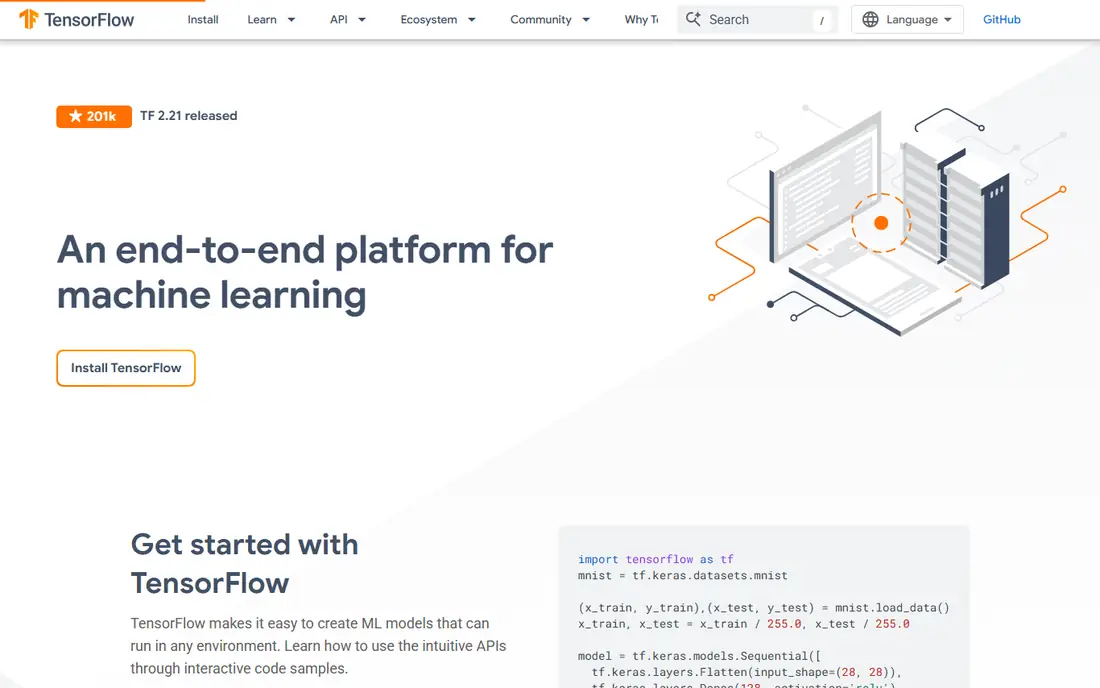
TensorFlow describes itself as an end-to-end platform for machine learning, and its homepage shows the classic workflow: build a model with the Keras API, compile it, train it, and evaluate it, then deploy it anywhere. Its ecosystem adds production-tested tools for modeling, deployment, and serving, plus curated learning paths for newcomers.
TensorFlow's strength is the full journey: the same framework covers research prototypes, mobile deployment, browser deployment, and large-scale serving. The cost is complexity, since the platform's breadth means more concepts to learn than PyTorch's leaner core. For a team shipping models to production, especially across mobile, web, and server, TensorFlow remains the most complete free option.
What we like- Complete platform from training to deployment
- Runs in any environment
- Large ecosystem of production-tested tools
- Keras built in
Watch out for- Larger API surface than PyTorch, so learning takes longer
- Eager and graph modes can confuse beginners
#2PyTorch
Best for: Research and flexible model building4.6/5 on
G2 (23 reviews, checked Oct 2026)
Visit pytorch.org
Starting priceFree
Free planYes
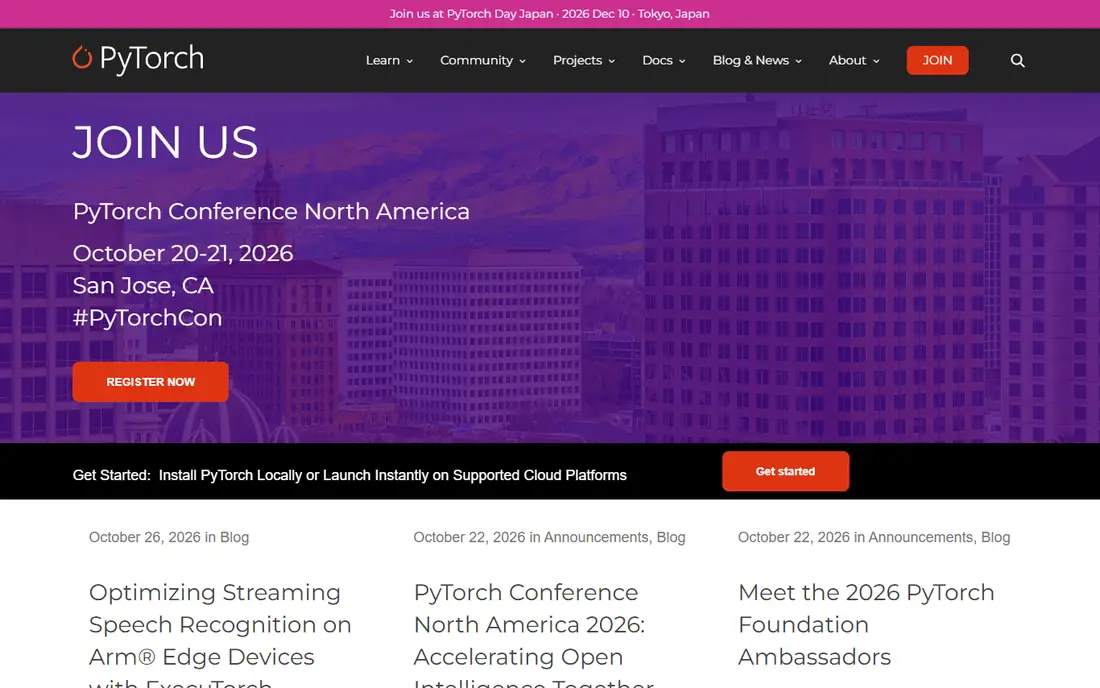
PyTorch, stewarded by the PyTorch Foundation, is the framework most researchers reach for first. Its homepage highlights production-ready transitions between eager and graph modes with TorchScript, scalable distributed training, a rich ecosystem spanning computer vision and language work, and support across major cloud platforms. The current stable release is 2.7, requiring Python 3.10 or later, and its 2026 conference drew more than 3,500 attendees.
PyTorch's appeal is that models are ordinary Python programs, which makes debugging and experimentation faster than graph-first frameworks. Its ecosystem includes tools such as Captum for interpretability and PyTorch Geometric for graph data. For research teams, startups, and anyone iterating quickly on new architectures, PyTorch is the default choice, with ONNX Runtime or TorchServe covering deployment.
What we like- Python-first, eager execution that feels natural
- Strong research community
- Distributed training and TorchServe for production
- Stable 2.7 release
Watch out for- Production serving needs extra tooling compared with TensorFlow's built-in path
- Mobile deployment is less central
#3Keras
Best for: Human-friendly deep learning API4.6/5 on
G2 (65 reviews, checked Oct 2026)
Visit keras.io
Starting priceFree
Free planYes
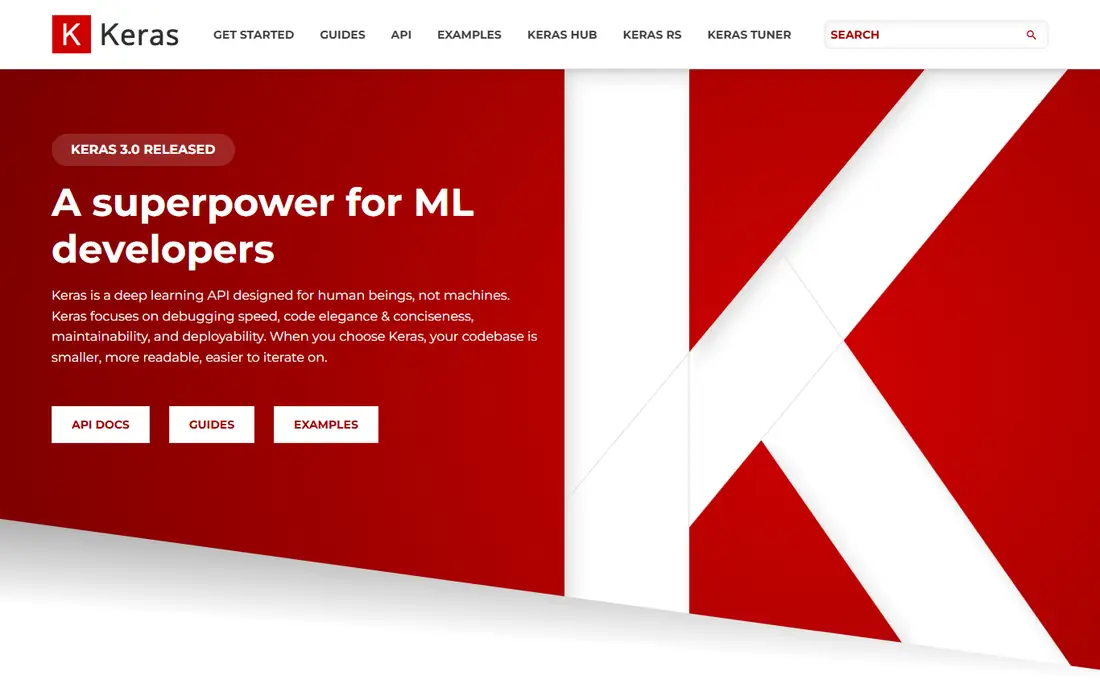
Keras calls itself deep learning for humans, and its homepage shows why: a small, readable model definition, a functional API for branching architectures, and built-in training methods that hide boilerplate. With Keras 3, the same code can run on JAX, TensorFlow, or PyTorch backends, so models move across frameworks without rewriting. KerasHub adds implementations of popular architectures with pretrained checkpoints from Kaggle Models.
Keras is trusted by CERN, NASA, NIH, and Waymo, which uses it for self-driving vehicles, and it partners with Kaggle and Hugging Face. Its trade-off is abstraction: teams that need custom training loops or unusual hardware control may eventually work directly in a backend. For most practitioners, especially those learning deep learning or shipping standard models, Keras is the fastest path from idea to working model.
What we like- Designed for debugging speed and readable code
- Multi-backend support for JAX, TensorFlow, and PyTorch
- KerasHub with pretrained models
- Used by CERN, NASA, and Waymo
Watch out for- Abstraction hides some low-level control
- Advanced users may outgrow it and drop to a backend directly
Starting priceFree
Free planYes
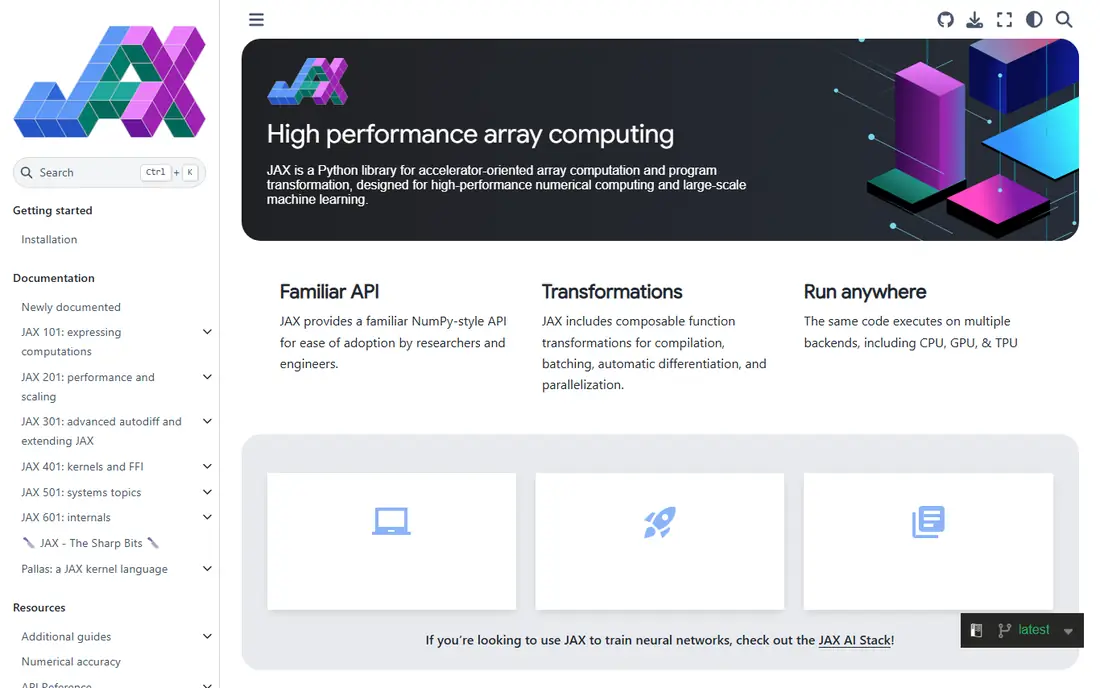
JAX is a Python library for accelerator-oriented array computation and program transformation, designed for high-performance numerical computing and large-scale machine learning. Its docs describe a familiar NumPy-style API, composable transformations for compilation, batching, automatic differentiation, and parallelization, and the same code running on CPU, GPU, and TPU backends. Its documentation is organized as a leveled course from JAX 101 through advanced topics such as custom kernels and multi-host systems.
JAX itself is deliberately narrow: it provides array operations and transformations, while neural network libraries are built on top of it through the JAX AI Stack and community projects. That design suits researchers who want precise control over differentiation and scaling, and it powers much of Google's large-model research. For applied teams that want ready-made layers and training loops, Keras on the JAX backend or PyTorch will be faster to start.
What we like- NumPy-style API with composable transformations
- Automatic differentiation, vectorization, and parallelization
- Runs on CPU, GPU, and TPU
Watch out for- Narrowly scoped, so neural network layers come from ecosystem libraries
- Smaller community than PyTorch or TensorFlow
#5H2O.ai
Best for: Enterprise AI with governance4.6/5 on
Capterra (10 reviews, checked Oct 2026)
Visit h2o.ai
Starting priceSee website
Free planNo
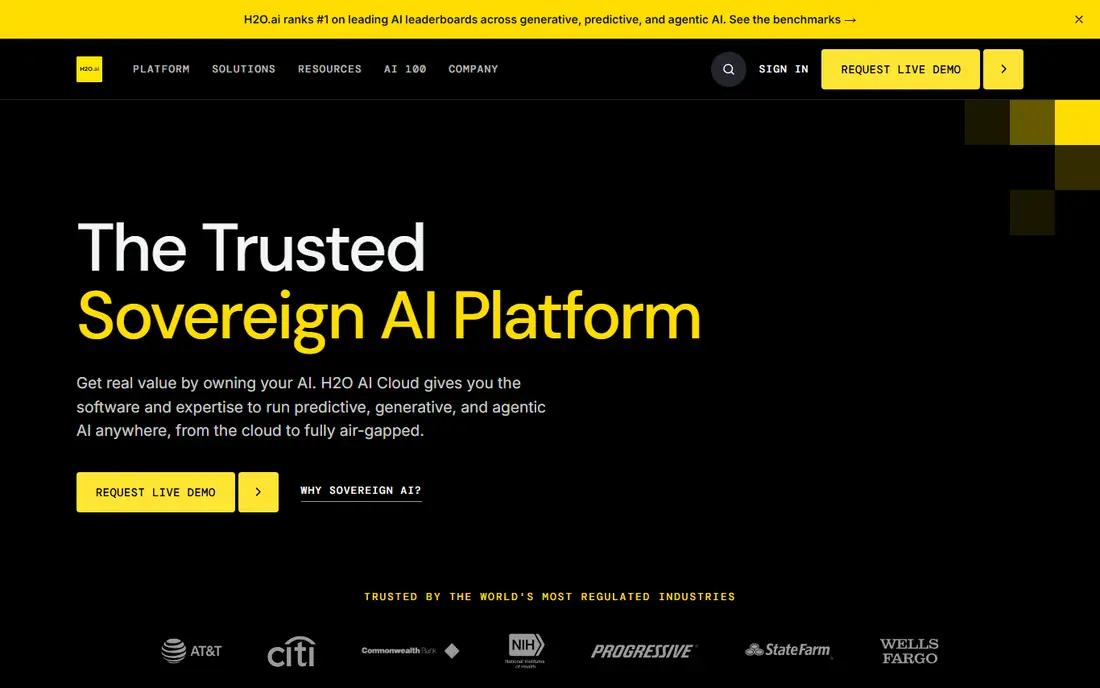
H2O.ai positions itself as a sovereign AI platform: you own your agents, models, data, and results, and run them anywhere, including fully air-gapped environments, with nothing leaving your walls. Its Super Agent orchestrates predictive, generative, agentic, and observability AI in one system, with enterprise governance built in rather than added later. It reports SOC 2, HIPAA, and FedRAMP High certifications, use by more than 200 Fortune 500 companies including 8 of the top 10 banks, and a community of over 2 million practitioners.
Pricing is one annual licence based on compute and memory, not per-token pricing, which H2O.ai presents as cost certainty at scale. Reported results include an 80 percent fraud reduction with predictive AI and a 90 percent cost reduction with generative AI at AT&T. For regulated enterprises that must prove governance and keep data inside their walls, H2O.ai is the strongest platform here, while individual researchers will find the open frameworks more practical.
What we like- One platform for predictive, generative, agentic, and observability AI
- Air-gapped and on-premises deployment
- SOC 2, HIPAA, and FedRAMP High
- Trusted by 200-plus Fortune 500 firms
Watch out for- Commercial annual licence priced on compute and memory
- More platform than an individual researcher needs
#6
MATLAB Deep Learning Toolbox
Best for: Engineering teams in MATLAB and Simulink
Visit mathworks.com
Starting priceSee website
Free planNo
MATLAB Deep Learning Toolbox brings neural networks into MathWorks' MATLAB and Simulink environment, where engineers already do signal processing, control design, and simulation. Its value is workflow: a team can preprocess sensor data, train a network, test it against a Simulink model, and generate code for deployment without leaving the MathWorks ecosystem. MathWorks' homepage highlights its latest R2026b release and training programs from fundamentals through advanced topics.
The limits are price and community. MATLAB is commercial software with no free plan, and its deep learning community is smaller than the open-source ecosystems around PyTorch and TensorFlow, so newest architectures usually appear there first. Note that we verified this tool through MathWorks' vendor homepage rather than a dedicated toolbox page. For an engineering organization already standardized on MATLAB, the toolbox is the natural deep learning choice.
What we like- Deep learning inside the MATLAB and Simulink workflow engineers already use
- Strong for signal, control, and simulation work
- Extensive training resources
Watch out for- Commercial licence with no free plan
- Smaller deep learning community than PyTorch or TensorFlow
Starting priceFree
Free planYes
PaddlePaddle, whose name means paddle in Chinese and is written as Fei桨, is an open-source deep learning platform that grew out of industrial practice at Baidu. It covers the full pipeline from model training to deployment, with tools for vision, language, and recommendation work, and it is widely used in Chinese industry and research.
Two cautions apply. During our homepage check, paddlepaddle.org.cn returned only its title, with no readable body content, so while the domain clearly belongs to the PaddlePaddle platform, confirm current documentation and English-language resources before adopting it. Its English community is also smaller than PyTorch's or TensorFlow's. For teams working with Chinese industry partners, or researchers who want a second major open framework, PaddlePaddle is a legitimate and capable choice.
What we like- Open-source deep learning platform built from industrial practice
- Strong in Chinese industry and research
- Full training-to-deployment pipeline
Watch out for- Homepage returned only a title during our check, so confirm current docs in English
- Smaller English-language community than PyTorch or TensorFlow
Starting priceFree
Free planYes
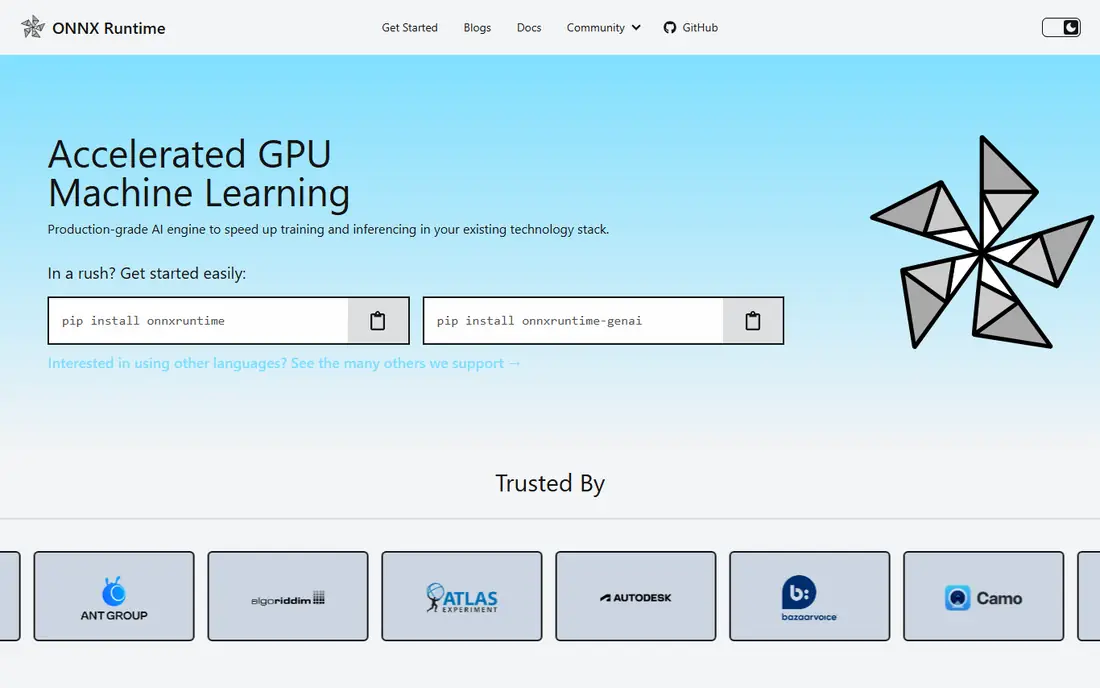
ONNX Runtime is a cross-platform inference engine for machine learning models, including generative AI and large language models. Its homepage shows Python, C#, JavaScript, Java, and C++ support, with models running on Linux, Windows, Mac, iOS, Android, and even in web browsers, on CPU, GPU, or NPU hardware. It powers AI in Microsoft products including Windows, Office, Azure Cognitive Services, and Bing, as well as thousands of other projects.
Its strength is deployment: train in PyTorch, TensorFlow, or another framework, export to the ONNX format, and run the same model fast everywhere, with optimization techniques for latency, throughput, and memory. It also supports training, including on-device training for personalized models. For a team whose problem is shipping models to many devices rather than inventing new architectures, ONNX Runtime is the most practical tool here.
What we like- Runs models from PyTorch and other frameworks on any platform
- Optimizes latency, throughput, memory, and binary size
- Powers AI in Windows, Office, and Azure
Watch out for- Inference-focused, so training is secondary
- Model conversion to ONNX format adds a step
How we chose
We compared software for building, training, and deploying artificial neural networks, from research frameworks to enterprise platforms and inference engines, and we opened each vendor homepage to confirm it loads and belongs to that product. We weighed ease of use, scalability, deployment options, ecosystem size, and cost. Where a price could not be confirmed on the vendor's own page, we list "See website" rather than repeating a third-party figure. MATLAB was verified through its vendor homepage and PaddlePaddle through its homepage title, as noted above.
Buying guide: how to pick neural network software
Start with your goal. If you are learning deep learning, Keras gives the fastest results with readable code. If you are researching new architectures, PyTorch or JAX gives the most control. If you are shipping a product, TensorFlow or ONNX Runtime gives the strongest deployment story. If you work in a regulated enterprise, H2O.ai gives governance and air-gapped deployment that the open frameworks do not bundle.
Next, check your hardware and deployment targets. GPU and TPU support, mobile and browser deployment, and on-device inference each favor different tools, and converting a model between frameworks costs time. Pick the framework whose deployment path matches your product, not just the one with the nicest training API.
Finally, weigh team skill and hiring. PyTorch and TensorFlow have the largest talent pools, so staffing is easier, while JAX and PaddlePaddle suit specialized teams. Run a small pilot on a real problem, measure training speed and inference latency, and confirm that the framework's ecosystem has the pretrained models and tools your project needs before committing.
Frequently asked questions
What is artificial neural network software?
It is software for building, training, and running neural networks: mathematical models loosely inspired by the brain that learn patterns from data for tasks such as image recognition, language processing, and prediction.
Which is better, TensorFlow or PyTorch?
PyTorch is usually easier for research and experimentation because models are ordinary Python programs. TensorFlow is usually stronger for production deployment across mobile, web, and server. Keras now lets you use either backend with the same code.
Is neural network software free?
The major open frameworks, TensorFlow, PyTorch, Keras, JAX, PaddlePaddle, and ONNX Runtime, are free and open source. Commercial platforms such as MATLAB and H2O.ai charge licences but add engineering workflows, support, and governance.
Do I need a GPU to train neural networks?
Small models train fine on a CPU, but large models train far faster on a GPU or TPU. Cloud platforms rent accelerators by the hour, so a team can train large models without buying hardware.
What is ONNX?
ONNX is an open format for representing machine learning models, so a model trained in one framework can run in another tool such as ONNX Runtime. It separates training from deployment, letting teams pick the best tool for each stage.
Sources we checked (0)
Is your product missing or out of date?
We review this list regularly. Vendors can request a listing, send updated pricing or ask about featured placement.

Shihab Mia · Founder, Rankite
Shihab has 5+ years in B2B and SaaS SEO. He writes Rankite's software buying guides from pricing pages, documentation and public user reviews. More about Shihab.