How we make this list: we compare pricing pages, product documentation and public user reviews. Ratings come from G2, Capterra or Trustpilot, with the date we checked them.

Key takeaways
- Fees decide your net profit more than sale price does. Local sales on Facebook Marketplace, OfferUp and Craigslist cost nothing, while Poshmark takes 20 percent on items over $15.
- eBay has the biggest buyer pool and suits almost anything, but its fee of about 13.25 percent plus a fixed amount adds up on low-value items.
- Fashion sells best on specialist apps: Poshmark for brand-name clothes, Depop for vintage and streetwear, Etsy for handmade and vintage goods.
- Meet local buyers in public, daylight places and never share personal details beyond what the app requires.
Quick comparison
| Tool | Best for | Starting price | Free plan |
|---|
 eBay | Almost anything, with the biggest buyer pool | Free to list; about 13.25% plus $0.30 per sale | Yes |
 Mercari | Household items and general goods, shipped simply | Free to list; 10% per sale | Yes |
 Poshmark | Brand-name fashion, shoes and accessories | Free to list; $2.95 under $15, 20% over $15 | Yes |
 Facebook Marketplace | Local furniture, bulky items and fast cash sales | Free for local sales; 10% for shipped sales | Yes |
 Etsy | Handmade, vintage and custom goods | $0.20 listing fee plus 6.5% transaction fee | Yes |
 Depop | Vintage, streetwear and trend-led fashion | Free to list; 3.3% plus $0.45 payment processing per sale | Yes |
 OfferUp | Fast local sales of everyday items | Free for local sales; 12.9% for shipped sales | Yes |
 Craigslist | Cash local sales with no fees at all | Free for most posts | Yes |
Is your product missing or out of date?
We review this list regularly. Vendors can request a listing, send updated pricing or ask about featured placement.
The best apps to sell stuff
#1eBay
Best for: Almost anything, with the biggest buyer pool1.2/5 on
Trustpilot (19,286 reviews, checked Oct 2026)
Visit ebay.com
Starting priceFree to list; about 13.25% plus $0.30 per sale
Free planYes
eBay remains the default when you do not know where an item belongs. With more than 130 million buyers worldwide, it covers electronics, collectibles, home goods, clothing and parts in one place, and the auction format can push rare items past their listed price. For a seller clearing a house or running a small resale business, that reach is unmatched.
The cost is complexity and fees. Final value fees run about 13.25 percent plus a fixed amount in most categories, and promoted listings add more. Shipping, returns and buyer disputes take time to learn. Sell on eBay when the item is unusual, valuable or hard to place locally, and price with the fee already subtracted.
What we like- Largest audience for general goods
- Auction format for rare items
- Buyer protection builds trust
Watch out for- Highest learning curve here
- Fees eat small sales
- Returns lean buyer-friendly
#2Mercari
Best for: Household items and general goods, shipped simply1.2/5 on
Trustpilot (20,512 reviews, checked Oct 2026)
Visit mercari.com
Starting priceFree to list; 10% per sale
Free planYes
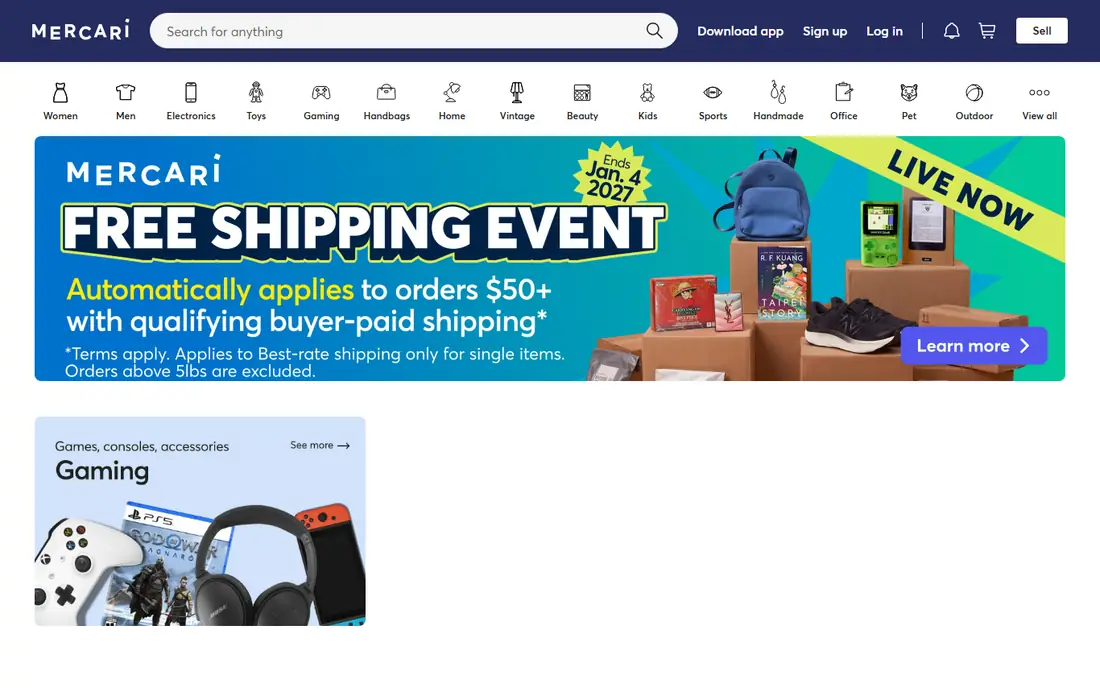
Mercari suits the casual seller with a box of household goods. Listing takes a few photos and a description, shipping labels come prepaid, and the 10 percent seller fee is easy to calculate before you list. Categories cover clothing, toys, electronics, home goods and more, so one app handles a whole cleanout.
The trade-off is reach. Mercari has tens of millions of downloads but a smaller buyer pool than eBay, so niche items may sit longer. Buyer fees and payout charges also trim the net on some sales. Use Mercari for everyday items in the $15 to $100 range, where the simple flow beats eBay's extra work.
What we like- Simple listing flow
- Prepaid shipping labels
- Broad general categories
Watch out for- 10 percent fee on every sale
- Smaller audience than eBay for niche items
Starting priceFree to list; $2.95 under $15, 20% over $15
Free planYes

Poshmark is the social closet: sellers share listings, join themed parties and build followings, and buyers browse closets the way they browse feeds. Shipping is simple, with a prepaid flat-rate label, and luxury items over $500 pass through Posh Authenticate before reaching the buyer. For mid-tier brands like Lululemon, Madewell and Anthropologie, it moves stock faster than general marketplaces.
The 20 percent fee on items over $15 is the steepest here, so margins matter. A $20 shirt nets $16 before any other cost, which makes Poshmark a poor fit for low-value basics. Sell here when the brand carries the price, and keep cheap basics for Mercari or local apps.
What we like- Prepaid flat-rate shipping
- Social features drive discovery
- Authentication for luxury over $500
Watch out for- Highest fee here at 20 percent
- Limited to fashion-adjacent categories
#4Facebook Marketplace
Best for: Local furniture, bulky items and fast cash sales1.2/5 on
Trustpilot (18,675 reviews, checked Oct 2026)
Visit facebook.com
Starting priceFree for local sales; 10% for shipped sales
Free planYes
Facebook Marketplace is the first stop for anything too big to ship. Sofas, appliances, bikes and cars sell locally with no listing fee and no commission when buyer and seller meet in person. The audience is already on Facebook, so listings get seen fast, and messaging stays inside the app.
Two flags belong here. First, during our check the Marketplace page returned an access-denied page, so this entry rests on search evidence rather than a fresh homepage view. Second, cash local deals carry no platform protection, so meet in public, daylight places, check items before paying, and never accept overpayment checks. Shipped sales add a 10 percent fee with purchase protection, which suits smaller items.
What we like- No fee for local sales
- Huge local audience
- Easy listing from the Facebook app
Watch out for- No seller protection on cash deals
- Shipped sales carry a 10 percent fee
- Scams need care
#5Etsy
Best for: Handmade, vintage and custom goods1.4/5 on
Trustpilot (21,438 reviews, checked Oct 2026)
Visit etsy.com
Starting price$0.20 listing fee plus 6.5% transaction fee
Free planYes
Etsy is not a general selling app. It is a marketplace where buyers arrive expecting handmade, vintage and custom goods, which means a maker does not have to convince shoppers that a hand-thrown mug belongs there. Shop tools cover variations, personalization, digital downloads and sale events, and the global audience suits small studios.
Fees stack: $0.20 per listing, 6.5 percent transaction fee, plus payment processing, and offsite ads can add a further percentage on some sales. Competition is fierce in jewelry, candles and printables, so photos and search terms matter more than on local apps. Sell on Etsy when your goods are genuinely handmade, vintage or custom, not for ordinary used items.
What we like- Buyers arrive looking for handmade and vintage
- Strong shop tools
- Global reach for makers
Watch out for- Listing plus transaction plus payment fees stack up
- Competition is intense in popular niches
#6
Depop
Best for: Vintage, streetwear and trend-led fashion
Visit depop.com
Starting priceFree to list; 3.3% plus $0.45 payment processing per sale
Free planYes
Depop removed its seller fee in the US, leaving only payment processing of 3.3 percent plus $0.45 per sale, which makes it the cheapest shipped fashion option here. The feed-driven app suits vintage denim, streetwear, Y2K pieces and one-off finds, and its homepage shows more than 49 million items for sale with over a million new listings daily.
The audience skews young, so classic workwear and mainstream brands may move slower than on Poshmark or eBay. Sellers also arrange their own shipping rather than using a prepaid label. List on Depop when the item reads as trendy, vintage or streetwear, and price with the low fee in mind.
What we like- No seller fee in the US
- Young, trend-driven audience
- Social feed discovery
Watch out for- Audience skews young, so classic styles sell slower
- Seller arranges shipping
Starting priceFree for local sales; 12.9% for shipped sales
Free planYes
OfferUp competes directly with Facebook Marketplace for local selling, and for many US cities it is the stronger second option. Local listings are free within listing limits, the app flow is simple, and categories cover furniture, electronics, vehicles and general goods. Its homepage shows live local listings across the country, from furniture to cars.
Shipped sales cost 12.9 percent, which is steeper than Mercari, so keep shipped volume on cheaper apps when possible. Local deals carry the usual cautions: meet in public, bring someone if you can, and never share home addresses or banking details. OfferUp suits sellers who want a dedicated selling app rather than selling inside a social network.
What we like- Free local listings
- Large local buyer base
- Simple app flow
Watch out for- Shipped fee of 12.9 percent is steep
- Local deals need the same safety care as Marketplace
Starting priceFree for most posts
Free planYes
Craigslist is the oldest tool here and still the cheapest: most posts cost nothing, and payment is cash in person. It remains strong for cars, furniture, appliances, tickets and local services, where buyers search by city and category rather than by feed. A plain text listing with good photos still sells.
The trade-offs are real. There is no protection for either side, no shipping flow and no app polish, and scam listings appear regularly. One flag: the Craigslist domain is blocked for automated fetching, so this entry rests on search evidence rather than a fresh homepage view. Never ship an item to a Craigslist buyer, never accept checks, and meet in public places. Used carefully, it is the highest-net option for local sales.
What we like- No selling fees on most categories
- Simple text listings
- Strong for cars, furniture and rentals
Watch out for- No buyer or seller protection
- Dated interface
- Scam listings need vigilance
How we chose
We compared vendor homepages, published fee schedules and independent selling-app roundups in October 2026, and opened each homepage to confirm it loads and belongs to the marketplace named. Two exceptions are flagged in the article: Facebook Marketplace returned an access-denied page and Craigslist is blocked for automated fetching, so those entries rest on search evidence. We weighted seller fees first, since they decide net profit, then audience size, category fit, shipping simplicity and safety protections.
What to check before you list
Start with the item, not the app. Bulky goods belong on local apps where shipping costs nothing. Fashion belongs on Poshmark, Depop or Etsy depending on brand and style. Rare or collectible goods belong on eBay, where the audience pays for scarcity. Listing the same item on two apps is allowed on most platforms, but remove it from the other the moment it sells.
Then do the fee math before you price. A $50 sale nets $50 locally, about $45 on Mercari, about $43 on eBay, about $40 on Poshmark and about $48 on Depop after processing. Price from the net you want, not the gross you hope for, and remember that promoted listings, payment processing and shipping materials all trim the result further.
Finally, protect yourself on local deals. Meet in daylight public places, preferably police station exchange zones where your city offers them. Bring a friend for high-value items, test electronics before paying, and never accept partial payment, overpayment checks or wire transfers. For shipped sales, photograph the item packed, keep tracking numbers, and use the app's own payment flow rather than side payments.
Frequently asked questions
What is the best app to sell stuff overall?
For general items, eBay has the biggest audience, while Mercari is simpler for casual sellers. For local sales, Facebook Marketplace and OfferUp cost nothing. For fashion, Poshmark and Depop beat general apps on buyer intent.
Which selling app has the lowest fees?
Craigslist and local sales on Facebook Marketplace and OfferUp charge no fee. For shipped fashion, Depop is cheapest at payment processing only. For general shipped goods, Mercari at 10 percent undercuts eBay at about 13.25 percent.
Do I need to pay taxes on items I sell?
Possibly. In the US, marketplaces report sellers who pass certain thresholds, and profits on resold goods can be taxable income. Rules changed recently and vary by state, so check current IRS guidance or ask a tax professional about your situation.
How do I avoid scams when selling locally?
Meet in public daylight places, accept cash or the app's own payment only, and never accept checks for more than the price. Be wary of buyers who cannot meet in person, ask to ship, or push you off the app's messaging.
Can I sell the same item on multiple apps?
Yes, on most platforms, and cross-listing usually sells items faster. Remove the listing everywhere else the moment it sells, or you risk selling one item twice and damaging your seller rating.
Is it better to sell locally or ship items?
Local sales keep the full price and skip packing, but limit buyers to your city. Shipping reaches national buyers and suits small, light, high-demand items. Heavy or fragile goods almost always net more locally once shipping and damage risk are counted.
Sources we checked (8)
- https://www.ebay.com
- https://www.mercari.com
- https://poshmark.com
- https://www.facebook.com/marketplace
- https://www.etsy.com
- https://www.depop.com
- https://www.offerup.com
- https://www.craigslist.org
Is your product missing or out of date?
We review this list regularly. Vendors can request a listing, send updated pricing or ask about featured placement.

Shihab Mia · Founder, Rankite
Shihab has 5+ years in B2B and SaaS SEO. He writes Rankite's software buying guides from pricing pages, documentation and public user reviews. More about Shihab.