How we make this list: we compare pricing pages, product documentation and public user reviews. Ratings come from G2, Capterra or Trustpilot, with the date we checked them.
Key takeaways
- Google Analytics is the free default for website traffic, and it is free of charge for understanding the customer journey across devices.
- Amplitude and Mixpanel are the best product analytics tools for teams that need funnels, retention and event-level insight.
- Plausible and Matomo are the best privacy-first alternatives, with no cookies, full data ownership and no sampling.
- Hotjar is now Contentsquare, and new users sign up for Contentsquare Free with heatmaps, recordings and surveys included.
Quick comparison
| Tool | Best for | Starting price | Free plan |
|---|
 Google Analytics | Free website analytics | Free | Yes |
 Mixpanel | Product behavior analytics | See website | Yes |
 Amplitude | Product analytics and AI agents | Free | Yes |
 Plausible | Privacy-friendly web analytics | See website | No |
 Matomo | Self-hosted analytics | Free | Yes |
 Heap | Automatic event capture | See website | No |
 Adobe Analytics | Enterprise analytics | See website | No |
 Hotjar | Heatmaps and recordings | Free | Yes |
Is your product missing or out of date?
We review this list regularly. Vendors can request a listing, send updated pricing or ask about featured placement.
The best analytics software
Starting priceFree
Free planYes
Google Analytics gives businesses the tools, free of charge, to understand the customer journey and improve marketing ROI across devices and platforms. Its strengths are customer-centric measurement across sites and apps, machine learning insights that anticipate future actions, and integrations across Google's advertising and publisher tools, including Google Ads, Search Ads 360, Display and Video 360, Google Cloud and Search Console. One customer cited on the product page cut reporting time by 50 percent after consolidating web and app data in Analytics.
The app itself lives at analytics.google.com, which returns an app and login page rather than marketing content, so the marketing page is the best public evidence for its features and free pricing. The limits are real: the interface takes time to learn, very large properties face sampling, and privacy regulations affect implementation in some regions. For most websites, though, Google Analytics remains the free starting point, and every other tool on this list is best judged against it.
What we like- Free of charge
- Cross-device and cross-platform customer journey
- Machine learning insights
- Deep integrations with Google Ads and Search Console
Watch out for- Complex interface for beginners
- Sampling on very large properties
- Privacy rules vary by region
#2Mixpanel
Best for: Product behavior analytics4.5/5 on
G2 (1,375 reviews, checked Oct 2026)
Visit mixpanel.com
Starting priceSee website
Free planYes
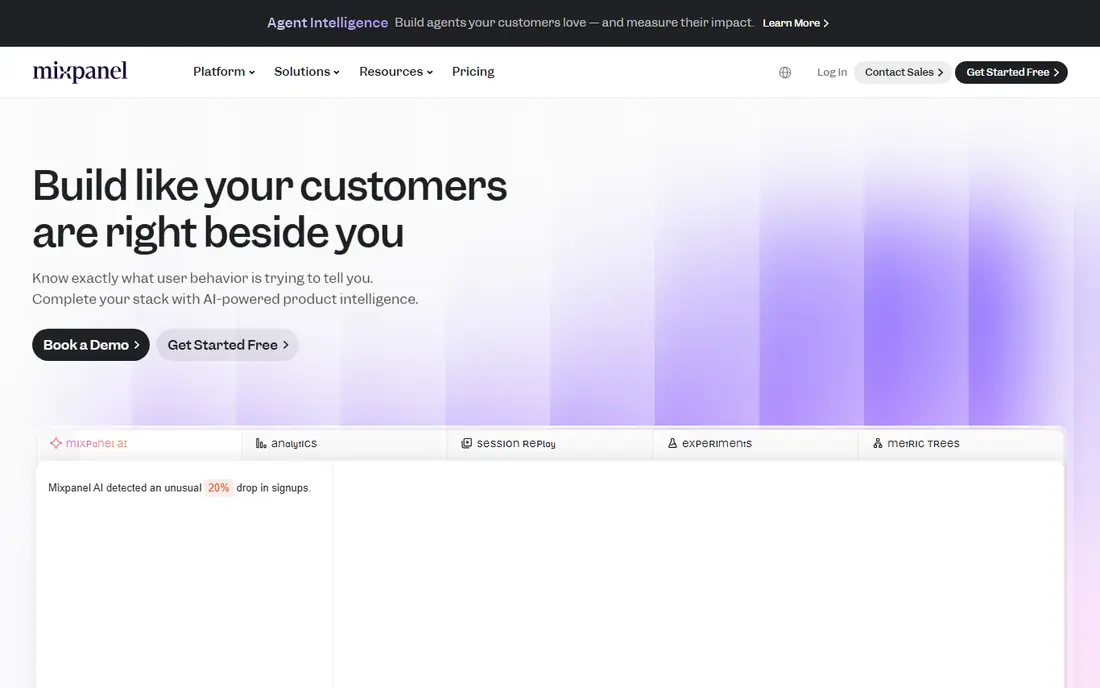
Mixpanel is a product intelligence platform for the AI era, built to show exactly what user behavior is trying to tell a team. Its queries run on a proprietary database called Arb, designed for spotting behavioral trends in seconds, and its AI features reduce manual work while staying grounded in the team's own data. Newer capabilities include Mixpanel MCP, which connects Mixpanel to Claude, ChatGPT, Cursor or any MCP client, and Mixpanel Headless for embedding dashboards, reports, cohorts, feature flags and experiments.
The vendor reports 29,000 customers worldwide and a community of more than 12,000 peers. Pricing was not shown on the homepage, so we list it as "See website" and recommend checking the pricing page for current free plan limits. For product teams that live in funnels, cohorts and retention curves, Mixpanel is one of the two best choices alongside Amplitude.
What we like- Lightning-speed queries on a proprietary database
- AI-powered product intelligence
- MCP connections to Claude, ChatGPT and Cursor
- 29,000+ customers
- Large analytics community
Watch out for- Pricing must be checked on the pricing page
- Product analytics focus means weaker web marketing reporting than Google Analytics
#3Amplitude
Best for: Product analytics and AI agents4.5/5 on
G2 (2,997 reviews, checked Oct 2026)
Visit amplitude.com
Starting priceFree
Free planYes
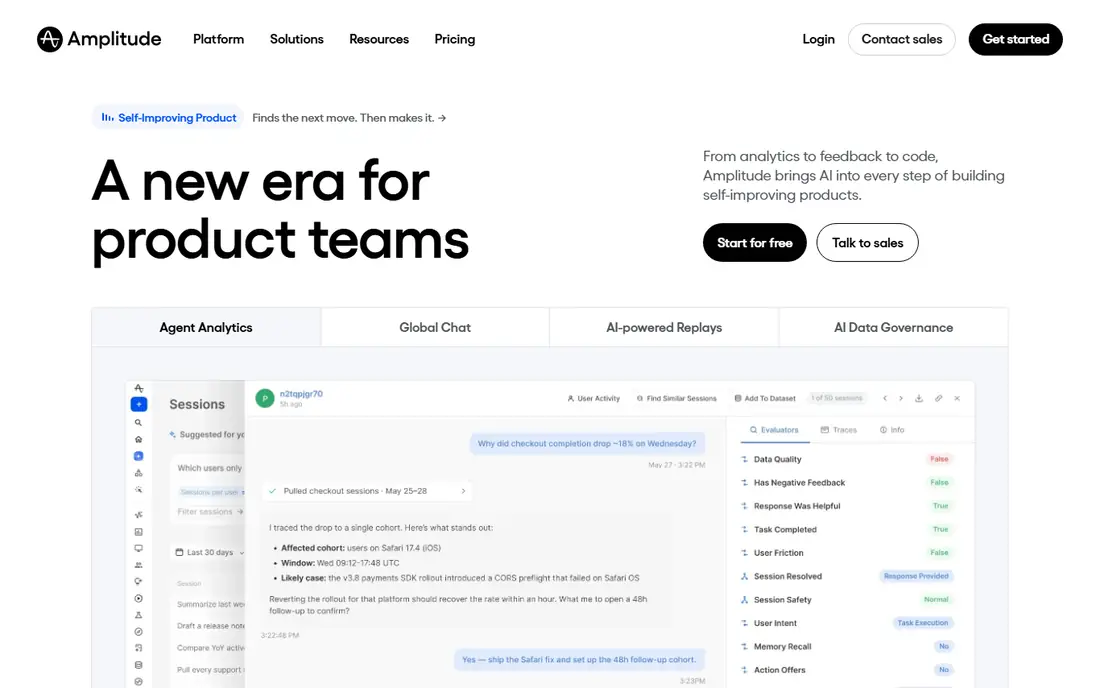
Amplitude brings AI into every step of building self-improving products, from analytics to feedback to code, in one interface. Its Global Agent pulls from everything Amplitude knows the moment a question is asked, and the vendor claims it resolves 76 percent of customer issues on average across more than 4,900 customers, improving about 1 percent each month. The pitch is a loop: let AI find where users get stuck, tell the team what to build next, and prove it worked, then repeat.
The free plan is described as the industry's most generous, with 2 million events per month free. That makes Amplitude the easiest product analytics tool to try at scale without a credit card. For teams that want AI agents working on top of their product data, Amplitude is the strongest pick on this list.
What we like- 2 million events per month free
- Global Agent resolves 76% of customer issues on average
- Analytics, feedback and code in one interface
- AI that finds where users get stuck
Watch out for- Enterprise features need paid plans
- Depth can overwhelm small teams
#4Plausible
Best for: Privacy-friendly web analytics4.8/5 on
G2 (3 reviews, checked Oct 2026)
Visit plausible.io
Starting priceSee website
Free planNo
Plausible is a simple, privacy-first alternative to Google Analytics that does not cut corners. Its dashboard shows essential insights on one page in one minute, with a consolidated view of all sites and no layers of menus or custom report building. The script is 54 times smaller than Google Analytics, saving about 135KB of JavaScript per visitor, and because it processes no personal data, tracks no individual users and uses no cookies, most sites need no cookie banner or GDPR consent for it. All visitor data stays on servers owned and operated by European companies and never leaves the EU.
More than 22,000 paying customers trust Plausible, and the team is fully independent, self-funded and bootstrapped since 2018, with open source code so users are never locked in. There is no free plan, though a free trial is offered. For site owners who want clean traffic numbers without surveillance, Plausible is the best privacy-friendly choice.
What we like- Simple one-page dashboard
- Script 54 times smaller than Google Analytics
- No cookies or persistent identifiers
- No cookie banners needed
- Open source
- Independent and bootstrapped since 2018
Watch out for- No free plan
- Fewer features than Google Analytics for deep product analysis
- Pricing must be checked on the pricing page
#5Matomo
Best for: Self-hosted analytics4.2/5 on
G2 (96 reviews, checked Oct 2026)
Visit matomo.org
Starting priceFree
Free planYes
Matomo is privacy-first analytics trusted by 1 million organizations worldwide, built on a simple promise: accurate data, full ownership and no lock-in. Popular tools can miss up to 40 percent of traffic, the vendor says, while Matomo delivers unsampled data with fewer blind spots from consent banners or blockers, using first-party tracking, JavaScript and log analytics, and raw data access. Features include funnels and flows, segmentation, A/B testing, heatmaps and session recordings, plus newer AI traffic tracking that shows how AI assistants, agents and chatbots discover and send traffic to a site.
The pricing model is unusually generous: start a 21-day free Cloud trial, or self-host forever for free with full access to all features and no credit card required. That makes Matomo the best choice for organizations that must own their data, from public sector bodies to privacy-conscious companies. The trade-off is setup effort for self-hosting, but for data ownership, nothing else on this list matches it.
What we like- Self-host forever for free
- 100% data ownership
- Unsampled data with no loss from consent banners
- Heatmaps, recordings, A/B testing included
- AI traffic tracking
- GDPR compliant
Watch out for- Self-hosting needs technical setup
- Cloud version is paid after a 21-day trial
- Smaller ecosystem than Google Analytics
#6Heap
Best for: Automatic event capture4.4/5 on
G2 (1,097 reviews, checked Oct 2026)
Visit heap.io
Starting priceSee website
Free planNo
Heap automatically captures the entire digital experience of every user on every platform from a single snippet, with no engineering needed for each new event. That autocapture approach means teams always have the data they need, even for behaviors they did not think to track in advance. Its data science tools alert teams to moments of friction and opportunity, show the alternate paths users take, the effort required to complete flows, and the events that most correlate with conversion and retention, all automatically.
Session replay adds qualitative context, directing analysts to the exact point in a session that matters rather than making them watch whole recordings. Heap is used by more than 10,000 companies and has now joined forces with Contentsquare, combining autocapture with experience analytics. Pricing was not shown on the homepage, so check the pricing page. For teams tired of re-instrumenting analytics every time a question changes, Heap's autocapture is the key advantage.
What we like- Single snippet automatically captures every user interaction
- Session replay with exact moment navigation
- Data science that surfaces friction and opportunity
- 100+ integrations
- Now joined with Contentsquare
Watch out for- No free plan shown
- Pricing must be checked on the pricing page
- Enterprise focus may be heavy for small sites
Starting priceSee website
Free planNo
Adobe Analytics is enterprise digital experience analytics, now framed as Adobe CX Analytics: trusted data architecture, consistent and persistent identity, democratized AI insights, and data-driven activation in one unified solution. It brings website analytics from web, mobile and product interactions into a single source of truth, breaking down data silos and enabling fast analysis across platforms, with real-time behavioral integration, unlimited data exploration, cross-channel attribution and in-depth reporting with unified customer profiles.
Governance is a core strength, with granular permissions, automated data processing, privacy safeguards and centralized control over web and mobile analytics, aimed at meeting compliance requirements. Pricing is enterprise and sales-led, with demo booking rather than public pricing. For large organizations that need governed, cross-channel analytics at scale, Adobe Analytics is the enterprise standard, though small sites should start with Google Analytics or Plausible.
What we like- Unified customer experience analytics across web, mobile and product
- Real-time behavioral data
- Unlimited exploration and cross-channel attribution
- Strong governance and privacy controls
- AI-powered insights
Watch out for- Enterprise pricing
- Demo and sales-led buying
- Overkill for small sites
#8Hotjar
Best for: Heatmaps and recordings4.3/5 on
G2 (345 reviews, checked Oct 2026)
Visit hotjar.com
Starting priceFree
Free planYes
Hotjar is now Contentsquare. The homepage confirms that everything users know from Hotjar, heatmaps, recordings and surveys, continues inside Contentsquare Free, with far larger limits: up to 200,000 sessions per month compared with 35 per day on the old Hotjar Free plan, plus attention maps, funnels, error monitoring, performance monitoring and AI assistant connections via MCP. It is no longer possible to create a new account on Hotjar itself; new users sign up for free on Contentsquare with no credit card required.
The platform is trusted by more than 1.3 million websites and apps, with 4.6 ratings on both G2 and Gartner. AI features include instant summaries of heatmaps and recordings and Sense Chat for asking questions about data in plain language. For teams that want to see why users behave the way numbers suggest, Hotjar through Contentsquare Free is the best qualitative analytics choice.
What we like- Heatmaps, recordings and surveys
- Now part of Contentsquare with 200,000 sessions per month free
- Attention maps, funnels and error monitoring
- AI summaries and Sense Chat
- Trusted by 1.3M+ websites and apps
Watch out for- New accounts must sign up on Contentsquare, not Hotjar
- Hotjar Free capped at 35 sessions per day for legacy users
How we chose
We picked analytics tools covering the main jobs: website traffic, product behavior, privacy-first measurement, automatic capture, enterprise reporting and qualitative insight. Each homepage was opened to confirm the product exists and matches its description, and pricing was taken from the vendor's own pages where shown. Where a homepage did not display pricing, we wrote "See website" rather than guessing. Google Analytics is listed with its app address, and its free pricing is confirmed on Google's own marketing page, since the app address itself returns only a login screen.
Choosing the right analytics stack
Most businesses need two tools, not eight. Pair a quantitative tool with a qualitative one: Google Analytics plus Hotjar through Contentsquare Free covers traffic and behavior for most sites at no cost, while Amplitude or Mixpanel plus Heap covers product analytics for app teams. Privacy-conscious sites should swap Google Analytics for Plausible or Matomo, and enterprises with governance needs should evaluate Adobe Analytics. Avoid stacking three tools that all measure the same traffic, since conflicting numbers create more confusion than insight.
Frequently asked questions
What is the best free analytics software?
Google Analytics is the best free website analytics tool, free of charge with cross-device reporting. For product analytics, Amplitude offers 2 million events per month free, and Matomo can be self-hosted forever for free.
What is the difference between Google Analytics and Mixpanel?
Google Analytics focuses on website and marketing traffic, including acquisition, pages and campaigns. Mixpanel focuses on product behavior, including events, funnels, cohorts and retention inside an app or product. Many teams use both.
Is Plausible really privacy friendly?
Yes. Plausible processes no personal data, tracks no individual users, uses no cookies or persistent identifiers, and keeps all visitor data on EU-owned servers. Most sites need no cookie banner for it.
What happened to Hotjar?
Hotjar merged into Contentsquare. The Hotjar homepage now directs new users to Contentsquare Free, which includes heatmaps, recordings, surveys, attention maps, funnels and error monitoring with up to 200,000 sessions per month free.
Do I need Heap if I already have Google Analytics?
Not necessarily. Heap's advantage is autocapture: it records every interaction automatically, so teams can answer new questions without re-instrumenting. Google Analytics requires planned event setup, so Heap suits teams whose questions change often.
Which analytics tool is best for privacy and data ownership?
Matomo is the best choice for data ownership, since it can be self-hosted forever for free with 100 percent data ownership and unsampled data. Plausible is the simpler privacy-first hosted option, with no cookies and EU-only data processing.
Sources we checked (8)
- https://analytics.google.com
- https://mixpanel.com
- https://amplitude.com
- https://plausible.io
- https://matomo.org
- https://www.heap.io
- https://business.adobe.com/products/analytics/adobe-analytics.html
- https://www.hotjar.com
Is your product missing or out of date?
We review this list regularly. Vendors can request a listing, send updated pricing or ask about featured placement.

Shihab Mia · Founder, Rankite
Shihab has 5+ years in B2B and SaaS SEO. He writes Rankite's software buying guides from pricing pages, documentation and public user reviews. More about Shihab.