How we make this list: we compare pricing pages, product documentation and public user reviews. Rankite is independent; if a vendor ever pays for a featured spot, that listing is clearly labeled Partner.
Key takeaways
- Business aviation and charter operators usually land on Veryon Tracking or CAMP Systems: both are built for airworthiness tracking with per-aircraft pricing.
- Airlines and large MROs need the heavier ERP footprint of AMOS, Ramco Aviation or TRAX, all of which handle fleet-wide work orders, inventory and compliance.
- Component shops and parts distributors fit Quantum Control, which is an aviation ERP first and a maintenance tracker second.
- Every product here is quote-based enterprise software: budget for implementation measured in months, not days, and get data migration terms in writing.
Quick comparison
| Tool | Best for | Starting price | Free plan |
|---|
 Veryon Tracking Veryon Tracking | Business aviation, charter and helicopter operators tracking airworthiness per aircraft | See website (annual subscription per aircraft, varies by make and model) | No |
 CAMP Systems CAMP Systems | Operators enrolled in engine and APU maintenance programs | See website (custom quote) | No |
 AMOS AMOS | Airlines and large MRO organizations needing a full aviation ERP | See website (custom quote) | No |
 Ramco Aviation Ramco Aviation | Operators and MROs that want aviation maintenance inside a broader enterprise ERP | See website (custom quote) | No |
 TRAX TRAX | Airlines and MROs needing granular control of maintenance production | See website (custom quote) | No |
 WinAir WinAir | Small to mid-size operators, flight schools and MROs wanting approachable software | See website (custom quote) | No |
 Quantum Control Quantum Control | Component MROs, parts distributors and manufacturers needing aviation ERP | See website (custom quote) | No |
Is your product missing or out of date?
We review this list regularly. Vendors can request a listing, send updated pricing or ask about featured placement.
The best aircraft maintenance tracking software
A missed inspection interval grounds an airplane. A lost logbook entry costs thousands at resale. For a director of maintenance, the tracking system is not back-office software; it is the record the FAA or EASA reads when something goes wrong. The seven platforms below cover the real market, from business-jet tracking to airline-grade MRO suites, with honest notes on where each one fits and where it strains.
#1
Veryon Tracking
Best for: Business aviation, charter and helicopter operators tracking airworthiness per aircraft
Visit veryon.com
Starting priceSee website (annual subscription per aircraft, varies by make and model)
Free planNo
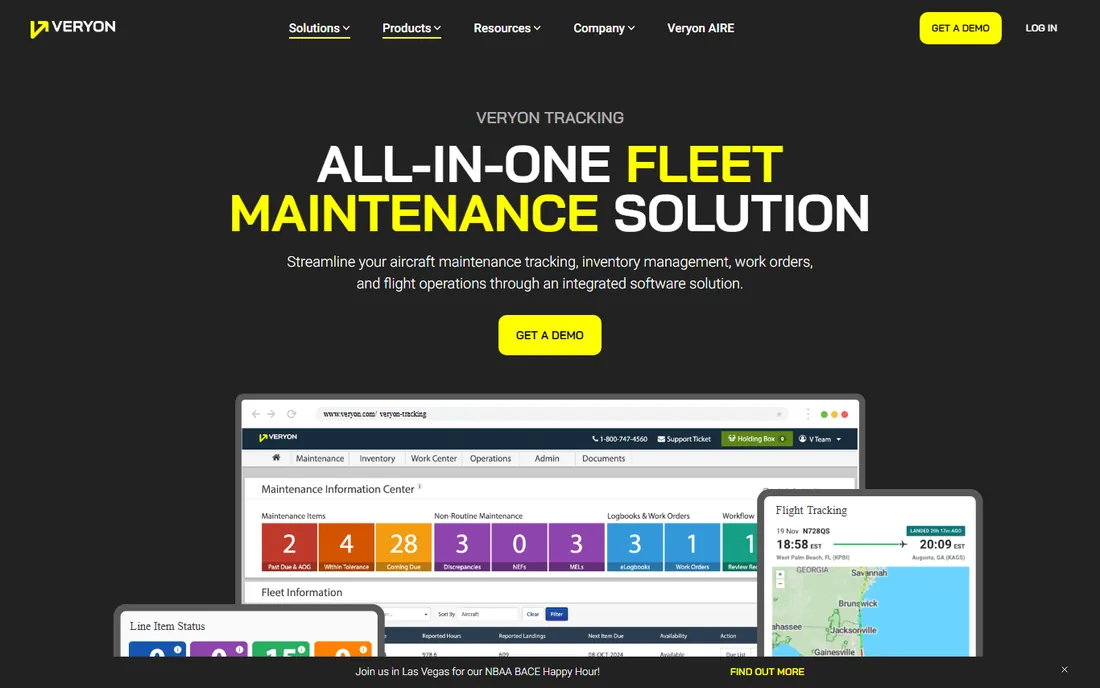
Veryon Tracking (the current name for the former Flightdocs) charges per aircraft per year, with the rate varying by make and model, plus a one-time enrollment fee that covers a dedicated onboarding analyst and data migration with Chapter 4 and Chapter 5 record reviews. That per-tail pricing is the concrete advantage for a flight department: mechanics, pilots and admin staff all get access without per-seat math. The platform covers maintenance tracking, inventory, work orders and flight operations, with Veryon Publications built in for tech pubs and regulatory content, and mobile apps for real-time record updates and sign-offs.
The trade-off is scope. Veryon is built for business aviation, charter and helicopter operations, from Cessnas to 737s, not for airline heavy checks or third-party MRO production planning. Implementation is white-glove: a welcome call, a personalized plan, analyst-handled data enrollment and verification before go-live. Expect weeks, not days, and get the enrollment fee and timeline in writing since both scale with fleet complexity.
What we like- Per-aircraft pricing instead of per-user, so the whole team can use it
- Built-in technical publications library
- 24/7/365 US-based analyst support with unlimited training
Watch out for- One-time enrollment fee on top of the subscription
- Geared to business and general aviation, not airline heavy maintenance
Starting priceSee website (custom quote)
Free planNo
CAMP Systems has tracked engine and airframe maintenance programs for decades, and for many business aviation operators the name is synonymous with the maintenance program itself. The concrete strength is program depth: CAMP manages the recurring tasks, inspection intervals and service bulletins tied to enrolled engines and APUs, with data flowing from OEMs and service centers. It is a Hearst company, independent of the Veryon consolidation happening elsewhere in the market.
The honest weakness is breadth. CAMP is a maintenance program tracker first, not a full MRO ERP: work order management, inventory and invoicing for a repair station need other systems or integrations. Everything is quote-based, and the sales process assumes you know your fleet and program enrollments. If your need is airworthiness tracking for enrolled aircraft, CAMP is the default; if you run a repair station, pair it with something heavier.
What we like- The industry standard for engine health and maintenance program tracking
- Deep OEM and service-center data integration
Watch out for- Narrower than a full MRO suite
- Pricing and modules are entirely quote-driven
#3
AMOS
Best for: Airlines and large MRO organizations needing a full aviation ERP
Visit swiss-as.com
Starting priceSee website (custom quote)
Free planNo
AMOS from Swiss-AS is the airline industry's workhorse: a single database covering engineering records, line and base maintenance, component tracking, materials management, quality assurance and finance. The concrete strength is integration depth at scale. An airline running AMOS does not reconcile maintenance data between systems because there is only one system. The installed base among carriers is large, which means regulators, lessors and auditors already know the record formats.
The weakness is the weight that comes with that depth. AMOS implementations run for months, require dedicated project teams on the customer side, and the commercial model assumes airline budgets. A 10-aircraft charter operator will drown in functionality it never uses while paying for it. This is the right pick when the fleet and the maintenance organization are both large; below that threshold, the lighter tools on this list deliver faster.
What we like- Genuinely comprehensive: engineering, maintenance, materials, quality and finance in one database
- Strong airline installed base
Watch out for- Heavyweight implementation measured in months
- Overkill and overpriced for fleets under ~20 aircraft
#4
Ramco Aviation
Best for: Operators and MROs that want aviation maintenance inside a broader enterprise ERP
Visit ramco.com
Starting priceSee website (custom quote)
Free planNo
Ramco Aviation Suite puts maintenance tracking inside a genuine enterprise ERP: the same system that runs work orders and airworthiness can run finance, procurement, HR and payroll. The concrete strength is consolidation for operators tired of stitching a maintenance tracker to a separate accounting system. Ramco has real traction with airlines, MROs and defense aviation, particularly in Asia-Pacific and the Middle East, and offers cloud and on-premise deployment.
The honest catch is that ERP breadth cuts both ways. Implementations are consultant-led and measured in quarters, and the aviation maintenance modules, while capable, do not match the depth of AMOS or TRAX in heavy MRO workflow. Buyers should evaluate the maintenance functionality on its own merits rather than assuming the ERP halo covers it. Best fit: mid-size to large operators that will actually use the non-aviation modules.
What we like- Full-suite ERP (finance, HR, supply chain) with aviation maintenance modules, not a point solution
- Strong in Asia-Pacific and Middle East markets
Watch out for- ERP breadth means longer, consultant-heavy implementations
- Aviation-specific depth lags the pure-play MRO vendors
#5
TRAX
Best for: Airlines and MROs needing granular control of maintenance production
Visit trax.aero
Starting priceSee website (custom quote)
Free planNo
TRAX (the eMRO product line) is built for the maintenance floor: planning and scheduling, hangar and dock management, work order execution with electronic signatures, tooling and calibration tracking, and materials. The concrete strength is production control. MROs that live on turn times and hangar throughput get the granularity they need, and the mobile apps for mechanics are genuinely field-tested rather than bolted on.
The weakness reviewers cite is the interface, which shows its age next to newer cloud products, and the implementation load: TRAX expects the customer to bring process discipline and training bandwidth. Pricing is entirely quote-based and enterprise-scale. This is a strong pick for an airline or independent MRO with a real production planning function; a small flight department will find it heavy.
What we like- Deep MRO workflow: planning, hangar management, tooling calibration and e-signatures
- Mobile mechanic apps are mature
Watch out for- Dated user interface in places
- Implementation and training demand is high
#6
WinAir
Best for: Small to mid-size operators, flight schools and MROs wanting approachable software
Visit winair.ca
Starting priceSee website (custom quote)
Free planNo
WinAir, from the Canadian vendor of the same name, targets the part of the market the giants ignore: flight schools, small charter operators, corporate flight departments and independent shops. The concrete strength is fit: it covers airworthiness tracking, work orders, inventory and logbooks without the enterprise overhead, and implementations are measured in weeks. For an operator stepping up from spreadsheets, that matters more than feature checklists.
The honest limit is scale. Multi-base airlines, heavy MRO production planning and complex component repair workflows stretch WinAir past its design center. The integration ecosystem is narrower than the big ERP suites, so check your accounting and flight operations connections before committing. For the small-to-mid-size buyer, though, it is one of the few products priced and packaged for them.
What we like- Approachable pricing and implementation for smaller operations
- Covers the core airworthiness, work order and inventory loop well
Watch out for- Less depth for airline-scale or multi-base operations
- Smaller vendor with a narrower integration ecosystem
Starting priceSee website (custom quote)
Free planNo

Quantum Control from Component Control (a CAMP Systems company) is an aviation ERP for the aftermarket: component repair shops, parts distributors, manufacturers and MROs that buy, sell, repair and exchange parts. The concrete strength is commercial depth. Quoting with integrated sales intelligence, purchasing, repair order management, inventory across multiple warehouses and accounting live in one database, which is exactly what a parts business needs and what pure maintenance trackers lack.
The trade-off is focus. If the job is tracking airworthiness on a flight department's aircraft, Quantum Control is the wrong shape: the maintenance workflow exists but sits inside an ERP designed around buying and selling parts. Implementation is a multi-month project with real consulting cost. For the aftermarket business, it is the category leader; for the operator, look at the top of this list instead.
What we like- Thirty years of aviation ERP depth for the aftermarket: quoting, sales, purchasing, repair and inventory in one system
- Large installed base in component MRO
Watch out for- ERP-first design means the pure maintenance-tracking workflow is less streamlined than Veryon or CAMP
- Implementation is a real project
How we chose
We started from the products that actually appear in aviation maintenance RFPs and peer discussions, then checked each vendor's own site for current product names, since this market consolidates fast. Veryon acquired Flightdocs, Traxxall, Corridor, ATP and Polaris Aero, so we list the surviving Veryon Tracking product rather than the retired names. Pricing pages, product documentation, G2 and Capterra reviews, and Reddit threads from maintenance professionals shaped the fit notes. We excluded general CMMS tools with no aviation compliance content and consumer logbook apps. No vendor paid for placement, and we did not test-drive the software; enterprise aviation sales cycles do not work that way.
What to check before you sign
Aviation maintenance software is a 5-to-10-year decision, because migrating airworthiness records is painful. Use this checklist in demos.
Data migration and record integrity
Ask exactly how historical logbook entries, AD compliance records and component trace documents move in, who verifies them, and what it costs. Veryon bakes Chapter 4 and Chapter 5 reviews into enrollment; others charge separately. Get the migration scope in the contract, not in a sales email.
Regulatory acceptance
Confirm the system produces records your authority accepts: FAA, EASA or both, plus any lessor-specific formats if you lease aircraft. Ask for reference customers under the same authority.
Pricing model fit
Per-aircraft pricing (Veryon) favors large teams on few tails; per-user or module pricing favors small teams. Model your cost at current fleet size and at plus-50 percent, because the pricing model that looks cheap today can punish growth.
Integration with your stack
The tracker must talk to flight operations scheduling, accounting and, for MROs, the hangar floor. Ask for live integration references, not slideware. Export matters too: confirm you can extract complete records in a usable format if you ever leave.
Implementation resourcing
Every vendor here except WinAir expects months of implementation with customer-side project staff. Ask for a named implementation team, a timeline with milestones, and what happens to the timeline when your data is messier than expected.
Airworthiness tracking vs. MRO ERP: which do you need
Buyers often conflate two different products. Airworthiness tracking (Veryon Tracking, CAMP Systems, WinAir) answers one question: is each aircraft legal to fly, and what is due when. It manages inspection intervals, ADs, service bulletins, logbooks and due lists. MRO ERP (AMOS, Ramco, TRAX, Quantum Control) answers a different question: how do we run the maintenance business, including work orders, labor, materials, hangar capacity, quoting and invoicing.
A flight department that outsources heavy maintenance needs the first and not the second. An airline or independent repair station needs both, either in one suite or integrated. The most expensive mistake in this market is buying an ERP when a tracker would do, or buying a tracker and discovering at the first heavy check that it cannot plan one. Map your actual workflow before taking demos, and make vendors demo your scenario, not theirs.
Frequently asked questions
How much does aircraft maintenance tracking software cost?
Vendors publish almost no prices; everything here is quote-based. Expect Veryon-style per-aircraft annual subscriptions for business aviation, and six-figure license plus implementation costs for airline ERP suites. Always get implementation, data migration and training quoted separately from the software.
Can small flight departments use these tools?
Yes. Veryon Tracking and WinAir are packaged for small operators, and CAMP Systems works for single-aircraft owners enrolled in its programs. AMOS, Ramco, TRAX and Quantum Control are built for larger organizations and will be overkill below roughly 20 aircraft.
What happened to Flightdocs, Traxxall and Corridor?
Veryon acquired all three (plus ATP and Polaris Aero). Flightdocs became Veryon Tracking; Traxxall and Corridor were folded into the Veryon portfolio. If a broker or consultant recommends them by the old names, ask which current Veryon product they mean.
Do these systems handle FAA and EASA compliance?
The established vendors do, but confirm for your specific authority and operation type. Ask for reference customers operating under the same regulator, and check that AD tracking, logbook formats and record retention meet your requirements.
How long does implementation take?
Weeks for Veryon Tracking or WinAir at a small operator; several months for TRAX or Quantum Control; six months or more for AMOS or Ramco at airline scale. Data migration quality, not software installation, usually sets the timeline.
Can we export our records if we switch vendors later?
Insist on this before signing. Confirm the export format, whether component trace documents and scanned logbooks are included, and what it costs. A vendor that cannot answer clearly is a vendor to avoid.
Sources we checked (7)
- https://veryon.com/flightdocs
- https://www.campsystems.com/
- https://www.swiss-as.com/amos-mro
- https://www.ramco.com/products/aviation-software/flight-operations/
- https://trax.aero/
- https://winair.ca/
- http://www.componentcontrol.com
Is your product missing or out of date?
We review this list regularly. Vendors can request a listing, send updated pricing or ask about featured placement.

Shihab Mia · Founder, Rankite
Shihab has spent more than a decade helping SaaS and e-commerce brands grow through search. He writes Rankite's software buying guides from pricing pages, documentation and public user reviews. More about Shihab.