How we make this list: we compare pricing pages, product documentation and public user reviews. Rankite is independent; if a vendor ever pays for a featured spot, that listing is clearly labeled Partner.
Key takeaways
- Generic chatbots invent citations; every tool on this list is built to avoid that, with Scite and Elicit grounding claims in real papers and Paperpal checking references before submission.
- For drafting, Jenni AI is the most popular academic-first writing assistant; for polishing, Trinka, Writefull and Wordvice AI are tuned specifically to scholarly English.
- Paperpal and Trinka cover the full submission pipeline: writing, citations, plagiarism checks and AI detection in one place.
- Wordvice AI publishes the clearest pricing here: a free Basic plan with 5,000 words per month and Premium from $9.95 per month.
Quick comparison
| Tool | Best for | Starting price | Free plan |
|---|
 Jenni AI Jenni AI | Researchers and students drafting academic papers with AI help | See website | Yes |
 Paperpal Paperpal | Researchers who want one workspace from literature search to submission | See website | Yes |
 Trinka Trinka | Non-native English speakers polishing academic manuscripts | See website (free plan; vendor lists range up to $20/month) | Yes (free plan with advanced grammar checks) |
 Writefull Writefull | Researchers who want AI proofreading trained on scholarly text | See website | See website |
 Wordvice AI Wordvice AI | Researchers who want proofreading, paraphrasing and translation in one toolkit | $9.95/month (Premium; Basic plan free with 5,000 words/month) | Yes (Basic plan free) |
 QuillBot QuillBot | Paraphrasing and summarizing research text quickly | See website | Yes |
 Scite Scite | Verifying citations and finding supporting or contradicting evidence | See website | See website |
 Elicit Elicit | Literature reviews and evidence-based research reports | See website | Yes |
 SciSpace SciSpace | Researchers who work directly from PDFs and want AI explanations | See website | Yes |
Is your product missing or out of date?
We review this list regularly. Vendors can request a listing, send updated pricing or ask about featured placement.
The best AI writing software for research papers
Ask a generic AI chatbot for research help and it will do two things: write fluently and invent citations. That second habit is fatal in academic work. The tools below exist because researchers needed AI that respects evidence: drafting assistants trained on academic prose, checkers that catch fake references, and research agents that cite real papers. Pick based on where your paper actually struggles: the blank page, the language, or the literature.
#1
Jenni AI
Best for: Researchers and students drafting academic papers with AI help
Visit jenni.ai
Starting priceSee website
Free planYes
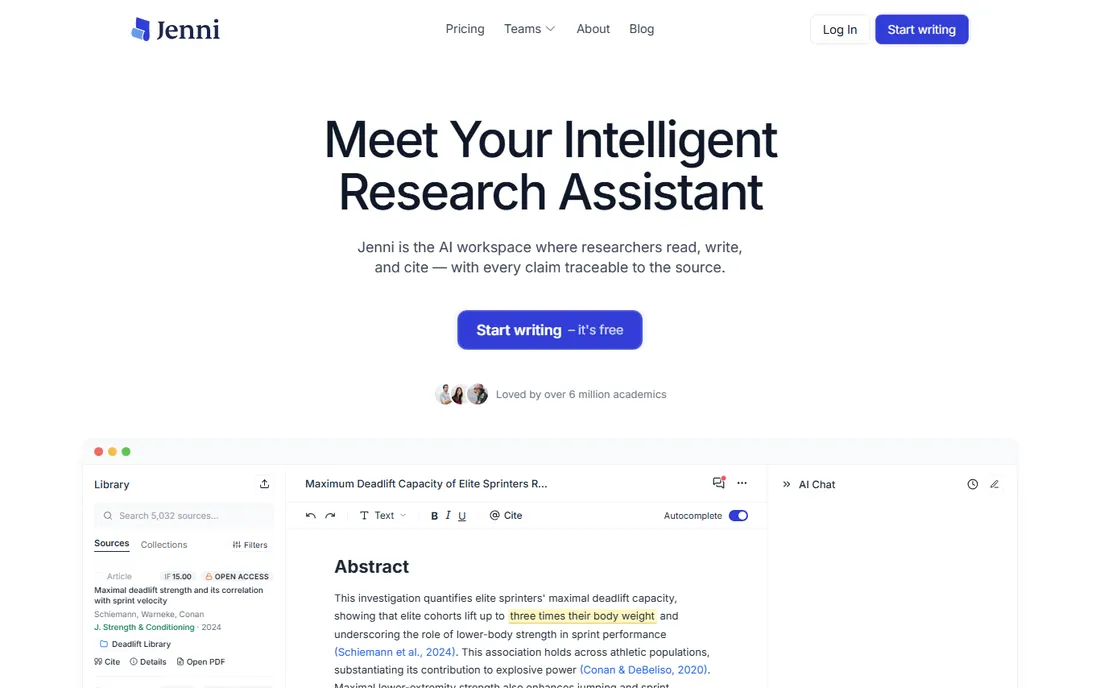
Jenni AI is the drafting assistant most associated with academic writing. Unlike general chatbots, it is built around the way papers are written: you draft in an editor, the AI suggests continuations in academic tone, and citations are handled as part of the workflow rather than pasted in afterward. For students facing the blank page on a term paper or researchers drafting a manuscript section, it removes the startup friction.
The caution applies to every drafting tool: the AI writes fluently about things it may not know. Jenni reduces the citation-invention problem compared with generic tools, but every claim and reference still needs verification against the actual source. Use it to draft faster, not to think less.
What we like- Purpose-built for academic writing with citation support in the editor
- Autocomplete and drafting assistance tuned to scholarly tone
- Works for essays, papers and theses
Watch out for- Pricing and free-tier limits are not published on the homepage
- Drafting assistance still needs careful fact-checking
#2
Paperpal
Best for: Researchers who want one workspace from literature search to submission
Visit paperpal.com
Starting priceSee website
Free planYes
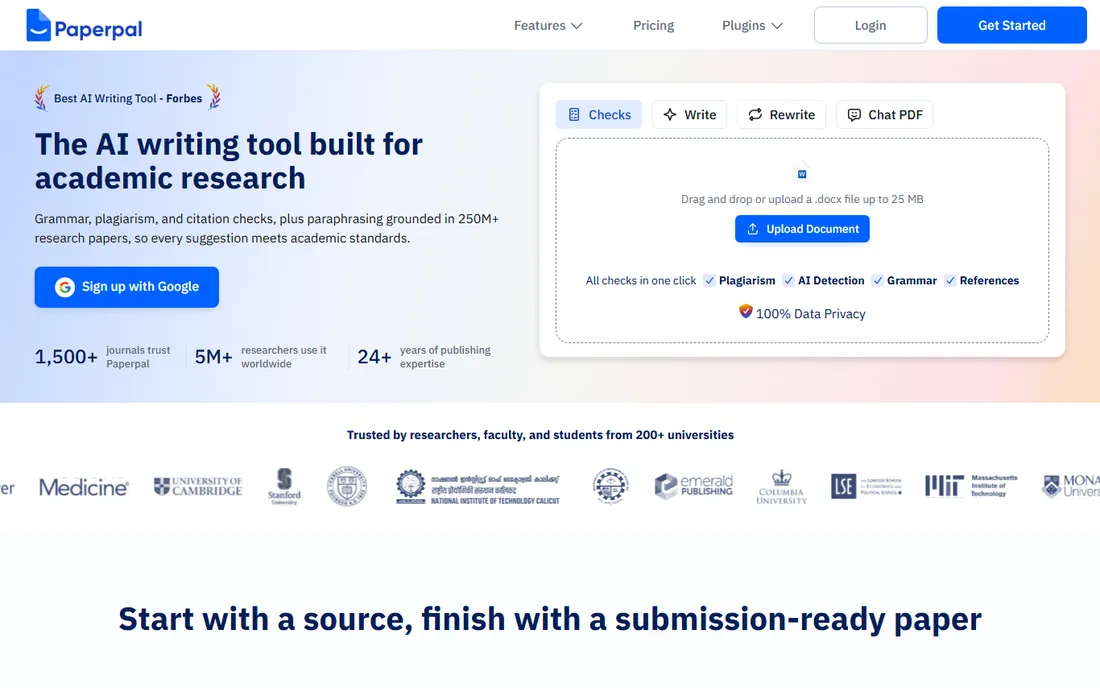
Paperpal positions itself as the only AI workspace a researcher needs from search to submission, and the scope is genuinely wide: AI-assisted drafting grounded in your sources, citation management across thousands of styles, and a pre-submission checker suite covering plagiarism, AI detection, grammar and reference accuracy. The reference check is the standout feature: it catches broken links and AI-hallucinated references before a journal does.
That breadth is also the tradeoff. Researchers who just need proofreading will find simpler tools faster to adopt. But for anyone preparing a manuscript for actual submission, having the integrity checks in the same place as the writing is the right design. Check the current pricing on the vendor's site before committing.
What we like- Covers writing, citations, paraphrasing, plagiarism and AI detection in one suite
- Checks references for errors and hallucinated citations
- 10,000+ citation styles supported
Watch out for- Pricing is not published on the homepage
- The breadth means a learning curve for the full checker suite
#3
Trinka
Best for: Non-native English speakers polishing academic manuscripts
Visit trinka.ai
Starting priceSee website (free plan; vendor lists range up to $20/month)
Free planYes (free plan with advanced grammar checks)
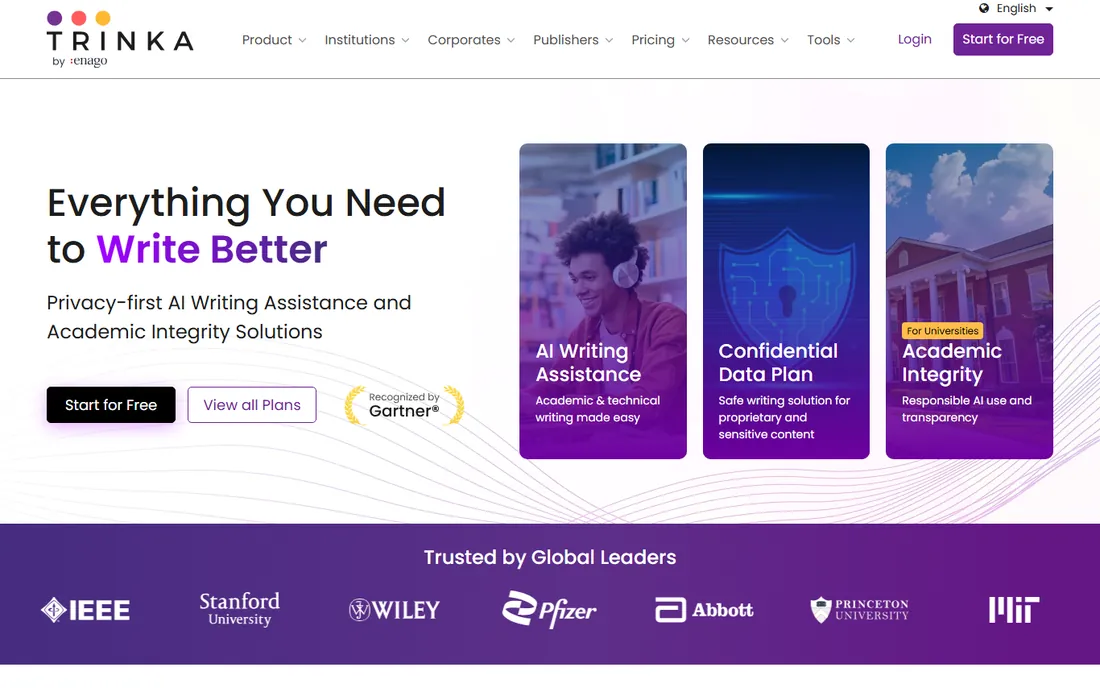
Trinka's pitch is precision: where generic grammar checkers correct conversational English, Trinka understands academic and technical language, including domain-specific phrasing in research papers and theses. It offers style guide support for major academic formats, a Microsoft Word add-in, file proofreading and a paraphraser, plus plagiarism and AI detection. The vendor's own page lists a price range of $0 to $20 per month.
The free plan covers advanced grammar and language checks, which is enough for many students. Heavy users (proofreading full manuscripts, running plagiarism checks) will need credits or a paid tier. For researchers writing in English as a second language, the academic tuning makes it meaningfully better than a general-purpose checker.
What we like- Grammar and style engine trained specifically on academic and technical writing
- Style guides for APA, IEEE, ACS and AGU
- Plagiarism and AI detection included
Watch out for- Credit-based system for some features can be confusing
- The deepest features sit on paid tiers
#4
Writefull
Best for: Researchers who want AI proofreading trained on scholarly text
Visit writefull.com
Starting priceSee website
Free planSee website
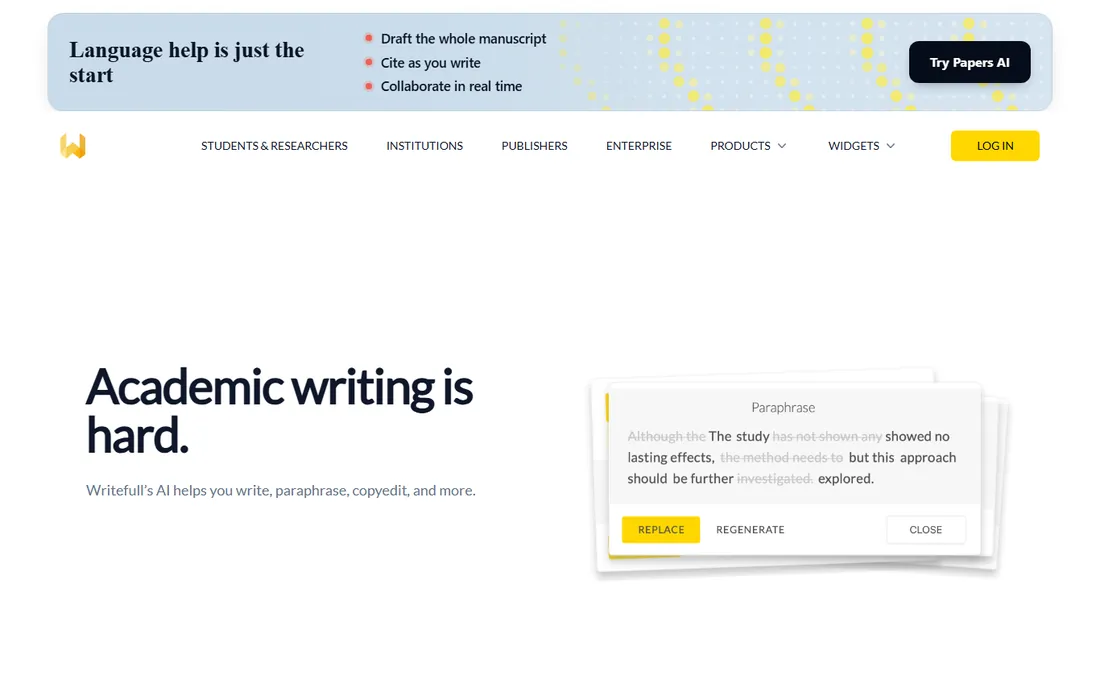
Writefull takes a different technical bet: instead of a general language model with academic features bolted on, its AI is trained on academic writing itself. The practical result is proofreading that understands how researchers actually write, catching the subtle issues generic tools miss. The vendor reports use at more than 1,500 institutions and trust from academic publishers, which is the right kind of social proof for this category.
It is a proofreading and editing tool, not a drafting assistant or citation manager, so most researchers will pair it with something else. Pricing is not published on the homepage, so get the current terms from the vendor. For the specific job of making academic English correct and natural, the specialization shows.
What we like- AI models trained specifically on academic language rather than general web text
- Used at 1,500+ institutions per the vendor
- Trusted by academic publishers and copyeditors
Watch out for- Pricing and free-tier details are not published on the homepage
- Narrower feature set than full writing suites
#5
Wordvice AI
Best for: Researchers who want proofreading, paraphrasing and translation in one toolkit
Visit wordvice.ai
Starting price$9.95/month (Premium; Basic plan free with 5,000 words/month)
Free planYes (Basic plan free)
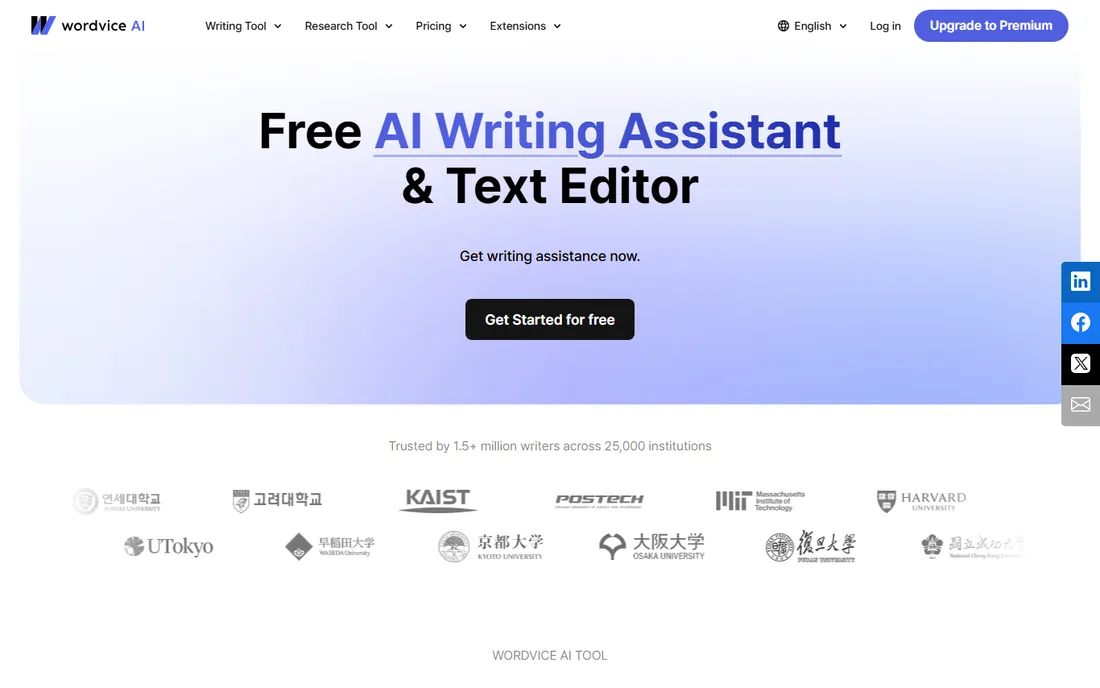
Wordvice AI wins on commercial clarity, which is rare in this category. The pricing page states it plainly: a free Basic plan with 5,000 words per month, Premium from $9.95 per month with a million words, and a Team plan from $8.45 per month. The toolkit covers proofreading, paraphrasing, translation, summarization, plagiarism checking and AI detection, all aimed at academic and professional writing.
The meaningful extra is the human fallback: Wordvice also sells expert proofreading by qualified editors, so a paper can go from AI polish to human review in one place. The 5,000-word free cap is enough to test seriously but not to live on. For researchers who want predictable pricing and a full toolkit, this is the easiest yes on the list.
What we like- Clear published pricing: free Basic with 5,000 words/month, Premium from $9.95/month
- Full toolkit including proofreader, paraphraser, translator, summarizer and plagiarism checker
- Human expert editing services available from the same company
Watch out for- Free tier's 5,000-word monthly cap covers roughly one paper
- AI detector and plagiarism checker are separate tools in the suite
#6
QuillBot
Best for: Paraphrasing and summarizing research text quickly
Visit quillbot.com
Starting priceSee website
Free planYes
QuillBot built its name on paraphrasing, and for research writing that remains its core job: restating a dense passage clearly, tightening a paragraph, or summarizing a section. The suite around it (summarizer, citation generator, grammar checker, AI chat) covers the common writing tasks, and the tools work across apps via extensions.
The limitation for research papers is specificity. QuillBot does not verify citations, search literature or understand academic conventions the way Paperpal or Trinka do. It is a writing tool that researchers use, not a research tool. Use it for the language work, and handle evidence with the tools built for it. Pricing is not published on the homepage.
What we like- The best-known paraphraser, with multiple modes for controlling output
- Summarizer, citation generator and grammar checker in the suite
- Browser extensions and apps for writing anywhere
Watch out for- General-purpose rather than research-specific
- Heavy paraphrasing of sources needs care to avoid accidental plagiarism
#7
Scite
Best for: Verifying citations and finding supporting or contradicting evidence
Visit scite.ai
Starting priceSee website
Free planSee website
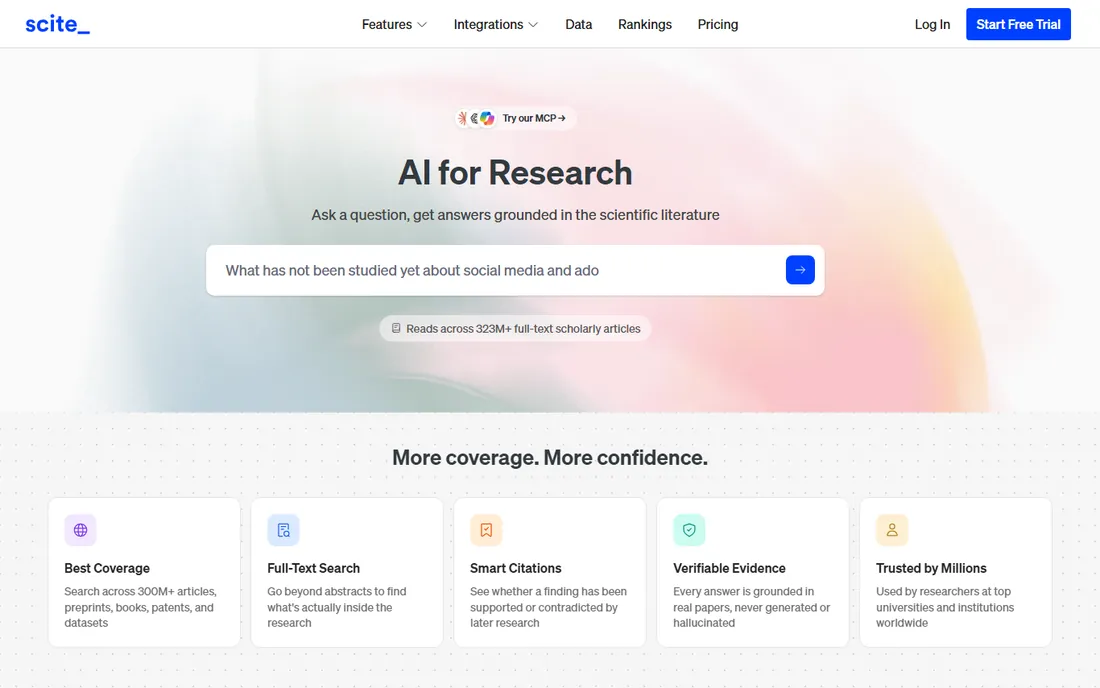
Scite solves the problem the other tools create: it tells you whether the paper you are citing actually says what you think it says, and whether later research supported or contradicted it. The Smart Citations feature classifies citing papers as supporting, mentioning or contrasting, which turns a bibliography from a list into an evidence map. Search covers over 300 million articles plus preprints, books, patents and datasets, with full-text search beyond abstracts.
It does not draft or proofread; it makes your citations trustworthy. For literature reviews and discussion sections, running your key references through Scite before submission is one of the highest-value habits in research writing. Check current pricing on the vendor's site.
What we like- Smart Citations show whether a paper has been supported or contradicted by later research
- Search across 300M+ articles, preprints, books and patents
- Every answer grounded in real papers
Watch out for- Pricing is not published on the homepage
- It is a research tool, not a writing editor
#8
Elicit
Best for: Literature reviews and evidence-based research reports
Visit elicit.com
Starting priceSee website
Free planYes
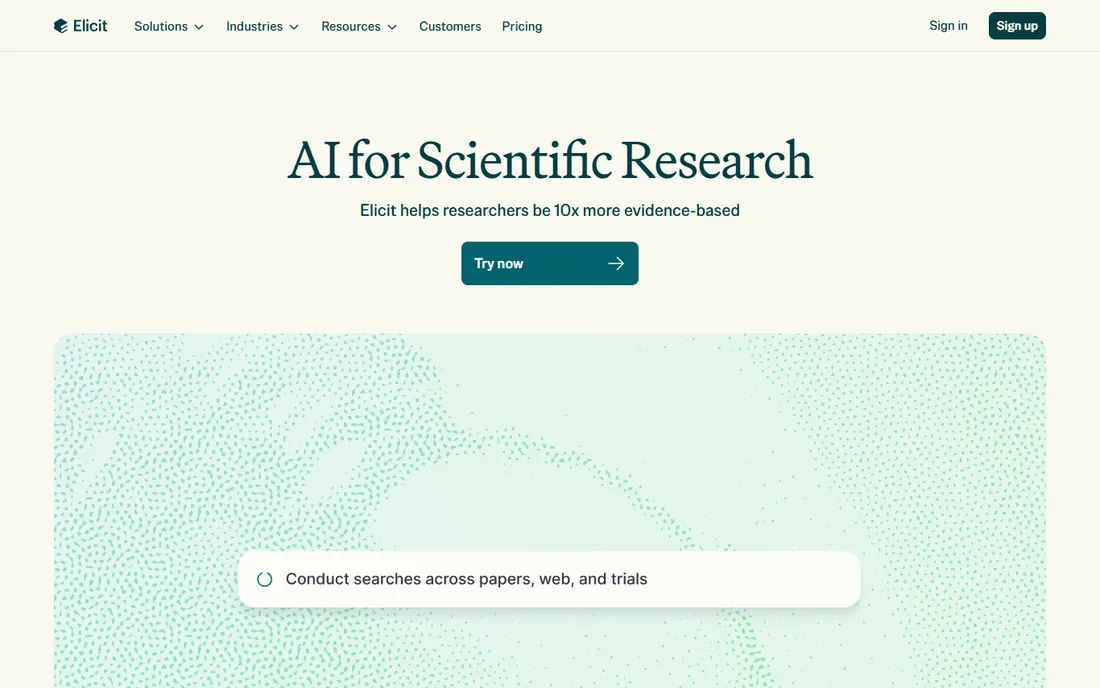
Elicit is the research agent on this list. You ask a research question in plain language, and it searches academic literature semantically (no keyword gymnastics), extracts findings into structured tables and generates cited reports. Every AI-generated claim carries sentence-level citations to the underlying sources, which is the transparency standard the category should meet. It also supports systematic literature reviews with screening and data extraction.
For writing research papers, Elicit's value is upstream of the draft: the literature review, the evidence table, the gap analysis. It does not replace the writing itself. The free tier lets researchers test the core workflow; heavy systematic-review use will need a paid plan. Verify current pricing on the vendor's site.
What we like- Semantic search across 138M+ papers and 545K+ clinical trials
- Generates structured, fully cited research reports
- Sentence-level citations on AI-generated claims
Watch out for- Pricing details are not on the homepage
- Deep systematic-review workflows have usage limits on lower tiers
#9
SciSpace
Best for: Researchers who work directly from PDFs and want AI explanations
Visit scispace.com
Starting priceSee website
Free planYes
SciSpace is built around the way researchers actually encounter knowledge: as PDFs. Upload a paper and chat with it, get explanations of dense passages, generate literature reviews and draft with the AI writer, then format citations. The template gallery covers common academic documents, and the paraphraser and AI detector round out the writing toolkit.
The overlap is the honest caveat: SciSpace's feature set touches Jenni (writing), Elicit (literature review) and QuillBot (paraphrasing). It is a credible single subscription for researchers who want one tool, but specialists beat it at each individual job. Check pricing on the vendor's site and compare against buying the best-of-breed for your weakest step.
What we like- Chat-with-PDF, literature review, AI writer, paraphraser and citation generator in one platform
- Explains complex papers in plain language
- Templates for common academic documents
Watch out for- Pricing is not published on the homepage
- The all-in-one scope overlaps with several tools on this list
How we chose
We started with the searches researchers use: AI writing software for research papers, AI academic writing tool, AI for literature review and AI paraphraser for research. For each candidate we opened the vendor's own site, confirmed the product is built for academic or research writing (not general marketing copy), and checked features, citation handling and pricing transparency against reviews on G2, Capterra and researcher communities on Reddit. Wordvice AI's prices were taken from its own pricing page; where a price could not be verified on the vendor's page we wrote "See website" rather than guessing. We excluded generic chatbots and essay mills.
The technology is the easy part; the policy is the hard part. Universities and journals have real rules about AI assistance, and they differ wildly. Before using any tool on this list for graded or submitted work, check three things: your institution's AI policy, your target journal's authorship guidelines, and whether the tool's output counts as assistance (usually fine with disclosure) or misconduct (submitting AI text as your own is not).
Practical habits keep you safe. Use AI for drafting, editing and summarizing, and keep the ideas and analysis yours. Disclose AI use where required; most journals now ask. Run the AI detector on your own draft before submission, not to game it but to see what a reviewer would see. And never let a tool insert a citation you have not opened and read. The researchers who get in trouble are not the ones who use AI; they are the ones who do not check it.
Citations: the part that actually matters
Every tool on this list handles citations differently, and the differences decide which one you need. Jenni and SciSpace help you draft with citations in the flow. Paperpal checks your references for errors and hallucinations before submission. Scite verifies what the cited papers actually claim. Elicit finds the papers worth citing in the first place. Trinka and Wordvice format them.
The workflow that works: find with Elicit or Scite, draft with Jenni or SciSpace, polish with Trinka, Writefull or Wordvice, verify with Scite and Paperpal's reference check. No single tool does all five jobs well. And the underlying rule never changes: a citation is a claim that you read the paper. AI can format that claim, find that paper and check that reference, but it cannot do the reading for you.
Frequently asked questions
Is it cheating to use AI writing tools for research papers?
It depends on your institution's and journal's policies, not on the tool. Most universities allow AI for editing, brainstorming and summarizing with disclosure; submitting AI-generated text as your own work without disclosure is academic misconduct at most institutions. Check the specific policy before you start, and disclose AI use where required.
Which AI tool is best for writing a research paper from scratch?
Jenni AI is the most purpose-built drafting assistant for academic writing. But "from scratch" should mean from your research: use Elicit or Scite for the literature review first, draft with Jenni or SciSpace, then polish and verify with the editing and citation tools. No tool should be generating your findings.
Can AI writing tools invent fake citations?
Generic chatbots can and do. The tools on this list are built to avoid it: Elicit and Scite ground claims in real papers with sentence-level citations, and Paperpal's reference check catches hallucinated references before submission. Still, open and read every paper you cite. Trust the workflow, verify the sources.
What is the best free AI writing tool for students?
Trinka's free plan covers advanced grammar checks, Wordvice AI's free Basic plan includes 5,000 words per month across its toolkit, and Elicit and SciSpace have free tiers for research. For pure drafting, Jenni AI has a free plan. Start with the free tier of the tool that matches your weakest step: language, drafting or research.
How is Paperpal different from Grammarly?
Paperpal is built specifically for academic publishing: it handles 10,000+ citation styles, checks references for errors and hallucinations, and runs plagiarism and AI detection aimed at journal submission. Grammarly is a general writing assistant. For a manuscript heading to a journal, Paperpal's submission-focused checks are the difference.
Do journals accept AI-assisted papers?
Many do, with disclosure. Major publishers require authors to disclose AI use in writing assistance, and AI cannot be listed as an author. Policies vary by journal and change often, so check your target journal's current author guidelines before submitting. The tools on this list are designed for disclosed, verifiable assistance, not ghostwriting.
Sources we checked (9)
- https://www.jenni.ai
- https://www.paperpal.com
- https://www.trinka.ai
- https://www.writefull.com
- https://www.wordvice.ai
- https://www.quillbot.com
- https://www.scite.ai
- https://www.elicit.com
- https://www.scispace.com
Is your product missing or out of date?
We review this list regularly. Vendors can request a listing, send updated pricing or ask about featured placement.

Shihab Mia · Founder, Rankite
Shihab has spent more than a decade helping SaaS and e-commerce brands grow through search. He writes Rankite's software buying guides from pricing pages, documentation and public user reviews. More about Shihab.