How we make this list: we compare pricing pages, product documentation and public user reviews. Ratings come from G2, Capterra or Trustpilot, with the date we checked them.
Key takeaways
- These tools help you find, screen, summarise, and check papers. They do not write your paper, and submitting AI written work as your own breaks the rules of every university and journal.
- Elicit leads for literature review work, with extraction tables across papers; Consensus answers evidence questions from real papers; Scite shows whether later work supports or contradicts a study.
- Semantic Scholar and Research Rabbit are free and cover discovery well, so a serious research stack can cost nothing.
- The standing risk is fabrication. General chatbots invent references; even database backed tools misstate findings, so open every paper and verify every citation yourself before it enters your work.
- Check your institution's AI policy before you use any of these, and disclose assistance where the policy or your journal requires it.
Quick comparison
| Tool | Best for | Starting price | Free plan |
|---|
 Elicit | Literature reviews and extraction tables | $11 per month | Yes |
 Consensus | Evidence backed answers | $12 per month | Yes |
 Scite | Checking how papers are cited | $20 per month | Yes |
 Semantic Scholar | Free discovery and skimming | Free | Yes |
 Research Rabbit | Finding related work visually | Free | Yes |
 Litmaps | Citation maps and keeping reviews current | $10 per month | Yes |
 Connected Papers | Mapping a field from one paper | See website | Yes |
 Undermind | Deep, agent style searching | $16 per month | Yes |
Is your product missing or out of date?
We review this list regularly. Vendors can request a listing, send updated pricing or ask about featured placement.
Starting price$11 per month
Free planYes
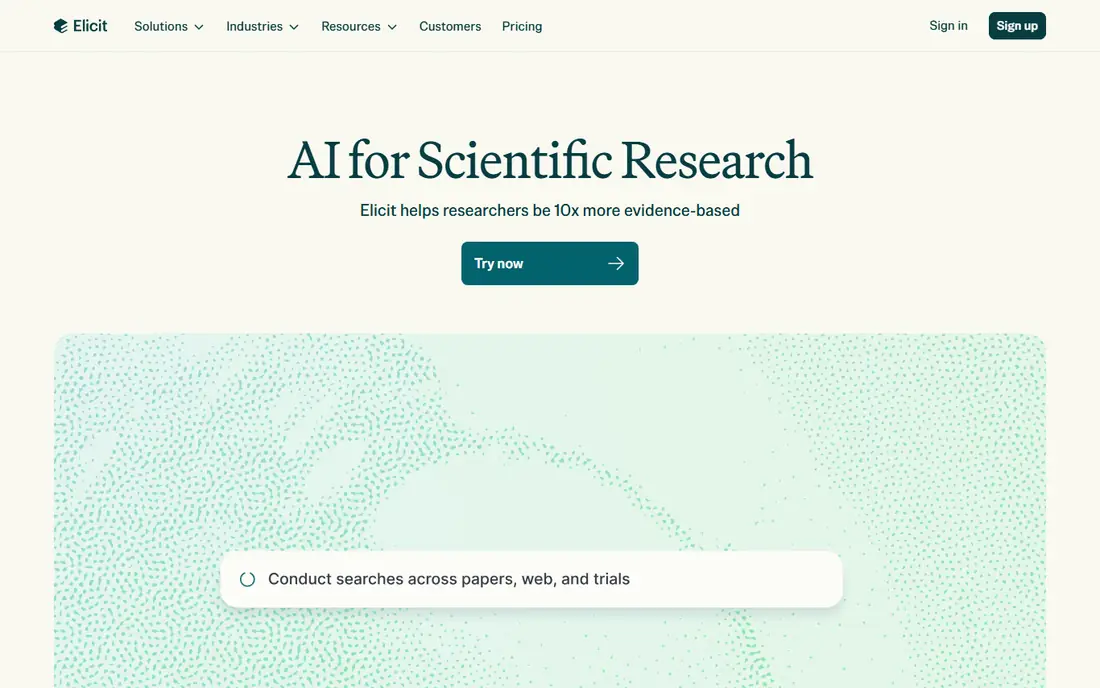
Elicit is the strongest tool here for the literature review itself. Ask a research question and it returns relevant papers as a table, one row per study, with columns for the details you choose: population, method, outcome, limitation. Anyone who has built that spreadsheet by hand over three weeks understands the value immediately. Its free Basic plan covers unlimited searching and summaries, which makes it usable for a whole project before any payment.
The discipline Elicit demands is verification. An extraction cell that says a trial found a significant effect is a claim about a paper; open the paper and confirm it before the claim enters your review. Elicit's pricing also deserves a direct check, since its tiers changed more than once in 2026 and secondary sources disagree on current figures. Used with that care, Elicit is the closest thing this category has to a standard recommendation.
What we like- Searches a database of 138 million plus papers and builds comparison tables automatically
- Custom columns extract methods, samples, and findings across dozens of papers
- Free Basic plan includes unlimited search and summaries
- Screening workflows suit systematic reviews
Watch out for- Paid tiers moved repeatedly in 2026, sources cite Plus from $11 and Pro from $39 to $49 per month
- Extracted data still needs spot checking against the papers
- Chat answers can smooth over disagreements between studies
- Full text access depends on the papers being openly available
#2Consensus
Best for: Evidence backed answers4.7/5 on
G2 (1,885 reviews, checked Oct 2026)
Visit consensus.app
Starting price$12 per month
Free planYes
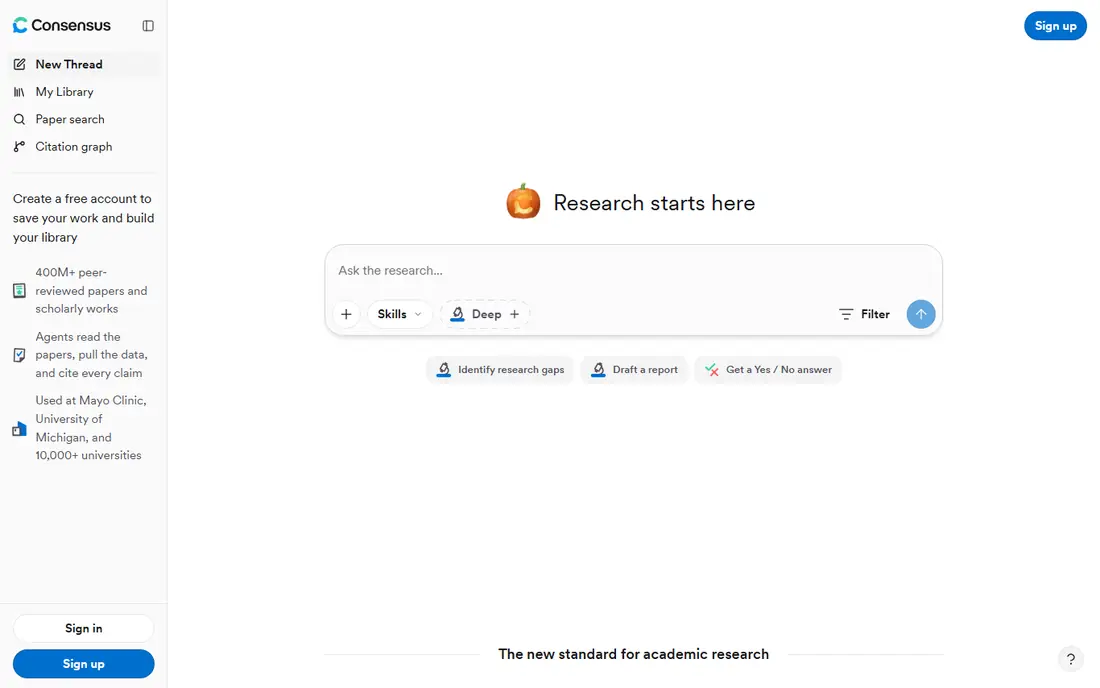
Consensus answers the question every introduction starts with: what does the evidence actually say. Type a question and it searches its index of more than 200 million papers, reads the findings, and returns a synthesis where each claim points to the studies behind it. On yes or no questions its meter shows the split of supporting, mixed, and opposing results, which is a fast, honest picture of a settled or unsettled field.
That speed is also the caution. A meter reading of mostly yes is a starting point for reading, not a conclusion to quote; the tool itself is synthesising abstracts and findings of varying quality. Consensus pricing runs from a free tier with limited advanced messages to Pro at $12 per month billed annually by current comparisons. For scoping a topic and finding the key papers fast, it earns its place near the top.
What we like- Answers questions by synthesising findings across real papers, with citations attached
- Its Consensus Meter shows how studies line up on yes or no questions
- Free tier includes basic search and limited Pro messages
- Deep Reviews assemble longer evidence summaries on paid plans
Watch out for- Synthesis can flatten nuance, a meter is not a meta analysis
- Weaker on very niche topics with thin literature
- Pro message and Deep Review allowances cap heavy use on free and entry tiers
- Answers are only as good as the underlying papers' quality
#3Scite
Best for: Checking how papers are cited4.7/5 on
G2 (27 reviews, checked Oct 2026)
Visit scite.ai
Starting price$20 per month
Free planYes
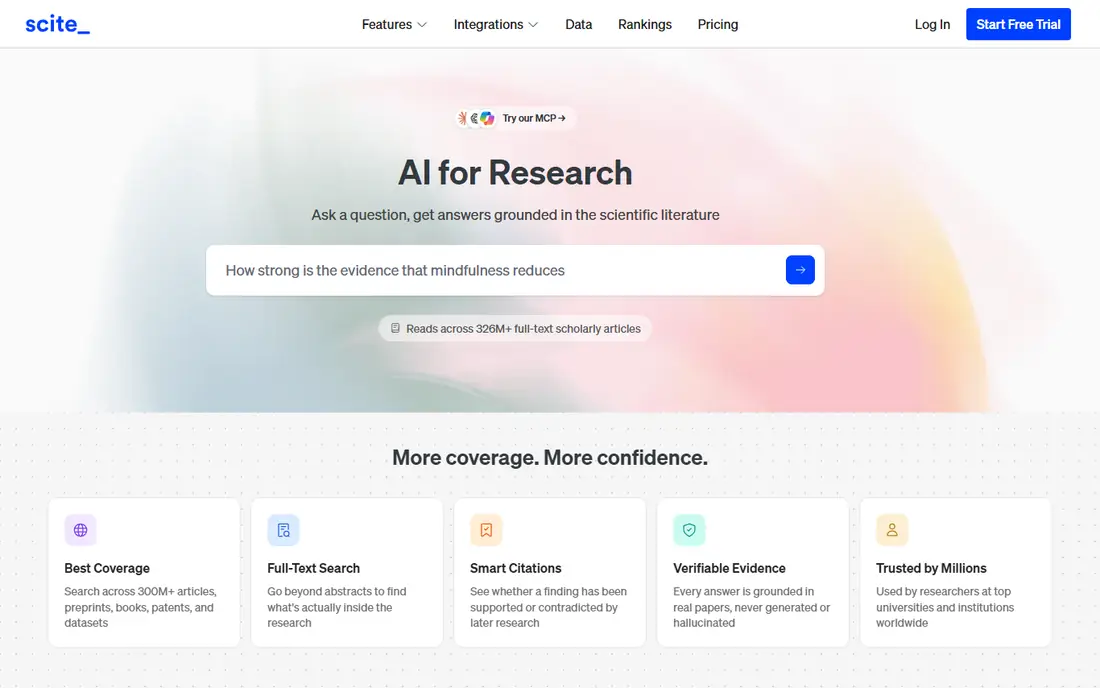
Scite answers a question no search engine asks: after a paper was published, what did the field do with it. Its Smart Citations read the sentences where later papers cite a study and label them supporting, mentioning, or contrasting, drawn from a citation database in the billions. A landmark paper with a wall of contrasting citations is a different object from the same paper uncritically celebrated, and Scite shows you that in seconds.
That makes Scite the integrity tool on this list as much as a discovery tool: it is how you avoid building an argument on a retracted, refuted, or heavily qualified result. At $20 per month for Basic it is priced for active researchers rather than students, and institutional access is common, so check your library login first. For anyone doing serious synthesis work, the citation context it provides exists nowhere else at this scale.
What we like- Smart Citations classify whether citing papers support, mention, or contrast a study
- A database of over a billion citation statements
- The fastest way to spot a famous paper that later work undermined
- A limited free Connect tier gives database access
Watch out for- Basic at $20 per month billed annually is the priciest entry here for individuals
- The free Connect tier excludes the Assistant and full Search
- Classification is automated and occasionally wrong in edge cases
- Many universities provide access, so check your library before paying
Starting priceFree
Free planYes
Semantic Scholar is the free foundation under much of this category, several tools above draw on its index, and for many researchers it is enough on its own. Its search covers upwards of 200 million papers, its one line TLDR summaries make scanning a results page genuinely quick, and it costs nothing, requires no account, and offers a free API that systematic reviewers use to build reproducible searches.
Its limits are scope, not quality. Semantic Scholar finds and skims; it does not extract comparison tables, track a review's screening decisions, or synthesise findings. As the free first pass of any literature search, it is the tool this list would keep if it could keep only one free tool.
What we like- Completely free, a nonprofit project from the Allen Institute
- Search across more than 200 million papers with no account needed
- AI generated TLDR summaries make triage fast
- A free API supports systematic and programmatic work
Watch out for- A search engine, not a workflow: no extraction tables or review management
- TLDRs compress aggressively and can drop key conditions
- Coverage and metadata quality vary by field
- No synthesis across papers, the reading is yours
Starting priceFree
Free planYes
Research Rabbit solves the snowballing problem: you have three perfect papers and need the thirty around them. Feed it seed papers and it maps the citation and author networks visually, suggesting earlier foundational work, later follow ups, and parallel lines you had not searched for, across an index its comparisons put above 310 million articles. It is free for unlimited searching, which still surprises people.
Discovery is all it does. There are no tables, no summaries to speak of, and no screening workflow; you take the papers it finds back to your own system. For expanding a reading list beyond what keyword search finds, especially in fields where terminology differs between research groups, Research Rabbit is the best free specialist here.
What we like- Free forever with unlimited searches across 310 million plus articles
- Builds visual networks of related papers and authors from seed papers you choose
- Surfaces earlier and later work and similar collections
- RR+ at $10 per month billed annually raises seed limits for power users
Watch out for- The graph approach has a learning curve
- Recommendations can wander from a tightly defined question
- No extraction or synthesis features, discovery only
- Exports and reference manager links are less central than in review tools
Starting price$10 per month
Free planYes
Litmaps turns a set of papers into a map: papers positioned by citation links and date, so the foundational work, the recent frontier, and the gaps between clusters are visible as a picture. Its monitoring is the feature researchers keep it for: save a map for your review and Litmaps flags new papers that cite your set, which is how a literature review stays current between submission and revision.
The free tier is a taster, a map or two at limited size, and education Pro pricing runs $10 per month billed annually, while commercial use is reported considerably higher. Litmaps will not run your screening or write your synthesis. As the visual layer over a search built in Semantic Scholar or Elicit, it shows structure that lists of results hide.
What we like- Visual citation maps arranged by time, so a field's development is visible at a glance
- Monitoring alerts you when new papers cite your seeds
- Education pricing at $10 per month billed annually for Pro
- Free tier covers a small map of up to 20 inputs
Watch out for- Free allowance is small, two maps of limited size by current listings
- Commercial Pro pricing jumps, reported at $50 per month
- Mapping complements rather than replaces systematic search
- Large maps can become hard to read without discipline
Starting priceSee website
Free planYes
Connected Papers is the five minute orientation: paste a key paper and receive a similarity graph of the field around it, sized by citations and shaded by age, with lists of prior works and derivative works one click away. For a researcher entering unfamiliar territory, or a supervisor checking a student's sense of the field, it is unmatched for speed.
Treat the map as a sketch, not a survey. The algorithm builds from one seed, so a fashionable or narrow seed paper tilts the picture, and its results belong in the exploration column of your method notes, never cited as coverage. Pricing reports disagree between comparisons, so its entry reads See website here.
What we like- Enter one paper and get a graph of the works most related to it
- The fastest orientation tool when entering a new field
- Free tier includes five graphs a month with all features
- Prior and derivative work views separate foundations from follow ups
Watch out for- One seed shapes the whole map, a biased seed gives a biased field
- Pricing reports conflict, $3 to $6 per month in current comparisons, so check the site
- No extraction, screening, or synthesis
- Graphs are exploration aids, not evidence
Starting price$16 per month
Free planYes
Undermind behaves less like a search box and more like a research assistant you brief: give it a precise question and it spends real time traversing papers and citations, then returns a report of what it found and how. For the needle questions, the specific method used in a specific population in a specific decade, that depth finds papers keyword search ranks nowhere.
The trade is speed and track record. A deep search is a coffee, not a click, and Undermind is a newer entrant than Elicit or Scite, so its coverage claims deserve the same verification as its findings. Pro runs $16 per month billed annually with a functional free tier below it.
What we like- An agent style search that follows citation trails and reads deeply before reporting
- Suited to hard, specific questions where keyword search fails
- Reports explain the trail so you can audit how papers were found
- Free tier offers full chat and deep search at standard rate limits
Watch out for- Deep searches take minutes, not seconds
- A younger, smaller tool than the incumbents here
- Pro at $16 per month billed annually for higher limits
- Audit the report's claims against the papers, as with every synthesis tool
How we chose
We required every tool to work from real, identifiable paper databases, the property that separates research tools from general chatbots in this category, and used October 2026 comparisons from Taskade's literature review pricing roundup, Exa's academic tools list, and AIToolRanked's Elicit review, cross checked against vendor pages. Where sources disagreed on price, Elicit repeatedly, Connected Papers, the entry says so or reads See website. We excluded AI writing assistants marketed for producing essays, paraphrasing tools, and general chatbots, none of which belong in a list a researcher can defend.
Start with provenance. The tool must name its paper database, Semantic Scholar, Crossref, OpenAlex, PubMed, or its own indexed corpus, and every result must resolve to a real paper you can open. If a tool cannot show you the paper behind a claim, the claim does not exist for academic purposes. This single test removes most of the dangerous products in the category.
Then fit the tool to the stage of work: discovery (Semantic Scholar, Research Rabbit, Connected Papers), extraction and screening (Elicit), evidence checking (Scite, Consensus), and staying current (Litmaps, Undermind for hard questions). Most researchers need two, not eight. Finally, set your own rules before you start: verify every citation against the original, note AI assistance where your institution requires disclosure, and keep your screening decisions documented. A defensible method section is worth more than any feature on this page.
Frequently asked questions
Is it allowed to use AI tools when writing a research paper?
It depends on your institution and your journal, and you must check both. The widely accepted uses are the ones on this list: searching, screening, summarising for your own understanding, organising, and citation checking. The prohibited use is presenting AI generated text, analysis, or references as your own work. Many journals now require an AI use disclosure statement, and universities treat undisclosed generative writing as misconduct. When in doubt, ask your supervisor and disclose.
Can these tools invent fake references?
Tools wired to real paper databases, all eight here, return papers that exist, which is the main protection. Two risks remain: a tool can misstate what a real paper found, and it can attach the wrong citation to a claim. General chatbots without database grounding are far worse, they fabricate entire references with invented authors and journals. Whichever tool you use, open every paper you cite and confirm the authors, year, method, and finding yourself. If you have not opened it, do not cite it.
Which of these tools is free?
Semantic Scholar and Research Rabbit are free in full for discovery. Elicit, Consensus, Litmaps, Connected Papers, and Undermind all have free tiers with real search capability and usage limits, and Scite offers a limited free Connect tier. A capable zero cost workflow is Semantic Scholar for search, Research Rabbit for snowballing, and Elicit's free plan for extraction tables, which covers most individual projects before any subscription is justified.
What is the difference between Elicit and Consensus?
Elicit is built for the reviewer's table: it gathers papers on a question and extracts structured details from each into columns you define, which is the raw material of a literature review. Consensus is built for the evidence question: it reads across papers and synthesises an answer with a view of how the findings split. Use Consensus to scope what the field thinks, then Elicit to do the systematic work of comparing the studies themselves.
Sources we checked (0)
Is your product missing or out of date?
We review this list regularly. Vendors can request a listing, send updated pricing or ask about featured placement.

Shihab Mia · Founder, Rankite
Shihab has 5+ years in B2B and SaaS SEO. He writes Rankite's software buying guides from pricing pages, documentation and public user reviews. More about Shihab.