How we make this list: we compare pricing pages, product documentation and public user reviews. Ratings come from G2, Capterra or Trustpilot, with the date we checked them.
Key takeaways
- Otterly, Peec AI, and Brandlight suit beginners best, since they focus on simple prompt tracking, clear dashboards, and plain-language reports.
- Profound and Evertune offer deeper analysis for teams that want citation sources, competitor comparisons, and content recommendations.
- Goodie suits small brands that want a guided start, with recommendations tied directly to tracked prompts.
- Semrush and Ahrefs suit beginners who also need traditional SEO, since AI visibility sits alongside keyword and site tools they already know.
Quick comparison
| Tool | Best for | Starting price | Free plan |
|---|
 Otterly | Simple prompt tracking | See website | No |
 Peec AI | Clear AI visibility reports | See website | No |
 Brandlight | Beginner dashboards | See website | No |
 Profound | Deep citation analysis | See website | No |
 Evertune | Content recommendations | See website | No |
 Goodie | Guided small-brand start | See website | No |
 Semrush | AI plus traditional SEO | See website | No |
 Ahrefs | AI plus backlink data | See website | No |
Is your product missing or out of date?
We review this list regularly. Vendors can request a listing, send updated pricing or ask about featured placement.
Starting priceSee website
Free planNo
Otterly is one of the easiest AI search tools for a beginner to understand. You add the prompts your buyers ask, and Otterly tracks how AI answers mention your brand, rank your site, and cite your pages. The dashboard shows trends in plain charts rather than dense tables, so a first-time user can see progress without training. Competitor comparisons show how your visibility stacks up against rivals on the same prompts.
The limits are cost and depth. Otterly has no free plan, so beginners must pay to try it, and deeper analysis sits on higher tiers. Still, for a small team that wants to start tracking AI visibility this week, Otterly is the least confusing option. Start with ten to twenty prompts that match real buyer questions, and expand the list only after the first month of data arrives.
What we like- Clean dashboard
- Prompt-level tracking
- Competitor comparisons
Watch out for- No free plan
- Deeper analysis needs higher tiers
#2Peec AI
Best for: Clear AI visibility reports4.7/5 on
G2 (21 reviews, checked Oct 2026)
Visit peec.ai
Starting priceSee website
Free planNo
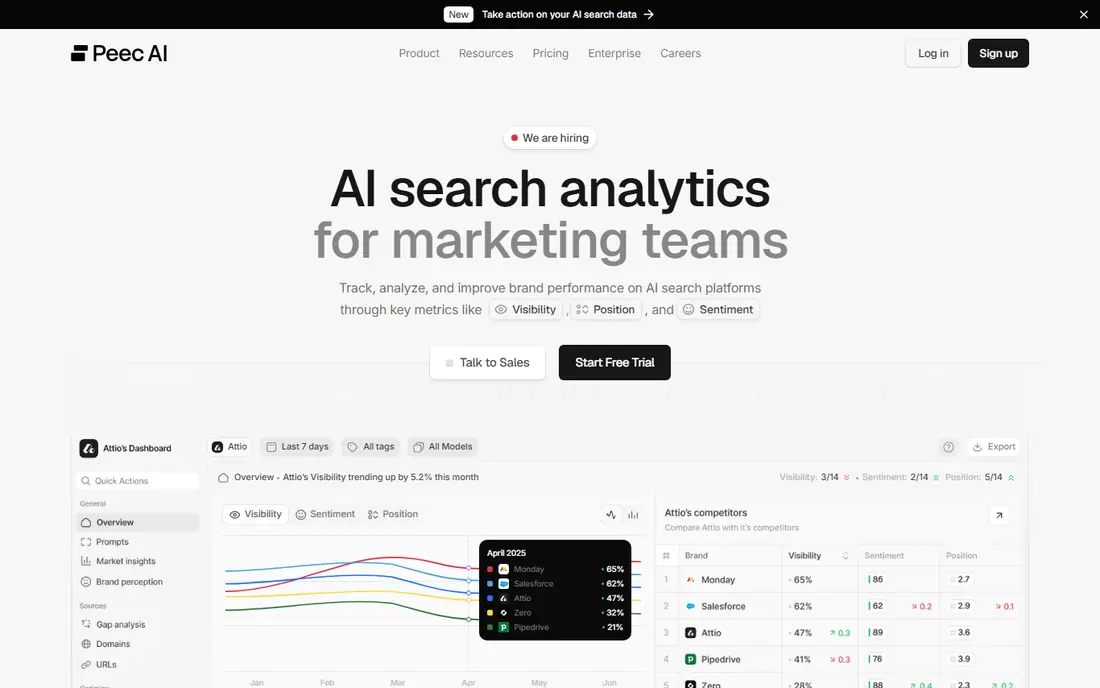
Peec AI focuses on readable reports that a beginner can share with a boss or client without explanation. It tracks brand mentions, ranks, and share of voice across AI answers, and it suggests prompts based on your industry, which helps beginners who do not know where to start. The interface keeps setup to a few steps: add your brand, add competitors, and pick prompts from suggestions or your own list.
Peec AI has no free plan, and as a newer vendor it has a shorter public track record than Semrush or Ahrefs. That matters less for beginners, since the core tracking works the same way, but check trial terms before paying. Peec AI suits beginners who value clear reports over advanced features. Use its prompt suggestions as a starting point, then replace generic prompts with your buyers' real questions.
What we like- Readable reports
- Share-of-voice views
- Prompt suggestions
Watch out for- No free plan
- Newer vendor with a smaller track record
Starting priceSee website
Free planNo
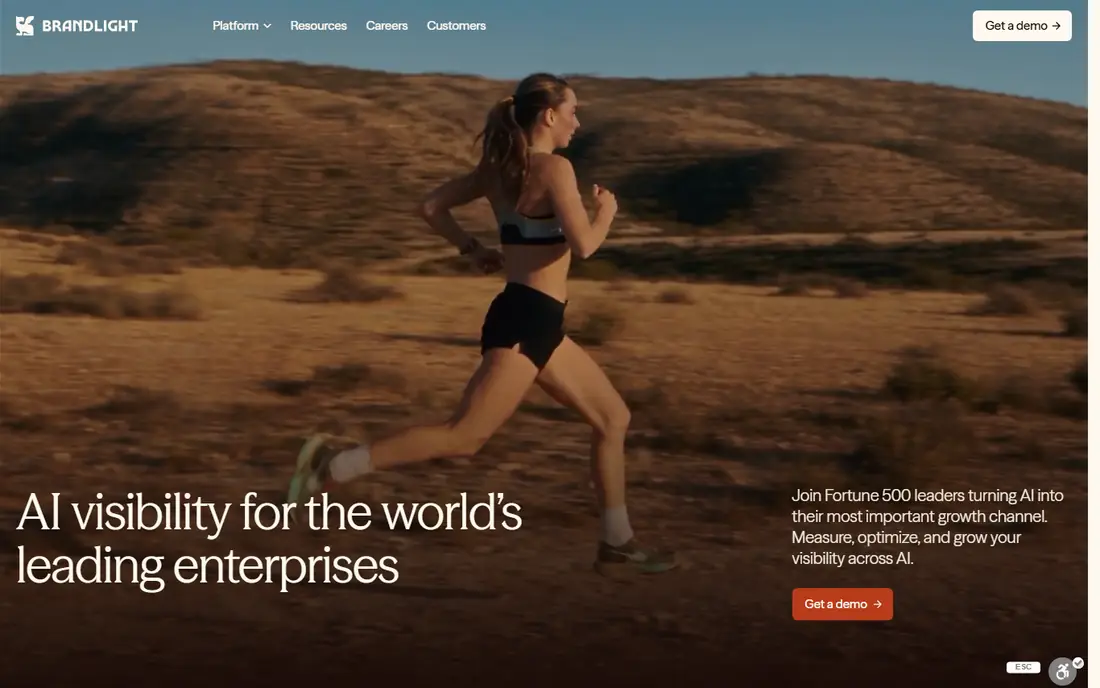
Brandlight keeps AI visibility simple: track your brand across AI answers, watch trends over time, and compare against competitors. Setup asks for your brand and a few prompts, and the dashboard presents results in charts that a non-technical user can read. That simplicity is the point. Beginners often abandon tools that demand heavy setup, and Brandlight avoids that trap by keeping the first run short.
The trade-offs are a missing free plan and fewer integrations than larger suites like Semrush. Brandlight also offers less depth on citation sources than Profound, so advanced users may outgrow it. Brandlight suits beginners who want a quick, readable start to AI tracking. Add your top product pages as tracked sources, so you can see which pages AI answers actually cite.
What we like- Simple setup
- Brand mention tracking
- Trend charts
Watch out for- No free plan
- Fewer integrations than larger suites
Starting priceSee website
Free planNo
Profound is the most detailed tool on this list, tracking how AI answers mention brands, which sources they cite, and how competitors compare. Its citation data shows exactly which pages AI models pull from, which helps content teams decide what to write next. For a beginner with growth plans, that depth becomes valuable once basic tracking feels familiar. Profound also offers benchmarking that places your visibility in market context.
The drawbacks for beginners are price and complexity. Profound leans toward enterprise buyers, and its dashboard has more views than a first-time user needs. Beginners should start with its core tracking views and ignore advanced reports until the basics feel comfortable. Profound suits beginners who expect to grow into advanced analysis, or teams that already track SEO seriously and want AI data at the same depth.
What we like- Detailed citation data
- Competitor benchmarking
- Content insights
Watch out for- Enterprise pricing
- Steeper learning curve for beginners
Starting priceSee website
Free planNo
Evertune pairs AI visibility tracking with content recommendations, telling you which pages to create or improve so AI answers cite your brand more often. That guidance helps beginners who know they need visibility but do not know what to write. The prompt tracking covers major AI engines, and trend views show whether recommendations actually move the needle over weeks. For a small content team, that closed loop is genuinely useful.
Evertune has no free plan, and its recommendations only help if someone acts on them, so teams without writing capacity will see little value. Evertune suits beginners with a content team ready to publish, since its suggestions turn tracking into tasks. Start with its top five recommendations, publish those pages, and watch the next month of data before expanding effort.
What we like- Actionable content suggestions
- Prompt tracking
- Trend views
Watch out for- No free plan
- Recommendations need content team follow-through
Starting priceSee website
Free planNo
Goodie is built for small brands taking their first step into AI search, with guided onboarding that walks beginners through setup. The reports stay simple, focusing on mentions, ranks, and trends without jargon, and the tool frames results in terms of actions a small team can take. That guidance matters, since many beginners buy a tracking tool and then ignore it because the data feels abstract.
Goodie offers less depth than Profound or Evertune, and it has no free plan, so it suits beginners who want a guided start rather than a research platform. Small brands with one or two people handling marketing will find Goodie the least intimidating option after Otterly. Use its guided setup fully, since skipping steps leaves prompts and competitors unconfigured and data thin.
What we like- Guided onboarding
- Simple reports
- Small-brand focus
Watch out for- No free plan
- Less depth than enterprise tools
#7Semrush
Best for: AI plus traditional SEO4.4/5 on
G2 (4,035 reviews, checked Oct 2026)
Visit semrush.com
Starting priceSee website
Free planNo
Semrush adds AI visibility tracking to one of the largest SEO suites available, which suits beginners who also need keyword research, site audits, and rank tracking. If you already use Semrush for traditional SEO, its AI features slot into a familiar dashboard, and its keyword database helps you pick prompts grounded in real search demand. That combination makes Semrush efficient for teams that want one subscription for both old and new search.
The breadth is also the drawback. Semrush has dozens of tools, and beginners can feel lost navigating them, while its AI views are less focused than a dedicated tracker. Semrush suits beginners who need traditional SEO anyway and want AI tracking as an add-on. Start with its AI toolkit only, and explore other modules gradually rather than trying to learn the whole platform at once.
What we like- AI tracking plus full SEO suite
- Large keyword database
- Familiar reports
Watch out for- Broad tool can overwhelm beginners
- AI features sit inside a large platform
#8Ahrefs
Best for: AI plus backlink data4.5/5 on
G2 (717 reviews, checked Oct 2026)
Visit ahrefs.com
Starting priceSee website
Free planNo
Ahrefs brings its strong backlink and content database to AI search tracking, which helps beginners connect AI visibility with the pages and links behind it. Its brand tracking shows how AI answers mention your brand, and its content tools help you find topics that AI models cite often. For teams that already trust Ahrefs for SEO, adding AI tracking keeps reporting in one place and avoids a second subscription.
Ahrefs has no free plan, and its AI features are newer than its core SEO tools, so they offer less depth than dedicated trackers like Profound. Ahrefs suits beginners who already use it for SEO, or who want backlink context behind AI visibility. Use its content explorer to find pages worth improving, since AI citations often follow pages that already rank well in traditional search.
What we like- Strong backlink and content data
- AI brand tracking
- Reliable reports
Watch out for- No free plan
- AI features are newer than its SEO tools
How we chose
We compared AI search platforms on beginner ease of use, setup speed, report clarity, prompt tracking, competitor comparison, and price transparency, using vendor pages, product documentation, and public user experience. The reference buyer was a beginner with no AI tracking experience, so plain dashboards and guided setup mattered more than advanced analytics. Pricing was listed as "See website" across the board, since these vendors change plans often and many price by tracked prompts. Dedicated AI trackers were weighed against SEO suites, since beginners often need both traditional and AI search data in one budget.
How to start with AI search optimization
Pick prompts your buyers actually ask
List the questions buyers ask before choosing your product, using sales calls, support tickets, and search data. Generic prompts miss the specific questions that decide purchases, so interview your sales team for real buyer phrasing. Include comparison questions, pricing questions, and implementation questions, since those appear late in buying journeys. Start with twenty prompts, and expand only after the first month shows which ones drive useful data.
Track one brand and two competitors
Add your brand plus two main competitors, so every report has context. A mention count alone means little, while share of voice against rivals shows whether you lead or lag. Pick competitors your buyers actually compare you with, not the biggest names in your industry. Review competitor movement monthly, since AI answers shift with model updates and new content. Keep the competitor set stable, so trends stay comparable over time.
Turn tracking into content tasks
Tracking without action wastes money, so convert findings into writing tasks each month. If AI answers cite a competitor page for a key prompt, create or improve your own page on that topic. If your pages get cited but rank low, strengthen them with clearer answers, facts, and structure. Assign each task an owner and a deadline, and check the next month of data for movement. Small, regular content fixes beat occasional large rewrites for AI visibility.
Judge trends over weeks, not days
AI answers change with model updates and sampling, so daily rank jumps mislead more than they inform. Review weekly trends and monthly summaries, and look for patterns across several prompts before changing strategy. A single prompt dropping for a day means nothing, while a category of prompts sliding for a month signals a real problem. Share monthly trend reports with your team, so AI visibility becomes a habit rather than a one-time audit.
Frequently asked questions
What is AI search optimization?
AI search optimization means improving how AI answers mention, rank, and cite your brand when users ask questions. Traditional SEO targets search result pages, while AI optimization targets the answers that chatbots and AI overviews generate. The tools on this list track those answers, showing which prompts mention you, which sources get cited, and how competitors compare. Optimization then means creating content that AI models find clear, factual, and worth citing.
Do beginners need a paid AI tracking tool?
Not always. Beginners can start by asking AI tools their buyers' questions manually and noting which brands appear. A paid tool becomes worth it when you track many prompts, need trend data, or report to a team. Manual checks suit a one-time audit, while paid tracking suits ongoing programs. Start manual, and buy a tool once you track more than twenty prompts regularly.
How many prompts should a beginner track?
Start with twenty prompts that match real buyer questions, then expand to fifty as your program grows. Fewer prompts give thin data, while hundreds of prompts overwhelm a beginner and inflate costs, since many tools price by prompt count. Cover each stage of the buying journey, from early research to final comparison. Review the prompt list quarterly, and replace prompts that never produce useful data.
How long does AI visibility take to improve?
Expect weeks to months, not days. AI models update on their own schedules, and new content takes time to get cited. Most beginners see early movement within four to eight weeks when they publish targeted pages and fix gaps. Track weekly trends, and judge progress monthly rather than daily. If nothing moves after three months, revisit your prompts and content, since either the tracking or the pages may miss buyer intent.
Can AI tracking replace traditional SEO?
No. Traditional search still drives large traffic volumes, and many AI answers cite pages that rank well traditionally. AI tracking complements SEO by showing a new channel, not by replacing keyword research, technical fixes, or link building. Beginners should keep basic SEO work going while adding AI tracking. The strongest programs treat AI visibility as one more report inside a broader search strategy.
Sources we checked (0)
Is your product missing or out of date?
We review this list regularly. Vendors can request a listing, send updated pricing or ask about featured placement.

Shihab Mia · Founder, Rankite
Shihab has 5+ years in B2B and SaaS SEO. He writes Rankite's software buying guides from pricing pages, documentation and public user reviews. More about Shihab.